A Fragile Restoration: Samuel Hayes and the Quiet Geography of Finding Home After the Silence
CHAPTER 1: The Threshold of Light
The lock turned. It was a mechanical, hollow sound that had been the heartbeat of Samuel’s life for the last forty-eight hours—the sound of barriers being moved or maintained. The heavy steel door creaked open, not into the dark corridor of the holding area, but into the gray, filtered light of the precinct’s intake room.
Samuel stood, the movement slow, deliberate, as if his joints were filled with rusted iron filings. His duffel bag, the canvas worn to the color of a bruised twilight, hung heavy from his shoulder. He did not look up immediately. He focused on the floor, on the way the scuffed linoleum caught the dying afternoon light. It was a texture he had come to know intimately: a map of grime, footsteps, and indifference.
“Mr. Hayes?”
The voice was not the gruff, transactional bark of a guard. It was clear, resonant, and carried an edge of tempered steel.
Samuel raised his head. Standing just past the threshold was a woman in a charcoal-colored suit, the fabric crisp and smelling faintly of rain and parchment. Her eyes, a sharp, inquisitive hazel, didn’t slide past him or look through him. They landed on his face—really landed there—cataloging the deep, topographical lines carved by the winter and the war. She held a leather briefcase like a shield.
“I’m Rebecca Monroe,” she said, her posture softening just enough to invite him into her space. “I’m here to represent you. Not as a defendant, but as someone who has been waiting a long time to be heard.”
Samuel gripped the strap of his duffel bag, the fabric biting into his calloused palm. He felt a sudden, sharp ache in his chest—a phantom sensation, like a limb that had been missing for years suddenly waking up with a jolt of nerves. He looked at her, searching for the catch, the inevitable shift where the smile would sour or the gaze would glaze over with the realization of his poverty.
“I don’t have the money,” Samuel rasped. His voice was a dry, unused instrument, thin and cracking like parchment.
“I’m not here for money, Samuel,” she replied, stepping closer, closing the distance between the cell’s threshold and the hallway. She didn’t offer a hand, sensing perhaps that the gesture was too much, too fast. Instead, she offered him a small, sealed bottle of water. “I’m here because your file was the one that stopped Judge Whitaker’s gavel in its tracks. And that, in this city, is a miracle I intend to follow.”
Samuel took the water. His fingers, trembling, brushed against the cold plastic. The weight of the bottle was infinitesimal, yet it felt like a heavy, solid anchor pulling him back to the earth.
He glanced back at the open cell—the cramped, shadowed rectangle that had been his entire universe for the last two days. It seemed smaller now, less like a cage and more like a tomb he had miraculously climbed out of. As he turned to follow Rebecca toward the exit, his foot caught on a floor tile that had begun to peel away from the foundation.
He didn’t fall. He caught his balance, but in that moment of physical instability, he saw something tucked near the baseboard—a small, silver button, long forgotten by whoever had passed before him.
He looked at the button, then back at the woman walking toward the light of the main entrance. The air in the hallway felt different, carrying a faint, electric charge—the scent of approaching snow and the undeniable, terrifying vibration of a life that was about to demand he stand up again.
CHAPTER 2: The Ghost of the Desert
Samuel followed Rebecca through the precinct’s main lobby. The air here was different—stale, recycled, and thick with the frantic, metallic scent of coffee and printer toner. It smelled of things that were constantly moving, which made his own stillness feel like a deficiency.
“My office is just a few blocks away,” Rebecca said, not turning back, her stride measured and purposeful. She didn’t wait for him to catch up, but she didn’t leave him behind, either. She moved in a way that assumed he was there, a courtesy Samuel found more jarring than the handcuffs had been.
Outside, the late afternoon sun was a pale, washed-out gold, clinging to the brick faces of the older buildings like a memory of warmth. Fair Haven looked different from the sidewalk. Without the filtered haze of a cell window, the world had too many edges. The sound of a distant delivery truck backfiring made his heart hammer against his ribs, a reflexive, unwanted response that he immediately suppressed.
Control, he reminded himself. Breath.
He looked at the bottle of water in his hand. The condensation had begun to bead on the plastic, wetting his palm. It was the most tactile thing he had felt in years.
As they turned the corner toward a row of narrow, brick-fronted buildings, a sudden, sharp scent cut through the cold air: the acrid, biting stench of burnt coffee wafting from a nearby office vent.
Samuel stopped dead.
The sidewalk didn’t disappear, but it lost its solidity. The gray pavement shimmered, turning into the uneven, dust-caked ground of a road he had walked twenty years ago. The air grew searingly hot, vibrating with the roar of a diesel engine that sounded like a dying beast. He could see it—the mangled rear end of a humvee, the black smoke rising like a jagged finger against a cloudless, mocking blue sky. He could hear the shouting, the chaotic, frantic commands that were meant to hold back the tide, and the weight of the man he had hauled from the wreckage, the blood soaking into his own uniform until it felt heavy enough to pull him down into the dirt.
“Samuel?”
The voice was distant, coming from the end of a very long tunnel.
He blinked, the image shattering like glass. The street rushed back in—the cold, the quiet, the muted color of the afternoon. Rebecca was standing three paces ahead, her brow furrowed in genuine concern.
“Are you alright?” she asked, her voice dropping into that guarded vulnerability he had heard in his own head for years.
“Just…” Samuel took a breath, the cold air scraping his throat. He forced his hand to unclench. “Just the air. It’s… sharp.”
“I understand,” she said, and for a second, she looked like she really did. She didn’t push. She didn’t ask what he had seen. She simply stood there, waiting for him to reset his internal compass. “We’re almost there. It’s quiet inside. I keep the lights low. It’s better for thinking.”
He nodded, though his heart was still trying to find a rhythm that didn’t involve adrenaline. He looked at the window of a shop they were passing. His own reflection stared back—hollow-cheeked, the jacket hanging off his frame like an afterthought. He looked like a ghost that hadn’t quite realized it was supposed to have vanished.
“I don’t need a soft chair, Miss Monroe,” he said, his voice regaining some of its gravelly stability. “I just need to know why the record was closed.”
Rebecca glanced at him, her eyes searching his face with a new intensity. She turned and continued walking, her heels clicking a steady, rhythmic cadence on the pavement. “That’s exactly what we’re going to find out. But you should know, Samuel—the file didn’t just close on its own. Someone made sure it stayed that way.”
She pushed open the door to a small, unassuming office building. The wood was dark, the brass polished to a dull, muted luster. It was a space designed for secrets, for the kind of slow, meticulous work that could unravel the knots of a lifetime. As Samuel stepped inside, he felt the heavy door click shut behind him, sealing out the wind. For the first time in an eternity, he felt a strange, terrifying sensation: he wasn’t just a man waiting for the end. He was a man waiting for an answer.
He followed her up the stairs, his boots sounding heavy and slow, the worn duffel bag still bumping against his hip. Each step felt like a reclamation, a tiny, painful inch of ground taken back from the silence.
CHAPTER 3: The Architecture of Neglect
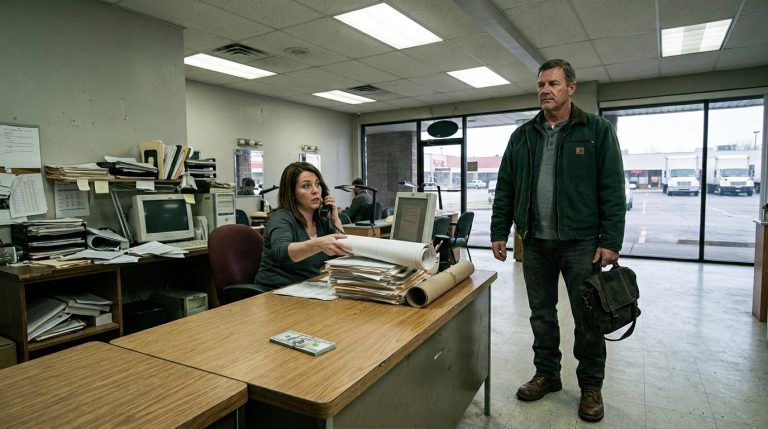
The office was small, crowded with towering stacks of manila folders that seemed to lean toward each other like tired mourners. The air tasted of dust and cold paper, a sharp contrast to the biting December air outside. Rebecca moved behind a mahogany desk that was scarred by years of use, its surface a roadmap of rings, scratches, and deep grooves.
“Sit,” she said, gesturing toward a chair upholstered in a fabric that had faded from navy to a dusty, uncertain gray.
Samuel sat. He placed his duffel bag on the floor between his feet, a protective habit he couldn’t quite shake, even here. His eyes roamed the room. There were no diplomas on the wall, just a framed photograph of a courtroom and a single, pressed flower preserved under glass. It was a space that didn’t demand anything of him, yet the weight of his own history felt amplified by the stillness.
Rebecca didn’t launch into a speech. She opened a drawer and pulled out a single, thin file folder. She set it on the desk and pushed it toward him. “I’ve been reviewing what the VA handed over to the defense network last night. They’re calling it a clerical error—a mismatch of social security numbers that led to a ‘decommissioning’ of your benefits in 2007.”
Samuel looked at the folder. He didn’t reach for it. “Clerical error,” he repeated, the words sounding hollow. “I went to their offices six times that year. I stood in line until the floor felt like it was moving. They told me my file was archived. ‘Inaccessible,’ they said.”
“I know,” Rebecca replied. Her voice wasn’t pitying; it was matter-of-fact, a surgical tool. “But look at the timeline, Samuel.”
She flipped the folder open. She didn’t let him read the whole document, but pointed to a date—a single line entry buried in a stack of computer-generated forms. It was a transfer order, marked with a code Samuel didn’t recognize.
“They didn’t just misplace you,” she said, her eyes tracking him with clinical precision. “They marked your file as ‘Transferred to Private Investigation’ in late 2007. That’s not a VA protocol. That’s something else.”
Samuel felt a cold knot tighten in his gut. The smell of the office—the old paper and the faint, underlying scent of ozone from a nearby heater—seemed to sharpen. “Investigation? Into what?”
“That’s the question,” Rebecca said. She leaned back, the chair creaking softly in the quiet. “I’ve been making calls. The Veterans Legal Defense Network has pull, but this code… it leads to a dead end in the regional office. It’s a phantom entry. But it suggests that someone, somewhere, decided your life wasn’t just a number to be filed away. They were tracking the fallout of the VA’s failures, and you were a primary subject.”
Samuel stared at the folder. The physical reality of the paper—the stiff, recycled texture, the stark black ink—felt like an accusation. If he had been the subject of an investigation, then his invisibility hadn’t been an accident of a broken system. It had been a choice.
“Why?” Samuel asked, his voice barely a whisper. “I was a soldier. I did what I was told. I came home. Why would they need to track me?”
“Because you were asking questions,” Rebecca said, her gaze fixed on him. “Because you were the only one who didn’t stop shouting when Caroline got sick. You were a liability, Samuel. Not because of what you did in service, but because of what you saw when you got back.”
The silence that followed was heavy, pressing against his eardrums. Samuel remembered those months—the long nights in the hospital waiting rooms, the phone calls to supervisors who wouldn’t answer, the way he had once tried to report the misdiagnosis to an oversight board that had looked at him like he was a ghost. He had been so focused on Caroline that he hadn’t realized he was becoming a target for a system that couldn’t afford to be exposed.
“I just wanted them to save her,” he said, his hands clenching on his knees. “That was the only fight I was ever interested in.”
“I believe you,” Rebecca said. She closed the folder. “And that’s why we’re going to find out who ordered that transfer. But this is going to be a long road, and it’s going to get harder before it gets easier. They’ll try to paint you as erratic, as a ‘disturbed veteran’—that’s their go-to narrative when things get messy.”
Samuel looked down at his duffel bag. The frayed seam he had stared at for years seemed to mock him. He had spent a decade thinking his struggle was personal, a private war against his own grief and the slow decay of his life. To realize it was systemic, that he had been systematically pushed into the shadows to protect someone else’s reputation, felt like a betrayal that cut deeper than the war ever had.
“What do I do?” Samuel asked.
“We start with the paper trail,” Rebecca said. “I need you to remember every person you talked to, every office you visited, every name you heard. Not just the big ones, Samuel. The ones who looked at you and didn’t see a hero, but saw a problem. We need to build a map of their neglect.”
Samuel looked around the room. The faded gray upholstery, the stacks of folders, the dim light—it all felt like a stage he was being asked to perform on, but for the first time, he wasn’t playing the role of the beggar. He was being asked to be a witness.
“I remember them,” Samuel said, his voice hardening. “Every single one.”
“Good,” Rebecca said, pulling a yellow legal pad toward her. “Then let’s start at the beginning. Tell me about the first day you realized they weren’t going to help you.”
Samuel closed his eyes, and the office seemed to melt away, leaving only the memory of the fluorescent lights, the smell of institutional cleaner, and the cold, flat stare of a clerk who had looked at him and seen nothing at all. He began to speak, the words coming slow and fractured, but each one carried the weight of a decade’s worth of truth, a slow, methodical dismantling of the silence he had been forced to inhabit.
CHAPTER 4: The Ghost Address
Samuel walked out of Rebecca’s office and back into the cold light of Fair Haven. The city felt different now—less a faceless expanse of indifference and more a series of coordinates he had to systematically deconstruct. Rebecca walked beside him, her presence a steady, muted anchor against the biting wind.
They reached Tmont Avenue twenty minutes later. It was a street of sagging porches and brick houses that seemed to have given up on maintenance years ago. The house he had shared with Caroline was there, nestled between a boarded-up Victorian and a vacant lot that had once been a neighborhood park. It looked smaller than he remembered, the brick facade dulled by a layer of soot that seemed to have settled into its very pores.
He stopped at the curb. The wrought-iron fence they had painted together every spring was now a web of rust, flaking away in jagged, orange scales under the pressure of his touch.
“Is this it?” Rebecca asked. Her voice was soft, stripped of the professional veneer she wore in the office.
“It was,” Samuel said. He looked at the front door. The paint was peeling in long, curled strips, exposing the gray, weathered wood underneath. “We spent three months fixing that porch. Caroline loved the way the sunlight hit the entryway in the mornings. She used to sit there with her coffee.”
He walked up the path, his boots crunching over dead leaves and the grit of broken glass. He didn’t intend to knock—the house was clearly abandoned—but as he reached the steps, he noticed something that made him pause. The lock on the door had been changed. It wasn’t the old, tarnished brass deadbolt he had installed; it was a heavy-duty, modern industrial lock, bright and out of place against the rotting wood.
He touched the metal. It was cold, clean, and aggressively new.
“That shouldn’t be there,” Samuel murmured. He turned to look at Rebecca. “The bank took the property in 2007. They were supposed to auction it. But it looks like it’s been secured.”
Rebecca pulled a small, digital tablet from her bag, her fingers moving across the screen with practiced speed. She tapped a few icons, then stopped. “Samuel, I just pulled the municipal tax records for this block. According to the city, this address doesn’t exist anymore. It was consolidated into a land-use permit for a regional utility project three years ago.”
Samuel felt a strange, detached chill. “Consolidated? The house is standing right here.”
“That’s not all,” she said, her expression tightening. “The land-use permit is tied to a holding company that shares the exact same incorporation address as the regional VA oversight board. This isn’t just an abandoned house. This is a property that was intentionally scrubbed from the records to prevent anyone from checking the title history.”
Samuel looked back at the house. The windows were opaque, covered by sheets of plywood that looked like bandages on a deep wound. He felt a sudden surge of something that wasn’t fear—it was a cold, precise anger. He hadn’t just been erased from the system; they had attempted to erase the very geography of his life.
“They couldn’t let it be auctioned,” Samuel realized, his voice steadying. “If someone had bought this place, they would have found the records I left in the crawlspace. Everything about the VA’s misdiagnosis, the medical charts, the letters—it was all hidden in a lockbox under the floorboards.”
He walked to the side of the house, moving along the narrow, overgrown alleyway that led to the backyard. The tall, dead grass whipped against his legs, a dry, rustling sound that filled the silence. He reached the cellar entrance—a slanted, wooden bulkhead that was now warped and partially buried under years of neglect.
He didn’t need to force it. The wood was so brittle it gave way under a single, firm shove, revealing a dark, musty-smelling throat leading into the earth.
“Wait,” Rebecca cautioned, grabbing his sleeve. “If this is tied to the board, there might be security. We shouldn’t be—”
“It’s my house,” Samuel said, the words possessing a finality that made her hand drop.
He descended into the dark. The air inside was trapped, stagnant, and tasted of dry rot and old memories. He clicked on the small, high-powered flashlight Rebecca handed him. The beam cut through the gloom, dancing over damp concrete walls and the skeletal remains of a long-dead furnace.
He moved toward the center of the crawlspace, his boots kicking up clouds of dust. He stopped at the spot where the floorboards had been loose—a secret, a small pocket of space between the rafters and the foundation.
He crouched down, the movement straining his knees, and pried at the wood with his knife. It resisted, then popped free with a dry, splintering crack.
There was nothing there.
He shone the light deeper into the pocket. It was empty. The lockbox was gone, the space swept clean of dust and debris, as if someone had meticulously vacuumed away the evidence of his past.
Samuel sat back on his heels, the flashlight beam trembling in his hand. The house was empty. His records were gone. The very memory of his life at this address had been systematically dismantled. He looked at the concrete floor, noting the faint, rectangular outline in the dust where the box had sat for years.
“They got here first,” he said, his voice barely audible over the sound of the wind whistling through the cracks in the bulkhead above. “They didn’t just close my case. They cleaned the crime scene.”
He looked up at the rafters, at the dark, silent underside of the home where he and Caroline had once planned their future. The weight of the erasure hit him then—a crushing, physical pressure that made it hard to breathe. He had come here looking for the truth, but the truth had been converted into a shadow.
“Rebecca,” he called out, his voice echoing in the hollow space. “They know we’re looking.”
He turned back to the cellar stairs, his shadow stretching long and distorted against the foundation. The hunt had changed. It wasn’t just about reclaiming his benefits anymore; he was now moving through a landscape designed to keep him invisible, and the people behind it were clearly watching his every move.
CHAPTER 5: The First Meal
The air in the crawlspace felt suddenly thin, as if the house itself were drawing a sharp, startled breath. Samuel held the flashlight steady, though the beam wavered slightly against the damp foundation. Above them, the sound of gravel crunching under tires wasn’t the tentative approach of a neighbor; it was the heavy, rhythmic roll of a vehicle that knew exactly where it was going.
“They’re here,” Samuel whispered, the words barely escaping his throat.
Rebecca froze, her eyes widening in the dim light. She reached for her bag, her movements sharp and jerky. “The land-use permit… they aren’t just holding the property. They’re monitoring it.”
The engine cut out, leaving a ringing silence that felt heavier than the noise. Footsteps crunched on the gravel outside—heavy, deliberate. Samuel didn’t wait for Rebecca to suggest a retreat. He moved with a grace that felt decades younger, his body automatically shifting into a defensive posture he hadn’t touched since his final deployment. He grabbed the edge of the bulkhead and pushed, the wood groaning in protest.
“We need to move,” he said, his voice low and devoid of panic. He didn’t focus on the fear; he focused on the physics of the space—the shadows, the exits, the timing.
They scrambled out of the cellar, the sudden exposure to the gray, winter afternoon light blinding. Samuel didn’t pause to catch his breath. He pulled Rebecca into the deep, overgrown brush of the backyard, moving toward the alleyway that bordered the park.
“My car is two blocks over,” Rebecca hissed, her breath hitching as they reached the edge of the vacant lot.
They didn’t look back, but the sound of a car door slamming echoed off the brick walls of the neighborhood. They reached the alleyway, the ground muddy and slick under their boots, and slipped behind the skeletal remains of a rusted dumpster.
“Why?” Samuel asked, crouching down, his eyes darting to the corner of the lot. “Why monitor an empty house? If they have the records, if they’ve cleaned the place out—”
“Because they’re not just cleaning,” Rebecca said, her face pale as she checked her tablet. “They’re waiting. They knew someone would come looking, Samuel. You weren’t just a veteran to them; you were a loose end. If you’re here, they have a way to close the loop once and for all.”
The logic hit him like a physical blow. He wasn’t a survivor reclaiming his life; he was bait. The realization shifted the landscape of his world—the city wasn’t just indifferent anymore; it was actively hunting him.
They reached the street, keeping to the shadows of the storefronts, and made it to Rebecca’s car—a nondescript sedan that blended into the drab color of the Fair Haven asphalt. As they pulled away, Samuel watched the rearview mirror. A dark SUV sat idling in front of his old house. It didn’t follow them, but the image remained burned into his mind: a predator marking its territory.
They drove in silence for miles, the heaters humming, the city skyline blurring into a smear of concrete and gray sky. The tension in the car was a physical weight, thick enough to stifle any attempt at conversation.
“I can’t go back to the hotel,” Samuel said, his voice quiet.
Rebecca glanced at him, her grip on the steering wheel tight enough to turn her knuckles white. “I know. My place is too close to the courthouse, and they’ll be watching my house. There’s someone you need to see.”
“Who?”
“My niece,” Rebecca said. “She lives in the outskirts, near the old mill. She’s… she’s the one who found your file for me. She’s the only one I trust.”
When they arrived at the small, drafty farmhouse at the edge of the woods, the evening light was a bruised purple, fading into the dark. Ellie was standing on the porch, a coat wrapped tightly around her, her face illuminated by the warm, flickering yellow light of the kitchen window.
She opened the door as they approached, and the smell of roasting garlic and woodsmoke rolled out—a sensory assault that brought Samuel to a standstill. He hadn’t sat at a table, hadn’t smelled a home-cooked meal, hadn’t been in a space that felt designed for life rather than survival in over a decade.
“Uncle Sam,” she said, her voice trembling as she looked at his worn, dirt-streaked jacket.
She didn’t wait for him to explain. She reached out, her hands warm as she took his elbow and guided him inside. The kitchen was small, crowded with the textures of a life being lived: stacks of books on the counter, a drying rack full of pottery, a threadbare rug that had been darned and re-darned.
Samuel sat at the kitchen table, his hands resting on the cool wood. He felt like an intruder in a world that didn’t belong to him. Ellie set a bowl of stew in front of him, the steam curling into the cool air of the room. It was simple, unpretentious, but as he picked up the spoon, he felt his hands shaking.
He didn’t eat immediately. He looked at the window, at the dark trees swaying in the wind outside, and then back to Ellie, who was watching him with a fierce, protective gaze.
“You’re not eating,” she whispered.
“I’m remembering,” he replied, his voice barely audible. He looked down at the bowl. The warmth of the food was a stark contrast to the cold, sterile reality he had lived in for so long. He wasn’t just hungry anymore; the physical act of eating felt like an acknowledgment that he was, indeed, still here—that he hadn’t been erased.
“Eat,” she insisted, pulling out a chair and sitting across from him. “We have a lot to talk about, Uncle Sam. And I think… I think I found something else in those archives. Something you need to see.”
Samuel took the first bite. The warmth of it flooded his senses, a slow, aching return to the living. He looked at her, his eyes searching, his heart beating a rhythm of caution, hope, and the terrifying realization that the walls were closing in, but for the first time, he wasn’t standing against them alone.
CHAPTER 6: The Architect of Silence
Samuel sat at the kitchen table, the heat of the bowl still radiating into his palms. Ellie sat opposite him, her hands folded tightly over a thick manila envelope. The kitchen was quiet, save for the rhythmic, low-frequency hum of a refrigerator that hadn’t been serviced in years and the wind rattling the loose pane of the window beside them.
“I found these in the off-site archive,” Ellie said, sliding the envelope toward him. “They weren’t in the standard VA files. They were labeled ‘Administrative Disposition—Classified Oversight.'”
Samuel didn’t open it immediately. He looked at the label. The ink was faded, the paper yellowed with the distinct, brittle texture of something that had been kept in a dark, humid place for far too long. He knew that label. It was the bureaucratic shorthand for ‘make it go away.’
“Who signed the order?” Samuel asked, his voice steadying.
“That’s the thing,” Ellie replied, her eyes dark with a mixture of anger and disbelief. “There is no signature. Just a department stamp. But I cross-referenced the stamp with the regional administrator’s office. It belongs to a man named Arthur Vance.”
The name hit Samuel like a physical jolt. Arthur Vance. He remembered the man—a smooth, impeccably dressed administrator who had sat behind a desk of polished walnut, smiling with the detached, professional coldness of a man who dealt in percentages, not people. Vance was the one who had told him that his records were ‘inaccessible.’ He was the one who had looked Samuel in the eye and lied about the VA’s ability to cover the medical costs for Caroline’s terminal care.
Samuel opened the envelope. Inside were pages of memos, internal emails, and budget projections. As he read, the kitchen seemed to shrink around him. The documents detailed a massive, systematic effort to reduce “long-term liability” by flagging specific veterans—those with complex service histories and unresolved medical claims—for “aggressive administrative disengagement.”
He wasn’t a clerical error. He was an item on a balance sheet that someone had decided to write off.
“He did this,” Samuel whispered, his finger tracing a line of text that explicitly mentioned his own name. “He didn’t just ignore us. He built an architecture of neglect.”
The room grew cold. The psychological phantom of Caroline’s voice—it’s not forever, Sam, just hold on—flashed through his mind, a sharp, piercing contrast to the bureaucratic cruelty printed on the page. He looked at the window, half-expecting to see the SUV from his old house parked at the end of the driveway. The fear he had been suppressing for years was beginning to curdle into something else: a cold, hard focus.
“We can’t take this to the police,” Rebecca said, her voice cutting through the silence. She had been standing in the corner of the kitchen, watching the street through the gap in the curtains. “Vance is on the board of the very committee that oversees the municipal courts. If we move on this, he’ll know before we even step into the courtroom.”
“Then we don’t go to the police,” Samuel said, standing up. The bowl of stew sat forgotten on the table. He felt the weight of his own history, the exhaustion of the last decade, and the sudden, sharp clarity of a man who had nothing left to lose. “If he built this, he knows where the bodies are buried. He knows why he did it.”
“Samuel, you can’t go after him,” Ellie said, reaching for his arm. “He has security, he has lawyers—”
“I don’t need a lawyer,” Samuel replied, looking at her. His eyes were hard, the color of wet slate. “I need an explanation. And I’m not leaving Fair Haven until I have one.”
He grabbed his duffel bag, his fingers finding the frayed seam he had unconsciously been tracing since the courthouse. The physical object, worn and damaged, felt like the only anchor he had left in a world that was rapidly unraveling.
“Where is he?” Samuel asked.
Rebecca hesitated, her eyes flickering toward the envelope. “He’s at a regional planning dinner tonight. The Fair Haven Country Club. It’s a closed-door event, mostly administrative staff and local government officials.”
“Good,” Samuel said. He picked up his jacket, the fabric heavy and familiar. “If he’s in a room full of people, he can’t hide behind a desk.”
He stepped toward the door, the floorboards creaking under his weight. He knew the risks—the SUV, the cameras, the system that had spent years trying to erase him. But as he stepped out onto the porch and felt the cold, biting wind against his face, he realized that for the first time in ten years, he wasn’t afraid of being seen. He was finally, violently, visible.
Ellie watched him from the doorway, her hands clasped to her chest. “Sam, please. Be careful.”
“I’m not going to break the law,” Samuel said, pausing to look back at the warm, flickering yellow light of the kitchen. “I’m going to ask a question. And I’m going to make sure he answers it.”
He walked toward Rebecca’s car, his steps sure, his breathing deep and rhythmic. The night was dark, the trees bordering the property looming like silent sentinels, but for the first time, Samuel felt the terrain. He knew the weight of the air, the distance to the road, the way the shadows played against the hood of the car. He wasn’t a veteran of the past anymore; he was a man walking into the future, and for the man who had been invisible for so long, the dark was no longer a place to hide—it was a place to act.
CHAPTER 7: The Foundation of Grace
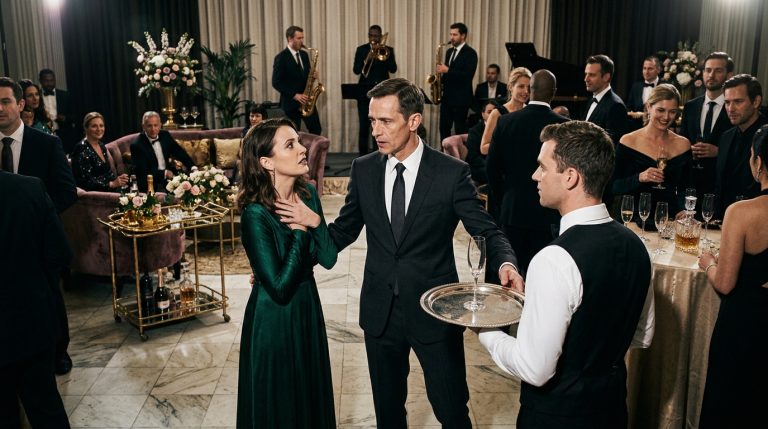
The Fair Haven Country Club was a fortress of soft light and polished wood, a world away from the dust-choked alleys Samuel had walked only days ago. As he stepped through the glass-and-brass rotunda, the change in pressure was immediate. The air was perfumed with expensive cologne and the faint, sweet scent of lilies. Samuel wore the new, dark coat Rebecca had procured, but it felt like a costume—a layer of fabric trying to smooth over a decade of ragged edges.
He kept his hands tucked deep in his pockets, his fingers tracing the familiar, comforting geometry of the dog tags hidden beneath his shirt. He was not here to blend in; he was here to be an anomaly in their perfectly manicured system.
“Stay behind me,” Rebecca whispered, her voice barely audible over the low, rhythmic swell of a string quartet performing in the grand hall.
Samuel didn’t answer. He watched the room, his eyes scanning for the man he had seen so clearly in his memory: Arthur Vance. The guests were a blur of tuxedos and gowns, a sea of figures who lived in the light Samuel had been barred from. He felt a sudden, sharp spike of vertigo—the realization that these people, with their elegant drinks and confident laughter, were the architects of the silence he had lived in for so long.
He spotted him near the bar, framed by the dark, ornate mahogany of the interior. Vance was older, his silver hair a masterpiece of barbering, his posture that of a man who had never had to worry about where his next meal was coming from. He was speaking to a group of men, his hands moving with fluid, practiced gestures.
Samuel began to move. He didn’t rush. He walked with the steady, measured gait of a man who had marched through sand, mud, and rubble. The floor was polished marble, reflecting the chandeliers like a frozen lake, and his boots felt jarringly heavy against the surface.
“Samuel, wait,” Rebecca hissed, but he was already drifting into the crowd.
The people around him were vibrant, blurred textures of silk and wool, and he felt like a shadow passing through a mirror. He wasn’t sure if they were ignoring him or simply didn’t see him—a man in a coat that didn’t fit, with the gaunt, hardened look of someone who had survived a different kind of war.
As he closed the distance, the quartet’s music seemed to fade into a dull, rhythmic thrumming in his ears. He reached the edge of Vance’s circle, his heart hammering against his ribs in a way that had nothing to do with the environment and everything to do with the truth he was about to face.
Vance turned, his smile professional and unreadable. His gaze swept over Samuel, lingering for a fraction of a second on the frayed cuff of his coat, before dismissing him entirely as a member of the catering staff or an unwanted interloper.
“Excuse me,” Samuel said. The voice was his own—thin, rasping, but steady enough to cut through the hum of the conversation.
Vance tilted his head, the smile tightening at the corners. “I’m afraid we’re in the middle of a private discussion, sir. If you’re looking for the coat check, it’s back toward the rotunda.”
Samuel stepped forward, forcing Vance to look at him, really look at him. He pulled the dog tags from beneath his shirt, letting them catch the light of the chandelier. They were scratched, dull, and tarnished—the antithesis of the polished perfection surrounding them.
“I’m not looking for the coat check, Mr. Vance,” Samuel said, his voice dropping into the quiet, sharp tone of a man who had seen the end of the world and was currently looking at the architect of it. “I’m looking for the records. The ones you archived in 2007.”
The change in Vance was instantaneous. It wasn’t fear—it was a cold, practiced calculation. His eyes narrowed, and for a fleeting second, the professional veneer cracked, revealing the raw, bottomless indifference beneath. He leaned in, his voice a low, threatening hum.
“I don’t know who you are, or what you think you’re owed,” Vance said, his face inches from Samuel’s. “But you’re making a very loud mistake in a place that prides itself on silence.”
“The silence is over,” Samuel said. He reached into his pocket and pulled out a single, folded page from the documents Ellie had recovered—the memo with Vance’s own stamp on it.
He didn’t hand it to him. He simply held it up, a piece of physical evidence that stood out in the pristine room like a rusted nail in an ivory wall. Vance’s expression didn’t change, but his grip on his glass tightened, his knuckles whitening.
“That’s a forgery,” Vance said, his voice as smooth and lethal as a blade. “And if you try to make this a scene, you’ll find that the system you seem so obsessed with has ways of protecting itself from people who refuse to stay in their proper place.”
“I’m not in my place anymore,” Samuel said. He felt a strange, terrifying calm wash over him. “I’m standing right in front of you.”
Before Vance could respond, a security guard detached himself from the shadows near the bar, his hand reaching toward his radio. Samuel didn’t flinch. He looked at the guard, then back at Vance, the connection between them absolute. He had come here to demand an answer, but he had found something else: the realization that the man who had erased him was just as trapped in his own architecture of lies as Samuel had been in the silence.
“You’re going to give me the truth,” Samuel said, the weight of his voice carrying the finality of a gavel. “Or you’re going to watch your own work tear this room down around you.”
The guard reached Samuel’s side, his grip heavy on his shoulder, but Samuel didn’t break eye contact. He held his ground, the fraying edges of his coat and the scars on his face a stark, violent contrast to the clean, sanitized luxury of the room. The silence around them deepened, not because of the music, but because of the man who had finally stepped out of the shadow to demand that he be seen.
CHAPTER 8: The Silent Horizon
The guard’s fingers were thick, pressing hard into the worn wool of Samuel’s coat. The grip was intended to intimidate, but Samuel didn’t lean away. He looked past the guard’s face, directly at Arthur Vance, who stood frozen in the center of the sudden silence, the glass in his hand trembling just enough to make the ice click against the crystal. The other guests had retreated, forming an unintentional circle around the drama, their faces a mix of confusion, indignation, and—as the recognition dawned—dread.
“You really want to do this, Vance?” Samuel’s voice was low, but in the hush of the grand hall, it carried with the weight of a physical blow. “You want to explain to these people—the ones who fund your legacy—that my file wasn’t a mistake? That it was a ledger entry designed to save a few thousand dollars in pension payments?”
Vance set his glass down on a nearby pedestal table with a sharp clack. His face was a mask of cold fury. “Get him out of here,” he commanded, gesturing to the security detail. “He’s trespassing. He’s clearly unstable.”
“I am the truth you didn’t think would ever find its way back to your doorstep,” Samuel countered. He reached into his pocket—not for a weapon, but for the rest of the documents Ellie had salvaged—and tossed the envelope onto the polished mahogany bar. “That’s everything. The transfer orders, the budget projections, the signatures of the people who watched our lives crumble and decided it was more efficient to let us disappear.”
The room seemed to tilt. Vance’s colleagues began to murmur, the sound rising like an approaching tide. The guard’s grip on Samuel’s shoulder loosened as the man shifted his attention from the ‘unstable’ intruder to the incriminating stack of papers now resting in the light of the chandelier.
Vance stepped toward the bar, his hand reaching for the folder, but a younger man—a local journalist who had been hovering near the edge of the gala—was faster. He stepped forward, his eyes fixed on the documents, and began to read.
The climax wasn’t a scream or a fight. It was the sound of a reputation disintegrating in real-time. Vance’s attempt to lunge for the papers was cut short by the realization that he was surrounded by cameras, by witnesses, and by the very system of ‘order’ he had weaponized against men like Samuel. He froze, his hands hovering in the air, and for the first time in his life, the power he wielded behind his desk evaporated.
He looked at Samuel, and in that gaze, there was no victory—only the shared, hollow recognition of two men who had spent their lives playing roles that had finally, irrevocably, collided. Vance turned, his face gray, and walked toward the rotunda, his retreat as silent and final as a death sentence.
The aftermath arrived not with a roar, but with a slow, suffocating stillness. The crowd drifted away, their interest turning toward the revelations now being whispered in corners. The guard stepped back, his presence suddenly irrelevant. Samuel stood alone in the center of the hall, the weight of his anger finally beginning to recede, leaving behind a profound, bone-deep exhaustion.
He didn’t stay for the fallout. He turned and walked out of the club, the heavy glass doors swinging shut behind him with a soft, final thud.
The winter night was crisp, the air smelling of ice and woodsmoke. Rebecca was waiting by the car, her face pale, but her eyes held a steady, quiet light. She didn’t speak; she simply opened the passenger door, a gesture of respect that felt like a healing balm.
In the days that followed, the story didn’t just break—it shattered. The documents Samuel had left on the bar were the catalyst for a broader, federal investigation into the oversight board’s systemic neglect. The resulting purge was thorough, clinical, and complete. Vance was stripped of his position, his career folded into the same silence he had imposed on others.
Samuel returned to the farmhouse. The process of reconstruction was slow, painful, and far from glamorous. There were meetings with attorneys, hours of therapy to process the phantom screams that still haunted his nights, and the exhausting task of learning how to live in a house that wasn’t a prison.
One afternoon, a month later, he sat on the porch of the farmhouse, the sun dipping low behind the skeletal trees of the woods. Rocky, the service dog, dozed at his feet, his breathing steady and rhythmic. Samuel held the tattered duffel bag in his lap. He had finally retrieved his sewing kit, and with hands that had stopped shaking, he began to work on the frayed seam.
The needle passed through the canvas with a soft, rhythmic friction. It was a mundane act, a small, stubborn reclamation of his own integrity.
“You’re doing it wrong,” a voice said softly.
He looked up. Ellie stood in the doorway, holding two mugs of tea. She sat down beside him, her presence warm and grounding.
“I’ve got it,” Samuel said, pulling the thread tight. The seam closed, the tear mended. He held the bag up, inspecting his work. It wasn’t perfect—the stitches were uneven, and the fabric was still scarred by time—but it held.
“It’s finished,” Ellie said, looking at the bag, then out toward the horizon where the first stars were beginning to blink into the deepening blue.
“The bag is,” Samuel replied. He leaned back against the porch railing, feeling the wood solid and cool against his spine. He looked down at the dog tags, resting flat against his chest. He wasn’t the man who had drifted through the alleys of Fair Haven, and he wasn’t the man who had burned in the desert. He was simply Samuel.
He let out a long, slow breath, watching it mist in the cooling air. The winter was finally, truly ending. The silence that had once been his cage was now just a space—a quiet, open horizon where he could finally learn to stand, to speak, and to simply be.
He reached out and stroked Rocky’s soft, sleeping head, the sensation of fur under his palm the most real, grounded thing he had ever felt. He didn’t need to look at the picture of Caroline to remember her smile; it was etched into the quiet air of the porch, a soft, bright echo that promised he had finally come home.