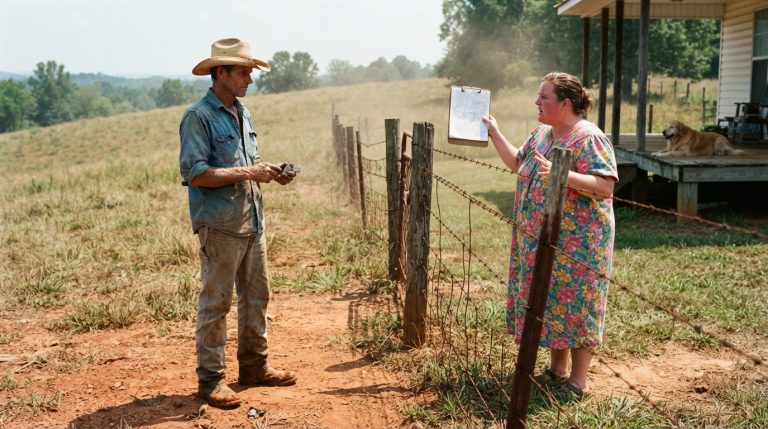
The Iron Perimeter: How a Georgia Farmer Turned a Glamping Incursion into an Unforgettable Reckoning
CHAPTER 1: THE MORNING INCURSION
The porcelain mug felt heavy and lukewarm against my thumb. Outside the kitchen window, the southern Georgia sun was barely clawing its way over the tree line, spilling a thin, watery light across thirty pastel tents that had no business existing on private dirt. A folding stage sat square in the middle of my lower pasture, flanked by a glowing gluten-free doughnut stand that looked like it had been air-dropped straight out of a coastal wellness retreat.
I took another slow sip, letting the bitter chicory-blend coffee burn the back of my throat. Ten feet away from my primary irrigation line, a woman encased in neon-pink yoga pants was attempting to lasso one of my red cows with a fringed silk scarf. The cow didn’t bolt; it just blinked its heavy, wet eyes with bovine disdain, chewing its cud as if a fluorescent parasite were attempting its capture.
“Get away from Bessie’s calf,” I muttered to the glass pane, though the words died against the double-pane insulation.
Across the hay bales, a man wearing a crisp white golf visor and linen trousers was meticulously arranging lavender sachets like they were VIP seating at a summer gala. Every movement was deliberate, soft, and entirely detached from the heavy iron reality of taxes, drought, and three generations of mortgage notes holding this dirt together.
I set the mug down on the formica counter. The ceramic made a sharp, dry crack against the laminate.
The truck door outside groaned on its hinges when I pulled it open five minutes later. The F-250 smelled like old oil, dried manure, and decades of damp work coats tossed behind the bench seat. I didn’t rush. Speed was for men who didn’t know their own land. I drove down the red-dirt track in second gear, letting the engine hum a low, vibrating growl that cut right through the distant murmur of acoustic guitar music drifting from their folding stage.
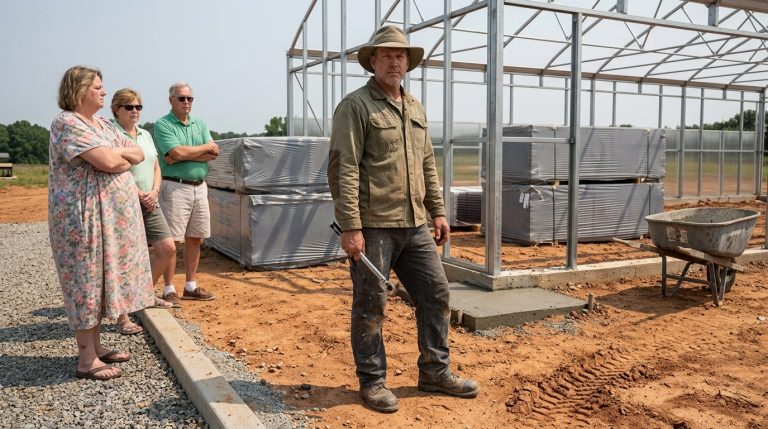
The woman with the clipboard—Trish, as I would learn later—was standing near my main hydrant, tapping a laminated schedule against her thigh. She wore a fleece vest despite the rising humidity, and her hair was pulled back into a knot so tight it looked like it hurt to blink.
I cut the engine. The silence that followed was heavy, broken only by the idle ticking of the hot exhaust pipe cooling in the grass.
“Mornin’,” I said, leaning my forearms against the steering wheel.
Trish didn’t look up from her clipboard right away. She made a small checkmark with a silver pen, then lifted her chin, her eyes sweeping over my faded flannel shirt and grease-stained denim with the precise, clinical coldness of a bank auditor appraising a failed asset.
“You’re the caretaker, I assume,” she said, her voice carrying that sharp, nasal glide that always sounded like an unfulfilled customer service complaint. “We’re going to need those cattle moved to the north perimeter. They’re disrupting the grounding circle. Several participants experienced sensory interference during our dawn breathing exercises.”
My hand rested on the textured plastic of the steering wheel. “This is private land, ma’am. Not a public park. And those cows go where they please.”
She offered a tight, patronizing smile, the kind people give to stray dogs they intend to call the county about. “The map clearly designated this corridor as open conservation space. We filed the digital notices weeks ago.”
“You filed nothing on my deed,” I said, keeping my voice flat, pared down to the bone. “You cut my barbed wire to get those tents in here. You’ve got an extension cord spliced into my wellhouse outlet.”
Trish sighed, a theatrical puff of air that fluttered the papers on her board. “We are here to reconnect with the earth, mister—what did you say your name was? Never mind. The earth belongs to everyone who respects its frequency. Now, please move the livestock. The sound of their chewing is throwing off the sound bath.”
She turned her back before I could answer, walking away with the brisk, weightless stride of someone who had never once in her life had to pull a calf out of a freezing mud ditch at two in the morning.
I sat there for a long moment, watching the way her white running shoes stayed entirely clean against the dust of my pasture. In that quiet second, right before the engine ticked its final cooling click, I knew two things with absolute clarity: manners were entirely useless here, and the fence was already down.
CHAPTER 2: THE NIGHT OF THE TIKI TORCHES
The engine ticked once more, a metal contraction cooling in the mid-morning heat, before falling entirely silent. I didn’t chase after her. There was no point arguing with a woman who looked at a working farm and saw an empty canvas waiting for her lifestyle brand. Instead, I reached down, my fingers catching the sharp, rusted barb of the wire she had trampled. It bit into my calluses, a familiar, grounding pinch.
I spent the next eight hours fixing what she broke. That’s the reality of owning land that doesn’t sit on a paved suburban cul-de-sac. Every hour spent dealing with someone else’s manufactured spiritual crisis was an hour stolen from the tractor maintenance I needed to finish before the autumn harvest. By late afternoon, the sun had burned through the morning haze, leaving a heavy, copper-colored glare hanging over the treeline. The cows had retreated to the shade of the live oaks, flicking their tails at flies while, thirty yards away, a group of adults in linen tunics engaged in some kind of silent synchronized stretching beside my water trough.
When dusk finally settled, the character of the pasture shifted.
The crickets started up, a dry, rhythmic scraping beneath the hum of the cicadas. And then came the tiki torches. I watched from the darkened doorway of the machinery shed as small, orange flames blossomed along the edge of my lower field. They had dragged my spare hay bales into a neat semicircle around a propane-powered fire pit they must have smuggled in past the cattle gate. A low, synthetic drone—some kind of ambient drone music played through a portable bluetooth speaker—drifted across the damp grass.
My phone buzzed against my thigh. It was a text from Earl, two words and a punctuation mark: Ready?
I looked back down at the field. Trish had taken a position near the center, standing on a folding stool with a clipboard clutched to her chest like a shield, her voice carrying across the quiet evening air as she lectured her followers about “reclaiming earth energy” and the moral failure of modern landowners who hoard spatial resources.
The phrase hoarding resources sat heavy in my chest. My granddad had cleared those stumps by hand with an old Ferguson tractor and a mule named Jack. My dad had nearly lost his thumb to a corn picker keeping the taxes paid through the bad drought of ’86. And now this woman, who looked like she’d call the county health inspector if she saw a garter snake, was standing on my dirt telling strangers I was a thief of the soil.
I stepped back into the shadows of the shed. The air inside smelled of stale gear oil, dry fertilizer sacks, and the sharp, metallic tang of old iron. In the corner sat Bessie.
Bessie wasn’t glamorous. She was a twenty-year-old vacuum tanker with rusted seams, a dented side panel where a backing error with a flatbed had left a permanent scar, and a discharge valve that shrieked like a dying hawk if you didn’t grease the gaskets. But she was loyal. And right now, her 1,500-gallon belly was filled with the richest, ripest, most densely fermented blend of autumn cow slurry, rainfall runoff, and barnyard bedding that southern Georgia physics could manufacture.
Ten minutes later, the gravel crunch of Earl’s half-ton pickup whispered down the lane. He killed the lights fifty yards back, rolling in on momentum alone. When he stepped out, he was wearing a pair of yellow rubber chore gloves and a grin that stretched from ear to ear.
“Saw their little light show from the county road,” Earl whispered, leaning against the fender of Bessie with a quiet chuckle. “They got a projector going now. Look over there. They’re showing a documentary about bees on the side of the feed silo.”
I looked. Sure enough, a glowing amber square of light was projecting a giant honeybee right over the faded red paint of our grain storage.
“They’re using the silo,” I said, my voice low.
“That’s crossing the line, Hank. A bee movie is fine, but projecting it on private grain storage without paying licensing fees to the bovine community is a federal offense in my book.” Earl tapped the side of the tanker. “She’s heavy. You got enough clearance on the south ditch?”
“Tight squeeze,” I said, climbing up into the cab of the F-250 and hooking up the pneumatic PTO line to the pump. “The ground’s soft near the creek, but if we hug the treeline, the canopy will hide us until we clear the ridge.”
We waited until 11:45 p.m. According to the laminated schedule Trish had dropped near the wellhead—which I had picked up and pocketed earlier—that was the exact hour set aside for the Silent Circle of Deep Earth Release.
Right on schedule, the ambient music stopped. The soft, rhythmic thrum of hand drums began to drift across the pasture, punctuated by the occasional deep, resonant hum of someone trying to vibrate their chakras into the clay.
“Cue music,” Earl muttered, climbing up onto the catwalk behind the tanker barrel with a heavy-duty flashlight in his grip.
I slipped the truck into low-range four-wheel drive. The clutch caught with a heavy, familiar shudder. We rolled out of the machine shed without turning on the headlights, trusting the starlight and the dark silhouette of the pecan trees to guide our path. The tires crunched softly over the dry pasture grass, muffled by the distance and the steady thud of the hand drums growing louder with every foot we advanced.
We were fifty yards out when the glow of the tiki torches illuminated the edge of the tents. Trish’s voice rose above the drumbeat, steady and self-righteous, preaching to a circle of thirty people sitting cross-legged on my Bermuda grass.
“We must detach from the ego of ownership,” she was saying, her voice echoing slightly off the metal side of the grain silo. “The earth yields to those who honor its—”
I pulled the PTO lever.
The pump engaged with a deep, shuddering groan that vibrated right through the floorboards of the cab. On the back of the tank, Earl cracked the primary discharge valve.
The first blast didn’t just hit the air; it owned it. A thick, high-pressure arc of fermented organic judgment cleared the treeline like a breaking wave, soaring majestically over the glowing tents before descending with a heavy, collective splat right into the center of the meditation circle.
For one long, beautiful second, the drums stopped. There was a stunned, absolute vacuum of sound.
Then came the screaming.
CHAPTER 3: THE MANURE TANKER OFFENSIVE
The screaming hit a pitched frequency that cut cleanly through the night air. It wasn’t the sound of physical danger; it was the specific, high-register shriek of people whose entire worldview had just been thoroughly unzipped by reality.
Beside me on the catwalk, Earl threw his head back and let out a bark of pure, unadulterated joy, swinging his flashlight beam across the chaos. The bright white light caught a man in an organic cotton tunic attempting to rescue a cooler, only to slip ankle-deep into the wet deposition with a heavy, wet thud. Tents sagged under the sudden weight of the misting drift. Coolers tipped over, spilling artisanal almond milk and bamboo water into the newly churned turf.
“They’re scattering north!” Earl hollered over the roar of the pump. “Mind the irrigation line near the pump house!”
I didn’t need the warning. I eased the steering wheel left, keeping Bessie moving at a steady, deliberate crawl. A tractor pulling a manure spreader isn’t designed for speed; it’s designed for persistence. We made a wide, sweeping arc across the eastern edge of the pasture, painting a precise boundary line that left no doubt where the private acreage began and their wellness fantasies ended.
Through the dust and the heavy, earthy miasma settling over the field, a familiar figure materialized. Trish came charging out of the haze, her fleece vest soaked, holding a dripping clipboard over her head like an inadequate umbrella. Her face was twisted into a mask of pure, incandescent fury.
“I have your license plate number!” she shrieked, stumbling forward through the damp grass. “This is criminal destruction of property! You’ll be in federal court before the week is out!”
I slowed the truck just enough to angle the discharge nozzle toward an empty patch of grass ten feet to her left, giving the valve a quick twist. A fine, aerosolized mist caught the tail end of the arc, drifting over her like an unscheduled blessing.
Trish gasped, her arms flailing backward as she tripped over a tipped-over compost toilet. She went down hard into the mud, her clipboard flying out of her grip and disappearing into the darkness.
Earl offered a crisp military salute from the back of the tank. “Complimentary farm treatment! All-natural exfoliation, courtesy of southern Georgia!”
By the time we swung the F-250 back toward the machine shed and cut the PTO pump, the lower pasture looked like a battlefield designed by an angry bovine deity. The air was thick with truth, heavy and unapologetic. We climbed down from the cab, our boots caked in the rich evidence of our work, and stood in silence listening to the distant sound of crying, gagging, and furious cell phone calls floating through the dark.
“Reckon they’ll stay for sunrise yoga tomorrow?” Earl asked, wiping a stray drop of mist off his forehead with a ginger hand.
“Doubt it,” I said, unhooking the pneumatic line. “They’re out of incense.”
Two days later, the expected paperwork arrived.
It wasn’t a polite note or a phone call from the county sheriff. It was a certified letter delivered right to my mailbox by a local courier who looked like he regretted every life choice that led him to my gravel driveway. I tore open the heavy envelope on the tailgate of my truck. Inside were four pages of dense legalese penned by a high-priced firm out of Atlanta. Trish was suing me for chemical warfare, emotional terrorism, structural sabotage, and willful infliction of distress. She demanded twenty thousand dollars in damages, a written apology published in the county gazette, and an agreement to surrender the lower pasture for ecological remediation.
I sat there in the afternoon sun and laughed until my ribs ached, choking on the dry air.
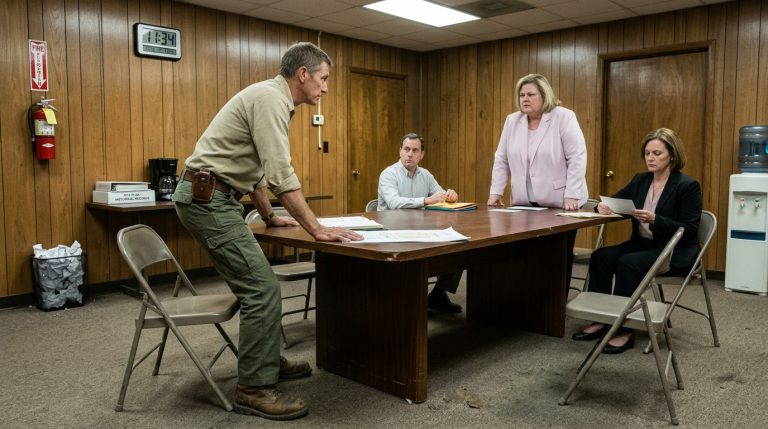
Thirty minutes later, I drove into town and laid the packet across the cluttered oak desk of Claude, our local attorney. Claude was seventy years old, wore a permanently stained tweed jacket, and had a mind like a steel trap left out in the rain. He adjusted his half-moon spectacles, scanned the first page in total silence, and then looked up at me over the rims.
“You didn’t chase anybody with that tank off your property line, did you, Hank?” Claude asked, his voice dry as corn husks.
“Stayed entirely on my dirt,” I said. “Got the GPS tracks on the truck to prove it. Put up warning signs three days prior.”
Claude leaned back, the old wooden chair groaning in protest, and a slow, dangerous smile crept across his lined face. “Well, that’s good. That’s real good.” He tapped the corner of the legal complaint with a yellowed finger. “She thinks you’re cornered. People like that always assume a working man will fold the second he sees a lawyer’s letterhead because they think you can’t afford the fight.”
He pulled a thick file drawer open, shoving aside twenty years of boundary disputes and timber deeds. “Now, let’s see if this woman has been quite as careful with her own property lines as she expects you to be with yours.”
That single sentence didn’t solve the lawsuit, but it planted a seed. Over the next forty-eight hours, while Claude drafted our legal response, I spent my evenings down at the county courthouse basement unrolling century-old plat maps and faded linen surveys. I was looking for anything—an old drainage easement, a forgotten utility right-of-way, a historical marker.
Instead, I found something much better.
It was an amended survey map from the autumn of 1982, filed when the old Miller tract was subdivided. I traced the black ink lines with a magnifying glass, cross-referencing the GPS coordinates of the cedar tree near the creek. The numbers didn’t lie.
I took the rolled-up blueprint back to Claude’s office the following morning. He unrolled it across his desk, anchored the corners with two heavy brass law books, and traced a red line with his thumb.
“Look right here, Hank,” Claude whispered, his eyes gleaming with quiet satisfaction. “That stone patio of hers—the one with the wind chimes, the outdoor pizza oven, and the sub-zero wine fridge—doesn’t sit on her parcel at all.”
I leaned in closer, smelling the old paper and pipe tobacco. “Where does it sit?”
“Sits thirty feet deep onto your family’s lower pasture,” Claude said, grinning like a fox in a henhouse. “Has for thirty years. She built her entire luxury entertainment deck smack on your dirt.”
The realization didn’t hit me like an explosion; it settled over me like a warm, heavy wool blanket on a freezing winter morning. The lawsuit she filed to intimidate me had just handed us the exact crowbar we needed to pry her whole operation apart.
CHAPTER 4: THE LEGAL THREAT AND THE SURVEY
The certified letter didn’t sit on the kitchen counter for long before Claude and I turned the tables from defense to offense. A lawsuit isn’t won by hiding behind the barn doors; it’s won by finding the rusted bolt holding the other fellow’s gate together. And Trish’s gate was anchored entirely on thirty feet of my family’s dirt.
Two days after discovering the anomaly on the 1982 plat map, Claude’s office filed a formal counter-motion with the county clerk. We didn’t just contest her claims of emotional terrorism and chemical discharge; we attached an official notice of real estate encroachment, complete with certified coordinates from a licensed surveyor we brought out quietly on a Tuesday morning.
The surveyor, an old man named Miller who had measured half the county lines south of Macon, drove his iron stakes deep into the red clay right through the middle of Trish’s manicured gravel terrace.
I watched from the cab of my truck as Miller tapped the final orange stake into place with a ten-pound sledgehammer. The heavy thud-thud echoed across the lawn where, only a week prior, people had sat cross-legged doing breathing exercises. Now, the expensive stone patio, the built-in pizza oven, and the sub-zero wine fridge sat squarely on the wrong side of the law.
The response was immediate.
On Thursday afternoon, a blue sedan came barreling down my gravel lane, kicking up a rooster-tail of dust that settled thick on the fenders of the F-250. Trish stepped out before the engine even finished pinging. She wasn’t wearing her fleece vest today. Instead, she wore a sharp linen blazer that looked entirely out of place against the backdrop of rusted machinery and weathered cypress siding. Her face was flushed, her jaw set so tight the muscles twitched near her ear.
“You think you’re clever, don’t you?” she snapped, marching right up to the porch steps where I was sitting with a whetstone, putting a clean edge on a draw-knife.
I didn’t stand up. I kept the steel blade angled against the grey stone, sliding it back and forth with a soft, rhythmic shhh, shhh. The smell of iron filings and light machine oil drifted up between us.
“Afternoon, ma’am,” I said evenly. “You’re trespassing past the orange stakes.”
“That patio has been there for six years!” she shouted, her voice losing its polished corporate cadence and cracking with genuine panic. “The contractors assured us the boundary was clear when we bought the property package! You’re weaponizing antiquated paperwork to harass a legitimate wellness enterprise!”
“It ain’t antiquated if it’s recorded at the courthouse,” I replied, not looking up from the blade. I checked the edge against my thumb, testing the sharpness before lowering the stone. “And that land’s been in my family since Eisenhower was in office. My granddad ran cattle over that exact patch of dirt before your contractors were even born.”
Trish’s hands trembled slightly as she clutched a fresh leather folder against her chest. “We are in the middle of a federal civil suit for damages. If you think this petty boundary dispute is going to make us drop the charges—”
“I don’t think nothing about your lawsuit, Trish,” I interrupted, finally raising my eyes to meet hers. There was no anger in my voice, just the heavy, immovable weight of facts. “Claude handles the courtroom. I handle the fence line. And right now, that patio of yours is sitting on my grass. You got thirty days to move your wine fridge before I rent that strip out to someone who needs the shade for livestock.”
She stared at me, her chest heaving under the linen blazer, searching my face for a bluff that wasn’t there. When she realized I wasn’t backing down, the last veneer of corporate control cracked entirely. She spun on her heel, marched back to her sedan, and slammed the driver’s side door hard enough to rattle the side mirror. The tires sprayed gravel into the ditch as she backed out, tearing down the lane in a cloud of dust and impotent rage.
I watched her tail-lights disappear around the curve of the pecan grove. The silence returned, heavy and deep, broken only by the lazy hum of a blue-bottle fly against the screen door. We had her on the defensive, but the court date was still two weeks away, and a cornered animal always thrashes hardest right before the gate drops.
CHAPTER 5: GOAT YOGA ON THE DISPUTED PATIO AND THE COURTROOM SHOWDOWN
The orange stakes didn’t stay lonely for long. If Trish wanted to treat thirty feet of my family’s pasture like her own personal wellness annex, I figured it was only neighborly to help her monetize the square footage properly. Two days after she stormed off my property, I called up Sarah, a local woman who ran a mobile small-livestock operation specializing in therapeutic pasture events.
By Friday morning, twelve energetic Nigerian Dwarf goats and three enthusiastic sheep were clattering across Trish’s prized stone patio.
I stood near the tree line with a cup of black coffee, watching the operation unfold. Sarah had laid out rows of purple and green yoga mats directly over the flagstones where Trish’s sub-zero wine fridge hummed against the exterior wall. Half a dozen women in matching pastel leggings were stretched out in downward dog positions while tiny hooves tap-danced across yoga blocks and curious kids nibbled playfully at the fringes of expensive athletic wear.
The atmosphere was a far cry from the solemn, silent breath-work Trish had tried to enforce. It was loud, chaotic, and wonderfully disruptive.
Right on cue, the back door of Trish’s vacation cottage flew open. She stepped out onto the patio, wrapped in a silk bathrobe, holding a smartphone to her ear. When she saw the goats bouncing across her flagstone terrace and a dozen strangers doing stretches next to her outdoor pizza oven, her face drained of every drop of color.
“Get those animals off my stone!” she shrieked into the phone, her voice cracking as a small white goat hopped up onto her cedar wood bench and peered curiously through the sliding glass door.
Sarah didn’t even blink. She walked over, her voice dripping with sweet, southern hospitality. “Morning, ma’am! We’re just utilizing the disputed easement space for localized tension relief. Would you like to join? Downward dog is fantastic for cortisol levels.”
Trish didn’t join. She dropped her phone, turned on her heel, and retreated inside, slamming the glass door so hard the wind chimes hanging from the eaves jangled in a frantic, metallic panic.
The courtroom showdown arrived on a crisp Monday morning two weeks later.
I traded my grease-stained work shirt for a clean blue button-down and a bolo tie my wife had bought me years ago as a joke. Claude met me on the courthouse steps, carrying a leather briefcase that looked older than the state constitution. Inside, we had the original 1982 survey, the certified GPS coordinates from Miller, and a thick stack of call logs from the county sheriff documenting Trish’s unauthorized trespassing.
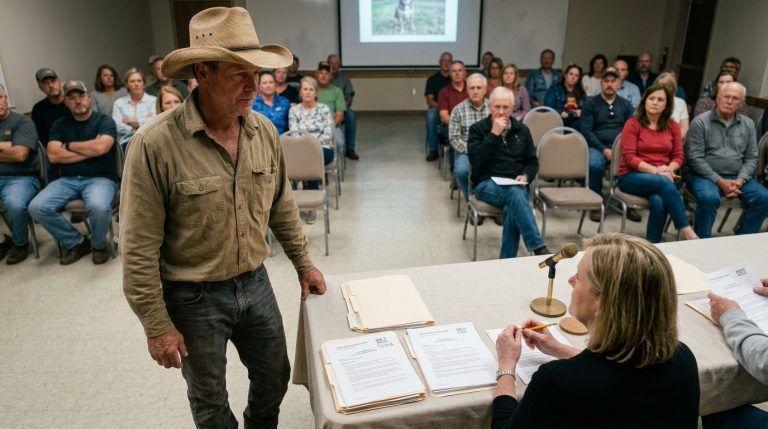
The courtroom smelled of floor wax, old paper, and suppressed anxiety. The judge, a lean man with silver hair named Henderson who had presided over half the property disputes in the county since the Reagan administration, sat behind a high mahogany bench with a look of permanent, world-weary exhaustion.
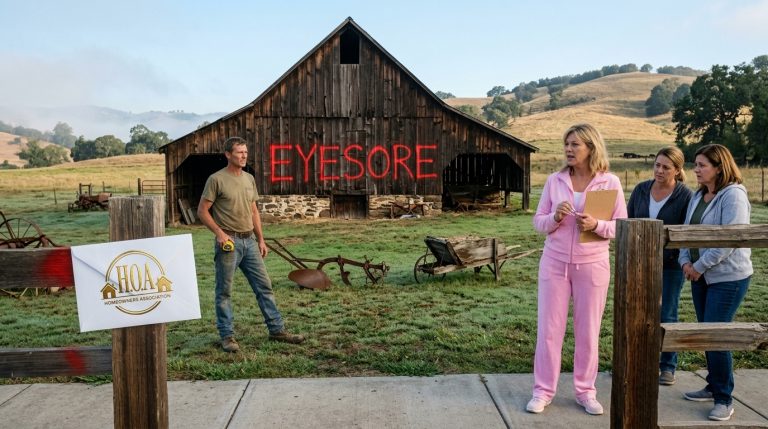
Trish sat at the opposite table, flanked by a young, sharp-suited attorney from Atlanta who smelled heavily of cologne and expensive hair gel. She had brought two of her HOA committee members with her as moral support, both of them dressed in muted earth tones as if they were attending a solemn environmental vigil.
“Case number 88-CV-412,” Judge Henderson announced, peering down through his bifocals. “Trish v. Hank. Let’s make this brief. I have three boundary arbitrations and a tractor repossession waiting after lunch.”
Trish’s attorney stood up first, adjusting his cuffs with practiced smoothness. He launched into an impassioned speech about community stewardship, historical usage, and the emotional distress caused by unexpected agricultural run-off. He waved photographs of the ruined tents and the mud-splattered pasture like a prosecuting attorney presenting evidence at a murder trial.
“Your Honor,” he concluded, his voice swelling with righteous indignation. “My client’s wellness sanctuary suffered irreparable psychological and material damage due to the deliberate, malicious sabotage executed by the defendant.”
Judge Henderson didn’t look impressed. He turned his gaze toward our table. “Mr. Claude? Response?”
Claude didn’t stand up right away. He slowly adjusted his glasses, picked up a single sheet of paper from the 1982 plat map, and leaned back in his chair.
“Your Honor, my client didn’t sabotage a sanctuary. He protected a fence line,” Claude said, his voice gravelly and calm. “As for the damages claimed, we’d direct the court’s attention to Exhibit C—the certified land survey completed by licensed surveyor Miller last Tuesday.”
Claude slid the map across the bench. Judge Henderson picked it up, tracing the red ink boundary lines with the blunt end of a fountain pen.
“According to county records and this unassailable deed,” Claude continued, “the plaintiff’s patio, outdoor kitchen, and wine storage facility are currently built thirty feet deep onto my client’s private agricultural land. Not an inch of that structure has legal permit or historical easement.”
The courtroom went dead silent. Trish turned sharply to look at her attorney, her eyes wide with sudden, sickening realization. Her lawyer blinked, scrambling through his papers as if hoping a missing deed would magically materialize between the pages.
Judge Henderson looked up from the map, staring directly at Trish over the rim of his glasses. “Ms. Trish. Did you or your contractors secure a formal boundary survey before constructing that stone terrace six years ago?”
Trish swallowed hard, her voice dropping to a nervous whisper. “We… we were told the land was part of the community conservation trust—”
“That’s a ‘no’, Your Honor,” Claude interjected smoothly.
Judge Henderson handed the survey back down with a sharp click of his pen against the wood. “Case dismissed. The plaintiff’s claims of damages are thrown out with prejudice.” He leaned forward, resting his forearms on the bench. “Furthermore, Ms. Trish, I suggest you consult a zoning attorney immediately regarding the unauthorized structures currently sitting on Mr. Hank’s property before he decides to exercise his full legal right to impound them.”
Trish sat frozen in her chair, staring blankly at the polished oak table as the reality of the defeat settled into her bones. The courtroom began to empty around us, the heavy doors swinging shut with soft, definitive thuds. We had won, not by shouting louder, but by letting the unbending weight of facts do the heavy lifting.
CHAPTER 6: THE QUIET MORNING AND THE FINAL ACCOUNTING
The drive back from the county seat was quiet. Claude stayed behind to file the final dismissal paperwork, leaving me alone in the cab of the F-250 with the hum of the tires against the asphalt and the steady, familiar vibration of the steering wheel. By the time I turned down the gravel lane toward the farm, the afternoon sun was hanging low over the treeline, casting long, bruised shadows across the lower pasture.
The pastel tents were gone. The folding stage had been hauled away by a pair of exhausted volunteers three days prior, and the bamboo compost toilet had vanished into the back of a rented box truck. All that remained of the great wellness invasion was a churned patch of Bermuda grass where the earth was slowly beginning to breathe again under the weight of the evening dew.
I parked the truck by the machine shed, killing the engine with a familiar metallic sigh. Bessie sat quietly near the corner, her rusted seams catching the amber light of the sunset like a retired war horse resting after a long campaign.
I walked over, resting my palm against the cool, dented metal of her tank. There was no triumph ringing in my ears, no grand cinematic satisfaction. Just a profound, aching fatigue and the deep, steady peace of a man who had successfully defended his perimeter.
Across the property line, the disputed stone patio looked remarkably lonely. The sub-zero wine fridge was unplugged, its digital display dark, and the expensive wicker chairs had been pulled back against the sliding glass door of the vacation cottage. Trish was inside, packing boxes. Through the front window, I could see the distinct, frantic silhouette of her boxing up wind chimes and ceramic essential oil diffusers, her movements rushed and defeated.
She didn’t come out onto the porch when I walked past the orange property stakes. There was no speech left in her, no laminated schedule, no grand proclamations about reclaiming earth energy. The facts had done what facts always do when they meet a fantasy: they ground it down to dust.
The next morning, the sun rose over the southern Georgia fields just like it always had.
At 4:30 a.m., I stood on the back porch with a hot mug of chicory-blend coffee in my hand, listening to the low, comforting rumble of the cows stirring down by the creek. The air smelled of damp earth, crushed pine needles, and the crisp bite of autumn. Down in the pasture, a pair of red calves trotted playfully near the fence line, entirely unbothered by yoga mats, sound baths, or corporate lawsuits.
I took a slow sip, letting the warmth settle into my chest. A “For Sale” sign had appeared near the edge of Trish’s gravel driveway overnight, small and white against the green boxwoods. She would be gone by the weekend, retreating back to whatever concrete-paved world she had crawled out of, leaving the quiet to the people who actually knew how to tend the soil.
I walked back inside the kitchen, setting the empty mug down on the formica counter with a soft, clean click. The farm didn’t need grand gestures or loud victories to survive. It just needed boundaries, patience, and a willingness to stand your ground when the world tried to pave over what matters.