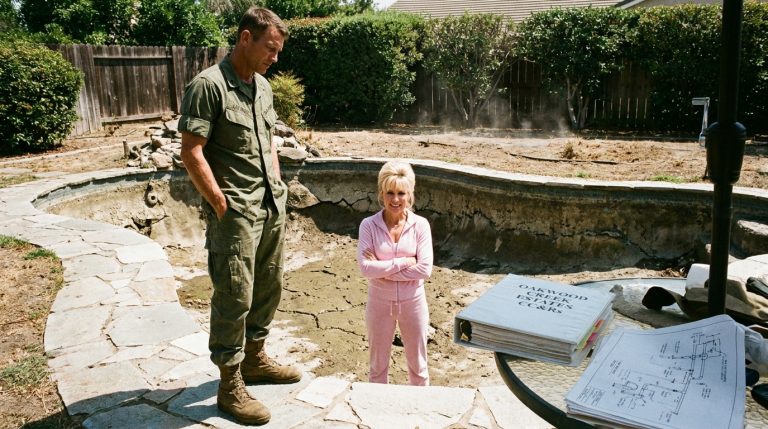
The Ironclad Workshop: How One Retired Veteran Out-Engineered a Power-Tripping HOA President and Restored Justice
CHAPTER 1: THE CLIPBOARD QUEEN
The clipboard came down hard against the vinyl siding, the plastic snap echoing sharp and ugly across the manicured grass.
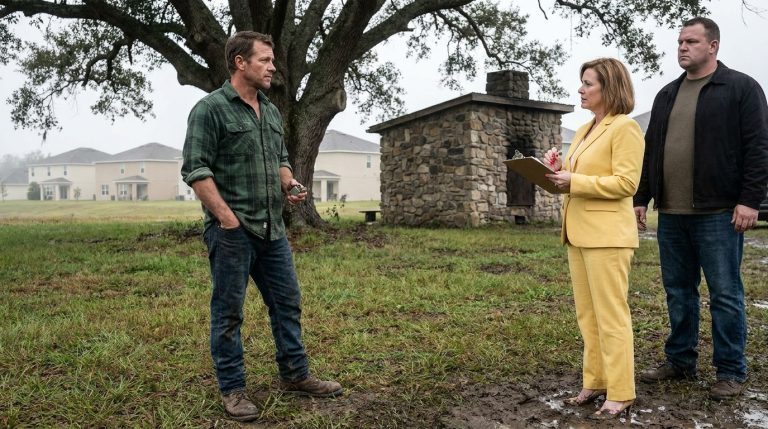
“Your little hobby shack is a clear and present danger to this community, Mr. Hayes,” Karen said.
Her voice dripped with a venomous sweetness that didn’t reach her small, hard eyes.
She stood on the public sidewalk just past my property line, a smear of bright pink lipstick forming a taut, disapproving line across her face.
Her gaze raked over the brand-new battleship-gray metal siding of my workshop.
It was a structure I had spent the better part of a year and a significant portion of my retirement savings to build.
To her, it was an eyesore.
To me, it was the place where the discipline and precision I learned in twenty years as an Army combat engineer would be turned into custom furniture and art.
I rolled a heavy brass carpenter’s pencil between my thumb and forefinger, feeling the cool metal ground my rising irritation.
I planted my boots firmly on my own grass and met her stare without flinching.
“This building was built to commercial-grade specifications,” I said, keeping my tone flat and even. “It passed every single county inspection from the foundation pour to the final electrical sign-off.”
Karen waved a dismissive, fleshy hand, the cheap gold bracelets on her wrist clinking together in an irritating rhythm.
“County permits mean nothing to the association,” she snapped, clutching her paperwork tighter to her chest. “We have our own covenants. Your industrial monstrosity is an aesthetic violation and a fire hazard. All that machinery, the chemicals, the sawdust—it’s a tinderbox.”
She hadn’t set a single foot inside the door, yet she had already passed sentence.
This wasn’t about safety or building codes.
It was about control, and the fact that I hadn’t asked for her blessing before building on my own land.
“I’ll be sending you the official notice of violation,” she said, already turning on her heel with the smug certainty of someone who had never lost an argument. “You’ll have thirty days to cease operations and submit a demolition plan.”
The word demolition hung heavy in the crisp autumn air as she marched down the sidewalk toward her beige sedan.
I didn’t yell or step off my property.
I simply watched her go, my thumb sliding back and forth over the scarred wood of my pencil.
She wanted a panicked reaction, a shouting match she could twist to her advantage.
Instead, I turned around, unlocked the heavy steel door of my workshop, and stepped inside to the quiet smell of fresh-cut oak.
CHAPTER 2: THE PAPER FORTRESS
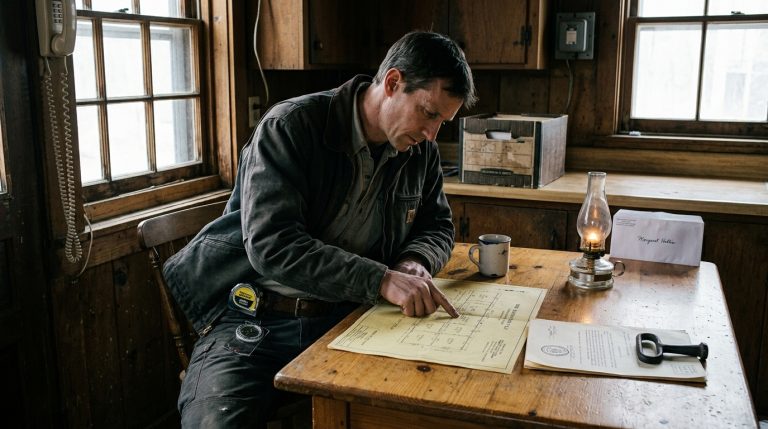
The scarred wood of the carpenter’s pencil left faint gray streaks across the margin of the printed covenants, a small map of the hours I spent tracing clause against clause.
Karen’s letter was sitting flat under my palm on the kitchen table, its faux-elegant embossed logo mocking the sheer laziness of its claims.
Sarah stood behind my chair, her fingers resting lightly on my shoulder where the muscle still cramped from old cold-weather strains.
“She has to know county permits override her little rulebook, John,” Sarah whispered, her breath warm against my ear.
“She doesn’t care about what overrides what,” I said, tapping the paper with the blunt end of the pencil. “She cares about the appearance of absolute authority. If I back down, she wins. If I argue on her emotional terms, she wins.”
I didn’t waste time drafting an angry reply.
Instead, I spent the next two hours treating her notice of violation like a structural defect that needed a complete engineering teardown.
I pulled out my three thick, tabbed binders containing every blueprint, every county permit, and every preliminary sign-off from Dave, the grizzled old county inspector.
I drafted a formal legal brief, using her precise formal name—Mrs. Albright—in the salutation to strip away any neighborhood familiarity and frame this strictly as a matter of public record.
Appendix A held the final signed county building permit.
Appendix B contained the complete architectural and engineering blueprints.
Appendix C featured the fire marshal’s preliminary praise of the commercial-grade sprinkler system and rock-wool insulation.
Appendix D showcased high-resolution photographs of the workshop interior, displaying clean lines, metal conduit, and state-of-the-art safety equipment.
The final section, Appendix E, targeted her vague claims of noxious activity by attaching the exact technical specifications for my dust collection system, which filtered particles down to one micron.
I made two complete copies of the package.
One went out via certified mail requiring a signature, while the other I hand-delivered directly to the HOA management company downtown to secure a stamped receipt for my permanent file.
When I returned home, the stillness of the afternoon was broken only by the low, regular hum of the refrigerator.
A beige sedan drifted slowly past the end of the driveway, pausing just long enough for the driver’s silver-blonde helmet of hair to turn toward my house.
The car didn’t stop; it merely accelerated away, leaving a faint trail of exhaust in the cool autumn air.
I didn’t flinch or look up from my logbook.
Let her drive by twice a day.
Let her send her nervous acolytes to peek over the fence and take shaky phone videos of my lumber stacks.
Every petty pass, every unvetted anonymous complaint about nonexistent chemical fumes or midnight noise, only added another verified entry to my documentation file.
The certified mail receipt arrived three days later bearing Karen’s spiky, indignant signature.
I could picture her sitting in her floral living room, watching her face darken as she turned page after meticulous page of building codes she had never bothered to read.
Silence followed, but it wasn’t peace.
It was the heavy, low-pressure quiet that settles right before a squall line hits.
CHAPTER 3: THE STATE SANCTIONED TRAP
The certified mail receipt crinkled slightly beneath my thumb as Miller’s white county vehicle pulled up to the curb, right behind the beige sedan that had already locked its beige brakes.
Karen scrambled out of her car before the dust had even settled, her clipboard clutched like a shield as she intercepted the fire marshal mid-stride.
“Marshal Miller, thank you so much for coming,” she gushed, her voice pitching high with faux concern. “We’re all just terrified of what’s happening inside that metal box.”
Miller gave her a curt, unblinking nod, his eyes already tracking past her shoulder to where I stood waiting at the top of the driveway.
“Mr. Hayes?” he asked, ignoring her outstretched hand.
“John Hayes,” I said, stepping forward to offer a firm handshake. “Glad you made it, sir. Please, come right in.”
Karen trailed behind us like an unwelcome shadow, her heels clicking a frantic rhythm on the concrete as I pushed open the heavy steel door of the workshop.
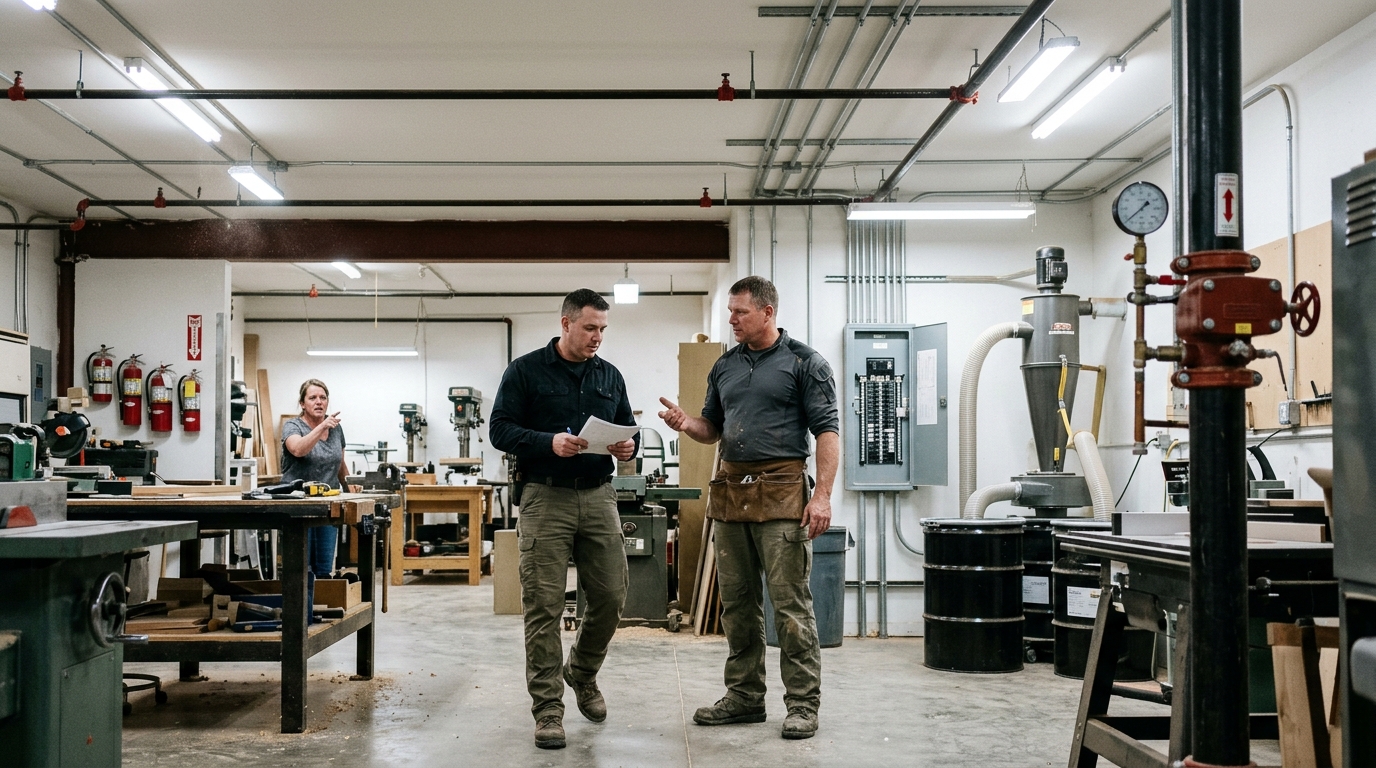
Miller stepped inside, his gaze sweeping across the exposed structural beams, the clean runs of metal conduit, and the red sprinkler heads spaced at precise intervals along the ceiling.
“Let’s start with your fire suppression,” Miller said, pulling a checklist from his pocket.
I led him straight to the main riser in the corner, tapping the pipe with my knuckle.
“Commercial wet-pipe system tied directly to the four-inch main at the street,” I explained, pointing to the pressure gauge. “All tested and certified before the drywall went up.”
Miller nodded, running a calloused thumb over the valve handle.
“Good pressure. What about detection?”
“Hardwired, interconnected smoke and heat detectors with battery backup,” I replied, pointing upward. “Dedicated heat sensor right above the main panel.”
He walked over to the 200-amp breaker box, leaving the cover off to reveal the orderly arrangement of the subpanels.
Karen pushed past a workbench, her face blotchy and desperate as she pointed a trembling finger toward my table saw.
“What about all the sawdust?” she stammered, her voice cracking slightly. “Sawdust is explosive!”
Miller turned slowly, a heavy patience settling over his features.
“Maáam, a certain amount of dust is expected in any working shop,” he said, before turning back to me. “Show me your collection setup.”
I walked him to the five-horsepower cyclone separator, explaining the metal grounding straps and the sealed fifty-five-gallon drum that caught every heavy particle before the air passed through a fine filter.
Miller inspected the motor housing and nodded approvingly.
“Top of the line for a space this size.”
He spent the next forty–five minutes checking fire extinguisher expiration dates, emergency exit lighting, and clearance zones, his pencil scratching methodically against his clipboard.
With every checkmark, the triumphant smirk melted completely off Karen’s face, leaving behind a sour, mask-like disbelief.
Miller snapped his pen shut and turned to face us both, raising his voice so it echoed clearly off the steel walls.
“Mr. Hayes, I’ve been a fire marshal for eighteen years,” he said, locking eyes with her. “This is one of the safest, most meticulously maintained facilities I have ever inspected. You exceed county code by a mile. You’ll receive a report stating this building is in no way a hazard.”
Karen’s face went from pale pink to a blotchy, furious crimson.
“That can’t be right,” she hissed, her hands balling into tight fists against her clipboard. “He has chemicals! There’s wiring! You have to shut him down!”
Miller sighed, his expression hardening into cold granite.
“Ma’am, my job is to assess actual hazards based on the law, not your personal feelings,” he said, gesturing vaguely toward the subdivision entrance as he walked toward his truck. “You know, this subdivision is getting on in years. Maybe I should schedule a time to look at the common areas, the clubhouse, the pool equipment room, just to make sure everything’s up to standard.”
He drove away, leaving Karen standing alone in the driveway with her mouth half-open.
I stood in the doorway of my workshop, the words echoing in my head like the dropping of a heavy plumb bob.
The clubhouse.
If she could use the county to investigate me, I could certainly check what she was hiding under her own roof.
CHAPTER 4: THE DUSTY ARCHIVE
A heavy metal clipboard slipped from slack fingers onto the pavement with a sharp clatter while a set of dusty 1962 blueprints was unrolled across the cold wooden table of the county records office.
The air in the basement room smelled of yellowed paper, dry mold, and decades of forgotten administrative history.
I smoothed my palm over the brittle edge of the master site plan for Oakridge Meadows, tracing the ink lines that mapped out the community clubhouse.
The clerk had wheeled out a high-sided cart loaded with rolled documents and thick, cloth-bound binders.
“Everything from the original development is in here, Mr. Hayes,” she said, tapping a stack of ledgers.
I pinned the corner of the map down with a brass paperweight and began checking the electrical schematics line by line.
The entire layout was powered by a single 100-amp main panel that fed straight into obsolete knob-and-tube lighting circuits.
It was a relic from an era before central air conditioning, high-wattage refrigerators, or digital sound systems.
I moved from the blueprints to the chronological permit binders, flipping backward through the decades to verify what updates had been logged for the property at 1200 Oakridge Lane.
A roof replacement permit appeared in 1988.
A plumbing fix for the pool bathrooms showed up in 1997.
An HVAC replacement was recorded in 2005, followed by a minor restroom light fixture swap in 2011.
That was the sum total of sixty years of recorded maintenance.
Not a single permit for a main electrical panel upgrade.
Not a single line item for structural rewiring.
Karen had spent twelve months trying to condemn my state-of-the-art, fire-sprinklered workshop while presiding over a community building running commercial-grade appliances on 1960s residential infrastructure.
I pulled out my phone and captured high-resolution photographs of every single page, framing the evidence with the cold clarity of a combat engineer logging a structural failure.
When I got home, I dialed Mike, an old Army buddy who now ran a commercial electrical contracting business two counties over.
“Look at these schematics I just texted you,” I said when he picked up.
His response came back flat and harsh over the speakerphone.
“Is this a joke, John? Knob and tube on a public assembly hall? That’s not just out of code; that’s an active disaster waiting for a hot afternoon.”
I thanked him and hung up, staring out the kitchen window toward the quiet stretch of lawn where Karen’s sedan usually made its afternoon pass.
The paperwork wasn’t defensive anymore.
It was a loaded weapon.
CHAPTER 5: THE ANNUAL MEETING
A glowing phone screen displaying 1962 wiring schematics illuminated the dim interior of the community clubhouse while the distant hum of a neighborhood lawnmower cut through the gathering tension of the room.
Karen sat at the center of the head table, her fingers tapping a rigid, impatient rhythm against her clipboard as she droned through routine landscaping contracts.
The hall was packed to the doors, every metal folding chair occupied and neighbors standing shoulder-to-shoulder along the back wall.
She thought she was presiding over another compliant audience of passive homeowners.
She had no idea she was staring directly at a jury.
When she finally paused to ask for new business from the floor, Carol stood up near the middle row with a quiet, unshakeable dignity.
“Madam President, I have a question regarding the safety and structural integrity of this exact building,” Carol said, her voice carrying easily across the silent room.
Karen forced a tight, condescending smile that didn’t reach her eyes.
“What is it, Carol?”
“Could the board inform us when the last comprehensive electrical safety inspection was performed on this clubhouse?”
Karen’s smile hitched, her eyelids tightening into small, hard points.
“All community assets are regularly maintained to the highest standards by our professional contractors.”
“That’s a platitude, not a date,” Carol fired back without missing a beat. “When was a licensed professional last brought in to certify that sixty-year-old wiring?”
Before Karen could bang her gavel or shut down the microphone, I stepped out from the back row and walked straight down the center aisle.
“Perhaps I can answer that, Madam President,” I said, laying my heavy binder flat on the front table.
Karen’s head snapped toward me, her face draining of color before flushing a mottled, furious purple.
“Mr. Hayes, this is not the forum for your personal vendettas—”
“This isn’t about my workshop,” I said, holding up the county blueprint copies for the entire room to see. “This is about public records showing that this facility has never received a single permit for an electrical upgrade since it was built in 1962.”
A low wave of murmurs rippled through the rows of folding chairs, neighbors leaning in to look at the ungrounded outlets and old switches along the baseboards.
I dropped the HOA lawyer’s dismissive rejection letter right beside the blueprint.
“And when we formally requested safety documentation, the board responded by calling our request burdensome while hiding behind a single outlet repair receipt.”
Mark stood up near the front, his expression darkening.
“Are you telling us our dues are paying for a fire trap while the board covers it up?”
Karen shrieked, striking her gavel against the wood so hard the handle cracked.
“Order! These are malicious lies spread by an unauthorized agitator trying to destroy this neighborhood!”
It was a fatal, unhinged overreaction that proved to everyone in the room this was her personal war.
Carol raised her hand high, cutting through the rising noise.
“Madam President, I formally move that the association immediately fund an independent, level-three engineering inspection of this clubhouse, with the full report distributed to every homeowner.”
“I second the motion,” Mark yelled.
At least two dozen hands shot up across the room in immediate agreement.
Karen stared out at the sea of raised hands, her mouth opening and closing like a fish stranded on dry land, completely stripped of her leverage.
CHAPTER 6: THE FINAL INSPECTION
A cracked wooden gavel rested motionless beside a signed engineering inspection order while bright red warning tape was pulled tight across the glass door of the clubhouse.
Karen stood silently in the corner of the parking lot, her beige sedan idling with the door ajar like a makeshift escape hatch.
She wasn’t carrying a clipboard, and her face wore the stunned, vacant expression of someone watching an empire dissolve into dust.
Lead engineer Peterson snapped his diagnostic case shut with a sharp metallic click.
“That’s it,” Peterson said, wiping his hands on a clean rag before looking over at Fire Marshal Miller. “Active knob-and-tube wiring spliced straight into modern Romex with nothing but brittle electrical tape. This entire service panel is a ticking bomb.”
Miller stepped back from the open breaker box, his jaw tight as he unclipped a red sign from his belt.
“I am officially shutting this building down for public occupancy,” Miller announced, his voice carrying across the parking lot.
He slapped the bright red sticker squarely over the glass handle of the front door.
The adhesive gave a dry, final pop as it took hold.
Karen flinched at the sound, turned her back on the gathering crowd, and climbed into her car without uttering a single word.
She peeled out of the lot in a spray of loose gravel, disappearing down the street and out of the neighborhood for good.
The engineering report landed two days later like a sledgehammer, detailing over fifty code violations and a remediation price tag exceeding two hundred thousand dollars.
Her remaining board allies resigned via email within the hour, leaving a massive leadership vacuum that the community needed filled immediately.
When Carol and Mark walked up my driveway a week later to ask me to step in as interim HOA president, I didn’t want the title, but I understood the debt we owed to common sense.
I took the job strictly to oversee the reconstruction, ensuring every permit was pulled, every wire was run to code, and every dollar of the reserve fund was accounted for with absolute transparency.
Six months later, Miller walked through the fully renovated clubhouse, inspecting the bright LED fixtures and the modern 200-amp service panel.
He signed off on the certificate of occupancy with a crisp stroke of his pen.
“Looks good, Mr. President,” Miller said, offering a small, respectful nod. “Almost as good as your workshop.”
That evening, I stood inside the open doorway of my battleship-gray metal building, the cool autumn air carrying the clean scent of freshly cut oak.
I reached down and picked up my heavy brass carpenter’s pencil from the workbench, rolling it smoothly between my calloused fingers.
The table saw hummed to life with a steady, reliable drone, a simple sound of hard work and honest boundaries in a world that finally made sense again.