The Rust and the Rulebook: How a Retired Marine Turned a Suburban Tyrant’s Weapon Against Her
CHAPTER 1: THE IDLE AND THE OUTRAGE
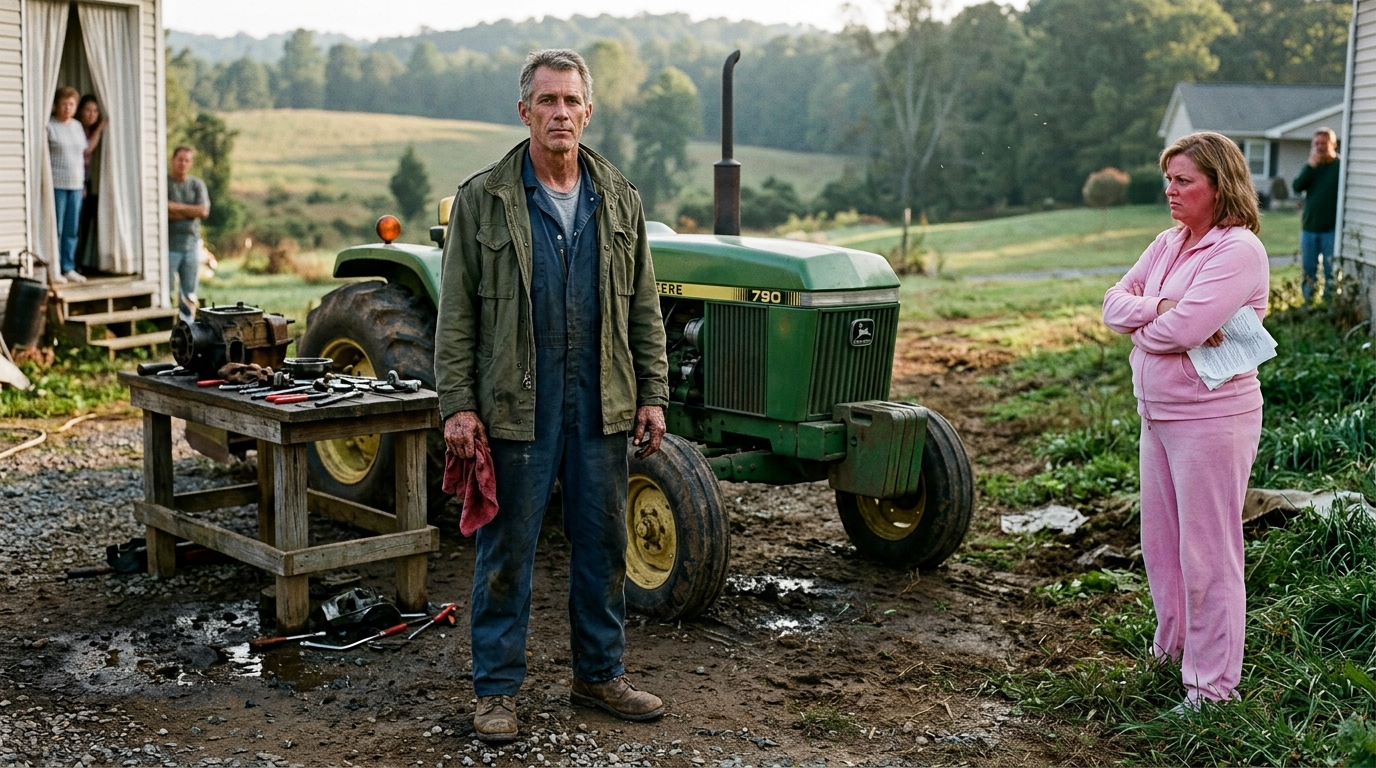
The air smelled of old oil, hot steel, and damp Virginia earth. I kept my eyes fixed on the greasy bolt beneath the casing, letting the steady vibration of the motor drown out the noise in my head.
“That machine is a public nuisance.”
The voice cut through the morning like a rusty saw blade. It was sharp, brittle, and entirely uninvited.
I wiped my knuckles with a stained red rag, the fabric rough against my skin. I didn’t rush my movements.
Standing at the edge of my thirty acres was a woman in a pastel pink tracksuit that looked ready to split at the seams. Her arms were locked across her chest in a tight defensive knot.
This was Karen, the self-appointed empress of the Oakidge Estates Homeowners Association. She was glaring at my restored John Deere 790 as if it were a tactical threat.
“If I see you start it one more time,” she snapped, her face flushed with unearned authority, “I will have it seized and sold for scrap.”
I tossed the rag onto the workbench. Twenty-five years in the Marine Corps taught me how to measure an adversary in seconds, and this woman possessed all tactical awareness of a brick wall.
Her threat hung in the cool morning air, heavy with the absolute certainty of someone who had never been told no. My peaceful retirement on this old farm was officially over.
CHAPTER 2: THE ARRIVAL OF THE HEAVY PAPERWORK
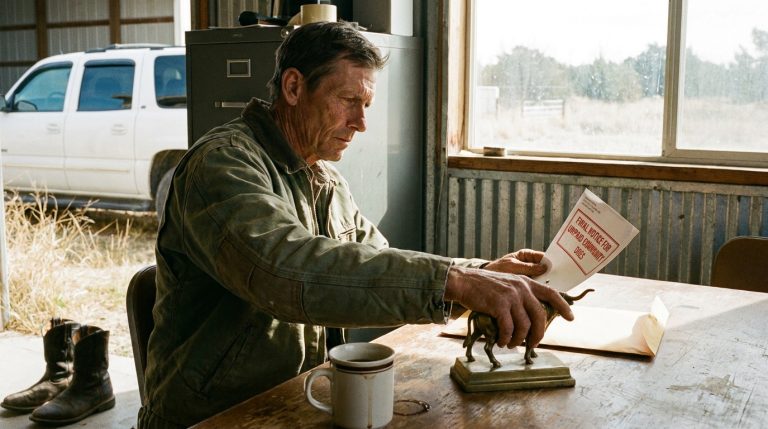
I set the cup down on the scarred wooden table. The thick envelope sat beside it like a brick, bearing a return address that smelled of municipal overreach and bad toner.
The Oakidge Estates Office of Compliance didn’t waste words. Inside was a multi-page document printed on heavy bond paper, levying a two-thousand-dollar penalty for my vintage tractor.
Violation one cited noise outside approved hours. Violation two classified my restored machine as unapproved commercial vehicle storage.
I turned the page. Violation three was a catch-all clause for aesthetic blight, carrying a staggering thousand-dollar fine.
The total came to four thousand dollars with a stern warning of property liens if left unpaid.
I picked up a cold pencil and traced the legal boundaries on the county plat map spread across the counter. My thirty acres sat entirely outside their jurisdiction.
They were counting on the intimidation factor of official letterheads and legal jargon to force a quiet capitulation.
Instead of panic, a cold, methodical focus settled into my chest. I opened a clean logbook and began recording the exact dates, times, and fine amounts.
The front gate clicked shut outside, followed by the crunch of heavy rubber tires rolling down the gravel access track.
CHAPTER 3: RECONNAISSANCE BEYOND THE TREELINE
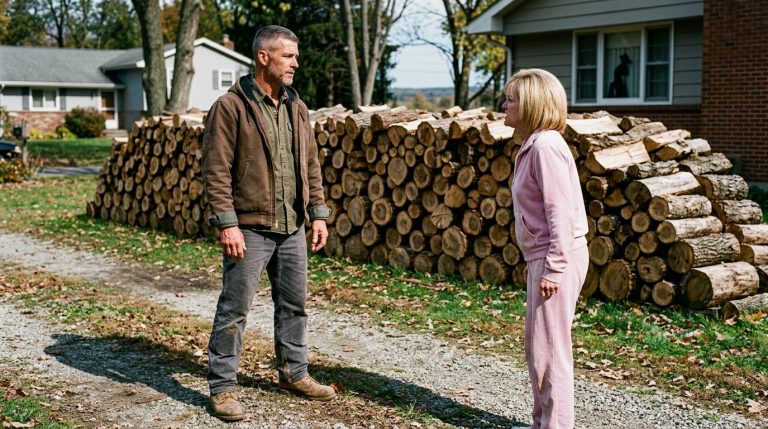
I stepped out from behind the property line and walked into the manicured sprawl of Oakidge Estates. The uniform beige houses stared back with identical blank windows, a stark contrast to my rolling timberland.
Mrs. Gable was tending to her prize-winning rosebushes near the sidewalk, her hands gloved and her brow furrowed in deep concentration.
“Morning, Jack,” she said, her voice dropping instantly as she glanced nervously toward the neighboring lawns. “People are talking about those violation notices. Karen has everyone walking on eggshells.”
“She’s running a tight ship built on bad paperwork,” I said, leaning against the wooden fence post.
“That’s an understatement,” Mrs. Gable muttered, pruning a dead stem with a sharp snap of her shears. “She fined me two hundred dollars last spring because my garden hose wasn’t coiled in a mathematically perfect circle. She even attached a diagram.”
Tom stepped out from a nearby driveway, wiping grease from a wrench onto an old shop towel.
“Make it four thousand for me over custom shutter colors,” Tom chimed in, tossing the towel onto his toolbox. “The woman treats the community rulebook like a personal fiefdom.”
The pattern was unmistakable. Karen wasn’t maintaining standards; she was enforcing absolute submission through manufactured fear.
CHAPTER 4: THE RUSTY CHAIN AND THE RECORDED EASEMENT
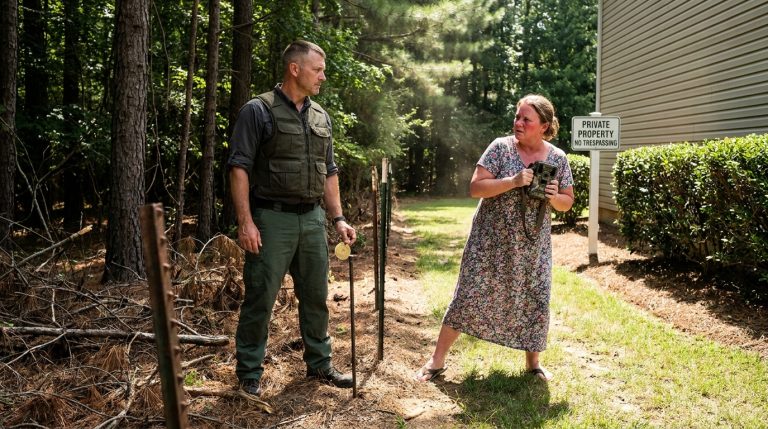
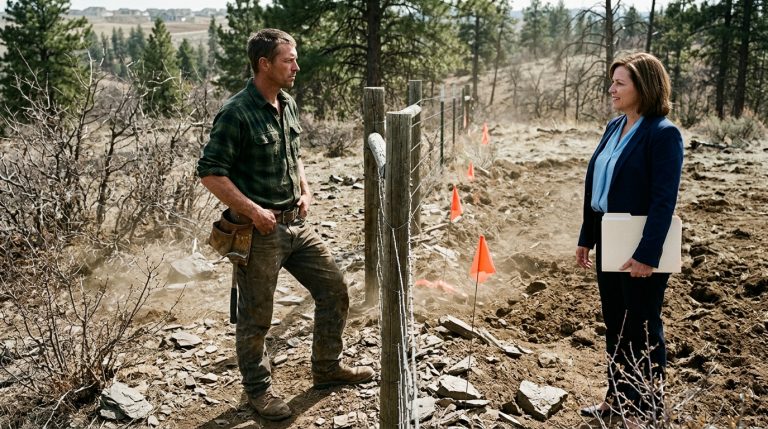
I stared down the makeshift barrier blocking the fire road at my property line. Two flimsy metal posts had been hammered into the earth, strung with a warning sign declaring the lane private HOA territory.
It was a clumsy trap designed to wall me in and cut off my access.
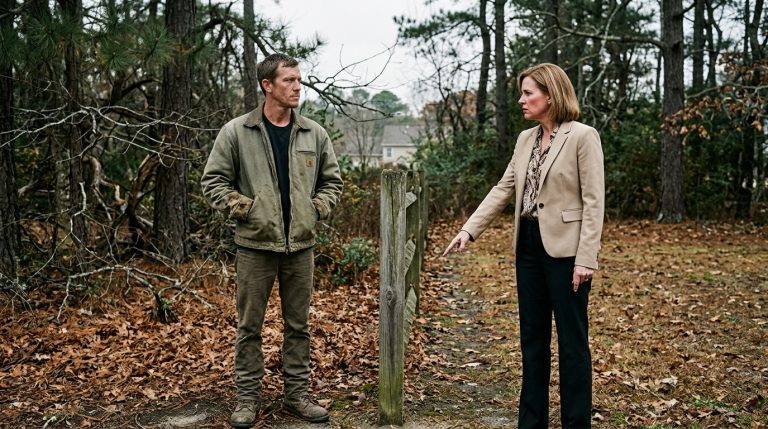
Instead of cutting the links in a blind rage, I pulled out the certified plat maps I had retrieved from the county clerk. My finger traced the exact boundaries of the recorded emergency access easement.
The document explicitly stated the lane was for joint benefit and unhindered use, granting my parcel perpetual, unrestricted passage.
By erecting that chain, Karen hadn’t just committed an act of petty harassment; she had illegally blocked a designated emergency fire route.
I pulled my phone from my pocket and took wide, detailed photographs of the lock and posts.
If she wanted to play bureaucratic warfare, I would hand the ammunition straight to the county fire marshal.
CHAPTER 5: THE FIRE MARSHALS VISIT
I watched from the shade of my front porch as a pristine white county vehicle rolled slowly down the gravel track, parking squarely twenty feet from the unauthorized chain.
Chief Miller stepped out, his uniform shirt crisp and his expression locked in a severe line.
Before he could take two steps toward the barrier, Karen’s front door flew open, and she marched across her manicured lawn like a general spoiling for a fight.
“Can I help you?” she demanded, her voice carrying across the open grass with a sharp edge. “You’re trespassing on private HOA property.”
The chief didn’t blink. He pulled a tablet from his belt and tapped the screen with a steady thumb.
“Ma’am, I am Chief Miller with the County Fire Marshal’s Office,” he said, his tone dangerously calm. “This lane is a recorded emergency access easement, and blocking it is a class one misdemeanor.”
Karen’s face flushed from pastel pink to a mottled, blotchy crimson.
“This is a private community!” she shrieked, her composure cracking under the weight of actual authority. “We have every right to secure our boundaries!”
“You have the right to secure your property,” Miller replied, holding up the official plat map for her to see. “You do not have the right to violate county code or block emergency vehicle access.”
He gave her twenty-four hours to clear the chain or face maximum daily fines and a formal report to the prosecutor.
CHAPTER 6: THE TRIBUNAL AND THE COUNTY CONTRACT
The room fell dead silent as I stepped up to the wooden podium, holding the county public works agreement firmly in my hand.
Karen sat near the front, her navy blue pantsuit rigid, her fingers clawing frantically at the edge of her notepad as the forensic accountant’s final numbers settled over the crowd like a heavy blanket.
“As of last week,” I said, my voice cutting cleanly through the heavy air, “I am the official county-sanctioned maintenance provider for this access road.”
I laid the contract flat on the glass of the overhead projector, illuminating the county seal against the wall for everyone to see.
“The county will be paying me to maintain this lane using my own equipment,” I continued, looking straight into Karen’s bloodshot eyes. “Every time I start that diesel engine, I will be fulfilling a public service for this community.”
The realization hit the room instantly, rippling through the rows of exhausted homeowners who had suffered under years of arbitrary fines and hidden embezzlement.
Karen tried to jump from her seat, her mouth opening in a frantic, sputtering shriek of denial, but her voice was completely swallowed by the collective, unyielding gaze of her former neighbors.
The vote of no confidence was swift, unanimous, and final, stripping her of her title on the spot before she could utter another word of defense.
Weeks later, the community clubhouse returned to quiet potlucks, Mrs. Gable took over the board to restore neighborhood trust, and the Chantilly lace paint rules were permanently tossed into the trash.
I stood on my porch under the golden autumn sun, watching the long shadows stretch across the grass while the low, rhythmic rumble of my restored John Deere smoothed out the gravel path below.
The tractor wasn’t a nuisance anymore; it was the steady sound of boundaries held, peace restored, and a hard-earned quiet reclaimed for good.