The Restorer’s Cold Calculated Vengeance Against Her Own Blood
CHAPTER 1: THE CLICK OF THE LOCK
The brass compass sat between my fingers, its worn adjustment screw cold against my thumb.
I rolled the metal back and forth, counting the fine threads beneath my skin while the streetlamp outside cast long, distorted shadows across the wet pavement.
The air smelled of fresh rain meeting old limestone.
I turned back toward the restaurant entrance, my boots making a heavy, measured click against the stone steps.
Inside, the converted library was dim, the soft amber lighting turned down low for closing.
Tables were already cleared, white linen napkins stripped away to reveal dark, polished mahogany underneath.
I reached the inner foyer, my hand hovering near the edge of my coat pocket where my phone usually rested.
“Excuse me,” I said into the quiet space, my voice flat and even. “I left my mobile on the corner table.”
A figure stepped out from behind the bar.
It was the young waitress who had served our wine—dark hair pulled back so tight her pale skin looked stretched across her cheekbones.
She didn’t speak.
Instead, she reached out, pulled the heavy oak door shut behind me, and turned the brass deadbolt until it clicked with a sharp, metallic ring.
My thumb clamped hard against the compass screw.
“I just need my phone,” I repeated, keeping my feet planted six inches apart to stabilize my balance as the room took on a slight, sickening slant. “There is no need to lock the entrance.”
The girl—her tag read Mara—swallowed, her throat moving violently.
Her hands trembled as she wiped them repeatedly on her black apron.
“Please,” she whispered, her eyes darting toward the empty dining area before locking onto mine. “Don’t shout. I wouldn’t do this if I had any other choice.”
“I am sixty-two years old, not a hostage,” I said, leaning my weight subtly against the oak frame to hide the blur creeping into the edges of my vision. “Open the door.”
“Your son,” she said, her voice dropping to a harsh rasp. “The man who sat across from you.”
A cold draft seemed to push through the floorboards, cutting right through my wool coat.
“Nathan,” I said.
“He put something in your glass,” Mara said, stepping closer, her hands still shaking. “I was clearing the tray behind the pillar. He waited until you walked toward the corridor, then he pulled a clear vial from his jacket.”
I didn’t blink.
The room seemed to tilt further, but I locked my knees.
“He was mixing your medicine,” I said, testing her, forcing my voice to remain clinical. “He worries about my health.”
“No,” Mara said, shaking her head fiercely. “He didn’t look worried. He looked at the woman sitting with him—his wife—and he smiled. He tapped three drops into the red wine, swirled it, and said, ‘A few more weeks of this and she won’t even be able to read her own name, let alone a contract.'”
The air starved in my lungs.
My fingers pressed into the steel points of the drafting compass in my pocket until the sharp metal bit into my palm.
“He said that?” I asked quietly.
“She laughed,” Mara whispered, her eyes brimming with a terrifying mix of pity and fear. “She told him to make sure you didn’t notice the taste. And he said you were too foolish and tired to notice anything anymore.”
I stood perfectly still in the dim foyer, the quiet humming of the refrigeration units behind the bar filling the silence between us.
Thirty-two years of holding his hand across traffic, of checking his geometry homework under the kitchen lamp, condensed into three drops of clear liquid in a wine glass.
My vision swam, a heavy grey fog closing in around the borders of my sight, but my mind stayed absolutely, ruthlessly sharp.
“Where is the glass?” I asked.
CHAPTER 2: FORENSIC DIAGNOSTICS
The damp fabric wrapped around the wine glass stem felt icy through my wool glove.
Mara stayed in the shadow of the back door, her knuckles white against the metal frame, watching me step out into the rain.
I didn’t turn back.
The three-mile drive to my studio passed without a single traffic light turning red, the city rolling past in blurry, distorted streaks of yellow and wet asphalt.
Inside the studio, the air was dead quiet, smelling of dry oak timber, drafting ink, and cold stone.
I set the cloth-wrapped stem on the heavy zinc surface of my workbench, right beneath the articulated neck of the brass halogen lamp.
My vision flared, the edges of my peripheral field fraying into soft gray cobwebs as I adjusted the optic analyzer’s focusing wheel.
The machine was forty years old, built for testing lime mortar composition and timber rot, but its dual-magnification lenses didn’t care about human intent—only physical truth.
I used a steel scalpel to scrape a micro-flake of dried dark red residue from the glass lip, dropping it onto a clean quartz slide.
Two drops of neutral solvent dissolved the film instantly, turning the droplet a pale amber under the white beam.
I leaned over the eyepiece, twisting the micro-adjustment dial until the crystalline structure locked into focus.
It wasn’t organic sediment from an aged bottle.
The lattice was sharp, repeating in rigid, synthetic octagons—a commercial optical nerve suppressant used strictly in controlled ophthalmology trials to temporarily freeze pupil response.
A high dose didn’t damage the organ permanently; it simply blindfolded the brain, mimicking rapid-onset degenerative nerve atrophy.
“Calculated,” I murmured, my voice vanishing into the high rafters of the workshop.
He hadn’t wanted me dead.
If I died, the firm’s historic preservation charters were locked by default into a board-managed trust; if I was simply declared incompetent due to failing health, the signing authority passed directly to him as legal next-of-kin.
I reached into my pocket, pulled out the brass drafting compass, and set its two sharp legs exactly one inch apart on the steel workbench.
The phone on the desk buzzed, its vibration rattling a row of glass specimen vials.
Nathan’s caller ID lit up the screen.
I let it vibrate three full cycles before lifting the receiver, allowing my breath to come out thin, shallow, and unsteady.
“Nathan?”
“Mom?” His voice came through the speaker entirely too loud, laced with a practiced, velvet concern that made my stomach turn. “Are you alright? Brooke said you looked shaken when you left the restaurant.”
“I… I can’t read the labels on my drafting ink, Nathan,” I stammered, letting my words slur just enough at the tail end. “The lamp is on, but the room is… everything is so dark.”
A pause on the line—brief, barely half a second, but long enough for the cold satisfaction to settle into his quiet breath.
“Mom, listen to me,” he said, his tone softening into the rhythmic cadence an adult uses with a confused child. “We talked about this at dinner. It’s time to step back. Stress is accelerating the condition.”
“Maybe you’re right,” I whispered into the receiver, pressing the steel point of the compass into the pine edge of the table until the wood groaned. “Bring the power-of-attorney forms tomorrow. I don’t think I can manage the council review next week.”
“We’ll be there at two o’clock,” Nathan replied instantly, his eagerness leaking straight through his artificial restraint. “Don’t touch anything. Just rest.”
The line went dead.
I straightened my spine, the fake tremor leaving my hands in an instant as I looked down at the tiny, synthetic crystals still glowing beneath the analyzer’s cold white lens.
They thought they were setting a trap for a dying woman, unaware that I was already measuring the dimensions of their cage.
CHAPTER 3: THE WATER ON THE DEED
The heavy front door clicked open before the doorbell finished its chime.
Nathan walked into the entryway with a tight, efficient stride, a thick leather portfolio tucked under his left arm like a trophy.
Brooke followed two steps behind, holding a silver baker’s box tied with a satin ribbon, her eyes sweeping the hallway with the cold appraisal of an appraiser pricing an estate.
“Mom,” Nathan called out, elevating his pitch into that insufferable, false cheer. “We brought the lemon tarts you like. You need to keep your strength up.”
I stayed in the wingback chair, letting my eyelids droop until the two figures blurred into pale shapes against the mahogany paneling.
I adjusted my grip on the brass compass hidden in the fold of my shawl, turning the screw once until it clicked.
“Is that you, Nathan?” I asked, squinting straight past his shoulder toward the empty hall closet. “My eyes… the light in here is so harsh today.”
Brooke set the box on the low oak table, her silk blouse whispering against her skirt as she leaned down, her smile fixed and rigid.
“The doctor said light sensitivity comes right before the optic nerve gives up,” she murmured, resting her hand on my shoulder with a weight that felt like an anchor. “You shouldn’t be sitting in the dark like this, Eleanor. It’s depressing.”
“We need to get this done quickly so you can lie down,” Nathan said, unzipping the portfolio with a loud, aggressive jerk.
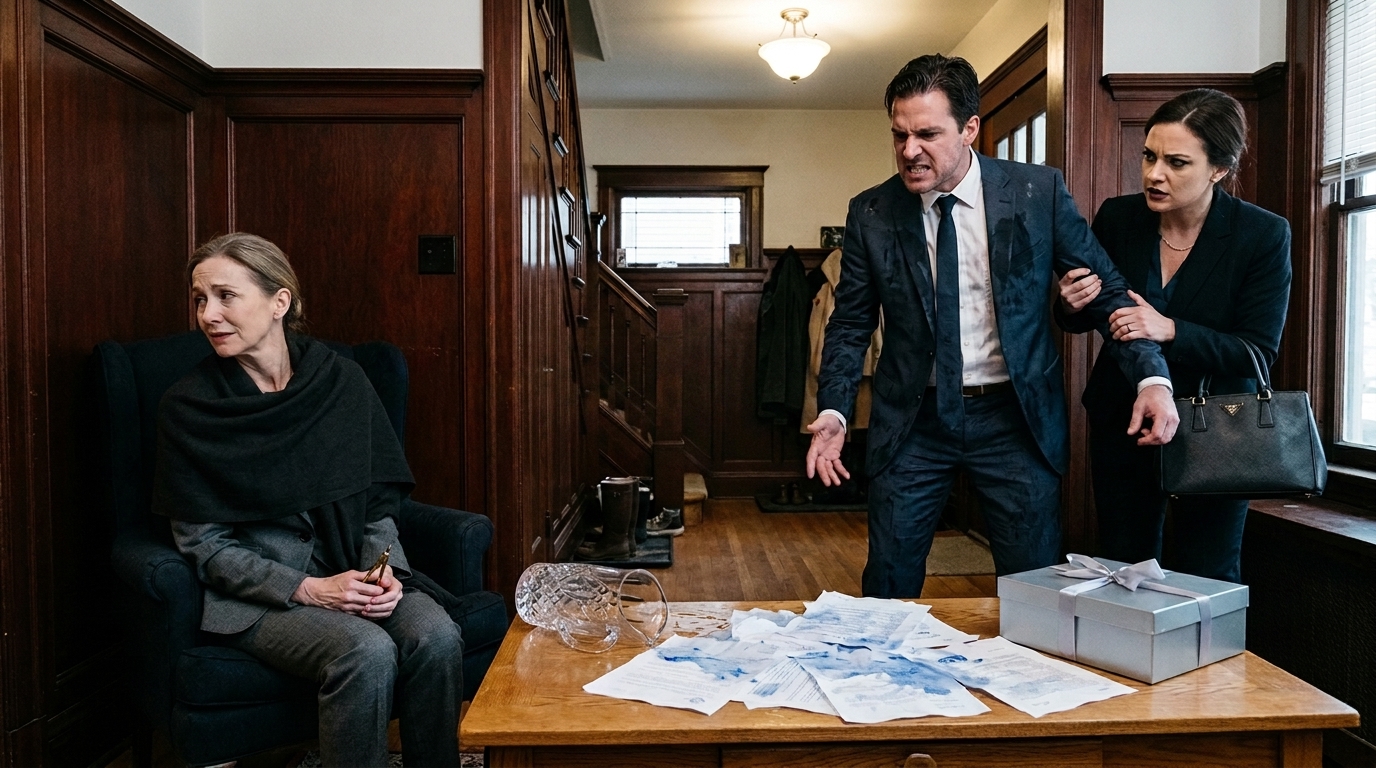
He laid three crisp sheets of bond paper on the table, right next to the heavy glass pitcher of ice water I had set out ten minutes prior.
The notary seal at the bottom of the top page glowed in fresh blue ink—a complete transfer of executive authority over Whitfield Preservation Trust, effective immediately.
“Just initial the bottom of page two, and sign page three,” Nathan said, clicking a heavy silver pen and forcing it between my knuckles. “I’ll file them with the municipal board before four.”
I held the pen loosely, letting my thumb tremble until the point scratched uselessly against the dry margin.
“I don’t… I can’t see the line, Nathan,” I said, my voice thin, carrying the precise tremor of an old woman succumbing to panic. “Where is the line?”
“Right there,” Brooke urged, her fingers pinching my wrist to guide my hand down. “Just sign it, Eleanor. Stop dragging this out.”
I let my shoulders collapse forward, gasping in a short, ragged breath as if my balance had completely failed me.
My left elbow swung outward in a wide, frantic arc, catching the heavy crystal rim of the water pitcher.
The pitcher tipped.
Two quarts of ice water erupted across the table in a cold, rushing wave, soaking the bond paper instantly.
The blue ink of the notary stamp bled into a cloudy streak, the thick paper pulping under the deluge as the water pooled over the polished wood and onto Nathan’s tailored trousers.
“Dammit!” Nathan roared, leaping back so hard his chair clattered against the floorboards.
Brooke shrieked, snatching her designer bag off the rug as the water dripped over the edge of the table.
“Oh dear,” I whimpered, wringing my hands together in my lap while keeping my face turned entirely toward the blank wall. “Oh, look what I’ve done. I’m so sorry, Nathan. I can’t… my hands just won’t hold.”
Nathan stared down at the ruined, dripping heap of paper, his jaw working violently, the polite mask slipping off his face to reveal a raw, ugly rage.
“This was the only original set,” he snapped, his voice dropping into a harsh, metallic snarl that he didn’t even bother to soften.
“It doesn’t matter,” Brooke hissed, grabbing his arm, her eyes darting toward me with pure venom before catching herself. “The council meeting is on Friday. She has to appear in person anyway to confirm the transfer before the board.”
I looked up toward the sound of her voice, my expression perfectly smooth, completely devoid of fear.
“Friday?” I asked softly. “Yes. I will be at the council meeting. I want everyone to see that I am doing the right thing.”
Nathan took a long, slow breath, smoothing his soaked jacket down with trembling fingers, trying desperately to rebuild his composure.
“Fine,” he gritted out through clenched teeth. “Friday at nine. Don’t touch anything else today, Mom. Just stay in this chair.”
They left without another word, the front door slamming shut behind them so hard the leaded glass panels rattled in the frame.
I stood up from the chair instantly, my posture straightening, my hands as steady as the stone foundations I had built my life upon.
I didn’t waste a second drying the table.
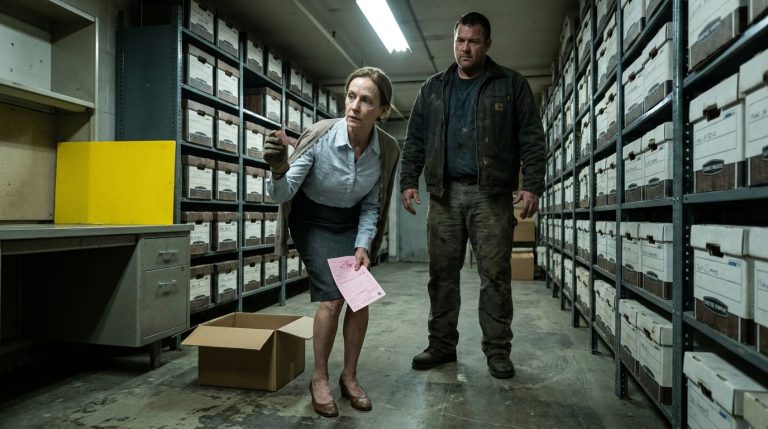
I walked straight to the hall closet, grabbed my trench coat, and picked up the heavy brass key to the north city archive vault.
CHAPTER 4: THE UNDERGROUND VAULT
The iron key resisted, thirty years of damp air and neglected iron fighting the tumbler until the lock yielded with a heavy, grinding clunk.
Daniel Mercer wiped his fogged spectacles on his flannel sleeve, his breath pluming in the icy sub-basement air as he shone his lantern over my shoulder.
“Eleanor, this wing hasn’t been logged in the county registry since ninety-eight,” Daniel muttered, his voice echoing off the damp concrete walls. “If the city council finds out we bypassed the seal—”
“The city council doesn’t know this room exists,” I interrupted, stepping over a pile of decayed blueprint tubes. “Only three people ever held keys to the municipal archives’ lower vault. Two of them are buried in St. Jude’s.”
I fit my thumb into the worn groove of my brass compass, turning the adjustment screw until the steel points touched the edge of a heavy, riveted iron cabinet at the rear wall.
“Nathan thinks he’s clearing a path for Meridian Developments,” I said, setting the flashlight on a dry shelf so its beam illuminated the double-combination lock on the cabinet door. “He doesn’t realize every historic site my firm touched over thirty years was bound by a secondary preservation covenant.”
Daniel paused, holding a stack of mold-damaged ledger folders against his chest.
“A covenant?” he asked, frowning. “Eleanor, a legal transfer of authority supersedes standard historic board protections if the founder is declared incapacitated.”
“It supersedes board protections,” I agreed, spinning the brass dial to the left—forty-two, sixteen, zero. “It does not supersede a private heritage trust with an irrevocable reversion clause.”
The heavy cabinet latch popped open with a dry metallic click.
Inside, stacked in neat, acid-free parchment boxes, were fifty-four original charters, each stamped with an embossed red wax seal that had never seen public light.
I pulled the top box out, laying the thick parchment under the white beam of Daniel’s light.
“Thirty years ago, when Meridian tried to buy out the old courthouse district, I wrote a self-executing contingency into our corporate bylaws,” I explained, tracing my finger over the dense black lettering. “If any transfer of my authority is initiated under medical duress, power doesn’t pass to my heirs.”
Daniel leaned in close, his eyes scanning the dense legal text before he let out a low, disbelieving whistle.
“It reverts entirely to an independent preservation trust managed by a trustee board,” he said, turning to look at me with fresh respect. “And the trustee board is…”
“You,” I said, meeting his gaze cleanly. “And two senior conservators from the state historic society who have hated corporate developers since seventy-five.”
“They can’t touch a single brick,” Daniel whispered.
“They can’t even list the properties on a municipal auction block,” I corrected, closing the parchment box and handing it to him. “Nathan promised Meridian a clean wipe by next week. He took their retainer, he took their lab-grade nerve suppressant, and he set a timer on my life’s work.”
“He’s your son, Eleanor,” Daniel said quietly, his hand lingering on the box, his forehead lined with genuine concern. “When you drop this on the council floor…”
“He stopped being my son the moment he put three drops of poison into my wine glass,” I said, my voice as unyielding as cold granite.
I locked the cabinet, pulled the iron key from the door, and pocketed the master covenant documents.
“Let’s go, Daniel,” I said, heading toward the concrete stairwell. “We have forty-eight hours to prepare the public trap.”
CHAPTER 5: THE COUNCIL TRAP
The wooden gavel struck the block three times, echoing sharply through the vaulted ceiling of the council chamber.
Nathan stood up immediately at the front microphone, smoothing the front of his dark suit jacket, a thick manila folder held firmly between his palms.
Brooke sat right beside him, her hands folded over a leather handbag, wearing a practiced look of quiet, grieving sorrow that was rehearsed down to the second.
“Item four on the docket,” Council President Vance announced, shuffling his papers. “Petition for emergency transfer of historic oversight authority for the Whitfield Preservation Trust.”
“Thank you, Mr. President,” Nathan said, his voice carrying smoothly through the room’s sound system. “It is with a heavy heart that my family submits this petition. My mother, Eleanor Whitfield, has served this city for over three decades, but as her medical records show, her rapidly deteriorating visual and cognitive health makes it impossible for her to safely execute her duties.”
Brooke dabbed the corner of her eye with a linen handkerchief, right on cue.
“She is unable to read legal documents, unsuited to evaluate structural risks, and sadly, no longer capable of managing the trust’s assets,” Nathan continued, leaning closer to the microphone. “We request immediate execution of power-of-attorney to prevent municipal deadlock.”
“Is Eleanor Whitfield present?” Vance asked, looking out over the crowded benches.
I stepped out from the back shadow, my boots hitting the hardwood aisle with a single, firm strike that cut right through his sentence.
“I am here, Mr. President,” I said.
Nathan turned around, his eyes widening in a sudden shock that he tried desperately to cover with a tight, patronizing smile.
“Mom,” he said, stepping away from the podium to reach for my elbow. “You shouldn’t be standing. Please, sit down before you disorient yourself.”
I brushed his hand away with a clean, sharp flick of my wrist, walking past him until I stood directly before the council dais.
I placed the heavy leather dossier on the mahogany railing, right beside the microphone.
“My sight is quite clear today, Nathan,” I said, turning my head to look him straight in the eyes. “Clear enough to read chemical compound analyses.”
A quiet murmur rippled across the three rows of spectators behind us.
“Mr. President,” Nathan interrupted quickly, his voice raising half an octave, a red blotch spreading up the side of his neck. “My mother is experiencing a severe episode. She’s confused—”
“I am holding a certified chemical spectrograph from the state material research lab,” I said, my voice ringing out flat, cold, and absolute as I opened the dossier. “It identifies a synthetic optical nerve suppressant found in the residue of my prescription eye drops and a bottle of supplement pills brought into my home three weeks ago.”
Brooke snapped her handbag shut with a loud latch click, her knuckles turning bone-white.
“That’s a lie!” Nathan barked, slamming his palm down on the podium table. “She’s making wild accusations! She’s mentally unstable!”
“The compound bottle bears an unpeeled manufacturer batch seal underneath a fraudulent consumer label,” I continued, handing three copies directly to the council clerk. “A batch seal registered exclusively to Meridian Developments—the same corporate entity currently bidding to clear the historic courthouse district for commercial demolition.”
Council President Vance adjusted his glasses, leaning over his desk to examine the red wax stamp on the paper I provided.
“Furthermore,” I said, taking out the original parchment charter Daniel had retrieved from the lower vault, “under section four of the original Whitfield founding covenant, any attempt to transfer trust authority under fraudulent or chemically induced medical duress instantly dissolves executive board oversight.”
Nathan lunged forward, grabbing the edge of the clerk’s desk. “She has no proof I gave her anything! You can’t accept those papers! She’s a sick old woman trying to ruin my reputation!”
“All assets and oversight rights revert permanently to an independent preservation foundation managed by Daniel Mercer,” I said, ignoring his outburst entirely. “Effective eight o’clock this morning. The transfer petition before you is legally void.”
Nathan’s face turned gray, his breathing ragged as he looked between the council members, who were already signaling for bailiffs at the side doors.
“This isn’t over!” Nathan snarled, leaning over the wooden bar toward me, his teeth bare. “You think you can just throw thirty years of family away over some old papers?”
“You threw it away for three drops in a wine glass, Nathan,” I whispered. “And you didn’t even get the price right.”
CHAPTER 6: THE UNBROKEN FOUNDATION
Nathan pulled against the officer’s grip on his arm, his head turning back toward the high studio windows, his face contorted in a final, ugly burst of panic.
“You did this!” he screamed across the lawn, his voice muffled by the heavy glass panes. “You destroyed your own family for a bunch of old bricks!”
Brooke said nothing, her head bowed low, her designer coat trailing through the wet grass as the rear door of the sedan slammed shut behind them.
Daniel exhaled a long, measured breath beside me, adjusting his glasses before setting a thick folder of stamped receipts on the oak drafting board.
“The state prosecutor accepted the chemical analysis and the corporate paper trail from Meridian,” Daniel said, his tone quiet and devoid of triumph. “Corporate fraud, reckless endangerment, and conspiracy. They won’t be able to posted bail before the grand jury convenes.”
“Good,” I said, my voice steady.
I pulled my brass compass from my coat pocket and laid it flat on the pine drafting table, right beside the rolled blueprints for the old city library restoration.
The gray mist in my eyes was completely gone, replaced by the clean, sharp lines of the room’s geometry—the true 90-degree angles of the window frames, the exact plumb line of the door jamb, the steady grain of seasoned timber.
Daniel picked up his hat from the stool, hovering for a moment as if waiting for a break in my composure that was never going to come.
“What happens to the firm now, Eleanor?” he asked softly.
“The firm is dissolved,” I replied, rolling the blueprint out across the wood and anchoring its corners with four iron weights. “The Whitfield Heritage Trust takes over tomorrow. Every property is sealed under the non-profit covenant. No developers, no sales, no family arguments.”
Daniel nodded once, a faint smile touching the corner of his mouth. “You built something that can’t be torn down.”
“Structures only hold if the foundation is honest,” I said. “I spent thirty years fixing buildings. I just needed to fix my own house.”
He walked out toward the foyer, the heavy front door clicking shut behind him with a clean, solid thud that settled into the quiet afternoon.
I picked up an India ink pen, unscrewed the cap, and touched the fine steel nib to the linen paper, drawing a single, perfectly straight line across the blueprint.