The Seven-Day Notice: How Calculated Patience Dismantled a Suburban Tyrant and Protected a Mother’s Legacy
CHAPTER 1: THE CEDAR KITCHEN TABLE
The screen door did not creak; my father had oiled the hinges with graphite in the summer of ninety-eight, and the habit had outlived him. I stepped into the kitchen, the air thick with the faint, unmistakable scent of instant chicory and damp earth.
Dolores sat at the Formica table with her glasses perched on top of her graying crown, her fingers neatly folded over a three-page legal document that looked like it had been printed by someone who hated trees.
“You drove too fast, Garrett,” she said, her voice steady, stripped of the tremor that usually accompanied late-night phone calls.
“I drove the speed limit, Mom,” I said, setting my duffel bag against the refrigerator. The kitchen was cold, kept deliberately low to save on electric bills she didn’t need to pay. I pulled out a metal chair, the legs scraping sharply against the linoleum. “Let’s see it.”
She slid the papers across the table. Her skin had the translucent quality of old parchment under the harsh glare of the overhead fluorescent bulb, but her eyes were sharp, tracking my hands as I lifted the notice.
Pristine Properties Management on behalf of the Oakridge Homeowners Association.
I scanned past the bureaucratic padding, my eyes locking onto the operative paragraph. …pursuant to Section 14, Paragraph C, repeated infractions regarding unapproved flora and exterior modifications constitute habitual non-compliance. Notice to vacate premises within seven (7) business days.
Seven days. For hydrangeas and four inches of climbing rose.
“She didn’t knock,” Dolores said softly, reaching out to straighten a salt shaker that was already square with the tile. “Beverly drove that big white Cadillac right past the driveway at four in the afternoon, saw me out pulling weeds, and didn’t even slow down. An hour later, the boy from the law firm dropped this in the box.”
I didn’t answer immediately. I kept my eyes on the paper, letting the silence stretch, calculating the angles. A Navy SEAL learns early that panic is just wasted adrenaline. You don’t strike out when the ambush drops; you freeze, you read the ground, and you find the seam in the enemy’s formation. Beverly Trout thought she was delivering an eviction notice. What she had actually delivered was a paper trail.
“She thinks she’s untouchable because she wears those cream blazers to every county meeting,” I said, my voice dropping an octave, flat and measured.
“She’s lonely, Garrett,” Dolores murmured, pouring me a cup of chicory without asking. “People who rattle cages are usually just terrified of being empty inside.”
“Maybe,” I said, wrapping my hands around the warm mug, feeling the rough ceramic against my knuckles. “And maybe she’s about to find out what happens when she pokes the wrong bear.”
I reached out and touched the edge of the second page, where a signature block sat beneath a sparse line of text authorizing immediate enforcement. The signature was sharp, aggressive, and entirely lacking a board counter-signature.
“Drink your coffee,” Dolores said, watching the cold set into my expression. “And don’t you go doing anything reckless before sunrise.”
“I’m not going to do anything reckless, Mom,” I said, keeping my gaze fixed on the paper. “I’m just going to read.”
The front windowpane suddenly rattled as a gust of wind swept through the dead hydrangeas outside, and in the reflection of the glass, I caught the faint, distorted flash of a white SUV creeping past the end of the driveway with its headlights off.
CHAPTER 2: THE PAPER TRAIL AT DAWN
The county courthouse in downtown central North Carolina smelled of floor wax, damp wool, and the institutional exhaustion of a hundred minor grievances filed daily. By 8:30 AM, the linoleum hallways were already echoing with the hard-soled shoes of bailiffs and attorneys carrying thick, red-rope folders.
I kept my hands deep in the pockets of my jacket, my eyes scanning the directory board by the elevators before taking the stairs to the third floor. Records and deeds. That was where the real architecture of a neighborhood lived—not in the manicured green lawns or the cheerful flowerbeds, but in the cold, unyielding ink of public filings, property deeds, and municipal codes.
The clerk behind the high counter was a middle-aged woman with a stack of pink carbon slips pinned to her collar. She didn’t look up when I approached, her fingers flying over an ancient mechanical keyboard with a rhythmic clack.
“Public record requests are filed on the ground floor, room twelve,” she said, her voice flat, as if reciting a phrase carved into her skull.
“I don’t need a general request,” I said, keeping my tone level, stripped of any conversational padding. “I need the historical ledger and organizational filings for the Oakridge Homeowners Association, specifically corporate resolution filings and board minutes for the past thirty-six months.”
She stopped typing. The silence that followed was heavy, broken only by the distant ring of a rotary phone somewhere down the corridor. She raised her eyes then, appraising me with a look that suggested she had seen every variety of angry homeowner, desperate debtor, and petty tyrant pass through this room. Her gaze lingered on the stiffness in my shoulders, the calculated stillness of a man who did not waste movement.
“That’s archived archive data,” she said slowly. “Requires a formal lookup fee and a written justification under state property statutes.”
“I have the statute memorized, and I have a checkbook,” I replied, sliding a folded business card across the scarred wood alongside a pre-filled administrative form. “Let’s start with the incorporation papers and any amendments filed under Beverly Trout’s signature since twenty-twenty-two.”
She picked up the form, her eyes scanning the lines with practiced speed. As she pulled a heavy iron key from her belt and unlocked a sliding side door leading into the back stacks, a sharp wave of memory pulled at the edges of my mind. I thought of my father, thirty years ago, kneeling on this very county’s red clay with calloused hands, leveling the first stone of the garden path outside my mother’s kitchen. He had believed that if you built something with your own sweat, it belonged to you. He hadn’t accounted for people like Beverly Trout, who viewed ownership not as a product of labor, but as a license to dictate terms to everyone else.
The clerk returned ten minutes later carrying a cardboard box smelling of old paper and dust. She set it on the counter with a dull thud.
“You have forty-five minutes before I clear this desk for lunch,” she said.
I didn’t answer. I pulled the first file folder toward me, flicking past the standard bylaws and architectural guidelines until I reached the board roster and amendment logs.
A Navy SEAL learns early how to spot an anomaly in a field of noise. You look for the pattern, then you look for the break in the pattern. I traced my finger down the signature blocks of the annual HOA filings for twenty-three and twenty-four. The signatures of the four other board members—names like Dorance and Miller—were present on the foundational documents, written in distinct, shaky or hurried hands. But when I reached the special enforcement amendments filed eighteen months prior—the ones granting the board president unilateral authority to issue expedited violation notices—the signature block for the other board members was blank.
Not forged. Simply missing.
Beverly had checked the box marked Unanimous Board Consent, signed her own name across the president’s line, and left the remaining lines empty, betting that no one at the county clerk’s office would cross-reference the active roster against the corporate bylaws. It was an act of staggering arrogance, born of the assumption that paperwork was just a decorative shield behind which she could hide her personal vendettas.
I pulled out my phone and took high-resolution photographs of every page, the shutter clicks silent in the cavernous room.
My phone vibrated in my palm. A text from Thatcher, the real estate attorney in Charlotte: Checked the county tax assessor’s GIS maps on that front fence line your mother’s roses are crowding. Did you know the property line for the common area easement was shifted two feet toward the street back in ninety-six?
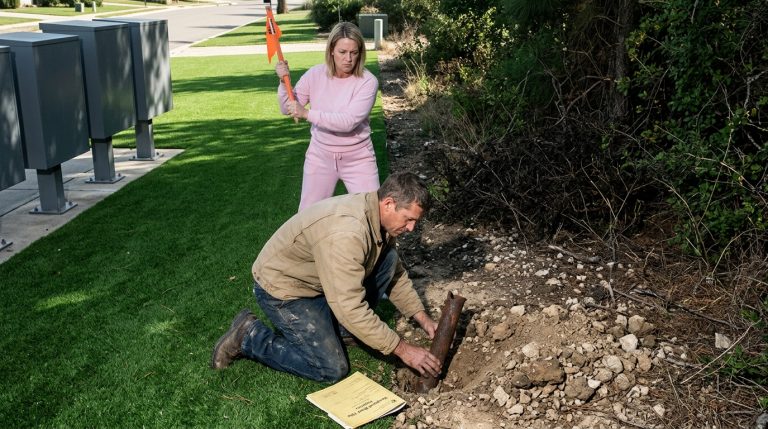
I stared at the screen, the pieces clicking together with the cold precision of a well-oiled bolt carrier. The rose bushes weren’t just a petty excuse; they were sitting on a disputed sliver of easement that Beverly had quietly tried to incorporate into her own expansion plans two doors down.
I pocketed the phone, the cold edge of determination settling deep into my chest. The wall was going up, brick by heavy brick, and Beverly Trout hadn’t even noticed that she was the one supplying the mortar.
CHAPTER 3: THE WHITE CADILLAC THRESHOLD
The white Cadillac SUV sat in the driveway of Number 14 like an armed sentinel, its pristine finish reflecting the midday sun with an aggressive, antiseptic glare. I didn’t park behind it. I left the sedan idling at the curb, stepping out onto the crisp asphalt with the manila folder tucked firmly beneath my arm.
The neighborhood was dead silent, save for the rhythmic, mechanical hiss of an automated sprinkler system spraying water against a neighbor’s pristine, chemically treated lawn. It was the kind of manufactured quiet that people bought into when they traded community for compliance.
I walked up the brushed-concrete steps of Beverly Trout’s front porch, my boots making a hard, deliberate sound against the tiles. I didn’t knock politely. I struck the heavy oak door twice with the flat of my knuckles—a sharp, measured impact designed to carry through the hollow-core construction inside.
Inside, the muffled rustle of fabric stopped instantly.
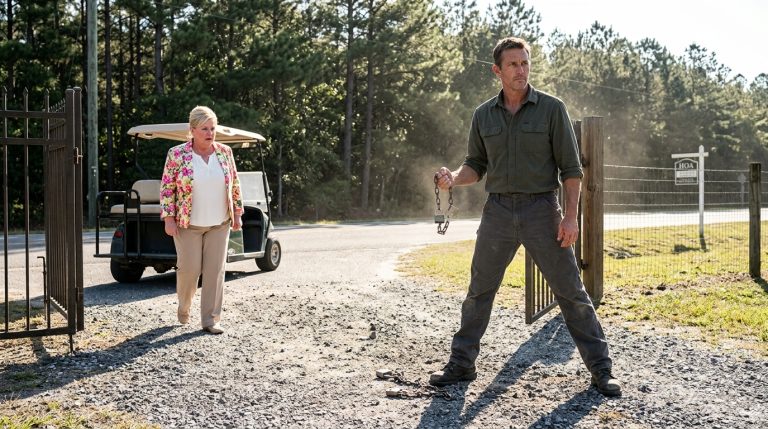
The deadbolt turned with a heavy, oiled click, and the door swung open six inches. Beverly Trout stood in the gap, framed by a foyer that smelled faintly of lemon polish and expensive potpourri. True to form, she wore her uniform: a structured cream blazer over a silk blouse, her blonde hair styled into a helmet of professional intimidation. Her lips were pursed into a thin, defensive line, but her eyes—small and darting—immediately dropped to the folder under my arm before rising to meet mine.
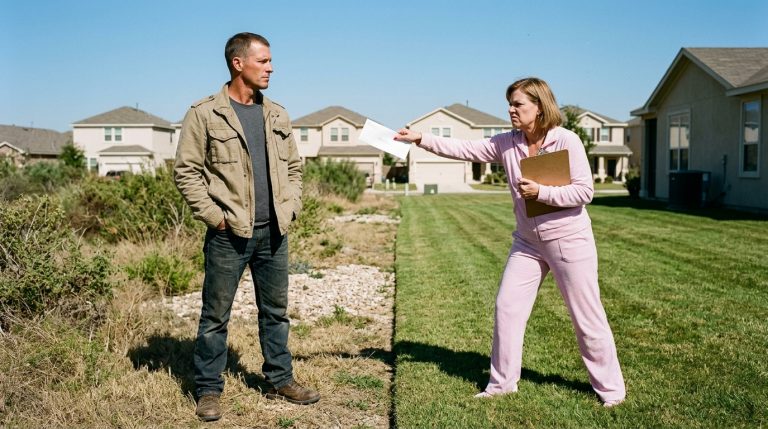
“If you’re here representing Dolores Wolfson, you’re trespassing on private property,” Beverly said, her voice dropping into the cool, practiced register of a woman who believed every rule bent to her convenience. “The association’s legal counsel handles correspondence through official channels only.”
“There is no legal counsel representing this conversation, Beverly,” I said, my voice flat, low, and stripped of all conversational friction. I didn’t move away from the threshold; I planted my boot an inch closer to the sill, forcing her to choose between holding her ground or giving way. “And we aren’t talking about correspondence. We’re talking about signatures.”
Her eyes flicked down to the manila folder again, a microscopic twitch of her jaw betraying the steady facade. “I don’t know what you think you’ve found, Mr. Wolfson, but the HOA board acts with absolute authority under municipal bylaws. Your mother was given due notice of her violations.”
“Section fourteen, paragraph C,” I recited smoothly, keeping my gaze locked on hers. “Requiring a unanimous quorum vote recorded in official meeting minutes with verified signatures from all five board members. I just spent the morning staring at the corporate filings down at the county clerk’s office, Beverly. The signature block for the board is completely blank. You didn’t hold a vote. You didn’t get a quorum. You signed your own name to an administrative power you don’t legally possess.”
The temperature in the doorway dropped. The faint color in her cheeks receded, leaving her skin the pale, tight shade of old porcelain. She tried to maintain the posture of authority, but her shoulders stiffened, the fabric of the cream blazer pulling tight across her chest.
“Administrative oversight,” she said, though the sharp edge in her voice had lost its velocity. “Minor procedural filings are handled at the presidential discretion during interim periods to protect property values.”
“Protecting property values by evicting a ninety-three-year-old woman over four inches of climbing rose?” I took half a step forward, forcing her back a fraction of an inch into the dim foyer. “That’s an interesting definition of protection. Especially considering the county assessor’s office has a very different file on what happens to community funds when people start looking closely at unauthorized infrastructure.”
She didn’t blink, but her breathing hitched—just a fraction of a second, the telltale sign of a predator realizing the trap had just snapped shut around her own ankles.
“You’re making a grave mistake,” she whispered, her voice tightening into a thin hiss. “This neighborhood relies on order. People like your mother—people who think rules don’t apply to them—drag everyone down. If you think you can walk in here with a handful of photocopies and intimidate the board, you have severely underestimated the resources at my disposal.”
“Resources,” I repeated quietly, letting the word hang in the space between us like a dropped blade. “Is that what you call a three-hundred-thousand-dollar gap in the community pool maintenance ledger? Because the county permit says thirty-one thousand. Your shell company ledger says three hundred and eighty.”
The blood drained entirely from her face. The door trembled slightly against her fingers.
Before she could form a counter-move, I pulled a single sheet from the folder and slid it across the polished wooden threshold, letting it land squarely at the toes of her pumps.
“I’m not here to intimidate you, Beverly,” I said, turning on my heel and stepping off the porch. “I’m just laying the track. Make sure you’re reading the right signals when the train gets here.”
I walked back down the concrete steps without looking back, hearing the heavy oak door slam shut behind me with a hollow, panicked echo that reverberated across the silent, manicured street.
CHAPTER 4: THE KITCHEN TABLE COALITION
The screen door of Number 42 clicked shut behind me with the familiar, frictionless glide my father had engineered thirty years ago. Inside, the kitchen was warm, smelling of toasted bread and black chicory. Dolores sat at the Formica table with a pair of reading glasses pushed up on her forehead, her fingers resting lightly over an expanding file folder stuffed with legal papers, tax receipts, and handwritten notes.
Across from her sat Thatcher, his sleeves rolled up to reveal thick forearms tanned by years of outdoor work before he traded the yard for a law library in Charlotte. He looked up as I dropped the manila folder onto the table next to the sugar bowl.
“She didn’t invite you in for tea, I take it,” Thatcher said, eyeing the rigid set of my jaw.
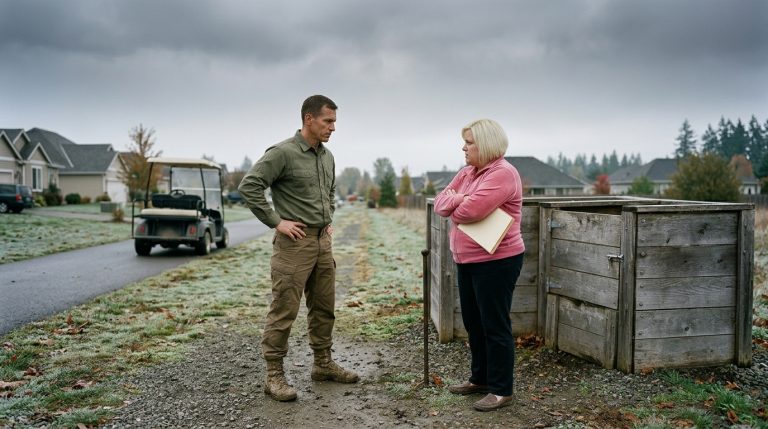
“She didn’t have much of a script left,” I said, pulling out a metal chair and sitting down. “Her signature is on the unauthorized filings, and she knows we have the county records. But Beverly isn’t the type to fold just because the floor dropped out. She’s going to scramble.”
“Let her,” Thatcher replied, tapping a pen against a printed ledger sheet. “A cornered animal makes noise. And noise is exactly what we need to wake up the rest of this street.”
He turned the ledger toward me. The numbers stared back in rigid columns of black and white, stark and undeniable.
“I pulled the comprehensive financial disclosure for the Oakridge Homeowners Association,” Thatcher continued, his voice dropping into professional cadence. “The development took in eight hundred and forty-seven thousand dollars in dues and maintenance fees over the last fiscal cycle. Their reserve fund—the pool of money legally mandated to cover major structural repairs—is sitting at forty-two thousand dollars. For a community this size, that’s not just low. That’s a flat-out insolvency risk.”
Dolores shook her head slowly, her eyes fixed on the grain of the laminate table. “People pay those dues on time every month, rain or shine. Mrs. Gable down the lane had to skip her prescription refill two winters ago because the assessment went up twenty percent.”
“Because the money isn’t sitting in the reserve,” I said, tracing the edge of the paper. “It’s being siphoned.”
” Exactly,” Thatcher said, sliding a second sheet across the table. “Two years ago, Beverly bragged at a block meeting that resurfacing the community pool cost three hundred and eighty thousand dollars. I ran a cross-check on the corporate registry for the vendor listed on the invoice: Pristine Aquatic Solutions LLC. It’s a single-member shell company registered out of a UPS store in Raleigh. The registered agent and sole beneficiary is Beverly Renee Trout.”
The kitchen grew deathly quiet. Even the refrigerator’s compressor hum seemed to drop away, leaving only the distant, steady hiss of the neighborhood sprinklers outside. The decoy secret—the unauthorized rose bush notice and the fake board signatures—was merely the scaffolding. Beneath it lay the true architecture of her control: a multi-year embezzlement engine disguised as community governance.
“Three hundred and eighty thousand dollars for a pool patch job that the county permit values at thirty-one thousand,” I murmured, staring at the discrepancy. “That kind of gap doesn’t hide behind a clerical error.”
“And that’s why she came after your mother,” Thatcher said, leaning forward. “Dolores has lived here since ninety-three. She knows the property lines, she knows the history, and she’s quiet enough to notice when heavy trucks or contractors start showing up where they shouldn’t. Beverly needed someone out of the way before the annual audit cycle hit next month. Your mother was a loose end in a kingdom built on stolen drywall.”
“We can’t just drop this in a mailbox and hope the county prosecutor feels ambitious,” I said, locking eyes with the attorney. “We need weight. Real people with real names who have felt the exact same boot on their necks.”
Thatcher smiled faintly, a grim, humorless lift of the corner of his mouth. “Already started. I brought a stack of blank affidavits and witness deposition forms. But you’re the one who has to go knock on the doors.”
Twenty minutes later, I walked out of the kitchen and back into the midday sun. I didn’t go after strangers; I went after the houses that had the drawn blinds and the quiet yards—the places where the air felt just a little too heavy.
At Number 28, a retired firefighter named Miller answered the door in a frayed plaid shirt, his knuckles swollen with arthritis. When I asked him if the HOA had ever hit him with sudden, inexplicable repair costs, he didn’t invite me in, but he didn’t close the door either. He just stood in the frame for a long, silent minute, staring at the asphalt of the driveway before he turned around, walked into his den, and came back with twelve thousand dollars in invoices for unapproved contractor work that the board had forced him to pay under threat of a lien.
At Number 19, a seventy-eight-year-old widow named Netty broke down in tears over a shoe box filled with three thousand dollars in petty fines for leaves in a gutter and a trash can left out three hours past the collection window.
“I thought I was just getting old and clumsy,” she whispered, her hands shaking as she clutched the faded pink violation notices. “I thought I was the only one on the street who couldn’t keep up.”
“You were never the only one, Netty,” I said, sliding an affidavit across her kitchen table. “You were just the isolated one.”
By evening, I had twelve signed statements in my folder. Twelve distinct accounts of intimidation, manufactured violations, and inflated contractor bills. I walked back toward Number 42 as the sun dipped below the tree line, casting long, sharp shadows across the road.
My phone vibrated in my pocket. A text from Renwick, the HOA compliance officer: She ordered me to do a surprise sweep of your mother’s fence line at six tomorrow morning. What do I write down?
I stopped on the sidewalk, looking up at the glowing amber porch light where my mother was waiting inside with the kettle on. I tapped out a single sentence reply: Write down the truth, Renwick. Your signature is the only one that’s going to matter by noon.
CHAPTER 5: THE EMERGENCY BOARDROOM SHOWDOWN
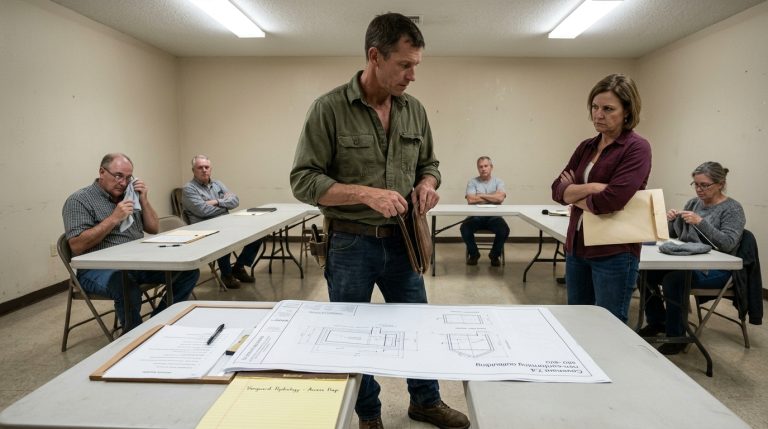
The fluorescent lights of the Oakridge Community Center hummed with a harsh, institutional frequency that set the teeth on edge. By 6:45 PM, the folding chairs arranged in rows across the linoleum floor were entirely occupied, the air thick with the smell of damp coats, cheap floor wax, and the restless collective murmur of twelve homeowners who had spent years learning how to keep their heads down.
I stood near the back, my shoulders braced against the cinderblock wall, watching the front table where the board members sat under a plastic sign that read Oakridge HOA.
Dorance, a stocky man with tired eyes and a salt-and-pepper mustache, sat in the center seat. He looked uncomfortable, his fingers drumming a nervous tattoo against a yellow legal pad. To his right, Beverly Trout sat erect in her signature cream blazer, her posture stiff as a ramrod, her gaze fixed rigidly on the double doors at the back of the room. She hadn’t expected a packed house. She had expected an administrative rubber stamp.
At precisely 7:00 PM, Dorance reached out and tapped the base of a battered silver microphone, the speaker spitting a sharp, metallic squeal that silenced the room instantly.
“Call to order,” Dorance said, his voice carrying a dry, fatigued authority. “Before we review the interim agenda, this emergency session was petitioned under association bylaws by Director Miller and supported by quorum notification regarding executive enforcement actions.”
He didn’t waste time. He looked straight across the table at Beverly.
“Beverly, the chair has a formal inquiry. Where are the certified meeting minutes and quorum sign-offs for the habitation restriction notice issued against Dolores Wolfson last week?”
The silence that fell over the room was absolute. You could hear the faint hum of the HVAC unit kicking on high overhead.
Beverly didn’t flinch. She adjusted the collar of her cream blazer, her chin lifting with practiced disdain. “The executive committee possesses interim emergency authority under clause nine to preserve community standards,” she said, her voice ringing clear and steady across the hall. “When property values are threatened by unmaintained landscaping and repeated non-compliance, the presidency does not require a week-long debate to protect this neighborhood.”
“Not for this, Beverly,” Dorance said quietly, dropping his pen onto the yellow legal pad.
The HOA’s retained legal counsel, a young attorney in a charcoal suit sitting off to the side, shifted uncomfortably in his chair. He cleared his throat, slid a manila folder away from himself as if it were contaminated, and stood up.
“For the record,” the lawyer said, addressing the room while keeping his eyes averted from Beverly, “legal representation was provided with supplementary audit documents by Mr. Wolfson this afternoon. After reviewing the corporate charter, the missing quorum logs, and the statutory requirements for structural enforcement, I have advised my client that the action against Mrs. Wolfson is procedurally indefensible. My firm will not represent the association in any litigation arising from this notice.”
The room erupted into a sharp wave of murmurs. Beverly’s head snapped toward the lawyer, her eyes widening with a sudden, naked flash of betrayal.
“You’re out of line,” she hissed, her professional veneer cracking down the middle. “You represent the board, not an outside agitator!”
“I represent the law, Mrs. Trout,” the attorney said smoothly, gathering his leather folio. “And right now, the books don’t balance.”
I pushed off the cinderblock wall, my boots clicking rhythmically against the linoleum as I walked down the center aisle, holding the thick dossier of twelve signed affidavits and county tax prints. The air grew colder with every step, the tension tightening until the entire room seemed to hold its collective breath, waiting for the structural weight of the truth to finally land.
CHAPTER 6: THE ROSE GARDEN RESTORED
The fluorescent hum overhead seemed to sharpen as I laid the documents across the polished wooden table directly in front of Dorance. Every eye in the crowded room locked onto the pages—the inflated pool maintenance contracts, the shell company registry out of the UPS store in Raleigh, and the stark, indefensible gap between thirty-one thousand dollars in county permits and three hundred and eighty thousand in community disbursements.
Beverly Trout stood up abruptly, her structured cream blazer straining against her shoulders. Her face had lost its color, reduced to a tight, bloodless mask of sheer desperation.
“These are unverified accusations!” she snapped, her voice cracking slightly before recovering its sharp, transactional edge. “Fabricated documents from an outsider trying to derail community standards! You have no authority—”
“I have twelve signed depositions from homeowners on this very street,” Thatcher said smoothly, stepping out from the side aisle to place the witness statements beside the ledger. “Statements detailing systematic coercion, retaliatory fines, and unauthorized financial drains. And more importantly, Beverly, the D&O insurance policy carrying your board exemption has a clean clause for self-dealing outside institutional authority. You aren’t defending the neighborhood. You’re defending a bank account.”
The room did not erupt into shouting; it settled into a cold, heavy judgment. The neighbors she had spent three years intimidating—Netty, Miller, and a dozen others—sat in silence, their expressions hardened into an unyielding wall. Beverly looked around the table, her eyes searching the faces of the other board members for an ally, a nod, anything to catch her fall.
Dorance met her gaze without blinking. He didn’t offer a speech. He simply picked up his pen, signed the emergency motion rescinding the eviction notice against my mother, and slid the paper across the table.
“Effective immediately, Beverly, you are placed on administrative leave pending an independent forensic audit,” Dorance said, his voice flat and absolute.
Beverly stared at the signature block for a long, agonizing moment. Then, as the side door of the community center clicked open and a regional reporter stepped inside with a camera operator, something inside her posture collapsed. She didn’t offer a final threat or a parting justification. She turned on her heel, pushed past the folding chairs, and walked out into the night.
Six weeks later, the audit report landed on the county prosecutor’s desk. The three hundred thousand dollar gap in the pool funds was fully mapped, tracing every dollar back to Beverly’s shell company. The state attorney general’s office stepped in, and the white Cadillac SUV disappeared from the driveway of Number 14 shortly before the foreclosure notice was posted on the door. Netty received her refunded fines. The county inspectors formally recognized the historical boundary of the property line.
When I drove back down Penrook Lane a month after the dust had settled, the sun was casting a long, warm amber light across the asphalt. I parked the sedan and walked up the brushed-concrete path to Number 42.
The screen door swung open with its familiar, oiled graphite glide. My mother stood in the doorway, wearing her favorite blue church dress, her silver hair catching the late afternoon sun.
I stepped onto the porch and leaned down to inspect the flowerbeds bordering the stone path my father had laid by hand three decades ago. The climbing roses were in full bloom, heavy and rich, spilling two inches past the wooden fence rail just as they always had.
Dolores looked up at me, a quiet, knowing smile touching the corners of her mouth as she handed me a cup of hot chicory.
“So,” she said softly, watching the light catch the hand-painted wooden sign by the mailbox. “We can keep the roses?”
I took the mug, feeling the rough ceramic warm against my palms, and looked out across the quiet, breathing street where the neighborhood had finally settled back into peace.
“Yeah, Mom,” I said, leaning against the porch railing. “You can keep the roses.”