The Chemistry of Gray Matter: A Novel of Structural Justice and Rusted Truths
CHAPTER 1: THE TANGIBLE LINE
“That pile of rotting filth will cost you five thousand dollars, Mr. Jensen. And that is just the start.”
The syllables cut through the sharp, clean scent of damp pine needles and turning leaves. Karen stood exactly two inches short of the surveyor’s iron pin marking the southern boundary of my lot. Her arms were locked across the front of a pink velour jacket, the fabric strained until the cheap polyester seams showed white. Her hair, an unyielding platinum helmet that resisted the steady October breeze, caught the gray morning glare like stamped tin. She didn’t look at me; she looked past my shoulder, her eyes fixed on the three-bin enclosure I had joined together from reclaimed red cedar.
“Get it gone by Friday,” she said, her voice dropping into a flat, practiced register that carried the weight of small, legal intentions. “Or the association will have it removed for you. We will bill your account for the labor, the transit, and the disposal fees.”
I didn’t move from the gravel path. Twenty years in the Army Corps of Engineers teaches you to watch the ground before you look at the person standing on it. I noted the damp gray soil clinging to the square toes of her loafers, the slight, uneven tilt of her golf cart’s rear axle where it sat idling on the asphalt behind her, and the clipboard clutched against her ribs like a small shield.
“Five thousand,” I said. The number had no basis in logic, which meant it was an anchor designed to drag an opponent into a emotional response. I kept my breath steady, dropping my heart rate to the baseline I used when calculating concrete stress loads under mortar fire. “Which specific paragraph of the covenants covers the operational definition of a closed, three-stage biological digestion cell, Karen?”
She pulled the clipboard free, the spring-loaded metal clip snapping against the plastic backing with a dry crack that echoed off my workshop wall. “Bylaw Seven, section C, paragraph four,” she announced, her thumb tracing a highlighted line on a sheet of heavy cream cardstock. “Prohibition of unsightly storage of debris, refuse, or rubbish. The board is the sole arbiter of what constitutes an affront to the visual harmony of Whispering Pines.”
I glanced back at the enclosure. The cedar was silvering evenly under the autumn damp, the three-eighths-inch stainless steel carriage bolts holding the corner plates together without a trace of rust. The latch on the secondary bin, however, sat slightly crooked—a sixteenth of an inch lower than it had been when I turned the pile on Sunday. Someone had pulled the pin recently. Someone who didn’t know the trick to the counterweight.
“This is an aerobic system,” I said, my tone flat, transactional. “The core temperature is currently sitting at one hundred and forty degrees. There is no off-gassing of methane, no vector attraction, and the perimeter is swept to bare gravel. It meets the state extension service guidelines for urban nutrient management.”
“It looks like a trash heap to me, Mr. Jensen,” she said, her lips thinning into a straight line that showed the pale yellow of old dental work. She turned toward her cart, her thumb already switching the key to reverse. “And the health of this community doesn’t negotiate with your science projects. Friday morning. After that, we file the lien.”
The electric motor whined, a low-frequency hum that smelled faintly of warm copper windings and battery acid as the cart backed down the slope, leaving two dark tracks in the frost-rimed grass of the common green. I stayed on the gravel until the sound died out at the corner of Chestnut Lane. The air returned to its proper stillness, cold and heavy with the scent of wet earth, but the silver latch on the middle bin remained out of alignment, a small iron discrepancy waiting for the documentation to begin.
CHAPTER 2: THE ARCHIVE ENVELOPE
The low-frequency vibration of Karen’s golf cart faded into the damp hollows of Chestnut Lane, leaving behind a silence that felt heavy, almost metallic. My boot didn’t leave the gravel path. My gaze remained anchored to the lower left quadrant of the secondary cedar bin where the latch met the frame. Under the gray October light, the fresh scratch on the three-eighths-inch stainless steel plate stood out like a bright silver needle. It was bare metal, completely clean of the fine, dark patina that three months of wood acid and rainwater usually deposited on exposed hardware.
I reached out, my fingers tracing the cold edge of the flange. The drop-pin didn’t clear the sleeve by its usual margin; it caught on the lip of the lower bracket with a dry, iron scrape. Someone had pried at it with a tool too wide for the gap—likely the flat edge of a standard-issue surveyor’s rule or a heavy utility blade. They had tried to lift the lid without releasing the counterweight wire I had routed through the rear joist.
A civilian would have looked at the scratch and thought of vandalism. An engineer looks at the force vector. The mark trended upward from the bottom right, meaning whoever stood here had been crouching, trying to peer into the ventilation gap between the second and third bins while working the latch by blind touch.
I didn’t open the bin. I didn’t turn back toward the house until I had documented the scratch with three tight macro-photographs, using my thumb as a scale indicator against the graying cedar grain. The ground truth was changing. The five-thousand-dollar fine wasn’t a warning shot; it was a perimeter sweep. Karen wasn’t just enforcing uniformity—she was looking for something specific inside the biological cell, or she was trying to establish a legal pretext to clear the ground entirely.
The gravel crunched beneath my soles with a precise, rhythmic snap as I walked back toward the workshop. The air inside the garage was different—it smelled of boiled linseed oil, cold paste wax, and the dry, mineral scent of old blueprints. I bypassed the main workbench and walked straight to the steel filing cabinet tucked behind the drill press. The three-drawer unit was a remnant from my logistics assignment at Fort Meade, painted army gray with a heavy mechanical combination lock that required three full rotations to clear the tumblers.
The drawer slid open with a heavy, oiled glide. From the back of the bottom shelf, I pulled the black three-ring binder given to every resident during the closing settlement two years ago. The cover was stamped with the twin-tree logo of the Whispering Pines development, the gold foil already flaking off the plastic grain to reveal the dull gray resin beneath. Two hundred pages of covenants, conditions, restrictions, and amendments. A dense wall of boilerplate text designed to make the reader skip straight to the signature page.
I laid the binder flat under the fluorescent shop light. The paper was crisp, a cheap twenty-pound bond that rustled like dry husks as I turned the pages. I didn’t start at the beginning. I went straight to the index under section seven, searching for the exact wording Karen had quoted on the property line.
My index finger followed the column down. Bylaw 7, Section C: Architectural Maintenance.
The print was tight, set in a standard ten-point Arial font. But as I flipped the page to reach paragraph four, my thumb caught on the spine. The texture of the paper changed. Paragraphs one through three were clean, flat impressions. Paragraph four—the specific clause regarding the sole discretion of the architectural control committee—sat on a sheet that had a fractionally higher tooth, a subtle roughness that didn’t match the smooth finish of the preceding sheets.
I tilted the binder toward the light. The margins on the right-hand page were three millimeters narrower than the left. The header across the top read Whispering Pines Board of Directors – Revised July 2024, but the ink had a faint purple cast under the white tube light—the unmistakable signature of a high-end commercial inkjet reprint, not the heat-set toner used on the rest of the document.
Near the bottom binding edge, tucked into the gutter where the plastic rings met the margin, was a small, italicized print code that hadn’t been trimmed correctly: Oakhaven Logistics – Form 904-B.
I sat down on the stool, the metal legs groaning slightly against the concrete floor. The name didn’t belong in a residential covenant. Oakhaven Logistics wasn’t the local management company; they were the commercial aggregate supplier that handled the road grading for the industrial park three miles north, just beyond the protected woodland buffer behind my lot.
I picked up my steel ruler, aligning the edge with the purple-tinted text of paragraph four. The ink was dry, but the indentation from the printer rollers was still visible on the back of the sheet—a fresh impression that couldn’t have been more than six months old. The binder hadn’t been assembled this way at closing. Someone had swapped the sheet after the fact, slipping the revised clause into the master repository before the binders were distributed to the final block of buyers.
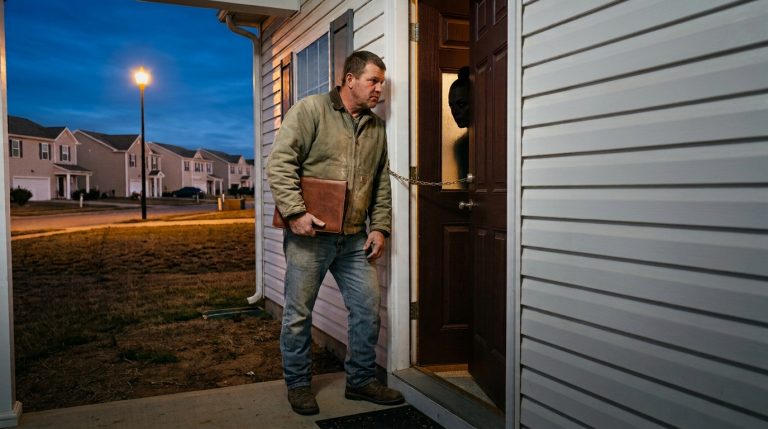
The back door opened with a soft click, the kitchen draft carrying the scent of fresh coffee and damp wool into the shop. Sarah stood on the threshold, her small frame framed by the yellow light of the hallway. Her fingers were curled tight around the rim of a ceramic mug, her knuckles showing pale under the skin.
“Marcus,” she said, her voice dropping into the quiet space between the machines. “Dave Sterling just called from down the street. Karen’s cart is parked at the community clubhouse. He says she brought two people from the district office down to the common green. They’re carrying transits and measuring chains.”
I didn’t close the binder. I took a clean sheet of grid paper from my clipboard and wrote down the form number exactly as it appeared in the gutter: Code-Redemption 904.
“Tell Dave to stay off his porch,” I said, my voice level, the tone shifting back to standard operating procedure. “I’m heading to the post office first. If they want to measure the line, we’ll make sure the record is permanent.”
CHAPTER 3: THE CERTIFIED BLOCK
The door latch clicked behind Sarah, the sound small and metallic in the quiet of the workshop. I didn’t let my hand drop from the clipboard. The charcoal line on the grid paper, tracing out the letters Code-Redemption 904, remained stark against the white squares. The purple-cast sheet of the modified HOA covenants sat open beside it, its narrow right-hand margin exposed to the harsh light. I reached for my technical drafting pen, capped it with a deliberate twist of the brass barrel, and slid the binder into a heavy canvas field bag.
Every operation requires a solid log entry before the physical deployment begins. I pulled the three manila envelopes from my desk drawer—each one a rigid, nine-by-twelve fiber packet built to withstand standard handling. I slid one clean copy of the formal, multi-page technical appeal into each envelope. My fingers traced the rough, pulpy texture of the paper flaps as I pressed down on the adhesive seals, smoothing out the microscopic air pockets until the glue bonded completely.
I picked up the canvas bag by its thick webbed strap, the metal buckles clinking like dull coins against the copper rivets of my work pants. The transition from the garage to the driveway was cold, the morning mist still hanging in the low branches of the pines. I didn’t look back toward the green common area where Karen’s surveyors were supposedly working their chains. That was a distraction; the tactical objective was three miles east, at the blue-painted brick counter of the municipal postal station.
The drive was standard, timed to thirty-two miles per hour along the perimeter road to avoid the speed sensors Karen had installed near the cul-de-sac. The steering wheel of the old truck felt rough under my palms, the worn vinyl grip pitted by years of sun exposure and sweat. The smell of unburned fuel and damp floor mats filled the cab, a grounded contrast to the sterile, manicured air of the development behind me.
When I pulled into the small gravel lot of the post office, the dry stones ground loudly under the front tires. Inside, the small station smelled of floor wax, dried ink, and dead letters. The counter was iron-faced, the gray paint chipped down to the dark metal substrate where thousands of commercial scale weights had struck it over the decades.
A clerk with dry, paper-cut thumbs looked up from a stack of sorting trays. I didn’t offer a greeting. I laid the three manila packets on the iron ledge in a precise vertical column, their corners aligned with the metal ruler embedded in the wood.
“Three packets,” I said, my voice maintaining its flat, even pitch. “Certified mail. Return receipt requested. Restricted delivery on packet number two.”
The clerk pulled the green PS Form 3800 slips from a metal dispenser, the paper tearing against the serrated edge with a sharp, dry whistle. “That’s three receipts, separate tracking,” he murmured, his voice sounding like gravel being turned in a bucket. He began stamping the slips, his old steel ink pad thudding rhythmically against the counter.
As he worked, my gaze settled on a stack of discarded shipping manifests sitting in a wire basket beside the scale. The top sheet was a commercial weight ticket from the municipal landfill, stamped two weeks prior. In the column marked Origin, the thermal paper bore a faint, blue stamp: Oakhaven Logistics – Sector 4 Clearance.
The paper ticket was greasy, stained with a dark, oily ring that had soaked through the wood fibers until the printed text was nearly translucent. I watched the clerk’s hand slide a green tracking sticker onto my secondary envelope—the one addressed directly to Karen’s residence. The physical link was small, but the proximity of the two names in the local ledger wasn’t a coincidence.
“Sign here, and here,” the clerk said, pushing a worn plastic stylus across the digital pad. The screen was scratched, the glass clouding from years of pressure.
I signed with three deliberate strokes, ensuring the digital image matched the signature on my retired military credential. The green receipts were handed back to me, the paper still warm from the heat of the counter lamp. I tucked them into the front pocket of my canvas bag, the stiff edges digging through the fabric into my palm. The clock was officially active. They had fifteen days to set the ledger straight, or the state property statutes would override their sole discretion entirely.
I turned back toward the glass exit doors. The gray light outside was bright, reflecting off the chrome bumper of my truck with a cold, zinc glare. The next phase required a field sweep of the neighborhood lines, and the afternoon damp was already rising from the pine flats.
CHAPTER 4: THE ANCHOR RECONNAISSANCE
The glass doors of the postal station rattled in their aluminum frames as the dead weight of the hydraulic closer pulled them shut. I stood on the threshold, the green certified mail receipts tucked inside the front pocket of my canvas field bag. The air outside was thickening, a cold, slate-gray sheet of low mist rolling in off the protected woodland buffer. I crossed the crushed stone of the parking lot, climbed into the cab, and fired the engine. The old transmission engaged with a mechanical clunk that resonated through the floorboards.
The route back to Chestnut Lane required zero deviation from the standard perimeter speed. When I reached the eastern entrance of the development, the yellow cautionary flags of the surveying crew were already visible against the manicured rye grass. I drove past them without slowing down, noting the three metal boundary stakes they had hammered into the turf near the main cul-de-sac. They were marked with red plastic surveyors’ ribbon, but the layout wasn’t designed for a standard parcel split. The stakes formed a linear barrier that cordoned off the path leading directly toward the neighborhood’s shared common spaces.
I pulled my truck into the gravel curve of my driveway, killed the ignition, and stepped out into the chill. Instead of heading toward my own workshop, I turned south, cutting across the property boundary where the frost had begun to thaw into a dark, muddy slurry.
Fifty yards down, John Henderson was hunched over the exposed deck of his John Deere mower. The machine sat propped on two split pine logs, its green paint faded to a chalky olive drab, the smell of stale gasoline and WD-40 hanging low in the cold air. John’s knuckles were black with grease, his breathing heavy and rattling as he struggled to clear the blade spindle with an old iron socket wrench.
“The bolt’s frozen, Marcus,” John muttered without looking up, his shoulder straining against the rusted handle of the wrench. “Every spring and autumn it does this. The threads just seize solid.”
I knelt on the damp earth beside the machine, the cold soaking through the knees of my work trousers. I didn’t offer a hand with the wrench; I reached under the lip of the rusted steel deck, my index finger brushing the thick layer of packed lawn clippings that had accumulated around the housing.
“You’re using the wrong leverage, John,” I said, my voice dropping into its flat, operational register. “Let the weight of the frame work for you. Don’t fight the iron.”
My fingers dug deeper into the debris beneath the deck, looking for the clearance gap. But as my nails scraped the underside of the housing, the texture changed. The debris wasn’t just old grass and organic rot. Beneath the green layer of mulched rye, my fingertips met a gritty, granular substance that had dried into a thick, gray crust against the metal spindle. It had a sharp, mineral acridity to it—a sulfurous tang that didn’t match the standard nitrogen profile of residential lawn clippings.
I pulled my hand back, rubbing my thumb against my forefinger. The gray dust left a dark, iridescent sheen on the skin, a greasy residue that caught the weak sunlight like motor oil on a puddle.
“John,” I said, keeping my gaze anchored to the underside of the mower deck. “Where did you clean the blades the last time you ran this through the perimeter common space?”
John wiped his brow with the back of his sleeve, leaving a long streak of carbon across his forehead. “Near the community garden gate. Karen had that delivery truck back in there three weeks ago—the one from the corporate office. She told me to cut the rough edge right up to the timber boundary. The mower clogged up twice out there. Tallow-colored muck. I had to scrape it loose with a garden trowel.”
I reached into the bag at my hip, pulled out a small, clear sample envelope I used for soil testing, and scraped a small cross-section of the gray crust off the spindle housing using the flat edge of my pocketknife. The iron-on-iron scrape was sharp, a dry hiss that made John pause.
“She gave Mary another notice yesterday,” John said quietly, his hand resting on the cold metal of the mower deck. “A fifty-dollar assessment because the font on the welcome mat wasn’t centered with the brass threshold plate. Mary’s inside crying about it now. We’re too old for this, Marcus. We don’t have the stomach for the paperwork.”
“The paperwork is just structure, John,” I said, sealing the plastic track of the sample envelope. The gray granules shifted inside the pocket, tiny, heavy crystals that didn’t break down under the pressure of my thumb. “It only holds as long as the foundation is clear. Keep the mower on the gravel until I verify the line.”
I stood up, the joints in my knees clicking with a dry, mechanical snap. As I turned back toward my property, I looked toward the common green. The yellow transit lines were gone, but the two deep tracks left by Karen’s golf cart remained, filled with gray, stagnant rainwater that didn’t drain into the soil.
CHAPTER 5: THE METADATA INTERCEPT
My boots carried the damp weight of the perimeter silt up the back porch steps, each strike leaving a dull, gray wedge of mud against the weathered timber treads. Inside the kitchen, the air was warm but completely still, smelling of stale grounds and the faint, dry copper tang radiating from the baseboard heaters. I didn’t drop my field bag on the counter. I kept my fingers locked around the seal of the clear plastic sample envelope, feeling the hard, crystalline grain of the gray residue compress under the tension of my grip.
Sarah was standing by the window, her silhouette framed against the cold glare of the driveway. She didn’t turn around as the door closed, but the small, rhythmic twitch of her shoulder blade beneath her woolen sweater signaled the unresolved friction of the surveyors’ presence down the lane.
I walked straight past the hallway line into my workspace, clicked the manual toggle on the workstation monitor, and sat down on the hard oak chair. The screen flickered to life, its cold, white luminescence painting the desaturated wood paneling of the back wall in a pale zinc wash. The system had already pulled down the monthly distribution directory from the shared neighborhood portal. The digital publication sat in the inbox—a file titled The Whispering Pines Whisperer – Autumn Issue.
My hand moved to the heavy trackball mouse. The mechanical bearings inside the housing were old, rolling with a dry, iron-like click as I targeted the file extension. I opened the document, bypassing the stylized text columns and scrolling straight to the third page, where the community spotlight box was framed in a thick, artificial border.
The photograph filled the center of the panel. It was an image of my three-bin cedar cell, but the spatial metrics were completely warped. The lens had been positioned low to the gravel line, shooting upward through a three-inch gap in the horizontal lattice slats. The cedar planks looked bloated, their silvered wood grains stretched into long, dark scars by the wide-angle distortion, making the clean square joints appear like a collapsing, chaotic heap.
I didn’t study the surface layout. I right-clicked the raw image layer, extracted the raw data block, and dropped the file directly into a hexadecimal text reader. A civilian reader looks at the picture to find an offense; an engineer decodes the transmission ledger to identify the coordinates of the sender.
The screen filled with lines of black machine code, the strings of data scrolling down until the header parameters settled into alignment. My index finger traced the terminal output line: Camera Model: Industrial-C600. Software Interface: Oakhaven-Direct Core.
The data didn’t contain a standard residential phone signature. The exposure had been captured by a fixed-lens inspection unit used for commercial land management. Beneath the camera parameters, the embedded system log held a deeper timestamp matrix: File Registry: Code-Redemption 904 / Sub-Folder: Hexavalent-Humus-Pre-Clearance.
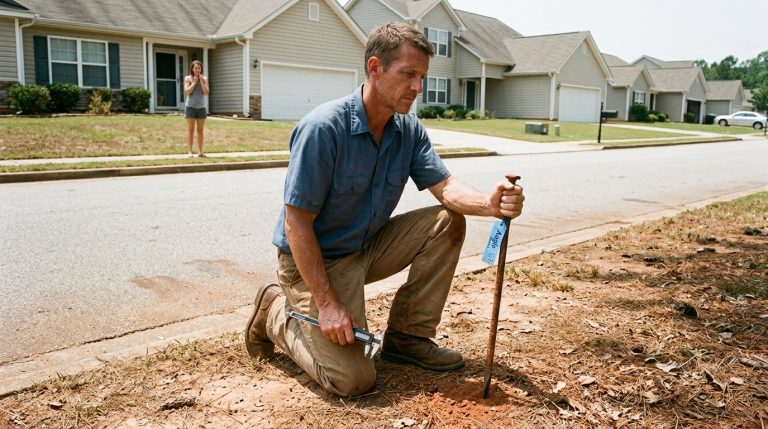
I zoomed in on the bottom edge of the photo, where the gray gravel met the cedar base plate. The compression artifacts had left a series of blocky, dark pixels near the bottom left corner, but through the digital grain, a tiny, vertical metal rod was visible stuck into the ground behind my lattice screen—a bright, zinc-plated ground marker that hadn’t been there when I cleared the perimeter line on Sunday morning.
The door frame behind me creaked under a sudden shift in weight. Dave Sterling stood in the doorway, his canvas field jacket zipped clear to the chin, his thumbs hooked under the webbed strap of a heavy leather utility case. His face was set in a tight, unyielding grimace, his breathing coming short through his nose.
“They’ve just locked the main access road behind the clubhouse, Marcus,” Dave said, his voice dropping into a harsh, granular whisper that vibrated against the narrow walls of the room. “Karen brought two guys from Oakhaven in a white utility truck. They’re running a core drill through the center of the old garden beds. They aren’t checking the property lines—they’re digging into the substratum.”
I didn’t close the hexadecimal reader. I reached down, pulled the plastic sample bag from my pocket, and laid it flat on the desk surface right beneath the cold glare of the monitor. The gray crystals inside the plastic caught the light, showing a faint, oily shimmer against the dark wood grain of the desktop.
“They’re trying to validate the easement before the certified receipts hit the board file,” I said, my voice completely flat, stripped of pitch. “The digital file was registered on their network before she even walked onto my property line. This isn’t an inspection, Dave. It’s a containment sweep.”
I stood up, my canvas bag slinging over my shoulder with a short, heavy thud as the metal adjustment buckle struck my belt. The baseline was clear; we had to move past the paper boundary and check the physical source before they pulled the drill string from the hole.
CHAPTER 6: THE PERIMETER TRACE
The metal adjustment buckle settled against my leather belt with a dull, iron clang. My hand didn’t drop from the canvas strap. I turned toward the doorway where Dave Sterling stood, his face carved into hard, sharp shadows by the low-degree northern light filtering through the corridor. I didn’t offer a verbal acknowledgment; I moved my feet across the threshold, my worn boots tracking a faint line of gray silt across the linoleum as I followed him down the narrow utility hallway.
We crossed the back porch in silence. The air outside had dropped another two degrees, the dampness from the pine flats settling over the property line like a cold, wet sheet. We didn’t take the main asphalt driveway. I led Dave along the western edge of the cedar lattice screen, our boots sinking two inches into the unmanaged undergrowth where the wild rye met the timber line. Every step was mechanical, calculated to keep the thick trunk of the boundary oak between our bodies and the clear line of sight from the clubhouse windows.
The hum of the utility engine grew louder as we neared the green common space. It wasn’t the light, rhythmic drone of a neighborhood lawn maintenance tool; it was the heavy, cyclical thud of a single-cylinder diesel motor under load. As we cleared the final cluster of low pine branches, the machine came into full view fifty yards ahead.
A white flatbed truck bearing the stenciled lettering Oakhaven Logistics on its steel door panel sat parked directly inside the fenced perimeter of the community garden. Two men in thick canvas work jackets stood near the rear platform, their hands locked around the guide handles of a portable trailer-mounted core drill. Karen stood five feet back on the gravel path, her pink velour jacket replaced by a stiff, industrial windbreaker that rattled in the gusting wind. Her clipboard was clutched tightly under her left forearm, her posture completely rigid as she watched the diamond-tipped barrel bite into the soil of the raised beds.
A sudden, sharp metallic crack echoed from the rig. The diesel engine choked, its exhaust pipe spitting a thick plume of black, greasy smoke that smelled heavily of sulfur and raw unburned fuel. The core drill’s hydraulic pressure gauge plummeted, the needle slapping the iron pin at the baseline.
“Pressure drop on the lower block,” one of the operators shouted, his voice flat, transactional, completely ignoring Karen’s sudden step forward. “We hit the secondary substrate layer early. The shale’s too soft here. It’s sloughing into the sleeve.”
I dropped my bag behind a weathered cedar timber post, my fingers brushing the rough, splintered grain of the wood. My eyes stayed locked on the three-foot extraction tube the second operator was now hoisting from the drill hole. The steel cylinder was wet, covered in a thick, pasty clay that didn’t match the clean, sandy loam of the upper development. It was an unnatural shade of olive-gray, bleeding a thin, discolored fluid that ran down the side of the rusted metal tray.
“Dave,” I whispered, my voice remaining in its low engineering register as I reached into my canvas sack for the secondary soil sample kit. “Look at the base of the open plastic collection bins behind the gazebo. The bottom seams aren’t sealed. They’ve been using the garden soil as a natural filter layer.”
Dave shifted his weight, his boot scraping a rusted iron spike buried in the grass. “They aren’t testing for an easement, Marcus. Look at the shipping logs sticking out of the truck’s cab pocket. They’re running a clearance ledger under Code-Redemption 904. They’re trying to log the core data before the state inspector arrives.”
The operators were already resetting the hydraulic arm, their heavy iron wrenches clanking against the steel stabilizers with an abrasive, rhythmic ring. Karen turned toward the truck, her eyes scanning the timber line where we stood, her thumb nervously flicking the corner of her cardstock ledger. The false layer of the HOA mystery was beginning to fracture under the weight of the physical evidence, but the true depth of the Oakhaven contamination was still locked beneath eighteen inches of corrupted soil.
I didn’t break our cover. I kept my pocketknife open, waiting for the operators to transition to the secondary bore site before I made the physical sweep to collect the surface runoff from the drainage ditch.
CHAPTER 7: THE CLUBHOUSE RECKONING
The glass doors of the neighborhood clubhouse swung wide with a slow, hydraulic hiss, sealing out the damp, sulfurous air of the pine woods behind me. I stepped straight onto the desaturated linoleum floor, my boots leaving two dark, damp stamps of gray clay by the threshold. I didn’t shake the mud clear. My hand remained closed around the structural handle of my technical binder, the weight of the document packets inside pulling the canvas strap tight against my shoulder blade.
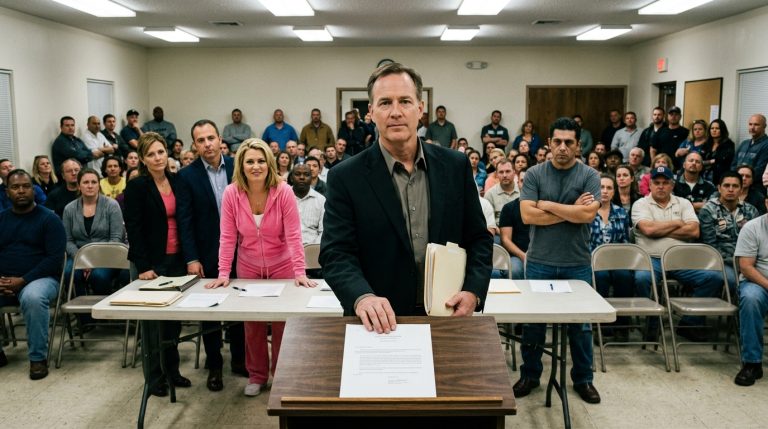
The multipurpose room smelled of commercial pine cleaner and old coffee. Thirty residents occupied the rows of stacked metal chairs, their voices locked in a low, vibrating murmur that cut off the moment my boots struck the center aisle. At the front table, five board members sat under the raw glare of the fluorescent tubes. Karen occupied the center seat, her knuckles pressed flat against a thick stack of manila folders, her platinum helmet of hair reflecting the hard white light like zinc plating.
To her left sat Maria, the board’s legal counsel, her fountain pen poised over a yellow legal pad. To her right sat Frank, his fingers tapping a rhythmic, nervous cadence against the side of an old mechanical adding machine.
“You are out of order, Mr. Jensen,” Karen said, her voice cutting through the room with the dry rattle of gravel sliding down a chute. She didn’t look at my face; her eyes were locked on the small plastic sample envelope protruding from my front pocket. “This item is an administrative review of a residential violation notice. We are not here to debate your personal theories regarding the perimeter line.”
I didn’t take a seat in the gallery. I walked straight to the long table, the iron legs of the layout structure groaning slightly as I set the heavy binder down with a hollow thud.
“The violation notice is a secondary variable, Karen,” I said, my voice dropping into the flat, unyielding pitch of an engineering brief. “Let’s look at the primary log.”
I flipped the binder open to the central divider. I didn’t read from a script. I reached into my field sack, pulled out the high-resolution metadata logs I had extracted from the neighborhood newsletter, and laid the printed hex sheets flat under the fluorescent lamps.
“Bylaw Seven, section C was systematically modified six months ago,” I stated, pointing the tip of my brass mechanical pencil to the purple-cast printing in the margin. “The sheet was inserted into the closing documents to establish sole discretion over the easement buffer. The printer tracking code on the backing sheet traces directly to an industrial account held by Oakhaven Logistics under contract registry Code-Redemption 904.”
Karen’s posture didn’t shift, but the muscle beneath her left jawline twitched once, a tight knot of tension pulling her lips into a hard, defensive line. “Oakhaven is our contracted landscape supplier, Mr. Jensen. Their administrative nomenclature is entirely irrelevant to your unsanitary refuse heap.”
“They aren’t hauling mulch, Karen,” I said.
I reached down and produced the second document layer—the municipal waste tickets I had pulled from the landfill basket, cross-referenced with the core drill logs Dave Sterling had photographed two hours ago. I laid the clear plastic sample envelope containing the gray granular silt right on top of her manila folders. Under the white light, the iridescent sheen of the gray crystals left a dark, oily smudge against the cream cardstock.
“This is a sample from the center spindle of John Henderson’s mower deck, collected after he cleared the common border,” I said, my voice cutting through the silent room like a file across rusted iron. “It isn’t organic humus. It’s industrial silt—specifically Hexavalent Humus residue from the commercial zone’s northern retention basin. The open-top plastic bins behind the community garden weren’t built for composting. They were configured as unlined drainage sinks to absorb runoff overflow, allowing Oakhaven to evade the municipal disposal fees while using our shared property as a hazardous filter bed.”
A collective rustle passed through the rows of metal chairs behind me. Dave Sterling stood up from the front row, his voice steady, anchoring the eyewitness ledger. “I watched them pull the core drill three hours ago, Maria. The substrate at eighteen inches is completely saturated with gray clay. Karen signed the entry log herself before the truck cleared the access gate.”
Maria leaned forward, her fountain pen dropping onto the yellow pad with a sharp click. She picked up the plastic sample bag, tilting the gray granules against the fluorescent light, her brow furrowing into a hard, legal calculation. “Karen, is this log sheet part of the current Oakhaven clearance contract?”
Karen didn’t answer. Her hand moved to the edge of her clipboard, her fingers curling tightly around the metal spring mechanism until the cardstock paper bent under the force. The equal intellect of the adversary was still searching for a procedural escape line, but the physical reality of the gray soil sample had already locked the boundary mechanism in place.
“The county department of health has already logged the digital filing,” I said, closing the front cover of the binder with a decisive snap that echoed off the concrete walls. “The inspector’s vehicle cleared the front gate ten minutes ago. The structure of this board isn’t debating a fine anymore, Karen. It’s debating the liability of a structural cover-up.”
CHAPTER 8: THE RECLAIMED SOIL
The echo of the closed binder casing against the long table died out, leaving the room trapped in an absolute vacuum. Karen’s fingers remained clamped around her clipboard, the thick cardstock groaning under the lateral force of her grip until the gold embossed trees at the header warped out of true. She didn’t drop her head. Her chin was thrust forward, a sharp, white bone line showing through her skin as the county vehicle’s headlights swept across the high clubhouse windows, casting long, barred shadows across the crowded floor.
“This is an unverified challenge to an active municipal easement,” she said, her chest tightening as she forced the air through her throat. She stood up, her industrial windbreaker rustling like dry brush. “The Oakhaven Logistics inventory is private corporate ledger. You have no standing to request an external intervention.”
“The ledger is already state record, Karen,” Maria said, her voice dropping the formal board cadence entirely. She slid the raw hex sheets across the table, her fingernail drawing a hard, audible line across the printed data. “The tracking codes match the internal maintenance vouchers you approved in the June budget cycle. The liability belongs to the corporate signatory. That’s you.”
Frank didn’t look up from his adding machine. His thumb struck the manual release bar, the paper tape spitting out a long, white column of figures that drifted off the edge of the wood like a dead leaf. “The cleanup reserve doesn’t clear the baseline, Karen. If the state initiates an environmental extraction under Code-Redemption 904, the personal indemnity clause in your board contract is voided by the misrepresentation of the parcel metrics.”
The cornered beast protocol operationalized exactly as predicted. Karen didn’t fold her folders; she swept the manila packets off the table with a wide arm movement, her leather purse swinging like a pendulum as she pushed past the empty chairs toward the side exit. Her loafers struck the linoleum with an irregular, heavy beat, but the crowd didn’t part for her cart this time. They stood in the aisles, their faces completely desaturated under the white light, their silence an unyielding physical wall that forced her to follow the narrow corridor down to the utility door.
The kinetic energy of the room dissolved the moment the exterior latch slammed shut. The denouement began with a slow, measurable drop in the pacing. The hard white glare of the fluorescent tubes was cut by half as Frank turned off the secondary breaker panel, allowing the softer, natural gray twilight to enter through the high transoms.
Six weeks later, the physical landscape reflected the final calibration. The morning sun was pale, a weak yellow disc climbing over the protected woodland flats behind my lot. I stood at the workbench in my workshop, the smell of boiled linseed oil and iron filings clean and clear in the cool air. On the bench lay the silvered cedar latch from my secondary compost cell—the one the surveyor’s rule had bent out of line during the initial sweep.
I picked up a flat-head machinist’s hammer, its carbon-steel face pitted by years of shop service. With three small, deliberate taps against the anvil block, I straightened the bracket sleeve, the cold iron resisting the force before settling back into its precise ninety-degree alignment. I ran my thumb along the metal flange; the scratch was still there, but the drop-pin cleared the barrel now with a smooth, silent slide that required zero friction.
The view through the open workshop door showed the transformed common green. The yellow caution tape was gone. The heavy diesel core rigs from Oakhaven Logistics had been replaced by a municipal excavation crew that had spent fourteen days stripping the topsoil from the community garden site down to the bare, red clay sub-base. The Hexavalent Humus had been cleared under state environmental oversight, hauled away in sealed, lead-lined containers that left no residue in the soil.
Dave Sterling walked down the gravel boundary path, his hands tucked deep into the pockets of an old olive flight jacket. He didn’t carry a clipboard. He stopped by my lattice screen, his eyes tracking the flight of a native bluebird that settled onto the raw, turned earth where Karen’s toxic gazebo had once stood.
“The revised covenants cleared the county registry this morning, Marcus,” Dave said, his voice quiet, blending with the sound of the wind through the pines. “The sole discretion clause is permanently struck from the ledger. Every resident has a signed copy with the standard municipal exemptions locked in.”
I picked up the repaired cedar latch, walked out to the three-bin enclosure, and set the stainless steel screws back into the weathered wood using my manual brass driver. The metal bit turned without resistance, the threads catching the dry grain until the plate sat flush against the cedar frame.
“The structure holds, Dave,” I said, dropping the tool back into my canvas pocket. The air smelled of wet pine and rich, clean earth—the true scent of controlled decomposition, stripped of industrial additives. “The ground is clear. Now we let the wild grass come back.”