The Iron Line of Willow Creek: A Tale of Rusted Iron and Suburban War
CHAPTER 1: THE RIPPED STAKE
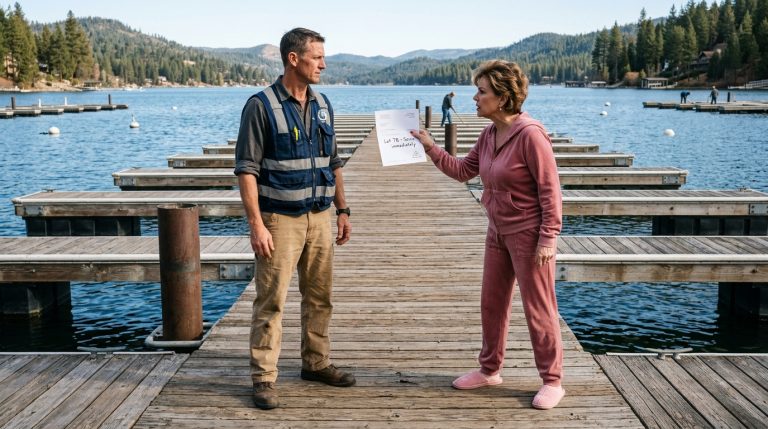
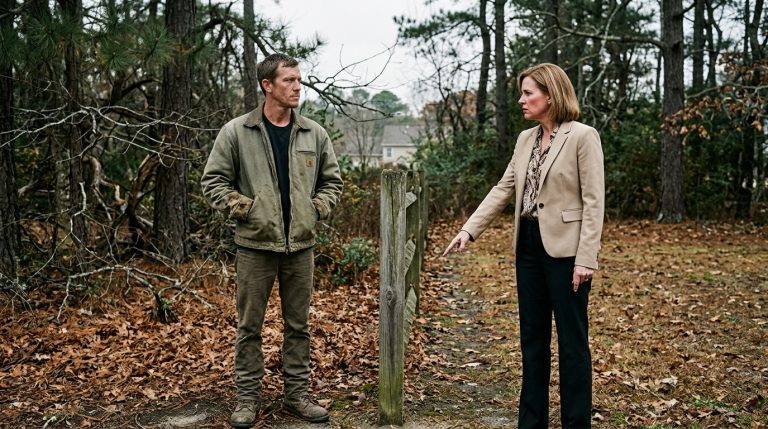
The bright orange survey stake hung from her hand like a broken branch, its tip clotted with damp, dark clay. Karen stood on the border of her pristine, unnaturally green grass, her pastel pink sweatsuit straining at the seams as she brandished the splintered wood.
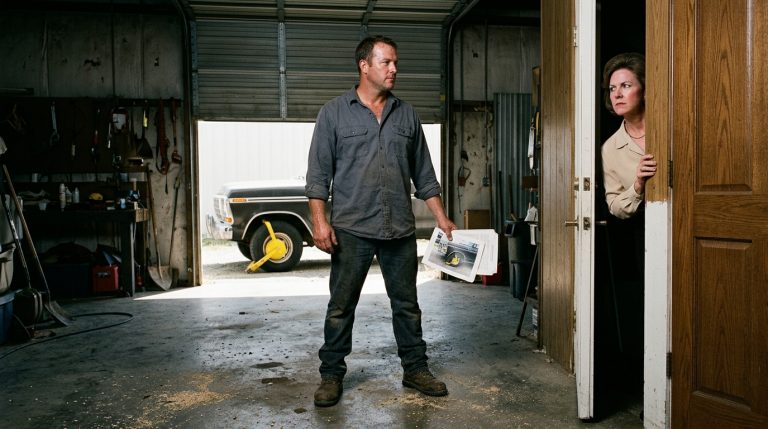
I didn’t move from the tailgate of my truck. The metal of the bumper was cold and slightly pitted with rust, a familiar grit that anchored me to the earth. I took a slow sip of black coffee, letting the steam bite the back of my throat. The morning air smelled of dry pine, engine oil, and the bitter copper tang of disturbed soil.
“The survey cost a thousand dollars, Karen,” I said, my voice flat, devoid of the heat she was clearly fishing for.
“A thousand dollars for kindling, then,” she replied, throwing the wooden lath into the dirt between us. “This is Willow Creek Estates. We don’t do metal garages, we don’t do gravel paths, and we certainly don’t do unapproved variables. You’ll have this trash cleared by sunset, or the board will make it very difficult for you to breathe out here.”
She turned, her white slippers sinking slightly into her manicured turf, and marched back toward her sliding glass door.
I didn’t follow her. I didn’t shout. Twenty years in the Army Corps of Engineers teaches you that raw anger is just wasted fuel. You don’t fight a fire with dry wood; you isolate it, strip it of oxygen, and let it choke on its own ash.
I walked over to the corner where the first stake had been driven. The earth was torn, the grass around the hole bruised and flattened. I knelt, my boots grinding into the dry, stony dirt of the Ardent-9 Plot.
My fingers brushed the empty space where the half-inch rebar monument should have been. But as I cleared away the loose clods of earth, my hand hit something solid. Not the clean, newly minted steel my brother Ben had driven into the ground just yesterday.
This was rougher. Flaking.
I cleared more dirt away, the dry earth scratching beneath my fingernails. Beneath the fresh excavation lay an old, heavy iron pipe, sheared off at an angle and deeply oxidized. It smelled of ancient iron and stagnant groundwater. Taped to the side of this hidden pipe, protected by a decaying plastic sleeve, was a weathered yellow document bearing the faded header of the Vanguard-West Title registry.
It wasn’t a standard property survey marker. The document was dated 1974, and the coordinates listed weren’t just for my property boundary. They marked a regional geological benchmark that had been deliberately defaced, bent backward into the earth by a heavy machine long before I ever signed the deed.
I pulled my phone from my pocket, the camera lens catching the sharp glare of the rising sun. I snapped a macro photo of the sheared iron, the faded plastic sleeve, and the unmistakable yellow paper.
Karen hadn’t just pulled my new stakes to protect her neighborhood’s view. She had been hiding a boundary line that had been physically altered decades ago.
CHAPTER 2: THE SILENT RECONNAISSANCE
The rusted metal flaked off under my thumb, leaving a dark, greasy smear across my skin that smelled of iron and stagnant groundwater. I held the weathered yellow slip of the Vanguard-West Title registry between two fingers, careful not to tear the damp, fibrous paper. It was a fragment of a larger puzzle—a legacy boundary marker shifted, buried, and forgotten beneath thirty years of suburban encroachment.
I slipped the document into my breast pocket, patted the canvas flat, and stood up. My knees popped in the morning quiet. To my left, the sprawling green lawns of Willow Creek Estates sat silent under the pale sun, their automated sprinklers hissing in unison. To my right, my two acres of un-cleared brush looked dark, wild, and entirely out of place.
I needed eyes on the ground. I needed to map the perimeter of Karen’s influence before she tried to rewrite the landscape again.
I grabbed my work jacket from the bed of the truck, the stiff canvas scraping against the tailgate, and started down the gravel path. I didn’t take the truck; a vehicle is a loud signature. Instead, I walked, my boots crunching softly on the transition where my crushed stone met the public asphalt of Willow Creek Lane.
The transition was jarring. The air on this side of the line smelled of fertilizer and freshly cut rye, clean and completely sterile. Every mailbox was a uniform charcoal gray; every driveway was a flawless stretch of dark asphalt without a single oil stain.
A block down, the low, rhythmic scrape of metal on chrome broke the silence.
I paused near a hedge of manicured boxwoods. In the driveway of a house that sat high on a terraced slope, a man with a military posture was wiping down the chrome pipes of a heavy Harley-Davidson. His movements were deliberate, his jaw set in a hard, square line that I’d seen in dozens of motor pools across three continents.
I stepped onto his driveway, keeping my hands visible, my thumbs hooked loosely in my pockets. “Nice rig,” I said, my voice low. “Seventy-four?”
The man didn’t look up immediately. He finished his stroke with the microfiber cloth, folded it precisely into quarters, and then turned his head. His eyes were the color of stagnant river water, sharp and unblinking.
“Seventy-six,” he grunted, his voice a gravelly rumble. “Last of the shovelheads. You’re Hayes. The engineer with the dirt out back.”
“Alex,” I said, extending a hand.
He looked at my hand, saw the dark iron grime still ground into my cuticles, and gave it a single, crushing squeeze. “George Miller. Retired Marine. I’ve been watching your little border skirmish.”
“It’s about to get louder,” I said, leaning back slightly against the cold brick of his mailbox. “She pulled the steel monuments last night. Ripped them straight out of the ground.”
George let out a short, dry laugh that sounded like dry leaves scraping across concrete. “Of course she did. Queen Karen doesn’t tolerate variables. Last year she tried to fine me because my American flag snapped too loudly in the wind. Said it was an audible disturbance to the community harmony.” He spat into his lawn. “I told her if she touched my pole, she’d be looking at the business end of a trespass suit. She backed off, but she’s like water, Hayes. She always finds the soft spots.”
“She’s looking for something specific,” I said, my hand instinctively checking the weight of the Vanguard-West document in my pocket. “This isn’t just about a steel workshop. She’s pushing too hard, too fast.”
George’s eyes narrowed. He stepped closer, his shadow falling across my boots. “You want to know about her reach? Walk down to number forty-two. The Garcias. Sweetest people on the block, lived here thirty years. Karen spent a year breaking them over a yellow door. A yellow door, Hayes. Because it didn’t fit the ‘Meridian’ color scheme.”
He paused, his hand gripping the handlebar of his bike until his knuckles went white. “She didn’t just fine them. She threatened a lien. She told them if they couldn’t afford the lifestyle, they should move. Mrs. Garcia had a minor stroke last fall from the stress. They painted the door beige. It broke them.”
A low chill settled in my chest, colder than the morning breeze. “She’s using the HOA as a lever,” I murmured.
“She is the lever,” George corrected. “But people are tired of the rust, Alex. We’re just waiting for someone to show us where the hinge is.”
I nodded, my mind already calculating the angles. “I’m going to go see the Garcias,” I said. “Thanks for the lead, George.”
“Keep your head down,” he called out as I turned back toward the street. “And watch your flanks. She’s already got the board running her errands.”
I walked down the quiet, winding street, the silence of the neighborhood feeling less like peace now and more like a held breath. The dirt under my fingernails was dry, flaking off as I walked, but the weight of the old iron monument stayed with me. This wasn’t a petty neighborhood dispute anymore. It was a siege, and I was just beginning to see the shape of the wall.
CHAPTER 3: THE CONCRETE ANCHOR
The dry asphalt of Willow Creek Lane burned through the thin soles of my boots as I walked away from George Miller’s terraced driveway. Behind me, the steady, rhythmic throb of his shovelhead engine gradually faded into the ambient hum of the morning, replaced by the high-pitched hiss of a neighbor’s oscillating sprinkler. I adjusted the stiff collar of my canvas jacket, my fingers brushing the edge of the Vanguard-West Title document tucked safely in my breast pocket.
Number forty-two sat at the bend of the cul-de-sac. Its exterior was a study in forced compliance—a sterile, uniform shade of builder-grade beige that looked like dried river mud under the harsh summer sun. I could still see the faint, dark ghost of buttery yellow paint bleeding through the edges of the cedar siding near the doorframe, a physical scar left by a bureaucratic blade.
I didn’t reach for the doorbell. Instead, I stood on the small concrete stoop, taking in the small details: a single, meticulously trimmed rosebush in a cracked clay pot, and a faded welcome mat worn down to the coarse brown fiber.
The door opened before I could knock. An elderly man with thin, silver hair and shoulders that sloped forward under a faded plaid shirt looked out at me through the screen. His eyes were milky, shadowed by a quiet, protective weariness.
“Mr. Garcia?” I asked, keeping my voice low, matched to the quiet of the porch. “I’m Alex Hayes. I own the acreage bordering your back fence line.”
He didn’t open the screen immediately. His fingers, spotted with age and slightly crooked, tightened on the wooden frame of the door. “George called me,” he murmured, his voice carrying the soft, rolling cadence of the southwest. “He said you were walking the line.”
“I am,” I said, leaning slightly against the weathered cedar post of the porch. “And I’m trying to understand the shape of what I’m fighting. George told me about your door.”
A shadow crossed his face, a brief flicker of old pain that seemed to age him another decade. He unlatched the screen, the metal hinges giving a dry, raspy squeak, and gestured for me to step into the cool, dim entry hall. The house smelled of cinnamon, old paper, and the sharp, clean scent of rubbing alcohol.
“It was never about the paint, Mr. Hayes,” a soft voice called from the kitchen.
An elderly woman appeared in the doorway, her small frame supported by a metal walker that clicked softly against the linoleum. Mrs. Garcia offered a faint, tired smile, but her eyes were fixed on the canvas pocket of my jacket.
“She wanted the paper,” she said, her voice trembling slightly but carrying a hard, stubborn core. “When we painted the door, she came with the board. They said they needed to verify our foundation survey. They wanted to see the old county plats from 1974. They kept asking if we had the original easement agreements for the northern boundary.”
Mr. Garcia walked over to a small mahogany sideboard, his hand reaching into a drawer to pull out a thick, tattered cardboard folder. He laid it on the dining table under the pale light of a single lamp.
“We kept everything,” he said, flipping open the cover to reveal a stack of yellowing letters, all embossed with the Willow Creek Estates HOA logo. “But look at this one. It came from her personal email, not the association’s management firm.”
I stepped closer, the rough grain of my work shirt scraping against the edge of the table as I leaned over the documents. My eyes scanned the text. It was a formal request for an access easement across the southern edge of their lot—specifically referencing the “Meridian-Green infrastructure corridor.”
My thumb brushed the heavy, textured paper. There it was. The second seed. Project Meridian-Green.
“She told us that if we didn’t sign the easement, the fines on the door would double,” Mrs. Garcia whispered, her hand resting on the chrome bar of her walker. “She said the community standard required a clear utility pathway. But our deed doesn’t list any utility rights-of-way here. This land has been private since the seventies.”
I pulled the Vanguard-West Title slip from my pocket and laid it side-by-side with their easement request. The coordinates on their document matched the hidden, altered geological monument I had just uncovered in the dry clay of the Ardent-9 Plot.
“She’s not trying to protect the neighborhood’s looks,” I said, the words falling cold and heavy into the quiet room. “She’s trying to clear a physical path through our properties. And she’s using the HOA’s rules to force you to hand over the key.”
Mr. Garcia looked from the yellowed document to my face, his jaw tightening. “Can she do that, Alex?”
“Not if the line is anchored in concrete,” I said, my voice flat, shifting back into the cold, calculated mindset of a logistics officer. “My brother Ben is coming back this weekend. We’re going to pour three feet of quick-setting mix around every monument on that boundary. She wants to clear a corridor? She’ll have to chisel through solid steel to do it.”
I gathered my papers, slipping the Vanguard-West title back into my pocket. The paper felt different now—no longer just a historical curiosity, but a weapon.
“Keep your door yellow on the inside, Mrs. Garcia,” I said, offering a small nod as I moved back toward the screen door. “We’re going to make sure she pays for the beige.”
I stepped back out into the dry, blinding glare of the afternoon. The air was dead, but as I walked back toward the Ardent-9 Plot, the low vibration of a heavy diesel engine rumbled in the distance. Ben’s F-250 was pulling up to the gravel path, its chrome grille coated in highway dust. The tools were arriving, and the ground was about to get much harder to move.
CHAPTER 4: THE MIDNIGHT FRICTION
The deep, throat-clearing rattle of the F-250’s diesel engine died with a mechanical sigh, leaving a heavy silence in its wake. A cloud of fine gray road dust rolled over the hood, settling on the dry weeds of the Ardent-9 Plot. The driver-side door swung open with a dry, metallic screech of dry hinges, and Ben stepped down onto the gravel, his heavy work boots sinking slightly into the loose stones.
“You look like you’ve seen a ghost, Alex,” Ben said, tossing a pair of stiff leather work gloves onto the tailgate.
“Not a ghost,” I replied, my fingers still resting on the rough canvas of my pocket where the yellowed Vanguard-West Title document lay. “Just the blueprint of a trap.”
Carlos, Ben’s young assistant, was already at the back of the truck, slide-dropping the heavy tailgate with a resounding slam that echoed off the neat, beige garage doors of Willow Creek Estates. Inside the bed lay four three-foot lengths of thick, galvanized steel pipe, their threaded ends rusted and grey, alongside three heavy bags of quick-setting concrete and a pair of long-handled post-hole diggers.
“Let’s get these in the ground before she decides to call her zoning board friends again,” Ben muttered, his hand lifting a heavy iron sledgehammer from the tool chest. “If she wants a war over a few inches of clay, we’re going to give her a boundary she’ll need a backhoe to move.”
We worked in silence, a coordinated rhythm of muscle and iron that required no translation. The post-hole digger bit into the stubborn earth, grinding against buried river rocks and dry, yellow clay. My shoulders burned under the noon sun, the rough canvas of my shirt scraping against my collar with every plunge of the steel blades. We cleared the holes down to thirty-six inches, the dirt dry and powdery at the top, but cool and packed like stone at the bottom.
By mid-afternoon, the sky turned the color of bruised iron. A sudden, hot wind began to whistle through the pine branches, whipping up the loose topsoil we had excavated. It was a summer dust storm, the grit stinging our eyes and threatening to contaminate the dry concrete mix before we could add the water.
“The wind’s shifting,” Carlos called out, squinting through the dust as he held one of the heavy galvanized pipes level in the first hole. “If this silt gets into the wet mix, it won’t cure right. It’ll crumble like chalk.”
I scanned the edge of my property, my eyes landing on a pile of discarded corrugated tin sheets from an old shed I had torn down. The metal was heavily oxidized, its surface a mosaic of orange rust and flaking gray zinc.
“Carlos, grab those tin sheets,” I ordered, my voice cutting through the rising howl of the wind. “We’ll cut them into collars to shield the holes. Ben, get the cameras up on the oak tree now. The wind is going to cake the lenses with dust if we don’t improvise some hoods.”
Using a pair of rusted tin snips from the truck’s toolbox, I sheared the corrugated metal into rough, heavy cylinders, my knuckles scraping against the jagged edges of the iron. We jammed the improvised metal collars into the mouths of the holes, blocking the wind-blown silt while Ben mixed the concrete in a battered steel barrow. We poured the grey, steaming slurry around the steel pipes, the chemical heat of the curing cement rising up to meet the dry heat of the storm.
By the time the last camera was clamped to the high branch of the oak tree—its lens protected by a small, hand-fashioned overhang of rusted tin—the sun had dipped below the horizon, leaving the sky a deep, desolate purple.
Now, the waiting began.
I sat in the dark cab of my truck, the engine off, the windows rolled down just a crack to let in the cooling night air. The smell of curing concrete, damp clay, and the faint, sweet scent of distant rain filled the small space. On my dashboard, the small blue indicator light of my phone flickered, displaying the live, infrared feeds from the three trail cameras.
The screen was a silent world of black, white, and ghostly grey. The property line was perfectly illuminated by the invisible infrared glow.
At 2:17 a.m., a pixel shifted on the screen.
A bulky, dark figure emerged from the shadow of the sliding glass door at number forty-two. Even in the pale monochrome of the screen, the voluminous floral bathrobe and fuzzy slippers were unmistakable. In her gloved hands, Karen carried a long, heavy iron pry bar, its claw end glinting under the starlight.
My chest tightened, a cold, calculated focus settling over me. I didn’t reach for the door handle. I didn’t start the engine. I just watched.
She approached the first corner monument—the one we had reinforced with three feet of steel and concrete. She didn’t hesitate. With a grunt that I could almost hear through the silent feed, she jammed the tip of the pry bar beneath the lip of the concrete anchor.
She threw her weight onto the bar. The metal groaned, but the monument didn’t budge. A look of dawning frustration crossed her face. She repositioned her feet, her slippers slipping in the loose dirt, and heaved again.
Nothing. The steel pipe, anchored deep in the concrete and shielded by the rusted iron collar, held fast.
She stood back, breathing heavily, her face twisted in a mask of pure, stubborn rage. She spat on the concrete, then turned and began to pace along the line, her eyes scanning the dark woods, entirely unaware of the three silent cameras recording the mechanical failure of her quiet invasion.
I tapped the screen, saving the file to the secure cloud. The trap had closed, and the line remained unbroken.
CHAPTER 5: THE DAYLIGHT AMBUSH
The screen of my phone went dark as I tapped the save command, locking the digital recording of her failure into the secure cloud. Outside the cab of my truck, the deep, desolate purple of the pre-dawn sky slowly dissolved into a flat, sterile gray. Karen had retreated back into her home, her boots dragging across the manicured grass, but the kinetic reality of her midnight defeat remained written in the dry dirt of the Ardent-9 Plot.
By 0930, the flat morning heat had settled over the property line like a wet canvas.
“She’s going to hit the wall today, Alex,” Ben said, his shoulder leaning against the dusty rear quarter panel of the F-250. His hand tapped rhythmically against a laminated copy of his state land surveyor credentials. “A bully with a crowbar is one thing. A bully who realizes the law is anchored in three feet of quick-setting concrete is another.”
“Let her hit it,” I replied. My boots ground into the gray silt we had fought during the storm. “We play the board exactly as we laid it.”
Carlos was already positioning the bright yellow tripod-mounted total station directly over the concrete-encased corner monument. He worked with an exaggerated, slow-motion deliberateness, his high-visibility orange vest catching the harsh glare of the morning sun. We weren’t just checking coordinates; we were setting up a stage.
The first twitch of the curtain at number forty-two occurred at exactly 0945.
Ten minutes later, the sliding glass door screamed along its metal track. Karen didn’t walk; she marched. The purple sweatsuit she wore was a violent contrast to the dry, desaturated weeds of the plot. In her right hand, she gripped her phone like a weapon, her face flushed to a dark, blotchy red.
“You are done here,” she said, her voice vibrating with a high, thin pitch that cut through the quiet morning air. “I told you yesterday, and I am telling you now in front of everyone—this is common area. You are violating the aesthetic harmony of Willow Creek Estates, and your little metal sticks are coming out today.”
Ben didn’t look up from his digital readout. “Ma’am, I am a licensed professional land surveyor acting under state statute,” he said, his voice flat, dry, and entirely transactional. “This point is registered under the Vanguard-West Title records. This is private property. Any interference with these monuments is a class C felony.”
“I don’t care about your numbers!” she shrieked, her finger stabbing toward my face. “I am the president of this association! I run this community, and I will have you arrested for trespassing!”
“Then dial the number, Karen,” I said, my voice dropping into the quiet, steady cadence of a tactical briefing. I held my phone at chest level, the camera lens focused on her twitching hands. “Call them. Let’s see whose line holds.”
Her face went pale, then mottled with a sudden, desperate anger. She stabbed at her screen, her breathing coming in ragged, shallow gasps that sounded like dry paper scraping together. “Yes, I need dispatch immediately! One-twelve Willow Creek Lane! There are armed men trespassing on our common area, threatening our residents!”
She was lying to the operator, throwing every heavy keyword she could find into the air, but her voice cracked on the final syllable. She stood on her perfect lawn, her chest heaving, waiting for the authority she had rented to vindicate her.
She didn’t hear the silent click of my phone recording her words. She didn’t see George Miller standing on his porch down the street, his arms crossed over his chest, his eyes fixed on her. She didn’t see the Garcias’ screen door open a fraction of an inch, the buttery yellow of their inner door frame catching the light.
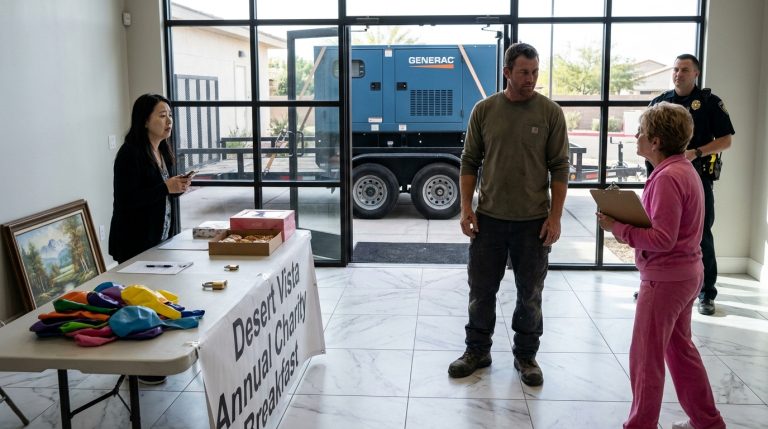
When the two white-and-blue patrol units pulled up to the curb ten minutes later, their tires crunching softly on the gravel, she rushed forward, her voice a torrent of breathless, rehearsed indignation.
“Officers, thank God! These men have been harassing us, putting up non-compliant steel posts on our common ground! I want them off this property now!”
The lead officer, Sergeant Miller, stepped out of the cruiser, his sunglasses reflecting the harsh glare of the sun. He didn’t look at her. His eyes went straight to the laminated surveyor’s license on the F-250’s dash, then to the clean, concrete-reinforced monument, and finally to the yellowed Vanguard-West document in my hand.
“Let’s slow down, ma’am,” the sergeant said, his voice a cool, professional wall. “Let’s look at the paper.”
I stepped forward, my movements slow and deliberate, and handed the file to the officer. “The deed is unincorporated county land, Sergeant. It’s never been part of the HOA. And more importantly, the woman who called you just admitted on camera to destroying the previous legal markers—which we have documented on infrared video from three separate angles.”
The silence that followed was heavy, broken only by the high, dry rattle of the wind through the dry weeds. Karen’s mouth opened, but no sound came out. The pasty shade of confusion that settled over her face was the first true indicator that her little kingdom was starting to slide into the dust.
CHAPTER 6: THE RECLAMATION OF SOIL
The silence on the boundary line was absolute. Sergeant Miller’s partner quietly slipped the digital storage drive containing the infrared recordings of Karen’s midnight incursions into her pocket. Karen stood on her manicured sod, her shoulders sloping inward as if the violet fabric of her sweatsuit had suddenly doubled in weight. Her mouth twitched, but no sound came out; the illusion of her absolute authority had dissolved right into the dry clay of the Ardent-9 Plot.
The legal machinery, once set in motion, did not grind slowly. It crushed.
Three weeks later, the sterile fluorescent lights of the Willow Creek Estates community clubhouse hummed overhead, casting a harsh glare on the crowded plastic chairs. The room was packed to capacity, smelling of stale coffee, wet raincoats, and a mounting, electric tension. I sat in the back row, my hands resting flat on my knees, feeling the rough, reassuring canvas of my work trousers. Beside me sat George Miller, his arms crossed over his chest like a sentinel, and the Garcias, their fingers intertwined on the metal handle of her walker.
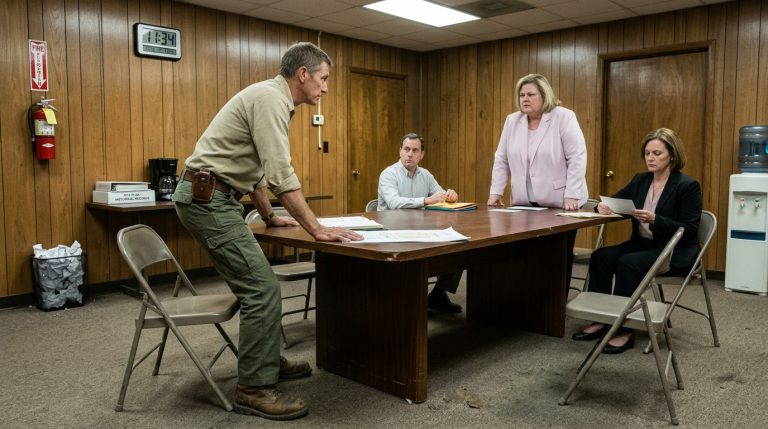
At the front table, Karen sat under the gaze of her four fellow board members. She looked visibly shrunk, her hands trembling as she adjusted a stack of generic folders.
“We are here to discuss the outstanding budget items,” Karen began, her voice a reedy, dry imitation of its former administrative venom.
“No, we aren’t, Karen,” George’s voice boomed from the back, cutting through the hum of the air conditioner. He stood up, his jaw rigid. “We are here to talk about the fact that your personal war has dragged this entire association into a felony investigation and a civil lawsuit.”
The room erupted into a low, angry roar. A pile of paper documents—fines for open garage doors, yellow paint, and children’s toys—swirled as residents waved them in the air. The other four board members looked like they were facing a firing squad.
I walked down the center aisle, my boots thudding softly on the linoleum. I didn’t raise my voice. I simply tapped the button on the projector remote.
The screen behind the board illuminated. First came the infrared footage of Karen in her bathrobe, straining against the steel pipe of our reinforced boundary monument with a heavy crowbar. Gasps rippled through the audience. Then came the second slide: a certified copy of the Vanguard-West Title registry and a leaked easement plan showing her personal signature on a commercial option agreement.
“This was never about standard rules,” I said, letting the words carry clearly through the silence. “The Ardent-9 Plot was being cleared. She used the HOA as a weapon to force the Garcias and me into giving up an easement for Project Meridian-Green—a commercial developer who was paying her a personal finder’s fee to bypass county zoning. She was ready to sell your borders to clear her own path.”
The betrayal was too stark for her former allies to ignore. Within ten minutes, a motion from the floor was made to strip her of her title and remove her from the board. The vote was immediate, unanimous, and silent. Karen gathered her leather purse with stiff, clumsy fingers and walked down the center aisle. The crowd parted around her, leaving a wide, quiet space of cold indifference. She did not look back.
The settlement arrived two months later, funded entirely by the HOA’s insurance carrier and a court-ordered liquidation of Karen’s personal assets.
The sun was setting on a Friday afternoon when I walked out to my newly completed workshop. The concrete floor inside was a smooth, light grey, smelling of fresh sealer and iron shavings. On the heavy car lift in the center of the bay sat the 1969 Mustang, its hood raised, its faded red paint catching the amber light of the dusk.
I walked over to the edge of the property line. A sturdy six-foot fence of red cedar now ran exactly along the legally established boundary. It was straight, solid, and built to last a lifetime. On the other side, I saw Mr. Garcia standing on his lawn. He held a paint roller in his hand, applying a bright, buttery yellow to his front door. He looked up, caught my eye, and offered a slow, grateful nod. Beside him, the American flag on George’s lawn snapped proudly in the evening breeze, making its own loud, undisturbed sound.
I walked back into the cool shadow of the workshop. I picked up a heavy chrome box wrench, its metal cool and familiar in my hand, and went to work on the Mustang’s engine block. The line was drawn, the soil was mine, and the silence was finally peaceful.