The Smoking Gun: A Calculated Dismantling of Power Within the Sterile Confines of Oakwood Preserve
CHAPTER 1: THE DRIVEWAY TRIBUNAL
The truck was a masterpiece of stainless steel and industrial potential, a twenty-four-foot monument to my decade of service and every cent of my severance pay. It sat in my driveway, gleaming under the harsh, unyielding suburban sun. To me, it was a dream. To the woman standing at the edge of my lawn, it was a target.
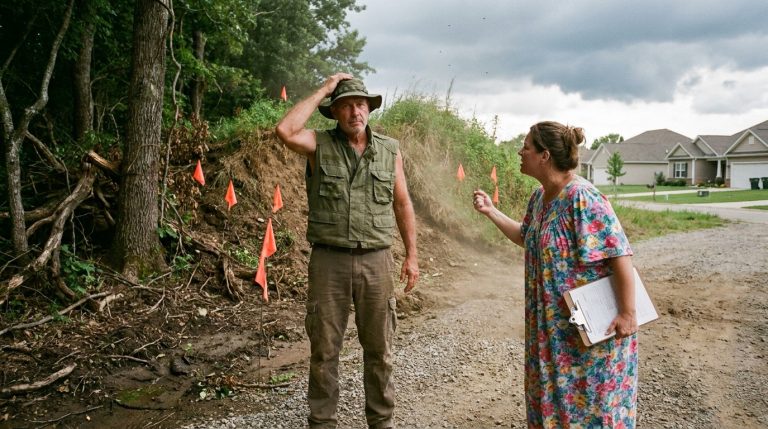
Karen Peterson didn’t walk; she descended. Her presence was a localized drop in pressure, a weather system of pure, unadulterated authority. Her clothes were crisp, expensive, and utterly devoid of color. She stopped at the concrete apron, her gaze dissecting the truck with the clinical detachment of a butcher examining a carcass.
“That monstrosity,” she spat, the words curling from her lips like sour milk. She didn’t look at me; she looked at the vehicle. Her hand, adorned with a ring that caught the light with a sharp, predatory glint, gestured dismissively. “It’s a commercial vehicle. A violation of section 12, paragraph C, of the Oakwood Preserve covenants. You have twenty-four hours to remove it, Mr. Jensen, or it will be towed at your expense. And consider yourself fined five hundred dollars.”
I didn’t blink. My pulse was a steady, rhythmic thud in my ears, the same tempo I had maintained when briefing commanders in the desert. I felt the cold, hard geometry of the situation: her position, her leverage, and the thin, brittle shell of the rules she used as armor.
“The truck is personal property, Karen,” I said, my voice intentionally level, a flat line against her erratic pitch. “It’s registered in my name. No signs. No cooking on-site. It’s parked in my driveway, just like your husband’s oversized SUV.”
She finally looked at me. Her eyes were small, hard pebbles, peering into slits of authority that had clearly never been challenged by someone who didn’t fear the outcome. “Don’t lecture me on semantics. The board’s interpretation of the covenants is final. It lowers property values. It’s an eyesore. And frankly, your presence here is becoming a nuisance.”
She turned on her heel, a movement so practiced it felt choreographed. I watched her walk away, the silence of the neighborhood returning like a physical weight. My jaw ached. The sun was warm on my skin, but the dread in my stomach was freezing, a deep, pervasive cold that suggested this wasn’t a misunderstanding. It was a declaration of war.
As she retreated, I noticed something caught under the wiper blade of her SUV—a yellow slip of paper that looked suspiciously like a copy of my own property survey. A sharp realization pierced the calm: she hadn’t just stumbled upon me. She had been tracking this movement for days. The battlefield was already defined, and I was losing before I had even realized the fight had begun.
I looked back at the truck. The chrome reflected a distorted, wider version of my own face—grittier, tighter, the soldier emerging from the civilian shell. If she wanted a war of paper and postage, she would get one. I reached into my pocket, felt the hard edge of my phone, and began to calculate the logistics of the counter-offensive.
CHAPTER 2: THE SIEGE LINE
Karen’s departure left a hollow ringing in my ears, a dissonance that didn’t belong in the manicured calm of Oakwood Preserve. I stared at the spot on the concrete where she had stood. The oil stains from my truck looked darker, more prominent against the pavement, as if they were drawing attention to themselves. I was standing in the open, exposed, and for the first time in years, the tactical habits of the desert surged to the surface, unbidden and sharp. I checked the perimeter of my own lawn, my eyes scanning the windows of the neighbors’ houses. Curtains twitched. A shadow moved behind glass.
The neighborhood wasn’t just a place to live anymore; it was a contested zone.
I walked back into the garage, the concrete floor cool under my work boots. The space had been my sanctuary, a place where I could organize tools and think through the logistics of a business that was supposed to represent my freedom. Now, it felt like an armory. I pulled out my legal pad, the one I had used to dissect the covenants, and flipped to the next empty page. My hand trembled, just slightly—a phantom tremor from a life I thought I had left behind in the dust of a dozen deployments.
“Mark?”
Sarah’s voice was soft, but it cut through the haze of my internal tactical briefing. She was standing in the doorway, a stack of mail in one hand and the same grim expression she’d worn since the eviction notice arrived. She didn’t have to ask what happened; the tension in my shoulders told the whole story.
“She’s coming for us, Sarah,” I said, my voice sounding foreign even to me—harder, more clinical. “Not just the truck. She’s mapping the target. She’s done this before, and she knows how to apply pressure until something snaps.”
Sarah stepped into the garage, closing the door behind her with a definitive click. She set the mail on the workbench and leaned against the frame of my truck. The stainless steel, usually so inviting, seemed cold now. “I did some digging,” she said, her voice dropping to a conspiratorial whisper. “While you were out, I looked up the county records for property liens and HOA litigations in the last five years. There’s a pattern, Mark. It’s not just people breaking rules. It’s a filtration system.”
I stopped writing. “Filtration?”
“She targets people who have resources, but also people who have a lot to lose,” she explained, her eyes searching mine for a reaction. “The ones who are likely to fold because they can’t afford the time or the legal fees to fight. It’s calculated. If you’re a single parent, or a veteran with a pension to protect, or someone who just bought in and is terrified of losing your equity—you’re the perfect mark.”
The logic of it hit me with the force of a physical blow. The silence of the garage suddenly felt suffocating, filled with the ghosts of soldiers I had known—men who had survived the most harrowing conditions only to be dismantled by the systems they came home to. I looked down at the highlighter in my hand, its yellow tip already frayed. I realized then that my desire for “predictability” had blinded me to the fact that I had moved into a battlefield governed by a different kind of war.
“I called Tom,” I said, my voice steadying as the plan began to calcify in my mind. “He’s got a space at his storage facility. An indoor bay. It’s secure, climate-controlled, and private.”
Sarah nodded slowly. “We move it tonight?”
“Under the cover of darkness,” I confirmed. “If she wants a battle of attrition, she’s not going to get it with the truck sitting on her front line. I’m going to deny her the objective. But we need to do more than hide. We need to start building a counter-case.”
I looked out the garage window toward the street. A neighbor’s mower cut through the evening air, a drone that sounded like a warning. The psychological phantom of my last deployment—the constant, grinding suspicion that every face could hide an enemy, that every route could be mined—pushed its way into my thoughts. I hated that feeling. I had come to Oakwood Preserve to bury it, not to invite it to dinner.
“We need to know who else she’s done this to,” I said, turning back to the legal pad. “If she’s filtering the neighborhood, there are others. People who didn’t fight back, or people who are still being squeezed. We’re going to find the ones who have a reason to want her gone.”
Sarah reached out, covering my hand with hers. Her touch was the only thing that felt real in the manufactured atmosphere of the suburbs. “Be careful, Mark,” she warned. “Don’t turn into the thing we’re fighting.”
I looked at my truck, then at the suburban street beyond. The sun had dipped below the horizon, and the streetlights were flickering to life, casting long, sharp shadows across the driveways. The transformation was already happening. I felt the familiar weight of a mission, the cold focus that meant everything else—the quiet life, the daughter’s bike, the peace—was moving into the background.
“I won’t,” I lied.
The rest of the evening was a blur of tactical preparation. We packed the truck as if we were prepping for a convoy. Every piece of equipment, every magnetic decal, every scrap of paper was accounted for. By 2:00 a.m., the neighborhood was in a deep, artificial sleep. The air was biting and cold, smelling of ozone and manicured lawn clippings.
I climbed into the driver’s seat. The engine turned over with a deep, throaty rumble that sounded like a challenge to the entire street. As I backed out of the driveway, the tires crunching softly on the asphalt, I caught a glimpse of Karen’s house. A single light was on in an upstairs window. I didn’t turn away. I watched it until I pulled onto the main road, the feeling of being hunted turning into the thrill of the hunt.
The siege had officially begun. I wasn’t just defending my property anymore; I was moving into position. And as I turned the truck away from Oakwood Preserve, I knew the version of myself that had arrived here six months ago was already gone, left somewhere in the driveway, replaced by someone who knew exactly how to dismantle an enemy from the inside out.
CHAPTER 3: THE ARCHAEOLOGY OF ABUSE
The drive to Tom’s facility was a descent into a different kind of quiet. Away from the suburban cul-de-sacs and the manicured, fearful lawns of Oakwood Preserve, the industrial district felt honest. It was a landscape of raw concrete, chain-link fences, and the rhythmic, guttural hum of long-haul trucks passing on the nearby highway. Tom met me at the main gate, his presence a solid, reassuring weight in the darkness. He didn’t ask why I was moving the truck at three in the morning; he just opened the gate, his face obscured by the brim of a worn baseball cap.
“Bay four is open, Mark,” he said, his voice gravelly and devoid of curiosity. “Electric, water, and full security. Nobody comes in here without me knowing.”
“I appreciate it, Tom,” I replied, pulling the smoking gun into the bay. The cavernous space swallowed the truck, the metallic echo of the engine cooling snapping back at us like gunfire.
“You’re deep in it, aren’t you?” he asked, not looking at me, but at the reflection of the work lights on the truck’s chrome.
“I’m just protecting my investment,” I said, a defensive reflex that tasted like copper in my mouth.
I didn’t stay to chat. Once the truck was secured, I went straight back to the car. The transition from the physical security of the bay to the mental load of the paperwork was abrupt. I had a stack of requests to draft—formal, aggressive, and grounded in the state statutes Marcus had pointed me toward. Back at the house, the living room felt like a command center. Sarah was already awake, her laptop open, the screen glowing like a beacon in the dark.
She didn’t look up when I entered. “I’ve been looking at the state property codes, Mark. The HOA board isn’t a sovereign nation. They have fiduciary duties. Every fine they issue, every contract they sign, it has to be justifiable under the community’s best interest. If we can prove they’re using these rules to benefit a specific group—or just one person—we have the lever.”
I sat across from her, the legal pad open. “I don’t want to sue them for money, Sarah. I want to sue them for transparency. If they have to disclose everything—every contract, every minute of every meeting—they’ll have to operate in the light. Bullies hate the light.”
We spent the next six hours in a methodical, surgical disassembly of our situation. It was archeology; we were digging through the layers of the HOA’s history to find the foundation of Karen’s power. My phone sat beside me, the screen dark, an anchor tethered to the inevitable calls I would have to make.
Around 5:00 a.m., I found it. Tucked into a folder of old landscaping invoices Sarah had pulled from a previous audit, I found a handwritten note clipped to an invoice from a company I didn’t recognize. The name was G.T. Maintenance. At first, it looked like a simple typo or a secondary contractor, but when I cross-referenced the service date with a board meeting, the timing was too precise to be coincidental. The invoice was approved the day before Gary Thompson—the man I’d seen walking his dog near Karen’s house every evening—was appointed to the architectural committee.
My heart rate spiked. It was a small, almost invisible discrepancy. It was the kind of thing someone would only notice if they were looking for the exact seam where the corruption started. I tapped the name on the screen.
“Sarah,” I said, my voice barely audible. “Look at this.”
She leaned over, her brow furrowing. “G.T. Maintenance. Gary Thompson’s initials?”
“And he’s the one who’s been pushing for the stricter enforcement on commercial vehicles,” I added, the pieces clicking together with the chilling precision of a machine. “He wasn’t just a committee member. He was a supplier.”
The realization wasn’t a triumph; it was a cold, clarifying dread. We were looking at a closed loop. Karen enforced the rules that made Gary’s services necessary, and Gary’s company was being fed contracts that were paid for by the fines she levied on the rest of us. It was a perfect, self-sustaining system of exploitation. The “eyesore” of my truck wasn’t just an aesthetic grievance—it was an obstacle to their bottom line.
The sun began to bleed into the room, casting a pale, unforgiving light on the piles of paper. I felt a surge of exhaustion, but beneath it, the tactical hunger was sharper than ever. I realized I couldn’t just fight this on paper anymore. I needed to see it, to confirm it.
I picked up the phone and dialed the number for the local government’s business registry. I was a logistics officer; I knew how to map a supply chain, and I was about to trace this one all the way to its source.
“I’m going to reach out to David Petri,” I said to Sarah, not looking away from the screen. “He was the first one she targeted. If she had a system, he was the prototype. He’ll know exactly how far back this goes.”
Sarah hesitated, her hand hovering over the keyboard. “Mark, once we make that call, there’s no going back. We aren’t just protecting the truck anymore. We’re going to be targets.”
I looked at her, and for a moment, I saw the fear in her eyes—a reflection of the vulnerability I had hoped to insulate her from. But I also saw the resilience. She wasn’t just my partner; she was the only reason I was still thinking clearly.
“We’re already targets,” I said, my voice hardening. “The only difference is, now we know the range.”
I dialed the number. It rang once, twice, three times—a hollow, rhythmic sound that seemed to measure the distance between the life I had wanted and the war I was now fighting. On the fourth ring, a voice answered, rough and weary.
“Yeah?”
“David? This is Mark Jensen. We need to talk about Oakwood Preserve.”
The line went silent. In that silence, I felt the shift. The archeology was done. The structure was exposed, and it was time to start tearing it down, brick by brick.
CHAPTER 4: THE BREACH
The Oakwood Preserve clubhouse smelled of stale chlorine and cheap commercial-grade carpet cleaner—a sterile, suffocating scent that clung to the back of my throat. It was ten business days since the “legal stiletto” Marcus had drafted landed on Karen’s desk, and she had finally folded. Or, more accurately, she had been forced to concede ground. The boxes were stacked in the corner of the beige-walled room, five cardboard monoliths that represented the entire history of her administrative tyranny.
“They look like they’ve been sitting in a damp basement for a decade,” Sarah whispered, her eyes tracking the dust motes dancing in the pale afternoon light that filtered through the high, narrow windows.
I didn’t answer. I just moved toward the pile, my hands feeling heavy and capable. Karen was sitting at the far end of a long, folding table, her back perfectly straight, her eyes fixed on her phone. She didn’t look up as we entered. She didn’t offer a greeting. She simply existed as a sentinel, a gatekeeper guarding the remnants of her own bad faith.
I pulled the first box toward me and cracked the tape. The sound of it ripping through the silence was like a gunshot in a library. Inside, the documents were a chaotic mess of meeting minutes, invoices, and violation notices—a paper labyrinth.
“Four hours,” Karen said, her voice thin and cold, not looking up from her screen. “That’s the window. I’m not staying a minute longer.”
I ignored her. My focus shifted to the physical texture of the work. I pulled out a stack of meeting minutes, the paper thin and yellowed at the edges. Sarah settled in beside me, her laptop open, the screen’s glow catching the edge of her glasses. We worked in a state of hyper-focused rhythm. I was the triage—scanning, sorting, discarding the noise to find the signal. Sarah was the architect, building the spreadsheet that would eventually serve as our evidence map.
The first hour was frustration. Most of the files were banal—playground maintenance schedules, requests for tree trimming, minutes from meetings that had clearly been scripted in advance. But then, I hit the fourth box. I felt the change in the atmosphere immediately. The tone of the correspondence shifted from administrative to punitive.
I pulled out a document, then another. They were violation notices—dozens of them—all signed by Karen, all citing the same vague catch-all clauses that she had used against me. I began to line them up on the table, a physical timeline of her campaign. The scale of it was staggering. It wasn’t just a pattern; it was a systematic harvesting of the neighborhood’s stability.
“Look at this,” I murmured, sliding a notice across the table toward Sarah. It was a fine levied against a neighbor for an ‘unapproved mailbox flag’—a minor infraction that had somehow escalated into a legal threat.
Sarah looked, her expression tightening into a grim line. “She wasn’t just enforcing rules, Mark. She was manufacturing crises. Look at the date. This was three weeks before she introduced the new vendor contract for mailbox cleaning services.”
I felt a cold thrill of clarity. It wasn’t just the landscaping; it was everything. She was creating the problems, then selling the solution, using the association’s dues to pay for it all. I looked over at Karen. She was still staring at her phone, but her hand was gripping it so tightly that her knuckles were white. She knew what we were finding. She could feel the narrative shifting, the walls of her paper fortress beginning to crumble.
I reached into the next box and pulled out a file that stopped me cold. It was the David Petri file. It was thick, heavy with the weight of a man’s life being systematically dismantled. I opened it and saw the photographs—staged, timestamped, and clearly taken from a position of hiding. My blood turned to ice. She had been stalking him, just as she was stalking me.
“She didn’t just want him gone,” I whispered to Sarah, my voice a jagged edge. “She wanted to destroy the precedent of anyone standing up to her.”
I took a photo of the file with my phone, the shutter click sounding impossibly loud. Karen stood up, her movement sudden and violent. “Time’s up,” she announced, her voice trembling with an effort to sound composed. “The four-hour window has expired. Get out.”
I didn’t argue. I didn’t gloat. I simply gathered my notes, my phone, and the evidence I had secured. I looked at her—really looked at her—and saw not the invincible authority figure she portrayed, but a small, frightened woman who was realizing that her control was an illusion.
“We’re done here, Karen,” I said, my voice quiet but carrying a weight that forced her to flinch. “But we’re just getting started.”
We walked out of the clubhouse and into the cooling afternoon air. The neighborhood looked the same as it had when we arrived—the manicured lawns, the quiet streets—but to me, the texture of the place had changed. The silence wasn’t peace anymore; it was a holding pattern. We had the evidence, we had the connections, and the blueprint of her operation was now sitting in my pocket. The breach had been successful. Now, we had to figure out how to take the whole thing down without burning the neighborhood to the ground with it.
CHAPTER 5: THE TROJAN HORSE
The ride back from the clubhouse was spent in a silence so thick it felt like driving through liquid lead. Sarah kept her eyes fixed on the passenger window, her fingers tapping a restless, erratic rhythm against her thigh. Every car that passed, every flickering streetlight, felt like an observation post. We weren’t just homeowners anymore; we were operatives in our own neighborhood, and the realization that Karen was now aware of our intelligence-gathering felt like a tightening noose.
As soon as we pulled into our garage, the phone in my pocket—the cheap, pre-paid device we’d bought for the “Patriot Provisions” front—vibrated with a sharp, insistent buzz. I pulled it out, the screen glowing with a generic incoming call notification.
“It’s the burner,” I whispered, the tactical instinct taking over. I hit the speaker button.
“Mark,” David Petri’s voice crackled through, sounding brittle and rushed. “She knows. Or she suspects. She just sent a blast email to the entire board about ‘security breaches’ and ‘unauthorized access to private association records.’ She’s framing the document review as a theft. She’s moving to lock the books and get a motion passed to bar us from future inspections.”
I felt a surge of hot, focused adrenaline. “She’s panicking. Good. If she’s moving to block access, it means we hit a nerve—literally. What’s the timing on the block party bid?”
“She accepted the proposal,” David replied, though his tone was heavy with a mix of apprehension and grim amusement. “She sent the signed contract an hour ago. She’s banking on this event to solidify her standing with the community—to show them she’s still the queen of the cul-de-sac.”
“Then we play the hand,” I said, my gaze shifting to the workbench where the blueprints for the smoking gun sat rolled up like a weapon. “We go through with it. We bring the truck.”
The plan felt more dangerous now, the stakes elevated from a mere neighborhood dispute to an active insurgency. We had the contract, we had the Trojan horse, but we also had an antagonist who was now fully alerted to the threat. I spent the next three hours in a state of high-octane maintenance. I checked the gas lines, the grease traps, the cooling systems—not because they needed it, but because the physical labor was the only thing keeping the encroaching paranoia at bay.
The glitch occurred around midnight. I was trying to sync the burner phone with the tablet we’d use to manage the catering orders, but the software kept cycling, unable to verify the P.O. box credentials we’d used for the LLC. It was a stupid, mundane failure—a technical hurdle that felt like a deliberate jab from the universe.
“The server’s down,” Sarah said, looking over my shoulder as the screen flashed an error message. “The Pack and Ship store, they use an encrypted relay for all their business accounts. If they’re updating their security, we’re locked out of the P.O. box correspondence for at least twenty-four hours.”
“We can’t afford twenty-four hours,” I snapped, the frustration finally leaking into my voice. I leaned back, rubbing the grit from my eyes. The sharp, metallic scent of the garage—the oil, the steel, the cold concrete—seemed to amplify the tension. “If she sends a verification request to that address and we don’t respond, she’ll cancel the contract before we even reach the cul-de-sac.”
I stood up and paced the narrow length of the garage, the rhythm of my boots on the concrete matching the frantic pulse in my temples. I had to pivot. The digital trail was failing, so I had to make the move physical.
“Forget the digital verification,” I said, stopping in front of the workbench. “We drive to the Pack and Ship in the next town over. Right now. We go to the facility manager, we show them our registration documents in person, and we override the server bypass. It’s an extra hour of travel, and we’ll be exhausted, but it ensures the paper trail stays live.”
Sarah looked at me, her face pale in the harsh overhead light. “Mark, if someone spots us at that store—if someone from the HOA sees us—”
“They won’t,” I said, already grabbing my keys. “We take the back roads. We’re ghosts, Sarah. That’s the nature of this work.”
The drive was a lesson in endurance. The winding back roads were shrouded in a thick, low-hanging mist that distorted the headlights, making every tree look like a sentry. We didn’t speak. The atmosphere inside the car was defined by a quiet, shared resolve, the kind that only exists when you know that a single wrong move could end the entire mission.
When we reached the Pack and Ship, the store was dark, save for the blue glow of the security kiosk. I hammered on the glass until the night manager appeared, a sleepy, irritated man who clearly didn’t want to be dealing with two strangers at one in the morning. I didn’t give him a chance to refuse. I laid out our documentation with the surgical precision of an officer delivering a brief, appealing to the professional weight of our situation.
“I have a business, and I have a contract that needs to be active,” I said, my voice steady, stripped of all civilian politeness. “If I don’t verify this account tonight, I lose an event that feeds two hundred people. You want to be the one who tells me I failed, or do you want to unlock the terminal?”
He looked at the papers, then at my eyes—at the look of a man who had seen worse things than a locked server—and he sighed, sliding the key into the terminal.
It took ten minutes. When the confirmation light finally turned green, the relief was so profound I almost collapsed. We had the contract, we had the connection, and we had the Trojan horse. We were back on schedule. As we drove home, the sun starting to paint the horizon in shades of bruised purple and gray, I felt the shift. We weren’t just fighting back anymore. We were setting the trap, and by the time the block party arrived, Karen Peterson would be the only one caught in it.
CHAPTER 6: THE BLOCKBUSTER
The morning air in the garage was thick with the scent of old grease and the sharp, chemical tang of the printer toner we’d used for the packets. I stared at the piles—each one a precise, damning indictment of Karen’s administration. My hands felt raw, the skin cracked from hours of assembly. Sarah sat on a nearby milk crate, her head resting on her knees, the exhaustion finally pulling at her frame. She looked fragile, but when she lifted her head, the look in her eyes was tempered steel.
“We have to be fast,” she said, her voice raspy. “Once we start dropping these, there’s no recall. Karen will be notified within minutes.”
“That’s the point,” I replied, grabbing a stack and jamming them into my tactical vest. “We need the distribution to be simultaneous. If she gets a head start, she’ll just start collecting them herself, acting like it’s neighborhood trash. We need everyone to have one before she can mobilize a response.”
I looked at my watch: 7:15 a.m. The neighborhood was just starting to stir. I could hear the distant, rhythmic hum of a garbage truck, the sound of a garage door rolling up three houses down. I moved to the door and eased it open just a crack. The street was quiet, the shadows of the trees still stretching long and thin across the pavement.
“Take the north side,” I said to Sarah, handing her a portion of the load. “I’ll handle the south and the cul-de-sac. David and the others are on standby at the periphery. Once you drop a packet, you move to the next. Do not linger. Do not engage.”
We moved out into the dawn. The grass was wet with heavy dew, soaking through my boots, but I didn’t feel it. I was in a tunnel of singular focus, my mind partitioning the street into sectors. The first house was the Miller’s. I hurried up the path, my heart hammering against my ribs, and slid the packet under their mat. I didn’t knock. I kept moving, the paper rustling against the fabric of my vest like a deck of cards.
By the time I reached the fifth house, the adrenaline was beginning to warp my perception. Every movement in a window felt like Karen watching me; every silhouette in a doorway looked like a potential threat. I caught myself scanning the bushes, my hand instinctively checking for the weight of the packets, my eyes searching for the tactical high ground. Stop it, I told myself, a cold voice in the back of my mind. You’re not in a patrol zone. You’re in the suburbs. But the distinction felt increasingly thin.
At the seventh house, a neighbor—an older man named Henderson who I’d exchanged polite nods with for months—stepped out onto his porch to retrieve his morning paper. He froze when he saw me, his eyes darting to the packet in my hand, then to my face. I didn’t wait. I stepped forward, shoved the packet into his hand, and walked away before he could ask a question.
“Read it,” I said, my voice tighter than I intended.
He didn’t reply, just stood there, the white paper looking stark and aggressive against his bathrobe. As I rounded the corner toward the cul-de-sac, I saw David Petri standing by a mailbox, his movements efficient and practiced. He caught my eye and gave a sharp, imperceptible nod. The distribution was happening. The information was flowing.
I approached the cul-de-sac—the epicenter. My target was the house directly across from Karen’s. I needed to get the packet to the front door without being spotted by her driveway security cameras. I hugged the fence line, the wood rough against my palms, feeling like a thief in my own community.
That was when the irony hit me: I was using the same shadow-bound tactics she had used to stalk David, to monitor the Millers, to build her web of control. The realization was a bitter, metallic taste. I wasn’t just exposing her corruption; I was mimicking her methods. For a fleeting second, I stopped, the packet trembling in my grip. Is this the cost? I thought. Do we have to become the monster to kill it?
I shook the thought away, the discipline of the soldier overriding the doubt of the civilian. I reached the door, deposited the packet, and retreated into the cover of a thick hedge.
From my vantage point, I watched. A few minutes later, the front door of the house opened. A woman stepped out, picked up the packet, and began to read. Her posture changed—she stiffened, her hand flying to her mouth, her eyes widening as she scanned the pages. She looked up, toward the street, her eyes locking onto the cul-de-sac, toward Karen’s house. She turned and went back inside, but she didn’t close the door immediately. She stood there, watching the street.
The seed was planted. The neighborhood was waking up to a reality they had been carefully shielded from for years. I checked my watch: 8:00 a.m. The block party wasn’t for hours, but the internal collapse of the HOA had already begun. Karen Peterson didn’t know it yet, but the ground she stood on had just turned to quicksand. I headed back toward home, my pace steady, my mind already calculating the next move, but as I walked, the silence of the neighborhood no longer felt artificial. It felt heavy, expectant, and charged with the kind of kinetic energy that only comes before a storm.
CHAPTER 7: THE PIVOT
The cul-de-sac was a pressure cooker. I climbed down from the driver’s side of the smoking gun, my boots hitting the asphalt with a sound that felt deliberate, a rhythm I was forcing onto the chaotic energy of the neighborhood. The air smelled of hickory smoke—the scent of my own success—but underneath it was the sharp, ozone-like tension of a storm about to break.
Karen Peterson stood by the barricades, her red, white, and blue pantsuit looking garish against the somber backdrop of the gathering crowd. She wasn’t shouting. She wasn’t blustering. She was just waiting. That composure was the most dangerous weapon she had.
“You’re late, Mr. Jensen,” she said, her voice cutting through the murmurs of the crowd like a knife.
“I’m exactly where I need to be,” I replied, my voice steady, though my pulse was a frantic, irregular beat. I could see the patrol cruiser idling at the mouth of the cul-de-sac—the senior officer, a man I’d seen around town, watching with eyes that held the weary, cynical weight of a lifetime of neighborhood disputes.
I turned to the crowd. They were holding the packets, the edges of the papers crinkled and torn. Some looked at me with expectation, others with raw, open anger toward Karen. David Petri stood near the back, his arms crossed, a silent sentinel for the years of abuse she had doled out. I saw Marcus, my lawyer, standing near the barricade, his briefcase gripped tightly. He gave me a single, sharp nod.
“Ladies and gentlemen,” I began, my voice projecting with the clarity of a field briefing. “We are here for a block party. But we’re also here because the rules that govern our home have been used to dismantle our security. We have the contracts. We have the proof of financial malfeasance regarding Evergreen Solutions and the board’s selective enforcement.”
Karen didn’t react, but I saw her jaw tighten. She stepped forward, her hand moving to her phone—a gesture that looked like she was about to summon the authority she had always relied on to crush dissent.
“Officers!” she shrieked, her voice finally cracking, the mask of the composed tyrant slipping to reveal the panic underneath. “This man is trespassing! He’s trying to extort this association. Arrest him!”
The senior officer stepped out of his cruiser, his gait slow and measured. He didn’t look at Karen. He looked at me, then at the crowd.
“Mr. Jensen,” the officer said, his voice flat. “Is this man your legal counsel?”
“He is,” I said, pointing to Marcus.
Marcus stepped up, his briefcase opening with a soft click. He didn’t offer a monologue; he offered a stack of papers. “Officer, my client is here as a contracted vendor. We have the signed agreement, the business registration, and a formal complaint regarding the misappropriation of association funds by the current board president. We are not here to cause a disturbance. We are here to fulfill a contract and provide evidence of criminal activity to the authorities.”
The scene erupted. The murmurs turned into shouting. I could hear Mrs. Gable’s voice, frail but resolute, calling out about her gnomes. The Millers were demanding to know why their fines were being used to pay for Karen’s private legal consultations.
Karen was physically vibrating, her face a blotchy, frantic mess of color. She turned to her “gargoyles,” Gary and Albert, but they had already backed away, distancing themselves from her like rats fleeing a sinking ship. She was alone.
Then, the psychological phantom hit me. For a split second, the cul-de-sac blurred into the dusty, sun-bleached expanse of my last deployment. I saw the faces, the uncertainty, the fear of the unknown. I remembered the feeling of holding a position that was becoming untenable. Hold the line, the voice inside me commanded. Don’t let her dictate the tempo.
I looked at Karen. I saw the hollowness of her expression. She had nothing left. She had played her final card—the threat of police force—and it had been neutralized by the very legal structure she had exploited.
“It’s over, Karen,” I said, my voice quiet, cutting through the noise. “The documents are with the DA. The board is done. You have no one left to order around.”
She didn’t answer. She just stood there, her shoulders slumping, the veneer of authority finally, completely, peeling away. She looked around at the faces of her neighbors—the people she had treated as subjects for years—and she finally saw them as people. She turned and walked toward her house, her gait stumbling, her composure shattered.
The police officer signaled for the crowd to move back, but the tension was changing. The anger was dissipating, replaced by the heavy, silent weight of realization. We had won. The tactical goal was achieved. But as I watched her door close, I felt a hollow, cold void in my chest. I had dismantled the tyrant, but I had used her own tools to do it. The victory didn’t feel like liberation; it felt like a mirror, reflecting a version of myself I wasn’t sure I could live with.
CHAPTER 8: THE PRICE OF THE BATTLEFIELD
The silence that followed was not the peaceful stillness I had craved six months ago. It was a vacuum, sharp and thin. People were still standing in the street, their conversations muted, the energy of the confrontation leeching out into the cooling pavement. I watched Karen’s house—the closed blinds, the single dim light in the foyer—and felt a strange, cold detachment. The “gargoyles,” Gary and Albert, were already vanishing into the shadows of their own driveways, their heads bowed, their posture that of men who knew their relevance had expired with their leader.
I walked over to the smoking gun. The stainless steel sides were still warm, radiating the heat of the long cook. I reached out and ran my hand along the surface, feeling the slight vibration of the cooling metal. It had survived. It had served its purpose as both a tool of my livelihood and a weapon of this war. But as I touched the surface, I didn’t feel the pride of a soldier who had successfully defended his post. I felt the hollow ache of a man who had burned his own house down to kill the spiders.
Sarah approached me, her steps quiet. She stopped beside me, her eyes tracking the same darkened window I had been staring at. She didn’t speak for a long time. She didn’t need to. I could see the reflection of the streetlights in her glasses, and behind them, a exhaustion that went deeper than the last twenty-four hours of maneuvering.
“Is it done?” she asked. Her voice wasn’t triumphant; it was soft, cautious, as if she were afraid that speaking the words might shatter the fragile reality we had just constructed.
“The board is calling an emergency session tomorrow,” I said, reciting the facts like a mission brief. “Susan is taking interim command. The forensic audit is already underway. Karen is looking at criminal charges. It’s done.”
“Then why do you look like you’ve lost?”
I turned to her. The truth sat heavy in my throat, a realization I hadn’t been able to articulate until this exact, quiet moment. The Layer 2 of this conflict wasn’t the corruption, or the kickbacks, or the petty tyranny. It was the fact that to win, I had been forced to adopt the same calculated, predatory lens that Karen had used to rule. I had monitored neighbors, manipulated their fears, and used their grievances as leverage. I had weaponized the very system I claimed to hate, proving that in this environment, power didn’t care about the morality of the user—only their efficacy.
“I won the battle, Sarah,” I said, my voice barely audible over the distant sound of a neighbor’s car pulling into a drive. “But I realized tonight, in the middle of that confrontation, that I wasn’t just fighting her. I was becoming her. I was enjoying the chess moves. I was calculating the vulnerabilities. I was turning our neighbors into pieces on a board.”
Sarah reached out and took my hand. Her grip was tight, grounding me to the cold pavement. “You were fighting to protect us, Mark. There’s a difference.”
“Is there?” I asked. I looked at the neighborhood—the houses, the lawns, the people who were now tentatively starting to talk to one another again, the fear finally beginning to ebb. I had saved the sanctity of our home, yes. But the feeling of total, absolute control that had fueled me during the last week was a drug, and now that it was gone, I felt the withdrawal.
I turned away from the house and walked back toward our own driveway. I needed to do something physical, something that didn’t involve tactics or leverage. I knelt by the front garden, where I’d accidentally trampled a row of marigolds while unloading the truck earlier that day. The stems were bent, crushed into the dirt.
I spent the next hour there, in the dark, my fingers working the soil. I braced the stems with small twigs, cleared the debris, and watered them until the earth was dark and rich. It was a simple, meaningless act, a tiny repair in a world that had been turned upside down. But as I worked, the tension in my shoulders began to release.
I looked up to see Lily standing on the porch, her small face bathed in the soft yellow glow of the entryway light. She was watching me, her eyes curious and calm. She didn’t see a combat veteran or an HOA insurgent. She just saw her father fixing the garden.
“Are the flowers going to be okay, Daddy?” she asked.
“Yeah, Lil,” I said, standing up and brushing the soil from my knees. “They’re resilient. They just needed a little help getting back on their feet.”
I walked back to the porch and sat down next to her. The house was quiet. The street was quiet. For the first time in months, I didn’t feel the need to scan the windows. I didn’t feel the need to check the perimeter. I just sat there, listening to the wind move through the trees, the smell of the damp earth replacing the metallic, antiseptic scent of the investigation.
The victory was real. The corrupt system was dismantled, and the neighborhood was free to breathe again. I had paid a price, and the scar would remain—a reminder of how quickly a man can lose himself in the mechanics of a war. But the war was over. I wasn’t the soldier anymore. I was just a neighbor, sitting on a porch, waiting for the sun to rise on a day that, for the first time, felt like it actually belonged to us.