The Weight of the Land: A Quiet War Against the Encroachment of Rusted Steel and Bureaucracy
CHAPTER 1: THE GATE
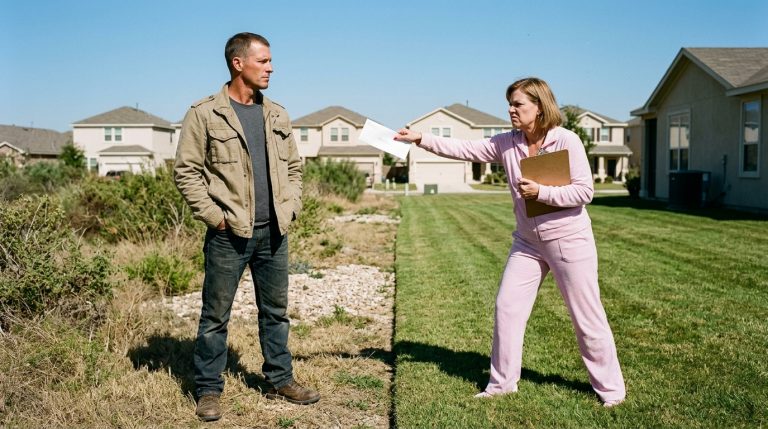
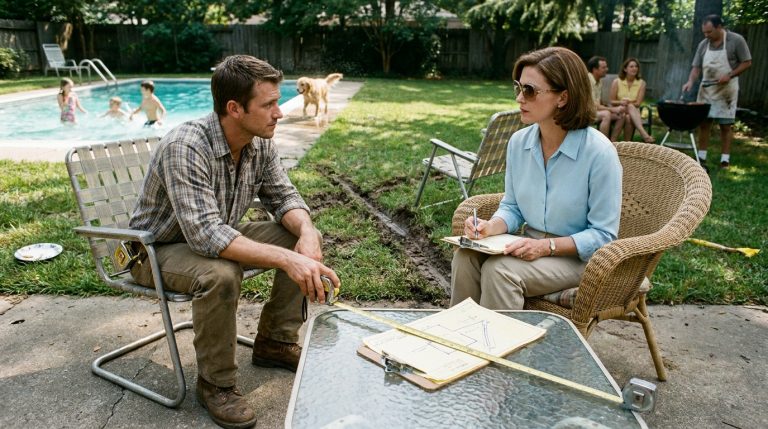
The scent of aggressive floral perfume preceded her, drifting through the screen door the moment I stepped onto the porch. Dolores Fitch didn’t wait for an invitation; she stepped out of her SUV with the practiced grace of a woman who had never been told “no” in a capacity that mattered. She carried a manila folder tucked under her arm as if it were a weapon of state, her smile fixed and brittle, a barrier designed to deflect rather than connect.
“Mr. Voss,” she said, her voice carrying over the sound of the wind moving through the ponderosas. She didn’t look at the land; she looked at the dirt path, measuring it with her eyes, converting my solitude into potential square footage.
I didn’t answer. I leaned against the porch rail, my hands buried in my pockets, feeling the weight of the key to the main gate—a heavy, cold piece of iron that felt like the only anchor in a suddenly shifting world.
“The community has really been counting on this access,” she continued, gesturing vaguely toward the lower track where the creek carved a jagged scar through the shale. Her tone was that of a bureaucrat announcing a necessary maintenance schedule, not a neighbor asking for a favor.
“Ma’am,” I said, keeping my voice level, stripped of the reflexive anger that burned just beneath the surface. “The community doesn’t own this land.”
She paused, the smile faltering for a micro-second before it snapped back into place, tighter than before. She opened the folder, revealing a map covered in colored highlighters—a surgical dissection of my property lines. “We have the planning commission on our side, Garrett. This isn’t just about us. It’s about the functionality of the ridge.”
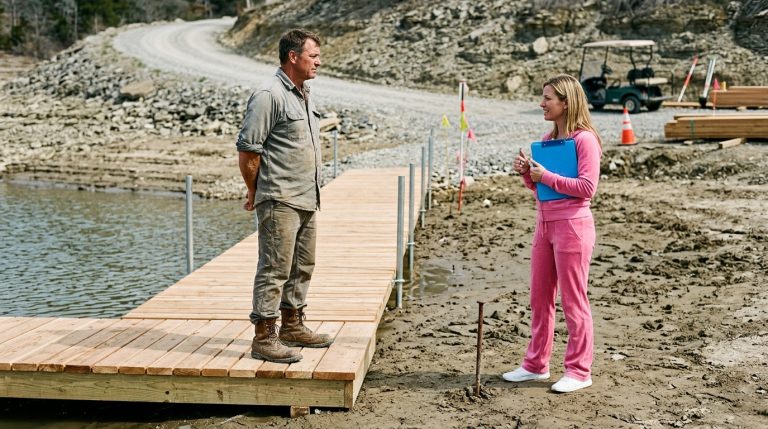
As she spoke, I noticed something that sat wrong against the landscape. Beyond the line of the fence, where the dirt turned to disturbed dust, there was a series of bright orange markers driven deep into the soil. They weren’t there yesterday. They were perfect, rhythmic, and entirely unauthorized.
“You’ve been across the line,” I said, my gaze shifting from her eyes to the orange plastic flags trembling in the breeze.
“We were conducting a preliminary site assessment,” she replied, her eyes widening with a rehearsed innocence that made my stomach turn. “It’s standard practice.”
“It’s trespassing.”
She closed the folder with a sharp, final click of plastic. “We’ll see what the county says about that when the road proposal goes to a vote on Tuesday.”
She turned and walked back to the Cadillac, the gravel crunching under her heels with a sound that felt like metal grinding against bone. As she pulled away, the engine note fading into the distance, I stepped off the porch and walked toward the fence line. I pulled the first orange flag from the ground, the soil clinging to the bottom of the stake like dirt-caked evidence. I wasn’t just holding a plastic marker anymore; I was holding the first piece of the thread that would eventually unravel their entire claim, but looking at the empty hole it left in the earth, I realized this was going to be a long, quiet war.
Then, I saw it—a footprint in the soft silt near the creek bed, deeper and heavier than the tread of the boots I’d seen earlier that morning. It wasn’t Dolores.
CHAPTER 2: THE PAPER TRAIL
I stared at the print. It was deep, the heel dug into the soft, rain-darkened soil of the creek bank with a purposeful force that spoke of a deliberate stride. I crouched, my knees popping in the morning silence, and traced the outer edge of the tread with the tip of my finger. It was a heavy-duty lug, the kind worn by construction boots—not the sleek, rubber-soled loafers Dolores Fitch would be caught dead in, and certainly not the kind of thing a casual hiker would leave behind.
My father’s voice echoed in the back of my mind, a phantom lecture delivered from the passenger seat of an old flatbed: “Buy land they can’t make more of, Garrett, but remember—the dirt holds memory. If you know how to read it, the ground will tell you exactly who’s been walking on your conscience.”
I stood up, the damp chill of the ridge seeping through my flannel shirt. The wind rattled the dry, skeletal branches of the scrub oak, but the silence beneath it felt crowded. Whoever had been here hadn’t just been surveying; they had been hunting for weaknesses. I walked back toward the barn, my boots crunching on the gravel with a sound that felt too loud, too revealing. I felt the gaze of the ridge on my back, a thousand empty acres that suddenly felt like a stage I was performing on for an audience of one.
Inside the barn, the air was cool and smelled of dry hay and stored tools. I went straight to the workbench, where a stack of manila folders sat organized like a deck of cards. I pulled the one labeled “County Correspondence” and laid it out under the singular, harsh light of the overhead lamp. I began the process of cataloging. It was the “boring work” my father had always emphasized, the tedious alchemy of turning frustration into leverage.
I took a photograph of the boot print from four different angles with my phone, ensuring the metadata—GPS coordinates, time, date—was locked into the file. Then, I cross-referenced the physical location with the survey flags I had pulled earlier. They weren’t just randomly placed; they formed a vector. They pointed straight toward the narrowest point of the seasonal drainage, the only place where heavy equipment could feasibly cross without needing a massive, multi-million dollar bridge.
The strategy was becoming clear. They weren’t just asking for an easement; they were looking to force a path through the path of least resistance, banking on my lack of resources to stop them. They figured if they made the pressure constant enough—the flags, the “preliminary” assessments, the constant presence of their vehicles—I would eventually tire of the friction and sign the papers just to get the peace and quiet back.
My phone vibrated on the workbench—a standard notification from the county property management portal. Another letter. I opened it, my eyes skimming the formal, sterile language. It was a “Notice of Potential Zoning Non-Compliance” regarding the shed I’d built two years prior. My breath hitched, not with fear, but with a sudden, cold clarity. They were attacking on two fronts: the physical land and the bureaucratic red tape. They wanted to tie me up in hearings, permit reviews, and legal fees until the land itself became a liability rather than an asset.
I sat down at the pine table, the wood smooth and cool under my palms. I didn’t reach for the phone to call a lawyer. I reached for a yellow highlighter. I opened a fresh file, labeled it “Regulatory Harassment,” and began to list every contact, every visit, and every piece of paper they had sent. I was documenting the pattern. If they wanted to play a game of administrative attrition, I would provide them with a masterclass in it.
The sun climbed higher, the light shifting from a pale, watery blue to a hard, unforgiving gold. I looked out the window at the empty track leading to the creek. The silence was back, but it wasn’t the peaceful quiet of the mountains anymore. It was the silence of a held breath. My father was right about one thing: the land couldn’t defend itself. It was just dirt and rock. The defense had to come from the man who stood on it. I picked up my pen, ready to write the next chapter of a story they hadn’t realized was being told at their expense.
The next move wasn’t mine to make; it was theirs. And I was going to be waiting, pen in hand, when they made it.
CHAPTER 3: THE SURVEY
I spent the next forty-eight hours in a state of high-alert observation. I had not left the property, not because I was afraid, but because I had become a fixture in the landscape, a surveyor of my own survival. The game camera on the fence post had become my eyes. It pulsed with a soft, rhythmic LED light every time a squirrel or a stray gust of wind tripped its motion sensor, a digital heartbeat that felt strangely loud in the absolute stillness of the ridge.
The orange flags I had pulled were gone, but the ghost of them remained. Every time I looked out toward the lower track, my eyes played tricks on me. I saw splashes of orange in the brush that turned out to be nothing more than autumn leaves, or the glint of sunlight on a piece of discarded rusted wire. My own perception had become a weaponized suspicion. I wondered if they were watching me back—if the truck I’d seen on the road was just a passing delivery, or if it was one of Caswell’s people, counting the seconds until I walked away from the fence line to check the mail.
I walked the perimeter at dawn, my boots heavy with the morning dew. I was looking for more than just footprints now. I was looking for the logic of their design. If they wanted the hall road, they had to move through the drainage corridor. If they did that, they had to disturb the grade. I pulled a long, rusted steel tape measure from my tool belt and began to pace out the distance between the fence line and the primary drainage cut. The ground was uneven, a chaotic map of shale and scrub oak, and I found myself sweating despite the morning chill.
I stopped at the fifteen-foot mark. Something was wrong. I knelt, pushing aside a cluster of dry grass. The soil here had been compressed recently, but not by a boot. It was a precise, narrow indentation, as if a thin metal rod had been driven into the earth and then pulled out with surgical care. I stood up, my pulse quickening. They hadn’t just put up flags; they had been performing core sampling tests. That meant they weren’t just guessing about the load-bearing capacity of the soil—they were gathering data to argue for a variance in the engineering requirements. They were building a legal file to bypass the very restrictions they knew would stop them.
My phone buzzed. It was an email from the county planner’s office. A curt, automated response: “Receipt of your inquiry regarding the 1987 plat is acknowledged. A review is pending.”
“Pending.” It was a word that meant everything and nothing. It was the bureaucratic equivalent of a stone wall. I looked back toward the ridge, toward the direction of the Saddleback Estates. I could almost visualize Dolores Fitch sitting in her white Cadillac, tapping her fingers on the steering wheel, waiting for me to make the first mistake. She was playing a game of attrition, banking on the fact that the county would move at the speed of government while Caswell’s money moved at the speed of progress.
I turned back to the barn, my footsteps deliberate, measured. I didn’t go inside to drink coffee. I walked to the shed, retrieved a bag of plaster of Paris, and began the process of casting the indentations I’d found in the soil. It was dirty, back-breaking work, and every time I bent over, the wind seemed to howl a little louder through the ponderosas.
I realized then that the fight wasn’t going to be won in a courtroom, not initially. It was going to be won in the dust, in the mud, in the physical documentation of every encroachment. If they wanted to build a road, they would have to step over every single piece of evidence I laid in their path. I poured the plaster into the mold, the white slurry hardening against the dark earth, and for the first time, I felt a grim, cold sense of satisfaction. I wasn’t just defending a boundary; I was building a barricade of paper and fact that they couldn’t simply bulldoze over.
As I stood back to let the cast set, I glanced at the fence line one more time. Was there another mark? Another indentation I’d missed? The variance in my vision was back—a shimmering distortion of the horizon that made it impossible to tell where my property ended and the intrusion began. I blinked, trying to clear my head, but the feeling of being surveyed, of being measured for a suit I didn’t want to wear, persisted. I had a lot of work to do, and the sun was already starting to dip below the crest of the mountain.
CHAPTER 4: THE COMMISSIONER
The meeting room smelled of stale coffee and industrial-grade floor wax. I sat in the third row, my back stiff against the cold plastic of the folding chair. My three-ring binder, filled with the casts of the soil samples, photographs of the flags, and the meticulously organized regulatory correspondence, sat on my lap like a shield. I wasn’t just here to speak; I was here to force the system to acknowledge its own failure.
Commissioner Dale Ortega sat at the elevated table, his posture slumped, the weary expression of a man who spent his life dealing with boundary disputes and drainage variances. He looked like he wanted to be anywhere else—a fishing boat, a darkened office, even a different county. To his left, the HOA attorney, Fletcher, sat with a confidence that felt like a polished chrome bumper, his fitted blazer a jarring contrast to the rural grit of the room.
When the chair called for public comment on the Ridge development permit extension, I stood. The floor felt solid, but the air in the room was thick with the weight of expectation. I didn’t rush to the podium. I walked with the deliberate, heavy-footed rhythm I had adopted over the last few weeks, the pace of someone who knew exactly what they were carrying.
“My name is Garrett Voss,” I began, my voice steady, stripped of the reflexive defensiveness that usually characterized these sessions. I placed the binder on the podium. I didn’t read from a script; I spoke from the documentation. “I am here to address the permit applications submitted by Ridge Development, which currently rely on an access road crossing my property.”
Fletcher shifted, a thin, patronizing smile curling his lips. “Mr. Voss, we have already established—”
“I’m not here to debate easement law,” I interrupted, my tone cutting through his arrogance like a cold blade. “I’m here to submit evidence of a regulatory oversight.”
I opened the binder to the page I had highlighted in yellow. I pointed to the 1987 plat restriction, a document the county had been sitting on for nearly four decades without referencing in a single recent permit review. I didn’t need to shout; the silence that followed my words was loud enough. I could see Ortega leaning forward, his eyes narrowing as he peered at the projected image of the plat. For a second, the room seemed to tilt. The commissioner’s hand, which had been restlessly clicking a pen, went still.
He looked at the county engineer, who was frantically shuffling through a thick stack of files, his face going pale. The engineer wasn’t looking at the audience; he was looking at his shoes, a tell-tale sign that the oversight wasn’t just a mistake—it was a systemic failure. Ortega turned back to the binder, his gaze lingering on the highlighted clause. He didn’t look at Fletcher, and he didn’t look at me. He looked at the document with the eyes of a man who realized, perhaps for the first time, that he was holding a live wire.
“Is this valid?” Ortega asked, his voice rough, lacking its usual performative tone.
“It is a recorded, legally binding plat restriction,” I replied, keeping my eyes fixed on the commissioner. “It was never vacated. It was never reviewed. And under the current land use code, it necessitates a full drainage impact reassessment before any further construction activity can be authorized.”
Fletcher started to stand, his polished veneer cracking, but Ortega waved him down. The commissioner’s hesitation was palpable—a momentary, fragile crack in the armor of the board. He looked like a man deciding whether to uphold a flawed process or to allow the truth to collapse the entire project. The room felt like it was holding its breath. The silence stretched, thin and brittle, until the scraping of a chair in the back of the room sounded like a gunshot.
“We will take this under advisement,” Ortega finally said, though the words lacked the usual dismissive weight. He didn’t look toward the exit. He looked back down at the binder on the podium, his expression unreadable, and I knew that the “bottom of the filing cabinet” was no longer an option.
I stepped away from the podium, my joints aching from the tension of the last hour. As I walked back to my seat, I didn’t glance at Dolores Fitch, who sat four rows back, her face a mask of calculated indifference. I didn’t need to. I had delivered the weight of the evidence into the center of their planning process, and I could feel the gears of the system beginning to grind against it. The war wasn’t over, but for the first time, the terrain had shifted in my favor.
CHAPTER 5: THE PLAT
The drive home from the meeting hall felt like moving through thick, pressurized air. The sky over Saddleback Ridge had bruised to a deep, sickly purple, the clouds piled against the mountain peaks like heavy, wet wool. By the time I turned off the main county road and pulled up to my gate, the first fat drops of rain were already beginning to pit the dry, cracked earth. It wasn’t just a storm; it was the seasonal deluge that turned the low-lying drainage corridor into a churn of mud and runoff.
I killed the engine, but I didn’t step out. I sat for a moment, listening to the metallic ticking of the cooling manifold, feeling the weight of the binder on the passenger seat. The meeting hadn’t been a victory—not yet. It was a reprieve, a fragile pause in a sequence of events that was still accelerating. I could still see the commissioner’s face, that sudden, micro-second flicker of realization when he looked at the 1987 plat. He hadn’t expected it. Nobody had. That was the decoy I had successfully planted, the revelation that would keep them busy in administrative purgatory while I dug for the deeper rot beneath.
A crack of thunder, close and sharp, shook the chassis of my truck. I grabbed the binder, tucked it inside my jacket, and stepped out. The wind had picked up, smelling of ozone and wet iron. As I reached for the gate lock, I saw it—a flash of movement down by the drainage crossing.
I froze, the rain beginning to soak through my shirt. In the flickering, low light of the storm, I saw the silhouette of a man in a high-visibility vest standing over the crossing. He was holding something, his movements frantic as he jammed a series of wooden stakes into the mud, his posture hunched against the rising gale. He wasn’t surveying anymore. He was trying to reinforce the embankment, trying to stabilize the soft clay before the runoff turned it into a slurry.
The realization hit me with the force of a physical blow. Caswell wasn’t waiting for the administrative review. He was trying to force the road through before the drainage permit issue could freeze the site. He was betting on the storm to mask his movements, to bury the evidence of his work under layers of churned mud.
I didn’t think. I started running. The mud slicked beneath my boots, my legs burning with the effort of fighting the incline and the rising wind. The rain was coming down in sheets now, a relentless, blinding curtain that blurred the trees into dark, shifting shapes. I didn’t yell; I didn’t want to alert him until I was close enough to get the shot. I reached into my pocket, my fingers fumbling for the camera, my mind calculating the distance, the angle, the light.
The man looked up, his face pale in the flash of lightning, his eyes widening as he recognized me. He dropped the shovel, the handle clattering against a rock, and scrambled back toward a pickup truck idling in the shadows. He didn’t even try to finish the work. He slammed the truck into gear, the tires spinning in the softening mud, throwing up a spray of dirt that coated my shins.
I stood there for a long moment, shivering in the deluge, watching the taillights vanish into the darkness. I pulled out my camera, the lens already streaked with rain, and tried to frame the damage he’d done. The embankments were scarred, torn open by the shovel, the natural vegetation crushed into the mire. He had tried to hide the instability, to force the earth to hold a weight it wasn’t designed for, and in doing so, he had only made the failure more certain.
I walked to the edge of the creek. The water was already rising, the clear, pale stream turning the color of churned clay. I looked down at the site. This was it—the failure of Layer 1. The decoy secret had been exposed, but the true damage was in the soil itself. I realized then that I couldn’t stop the physics of the mountain. If the storm was heavy enough, the crossing would wash out anyway, regardless of what the county decided.
I turned back to the barn, the cold sinking into my marrow. I had the evidence of the unauthorized work, but I was exhausted—tactically, physically, emotionally. I walked into the barn, the roof drumming with the intensity of the storm, and set the camera down on the workbench. My hands were shaking. I had forced their hand, and they had reacted with a desperate, clumsy maneuver that would seal their fate, but at what cost to the land? I sat there in the dark, listening to the rain, wondering if the creek would be there in the morning, or if I’d finally broken the very thing I was trying to save.
CHAPTER 6: THE TRAP
The storm didn’t break by morning. It settled into a gray, weeping drizzle that turned the ridge into a landscape of slick clay and treacherous footing. I didn’t sleep. I sat in the barn, the cold radiating through the concrete floor, listening to the rain hammer against the corrugated metal roof. Every gust of wind, every rhythmic drumming of water against the eaves, sounded like the heavy-tread engine of a transit mixer or the crunch of gravel under a truck that wasn’t supposed to be there. My mind, sharp and frayed by the adrenaline of the night before, started playing tricks on me. I kept hearing the phantom grinding of steel on stone, a psychological echo of the contractor’s desperate attempt to stabilize the crossing.
I looked at the camera on the workbench. The memory card was full of files, a digital record of the breach, but looking at them didn’t bring the satisfaction I’d expected. It brought only a cold, hollow awareness of how much effort it took to keep the line. I stood up, my knees popping, and walked to the door. The air outside was thick with the scent of wet pine and dying earth. The lower track, where I had stood only hours before, was now a jagged, muddy wound.
I didn’t head back to the house. I walked toward the gate, the mud sucking at my boots with a relentless, adhesive pull. My objective was singular: the crossing. I needed to see what the storm had done to the work the contractor had attempted. If they had damaged the integrity of the embankment, that was no longer just a trespass—it was an environmental hazard, one that the county could not ignore, no matter how much they wanted to stay neutral.
As I approached the crossing, I saw that the creek had swollen, turning from a stream into a churning, aggressive torrent of brown water and debris. The wooden T-post, the one that held my “Load Limit” sign, was still standing, though the sign itself hung crookedly, lashed by the wind. And there, in the mud around the post, were the deep, distinct impressions of truck tires. Not just the contractor’s pickup, but something heavier. They had tried again in the middle of the night, while the rain was at its peak.
I knelt, ignoring the water seeping into my jeans, and looked at the treads. They were deep, the clay packed into the grooves with a density that suggested they had been testing the limits of the crossing even after the contractor had failed. It was reckless. It was arrogant. And it was exactly the kind of evidence I needed to prove they were not just exploring the site—they were actively destroying it.
I pulled out my phone, but the screen was wet and unresponsive, the touch interface failing in the relentless mist. I wiped it against my jacket, my hands shaking—partly from the cold, but mostly from the sheer, burning intensity of my resolve. I wasn’t just a landowner defending a border anymore. I had become a witness to a slow-motion disaster. Every move they made was another layer of evidence, another nail in the coffin of their project.
But as I stood up, I caught a flicker of movement through the trees up on the ridge. A white shape, barely visible through the curtain of rain—the Cadillac. They were watching me. They had been watching me the entire time, waiting for me to react, to slip, to show the slightest sign of frustration. The realization hit me like a slap to the face: I was the variable they were trying to account for. They weren’t just fighting the land; they were fighting me.
The weight of the binder, still tucked under my jacket, felt suddenly immense, a heavy, cold burden against my chest. I had to get this to Rosalind. I had to document the nocturnal trespass, the additional damage, and the fact that they were pushing equipment onto a site that was, by the county’s own recent standards, under administrative freeze. I turned and started back up the track, my breath hitching in the cold air. The rain intensified, the sound now a deafening roar in my ears, but I didn’t care. I was focused, steady, and for the first time since this started, I felt the trap snap shut. Not for me, but for them.
CHAPTER 7: THE IMPACT
The sound wasn’t a sudden explosion, but a deep, groan-like structural resignation—the slow, rhythmic tearing of timber fibers followed by the wet, slapping suction of mud displaced by mass. I was standing ten feet back, the camera gripped so hard in my hand that my knuckles ached, when the transit mixer’s rear axle dipped. The embankment, already saturated by the relentless rain and further destabilized by the contractor’s panicked nighttime reinforcement, simply ceased to be a solid thing.
The truck didn’t flip; it tilted, a slow, predatory lean that brought the massive steel drum toward the creek bed at a thirty-degree angle. The engine shrieked as the tires spun against the slick clay, throwing a rooster tail of mud that splattered against my chest. I didn’t move. I kept the lens focused on the intersection of the rear wheels and the broken culvert, recording the physical reality of their negligence.
“Cut the engine!” I shouted, the sound lost in the roar of the rushing creek.
The driver, a man whose face was a mask of sheer, blinding panic, didn’t seem to hear me. He was still hammering the throttle, the massive machine rocking violently in the mire. He was trying to crawl his way out of a trap that was designed to swallow him whole. I walked forward, ignoring the safety risk, my boots finding purchase on the slick, churned edge of the bank. I needed the shot of the load-limit sign—the one I’d posted weeks ago—clearly visible against the wreckage.
It was there, standing crookedly on its T-post just inches from the rear bumper. The juxtaposition was perfect: a warning of eight thousand pounds standing sentinel over a machine weighing sixty-six thousand.
The driver finally killed the engine. The silence that rushed into the gap was heavier than the noise. The only sounds left were the drumming of the rain and the rhythmic slosh of the creek water rising around the stalled axle. He climbed out of the cab, his movements mechanical, his eyes wide as he stared at the churned-up bank and the wreckage of the culvert beneath him. He looked at me, then at the sign, then back at the road that no longer existed.
“The gate was unlocked,” he stammered, his voice thin against the gale.
“The gate was locked,” I replied, my voice cold, the words feeling like stones in my mouth. “And you crossed a posted load limit. I have every second of this on record.”
I didn’t offer him a hand. I didn’t offer him comfort. I backed away, keeping the camera high, capturing the scene as the first sirens began to wail in the distance—a high, piercing sound that cut through the gray light of the ridge. I had called 911 the moment the tires hit the bank, not because I was a good samaritan, but because the presence of law enforcement was the final, non-negotiable proof of the trespass.
As the flashing lights crested the ridge, turning the rain-slicked trees into a strobe of blue and white, I felt the familiar weight of the binder in my jacket. It was no longer a collection of papers; it was a dossier of consequence. I watched the sheriff’s cruiser pull to a stop, watched the deputy step out, his face etched with confusion as he scanned the scene of the 32-ton mistake. I walked toward him, the mud clinging to my boots, the rain washing the grit from my face.
The standoff was over. The physical truth of the land had overridden the political convenience of the HOA. I had the wreckage, I had the sign, and I had the proof that their arrogance had finally run out of ground. I felt a strange, detached calm settle over me—the work was done. All that remained was the reckoning, and that was a process I knew how to navigate better than any of them.
CHAPTER 8: THE SETTLEMENT
The deputy’s flashlight beam danced across the mud, picking out the jagged edge of the broken culvert and the tilted, hulking mass of the transit mixer. I stood near the T-post, my arms crossed against the biting wind, watching as the law enforcement presence expanded. Another cruiser arrived, then a third, their lights washing the scene in a rhythmic, clinical pulse.
Dolores Fitch was there, her white Cadillac parked precariously on the shoulder of the county road. She stood by the driver’s side door, draped in a designer raincoat that looked laughably out of place against the raw, wet chaos of the embankment. Beside her, Rupert Caswell had materialized from the gloom, his face a landscape of calculation now curdled into pure, unadulterated fury. They weren’t looking at the truck anymore; they were looking at me.
“You did this,” Caswell said, stepping toward me. He didn’t raise his voice, but the intent was as sharp as a razor. “You set the grade. You knew the culvert wouldn’t hold.”
“I knew the weight rating,” I replied, my voice steady, the cold of the rain barely touching me. “I filed the inspection. I marked the restriction. You chose to ignore it. The physics of this valley aren’t negotiable, Rupert.”
He started to retort, but the sheriff, a man named Miller who knew every acre of this county, stepped between us. He looked at the truck, then at the T-post with my sign, and then at the heap of mud and timber that used to be a crossing. Miller was a practical man; he didn’t care about development deals or homeowners’ associations. He cared about liability, and right now, the liability was screamingly obvious.
“Mr. Caswell,” Miller said, his tone flat, “your contractor is in violation of county ordinances regarding unpermitted work and property damage. My office is filing a full incident report. I suggest you get your people off this site until the county engineer arrives tomorrow morning.”
Dolores opened her mouth to argue, her face flushing, but for once, the bureaucratic machinery had stalled. The weight of the evidence—the physical wreckage combined with the documented plat restriction—had created a blockade they couldn’t bribe or threaten their way through. She looked at the truck, then at the camera still gripped in my hand, and the realization hit her: the narrative they had built, the one where I was the villain, had physically collapsed into the mud.
The hours that followed were a blur of paperwork, insurance adjusters, and the slow, methodical process of documenting the failure. By the time the heavy lift crane arrived the next day, the project’s momentum had evaporated. The county board held an emergency session within forty-eight hours, officially suspending all construction permits for the Ridge development pending a “comprehensive review” of the 1987 plat documentation—a review that I knew would take months, perhaps years.
Six months later, the ridge was quiet. The road project had been moved to the county’s designated easement route, three miles to the east, avoiding my land entirely. Caswell’s company had declared bankruptcy on the specific project, its assets tied up in litigation.
I stood by the creek again, the morning air crisp and tasting of frost. The embankment had been stabilized with native willow cuttings, their roots beginning to grip the soil like skeletal fingers. I reached down and picked up a rusted piece of the old culvert, the iron flaking away under my touch. It was a small, ugly object, but it was mine. I tossed it into the tall grass and walked toward the water.
Marcus, the new HOA president, had been true to his word. The conservation easement was signed, recorded, and filed in the county courthouse—a permanent shield against the greed that had nearly cost me everything. I stood at the edge of the pool where the big cutthroats held, the water dark green and deep, reflecting the stillness of the trees.
I wasn’t the same man who had stood here at the start. I was tired, my hands still bore the faint scars of the labor I’d put into the barricades, and I possessed a cynicism that had settled into my bones like rust. But as I watched the water move—uninterrupted, unhurried, following the ancient logic of the mountain—I felt a quiet, absolute sense of peace. I had protected the land. I had read the fine print, I had held the line, and I had survived the attempt to turn my life into someone else’s road.
I turned back toward the barn, my stride even, my mind already on the next season of maintenance, the next stretch of fence to mend. The land was still mine. And for the first time in a long time, the only thing I had to worry about was the weather.