The Harmonic Repair: A Legacy Reclaimed Through the Quiet Resonance of a Broken Heart
CHAPTER 1: THE ECHO OF SILENCE
The silence in the Thorn Industries Innovation Lab was not an absence of sound; it was an active, crushing weight. It hummed with the high-frequency vibration of failed ambitions, a cathedral of white-tiled floors and forty-foot glass walls that captured the sterile light of a dying sun.
Harrison Thorne stood in the center of this vacuum. He was a man composed of sharp angles—the crease in his bespoke suit, the predatory arch of his brow, the calculated rhythm of his pacing. Behind him, his team of engineers, decorated with degrees from the world’s most elite institutions, looked like statues in a museum of their own defeat.
“Ninety seconds,” Harrison whispered, his voice thin but cutting. “That is the limit of our genius, isn’t it?”
Dr. Miles, a man who had not slept since the previous month began, opened his mouth to offer another diagnostic report, but the words withered. The Prometheus engine sat on its pedestal, a massive, silent monument to two billion dollars of corporate hubris. It looked back at them with a hollow, metallic indifference.
Amelia Hayes stayed in the shadows. She kept her head low, her fingers working the mop with a rhythmic, hypnotic focus. She was the ghost of the lab, invisible to the architects of the future. Her world was not built of power and contracts; it was built of overdue medical bills and the thin, fraying hope that she could make it through one more night without a breakdown.
“Maybe the cleaning lady has the answer,” Harrison said.
The cruelty of the suggestion hung in the air like smoke. He wasn’t looking for a solution; he was looking for a target. He walked toward Amelia, his leather soles clicking against the floor with the precision of a metronome. She felt the sudden, hot rush of blood to her cheeks, a searing humiliation that made her knuckles ache as she gripped the handle of her mop.
“Sir, I—I wouldn’t know,” she murmured, her voice barely rising above the hum of the ventilation.
“But imagine you did,” Harrison countered, his voice dropping into a conspiratorial, mocking whisper. “A hundred million dollars, Amelia. That could fix a lot of simple problems. A mortgage. Maybe some expensive, life-saving medicine for a daughter who shouldn’t have to grow up in a place like this.”
The laughter from the engineers was nervous, sharp, and terrified. It was a joke, a dark, jagged piece of theater meant to highlight their irrelevance.
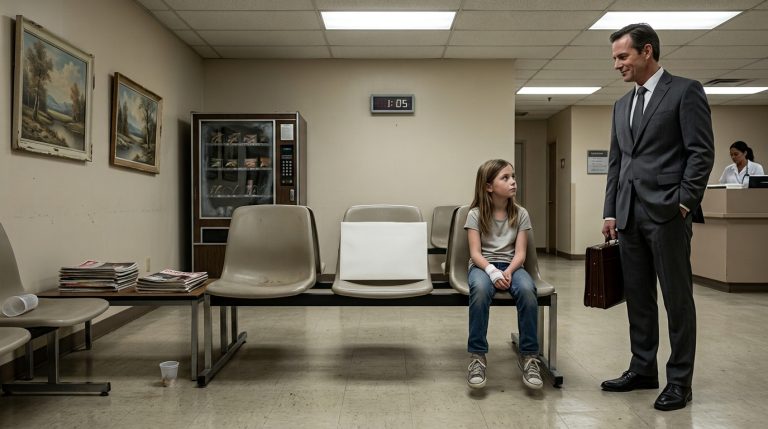
Then, the door to the lab creaked—a tiny, physical protest against the silence. Khloe stood in the threshold, her pink jacket faded at the cuffs, clutching a teddy bear that had seen better decades. Her eyes were not scanning the wealth or the technology; they were scanning the room for her mother.
“My mommy can’t,” Khloe said, her voice clear and impossibly steady against the cold expanse of the lab. “But I can.”
The silence changed. It went from a suffocating weight to a sharp, electric tension. Harrison turned, the mockery dying in his throat, replaced by a momentary, stunned bewilderment. He looked at the girl, then at the engine, then back to the girl. He didn’t see a child; he saw an anomaly. And in that moment, he decided to turn the trap into an execution.
“I accept,” Harrison said, his voice now booming with the terrifying warmth of a predator finally finding its sport. “Clear the area. Let the child try.”
Amelia lunged for her daughter, her heart drumming a frantic, terrified rhythm against her ribs. But Khloe didn’t move. She stepped forward, her hand reaching out not toward the expensive control panels, but toward the cold, unyielding metal of the engine. She closed her eyes.
She didn’t hear a failed project. She heard a hum—a subtle, discordant vibration—that felt like a bruised bone beneath the skin of the world.
CHAPTER 2: THE WEIGHT OF THE ATMOSPHERE
The lab had not changed, yet everything within it felt fundamentally altered. The silence that followed Khloe’s declaration wasn’t the sterile emptiness of before; it was heavy, expectant, and brittle. Harrison Thorne remained where he stood, his gaze fixed on the little girl with a confusion that flickered on the edge of fascination. For a man who lived to conquer variables, Khloe was an equation that refused to balance.
Amelia’s fingers were still trembling as she gripped the handle of her mop, her knuckles white. She looked at her daughter—so small against the colossal, chrome-plated Prometheus engine—and felt a wave of terror so profound it made her knees weak. This wasn’t just a child’s optimism; it was a target painted on their backs. Harrison Thorne did not lose, and he did not tolerate those who made him feel anything less than omnipotent.
“Clear the area,” Harrison repeated, his voice cutting through the hushed murmurs of the engineering team. He didn’t look at Dr. Miles or any of his staff. He looked at the floor, at the polished surface reflecting his own impeccably tailored image. “You heard the child. If she wants to listen, let her have her silence.”
The engineers scrambled, their movements uncharacteristically jerky and hurried. They moved back toward the perimeter of the room, their expensive shoes scraping softly against the white tile. Dr. Miles lingered for a second, his face a mask of professional humiliation. He looked at Amelia, then at Khloe, his eyes conveying a silent, desperate warning before he turned to join the others.
Amelia moved forward, her steps heavy, feeling as though she were walking through deep water. She reached out, her hand hovering near Khloe’s shoulder. “Khloe, baby, please,” she whispered, the words straining against the lump in her throat. “This is not a game. Mr. Thorne… he’s just waiting for you to fail so he can finish his point. We don’t have to do this. We can just walk out.”
Khloe looked up at her mother. Her eyes, clear and steady, possessed a calm that seemed entirely out of place in this cathedral of industrial stress. She didn’t look like a girl about to be crushed; she looked like someone about to perform a familiar, necessary chore.
“It’s okay, Mommy,” Khloe said, her voice soft but carrying across the vast room. She reached out, her small palm pressing flat against the cold, unyielding metal of the Prometheus engine. “It’s just sick. It’s trying to say where it hurts, but everyone here is shouting at it.”
Harrison watched them, his hands tucked deep into his pockets. A faint, mocking smile played at the corners of his mouth—the look of a man who had already calculated the outcome and was simply enjoying the theatrical buildup. “You have your space, child. Prove your theory. If you can stop the cascade, the money is yours. If you can’t… well, let’s just say your mother won’t need to worry about cleaning this floor anymore.”
The implication was clear. It was a threat wrapped in the guise of a business arrangement.
Khloe didn’t respond to him. She closed her eyes. Her posture shifted, her breathing slowing until it was almost imperceptible. She wasn’t standing in a multi-billion dollar research lab anymore; she was standing in the dusty, sun-drenched shed behind her great-grandfather’s house. She could almost smell the familiar blend of heavy motor oil, dry cedar, and old coffee.
You have to listen with your skin, kiddo, Grandpa Eli’s voice echoed in her memory, raspy and warm. The metal remembers every hit. Every time it gets too hot, every time it gets pushed, it leaves a scar. You don’t look for the failure. You look for the memory of the pain.
Khloe’s hand moved an inch, then another, trailing lightly over the surface of the engine block. The surface felt wrong under her fingertips—not just cold, but stressed. It wasn’t the smooth, unified texture of a healthy machine. It felt like a tightly wound spring that was losing its ability to hold itself together.
The lab remained deathly quiet. Even the ventilation fans seemed to hold their breath. Amelia stood back, her heart hammering, watching the way Khloe’s brow furrowed in concentration. She felt the eyes of every engineer on them—some mocking, some filled with pity, all of them waiting for the inevitable moment when the engine would shriek, die, and bury them in the fallout.
Khloe stopped. Her fingers rested over a small, inconspicuous mounting bolt near the base of the coolant assembly. She didn’t press down, but her entire focus seemed to converge on that single point.
“Okay,” Khloe murmured, her eyes still shut tight. “Turn it on. But just for a second. If you let it roar too long, it’ll start crying again.”
Harrison flicked a sharp, impatient glance toward the console. Dr. Miles, hesitating for a fraction of a second, stepped forward to the control panel. His hand hovered over the activation sequence. He looked at the engine, then at the girl, his face a complex map of scientific skepticism and a strange, burgeoning doubt.
“Begin the sequence,” Harrison commanded, his voice dropping an octave, losing its playfulness.
The lab’s air vibrated as the Prometheus engine hummed to life. The sound was an immediate, powerful roar, filling the vast space with a crescendo of raw energy. It was a sound that usually signaled the start of a ninety-second countdown to disaster. Amelia winced, her instinct to pull Khloe away nearly overwhelming her, but she stayed rooted, her own gaze locked on her daughter.
Khloe didn’t flinch. She stayed pressed against the engine, her head tilted, listening not to the overwhelming roar, but to the subtle, discordant vibrations shivering beneath the metal’s skin. She wasn’t just hearing it; she was feeling the ghost in the machine.
CHAPTER 3: THE FIRST DIAGNOSIS
The roar of the Prometheus engine was an absolute physical presence. It vibrated in the marrow of Khloe’s bones and turned the air in the lab into something thick and pressurized, like the water at the bottom of a deep lake. To anyone else, the sound was a monolithic wall of power, a testament to modern engineering that was rapidly hurtling toward its inevitable, catastrophic failure at the ninety-second mark.
But as Khloe kept her hand pressed against the engine casing, her world narrowed to the point of contact. She ignored the deafening volume. She pushed it aside as if it were nothing more than a passing wind. Her mind, guided by the phantom pressure of her grandfather’s calloused hand, searched for the rhythm that didn’t belong.
She felt it immediately—a sharp, erratic tremor that moved counter to the machine’s deep, booming pulse. It was a hitch in the breath of the engine, a tiny, stuttering skip that felt like a jagged stone in a riverbed.
“Turn it off!” Khloe shouted, her voice barely audible over the immense pressure of the sound.
Dr. Miles didn’t hesitate. His training was built on strict protocols, but the look of absolute, unnerving certainty on the child’s face bypassed his rational mind. He hammered the emergency cutoff.
The roar collapsed instantly. The sudden transition to silence was so jarring that it left a ringing in the ears, a temporary deafness that made the lab feel like an underwater tomb. The cooling fans continued to spin, their rhythmic whir-whir-whir now the loudest sound in the massive room.
Harrison Thorne stepped forward, his eyes narrowed, his posture rigid. The arrogance that usually defined his presence had been replaced by a tense, vibrating curiosity. “Well?” he demanded, his voice cracking slightly as he cleared his throat. “Was that a revelation, or are we just going to stand here and listen to the cooling fans while you pretend to commune with steel?”
Khloe ignored the bite in his tone. She wasn’t playing for his approval; she was focused on the diagnostic she had just run through her own touch. She looked at Dr. Miles, then scanned the room until her eyes landed on Dr. Evelyn Reed. The physicist was standing near the far console, her posture attentive, her hands clasped behind her back. She was the only person in the room who looked like she was actually waiting for an answer, rather than waiting for a failure.
“There’s a second vibration,” Khloe said, her voice clear and calm, echoing softly off the high glass walls. “It’s very small, and it’s not in the right rhythm. It’s… it’s a shiver, not a pulse.”
Dr. Miles scoffed, though the sound was weak. He gestured aggressively toward the bank of monolithic supercomputers that lined the north wall. “Impossible. We have four hundred localized vibration sensors embedded in the casing. We are tracking harmonic resonance at the nanometer scale. If there was a secondary vibration, the system would have flagged it before the engine even finished its startup cycle. We’re tracking an ant’s footsteps in a storm, kid. We would have seen it.”
Khloe didn’t argue. She didn’t possess the vocabulary to debate engineering tolerances or signal-to-noise ratios. She simply walked toward the base of the pedestal, her hand tracing the cool, polished metal of the lower assembly. “Your sensors are listening for an earthquake,” she said softly, looking back at Dr. Miles. “They’re missing the whisper because they’re too busy trying to measure the roar.”
She stopped near the base where a series of heavy-duty silver cables fed into the coolant assembly. She didn’t point at them; she just stood there, her head tilted, as if listening to something far away.
“Can you turn it on again?” Khloe asked, shifting her gaze to Harrison Thorne. She didn’t ask for permission; she stated a requirement. “But this time, I need everyone to stop talking. You need to be as quiet as the machine.”
Harrison looked at his lead engineer. Dr. Miles looked at the bank of sensors, then back at the girl, his face a mask of conflict. The stakes of the bet were irrelevant compared to the professional insult of being outclassed by a ten-year-old, but the silence in the lab was becoming a physical weight. He nodded once, a sharp, defeated motion.
“Clear the chatter,” Harrison ordered, his voice echoing through the silent lab. “Total silence. Now.”
The air in the room grew stagnant. Khloe moved a few feet away from the pedestal, giving the machine space to breathe. She closed her eyes. The mental preparation was the same as it had been a thousand times before in the shed—the ritual of casting out the noise of the world to find the hidden, discordant frequency of a broken part.
When the engine roared to life this time, the sound was even more intense than before. It surged upward, a tidal wave of mechanical power that shook the floor tiles under their feet. The engineers were motionless, their gazes fixed on their screens, their breath hitched in their chests as they waited for the eighty-second threshold—the mark where every previous test had disintegrated into failure.
Khloe stood completely still. She wasn’t watching the monitors. She wasn’t watching Harrison. She was listening. Deep within the thunderous, chaotic melody of the core, she heard it: a tiny, high-pitched ping. It was a microscopic dissonance, a sound so thin and sharp it was like a needle pricking a velvet curtain.
It happened exactly at the 4.7-second mark.
Her eyes snapped open. “There!” she exclaimed, pointing toward the coolant assembly. “It did it again. Did you hear it?”
The engineers stared, blank-faced. They heard only the roar. But Dr. Reed, who had been leaning over the auxiliary acoustic monitor, let out a sharp, indrawn breath. She hit a series of keys, freezing the raw audio feed, and pointed to the screen.
“Wait,” she said, her voice low and tight. She zoomed in on the waveform, magnifying a tiny, nearly invisible spike in the noise floor. “Mr. Thorne, she’s not hearing things. Look at the spectral analysis.”
The room fell into a deeper, more profound silence. On the screen, the spike was visible—a sharp, jagged tear in the smooth mountain range of the engine’s primary frequency. It lasted less than a hundredth of a second. It was the whisper that everyone had spent weeks ignoring, dismissing as statistical noise.
Khloe didn’t wait for them to process the data. She began to walk around the pedestal, her fingers hovering just inches from the cooling assembly. She wasn’t looking for a mechanical failure; she was looking for a ghost. She knew that metal kept secrets, and that the only way to find them was to identify where the metal had forgotten how to be strong.
CHAPTER 4: THE GHOST IN THE DATA
The laboratory didn’t just feel different; it felt wrong. The giant, magnified image of the engine block on the monitor, glowing with a faint, ghostly red light where the heat-sink crack pulsed, was more than just data. To Dr. Reed, it was a vindication of her own professional skepticism; to the engineers, it was a terrifying breach in their understanding of reality. To Khloe, however, it was a physical ache, a sharp, sympathetic throb that echoed in her own bones.
She stood frozen, her eyes wide, staring at the screen. The image of the crack felt like a mirror.
For a heartbeat, the pristine, clinical white of the lab flickered. The smell of ozone and synthetic floor wax was replaced by the thick, familiar scent of old oil and sun-baked wood. She saw her grandfather’s hands—rough, calloused, the skin stained with the permanent shadow of engine grease—guiding her own small palms over the block of a 1952 truck. She felt the vibration of a different engine, a different time, a different failure. The memory was so vivid, so intensely warm, that the coldness of the current lab felt like a physical blow.
“Khloe?”
Amelia’s voice was a lifeline, snapping the thread of the memory. Khloe blinked, the sterile lab rushing back into focus. The monitor was still there, the red crack still glowing with that sick, concentrated heat.
“The metal is tired,” Khloe whispered, her voice sounding small in the vast, echoing room. She reached out, touching the screen, as if she could feel the heat radiating through the glass. “It’s a memory crack. It happened when they tightened the bolt. They pushed it too hard, and the metal forgot how to hold on.”
Harrison Thorne hadn’t moved. He stood at the edge of the light, his shadow long and distorted against the white tiles. He was staring at the monitor with a hunger that bordered on the fanatical. He wasn’t seeing a flaw; he was seeing the reason for his empire’s stagnation. He moved toward the pedestal, his leather shoes making no sound, his face obscured by the high-contrast lighting of the lab.
“A tooling mark,” one of the junior engineers muttered from the back of the room, his voice thin with denial. “It has to be. You can’t have a structural failure based on a microscopic fissure. It defies the torque specifications. We ran the simulations. We tested the alloy. It should have held.”
“But it didn’t,” Dr. Reed interrupted, her voice sharp and authoritative. She didn’t look at the engineer; she kept her eyes on the screen, tracking the thermal signature. “The data confirms it. This isn’t a simulation error. This is physical stress accumulation. The engine isn’t failing because it’s poorly built; it’s failing because it’s holding onto the pain of its creation.”
Harrison Thorne’s eyes drifted from the screen to the girl. He looked at her not with the condescension of a billionaire dealing with a nuisance, but with the dawning, terrifying realization that he had been outplayed by a child’s intuition. He took a step toward Khloe, his body language shifting. He was looking for a way to maintain control, to turn this sudden, inexplicable revelation into something he could own, something he could command.
“Prove it,” Harrison said, his voice a low, gravelly rasp. “Prove that this ‘memory’ is the cause. If we remove the bolt, we void the assembly’s warranty. We destroy millions of dollars of proprietary hardware. If you’re wrong, we are not just losing the bet, we are losing the entire Apex project.”
Khloe turned to him, and for the first time, she didn’t look like a timid, frightened child. Her gaze was steady, calm, and weighted with a knowledge that had been passed down through generations of men who fixed things that were broken, not because they were paid, but because they understood that some things needed to be whole.
“I need a tool,” she said, her voice unshakable. “I need something to listen with. Not a computer. A stethoscope. The kind that hears the heartbeat, not the roar.”
Harrison signaled to the room. An assistant, looking as though he were participating in a religious ceremony rather than a mechanical repair, hurried to a corner of the lab and retrieved an old, tarnished mechanic’s stethoscope. It was an antique, a relic of a time before digital diagnostics. He handed it to Khloe with a trembling hand.
Khloe took it. The cold metal of the earpieces felt like a tether back to the workshop, a way to anchor herself against the suffocating pressure of the lab. She didn’t look at the engineers or the monitors anymore. She walked to the Prometheus engine and climbed onto the maintenance scaffolding, her movements fluid and practiced.
She placed the bell of the stethoscope against the casing, directly over the spot where the bolt anchored the coolant housing. She looked at Dr. Miles.
“Turn it on,” she said, her voice barely a breath. “Leave it on. I need to hear it scream.”
Dr. Miles hesitated, then looked at Harrison. Thorne nodded once, a quick, sharp motion. The engineer turned back to the control panel, his fingers dancing over the keys.
The roar returned, a tsunami of sound that seemed to vibrate the very air of the lab. But this time, Khloe wasn’t lost in the noise. She was listening beneath it, her eyes closed, her hand cupping the stethoscope’s bell to ensure a perfect, intimate seal against the steel.
She heard it. Not as a data point on a screen, but as a living, dying thing. Tick. Tick. Tick. The rhythm was frantic, a desperate, microscopic heartbeat struggling to keep pace with the massive, roaring power of the core. It was the sound of metal tearing itself apart at a sub-atomic level.
She leaned in, her forehead resting against the cold, vibrating casing. The world around her was falling away—the engineers, the billionaire, the monitors, the crushing expectations. There was only the machine, the crack, and the memory of her grandfather’s hands on her own, teaching her that when a machine is sick, it’s not the machine that needs the help—it’s the person who needs to learn how to listen.
CHAPTER 5: THE ANATOMY OF A WOUND
The sound was not a mechanical failure; it was a rhythmic, agonized metal song that resonated directly through the stethoscope and into the marrow of Khloe’s hand. She remained frozen, her body arched over the pedestal, listening to the ticking—tick, tick, tick—a countdown to a catastrophic fracture that the world’s most sophisticated digital sensors had completely missed.
Then, the laboratory died.
A deep, guttural moan shuddered through the power grid. The high-intensity overhead lights flickered once, twice, and then extinguished, leaving the lab in the jarring, velvet blackness of a total blackout. The Prometheus engine, deprived of its synchronized coolant flow, transitioned from a smooth, powerful roar to a turbulent, shrieking whine. The machine was screaming now, a metallic howl that filled the void where the light had been.
“Emergency power!” Harrison Thorne’s voice cut through the dark, cold and sharp. “Miles, get the backup grid online! If the resonance isn’t stabilized in the next ten seconds, the entire assembly will sheer.”
Khloe didn’t move. In the darkness, the world narrowed even further. She could feel the engine’s internal temperature spiking, the metal expanding in the pitch black. She didn’t need light to see the wound. She knew exactly where it was—at the base, under the primary mounting bolt.
“I can’t see the torque gauge!” Dr. Miles shouted, his voice thick with panic. “The digital interface is dead. We’re flying blind!”
Khloe reached into the darkness, her small fingers finding the cold, unyielding curve of the engine housing. She didn’t wait for permission. She didn’t wait for a plan. She felt for the head of the bolt, her heart hammering against her ribs like a trapped bird. The machine was shaking violently now, a tectonic, bone-rattling tremor that threatened to throw her from the scaffolding.
“Give me a wrench,” she commanded.
“What? No!” Amelia’s voice was a frantic, terrified note in the darkness. “Khloe, get down from there!”
“Give me the wrench!” Khloe repeated, her voice cracking with the strain of the physical vibration. “If it isn’t loosened now, the pressure will snap the block. It’ll explode!”
A moment later, a heavy, cold weight was pressed into her hand. It was the high-torque wrench. The metal felt oily and rough against her skin. Khloe gripped it, finding the head of the bolt by touch alone. She knew the weight of it, the angle, the resistance of the metal. She was back in the shed. She was working on her grandfather’s truck, the smell of dust and ancient engine fluid heavy in her lungs.
She threw her weight against the handle.
The bolt didn’t budge. It was locked tight, seized by the same heat and pressure that was tearing the engine apart. She gritted her teeth, her feet slipping on the metal grating of the scaffolding. She pushed harder, her entire small frame shaking with the effort.
The lab erupted in the stuttering, strobe-like light of emergency power—a sickly, flickering orange that cast long, grotesque shadows across the walls. Harrison Thorne stood at the base of the pedestal, his face pale, his eyes wide with a mixture of terror and obsessive wonder. He was watching a child attempt to wrestle a giant into submission, and he looked as though he were watching his own soul being dissected.
“It’s seized,” Khloe panted, her forehead pressed against the vibrating steel. She felt the bolt groan. She felt the crack beneath it, the invisible canyon, screaming under the sudden, erratic torque of her effort.
“Khloe, step away!” Dr. Miles screamed, rushing toward the pedestal, but Harrison shoved him back.
“Let her,” Harrison growled, his voice trembling. “She’s the only one who knows where it hurts.”
Khloe closed her eyes, ignoring the heat radiating from the casing, ignoring the violent shudders of the machine. She pictured the bolt as a living thing, a stubborn, locked muscle that needed to be persuaded, not fought. She didn’t use brute strength. She used a subtle, rhythmic pressure, tapping the wrench handle, coaxing the metal to give.
Just like this, her grandfather’s voice whispered in the dark. Listen to the tension. Don’t force the break; find the threshold.
She gave a final, sharp pull.
With a sound like a pistol shot in the confined space, the seal broke. The bolt shivered, turning a fraction of a millimeter. The scream of the engine changed instantly—the high-pitched, tearing whine subsided, replaced by a deep, resonant rumble that felt like a long-awaited exhale.
Khloe slumped against the engine, her hand still clutched around the wrench. The entire lab went silent, save for the hum of the emergency cooling fans struggling to regain their momentum.
She stayed there for a long moment, breathing in the smell of hot copper and burnt electrical insulation. Her hands were covered in a fine, dark grit of metal dust. She felt the engine cooling down, the ghost of the crack settling, the fever finally breaking. She had found the wound, but as she opened her eyes and looked down at the pale, stunned faces of the world’s most brilliant engineers, she realized that finding the crack was only the beginning. The real question wasn’t how to stop the machine from dying; it was why Harrison Thorne had been so desperate for it to live.
CHAPTER 6: THE HEALERS METHOD
The silence in the lab was thick, a physical medium that seemed to press against Khloe’s eardrums. She remained huddled on the scaffolding, her fingers still gripping the wrench, her knuckles bruised and smeared with a mixture of grease and sweat. Below her, the Prometheus engine emitted a faint, high-pitched cooling hiss, the sound of a beast finally settling into a fitful, uneasy sleep.
Harrison Thorne didn’t move. He stood at the base of the pedestal, his face etched in a shadow that the flickering orange emergency light could not reach. For the first time in his life, he wasn’t looking at a balance sheet or a project timeline; he was staring at a ten-year-old girl who had just performed a piece of mechanics that defied everything his two-billion-dollar R&D division had deemed physically impossible.
“Fabricate it,” Harrison said. His voice wasn’t a command; it was a rough, hollow sound that seemed to come from deep within his chest. “Dr. Miles. You heard her. A copper sleeve. Now.”
Dr. Miles didn’t hesitate. The arrogance that had defined his demeanor since the beginning of the project had evaporated, leaving behind the jittery, obedient reflexes of a man who had suddenly realized he was standing on shifting ground. He turned to the junior technicians, his movements frantic and precise. “You heard him! Machine shop, emergency requisition, copper-alloy bushing, high-ductility, thin-wall. Give me five minutes or don’t bother coming back.”
Amelia climbed the scaffolding, her eyes filled with an agonizing cocktail of relief and terror. She pulled Khloe away from the pedestal, wrapping her arms around the girl’s shoulders as if trying to shield her from the very air of the lab. “We’re done, Khloe,” she whispered, her voice trembling. “We did it. Let’s go home.”
But Khloe didn’t move. Her gaze was fixed on the engine, specifically the bolt hole she had just breached. Her perception felt skewed—the room’s boundaries seemed to stretch and warp, the supercomputers humming like a choir of static, the shadows dancing along the glass walls like living, breathing things. She was physically exhausted, her muscles vibrating with the echo of the engine’s tremor, but her mind was fixed on the physics of the repair.
“It’s not just about the copper,” Khloe said, her voice sounding strange and distant to her own ears. “The copper is a bandage, Mommy. It won’t stay if the bolt isn’t placed right. If we tighten it wrong, the vibration will just shear the sleeve.”
Harrison approached the scaffolding, his movements slower now, more deliberate. He stopped a few feet away, looking up at them. He wasn’t looking at Amelia; he was looking at Khloe, his eyes narrowed in an expression that was almost… pleading.
“How do you know, Khloe?” he asked, his voice low. “How do you know the exact tolerance? We don’t have the blueprints for this modification. We’re working from a guess. A child’s guess.”
“It’s not a guess,” Khloe replied, turning her head to look at him. Her eyes were glassy with exhaustion, but the intensity in them pinned him in place. “My grandfather worked on B-17s. He said that when you fix a wing in the middle of a flight, you don’t use the manual. You use the sound of the wind. You listen to how the air pulls against the metal. The copper has to move, sir. If it’s too stiff, it’ll break. If it’s too soft, it’ll slip. It needs to be just… right.”
Harrison felt a cold shiver trace a path down his spine. He reached into his pocket and pulled out a small, silver-framed photograph—the one he had shown the committee earlier, the one of the B-17 crew, the Iron Maiden. He held it out toward Khloe, his hand barely shaking.
“This is the man,” he said, his voice dropping to a near-whisper. “This is the mechanic who kept my grandfather in the sky when the whole world was falling apart. He didn’t have manuals either. He just had his hands.”
Khloe looked at the photo. She recognized the face instantly—the quiet, steady eyes, the slight, knowing tilt of the chin. It was Grandpa Eli. The realization hit her with the weight of a physical blow, grounding her, centering her. The flickering orange light reflecting off the glass of the frame made the faces look like they were smiling at her from across time.
“He taught me,” she said, her voice finally steadying. “He taught me that every machine is just a conversation. You just have to be willing to be the one who listens.”
Dr. Miles returned, holding a small, velvet-lined box. Inside, the copper bushing gleamed in the sickly orange light, a perfect, hand-machined cylinder of warm, reddish metal. It was a beautiful, simple thing, utterly out of place in the high-tech, cold-toned architecture of the laboratory.
“It’s ready,” Miles said, his eyes avoiding Harrison’s gaze. “But sir, if we install this, we’re overriding the manufacturer’s lockouts. If this fails, the core won’t just shut down—it will be destroyed. There’s no undoing this.”
Harrison looked at the box, then at Khloe. For a fleeting second, the ruthless, calculated persona of the billionaire flickered and dimmed, revealing a man who was desperately searching for a way to justify his existence. He wasn’t just fixing a machine anymore; he was trying to fix a history that had haunted his family for seventy years.
“Install it,” Harrison said, his voice hard. “And do it exactly as she says. I don’t care about the warranty. I don’t care about the board. I want this machine to run.”
As the engineers began to work, their movements synchronized and focused, Khloe leaned her head against her mother’s shoulder and closed her eyes. The hum of the lab, the frantic energy of the repair, the feeling of the heavy, cold wrench still lingering in her palm—it all began to blur into a single, cohesive rhythm. The engine was healing, but as the final bolts were tightened, Khloe felt a strange, cold unease, a sense that they were fixing the engine for a reason that went far deeper than clean energy or corporate contracts. The machine was becoming a monument, and she was the one who had cleared the path for it.
CHAPTER 7: THE RESONANCE TEST
The final bolt tightened with a soft, clean click, a sound that felt more significant than the roar of the engine itself. Khloe sat on the edge of the scaffolding, her legs dangling, her hands limp in her lap. She felt hollowed out, the adrenaline that had kept her focused for hours finally receding, leaving behind a profound, bone-deep fatigue. Below her, the Prometheus engine sat, looking identical to how it had been an hour ago, yet the atmosphere in the room had shifted into something almost sacred.
Harrison Thorne moved toward the console, his movements heavy. He looked less like a corporate titan and more like a man walking toward a judgment he was not prepared to face. He gestured to Dr. Miles, but the lead engineer was already at the controls, his hands hovering over the interface with a strange, hesitant reverence.
“Initiate startup sequence,” Harrison said, his voice barely a whisper. “And give me full diagnostic telemetry. I want to see everything.”
Dr. Miles hit the key.
The lab didn’t just vibrate; it seemed to hold its breath. The engine spooled up, the sound rising through the frequency spectrum with a smooth, fluid grace that felt entirely new. There was no grinding, no straining; it was the sound of a heart beating without a murmur. Khloe watched the large monitor as the waveform smoothed out, the jagged, chaotic spikes of previous tests replaced by a steady, powerful harmonic line that held perfectly at the target efficiency.
“Efficiency is at ninety-eight percent,” Dr. Miles said, his voice trembling. “Vibrational signature is stable. The copper bushing is dampening the resonance frequency exactly as… as she predicted.”
He looked up at the scaffolding, his eyes meeting Khloe’s. For the first time, he didn’t see the maid’s daughter. He saw a peer, an engineer who had used nothing but her own senses to correct a flaw that had defied their most expensive simulations.
“It’s working,” Amelia whispered, her hand tightening around Khloe’s shoulder. She wasn’t looking at the monitor; she was looking at her daughter, her face a mask of disbelief and overflowing pride.
But Khloe was focused on the diagnostic log. She was watching the data streams, her mind tracing the way the heat moved through the engine block. She saw something that didn’t make sense. As the internal temperature climbed, the thermal mapping showed a strange, unnatural pattern in the coolant flow. The heat wasn’t just concentrating at the crack; it was being funneled toward it.
She frowned. She leaned forward, squinting at the fine, flickering text of the live diagnostic log.
“Wait,” Khloe said, her voice cutting through the celebratory atmosphere of the lab. “Turn it down. Just a little.”
Dr. Miles paused. “What is it?”
“The heat,” Khloe said, pointing to the monitor. “It’s not just the memory. It’s moving. It’s like the coolant is trying to avoid the crack on purpose. That shouldn’t happen. The coolant should flow around it evenly.”
Dr. Reed stepped forward, her eyes scanning the data. She tapped the screen, isolating a subsection of the flow-rate logs. A moment later, her face drained of color. “She’s right. The internal valve geometry… it’s been modified. The flow pattern is designed to create a pressure differential that specifically targets the bolt-hole. It’s not a manufacturing defect, Khloe. It’s a deliberate design choice.”
The room went silent. The engine continued to hum, but the music of its operation felt suddenly, chillingly sinister.
Harrison Thorne stood frozen. He looked at the data, his gaze shifting to the senior engineering team, and then, slowly, to the dark, shadowed corners of the lab. “Design choice,” he repeated, the words tasting like ash. “You’re saying someone designed this engine to fail.”
Khloe felt a cold sweat break out on her forehead. The “memory” she had felt in the metal—the crack—it wasn’t just a mistake. It was a scar, placed there by someone who knew exactly how the machine would respond to the stress. She looked at Harrison, really looked at him, and for the first time, she saw the fear behind his arrogance. He hadn’t been fighting a mechanical failure; he had been fighting a betrayal.
“The crack isn’t a accident,” Khloe whispered, the truth finally settling into the marrow of her bones. “Someone made it wait for the right moment to break.”
Harrison’s expression hardened, his eyes narrowing as he scanned the room, his gaze resting on his own inner circle with a look of sudden, sharp suspicion. The engine was singing, perfect and stable, but the secret of its creation was now beginning to unravel, and it was a secret that threatened to pull down everything Thorne had built.
CHAPTER 8: THE FINAL CATHARSIS
The silence that followed was not empty; it was heavy with the weight of decades. Harrison Thorne stood at the center of the lab, looking less like a master of industry and more like a man watching the foundation of his life crumble. His eyes, usually sharp and calculating, were vacant, fixed on the diagnostic monitor that displayed the irrefutable evidence of the sabotage. The coolant flow pattern was not a failure of engineering; it was a map of intent. Someone within his own inner circle had rigged the Prometheus engine to fail, timing the collapse to coincide with the Apex project’s final review.
“Who?” Harrison’s voice was barely a breath, but it carried the chilling authority of a man ready to tear his world apart to find the truth. He turned slowly, his gaze sweeping over the engineers, the technicians, and the government observers. Everyone flinched.
Dr. Miles, his face pale as parchment, took a hesitant step forward. “Sir… the internal diagnostic architecture. Only three people have the clearance level to modify the coolant assembly code. Myself… Director Vane… and…”
The silence deepened. The third name remained unspoken, but everyone in the room knew it was the Chief of Security, the man who had been Harrison’s right hand since the inception of the lab.
Harrison didn’t react with rage. He reacted with a cold, absolute clarity. He turned his attention to Khloe. She was still sitting on the scaffolding, her small hands resting on the cold steel of the engine, her presence a stark, quiet contrast to the spiraling chaos in the room. He walked over to her, his movements stiff, and for a long moment, he simply looked at her.
“You knew,” he said, his voice quiet. “You didn’t just fix the engine. You knew someone had broken it.”
Khloe shook her head slowly. “I didn’t know who. I just knew the metal was hurting. Grandpa Eli always said that when someone hurts a machine, they leave a fingerprint of their anger on the parts. It feels different than a break. It feels… sharp. Angry.”
Harrison closed his eyes, a tremor passing through his hands. The 5-Pillar Catharsis he had been denied for seventy years was happening now, in the middle of his lab, delivered by the descendant of the man his grandfather had never been able to thank. He turned to the room, his voice suddenly powerful and resonant.
“Dr. Reed,” he called out, his eyes flashing with a renewed, steely resolve. “Document this. Everything. The diagnostic data, the structural failure, the deliberate sabotage. Then, get the Department of Justice on the line. I want every single person connected to the coolant assembly architecture held for questioning. I don’t care who they are. I want the truth, no matter what it costs the company.”
The reaction was instantaneous. Security personnel began to move, their presence filling the space with a sense of order that replaced the lingering tension of the betrayal. Harrison didn’t watch them; he returned to the scaffolding and sat on the lower rung, right next to Khloe.
“You and your mother,” he said, his tone softened by a genuine, weary humility. “You saved this company. But more than that… you finished a conversation that started in the sky over Germany in 1944. My grandfather looked for Elias Vance for thirty years. He died with the regret that he hadn’t honored the man who kept him alive. Today, you did that for him.”
He reached into his pocket and pulled out the photograph of the Iron Maiden’s crew one last time, pressing it into Khloe’s hand. “This belongs to you now. It’s not just a memory. It’s proof that some bonds are stronger than the greed of people who try to break them.”
Amelia stood nearby, her tears silent and steady, watching the billionaire—the man who had mocked her only hours ago—now sitting humbly beside her daughter, the two of them united by a past that had finally found its resolution. The chaos of the sabotage investigation swirled around them, but the core of the laboratory felt strangely, hauntingly peaceful.
The aftermath of the day was slow, a gradual settling of the world into a new reality. The sabotage was unmasked, the conspirators were systematically dismantled, and the Prometheus engine remained a stable, humming testament to a new way of working—not by crushing the opposition, but by listening to the truth hidden in the silence.
Days later, the lab was transformed. The sterile, cold aesthetic was replaced by a workspace that felt lived-in and human. Amelia, now the director of the Elias Vance Division of Intuitive Diagnostics, walked the floor with a calm authority that had been born from the fire of the previous months. She had taken the resources Thorne provided and built a sanctuary for gifted minds—people who, like her daughter, didn’t need manuals to understand the world.
Khloe was in her element. She spent her afternoons working with the engineers, showing them how to place their hands on the machines and truly listen, teaching them the language of the “ghosts” in the metal. The $100 million sat in a trust, a guarantee of a future that no longer held the looming shadow of medical debt or fear. But the real treasure was the work itself—the feeling of a broken thing becoming whole again under her touch.
Harrison Thorne often joined them. He had aged, the lines around his eyes deepening, but he moved with a lightness that had been absent before the engine’s repair. One afternoon, he found Khloe sitting by the Prometheus engine, which continued its steady, flawless hum. He sat down beside her, not as an employer, but as an apprentice to the quiet wisdom she had brought into his life.
“It’s doing what it was born to do,” Khloe said, her hand resting on the smooth, copper-bandaged bolt.
Harrison smiled—a genuine, soft smile that touched his eyes. “Yes,” he agreed, his gaze drifting to the photograph of his grandfather’s crew, now framed on his desk. “It finally has peace.”
The dust motes danced in the afternoon light, settling slowly over the lab. The story of the broken engine and the girl who heard its secret had reached its conclusion, leaving behind the quiet, enduring hum of a world that had finally learned how to be whole again.