The Widow Who Built an Empire in Silence Taught Her Entitled Family a Christmas Lesson They Will Never Forget
CHAPTER 1: THE CHRISTMAS ANNOUNCEMENT
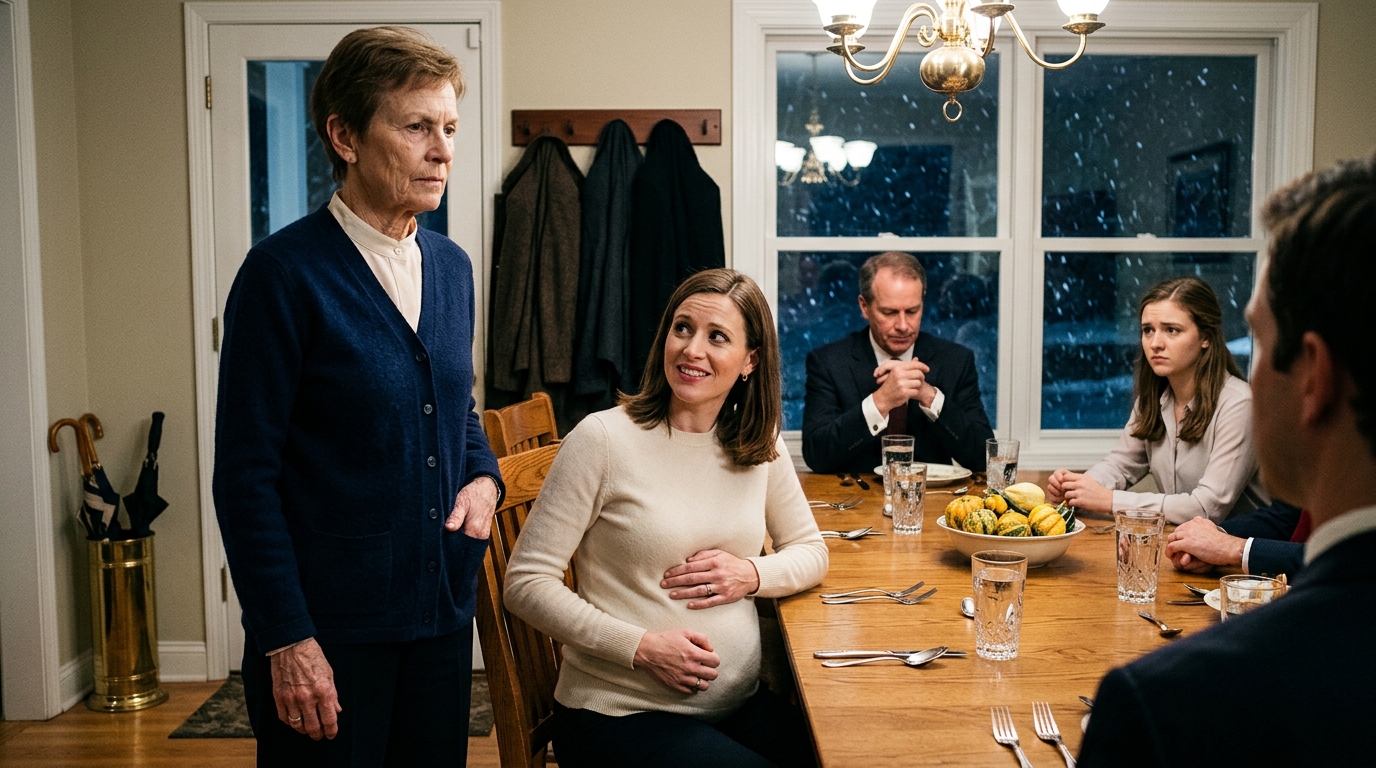
The air in Daniel’s dining room smelled of roasted turkey, expensive cinnamon wax, and the damp wool of coats drying near the door. Snow scraped against the windowpanes like dry paper.
Lauren lifted her silver spoon, tapping it twice against the rim of her water glass. The sharp ping cut through the hum of four conversations at once.
“I just want to say something before we carve the turkey,” Lauren said, smoothing the front of her tailored cream sweater. Her hand rested flat on her five-month bump, every ring on her fingers catching the overhead chandelier light. “With the baby coming, Daniel and I have been talking a lot about structure. About long-term stability.”
Daniel sat right beside her. He kept his eyes locked on his plate, his thumb endlessly tracing the edge of his cloth napkin. He didn’t look at me. Not once.
“We all know how overwhelming things can get as the years add up,” Lauren continued, her voice dipping into that soft, practice-rehearsed tone people use when speaking to small children or flighty animals. “Which is why, starting today, I’ll be stepping in to manage the family finances.”
My hand slipped into the deep pocket of my blue wool cardigan. My fingers found the cold, hexagon edges of a rusted half-inch steel bolt—a piece of the industrial stamping machine that had crushed my husband’s torso thirty-eight years ago in a dark plant off Michigan Avenue. I rolled the coarse threads against my thumb until the metal bit into my skin.
“Evelyn,” Lauren said, looking directly down the long oak table at me. Her smile remained fixed, perfectly white and perfectly frozen. “We had your primary credit card canceled this morning. It really is for the best. At your age, you shouldn’t be stressing over monthly statements.”
Someone across the table let out an awkward, nervous chuckle. A distant cousin nodded quickly, muttering that older folks get taken advantage of by internet scams every day.
“If you need anything—groceries, winter boots, prescriptions—you can just come to Daniel,” Lauren added. “We’ll make sure you’re taken care of.”
I didn’t shout. I didn’t reach for my cider. I simply let my thumb press harder against the iron bolt in my pocket, feeling every jagged thread anchor me to the cold floor beneath my feet.
“Daniel,” I said, my voice barely louder than the hum of the furnace kick-starting in the basement.
My son hesitated, his shoulders tensing before he finally raised his head.
“You really don’t have the slightest idea what you’ve just agreed to, do you?” I asked.
CHAPTER 2: THE SOUND OF COLD METAL
“Know what?” Daniel repeated, his voice dropping an octave as his eyes darted from my face to the carpet. “Mom, what are you talking about?”
Lauren didn’t wait for me to answer. She let out a sharp, practiced laugh—the kind designed to shut down awkwardness at dinner parties before it makes the hosts look bad. “Evelyn, please. No one is trying to make a scene here. We’re just being realistic about your situation.”
She reached across the table, aiming to take my left hand in hers, a gesture meant to display patronizing care for the surrounding cousins. I didn’t pull back fast or dramatically. I simply shifted my weight onto my left heel and turned three inches to the side, letting her fingers brush against empty air.
In my right pocket, my thumb dragged across the sharp edge of the six-sided steel nut jammed against Robert’s old bolt. The coarse rust bit into my callus. That small friction was real. The gold-rimmed china on the tablecloth, the cinnamon-scented air, Lauren’s pristine cream sweater—none of that was real. It was an illusion built on the assumption that I was just a tired old woman waiting to be put away in a corner.
“You canceled my card this morning,” I said, keeping my voice flat, unhurried. “You called the bank, used my personal details, and told them I was no longer capable of managing my own account.”
“It was a security precaution,” Lauren said instantly, her posture hardening. The warm smile slipped off her face like grease down a hot pan. “We found suspicious activity online. Seniors get targeted every single day, Evelyn. We did it to protect you.”
“You did it because you think my life is something you can manage from an app on your phone,” I replied.
I looked past her, straight at Daniel. He couldn’t hold my gaze for more than two seconds. His eyes kept sliding toward the hallway bench near the front door, where Lauren’s expensive brown leather handbag sat draped over a chair. Protruding from the side pocket of that bag, half-tucked beneath a cashmere scarf, was a sliver of bright red paper. I had seen enough mail in my sixty-nine years to recognize the bold, heavy typeface of a final notice from a county treasurer’s office.
“Daniel,” I said softly, stepping around the corner of the table. The floorboards didn’t squeak; I knew where the joists ran in this house because I had helped him inspect the subfloor when he bought it. “When your father died, the bank sent three letters in a blue envelope. Do you remember what I did with them?”
Daniel swallowed hard, his throat moving against his stiff collar. “You… you put them on the fridge.”
“I put them on the fridge,” I agreed. “Because we don’t hide debt in this family. And we don’t pretend we own things we haven’t paid for.”
Lauren’s eyes flicked toward the hallway bench, her left hand tightening into a fist against her stomach. “That’s completely irrelevant. We are talking about today. We are talking about making sure you don’t end up on the street because you’re too stubborn to accept help!”
“Help?” I let out a low, dry sound that wasn’t quite a laugh. “Lauren, you don’t want to help me. You want my signature.”
The room fell into an uncomfortable, absolute silence. One of the uncles shifted in his seat, his fork clinking against his plate like a warning bell.
“I’m going home now,” I said quietly, taking my hand out of my pocket and letting the heavy steel bolt drop back into the lining of my coat. “Enjoy the rest of your dinner.”
“Evelyn, sit down,” Lauren demanded, her voice losing its gentle tone entirely, snapping sharp and authoritative across the room. “We’re not finished talking about this.”
I didn’t turn back. I reached the front hallway, grabbed my dark coat from the rack, and walked out into the freezing Detroit night without looking at my son even once.
CHAPTER 3: PAPER TRAIL IN THE DARK
The floorboards in my hallway groaned as I kicked the snow from my boots. The house was cold, but it was quiet—a clean, honest cold that didn’t hide behind scented candles or glass chimes.
I walked straight to the small study behind the kitchen. I didn’t turn on the overhead lamp. I clicked on the brass desk light, its shade tilting down to cast a sharp ring of yellow over the green blotter.
Under the desk stood the heavy, two-drawer iron fire-safe Robert and I had bought second-hand forty years ago. I squatted down, my knees popping softly in the quiet room. I turned the mechanical dial—three numbers left, two right, one left—until the internal bolt clicked open with a dull, heavy thump.
I pulled out the thick leather binder that held thirty-eight years of quiet decisions.
Deeds for six light industrial properties across Wayne County. Certified tax assessments. Current lease agreements for three logistics distributors and two automated machine shops. Every single document bore my name, Evelyn Brooks, as sole proprietor. No mortgage liens. No bank debt.
I laid the primary ledger on the desk, the yellowed pages showing the quarterly dividends that had cleared into a private commercial account every ninety days for two decades. Valuation: seven point two million dollars. Monthly passive cash flow: three hundred and twelve thousand dollars.
The phone on my desk vibrated against the blotter, its buzz harsh against the stillness. The screen lit up with Daniel’s name. I didn’t answer. It buzzed three times before dropping to voicemail, only to light up again two seconds later with Lauren’s number.
I let it ring until it died.
Instead of answering, I opened my bottom drawer and pulled out a plain brown accordion folder. Inside were the public court printouts and county tax records I had quietly retrieved six months ago after Lauren’s first visits—the ones where her eyes spent more time evaluating my living room furniture than looking at my face.
I pulled out the top sheet. Lauren’s maiden name was plastered across three separate tax garnishment notices from Oakland County. Two default judgments from private credit unions totaling eighty-four thousand dollars. And a recent pre-foreclosure notice on her and Daniel’s suburban house, marked with a statutory cure date just seventeen days away.
She didn’t want to manage my credit card to save me from phone scammers. She was drowning, and she needed my identity to secure a high-yield equity loan before her own debts pulled them under.
I folded the tax notices, slid them inside the leather ledger right beside my property deeds, and snapped the brass clasp shut.
I didn’t need a lawyer in a sharp suit to stand beside me at a dining table. I had the paper, I had the truth, and I had built every single dollar with my own two hands while they were still sleeping.
The front doorbell rang—hard, continuous, and heavy enough to rattle the glass pane above the frame.
CHAPTER 4: THE UNRAVELING MASK
I opened the front door three inches. Snow swirled across the porch light, catching in Lauren’s curled hair. She stood on the top step in her cream coat, her breath turning to white steam in the freezing air. Daniel stood behind her on the icy walkway, his hands jammed deep into his coat pockets, looking down at his boots.
“We need to talk, Evelyn,” Lauren said, pushing past me into the narrow foyer before I could offer a greeting. She smelled of cold wool and wet leather. “Daniel and I drove all the way back here because what happened at dinner was unacceptable.”
I shut the door quietly against the draft, setting the brass deadbolt into place with a clear, heavy click. “You drove back here because you realized I didn’t panic when you brought up my credit card.”
“You made a scene in front of the entire family!” Lauren’s voice hit the plaster walls, sharp and echoing. She unbuttoned her coat with quick, jerked movements, her fingers trembling slightly against the mother-of-pearl buttons. “We came there to extend an olive branch. To offer you a structured way to handle your affairs so you don’t end up losing this house or falling victim to scammers!”
“Mom,” Daniel said, stepping into the hallway and pulling his wet cap off. His eyes were bloodshot. “Please. Lauren’s just trying to set up a power of attorney so we can manage the utility bills and property taxes before things get missed. You’re almost seventy. It’s just common sense.”
“Common sense,” I repeated softly.
I walked past them both, stepping into the study. I picked up the thick leather binder from the green blotter and brought it out into the hall, dropping it onto the dark oak telephone bench between us. The heavy thump of six hundred pages of bound paper made the hallway mirror vibrate against its nail.
“What is that?” Lauren asked, her eyes narrowing as she took a step back.
“That is thirty-eight years of work,” I said, unbuckling the leather strap. “Page one is the deed to a three-acre light manufacturing site on Fort Street. Page four is a commercial warehouse near the river. Page twelve is a logistics depot leased to a regional freight carrier.”
Lauren stared at the open binder. “This… this doesn’t mean anything. Anyone can print out old land descriptions.”
“The tax receipts are stapled to the back of every deed,” I said, my voice steady, flat, and quiet. “All paid in full. No bank loans. No mortgages. The total portfolio earns three hundred and twelve thousand dollars a month in clear passive revenue.”
Daniel took a step forward, his jaw dropping as he looked down at the stamped county seals. “Mom… what are you talking about? You fix sewing machines in the garage.”
“I fixed machines to buy broken buildings, Daniel,” I said, turning my eyes to him. “I paid your college tuition in cash through a private trust account so you would never carry student debt. I paid off your car loan four years ago when you thought the bank miscalculated your final balance.”
Lauren’s face went entirely white, the pale cream color of her coat matching her skin. But she didn’t apologize. Her chest heaved once, twice, before her lips curled into a rigid, hostile line.
“You lied to us,” Lauren spat, her voice dropping into a raspy whisper. “You lived in this old house wearing threadbare sweaters, letting Daniel think you were barely getting by, while you sat on millions? That’s sick, Evelyn. That is pure manipulation!”
“No,” I replied, pulling the plain brown accordion folder from beneath the binder and sliding the top paper out. “Manipulation is hiding three county tax garnishment notices in your handbag while trying to cancel a widow’s credit card.”
CHAPTER 6: THE CLEAN ENGINE
The sun came up over the Detroit River, throwing long, clean shadows across the gravel yard. The air was sharp, smelling faintly of dry frost and the machine oil I had used to lubricate the main roll-roller bearings inside the garage just after dawn.
A heavy, small hand landed on my knee, the fingers covered in blue chalk from the driveway drawings. Bobby, my four-year-old grandson, peered over the edge of the wooden slats, his dark eyes wide and clear as he held up a small brass hexagonal nut he had found under the cleaning table.
“Look, Nana,” he whispered, his small fingers dropping the metal piece into my palm with a tiny clink. “A tiny gear.”
“That’s a locking nut, little man,” I said, my voice steady, stripped of the heavy weight that had hung over the holidays four winters ago. “It keeps the parts from slipping when the machine gets hot.”
Daniel stepped out from the garage bay, wiping a thin layer of grease from his forearm with a piece of red shop cloth. He didn’t wear the expensive department-store sweaters anymore; he wore a functional gray flannel shirt with the sleeves rolled to the elbows, his shoulders pulled back with the quiet posture of a man who spent his mornings auditing actual inventory instead of balancing unearned lines of credit.
“The main timing belt on the Unit Three distributor is aligned, Mom,” Daniel said, setting a heavy metal wrench down onto the tool cart with a solid, definitive thud. “The tension is exactly within tolerance.”
I took a slow sip of the coffee, the porcelain cup anchoring the morning chill. After the note default tore down Lauren’s leverage, there were no dramatic courthouse speeches or public scenes; the asset structure simply did what it was designed to do. Lauren had relocated back to Ohio after the separation terms were finalized in mediation, her debts restructured under strict, transparent accounting constraints, while the trust I set up for Bobby remained locked behind iron boundaries that no external entitlement could ever breach.
“Good,” I said, rising from the bench as my knees gave a small, light click, completely clear of the old friction. “Always check the alignment before you lock down the casing.”
Daniel looked at his son, then back at my weathered hands, a small, quiet smile breaking across his face—the kind that didn’t ask for permission and didn’t seek an illusion. We had rebuilt the foundation, piece by piece, not with sudden luck, but with the gritty endurance of common sense.
I dropped the brass nut into my apron pocket, hooked my arm through Daniel’s sleeve, and guided Bobby toward the open workshop door where the clean machinery waited.
CHAPTER 5: THE COLLAPSE OF AUDACITY
“Where did you get that?” Lauren’s breath hitched, her hand flying to her throat as if she had suddenly run out of air.
“Public records,” I said, my voice dropping into that quiet, steady pitch I used whenever an engine block was beyond repair. “Oakland County Register of Deeds. It took me ten minutes to pull up your tax garnishments. Seventeen days until your home goes to auction, Lauren.”
Daniel stepped between us, his face drained of all color as he snatched the paper out of my fingers. His eyes scanned the bold red lines at the top, his hands shaking so violently the paper rattled against his coat sleeves.
“Lauren…” Daniel’s voice was barely a whisper. “What is this? You told me the bank made an accounting error on our mortgage. You said it was taken care of.”
“She’s lying!” Lauren shrieked, whirling around to grab Daniel’s forearm, her manicured nails digging straight through his heavy wool sleeve. “She forged it! She printed that out to turn you against me! Look at her—she’s been hiding millions of dollars while we struggled to put down a deposit on our house! She manipulated everything!”
“I didn’t forge the county seal, Lauren,” I said, pointing down at the official stamp resting at the bottom corner of the page. “And I didn’t cancel my own credit card. You thought if you got control of my identity and my estate, you could take out an equity line against my Fort Street property to cover your debt before Daniel ever found out.”
Lauren backed up against the front door, her heels hitting the wooden molding with a dull clatter. Her nostrils flared, her posture dropping the polished, refined stance completely as her eyes darted toward the deadbolt behind her.
“You think you’re so smart!” she screamed, her voice cracking as tears of pure rage finally broke over her mascara. “You lived like a pauper in this dump! You could have helped us! You could have saved our baby from starting life in a family with debt, but you chose to hoard every cent!”
“I built that money to protect this family from real disasters,” I said, looking her dead in the eye. “Not to pay for designer coats and credit card fraud.”
Daniel stood frozen in the middle of the hallway, holding the tax notice in one hand while his eyes slowly moved from his wife to the leather binder lying on the bench. The reality hit him not like a thunderclap, but like a slow, heavy freezing wave.
“Get out,” Daniel said softly.
Lauren stopped breathing for a second. “What?”
“Get out of my mother’s house,” Daniel repeated, his voice tightening into something cold, hard, and final—a tone he had never used in his entire life. “And don’t touch my phone.”
CHAPTER 6: A QUIET NORMAL
The echo of the door died out, leaving only the steady hum of the furnace kicking on in the basement. Cold air crept in along the baseboards where the weather stripping had worn thin.
Daniel dropped his hands to his sides, the folded county tax notice fluttering onto the oak telephone bench right beside my leather ledger. He leaned his head back against the plaster wall, staring up at the water stain near the ceiling—a mark from a roof leak we had patched together fifteen years ago.
“I didn’t see any of it, Mom,” he whispered, his jaw muscle twitching as he swallowed hard. “She had an answer for every missing dollar. Every single one.”
“People see what they need to see when they’re afraid of being alone,” I said softly, stepping closer to slide the tax notice back inside the accordion folder. “And fear makes smart people do foolish things.”
“What do I do now?” He looked at me then, his eyes wide and bloodshot, stripped of the unearned confidence Lauren had dressed him in for months. He looked like the nineteen-year-old boy who had sat on the edge of his bed when his first car broke down on Michigan Avenue.
“You go home, you pack your clothes, and you hire a good accountant to audit your joint bank accounts,” I said, snapping the leather strap around my binder with a sharp click. “Then you step up and be a father to that child when it arrives. Not with her money, and not with mine. With your own two hands.”
He nodded once, slowly, the tension in his shoulders finally breaking into a long, ragged exhale. He didn’t ask for a check. He didn’t ask to stay in his old room. He picked up his wet wool cap from the bench, pulled it over his ears, and turned the brass deadbolt himself.
“Thank you for stopping it, Mom,” he said quietly, opening the door just wide enough to slip out into the falling snow.
“I didn’t stop it, Daniel,” I said into the cold air before he pulled the door shut. “I just stopped playing along.”
I locked the bolt behind him. The house settled back into its familiar silence—no raised voices, no crystal glasses tapping, no patronizing promises of care.
I picked up the heavy leather binder from the bench, walked back down the hall into the small study, and slid it into the iron fire-safe under the desk. I turned the dial three times left, two right, until the internal mechanism locked tight.
Sitting down at the green blotter, I pulled the six-sided steel bolt out of my cardigan pocket and placed it on the brass tray beside my desk lamp. The dark grease on the threads caught the yellow light.
I picked up a ceramic mug of lukewarm coffee, took a slow sip, and set it down on the blotter. The house was quiet, the heat was running, and the quiet boundaries I had built forty years ago remained completely unbroken.