The Signal Architect: A Calculated Dismantling of Suburban Tyranny Through Cold, Precise Federal Law
CHAPTER 1: The First Volley
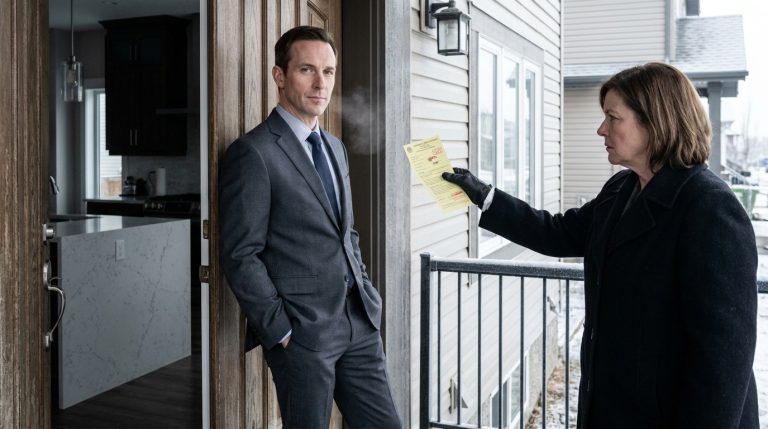
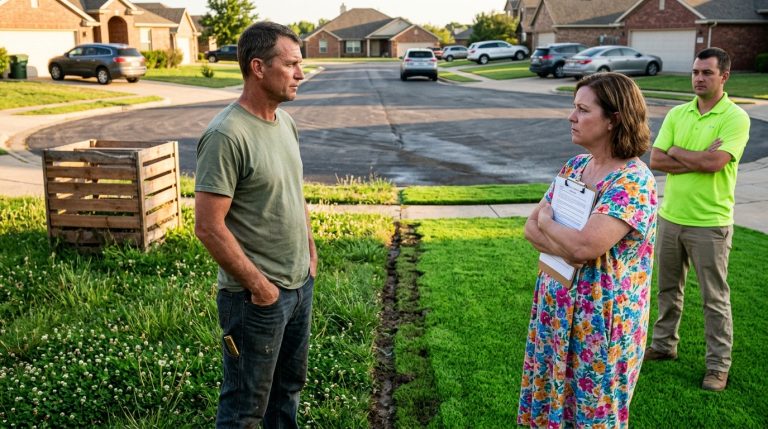
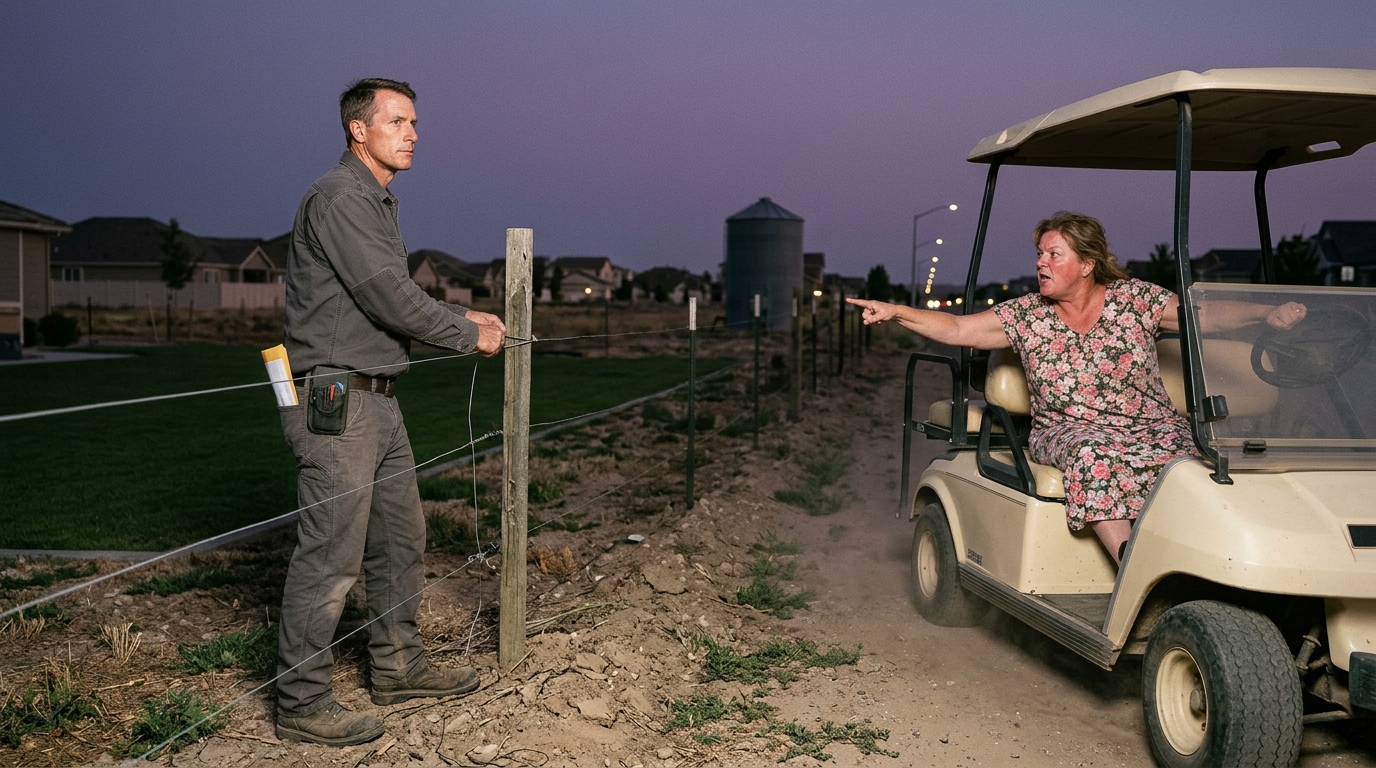
The envelope was thick, heavy with the weight of bureaucratic malice. It smelled faintly of lavender and cheap, store-bought ambition—the signature scent Karen left wherever she roamed. She stood by her golf cart, her face a flushed map of suburban fury, chest heaving beneath a floral mumu that looked like it was losing a war of attrition.
“Thirty days, Mr. Callahan,” she spat, her voice grating against the quiet hum of the valley. “Either that rusted eyesore comes down, or the fines begin. We have standards here.”
I didn’t answer. I looked past her, toward the corner of my ten-acre plot where the silo stood. From here, it looked like a standard agricultural relic, a gray monolith against the deepening blue of the pine-shielded horizon. In reality, it was a perfectly calibrated piece of infrastructure, its internal steel bracing humming with a frequency that the homeowners in the valley relied on for every text, every call, and every emergency alert they took for granted.
Karen didn’t know that. She saw a violation. She saw a reason to exert force.
“You’re not listening to me,” she pressed, her finger trembling as she jabbed it toward the structure.
“I heard you the first time, Karen,” I said, my voice as level as a spirit level. I didn’t look at her. I turned back to the fence post, focusing on the mechanics of the wire. If the tension wasn’t perfect, the fence would sag within a year. It was a lesson I’d learned early: do it right, or don’t bother doing it at all.
“This is a formal notice,” she snapped, pivoting toward her chariot of beige plastic. “Expect a follow-up if you think you can ignore the Board.”
As she rumbled away, the engine whine dying out against the trees, I finally looked at the envelope. I didn’t open it. I knew exactly what was inside: a list of bylaws, a mention of ‘aesthetic integrity,’ and an inflated dollar amount designed to induce immediate, panicked compliance.
I walked into my workshop. The air here was cool, smelling of ozone, sawdust, and gun oil. It was a place of logic, not opinion. I set the envelope on the workbench next to a disassembled two-way radio. I didn’t need to read the legal threats to understand their nature. They were seeking a confrontation, a public display of obedience. They wanted to see me sweat, to see me beg for an extension, to see me acknowledge their authority.
But I was a communications specialist. I knew how to read the silence between the lines of a transmission. Karen was pushing for a fight, and she had no idea that she had just walked into a firing solution. I reached for my phone, the screen showing a perfect five-bar signal, and opened the log I’d been keeping for two years.
There was a missing screw in the back of the radio I was repairing—a tiny, silver detail that shouldn’t have been out of place. My pulse didn’t hitch; it slowed. The discrepancy in the workshop was a ghost, a reminder that something was off-kilter, but it wasn’t the threat. The threat was the letter sitting on my desk, and for the first time in years, I felt the sharp, cold clarity of a mission starting.
CHAPTER 2: The Paper Trail
I didn’t pick up the letter again immediately. I let it sit there, an offensive rectangle of white bond paper against the scarred, oil-stained surface of my workbench. My gaze drifted to the two-way radio I had been working on. The internal components—the copper coils, the soldering, the precise alignment of the capacitors—represented a world where cause and effect were absolute. If a signal failed, it was because of a breakdown in physics, not a violation of someone’s arbitrary sense of “aesthetic harmony.”
My mind snagged on a memory, unbidden. Kadena Air Base, 2004. A thunderstorm had knocked out the primary relay, and I had been waist-deep in a server rack, trying to bypass a faulty bridge while the ground shook from the ordnance landing miles away. Back then, the pressure was kinetic, immediate. You fixed the link or the flight lead lost his eyes in the sky. Here, in the quiet of North Ridge Meadows, the pressure was made of paper and ink, but the risk to the integrity of the system remained exactly the same.
I reached for the envelope, the snap of the utility knife cutting through the thick stock sounding like a single, sharp heartbeat in the silent shop.
The letter was a masterpiece of amateur intimidation. It was printed on letterhead that felt flimsy, the text heavily weighted with bolded, underlined, and capitalized demands. NON-CONFORMING STRUCTURE. IMMEDIATE DEMOLITION. RETROACTIVE PENALTIES. They were trying to build a narrative of inevitability, a psychological wall designed to make me feel small, cornered, and desperate.
I scanned the legalese. They cited a hodgepodge of bylaws that were clearly drafted by someone who had spent a weekend Googling property law. They didn’t even reference the actual zoning permits from twenty years ago. To them, the land was a blank slate that they had inherited the right to define.
I set the letter down and pulled out the fireproof steel cabinet. The key turned with a heavy, satisfying click. I didn’t need to hunt for the file; I knew exactly where it was. The OmniLink Tower Lease folder was thick, the edges of the pages yellowed from time, but the ink was as crisp as the day it was notarized.
I spread the original contract out under the warm, focused glow of my task lamp. Section 4B: Perpetual Unrestricted Access. My finger traced the lines of text. I hadn’t just built a tower; I had integrated a node into a national network. I shifted to Section 11A, the federal preemption clause, which referenced the 1996 Telecommunications Act. It was a shield, forged in Washington and tested in courts across the country. It was the absolute, objective reality that Karen and her little committee of suburban gatekeepers had failed to check before launching their volley.
I felt a cold, sharp satisfaction. This wasn’t about whether or not the tower was a “blight.” It was about the fact that they had no legal jurisdiction to even ask the question. They were trying to govern a signal they didn’t understand, using rules that didn’t apply to the frequency they were currently standing on.
I walked to the corner of the workshop and picked up the landline phone. I dialed the number for David Chen at OmniLink. I didn’t rush. I let the phone ring four times, my eyes tracing the grid of my property lines sketched out on the wall-mounted map.
“Chen,” the voice on the other end was clipped, efficient.
“Jack Callahan,” I said. “Tower 734 is being targeted.”
There was a pause, just enough for him to recalibrate his tone. “Targeted? By who, Jack? The local power grid or the weather?”
“By the HOA,” I said. I held the phone tight, my knuckles turning white. “They’re not just complaining. They’ve moved to formal fines, and they’re threatening a lien on the property. They sent a letter citing non-compliance with aesthetic standards.”
I heard a sound from David—halfway between a sigh and a laugh. “Those HOA commandos again. They have a habit of forgetting that federal law tends to occupy the field before they even get a chance to show up to the game.”
“They’re escalating, David. They sent a signed order for demolition.”
“Send it to me,” David said, his voice hardening into professional territory. “Our legal team is going to love this. They’ve been looking for a clean, simple case to demonstrate the preemption rules in this region. You’re giving us the perfect opening.”
“I want the legal letter,” I said, “but I want to wait on sending it. Don’t go to their board yet.”
“What are you doing, Jack?” David asked, his curiosity piqued.
“I’m going to let them overextend,” I replied. “I need to know who else they’re harassing, and I need to see if they’re actually stupid enough to file a lien against a federal easement. If they want to play a game of legal force, I’m going to make sure they realize they’re outmatched before I even show my hand.”
“You’re giving them the rope?”
“I’m giving them a noose,” I corrected.
I hung up. The shop felt different now. The smell of oil and dust didn’t feel like a retreat anymore; it felt like a command center. I had the legal foundation, I had the corporate backing, and I had the silence of the shop to think. I looked at the letter one more time, then tossed it into the recycling bin. It was no longer a threat; it was just a draft. And I was about to rewrite the entire narrative of North Ridge Meadows.
I reached for my notebook, clicking my pen. It was time to map out the neighbors. If Karen wanted a war over standards, she was going to find out exactly what the standard for resistance was.
CHAPTER 3: The Underground Network
I didn’t leave the workshop immediately. I spent an extra minute scrubbing the grease from my knuckles, my movements slow and methodical. The transition from the world of circuits to the world of neighborhood politics required a psychological gear shift. Out here, the problems weren’t governed by voltage or current; they were governed by vanity, insecurity, and the desperate need to belong.
I stepped out of the workshop into the late afternoon heat. The sky was bruising into a deep, hazy purple, the kind of light that made the perfectly manicured lawns of North Ridge Meadows look almost artificial. My house sat at the edge of the development, the transition point between the rugged, pine-heavy slope of my property and the rigid, grid-like geometry of the subdivision.
As I walked toward the main entrance, I noticed the first disruption. Parked in a driveway three houses down—a house that belonged to one of Karen’s vocal supporters—was a black sedan with tinted windows. It didn’t belong to the neighborhood. The styling was sleek, expensive, and out of place among the sea of sensible family crossovers. I paused, adjusting the brim of my cap, and watched. A man in a dark suit stepped out, glanced toward my direction with a practiced, sweeping motion, and hurried inside. It was a detail so small it might have gone unnoticed by anyone who wasn’t trained to look for shifts in the baseline. Karen was definitely orchestrating something.
I reached the community bulletin board near the entrance. The red-font sign was still there, a jagged, offensive scream of typography that stood out against the beige-and-white aesthetic of the mail kiosk. I pulled out my phone, snapped a high-resolution photo, and took a moment to observe the surroundings.
“Evening,” a voice said.
I turned. It was Eleanor Henderson, her face partially obscured by a wide-brimmed gardening hat. She was pruning the bushes that lined the walkway, a pair of stainless steel shears clicking with rhythmic, metallic precision in her hands.
“Evening, Eleanor,” I said. My voice was pitched low, blending into the ambient sound of distant sprinklers. “The roses look better than they did last week.”
She didn’t look up immediately. She waited until she had finished a particularly thorny stem. “They do,” she said, finally meeting my eyes. Her expression was guarded, the way it always was when we spoke in the open. “But they’ll look even better if I don’t get another letter about the height of the mulch. It’s reached a point where I feel like I’m gardening for an audience of one.”
I stepped closer, ostensibly to look at the flowers, but kept my body angled away from the street. “Karen’s influence is widening, isn’t it?”
Eleanor sighed, a fragile sound. “She’s been having more meetings. Not the ones in the community center, but the ones behind closed doors. She’s been spending a lot of time with Todd. They’ve been looking at the property lines—specifically yours.”
I felt the familiar, cold focus snap into place. “And the others? The Garcías? The Klein family?”
“They’re tired, Jack,” she whispered. “The fines are small enough to be annoying but large enough to make people think twice about speaking up. That’s the genius of it. She doesn’t want to break us all at once; she wants to keep us just uncomfortable enough to be compliant.”
I nodded, acknowledging the tactic. It was a standard bottlenecking maneuver. You create enough friction in the everyday flow of life that people stop trying to move forward and just settle for the status quo.
“I’m not going to be compliant, Eleanor,” I said, my voice steady. “And I don’t think you are either. I need to know something. Have you noticed anyone coming to the neighborhood? Anyone who doesn’t live here? Someone driving a black sedan?”
Eleanor’s shears paused mid-air. She glanced toward the house where I had seen the vehicle, then back at me. Her brow furrowed. “I saw him yesterday. He was carrying a briefcase. He went into the president’s home for nearly two hours. When he came out, Karen was… different. Less frantic. More calculated.”
I thanked her, gave the roses a final, appreciative nod, and kept walking. My mind was already parsing the data. A mysterious visitor, a shift in Karen’s temperament, and the focus on my property lines. She wasn’t just acting on her own anymore; she was seeking professional, perhaps legal, backing to solidify her position.
I didn’t head home. Instead, I took a long, winding route through the neighborhood, my internal radar scanning the environment. I spoke to a neighbor I hadn’t properly introduced myself to before—a quiet man named Mr. Miller who spent most of his time working on his deck. He didn’t have a fence violation, but he had a grudge. He’d been told his garage door was the wrong shade of white.
“She’s everywhere,” he told me, his eyes tracking a patrol of Karen’s golf cart as it turned the corner. “It’s like she has a sense for when someone is about to deviate from the script. I’ve stopped leaving my tools out. I’ve stopped trying to improve the yard. I just wait.”
By the time the sun dipped below the tree line, leaving the valley in a long, cool shadow, I had confirmed three more instances of selective, aggressive enforcement. The pattern was undeniable. Karen was not just a neighborhood president; she was a collector of grievances, using the HOA’s thin, legalistic veneer to extract resources and compliance from anyone she perceived as a threat or a potential source of leverage.
I reached the edge of my own property, where the dark, imposing silhouette of the silo loomed against the stars. It was silent, efficient, and utterly unmoved by the chaos playing out a few hundred yards away.
I pulled out my phone and checked the log one last time. Every interaction, every name, every scrap of information I had gathered was uploaded to the encrypted spreadsheet. The digital picture was becoming clear. Karen was building an empire on the back of fear, but she was making a critical error: she was underestimating the very people she was trying to subdue. They weren’t just neighbors anymore; they were a reservoir of shared history, and they were all beginning to realize that the rules they were being beaten with weren’t as ironclad as the president claimed.
I looked back toward the subdivision, the streetlights flickering to life one by one in a rigid, predictable line. I wasn’t just a homeowner mending a fence anymore. I was an observer, gathering intelligence for a campaign that was no longer just about my tower. It was about the integrity of the valley itself.
CHAPTER 4: The Escalation
The walk back to my property was an exercise in suppressed intensity. Every house I passed—each one a temple of mid-range suburban aesthetics—seemed to watch me with a dull, vacant eye. I wasn’t just walking home anymore; I was moving through contested territory. My boots crunched against the manicured pavement, the sound sharp and intrusive in the artificial silence of the night.
When I reached the end of the old trail, I stopped. The house was dark, save for the single amber light I left burning over the workshop door. I didn’t go inside immediately. I stood on the porch, my back to the door, scanning the treeline. The paranoia, I realized, was starting to settle into my bones. It was a useful tool in the service, where the environment was designed to kill you, but here, in North Ridge Meadows, it was a volatile asset. Was I actually seeing patterns, or was I simply projecting a tactical framework onto a group of bored, petty people?
I shook the thought away and went inside.
The workshop was waiting. It was cold, the temperature having dropped as the desert night set in. I moved to my desk and pulled out the file containing the most recent letter from the HOA’s legal firm. I had been sitting on it for three days. It was a Notice of Intent to Lien, a formal, typed death sentence for my property’s financial freedom. The language was aggressive, filled with threats of foreclosure and asset seizure. It was a blunt force instrument, a warning that they were finally done with newsletters and were moving into the realm of permanent, irreversible damage.
I spread the document out. My hands were steady, but the room felt smaller, the walls closing in as I mentally mapped out the timeline of the board’s escalation. They were moving faster than I had anticipated. By bringing in a local law firm, they had forced my hand. I couldn’t just keep them in the dark anymore. The moment that lien was officially filed with the county, the stakes would shift from a neighborhood dispute to a matter of public record.
I picked up the phone and dialed David Chen at OmniLink again. I kept my voice low, speaking into the shadows of the shop.
“They filed, Jack,” David said, his voice devoid of the earlier humor. “The lawyers just transmitted the intent to lien. They aren’t bluffing. They’re coming for the property.”
“I know,” I replied. “I just saw the notice.”
“We can pull the trigger, Jack. We can send the legal firestorm their way tomorrow morning. But if we do, the HOA is going to know exactly who they’re dealing with. The element of surprise—if you still have any—will be gone.”
“Hold off,” I said, a dangerous clarity settling over me. “I want to see if they follow through with the actual filing. Let them walk right up to the edge. If they want to be aggressive, let’s see how they handle it when their own lawyers realize they’re suing a federal easement.”
I hung up, the silence of the shop returning, heavier than before.
I looked at the map on the wall again, specifically the marked perimeter of my land. I had spent the last two days with a surveyor, ensuring that every boundary, every easement corridor, and every foot of the tower’s footprint was marked with absolute, unimpeachable accuracy. The bright pink ribbons tied to the survey stakes out in the yard were more than just markers; they were a physical declaration of ground.
A knock at the door, soft but insistent, interrupted the silence.
I didn’t reach for a weapon, but my posture stiffened, every muscle primed. I walked to the door and pulled it open, my hand lingering on the frame. It was Marcus, his silhouette framed by the porch light. He looked tired, his shoulders slumped, but his eyes were sharp.
“They’re having an emergency board meeting,” Marcus said, bypassing any greeting. “I heard it from the Garcías. Karen’s calling it for two weeks from now. She wants to ratify the lien and authorize the court filing.”
“She’s playing right into the schedule,” I said, a thin, humorless smile touching my lips.
“She’s confident, Jack. Too confident. She’s walking around like she’s already won. The whole street knows what she’s planning, and she’s treating it like a coronation.” Marcus stepped inside, his gaze sweeping the organized chaos of the workshop. “Are we ready?”
“We’re ready,” I said, gesturing to the stack of documents on the bench. “We have the evidence of the selective enforcement. We have the proof of their stonewalling on the financials. And once they push the lien, we have the federal preemption to gut them.”
“And the others?” Marcus asked, his voice lowering. “Are they going to hold? They’re nervous, Jack. The fines are getting under their skin.”
“They’ll hold if they know they aren’t alone,” I said. “That’s the next step. We need to stop the whisper campaign and start the consolidation. Tomorrow, we go door to door. No more rumors. We give them the facts. We show them the redacted financials. We show them that Karen’s ‘utopia’ is built on their own bank accounts.”
Marcus nodded slowly, the stoic discipline of his training manifesting in his steady gaze. “They’ll try to stop us. Karen isn’t going to let us canvass her ‘beautiful community’ without a fight.”
“Let her try,” I said, the cold metallic precision of the workshop feeling like an extension of my own resolve. “Every time she tries to block us, she only confirms our suspicion that she has something to hide. Let her escalate. Let her push. The more she moves, the more mistakes she’ll make.”
I turned back to the workbench, my eyes catching the reflection of the workshop’s fluorescent lights in the glass of the survey maps. The room felt like a cockpit, a place where I was in control of every variable, every connection, and every input. Outside, the neighborhood was still asleep, unaware that the rules they had been living by were about to be systematically dismantled.
Karen thought she was the architect of this neighborhood. She was about to learn that some structures are built on foundations far older and much stronger than her committee bylaws.
CHAPTER 5: The Digital KillSwitch
The rain wasn’t just a weather event; it was a tactical complication. I sat in the cab of my truck, the wipers fighting a losing battle against the deluge. I had planned to meet the Garcías on their front porch to finalize the signatures for our formal challenge, but in this downpour, the neighborhood looked desolate. The streetlights struggled to pierce the gray curtain of water, and the quiet, orderly grid of North Ridge Meadows felt claustrophobic, like a cage being rapidly filled with fluid.
I checked the dashboard clock. 7:15 PM. The emergency board meeting was less than a week away, and Karen’s lawyers had just confirmed the filing of the lien. The pressure was moving from theoretical to physical. If I didn’t establish the coalition’s legitimacy before that meeting, the board would ratify the lien, and my property would be entangled in a legal purgatory that could last for years.
My phone buzzed. A message from Marcus: Meet at the Garcías. Back door. The street is being watched.
I put the truck in gear and pulled forward, moving slowly to avoid drawing attention. The “watched” part didn’t surprise me. Karen had been utilizing Todd and his golf cart for perimeter checks ever since she got the idea that I was organizing. I navigated the winding, identical streets with a navigator’s intuition, cutting through the alleyways behind the garages until I saw the soft, yellow glow of the Garcías’ back porch.
I parked three houses down and sprinted through the rain. The water was ice-cold, soaking through my jacket in seconds, but I didn’t care. The physical discomfort was a grounding element. I reached the back door and knocked once—a specific, rhythmic double-tap.
Mr. García opened it, his face tight with controlled panic. He ushered me in, the door clicking shut behind me with the heavy, final sound of a lock engaging.
“She’s parked at the end of the block,” García whispered, gesturing toward the front window where the curtains were pulled to a thin sliver. “Todd. He’s been sitting there for twenty minutes. He knows someone is here.”
I crossed the room to the window. Sure enough, a faint, blinking light from a golf cart’s battery indicator cut through the gloom. They were waiting. They wanted to see who was meeting whom. It was a classic intimidation tactic, meant to make us feel watched, monitored, and ultimately, alone.
“Let him sit,” I said, my voice low. I looked at the Garcías, who were standing in their kitchen, surrounded by the remnants of a quiet family evening—toys on the floor, a half-finished book on the counter. “The fact that he’s out here in this weather proves how desperate they are. They know we have the documents, and they know the audit is looming.”
“But the lien, Jack,” Mrs. García said, her voice trembling. “If they pass it at the meeting, what happens to you? What happens to the rest of us if they decide we’re the next targets?”
I took the satchel off my shoulder and laid it on their kitchen table. I didn’t use the documents as a prop; I used them as a blueprint. “The lien is a bluff based on a false premise. They think I’m just a guy with a structure they don’t like. They don’t know the tower is a protected, federal-level asset. And they certainly don’t know that we’ve discovered the link between the board and Lush Greenscapes.”
I pulled out the registration paperwork I’d recovered—the smoking gun. “When we stand up at that meeting, we don’t argue about mulch or house paint. We hand this to the entire neighborhood. We expose the conflict of interest, we highlight the missing funds, and we force the board to account for every single dollar they’ve extracted from you.”
“And if they refuse to let us speak?” García asked, his hands clenching.
“They won’t have a choice,” I replied, my eyes locking onto his. “Because I have the ability to demonstrate, in real-time, exactly why that tower matters. I have a direct line to the network operations center. I can show everyone in that room what happens when you let a petulant board play games with critical infrastructure.”
“A kill-switch?” García looked at me, a mixture of awe and fear in his eyes.
“A temporary diagnostic shutdown,” I corrected, keeping my tone strictly professional. “Five minutes. No service. Total silence. When their phones go dead, they won’t be listening to Karen’s rules anymore. They’ll be looking for someone who knows how to turn the power back on.”
The rain hammered harder against the roof, a rhythmic, driving beat that seemed to underscore the gravity of the plan. I stood there, looking at them, realizing that I was asking them to step out of their comfortable, beige-colored lives and into the center of a conflict that would change the neighborhood forever. They weren’t soldiers, but they were tired, and fatigue is a powerful motivator.
“We need the signatures for the formal challenge,” I said, reaching into my satchel. “If we have a majority of the neighborhood on record demanding an audit, the board cannot proceed with a legal filing. It would be a direct violation of their own charter.”
Mr. García took the pen. The signature was firm, a testament to the months of quiet, simmering resentment that had finally found an outlet.
“They’re watching, but they’re not listening,” I said, looking back at the window one last time. “They think we’re afraid. They have no idea that we’ve already moved past fear.”
I didn’t leave the way I came. I knew Todd was likely waiting for me to exit through the back. Instead, I waited for a lull in the downpour, then slipped out through the side gate, moving through the shadows of the neighboring yards. I was a ghost in the grid, a variable they hadn’t accounted for. My pulse was steady, my mind calculating the distance to my truck and the time until the board meeting.
The escalation was absolute now. There was no going back to the days of quiet compliance. I felt the cold air on my face, the sting of the rain, and for the first time in years, the absolute certainty of the path ahead. I had the kill-switch, I had the evidence, and I had the neighborhood. The countdown to the meeting had officially begun.
CHAPTER 6: The Public Confrontation
The community center smelled of floor wax and stale coffee, a sterile, hollow space that felt like it had been designed to strip the personality out of any gathering. I stood just inside the main doors, the weight of the satchel against my hip a constant, reassuring reminder of the leverage I held. Marcus was at my side, his presence a silent wall of stability against the murmur of the crowd.
We were early, but the room was already reaching capacity. It was a sea of beige-toned clothing and anxious expressions. I saw the Garcías near the front, their posture rigid, and the Hendersons toward the center, clutching their folders like shields. There were others I didn’t recognize, newer residents who had likely been lured in by the promise of order and property value protection, but the atmosphere wasn’t one of unity. It was a nervous, buzzing tension.
Then the side door opened.
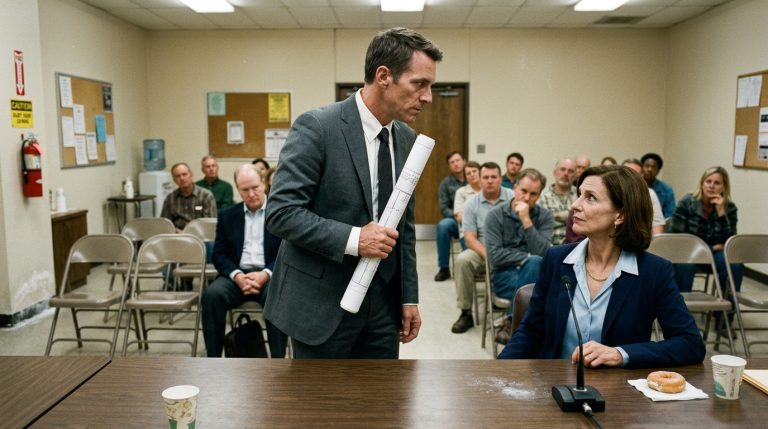
Karen walked in, flanked by Todd and two men in dark suits who moved with the practiced, predatory grace of corporate fixers. She was wearing the magenta power suit, her head held at an angle that screamed engineered authority. She didn’t look at the crowd; she headed straight for the riser, her heels clicking against the linoleum with the sharp, rhythmic cadence of a metronome.
I walked to the front row and took my seat. The room went silent. The shift was visceral, like a physical change in air pressure. Karen paused at the table, her eyes sweeping over the rows until they landed on me. For a second, the mask of the composed president flickered, a trace of genuine surprise—perhaps even fear—crossing her features. She hadn’t expected me to show up, or perhaps she hadn’t expected me to look so calm.
She tapped the microphone, the feedback whine piercing the air. “Welcome, neighbors,” she said, her voice strained, lacking its usual performative warmth. “We are here tonight to address the persistent issues surrounding the illegal, non-conforming structures that threaten the harmony of our community.”
She didn’t mention my name. She didn’t have to. The entire room turned as one toward my seat.
“The Board has authorized legal action,” she continued, her voice gaining strength, drawing on the presence of her two hired enforcers. “We have exhausted all avenues of mediation. We are here to ratify the filing of a formal lien against the property at 141 Oak Ridge Trail, and to initiate the process for total structure removal at the owner’s expense.”
“Madame President,” I said.
I didn’t stand up. I didn’t shout. I just spoke, my voice cutting through the space with the clarity of a calibrated instrument. The room reacted instantly, the silence becoming suffocating. Karen’s grip on the gavel tightened until her knuckles turned white.
“This is not an open forum, Mr. Callahan,” she snapped. “You will have your day in court. This is a Board meeting.”
“This is a community meeting regarding a matter of public interest, governed by the same bylaws you claim to protect,” I replied, standing slowly, deliberately. I didn’t rush. I made sure every eye in the room was fixed on the movement. “And before you move to ratify any action, the residents might want to know about the discrepancy in the financial filings—specifically the undisclosed landscaping contract awarded to your family.”
A collective gasp rippled through the room. It was the sound of a bubble bursting. Karen’s face drained of color, then flushed a deep, ugly crimson. She looked at Todd, who was visibly trembling, then to the men in suits. They didn’t move; they were watching the room, their eyes calculating the shifting allegiance of the crowd.
“That is a lie!” Karen screamed, the gavel hitting the wood with a crack that sounded like a gunshot. “Security! Remove him!”
“There is no security here, Karen,” Marcus said, stepping forward. He didn’t raise his voice, but his presence forced the two men in suits to check their footing. “There are only neighbors.”
I walked toward the riser, pulling the laptop from my bag. My movements were fluid, precise. I didn’t look at the fixers, didn’t look at the board; I looked at the people—the Hendersons, the Garcías, the people who had been fined for birdbaths and house-paint shades while their own funds were being siphoned away.
“You want to talk about harmony, Karen?” I opened the laptop, the screen illuminating the faces of the people in the front row. “Let’s talk about the cost of your version of it. Let’s talk about where the $50,000 in ‘fines’ has actually gone.”
I plugged the cable into the projector. The image on the screen behind her was not a technical diagram, but the simple, undeniable evidence of the Lush Greenscapes contract.
The room erupted. It wasn’t the polite, orderly discussion of a neighborhood association; it was the raw, unvarnished sound of a community discovering it had been robbed. Karen was still trying to speak, the microphone in her hand cutting in and out as she shook, but no one was listening to her anymore. The fixers looked at each other, realizing that the leverage had shifted in a matter of seconds.
I stood there, the laptop glowing in the dim light, and watched as the board’s authority dissolved. It wasn’t the dramatic, cinematic explosion I had envisioned. It was slower, more painful—a gradual erosion of power as every person in the room began to connect the dots. I had the kill-switch in my pocket, the phone ready to cut the signal, but I didn’t need it. The truth, once laid bare, was far more destructive than any technical shutdown.
CHAPTER 7: The Exposure
The room didn’t just feel like a community center anymore; it felt like a courtroom where the verdict had already been delivered. Karen stood behind the riser, her magenta suit suddenly looking like a costume from a play that had gone horribly, violently wrong. The documents on the screen—the bank statements with the blacked-out lines, the irregular vendor payments, the blatant nepotism of the Lush Greenscapes contract—were doing the work for me. They were silent, clinical, and utterly devastating.
“You have no right,” Karen hissed, but the microphone was dead. Whether someone had cut it or the system itself was overwhelmed by the erratic network traffic, the effect was the same. Her voice was thin, a pathetic sound lost in the vast, echoing acoustics of the hall.
“The right is in the bylaws, Karen,” Marcus said, stepping toward the riser. He didn’t look at her; he looked at the two men in suits, who had instinctively backed away from the stage as if afraid of being touched by the scandal. “You’ve been using the HOA’s accounts as a private reserve for eighteen months. The forensic audit will verify every cent.”
I moved toward the projector, my focus entirely on the screen. I flipped to the final slide: a direct, side-by-side comparison of the market rate for local landscaping services and the exorbitant fees paid to her brother-in-law’s company. It was an objective, mathematical proof of greed. There were no opinions, no interpretations—just numbers.
The room erupted. It was a chaotic, discordant sound—shouts of disbelief, accusations from people who had been fined for trivialities while their money was being funneled away, and the heavy, murmuring rumble of collective anger. People began to stand up, their chairs scraping against the linoleum, creating a cacophony that drowned out any hope of order.
Karen looked around, her eyes wide, searching for a path that didn’t end here. She tried to step off the riser, to walk toward the back door, but the path was blocked by the Garcías and a dozen other residents. They weren’t being violent; they were simply standing in her way, their expressions hard and unforgiving. They were the ones she had fined, the ones she had labeled as “non-conforming,” and they were the ones who finally had the agency to demand an explanation.
“Todd,” she whispered, a desperate plea to the treasurer who had been her primary enabler. But Todd was gone—or rather, he had shrunk so far into the back corner of the room that he was barely visible, a shadow in a room filled with light.
I walked up to the riser, my boots echoing against the floor. I didn’t say a word. I simply stood there, my presence a confirmation of the truth. I looked at the two corporate fixers, who had clearly decided that this contract was no longer worth the reputational risk. They were already packing their bags, their movements hurried and professional, focused only on getting out before the fallout became permanent.
“This meeting is adjourned,” I said, my voice projecting across the room, steady and resonant.
The sound of the gavel Karen had dropped on the floor was the only thing that interrupted the sudden, heavy silence that followed. It sat there, a wooden symbol of power that had just been rendered useless.
“The interim committee will take charge of all HOA records,” I continued, glancing at Eleanor Henderson, who nodded. “We have secured the files, and we have an independent audit firm standing by. Everyone in this room deserves to know the truth about what has been happening to their property values and their finances. We will hold a town hall in three days, and every single question—about the contracts, the fines, and the board’s conduct—will be answered.”
Karen was a ghost now. She stood on the riser, ignored by everyone, her face pale and slack. The triumph I had anticipated—the surge of vindication—didn’t come. Instead, I felt a strange, chilling clarity. She wasn’t a monster; she was a symptom of a system that allowed individuals to hoard power behind a thin, fragile wall of rules. Her desperation to keep the embezzlement hidden mirrored my own initial, obsessive need to protect the silo. We were two sides of the same coin: one using rules to control, the other using systems to insulate.
But the difference was the foundation. Mine was a federal, legal reality; hers was a petty, fabricated delusion.
As the crowd began to filter out—still buzzing, still angry, but now focused and directed—I remained on the riser for a moment. I watched the room slowly empty. The fluorescent lights flickered, a buzzing, rhythmic sound that reminded me of the diagnostic monitors in my workshop.
I looked at the screen one last time, the data of the fraud still projected in stark, black-and-white. It was done. The mechanism had been dismantled, the gears jammed by the very truth they had tried to black out with a Sharpie. I walked out of the community center and into the cool, damp night air. The rain had stopped, and the clouds were breaking, revealing a sliver of the moon over the ridge.
I took a deep breath. My hands were still steady. The mission was nearly complete, but the most important part remained: the aftermath, the denouement of the neighborhood, and the final stabilization of my own life. I turned toward the trail, my steps light, the weight of the last few months beginning to lift from my shoulders. The silo stood in the distance, a silent sentinel in the dark, still bathing the valley in its signal, still doing exactly what it was built to do.
CHAPTER 8: The Fallout
The drive back to my property was slow, the road winding through the valley under a sky that had finally cleared. The tension that had defined every muscle in my body for the last three months began to drain away, replaced by a profound, hollow exhaustion. I didn’t rush. I didn’t check the rearview mirror. I just drove, the steady hum of the engine a stark contrast to the chaotic, discordant shouting that had filled the community center an hour before.
When I pulled up to the workshop, I didn’t turn off the truck immediately. I just sat there, listening to the cooling metal tick in the night air. The silo loomed above, its silhouette stark against the stars, no longer a point of contention but a silent, reliable partner in the landscape.
I stepped out of the truck and walked not into the workshop, but toward the base of the tower. I hadn’t been this close to the structure in weeks. I ran my hand along the cold, textured surface of the steel. It was cool to the touch, vibrating with the subtle, deep-frequency hum of the equipment inside. This was the core of the conflict—a piece of critical, federally protected infrastructure that Karen had seen as a “blight.”
The forensic audit was already in progress; the district attorney had been notified by the interim board, and the formal process of dismantling Karen’s empire was underway. She was a ghost now—a woman whose entire sense of self had been built on the petty, fragile rules she had tried to impose on us. She had been forced to list her home the following morning, and the shame was a weight more substantial than any fine she had ever levied. The bank accounts were frozen, the landscaping contract was voided, and the neighborhood—my neighborhood—was beginning to breathe again.
I walked back into the workshop, the space feeling different now. It was no longer a war room. The maps on the wall, the logbooks, the surveillance data—they were artifacts of a conflict that was officially over. I picked up the two-way radio I had been working on in Chapter 1. I found the missing screw that had haunted my focus during the first volley of the conflict, and I set it in place with a gentle, precise turn of the screwdriver.
The click of the screw seating itself was the final sound of the operation.
The next morning, the sun rose over the valley with a clarity I hadn’t seen in months. I spent the day out on the trail, not mending fences for tactical advantage, but because the work itself was honest. Around midday, Marcus stopped by. He didn’t bring any news of scandals or board meetings. He brought a crate of beer and a quiet, satisfied look.
“They’re painting the swing set,” he said, gesturing vaguely toward the Garcías’ house down the trail. “The kids are out there. Blue again.”
I laughed, a sound that felt rusty in my throat. “Good.”
“The audit is going to take months, Jack,” he added, leaning against the fence post. “But the neighborhood is already different. People are talking to each other again, not through newsletters or formal warnings, but over the back fences. It’s quiet.”
“Quiet is what I wanted,” I said, looking out at the rolling hills.
After Marcus left, I spent the afternoon working on the garden. I repaired the small trellis that had been knocked over during the early days of the dispute—a minor, physical act of restoration that felt more important than any legal victory. It was a simple, tangible repair, a symbolic closing of the loop.
As evening fell, I sat on my porch and watched the lights of the subdivision flicker on. They were different now—no longer the rigid, controlled grid of a neighborhood under siege, but a scattered, warm constellation of homes. I thought about Karen, about the arrogance of her rules, and about the way she had tried to force the world to match her own internal need for control. She had failed because she didn’t understand the difference between rules and reality.
I reached into my pocket and touched the phone. I didn’t check the signal. I didn’t check the diagnostic tools. I didn’t need to. The tower was doing its job, the valley was connected, and for the first time in twenty years, I felt like I was actually at home. I wasn’t just a man on a property waiting for the next violation; I was a part of the landscape.
The air smelled of damp earth and pine, a scent that finally felt clean. I leaned back, closing my eyes, and listened to the distant, faint sound of the wind moving through the valley—not as a threat, not as a challenge, but as a simple, resonant truth. The conflict had left its marks, the scars of the struggle would remain on the neighborhood for a long time, but the underlying structure had held. I had reached the end of the roadmap, and what remained was not the victory I had planned, but the peace I had actually been fighting for.