The Concrete Covenants: How an Engineer Turned Suburban Tyranny Into a Masterclass in Pragmatic Retribution
CHAPTER 1: THE FRONT LINE APPEAL
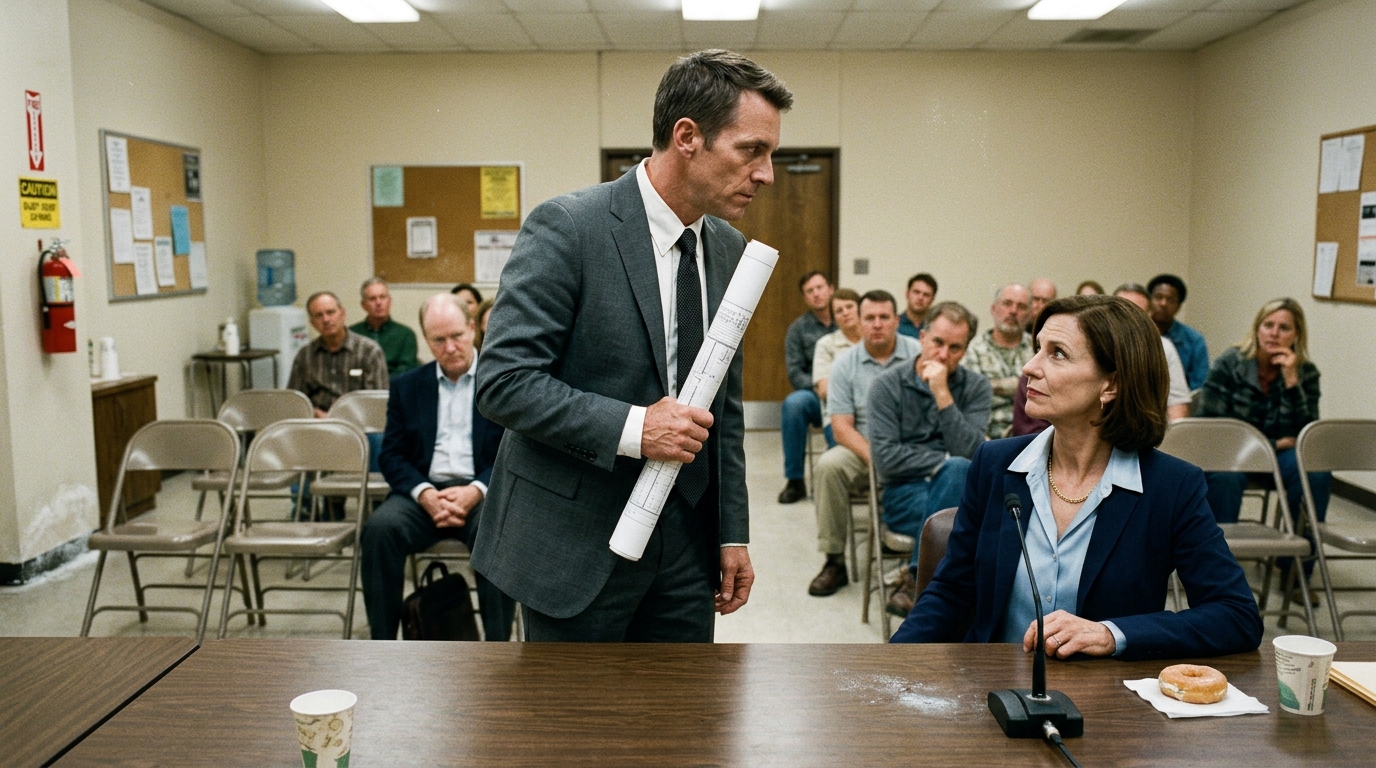
The folding chair creaks under my weight as I stand up, the heavy brass scale ruler in my coat pocket pressing cold against my hip.
Karen Miller doesn’t look up from her clipboard right away; she lets three seconds of dead air fill the sterile room, established authority dragging its heels.
“Mr. Riley,” she says, her voice echoing through the buzzing PA speaker as she finally taps her pen against the laminate table. “We have a full agenda tonight, so if this is about the unauthorized timber structure on Live Oak Lane, the board’s position is already matter of record.”
“It’s a treehouse, Karen,” I say, stepping into the center aisle so the fifteen scattered neighbors behind me can hear every syllable. “Built with four-by-six pressure-treated posts, drop-forged TAB bolts, and zero ground-penetrating footings.”
I set the stack of engineered blueprints and clear photo prints directly on the table, right over her floral-print folder.
The board member to her left, a pale man with a fading tan, glances down at the top sheet, his eyes catching the stamped load-calculation numbers.
“The bylaws restrict unapproved secondary structures,” Karen says, sliding my schematics to the side without reading a single line. “Article Seven, Section Four. It’s quite clear, Jack.”
“Article Seven covers detached sheds, pool houses, and permanent concrete foundations,” I say, keeping my hands resting flat on the table edge, feeling the rough grain of the folding vinyl. “It makes no mention of temporary arboreal play equipment, nor does the county building code require a permit for structures under one hundred twenty square feet.”
Karen tilts her head, a tight, thin smile stretching across her face as she leans toward her microphone.
“The board interprets the aesthetic impact of all rear-yard additions, Jack, and your little fortress violates the visual uniformity of Harmony Creek.”
Behind her, right along the baseboard where the drywall meets the slab, a thick crust of white, flaky salt sits heavy against the brickwork, damp to the touch from years of improper water runoff.
I tap my index finger once on the blueprint margin, right beside the red-inked municipal boundary map.
“Then you’ll want to put your interpretation in writing, along with the specific engineering failure you’re claiming poses a community hazard.”
Karen pulls a crisp white sheet from her binder, sliding it across the table until the corner touches my thumb.
“We already did,” she says, her voice dropping into a flat, quiet register that doesn’t need the microphone. “Effective midnight, the daily non-compliance fine doubles, and the notice of forced abatement has been filed with the county clerk.”
CHAPTER 2: THE PAPERWORK SIEGE
“A forced abatement filed with the county clerk,” I say, my voice staying flat enough to cut right through the hum of the cheap ceiling fans. “That’s an impressive turnaround for a notice you drafted forty-eight hours ago, Karen.”
Karen doesn’t flinch; she simply adjusts her spectacles, letting the gold chain around her neck clink against her floral blouse.
“The board acts in the interest of the community’s structural standard, Jack,” she says, leaning back in her padded leather armchair while the two board members beside her nod in tight, synchronized beats. “You don’t get special dispensation because you own a set of tools.”
“It’s not about tools,” I say, sliding my hand off the table and feeling the heavy brass scale ruler resting inside my coat pocket, its crisp edges anchoring my knuckles. “It’s about the law. A forced abatement requires a thirty-day cure period under Florida Statute 720, unless there’s an immediate safety hazard certified by a licensed municipal engineer.”
The pale man to Karen’s left—Dennis, her quiet husband who sits on the architectural review committee just to fill a seat—clears his throat, his eyes darting down to my stamped schematics.
“He… he did stamp these himself, Karen,” Dennis mutters, his fingers twitching toward the corner of my load-bearing calculations. “He’s got a professional license number right on the margin.”
“Dennis, quiet,” Karen snaps, not even turning her head to look at him, her gaze locked squarely on mine. “His personal license is a clear conflict of interest. We have our own legal counsel, and the injunction stands.”
I pull the scale ruler halfway out of my pocket, turning the triangular metal edge against my thumb, feeling the sharp metric notches before letting it drop back into the lining.
“Your legal counsel didn’t check the county land records before filing that injunction, did they?” I ask, stepping half an inch closer to the table so my shadow falls over her neatly arranged binder.
Karen’s thin smile falters for a fraction of a second, her hand freezing over her silver pen.
“What are you talking about?”
“I spent the last three nights reading the 1994 master plat for Harmony Creek,” I say, keeping my eyes fixed on the damp, crumbling line of white salt crusting the bottom brick of the wall behind her chair. “Article Seven doesn’t give you the right to fine a homeowner retroactively without a registered quorum vote, and page forty-two shows something much more interesting about this exact clubhouse lot.”
A soft murmur ripples through the twelve residents sitting in the metal folding chairs behind me, the sound of people suddenly waking up to a fight they didn’t know was coming.
Karen slams her palm flat against the laminate table, the cheap plastic microphone screeching in protest as her cheeks flush a blotchy, mottled red.
“This meeting is adjourned!” she announces, her voice cracking over the feedback. “Mr. Riley, you have fourteen days to tear down that blight, or the demolition crew will enter your property with a police escort!”
I don’t raise my voice; I just pick up my stack of blueprints, the heavy paper snapping smartly between my hands as I roll them tight.
“I’ll see you in the county clerk’s office at eight tomorrow morning, Karen,” I say, turning my back on her desk while she scrambles to gather her files. “Bring your drainage maps.”
CHAPTER 3: THE SOIL AND THE SHADOW
The parking lot is dead silent except for the metallic click of Karen’s heels hustling toward her beige sedan two aisles over.
I don’t chase after her; I stand under the sodium vapor lamp, unrolling the top edge of the plat map to check the county survey stamps against the street layout.
Sarah is waiting on the front porch when I pull into our driveway, her shadow stretching long across the lawn where Leo’s new cedar fortress stands silent under the oak canopy.
“Did they listen?” she asks, stepping down onto the top brick step, her arms wrapped tight around a worn navy sweater.
“Karen adjourned the meeting before I finished reading the survey lines,” I say, setting the rolled blueprints on the porch table and pulling the heavy brass scale ruler from my coat. “She thinks filing a civil injunction gives her total leverage.”
Sarah looks out toward the backyard, where the clean smell of dry cedar still lingers over the humid grass.
“She sent another letter today, Jack,” Sarah says quietly, reaching into her sweater pocket to pull out a crisp, folded piece of legal stationery. “A formal notice from an attorney downtown. They’re threatening a lien on the deed if we don’t dismantle the second story by Friday.”
I take the paper from her fingers, turning it toward the amber porch light to read the firm’s letterhead—a regional real estate practice three towns over.
“They’re using a boilerplate template,” I say, running the edge of the brass scale down the left margin, checking the filing reference number against my internal timeline. “They didn’t attach an emergency stay order from a judge because no judge would grant one without a preliminary hearing.”
“She’s trying to scare us into pulling it down ourselves,” Sarah says, her voice dropping as she glances toward Leo’s bedroom window upstairs.
“She’s trying to win before anyone checks the county recorder’s office,” I say, setting the letter flat on top of the blueprints. “Get Leo to school on time tomorrow morning. I’m taking a trip down to the clerk of courts before the doors unlock at eight.”
Sarah touches my forearm, her grip firm against the fabric of my jacket.
“Jack… don’t make this a war we can’t walk away from.”
“I’m not starting a war, Sarah,” I say, tapping the brass ruler flat against the legal paper once. “I’m just reading the boundaries they forgot were recorded.”
CHAPTER 4: BOUNDARY LINES
The clerk behind the counter—a woman with thick reading glasses resting on a beaded chain—leans over the counter as I tap the brass ruler against a set of coordinates.
“That’s a county drainage easement, sir,” she says, her fingernail pointing to the micro-print text along the lot margin. “Class A storm-water basin connector. It was deeded to the county before the developer poured the first slab of Harmony Creek.”
“And who holds maintenance responsibility for that specific easement under the municipal charter?” I ask, pulling my pocket notebook out to transcribe the filing page number.
“The primary homeowners association,” she says, sliding a second ledger sheet toward me. “They’re required by county ordinance to keep twenty feet of clearance along that line for emergency overflow access.”
I trace the line with the edge of the brass scale, watching the dashed vector cross straight through lot fourteen—Karen Miller’s property—and cut directly under the rear foundation wall of the community clubhouse.
The clerk watches my thumb press against the paper, her brow furrowing slightly.
“Is there an issue with your boundary line, Mr. Riley?”
“Not mine,” I say, closing my notebook with a soft snap. “My lot sits forty feet clear on higher grade.”
The county clerk stamps my copy of the master plat with a heavy red ink pad, the dull thud echoing off the high plaster ceiling of the archive room.
I take the certified copy, folding it twice before sliding it into my coat pocket next to the brass ruler.
“If an HOA board fills in or builds over a designated county storm-water easement without a municipal waiver,” I say, looking her straight in the eye, “what’s the civil penalty?”
The clerk adjusts her glasses, her mouth setting into a thin, knowing line.
“A mandatory restoration order from the county public works department, plus daily structural non-compliance fines assessed directly against the board members personally.”
I smile, a quiet, cold reaction that stays completely off my face as I pick up my coat.
“Thank you,” I say, stepping away from the wooden counter. “That’s exactly what I needed to confirm.”
CHAPTER 5: THE DEPTH OF THE FOUNDATION
The soil gives way under my palm like a wet sponge, water squeezing up between my knuckles despite three days without a drop of rain.
I pull my hand back, wiping my muddy fingers on a tuft of dry grass before reaching into my coat for the brass scale ruler.
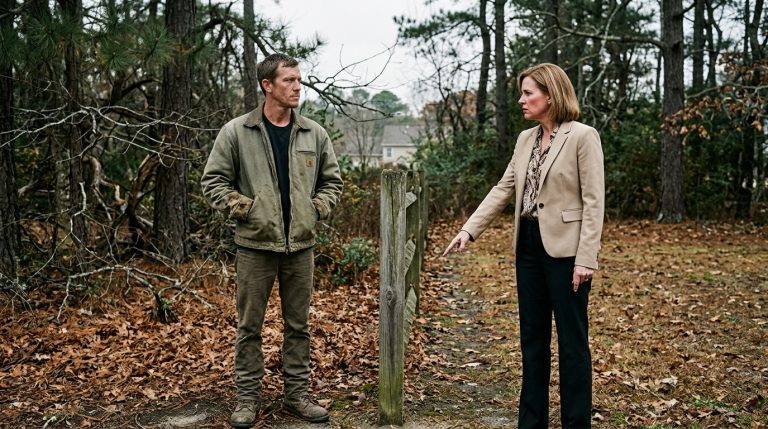
Dennis Miller stands twenty feet away on his back patio, a pair of garden shears frozen in his hand as he pretends to trim a perfectly manicured hibiscus bush.
“Morning, Dennis,” I call out, my voice flat as I push the narrow edge of the metal ruler six inches deep into the soft, uncompacted earth right alongside the fence post.
Dennis twitches, his shears snapping shut with a sharp, metallic click before he sets them down on his glass patio table.
“Jack… you shouldn’t be back here,” Dennis says, taking two hesitant steps toward the property line, his eyes nervously scanning his back windows. “Karen called the board’s attorney again this morning. They’re drafting a police escort for the removal crew.”
“They can draft whatever they want, Dennis,” I say, pulling the ruler out of the mud and wiping the black silt against my thumb to inspect the water line on the brass. “Tell me something. When did you and Karen backfill this retention swale?”
Dennis stops dead in his tracks, his lower lip trembling slightly as his eyes dart down to the muddy notch in the earth.
“That… that was four years ago,” Dennis stammers, his voice dropping to an anxious whisper. “The standing water was bringing mosquitoes into the yard. We just leveled it off with topsoil and sod so we could extend the patio.”
I stand up slowly, letting the brass scale slide back into my pocket alongside the certified county plat map.
“You filled in a Class A county storm-water connector with uncompacted topsoil and dumped eight inches of concrete over the intake culvert,” I say, stepping right up to his fence line. “That’s why the clubhouse brickwork is leaching efflorescence and sinking half an inch every wet season.”
Dennis’s face drains of color, his fingers gripping the top rail of his white vinyl fence until his knuckles turn chalky.
“Karen said… she said the county would never check a private suburban tract,” Dennis whispers, his voice cracking under the weight of the realization.
“The county won’t,” I say, leaning slightly over the rail so he can see the certified red seal on the folded paper in my coat. “But the municipal public works director will when I hand him the survey maps at two o’clock today.”
CHAPTER 6: FRACTURES IN THE BOARD
She throws her car door open, her floral blouse disheveled, a manic energy radiating from her posture as she strides across the sun-baked asphalt.
“Dennis called me, Jack!” she shouts, her voice echoing off the clubhouse wall where the white salt crust gleams under the midday heat. “You have no right trespassing on private board property or intimidating my husband!”
I stand my ground by my driver’s door, resting my arm flat along the truck bed, feeling the hot metal through my sleeve.
“It wasn’t intimidation, Karen,” I say, pulling the brass scale ruler out of my pocket and letting it rest lightly across my palm. “It was an engineering assessment of an unpermitted backfill over a Class A municipal drainage swale.”
Karen’s hands shake as she pulls a thick leather binder to her chest, her knuckles turning white against the cover.
“That swale was an eyesore,” she spits, stepping closer until I can smell the stale coffee on her breath. “We brought in four trucks of topsoil to protect property values. The board voted on it!”
“A board vote can’t override county zoning law,” I say, tapping the edge of the brass ruler against my truck bed with a slow, rhythmic click. “And it certainly doesn’t excuse burying a culvert that drains four square miles of residential runoff.”
Dennis’s car turns into the lot, pulling up ten feet behind her sedan, his hands gripping the steering wheel tight enough to show white tendon.
He steps out slowly, his shoulders slumped as he walks toward his wife.
“Karen… stop,” Dennis says quietly, his voice carrying a weary, desperate edge that freezes her mid-sentence. “He showed me the certified map. He’s got the county public works stamp.”
Karen spins on her heel, her floral sleeve cutting through the humid air as she glares at her husband.
“You shut your mouth, Dennis! He’s bluffing! He’s just an ex-army grunt trying to keep an illegal fort in his backyard!”
“I’m an engineer, Karen,” I say, stepping between her and Dennis so my height blocks the glaring sun from her eyes. “And at two o’clock, the county public works inspector is arriving to inspect the foundation of this clubhouse.”
Karen’s mouth opens to scream another threat, but no sound comes out; her eyes dart frantically between my face, the certified papers in my pocket, and the damp, chalky line along the clubhouse brickwork.
CHAPTER 7: THE STRUCTURAL INSPECTION
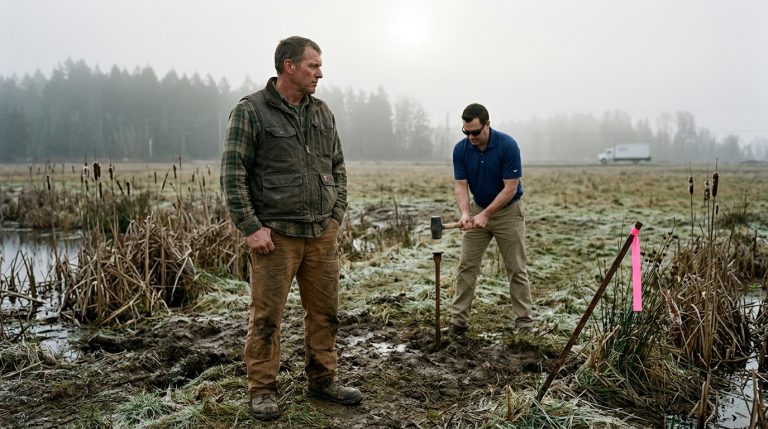
The county surveyor—a burly man named Vance wearing a sweat-stained high-vis vest—leans his full weight on the handles, pulling the metal shaft back up with a sucking pop of thick black mud.
“That’s illegal fill, alright,” Vance says, wiping his brow with the back of a leather work glove before pointing a mud-caked finger at Karen’s rear fence. “There’s eight inches of uncompacted dirt sitting straight over a four-foot reinforced culvert.”
Karen steps onto the lawn, her high heels sinking two inches into the damp turf, her clip-board clutching her chest like a shield.
“This is private community property!” she shrieks, her voice cracking as she gestures wildly at three deputy cruisers pulling into the clubhouse lot behind us. “Officer! I called dispatch twenty minutes ago! I want this man removed for trespassing and property destruction!”
A tall deputy steps off the pavement, his hand resting casually on his belt as he looks from Vance’s mud-covered probe to Karen’s flushed face.
“Ma’am, county public works has statutory right-of-way on all designated drainage corridors,” the deputy says, his tone weary and unbothered as he glances at the official seal on Vance’s county truck. “Mr. Riley isn’t trespassing; he’s assisting a municipal site audit.”
Karen’s eyes widen, her composure completely shattering as she spins toward the two board members standing quietly by the clubhouse pool gates.
“Dennis!” she screams, her voice echoing off the brickwork. “Tell them! Tell them Jack Riley threatened us! Tell them he built that non-compliant treehouse to intimidate the board!”
Dennis steps forward slowly, his eyes fixed on the muddy hole Vance drilled into the turf.
“He didn’t threaten us, Karen,” Dennis says, his voice quiet but steady enough to make the entire lawn go dead silent. “He warned us four days ago. We filled in that easement to extend our yard, and we used HOA reserve funds to pay for the topsoil.”
A low chorus of gasps rises from six neighbors who had gathered along the sidewalk to watch the commotion.
Karen’s face turns pale, her breath hitching in her chest as she looks at her husband like he just handed her a death sentence.
“Effective immediately,” Vance says, pulling a bright orange stop-work notice from his clipboard and slapping it flat against the front door of the clubhouse, “this structure is red-tagged for foundation settling due to improper drainage diversion, and the board has fourteen days to restore the easement at their personal expense.”
Karen drops her clipboard into the grass, the plastic frame snapping against a tree root as I pull the brass scale ruler from my pocket, sliding it into my sleeve with a single, smooth click.
CHAPTER 8: GROUNDWORK RESTORED
The condensation drips off the can, cool against my thumb, while the late afternoon sun paints the oak leaves in shades of deep amber and gold.
“Is the fort still a castle, Dad?” Leo asks, swinging his legs over the cedar deck railing, his small shoes tapping a soft, steady rhythm against the composite floorboards.
“It’s an engineered fortress, buddy,” I say, leaning back against the solid four-by-six post, feeling the firm support of the drop-forged bolts anchored deep in the tree trunk. “Nobody’s tearing it down.”
Down in the yard, Sarah walks out onto the back lawn carrying a small tray of tools, setting a tin of wood sealant and two clean brushes on the lower bench.
The front gate clicks open, and Dennis walks slowly down the side path, holding an official manila envelope stamped with the county clerk’s seal.
I step down the wooden ladder, meeting him by the edge of the patio where the cedar shadow meets the grass.
“The board held an emergency meeting this morning, Jack,” Dennis says, his voice quiet, his posture relieved as he hands me the envelope. “We formally dropped the violation notice, rescinded all fines, and dissolved Karen’s architectural review committee.”
I open the flap, scanning the signed dismissal order and the municipal waiver certifying the treehouse as a non-permanent recreational fixture.
“And Karen?” I ask, folding the document and sliding it into my back pocket.
“She resigned as president,” Dennis says, looking back toward his lot where a county excavator crew is already setting up orange cones along the easement boundary. “The county gave us thirty days to dig out the buried culvert. We’re paying for it out of the board reserve, and Karen’s covering the rest personally.”
Dennis holds out his hand, his grip firm and honest as we shake over the property line.
“Thanks for keeping it strictly about the engineering, Jack.”
“Always check the foundation before you build, Dennis,” I say, tapping the edge of my coat pocket where the brass scale ruler sits tucked away for good.
He nods once and turns back toward his house as Sarah steps up beside me, handing me a paint roller dripping with fresh clear coat.
I dip the roller into the tray, spreading a smooth, protective seal over the bottom cedar rail while Leo’s laughter echoes down from the lookout deck above.