The Weight of the Staple: How a Suburban Mayor Calculated the Downfall of an Iron-Fisted HOA Tyrant
CHAPTER 1: THE COLD IRON OF INCORPORATION
The house was too quiet at six in the morning, save for the rhythmic hum of the refrigerator and the faint, dry scrape of a neighbor’s snow shovel clawing at frozen pavement three doors down. Ethan sat at the kitchen island, his fingers resting lightly against the polished quartz surface, a cup of dark roast steaming quietly beside a stack of municipal zoning reports.
To the rest of Oakridge Estates, he was simply the quiet guy from the corner house who commuted downtown to some nameless desk job in city administration. To the woman currently marching down Maple Street with a neon-yellow highlighter and a binder thick enough to stop a bullet, he was Target Number Forty-Seven.
A sharp rap at the front door sliced through the silence. It wasn’t the friendly double-knock of the mail carrier or the hesitant tap of a neighbor borrowing a ladder. It was the calculated, rhythmic striking of knuckles designed to announce authority.
Ethan did not rush. He took a measured sip of the coffee, letting the bitterness settle on his tongue before standing. He walked across the hardwood floor with the slow, deliberate grace of a man who spent his days reviewing high-stakes property litigation. When he pulled the door open, the crisp December air rushed in, carrying the distinct, metallic tang of ozone and old paper.
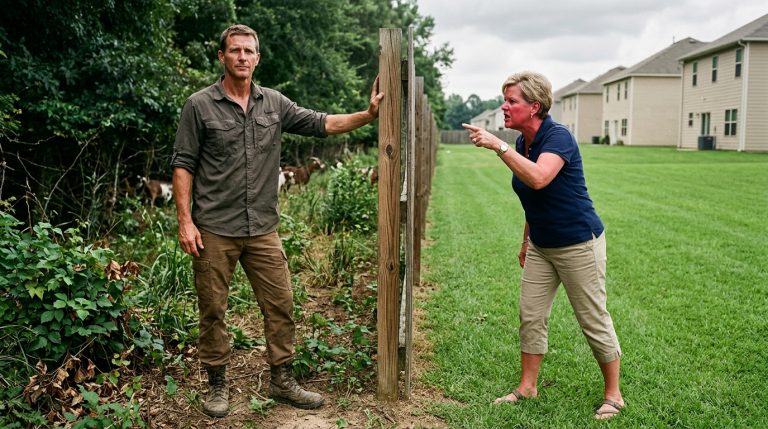
Delilah Thornfield stood on the porch, her breath pluming in grey wisps against the pale morning light. Her wool coat was buttoned to the chin, dark and severe, matching the unyielding slope of her jaw. In her left hand, she clutched a certified mail receipt; in her right, a freshly printed citation notice bearing a red stamp that practically vibrated with bureaucratic malice.
“You’re outside without a coat, Ethan,” she said, her voice dropping into that flat, transactional register she reserved for people she deemed non-compliant. “Though I suppose outdoor loitering without aesthetic clearance is the least of your household’s infractions this week.”
Ethan leaned his shoulder against the doorframe, keeping his weight balanced evenly, his hands tucked loosely into the pockets of his fleece zip-up. He looked past her shoulder toward the curb, where his daughter’s blue plastic sled lay abandoned near the driveway edge—a mortal sin in Delilah’s geometry of suburban perfection.
“Good morning, Delilah,” Ethan said, his voice entirely level, stripped of any neighborly warmth. “Cold out for paperwork.”
“It’s cold because discipline has broken down entirely in this subdivision,” she snapped, stepping closer, her eyes narrowing as she scanned the clean lines of his porch before fixing him with a stare of clinical scrutiny. “I saw the delivery truck parked on your apron for twenty-two minutes yesterday afternoon. Commercial loading without prior board notification carries a baseline penalty of two hundred dollars. The invoice is already in your box.”
She thrust the yellow paper forward. Ethan didn’t reach for it. Instead, his gaze dropped to the corner of the document, tracking the header font—a custom serif type she had paid a print shop to mimic official municipal stationery.
“Two hundred dollars,” Ethan repeated softly. He felt a cold, sharp calculation take hold behind his ribs, the familiar, precise mechanics of an attorney unspooling a flawed contract. “That’s quite an assessment for a delivery van, Delilah. Especially considering the state hasn’t recognized an active corporate filing for this association since the autumn of twenty-four.”
Delilah’s hand froze mid-air, the paper trembling by a fraction of a millimeter against the cold wind. The silence between them stretched, thick and brittle, before a thin, sharp shadow crossed her eyes—not panic, but the instant, defensive tightening of a predator whose blind spot had just been brushed.
CHAPTER 2: THE GARAGE TACTICS
The paper didn’t fall. Delilah pulled her hand back with a sharp, involuntary jerk, her knuckles whitening against the dark wool of her glove. For a fraction of a second, the immaculate architecture of her absolute control flickered, replaced by the narrow, calculating squint of a bureaucrat who realized her ledger had just been audited by an unknown hand.
“An expired filing means nothing,” she recovered, her voice dropping an octave, tightening into a defensive coil. “Clerical oversights at the state level are common during administrative transitions. The covenants recorded in the county courthouse supersede corporate registry dates, Mr. Wellington. You’d know that if you spent less time loitering on your porch and more time reading your subdivision bylaws.”
Ethan didn’t blink. He maintained his posture against the doorframe, letting her words hang in the freezing air, heavy with the brittle scent of frosted cedar. He didn’t offer a correction. He didn’t cite section numbers or statute years. In a game of calculated friction, letting an opponent double down on a collapsing foundation was worth more than a dozen immediate victories.
“Of course, Delilah,” Ethan said smoothly, his tone flat and devoid of challenge. “The bylaws are comprehensive. Have a productive morning with your route.”
He didn’t wait for her reply. With a slow, deliberate motion, Ethan stepped back and clicked the front door shut, latching the deadbolt with a solid, satisfying thud. Through the insulated glass of the sidelight, he watched her stand frozen on the porch for three long seconds—her head cocked slightly, processing the unnatural calm in his voice—before she turned on her heel, her boots crunching sharply into the frozen turf as she resumed her march down Maple Street.
By seven o’clock that evening, the temperature had plummeted, turning the lingering slush on the subdivision asphalt into a brittle sheet of glass. The air smelled of wet wool and woodsmoke drifting from chimney flues, but inside Joe Kowalsski’s detached garage, the atmosphere carried a distinctly different chemical signature: stale coffee, heavy motor oil, and the dry, nervous rustle of forty-seven families pushed past their breaking point.
Joe had cleared the center bay, pushing his vintage lawnmower and spare tires against the back wall to make room for a scarred wooden workbench that now served as an improvised command desk. Fluorescent strip lighting hummed overhead, casting a harsh, unsparing glare over the faces gathered in the semi-darkness.
Tom Rodriguez, a retired army colonel with iron-gray hair cropped close to the scalp, stood near the workbench, tapping a metal ruler against a thick binder filled with multi-colored sticky notes. Next to him, Mrs. Patterson clutched a mug of lukewarm tea, her posture rigid with seventy-three years of accumulated schoolteacher authority.
Ethan stepped into the garage from the side door, pulling his wool cap off and shaking the light frost from his jacket. The chatter in the room dropped instantly, replaced by a tense, expectant hush. These weren’t just neighbors anymore; they were an encampment holding the line against an invisible siege.
“She dropped another thirty citations on the north block before noon,” Tom said without preamble, his voice gravelly and low. “Mostly targeting exterior Holiday lighting tolerances and unregistered foot traffic. The Millers got tagged because their teenage nephew parked his sedan in their own driveway for four hours while helping shovel snow.”
“It’s not about the cars,” Ethan said, stepping up to the workbench and resting his palms on the scarred wood. He scanned the room, meeting the tired eyes of young parents and elderly widows alike. “It’s about isolation. She’s systematically testing response times, looking for the first household that breaks down and pays a fine out of pure exhaustion.”
“We can’t afford to pay, Ethan, and we damn well aren’t going to,” Mrs. Patterson said, her voice steady despite the slight tremor in her hands. She set her mug down with a sharp clink against the wood. “I spent the afternoon cross-referencing her latest notice with the county records office online. The section she’s citing—Section 12-B regarding unauthorized commercial structures—was repealed back when the county updated its zoning code in nineteen ninety-eight. She’s citing laws that literally evaporated twenty-eight years ago.”
Ethan felt a slow, dark satisfaction tighten in his chest. The parallel tracks of his life—the quiet, unassuming neighbor and the municipal executive who knew every back-alley municipal loophole—were beginning to converge. But he kept his face neutral, playing the role of the observant local lawyer helping friends untangle a knot.
“Repealed codes are just noise,” Ethan said quietly, leaning forward into the harsh fluorescent light. “If we challenge her at her own game—filing individual appeals through her kangaroo architectural committee—we play by her rules, and she drags us out through endless bureaucratic loops until we collapse. We don’t appeal. We bypass.”
Tom narrowed his eyes, leaning his weight onto the metal ruler. “What do you mean, bypass?”
“Delilah operates on the assumption that she is the sole arbiter of corporate standing,” Ethan said, his voice dropping into the steady, rhythmic cadence of a courtroom cross-examination. “She treats the HOA as her private proprietorship. But a homeowners association isn’t a dictatorship; it’s a registered non-profit corporate entity bound by state business laws. If the state corporation commission invalidates her charter, her entire authority evaporates overnight. Every fine, every threat, every piece of paper she’s printed becomes legally worthless waste.”
A murmur rippled through the gathered neighbors. Near the back, holding a clipboard covered in handwritten tallies, Sarah stepped forward from the shadows of the tool racks, her eyes fixed on him with a sharp, knowing intensity. She had spent the last hour listening to the accounts of the families whose kids had been driven indoors, whose flags had been challenged, whose daily routines had been warped by fear.
“And how do we trigger that state invalidation without her locking down the books first?” Sarah asked, her voice cutting cleanly through the murmur.
Ethan reached into his coat pocket and withdrew a single, folded sheet of official state corporation registry data he had printed from his office terminal before coming home. He laid it flat on the wooden workbench, smoothing the creases with the side of his thumb.
“We don’t ask her for the books,” Ethan said, looking up as the harsh overhead light caught the edges of the paper. “We file an anonymous compliance audit request directly with the state attorney general’s office, citing failure to maintain active corporate status and missing annual officer renewals for two consecutive fiscal years. Once the state opens that file, they freeze all associated bank actions and demand an immediate accounting of every dollar collected under an inactive seal.”
Mrs. Patterson leaned in closer, squinting down at the printed page. “And how long until they freeze the accounts?”
“Forty-eight hours once the digital packet hits the desk,” Ethan said, his jaw tightening as he pictured the look on Delilah’s face when her automated citation printer finally sputtered to a dead, silent stop. “Which means before she can issue another single-tier penalty or threaten another family with foreclosure, she’s going to find herself answering to state investigators who don’t care about aesthetic compliance.”
Tom let out a dry, humorless bark of laughter, running a hand over his close-cropped hair. “Well, damn. I haven’t seen a tactical strike like that since my second tour in the highlands.”
“It’s not a strike yet, Tom,” Ethan corrected softly, his eyes scanning the perimeter of the garage where the shadows met the cold night air outside. “It’s just pulling the pin. What happens when she realizes she’s cornered is going to be the real test. She won’t back down quietly. She’ll lash out at the weakest point she can find.”
“Let her try,” Mrs. Patterson said, her chin lifting with fierce, unyielding dignity. “We’ve got forty-seven families under this roof tonight, Ethan. And for the first time in six months, we aren’t hiding.”
Ethan nodded slowly, though the cold knot in his stomach refused to loosen. He knew the machine they were dismantling, and he knew the desperate, rigid mind of the woman running it. Delilah Thornfield was about to discover that when a tyrant runs out of paperwork, the real architecture of power begins to collapse from the bottom up.
CHAPTER 3: THE MIDNIGHT MAILBOX
The fluorescent hum overhead flickered once before settling back into a steady, sterile drone. Ethan kept his hands flat against the scarred grain of the workbench, feeling the cold transfer of the wood through his palms. The meeting in Joe Kowalsski’s garage had dissolved slowly, not in a rush of panicked chatter, but with the grim, orderly departure of veterans falling back to assigned positions. Families had slipped out through the side door two and three at a time, their breath pluming white against the dark suburban driveway, leaving behind only the faint scent of stale coffee and burnt motor oil.
Ethan waited until the last set of tailights turned the corner of Maple Street before he moved. He pulled his heavy wool coat back over his shoulders, the fabric stiff against the frost, and zipped it to the chin.
“You’re not heading straight back to the kitchen, are you?”
Sarah’s voice came from near the shadow of the spare tire rack. She was leaning against the fender of Joe’s old pickup, her arms crossed tightly over her chest, her eyes catching the overhead light with a sharp, analytical glint. She hadn’t missed the way his fingers had drifted toward the pocket containing the state corporation registry printouts during the briefing.
Ethan paused, his hand resting on the zipper. “Just checking the perimeter, Sarah. Delilah’s notices don’t stop printing because the sun goes down.”
“Don’t play the neighborhood watchdog with me, Marcus,” she said, using his first name with that particular inflection that bridged the gap between his domestic life and his downtown office. “I know that look. That’s the face you wore the night before the municipal zoning board tried to rezone the East District without public hearings. You’re not just waiting for her next move; you’re walking right into her line of sight.”
“I’m dropping information where people can actually read it,” Ethan replied smoothly, keeping his tone measured, stripping away any defensive edge. “Information is the only thing a paper tyrant can’t fine.”
He didn’t wait for her argument. Stepping out of the garage side door, he let the heavy wooden panel click shut behind him, sealing off the warmth of the makeshift headquarters.
The night was aggressively quiet. Oakridge Estates at two in the morning possessed a sterile, deadened quality, insulated by thick blankets of fresh snow that muffled the distant hum of the interstate. The streetlights cast long, amber spindles across the frozen asphalt, turning every stray shadow into an obstacle. Ethan pulled his hood low, burying the lower half of his face in his collar, his boots crunching rhythmically into the crust of the snow as he walked toward the main subdivision entrance.
The memory flickered unbidden—a sudden, sharp phantom from his early days at city hall, reviewing dusty municipal ledgers while the janitors vacuumed the empty corridors. Back then, paperwork had been a weapon of order, a way to keep cities from tearing themselves apart at the seams. Seeing it twisted here, compressed into petty fines and authoritarian eviction threats by a retired clerk with a grudge, left a bitter, metallic taste at the back of his throat.
He reached the first cluster of metal mailboxes at the corner of Elm and Maple. The green paint was chipped around the keyholes, scarred by years of winter salt and summer sun.
With gloved fingers, Ethan slid a folded packet of state corporation code transcripts into the oversized slot of Box 12, belonging to the Millers. He didn’t rush, but he didn’t linger either. Every movement was economic, calculated against the sweep of the second hand on his wristwatch. He moved to Box 14, then 16, sliding the unlabelled, photocopied guides on how to verify an active corporate seal. No signatures. No return addresses. Just raw, unvarnished state statute text proving that every dollar collected under Delilah’s current letterhead was legally non-binding.
As he reached Box 22—the Rodriguez household—a sudden shaft of light cut across the snow fifty yards down the street.
Ethan froze, flattening his profile against the cold metal pedestal of the mailbox cluster. The beam belonged to a late-model sedan creeping down Maple Street without its headlights fully engaged, relying only on running lamps that cast a sickly, bluish hue over the snowbanks. It rolled at a deliberate, agonizing crawl, pausing precisely where the curb met the edge of the Miller driveway.
Inside the car, a silhouette shifted against the glow of the dashboard instrument cluster. A camera shutter clicked—faint, but distinct enough to carry across the frozen air.
Delilah hadn’t just outsourced her paranoia; she had contracted it out. The private investigator she brought into the subdivision two days prior was running his nightly circuit, logging late-night foot traffic and cross-referencing shadow movements against his master ledger. If the driver spotted Ethan standing by the mailboxes at two-thirty in the morning, the entire architecture of his strategic anonymity would shatter before the state attorney general’s office could even open their compliance file.
Ethan didn’t run. Running kicked up snow spray and invited pursuit. Instead, he stepped smoothly around the back of the heavy brick column supporting the neighborhood directory sign, letting the dense masonry swallow his outline. He kept his breathing shallow, his eyes locked on the amber tailights of the sedan as it idled fifty feet away.
The engine hummed low, vibrating through the frozen ground beneath his boots. For ten agonizing seconds, the vehicle sat motionless, its high-intensity lenses sweeping across the facades of the sleeping houses like a mechanical eye searching for a pulse.
Then, with a soft crunch of gravel against ice, the sedan shifted into gear and drifted slowly down toward the south cul-de-sac, its red tailights dissolving into the heavy winter fog.
Ethan let out a slow, measured breath, watching the vapor dissipate instantly into the dark. He stepped back out from behind the brick pillar, his fingers brushing the cold metal of the last mailbox slot. The trap was laid, but the wire was beginning to fray faster than he anticipated. He pulled his hood down another inch and continued his rounds through the dark.
CHAPTER 4: THE DOUBLEBILLING ABYSS
The municipal office at city hall smelled faintly of ozone from the basement copy machines and the stale linoleum wax that had coated the floors since the late nineties. It was Thursday morning, exactly four days before the annual neighborhood Christmas party, and Ethan sat behind his heavy walnut desk, staring down at an open folder labeled Oakridge Estates Infrastructure Maintenance & Services.
Outside his frosted glass window, heavy grey clouds hung low over the municipal parking lot, threatening a fresh blanket of wet snow. But inside the office, the climate was controlled, sterile, and moving at the speed of a freight train gone off the rails.
A sharp rap sounded on the door frame before it pushed open. Jake Morrison, the city building inspector, slipped inside, closing the heavy wooden door behind him with a dull click. Jake looked tired, his canvas jacket dusted with grey mortar residue, a plastic tumbler of lukewarm coffee clutched tightly in his hand.
“You wanted the vendor audit logs from the past twenty-four months, Boss,” Jake said, dropping a thick manila envelope onto the center of Ethan’s desk. The papers inside shifted with a dry, rustling weight. “And trust me, you’re going to want to sit down for this, even if you’re technically already in the chair.”
Ethan didn’t smile. He laced his fingers together on the desk surface, watching the way Jake’s jaw ticked with suppressed irritation. “Tell me what you found, Jake.”
“I pulled the duplicate records for snow removal, street lighting maintenance, and asphalt upkeep in Oakridge Estates,” Jake said, pulling up a metal folding chair and sitting down uninvited. He tapped a finger against the manila envelope. “According to the municipal master agreement signed back when the subdivision was annexed in nineteen ninety-five, the city provides all routine road care, lighting power, and seasonal plowing free of charge as part of the municipal tax tier. It’s written into the foundational charter.”
Ethan nodded slowly. “I drafted those clauses when I was working as a junior attorney for the city planning board. I know they’re there.”
“Right. Well, here’s the glitch in the matrix,” Jake continued, his voice dropping to a low, conspiratorial murmur. “For the last twenty-four months, every single household in Oakridge Estates has been billed an extra seventy-five dollars a month for street maintenance and fifty dollars a month for snow removal by their local homeowners association.”
Ethan’s gaze narrowed. The pieces clicked into place with the cold, undeniable precision of a tumblers falling in a heavy bank vault. “Double billing. The city covers the cost out of public tax funds, while Delilah’s association charges residents a duplicate fee for the exact same services.”
“It gets worse,” Jake said, leaning forward, the fluorescent lights catching the deep lines around his eyes. “I cross-referenced the corporate deposit slips linked to those monthly homeowner assessments. The checks aren’t going into a standard neighborhood maintenance account. They’re being funneled through a shell entity registered under an address in downtown commercial storage—and the sole signatory listed on the account is Delilah Thornfield.”
Ethan pulled the file toward him, his thumb flipping open the cover. Inside lay a series of photocopied bank ledgers and cancelled checks bearing signatures written in sharp, rigid ink strokes. But as he scanned down the second page, his eye caught a glaring discrepancy. A formal municipal vendor contract for neighborhood snow clearance bore the official city seal, but the signature line lacked the mandatory second-party authorization stamp from the city comptroller’s office. A missing seal—a micro-mystery of administrative forgery that turned routine bookkeeping into an active embezzlement operation.
“Fifteen thousand dollars a year in duplicate charges,” Ethan murmured, his voice dead flat. “Multiply that by two years of active collection without a valid state business license, and you don’t just have a civil dispute over architectural rules. You have systematic financial fraud.”
“And that’s just the cash flow,” Jake added, shaking his head. “She’s weaponizing the city inspection system to cover her tracks. Yesterday alone, my department received forty-seven urgent code violation complaints originating from a single IP address inside her house. She’s drowning my inspectors in fake reports about garden hoses and holiday lights to keep us too busy to look at her property filings.”
Ethan felt a cold spike of adrenaline sharpen his focus. The walls were closing in, but they were closing in around Delilah, not him. The trap he had laid with state compliance was no longer just a bureaucratic inconvenience; it was the trigger for a full-scale financial collapse.
“Don’t shut down her inspection complaints yet, Jake,” Ethan said, looking up, his eyes hard and clear. “Let her keep filing them. Every false report her office generates creates an automated digital paper trail of administrative obstruction. Log every single one of them into the master municipal database with timestamps.”
Jake blinked, a slow, predatory grin breaking across his dust-stained face. “You want to let her bury herself in her own paperwork?”
“I want her to dig all the way to bedrock,” Ethan said, standing up and sliding the folder into his briefcase with a sharp, decisive snap. “She thinks she’s running a private kingdom out there. By the time she realizes she’s just been auditing her own indictment, the Christmas party will already be underway.”
The heavy glass door clicked shut behind Jake as he left, leaving Ethan alone in the quiet office. He walked over to the window, watching the first heavy flakes of afternoon snow begin to stick to the municipal courtyard below. The escalation was complete, but the final confrontation was now an unavoidable collision course.
CHAPTER 5: THE BRIBERY TRAP
The heavy glass doors of city hall swung shut behind Ethan, cutting off the muffled clatter of typewriter keys and ringing telephones. The air outside was dense with the metallic scent of impending snow, a cold, slate-grey haze settling over the concrete steps. He pulled his coat collar up against the biting wind, his briefcase gripped tightly in his right hand.
Before he could reach his vehicle in the reserved municipal bay, his cell phone vibrated sharply against his thigh. He pulled it out, checking the screen. It was a direct line routed through the inner municipal exchange—Jake Morrison’s extension.
Ethan pressed answer without breaking stride. “Talk to me, Jake.”
“Boss, you need to head back inside or pull into the lower loading dock right now,” Jake’s voice came through the receiver, breathless and tightly compressed with suppressed adrenaline. “You’re not going to believe the kind of foot traffic we just caught on the internal security monitors.”
Ethan stopped dead on the concrete steps, his boots crunching on a patch of black ice. “What kind of traffic?”
“Delilah’s private courier,” Jake said, the sound of paper rustling loudly in the background. “She just sent someone down to the municipal records window with a direct cash envelope and a formal request to fast-track emergency condemnation orders on three specific properties in Oakridge Estates—including yours, Kowalsski’s, and Mrs. Patterson’s. And she didn’t just drop it off at the intake desk. She sent her regular errand runner straight to the primary inspection bay to look for me.”
A cold, precise focus settled over Ethan’s thoughts. The escalation had crossed from passive administrative obstruction into active, prosecutable corruption. “Did she specify terms?”
“That’s the best part,” Jake laughed, a sharp, hard sound. “The runner handed over a sealed manila envelope containing one thousand dollars in crisp fifty-dollar bills, along with a sticky note explicitly demanding that I fabricate structural safety violations on your foundation before tonight. The guy literally told my intake clerk that ‘Miss Thornfield’s downtown connections will guarantee a promotion’ for whoever signs off on the condemnation papers.”
Ethan’s grip tightened around the handle of his briefcase until his knuckles turned white. “Did you secure the chain of custody?”
“Video, audio, timestamps, and fingerprint bags,” Jake said proudly. “We pulled the security feed from four different angles in the corridor. The cash is locked in my office safe, and the municipal compliance log has every transaction time-stamped down to the millisecond. She just handed us a textbook felony bribery charge wrapped in Christmas ribbon.”
Before Ethan could answer, a sharp, metallic screech cut through the air—a sudden, violent burst of static feedback from the municipal public address speakers mounted along the exterior brick wall of city hall. A local maintenance announcement blinked on and off, but the sharp interruption served as a jarring reminder of how tightly intertwined his two worlds had become.
“Hold onto that evidence box, Jake,” Ethan instructed, his voice dropping into an absolute, unyielding register. “Do not file it through the standard clerk routing. Bring it directly to the city attorney’s private office. We’re locking down the final paperwork before the afternoon briefing.”
“Consider it done, Boss,” Jake said. “She thinks she’s buying a demolition permit. She’s actually prepaying her own arraignment.”
Ethan disconnected the call and slid the phone back into his pocket. The air felt sharper now, biting hard against his face as he walked toward his car. The trap was no longer theoretical; the bait had been taken, swallowed whole, and the line was pulled taut. There were only hours left before the neighborhood Christmas party would transform from a festive gathering into the absolute final reckoning of Delilah Thornfield’s reign.
CHAPTER 6: THE BACKYARD RECKONING
The winter sun dipped low behind the skeletal oak trees lining Maple Street, casting long, bruised shadows across the freshly shoveled driveways of Oakridge Estates. By four o’clock, the Kowalsski backyard had transformed into a living tapestry of light and defiance. Warm white holiday strings pulsed softly between the frozen boughs, while the rich, sweet scent of roasted cinnamon and pine hung thick in the crisp air. More than two hundred people—neighbors, children running with paper cups of hot cocoa, and supporters from neighboring subdivisions—moved through the cleared space, defying every edict taped to the subdivision mailboxes over the past six months.
At the center of the perimeter, standing rigidly on the frosted grass with a portable megaphone clamped in her gloved hand, Delilah Thornfield surveyed the gathering with the frozen fury of an empress watching her throne burn. Her dark wool coat was buttoned tight against the dropping temperature, her breath pluming in sharp, angry bursts.
“This illegal gathering is in direct violation of association statutes!” Delilah’s amplified voice cracked through the peaceful evening air, shattering the murmur of conversation and the faint sound of carolers near the hot chocolate station. “I demand immediate dispersal! Anyone remaining past four-fifteen will face formal trespass citations and immediate property lien assessments!”
A few feet away, two local police cruisers idled near the curb, their amber indicator lights flashing silently against the twilight. Officer Martinez stood by the passenger door, his arms crossed over his chest, his expression a mask of bored professional tolerance as he watched Delilah pace back and forth along the boundary line.
Ethan walked slowly up the Kowalsski driveway, wearing his simple fleece zip-up and jeans, blending effortlessly into the crowd of families. He felt the cold crunch of frost beneath his boots, every step timed with absolute precision. Behind him, city attorney Rebecca Martinez and federal compliance officers moved quietly into position near the rear gate, their dark coats melting into the deep winter shadows.
Delilah spun around, her eyes locking onto Ethan as he stepped past the edge of the tent canopy. She lowered the megaphone by an inch, her gaze narrowing with clinical, paranoid intensity.
“You,” she spat, her voice slicing across the open lawn. “You’re the one who let your children track mud across the common sidewalk yesterday afternoon. I have your address logged, Wellington. You think because you hide behind that quiet corner house you’re immune to discipline?”
The crowd around them went entirely silent. Children stopped singing. The low murmur of conversation died out across the yard, leaving only the soft hum of the string lights overhead. Camera shutters clicked from the press box near the fence line where Channel 7 had set up their live feed.
Ethan didn’t stop walking until he was six feet away from her. He kept his hands relaxed in his pockets, his posture loose, his face stripped of any neighborly pretense.
“Discipline requires authority, Delilah,” Ethan said, his voice carrying clearly across the silent lawn without the aid of a speaker.
Delilah raised the megaphone again, her fingers whitening around the plastic handle. “I am the president of this association! I hold the charter, I hold the ledger, and I hold the enforcement mandate!”
“You hold an expired piece of paper,” Ethan replied smoothly.
He reached into his inner pocket, withdrawing a thick, cream-colored manila envelope bearing the official gold seal of the State Corporation Commission and the municipal watermark of Maplewood Heights. He didn’t thrust it at her; he simply held it out at waist height, letting the harsh amber light catch the raised lettering.
Delilah stared at the crest, her breath catching in her throat for a fraction of a second before her face twisted into a defiant sneer. “State stationery doesn’t intimidate me. I have active litigation pending against every household on this block.”
“You don’t have litigation, Delilah. You have an active federal audit,” Ethan said, his voice dropping into the steady, unyielding register of a prosecuting attorney reading a final verdict. “For two years, you operated this association on an expired state business license. Every fine you issued, every threat of foreclosure you mailed, and every dollar you collected under that seal was an act of unauthorized fraud.”
“That’s a lie,” she whispered, her voice losing its amplified edge as the megaphone slipped downward against her thigh. “The bylaws—”
“The bylaws require seventy-five percent resident consent for major assessments,” Ethan continued, stepping closer, closing the distance between them with quiet, gravitational weight. “Instead, you secretly mortgaged our community playground and common areas for forty-seven thousand dollars to fund your personal legal war against families. And while you were doing that, you instituted a systematic double-billing scheme—charging residents seventy-five dollars a month for street maintenance and fifty dollars for snow removal that the city has provided free under municipal tax agreements since nineteen ninety-five.”
The color drained completely from Delilah’s face, leaving her skin the greyish hue of winter slush. She took an involuntary half-step back, her designer boot heel catching on a frozen tuft of grass. “How… how do you know about the municipal vendor accounts?”
“Because for eighteen months, I haven’t just been your neighbor,” Ethan said, his eyes locking onto hers with absolute, unsparing clarity. “I am Ethan Wellington. Mayor of Maplewood Heights. Every complaint you filed over the past six months demanding an investigation into neighborhood criminals was sent directly to my desk—asking me to investigate myself for protecting the people who live here.”
A sharp intake of breath rippled through the gathered crowd. Across the lawn, Mrs. Patterson offered a thin, vindicated smile, while Tom Rodriguez nodded once in silent acknowledgment.
Delilah’s fingers convulsed around the plastic handle of the megaphone. For a second, her mind scrambled for a counter-move, a threat, a final bureaucratic lever to pull. But her fingers found only empty air as the megaphone slipped from her grip, hitting the frozen grass with a dull, plastic thud.
From the shadows behind the oak trees, FBI Special Agent Sarah Palmer stepped forward into the warm glow of the Christmas lights, a pair of steel cuffs gleaming dully in her hand.
“Delilah Thornfield,” Agent Palmer said, her voice calm and absolute. “You’re under arrest for mail fraud, wire fraud, embezzlement of community assets, and federal civil rights violations.”
Delilah tried to step back, her mouth opening to speak, but no sound came out. The absolute architecture of her control—built on paper, intimidation, and expired stamps—dissolved into the cold evening air. As the cuffs clicked shut around her wrists with a sharp, metallic snap, the silence broke.
First came a single, clear chime from a neighbor’s glass, followed instantly by the soft, triumphant strum of a guitar near the hot chocolate station. Children began to sing again, their voices rising clear and sweet into the winter night, unburdened by fear.
Ethan watched as the federal agents led her toward the waiting vehicle past the rows of twinkling lights, leaving behind a neighborhood that finally belonged to the people who lived in it. He turned back toward the porch where Sarah and the twins stood waiting, the bitter smell of manufactured conflict entirely replaced by the warm, enduring scent of woodsmoke and pine.