The Weight of Dust and Deed: A Combat Veteran’s Cold, Calculated War Against Suburban Corruption
CHAPTER 1: THE RETURN TO RUSTED SHADOWS
The boots still carried the fine, pale silt of the Helmand Province, caked deep into the rubber treads where the desert refused to let go. Marcus Holloway stood by the edge of the asphalt driveway, his hand curled around the cold paper cup of gas station coffee that had gone lukewarm three towns back. The asphalt should not have been here. Fifty yards of smooth, black-top ribbon cut straight across what useds to be the lower pasture, ending abruptly in a pristine circular cul-de-sac lined with young saplings and manicured sod.
Three houses stared back at him. They were monoliths of beige stucco and dark timber, windows reflecting the washed-out blue of a Tuesday morning sky like unblinking eyes.
On the porch of the middle house, a woman in a cream-colored linen blouse held a ceramic mug with both hands, her gaze drifting lazily over the newly minted sod. Vivien Ashworth. Even from a distance of sixty paces, her blonde hair caught the morning light with surgical precision, every strand anchored against the mountain breeze. She raised a hand, fingers curling in a slow, practiced wave—the kind of greeting reserved for new arrivals or people whose existence she had already monetized.
Marcus did not wave back. His thumb traced the rim of the cardboard cup, feeling the wet ring where condensation had begun to compromise the cheap paper.
Twelve months. He had spent a year managing logistics lines across a landscape of cinder blocks and blown glass, telling himself that the land his grandfather Ezra had bought with GI Bill money in nineteen fifty-two was waiting for him. A quiet anchor. The place where Sarah’s ashes had been scattered two summers after the eight-month siege of hospital visits and thinning hair. The old oak tree had stood there for a century, its roots tangled deep into the clay, holding the perimeter against time.
Now, a multi-car garage sat on top of its southern quadrant.
He turned his back on the white Range Rover idling in Vivien’s drive and walked toward the small, faded ranch house that sat like an unpainted tooth between the new developments. The aluminum siding was dull, chalky to the touch. The grass along the foundation was high, gray-green and bristling with dry seed heads where Mrs. Naomi hadn’t been able to reach with her electric push-mower.
The front door groaned on hinges that needed oil. Inside, the air smelled of stale cedar and closed windows—the vacuum left by a man who had not lived in his own home for three hundred and sixty-five days. Marcus dropped his duffel bag by the threshold. The canvas hit the linoleum with a heavy, flat thud that raised a micro-cloud of dust particles dancing in the sliver of sunlight cutting through the blinds.
He did not unpack. He walked straight through the narrow hallway into the kitchen, his eyes locking onto the small wooden table by the window.
A stack of certified mail sat neatly centered on the laminate surface, held down by a smooth river stone. The top envelope bore the return address of the Corner Meadow Homeowners Association. The postmark read eight months ago—six months after he had shipped out.
His fingers were steady as he slit the flap with the edge of his thumb. The paper inside was crisp, smelling faintly of commercial copy toner. Notice of Abatement and Fine Assessment. It cited municipal codes he had never heard of, bylaws passed during special sessions held on Tuesday afternoons when shift workers and field personnel were miles away. They had declared the property an unmaintained hazard. They had charged him twenty-three thousand dollars for the removal of “organic debris”—the wildflower garden Sarah had planted the spring before the diagnosis.
The metallic taste of old copper rose at the back of his tongue, sharp and familiar. It was the same taste he got thirty seconds before a mortar tube dropped its payload three ridges over—the taste of a zero-sum equation where someone had already calculated the angles while you were looking the other way.
He set the letter down on the laminate, perfectly aligned with the grain of the fake wood.
His phone vibrated in his tactical trouser pocket, a short, stuttering pulse against his thigh. He pulled it out. A text from an unknown local number flashed across the cracked screen: Welcome home, Marcus. We assumed you’d stay where the sand was quiet.
Marcus stared at the glowing blue letters for three steady seconds. He did not blink. His thumb tapped a single reply, then deleted it before sending. Instead, he locked the screen, slipped the phone back into his pocket, and walked over to the hallway closet. Behind three winter coats that hadn’t seen a freezing night in five years sat a heavy, brass-cornered metal box, untouched since Ezra had passed it down with a single, dry instruction: Keep your ledger clean, and never let them cross the wire while you’re looking at the map.
Marcus popped the brass latches. The lid lifted with a dry, metallic sigh.
CHAPTER 2: THE FIRST AUDIT ACROSS THE DESK
The lid of the brass-cornered footlocker stayed open, casting a narrow rectangular shadow across Marcus’s knees. Inside, the documents smelled of old paper and gun oil—the preserved scent of a man who filed his life like an inventory sheet. Marcus did not touch the federal papers yet. He reached down, lifted a small, leather-bound notebook with pages yellowed at the edges, and slipped it into the breast pocket of his work shirt.
The walk across the gravel and newly laid asphalt took ninety seconds.
Vivien Ashworth’s office did not look like a place where real estate was brokered; it looked like an intake room for a military prison camp disguised as a suburban boutique. The converted garage had been retrofitted with smoked-glass windows, brushed aluminum door frames, and a commercial-grade reception desk that smelled of concentrated lemon cleaner and expensive wax.
A young girl with blonde hair cropped into a geometric bob sat behind the desk, her fingers flying across a mechanical keyboard with the rhythm of a telegraph operator. She didn’t look up when the heavy oak door clicked shut behind him.
“Appointments are booked through Thursday,” she said, her voice smooth, toneless, rehearsed. “If you’re here regarding the Northside setback violation, Mr. Crest’s office handles those filings on Tuesdays.”
“Tell her Marcus Holloway is outside,” Marcus said.
His voice didn’t rise. It was the flat, level register he used when calling in coordinates over a static-choked radio.
The typing stopped. The girl looked up, her eyes narrowing as they flicked from his scuffed work boots up to the tight line of his jaw. Before she could touch the intercom switch, the inner door swung inward with a soft, pneumatic hiss.
Vivien Ashworth stood in the doorway. She wore a charcoal blazer over a silk shell, her hair pulled back into a severe twist that emphasized the sharp planes of her cheekbones. Her smile was instantaneous, bright, and entirely hollow—the kind of expression designed to disarm a hostile bank teller or a nervous zoning commissioner.
“Marcus,” she said, stepping into the outer office. Her voice was pitched three notes higher than natural, dripping with performative warmth. “I heard you were back. We were just wondering when you’d drop by to look at the new landscape adjustments.”
Marcus did not move toward her. He crossed his arms over his chest, his weight balanced evenly on both heels. “Adjustments usually require a property line, Vivien. Last time I checked a map, an oak tree doesn’t migrate forty feet to the left just because you poured concrete over its roots.”
The smile didn’t vanish, but it tightened, contracting at the corners like leather drying in the sun. She stepped forward, her heels clicking sharp rhythms against the polished concrete floor.
“Let’s not be dramatic, Marcus. Your property was classified under municipal code four-B as abandoned-in-fact during your deployment. The county streamlined the transition to maximize neighborhood equity. We didn’t steal your land; we rescued it from becoming a municipal liability.” She reached down to the edge of the glass reception table, sliding a single laminated folder across the surface. “Everything is filed. Everything is legal. You should be thanking us. Your remaining sliver of lot value just tripled.”
Marcus looked down at the folder. He didn’t touch it. Through the clear plastic cover, he could see the header of a county variance permit signed eighteen months ago—bearing a signature that did not belong to the municipal planning head, but to a name he recognized from old tax rolls: Derek Ashworth.
The silence in the room stretched, thin and brittle. A low-frequency hum from the wall-mounted air conditioner vibrated against the back of his neck.
“My grandfather taught me how to read an inventory sheet in nineteen fifty-two, Vivien,” Marcus said softly, his eyes fixed on the small gold pin fastened to her lapel—a tiny interlocking set of scales that looked remarkably cheap under the recessed track lighting. “When items go missing from the supply depot, you don’t blame the weather. You look at who signed the requisition forms when the locks were changed.”
Vivien’s breath hitched, just a fraction of an inch, her nostrils flaring as she caught the dead calm in his tone. The fake warmth drained from her face, leaving behind the hard, calculated glare of a predator whose territory had just been crossed by something larger than she anticipated.
“You’re out of your depth, Sergeant,” she said, her voice dropping an octave, losing its public-facing lilt. “You’ve been out of the country too long. People here build things. People here move forward. If you want to rattle cans and make noise about dirt and trees, the county courts will chew through your back pay before you even reach the discovery phase.”
Marcus uncrossed his arms. He reached out, his thumb and forefinger lightly tapping the corner of the laminated folder on the desk—not pushing it away, but grounding it in place.
“I didn’t come here to talk to the county, Vivien,” he said, turning toward the door without waiting for her to finish. “I came to check the serial numbers.”
The sun hit the windshield of his truck as he pulled out of the cul-de-sac, the glare reflecting off the chrome of the three houses that sat on his grandfather’s grave. He didn’t look at them as he drove past. His hand rested on the passenger seat, his fingers brushing the cold, leather-bound spine of the notebook he had taken from the footlocker.
The road ahead was narrow, dusty, and unpaved where the county maintenance ended. He pressed down on the accelerator, watching the dust kick up in the rearview mirror—a grey tail that followed him every inch of the way.
CHAPTER 3: THE CEASE AND DESIST
The truck door swung open with a dry groan of rusted springs, the metal vibrating through Marcus’s arm before he even killed the ignition. He stepped down onto the packed gravel of his own drive, the small stones shifting uncomfortably beneath his boots. On the screen door of the porch, wedged tightly behind the rusted wire mesh, sat a heavy, square envelope of thick bond paper.
It didn’t look like municipal mail. Municipal mail smelled of cheap industrial pulp and urgency. This smelled like expensive law offices downtown—the kind that charged three hundred dollars an hour just to staple a cover sheet to a threat.
Marcus pulled it free, his thumb catching the heavy wax-like fold. He didn’t go inside. He stood right there on the top step, the mid-morning sun casting a hard, unyielding shadow across his face as he tore the edge open.
The letterhead was crisp, embossed in dark navy ink: Crest & Associates Property Law.
His eyes tracked down the dense paragraphs with the mechanical efficiency of scanning a supply manifest. It was a masterpiece of legal intimidation, drafted with enough boilerplate jargon to make an unrepresented homeowner’s knees shake. According to the document, Marcus was formally notified that his presence on the perimeter of the three newly constructed northern lots constituted active harassment and criminal trespass against the homeowners’ association common areas. They had attached a freshly modified set of neighborhood covenants—amended during his deployment—that handed the board absolute jurisdiction over any disputed boundary zones.
A bitter, familiar ache flared behind his temples. It was the same pressure he felt when a supply convoy was ambushed not by superior firepower, but by administrative red tape that left trucks stranded at a closed checkpoint while ammunition ran low.
“They don’t want a conversation,” a voice rasped from the edge of the overgrown lawn.
Marcus looked up. Mrs. Naomi stood by the rusted chain-link fence separating their yards, her knuckles gripping the handle of a green plastic watering can so hard her knuckles looked like polished bone. At seventy-eight, her eyes were still sharp enough to catch a hawk in a cloudless sky. She had lived through four decades of neighborhood politics, watching rows of modest timber homes get swallowed by the creeping tide of developer capital.
“They’re trying to choke the line before I can deploy the assets, Mrs. Naomi,” Marcus said, his voice dropping into that low, flat register that carried across the dirt.
“Vivien doesn’t fight fair, Marcus,” she said, taking a slow step closer to the rusted wire. “She’s had six years to wire this town tight. The county clerk plays golf with her brother-in-law, and the local deputies treat her like an extension of the town council. You got a target on your back the minute you stepped off that transport plane.”
Marcus folded the heavy bond paper in half, sliding it back into its envelope with deliberate, unhurried care. An intrusive memory flickered behind his eyes—a supply depot in Paktia province where half the crates had been logged as empty ghosts while the quartermaster swore on his mother’s grave that the inventory balanced out. The trick wasn’t arguing with the quartermaster; the trick was finding the duplicate ledger hidden in the bottom drawer of the field desk.
“Paperwork leaves tracks, Mrs. Naomi,” Marcus said, his eyes shifting toward the gleaming slate roofs of the three mansions fifty yards away. “And people who write bad orders always leave a signature somewhere they shouldn’t.”
He turned on his heel, the screen door banging shut behind him with a sharp, metallic snap that echoed off the aluminum siding.
Inside the small kitchen, the air was cool and dead. He laid the cease-and-desist letter flat on the laminate table, aligning its edges precisely with the grain of the fake wood. Beside it sat the small leather-bound notebook he had pulled from his grandfather’s footlocker. He didn’t pick up the phone to call a lawyer yet. He opened the notebook to the flyleaf, where Ezra’s faded ink scrawl recorded the exact coordinates of the original nineteen fifty-two land grant.
The first line of defense wasn’t shouting across the fence. It was digging through the dirt until you hit bedrock.
CHAPTER 4: THE DUSTY MICROFILM AT THE COUNTY RECORDS OFFICE
The basement of the county recorder’s office maintained a steady, subterranean chill that smelled of old glue, damp concrete, and decades of administrative neglect. Marcus adjusted the focus knob on the heavy steel microfilm reader. The glass screen flickered to life with a harsh, blue-white glare, casting sharp shadows across the bridge of his nose and the deep lines etched around his eyes.
Reel 44-B.
His fingers turned the plastic crank with slow, methodical precision. Pages of tax rolls, zoning exceptions, and boundary adjustments blurred into a rapid gray smear across the glass before snapping back into legible, high-contrast black and white.
He wasn’t looking for broad strokes. He was looking for handwriting.
A shadow fell across the edge of the viewing station. Marcus didn’t look up; he already knew the heavy, irregular tread of the floorboards.
“They keep the older plats in the back locker room behind the boiler,” an old clerk muttered without breaking his stride, dropping a fresh cardboard box of index cards onto the laminate counter. “If you’re hunting for nineteen fifty-two, the state archives pulled half those ledgers during the interstate expansion. Whatever’s left in this drawer is what the desk clerks didn’t shred when the new district lines were drawn back in ninety-eight.”
“Appreciate it,” Marcus said, his voice flat.
The clerk gave a dry grunt and shuffled back into the shadows of the record stacks.
Marcus turned the crank again. The sprocket teeth clicked with a rhythmic, metallic bite. Click. Click. Click. And then, halfway down a faded assessment record from October of nineteen fifty-eight, a signature caught his eye.
It wasn’t Vivien’s. Vivien hadn’t even lived in the county back then; she was barely out of grade school when these plats were filed. But the family name at the bottom of the marginal notes was identical: Ashworth. A parcel variance signed off by a county sub-inspector named Arthur Ashworth—Vivien’s late uncle—granting an emergency sewer line easement across three veteran-settlement plots on the north ridge.
Marcus leaned closer, his chest nearly touching the edge of the steel machine. The ink on the microfilm was smudged, but the layout was unmistakable. It wasn’t an isolated mistake or a modern clerical oversight. It was a template. A thirty-year playbook of carving away slivers of property from owners who were overseas, elderly, or unrepresented, feeding the parcels piece by piece into commercial developments until the original boundaries ceased to exist except on yellowed paper locked away in government basements.
His hand reached into his shirt pocket, his fingers brushing the smooth leather spine of Ezra’s notebook. He pulled it out, laying it flat beside the glowing screen.
The dates in his grandfather’s handwriting aligned precisely with the marginalia on the microfilm. Ezra hadn’t just bought a home; he had annotated every single boundary dispute, every illegal surveyor’s stake, every coerced signature extracted from aging widows along the ridge line. He had built an evidence chain before the developers even laid the first slab of asphalt.
Marcus didn’t smile. The metallic taste of cold realization settled back onto his tongue. Vivien Ashworth wasn’t a rogue agent inventing corruption on the fly; she was operating an established machine, executing a playbook that had been refined over decades to swallow blue-collar land one square yard at a time. And she assumed the combat veteran she left behind would be too broken by his deployment to check the back catalog.
He reached out, pressing the print button on the side of the microfilm reader. The machine whined, spitting out a single, thermal-paper copy covered in sharp black text. Marcus picked it up, folded it into quarters with clean, military creases, and tucked it securely into his shirt pocket right next to his heart.
The baseline had shifted. He wasn’t just defending a patch of grass over Sarah’s ashes anymore; he was dismantling the entire foundation they had built upon it.
CHAPTER 5: THE SURVEY STAKES AND THE COLD SURVEY Line
The metallic click of the measuring wheel was a dry, metronomic heartbeat cutting through the humid afternoon air. Clack-clack, clack-clack.
Marcus stood near the base of the old oak tree’s southern root system, his hands shoved deep into his back pockets, watching the independent surveyor from the neighboring county drive a fresh wooden stake into the baked clay. The surveyor—a weathered man named Holloway, unrelated by blood but sharing the same steady, unblinking squint—wore a bright orange safety vest that looked out of place against the dull, desaturated greens of the overgrown pasture.
“You’re forty feet off the original marker, Mr. Holloway,” the surveyor said, his voice level as he tapped the top of the stake with a rubber mallet. A dull thud reverberated through the ground. “Not by accident, either. Foundation pours don’t migrate forty feet east on their own. Someone moved the iron property pins back when the grading permits were pulled three years ago.”
Marcus didn’t answer immediately. He leaned down, his fingers brushing the rough timber of the stake. The top was freshly cut, smelling of pine sap in a landscape that had long since forgotten anything natural growing without a developer’s sign-off.
Fifty yards away, the middle mansion’s side window slid open four inches. A sheer white curtain fluttered briefly before pulling taut against the frame—a silent, watching presence. Vivien Ashworth wasn’t about to come down here in the dirt, but she didn’t need to. Her eyes were already on the transit scope mounted fifty feet away on the neighbor’s back deck.
“The stakes don’t lie,” Marcus said, his voice low.
“They don’t,” the surveyor agreed, wiping sweat from his forehead with the back of a sun-browned forearm. “But paperwork and permits signed by a county inspector can bury an accurate survey underneath three layers of municipal immunity unless you’ve got the original federal plat numbers to back it up. You got those numbers, Sergeant?”
Marcus tapped his breast pocket, feeling the crisp, folded thermal print and the hard leather edge of Ezra’s notebook through his work shirt. “I’ve got them.”
“Good,” the surveyor muttered, packing his tripod legs together with a metallic rattle. “Because the moment I file this plat with the state registry, those three houses aren’t just sitting on a civil dispute line. They’re sitting on an unauthorized encroachment across a registered federal baseline. That changes the math from a neighborhood fine to a title catastrophe for every bank holding a mortgage on this ridge.”
He hoisted the heavy instrument case over his shoulder and walked back toward his truck, his boots crunching rhythmically over the dry gravel.
Marcus remained by the stake. The afternoon sun beat down on his shoulders, but the air felt thin, sharp at the edges like broken glass. He looked up at the second-story window of the middle mansion. The white curtain remained motionless, a dead weight against the glass.
He didn’t shout. He didn’t make a gesture. He simply reached down, pulled a small yellow carpenter’s marker from his pocket, and drew a single, clean vertical line down the face of the wooden stake, marking the exact boundary where his family’s ground met their stolen concrete. The war wasn’t going to be won by shouting across fences or waiting for the local deputies to notice an irregularity. It was going to be won by driving the stakes so deep into the record that not even a corrupt board of directors could pull them back out.
CHAPTER 6: THE CONFESSION OVER BLACK COFFEE
The knock on the screen door wasn’t the sharp, imperious rap of a process server or the casual tap of a neighbor dropping off mail. It was hesitant—two short, uneven strikes followed by the faint rustle of fabric against the weathered aluminum frame.
Marcus did not look up from the kitchen table at first. He was cleaning the mud from the edge of his boot using the flat tip of a flathead screwdriver, scraping the dried grey clay of the disputed boundary line into an empty coffee tin. The rhythmic scrape-scrape filled the dim kitchen, competing only with the low hum of the refrigerator.
“It’s open,” Marcus said, his voice flat.
The screen creaked on its rusted springs. The man who stepped across the threshold was built like a retired lineman, wearing a faded plaid work shirt with the sleeves rolled up to reveal forearms crosshatched with grease burns and faded ink. Bill Kowalsski. His boots shuffled awkwardly over the linoleum, hesitant to cross into the pool of light cast by the single overhead bulb.
“Saw the surveyor leaving around noon, Marcus,” Bill said, his voice dropping into a rough gravelly register as he pulled a crumpled ball of tissue paper from his pocket. “And I saw you out there by the iron pin. You’re stepping into a hornets’ nest that’s had thirty years to build its combs.”
Marcus set the screwdriver down on the laminate. The metal made a sharp clink against the surface. He stood up slowly, his joints popping with the stiff weariness of a man who hadn’t slept a full night since crossing back over the border.
“Sit down, Bill,” Marcus said, gesturing to the chair opposite his.
Bill didn’t sit immediately. He looked at the window facing north—toward the three multi-million-dollar mansions sitting squarely on the lower third of Ezra’s acreage. Through the glass, the amber porch lights of the middle house had just flickered on, cutting bright geometric slashes across the gathering twilight.
“I helped pour those foundations three years ago,” Bill muttered, finally dropping his heavy frame onto the metal-framed chair. The seat groaned under his weight. “Vivien’s brother-in-law, Derek, handed me the sub-contract with the site specs already drawn up. When I told him the western corner crossed fifty feet past the municipal easement marker, he didn’t even blink.”
Marcus crossed his arms, leaning back against the edge of the counter. “What did he say?”
“He told me to look at my own bills,” Bill said, his eyes dropping to the pattern of worn linoleum between his boots. “My wife’s insulin prescriptions had doubled that month. The bank was threatening a second lien on our truck. Derek looked me dead in the eye and said, ‘You want to feed your family, Bill, or you want to argue about whose dirt the concrete sits on?’ So I kept my mouth shut and ran the mixer.”
A heavy silence settled over the room, broken only by the steady dripping of the kitchen faucet—a slow, regular pulse measuring out the seconds.
Marcus reached into his shirt pocket and pulled out the folded thermal print from the county microfilm archives, laying it flat between them on the table. The black ink lines stood out stark and unforgiving against the white paper.
“Your name isn’t on the signature line, Bill,” Marcus said quietly. “Mine isn’t either. But Arthur Ashworth’s is. Right down in the margin of nineteen fifty-eight, approving an emergency easement that was never filed with the state register.”
Bill leaned forward, squinting through thick-rimmed glasses at the faded text. The color drained from his weathered face, leaving a pale, chalky grey beneath his stubble. “Jesus. They’ve been running this exact play for decades. They wait until a homeowner deploys, or gets sick, or buries a spouse, and then they quietly redraw the plat lines through the county back office.”
“They rely on people being too tired to fight back,” Marcus said, his voice dropping an octave, tightening around the edges like a drawn cable. “They think a man coming home from the desert is too broken to read a ledger.”
Bill raised his head, looking up at Marcus with eyes that had lost their defensive squint, replaced now by the grim, heavy resolve of a man who had finally put down a burden he was tired of carrying. “What do you need me to do, Marcus? I’ve got every delivery receipt, every concrete pour log, and every text message Derek sent me when they moved those boundary pins under cover of a rainy Tuesday.”
Marcus picked up his cold coffee mug, the ceramic slick with condensation. He didn’t drink. He just held it, feeling the solid, unyielding weight of it in his palm.
“Keep your head down, and keep the receipts dry,” Marcus said softly. “The trap isn’t sprung yet. Let them keep building on the line until the weight of the concrete is too heavy for the paper to hold.”
CHAPTER 7: THE AMBUSH IN THE COMMUNITY CENTER
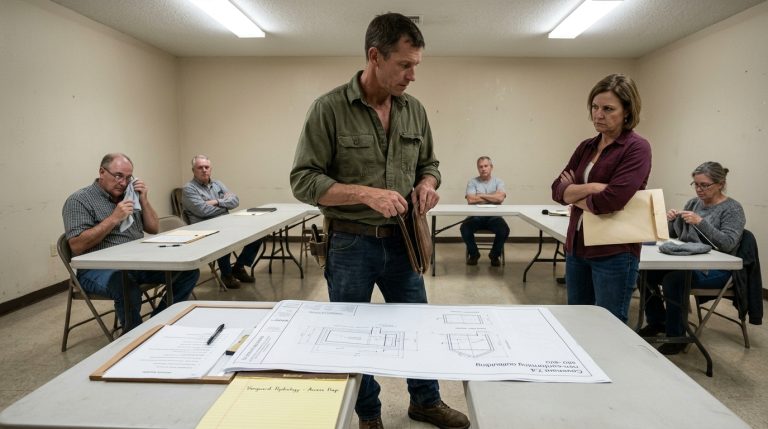
The air inside the North Ridge Community Center smelled of concentrated industrial floor wax and stale ozone, a sterile chemical cocktail that coated the back of Marcus’s throat. Fluorescent tubes flickered overhead, casting a harsh, cold light across the rows of folding chairs that had been dragged into rigid alignment.
Half the room was already filled. The faces belonged to the upper tier of the neighborhood—lawyers, local real estate brokers, and people who wore golf polos even on Tuesday evenings. They sat in tight clusters, their voices dropping to low, conspiratorial murmurs as Marcus pushed open the double doors at the back.
Up front, behind a long folding table skirted in blue plastic, sat Vivien Ashworth.
She wore a charcoal blazer over a silk shell, her blonde hair pulled back with surgical neatness. At her right hand sat Jonathan Crest, Esquire, his thousand-dollar tie catching the overhead glare as he methodically arranged a stack of heavy legal files.
Marcus didn’t take a seat in the back rows. He walked straight down the center aisle, his boots striking the linoleum floor with a sharp, heavy rhythm that cut cleanly through the murmur of the room. Heads turned. Eyes tracked him—some wide with cautious curiosity, others narrowed in practiced disapproval.
“Mr. Holloway,” Vivien said, her voice amplified slightly by the tabletop microphone. The manufactured warmth in her tone was razor-thin, designed to project public benevolence while signaling an administrative execution. “We didn’t expect you to attend tonight’s emergency agenda item regarding neighborhood compliance.”
“You posted the notice on the wrong board, Vivien,” Marcus said, stopping ten feet from the folding table. His voice didn’t carry anger; it carried the level, unyielding weight of an inspection briefing. “Hard to miss a meeting when the paperwork is taped to my own front door.”
Jonathan Crest adjusted his gold-rimmed glasses, his fingers tapping a crisp legal brief against the table edge. “Mr. Holloway, this is a closed session of the board of directors and invited stakeholders. Under amended section nine of the neighborhood covenants—duly ratified during your absence—unrepresented property owners are restricted from addressing the floor without prior filing.”
“Section nine requires a quorum of twenty baseline property owners,” Marcus said, his eyes locking onto Crest’s. “There are twelve people in this room who actually own their deeds. The rest of you are holding notes on land carved out by a county sub-inspector named Arthur Ashworth back in nineteen fifty-eight.”
A sudden, sharp intake of breath hissed through the front row. Vivien’s fingers froze against the edge of her tablet, her knuckles turning pale as the blood drained from her grip. For a fraction of a second, the surgical mask slipped, revealing the raw, startled panic of an operator whose back-channel wiring had just been mapped out loud.
“That is entirely irrelevant to the matter of zoning violations,” Crest interjected smoothly, raising his voice to mask the micro-hesitation in Vivien’s posture. “The board has already filed for an emergency injunction regarding your continued presence on the northern easement. If you do not vacate the premises within twenty-four hours, the county sheriff will enforce the abatement order.”
Marcus didn’t blink. He reached slowly into his shirt pocket, his fingers brushing the edge of Ezra’s notebook and the thermal print from the county microfilm archives. He didn’t pull them out yet. He let the silence stretch, heavy and thick, pressing down on the fluorescent hum until the people in the front row began shifting uncomfortably in their folding chairs.
“An abatement order requires a valid title, counselor,” Marcus said quietly, stepping one pace closer to the table. “And right now, the only thing sitting on that ridge is a pile of expensive concrete resting on top of a federal survey marker that predates every single signature in your briefcase.”
Vivien found her voice then, thin and sharp as a wire. “You’re delusional, Marcus. The board has documented your inability to function since your return. We’ve already contacted the county health division regarding your fitness to remain in the community.”
“Save your breath for the deposition, Vivien,” Marcus turned on his heel, his boots pivoting with mechanical precision. “The ledger’s already open.”
He walked back up the center aisle, the heavy double doors swinging shut behind him with a dull, echoing thud that left the community center dead silent in his wake.
CHAPTER 8: THE FLOODED WORKSHOP AND THE HIDDEN FOOTLOCKER
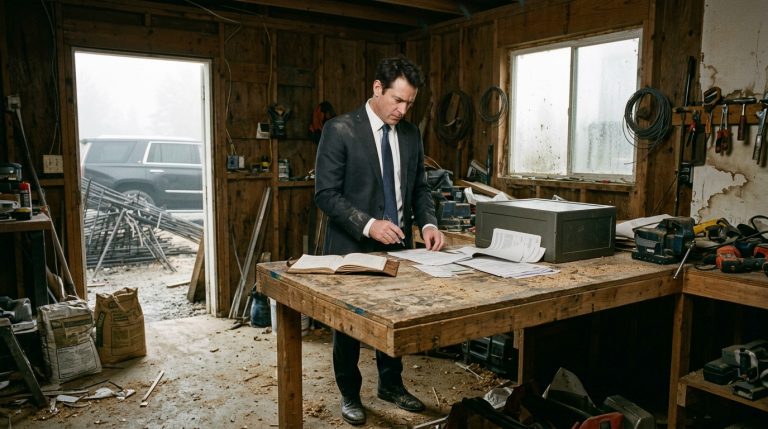
The dampness didn’t belong in the workshop. Marcus stepped across the threshold, his boots landing on concrete that felt slick and cold beneath the soles. A thin layer of standing water—barely a quarter-inch deep—had pooled along the eastern wall, creeping out from beneath the heavy wooden workbench where Ezra used to service his old outboard motors.
It wasn’t a plumbing leak. The main house line was shut off at the street.
Marcus clicked on his tactical flashlight, snapping the beam low across the floor. The white light cut through the gloom, bouncing off the wet concrete and illuminating the base of the water heater where a dark, viscous mixture of mud and silt was actively weeping from beneath the drywall.
He didn’t swear. His hand tightened around the aluminum flashlight barrel as he crouched down, sweeping the beam along the baseboard. Someone had forced a garden hose or an external pump line through the crawlspace vent on the outside wall, flooding the lower perimeter with enough slow-moving water to compromise the storage bins stacked against the floor.
At the bottom of those bins sat his field gear, his spare service records, and the remaining cartons of Sarah’s photographs—the physical anchors of everything he had left.
A cold, sharp spike of adrenaline hit his system, clearing away the dull fatigue of the evening. It wasn’t vandalism; it was a targeted sweep. A reconnaissance-in-force designed to flush out what he had hidden before the legal filings hit the state register.
Marcus dropped to one knee, the shallow water soaking through the knees of his work trousers. He moved past the ruined cardboard boxes, ignoring the soggy pulp of papers that had already dissolved into grey mush. He crawled deeper into the dark gap behind the water heater—a narrow utility void where the floorboards met the raw concrete foundation of the original nineteen fifty-two build.
His fingers scraped against something hard, metallic, and wrapped in stiff, oil-soaked canvas.
The brass-cornered footlocker.
When he had first checked it after coming home, it had sat out in the open room. But during the commotion of the past week, someone had broken the exterior latch on the sub-floor access door and dragged the heavy container deeper into the crawlspace, trying to submerge it before the county inspectors could issue a subpoena for physical evidence.
Marcus hooked his fingers beneath the heavy brass hasp and pulled. The metal groaned, dragging through the wet silt with a harsh, frictional screech. He hauled it out into the broader circle of the flashlight beam, his breathing steady, measured, and cold.
He threw back the lid.
Inside, beneath the top tray of faded photographs and spare ribbons, the manila envelope marked for his eyes alone was still sealed, protected by the heavy paraffin coating of the oil cloth. But the bottom of the trunk was wet. Water had pooled around the edges of Ezra’s deployment logs from Korea.
Marcus reached inside, his fingers closing around the thick manila packet. He pulled it free, holding it up to the beam of the flashlight. The ink on the outer label was intact, but the secondary records tucked beneath it—copies of federal land grants and inter-agency correspondence regarding the original veterans settlement program—were damp at the corners.
The warning was unmistakable. They weren’t just fighting him in court anymore; they were hunting his assets on his own ground.
He tucked the damp envelope securely inside the inner pocket of his jacket, zipped it tight, and stood up from the wet concrete. His jaw was locked so tight his teeth ached. Vivien Ashworth thought she was clearing a drainage ditch. She was about to find out she had just breached a containment line that couldn’t be patched with silicone and forged permits.
CHAPTER 9: THE ENVIRONMENTAL VECTOR AND THE FEDERAL THREAT
The overhead bulb flickered once, spat a sharp shower of orange sparks across the rafters, and died.
The darkness that rushed in to fill Ezra’s workshop wasn’t empty; it was thick, smelling instantly of hot copper, ozone, and wet sawdust. Marcus didn’t flinch. His hand stayed clamped around the manila packet tucked inside his jacket while his other hand instinctively dropped to the edge of the workbench, mapping the familiar geometry of the surface by touch alone—the heavy iron vise, the tin of assorted machine screws, the smooth wooden handle of Ezra’s favorite ball-peen hammer.
A breaker hadn’t just tripped from a standard overload. The sudden, unnatural electrical surge hummed through the walls, vibrating the floorboards beneath his boots.
Someone had tied into the exterior junction box on the north wall, cycling a heavy inductive load through the main line to fry the workshop’s sub-panel and wipe out any digital backups plugged into the outlets. It was a scorched-earth tactic designed to blind him before he could upload the digitized plats to state file servers in the morning.
Marcus stood completely still in the dark, his breathing measured and slow. He could hear the faint, steady drip of water still weeping from beneath the drywall near the water heater—plink, plink, plink—measuring out the seconds in the void.
He didn’t rush to the door. Rushing into an unlit perimeter was a beginner’s mistake. Instead, his fingers found a box of matches tucked inside the wooden drawer beside the vise. He struck a match against the abrasive side of the box, the sulfur flaring up with a bright, violent hiss that cast long, dancing shadows across the pegboards and tool racks.
The yellow flame illuminated his face, hard-edged and unreadable.
He used the match to light a heavy hurricane lantern sitting on the shelf. The wick caught, blooming into a steady, amber circle of illumination that beat back the dark corners of the room. Setting the lantern down on the center of the workbench, Marcus pulled the damp manila packet from his jacket and laid it out flat beside the flickering flame.
The water damage was superficial; the heavy oil cloth had protected the core documentation. He carefully untied the twine securing the packet and slid out the topmost document—a certified geological survey from nineteen fifty-two detailing an underground spring that cut diagonally across the lower ridge line.
A protected waterway.
His eyes tracked the faded blue ink of the marginal notes. Building within one hundred feet of a classified federal watershed required explicit Army Corps of Engineers permits, environmental impact studies, and multi-agency sign-offs. Permits that Vivien Ashworth’s contractors had never filed. Studies that Derek Ashworth had deliberately bypassed when rubber-stamping the foundation pours for the three multi-million-dollar mansions.
The legal reality shifted with the force of an artillery barrage. This wasn’t merely a civil property encroachment or a localized HOA dispute over boundary lines anymore. Every cubic yard of concrete poured over that drainage bed represented a compounding federal environmental violation carrying daily statutory penalties.
Marcus picked up his burner phone from the workbench. The screen glowed with a faint, pale light in the amber reflection of the lantern. He didn’t call the local sheriff’s department. He dialed a direct regional extension for the state environmental protection division, his thumb steady against the keypad.
“Report,” a flat, bureaucratic voice answered on the third ring.
“This is Marcus Holloway,” he said, his voice dropping into that low, level register that brooked no argument. “I’m calling to log a multi-site federal watershed violation at the North Ridge development plat forty-four-B. Bring your inspection teams at dawn. We have unpermitted industrial foundations sitting directly on top of a protected federal waterway.”
A brief pause hung on the line, followed by the dry rustle of paper being pulled across a desk. “Do you have documentation to substantiate an emergency inspection, Mr. Holloway?”
Marcus looked down at the amber-lit pages of Ezra’s notebook, then out the small workshop window toward the dark, looming shapes of the three mansions fifty yards away.
“I have the original plats,” Marcus said quietly. “And the concrete is still warm.”
CHAPTER 10: THE SMOKE IN THE FIRE PIT AND THE FORGED MEDICAL RECORDS
The grey light of dawn did nothing to soften the harsh angles of the North Ridge development. Marcus stood by the edge of the open workshop door, his heavy work boots planted firmly on the dew-soaked gravel as he watched a thin, acrid plume of grey smoke rise from the fire pit behind Vivien Ashworth’s property fifty yards away.
Even from a distance, the unmistakable smell drifted across the damp grass—the heavy, chemical stink of burning paper, laminated cardstock, and heavy binder board.
She wasn’t just clearing files; she was purging the active administrative records before the state environmental inspectors and federal utility investigators arrived on site.
Marcus didn’t move toward her property. He stood motionless in the shadow of the doorframe, his fingers curled around the strap of a heavy leather folio containing the original nineteen fifty-two plats, the microfilm prints, and the damp manila packet recovered from Ezra’s footlocker. Every muscle in his upper body was coiled tight, the exhaustion of three weeks without proper sleep burned away by the sharp, cold clarity of an operation reaching its final phase.
A set of tires crunched against the unpaved gravel of the access road.
Two dark sedan vehicles, their paint finished in a flat, nondescript government grey, rolled slowly past the end of the cul-de-sac and pulled directly onto the shoulder of Marcus’s drive. The doors opened with a simultaneous, heavy thud. A pair of state environmental inspectors in high-visibility vests stepped out, accompanied by an investigator from the regional water board carrying a heavy aluminum sampling case.
“Mr. Holloway?” the lead investigator asked, stepping over the edge of the overgrown lawn. His eyes flicked from Marcus’s face down to the smoking fire pit fifty yards away, then back to the multi-million-dollar mansions sitting squarely on the northern drainage bed.
“Right here,” Marcus said, his voice flat and controlled. He stepped down off the porch, the gravel shifting under his boots. “The drainage line runs directly beneath those three foundations. If you test the runoff samples near the eastern retaining wall, you’ll find unpermitted greywater discharge and concrete leachate dating back to the initial pours.”
The investigator didn’t waste words. He unlatched his aluminum case, pulling out a set of digital core-sampling tools. “Show us the baseline marker.”
Marcus turned and pointed toward the wooden boundary stake he had marked with yellow crayon five days ago. Beside it, the soil was dark, saturated, and visibly depressed where the underground spring had been artificially dammed by commercial foundation work.
Across the lawn, the back door of the middle mansion swung open. Vivien Ashworth stepped out onto her elevated wooden deck, wrapped in a silk bathrobe, her hair loose over her shoulders. For the first time since he had returned home, the surgical, plastered-on smile was entirely gone. Her face was pale, tight around the eyes, her gaze locked onto the two government sedans parked in Marcus’s drive and the yellow-vested inspectors unpacking core drills near her custom flagstone patio.
She raised a hand, her fingers trembling slightly as she pointed toward the road. “You’re trespassing,” she shouted across the wet grass, her voice losing its manufactured polish, cracking at the edges with sharp panic. “This is private association property! I’ll have the sheriff—”
“The sheriff isn’t coming today, Vivien,” Marcus called back, his voice carrying effortlessly across the morning air without a hint of strain. He didn’t raise his volume; he delivered the words with the flat, absolute authority of a field commander reading an after-action report. “Neither is Jonathan Crest. The federal watershed inspectors are already on your back step.”
Vivien froze. Her hand dropped slowly to her side, the silk of her robe fluttering against her leg in the morning breeze. She looked from Marcus’s unblinking stare down to the state investigators kneeling by her foundation wall with core drills in hand.
Marcus turned his back on her, walking steadily toward the inspectors with the leather folio gripped in his hand. The trap was sprung, the lines were locked, and the ledger was finally balancing out.
CHAPTER 11: THE TRIBUNAL OF THE HOA MEETING
The air inside the North Ridge Community Center hummed with a low, oppressive frequency, thick with the smell of cheap industrial floor cleaner and the collective tension of two hundred neighbors packed shoulder-to-shoulder on folding metal chairs. Overhead, the fluorescent tubes flickered with an unyielding glare, casting harsh shadows across faces that had spent the past three weeks avoiding eye contact across property lines.
Marcus stood at the back of the room, his weight balanced evenly on both heels, his hands resting quietly at his sides. Beside him stood Mrs. Naomi, her fingers tightly clutching a heavy, leather-bound notebook filled with decades of handwritten intelligence, and Rebecca Torres, holding a thick federal brief bound in navy cardstock.
Up front, behind the blue-skirted folding table, sat the emergency replacement board of directors. But all eyes were fixed on the center chair.
Vivien Ashworth did not wear her designer blazer tonight. She wore a standard issue orange jumpsuit, her wrists cuffed together with steel links that clinked softly against the laminate tabletop whenever she shifted her weight. Federal marshals stood sentinel on either side of her chair, their dark suits and quiet posture contrasting sharply with the erratic, desperate breathing of the woman between them. Her perfect blonde hair was unstyled, hanging straight and limp around a face stripped entirely of its surgical mask.
The newly elected board president tapped a gavel against the table, the sharp crack cutting through the murmur of the room.
“We are here tonight to place the formal record into public view,” the president announced, his voice tight with nervous strain. “Pursuant to federal findings by the Environmental Protection Agency and the Veterans Administration, the North Ridge Homeowners Association is placing all administrative authority into receivership.”
A low murmur rippled through the middle rows.
Marcus stepped forward down the center aisle. Every head turned, tracking his movement with the heavy silence of a jury awaiting a verdict. His boots struck the linoleum floor with a steady, metronomic cadence that filled the room. He didn’t look at the crowd. His eyes were locked straight ahead, fixed on the woman sitting in the orange jumpsuit.
When he reached the front row, he stopped, turning to face the packed hall before addressing the table.
“For thirty years, this neighborhood operated under a quiet understanding,” Marcus said, his voice dropping into that low, flat register that carried effortlessly without a microphone. “A template built on paper trails, forged permits, and the assumption that men and women returning from service would be too exhausted, too broken, or too isolated to audit the inventory of their own homes.”
He reached into his jacket pocket and pulled out the original nineteen fifty-two federal grant and the damp manila packet recovered from Ezra’s footlocker, laying them flat on the edge of the board table.
“Vivien Ashworth didn’t invent this corruption,” Marcus continued, his gaze shifting back to the woman at the center table. “She inherited it from her uncle, refined it through local back-channels, and weaponized the HOA bylaws to systematically strip property from five different military families. She thought a memorial garden for my late wife was an eyesore. She thought a combat veteran’s absence was an open invitation to seize the high ground.”
Vivien raised her head slowly. Her eyes—once sharp, calculating, and untouchable—were hollow, rimmed with red, staring at the polished wood of the table with absolute, unyielding defeat. She didn’t speak. She didn’t offer a defense. The network of shell companies, forged signatures, and intimidated contractors had dissolved under the weight of federal subpoenas, leaving nothing behind but the cold, stark geometry of the law.
“The federal investigation has confirmed forty-seven felony counts of mail fraud, wire fraud, conspiracy, and environmental violations,” Rebecca Torres stated clearly, stepping up beside Marcus to slide the navy-bound brief across the table. “Effective immediately, the three northern properties are condemned under federal watershed reclamation statutes. The titles revert entirely to the original baseline covenants.”
In the third row, David from House 2 bowed his head, his hands covering his face as the realization settled over him and his neighbors—victims of a fraud engineered from the top down, now granted federal protection and relocation assistance while the illegal foundations were slated for total demolition.
Marcus turned away from the table. He didn’t gloat. He didn’t raise his voice in triumph. He simply walked back up the center aisle, the heavy double doors swinging open to let in the cool, clean night air of the meadow waiting just outside.
CHAPTER 12: THE QUIET MEADOW AND THE CLEARED WATERSHED
The rumble of the heavy tracked excavator broke the stillness of the afternoon air, a deep mechanical growl that resonated through the damp clay of the North Ridge. Marcus stood at the edge of the lower pasture, his boots resting on the dark, freshly turned earth where the concrete foundation of the middle mansion had stood just a week prior.
The hydraulic arm of the machine rose, heavy jaws clamped around a slab of reinforced grey aggregate, lifting it clear of the drainage line with a sharp groan of stressed metal. Below it, freed from beneath twenty feet of crushed stone and poured footings, the underground spring bubbled up through the gravel beds, clear and cold, catching the afternoon sun like scattered glass.
The federal restitution order had moved with the relentless speed of an unalterable tide. Vivien Ashworth was already four months into a federal holding facility awaiting the final phases of her sentence, her real estate licenses revoked and her assets partitioned into a multi-million-dollar remediation fund. The architectural shell game that had preyed upon veterans and unrepresented families across three counties had been dismantled down to its last concrete stake.
Marcus reached into his pocket, his fingers brushing the smooth metal surface of Ezra’s brass-cornered footlocker key. He didn’t pull it out. Instead, he turned his gaze toward the small ranch house fifty yards away.
The aluminum siding had been scraped, primed, and painted a clean, weathered grey—the same shade it had worn back when his grandfather first secured the plat with his GI Bill paperwork. On the front porch, Mrs. Naomi sat in a wooden rocking chair, a tall glass of iced tea sweating in her hand as she watched the excavator peel away the last remnants of the fraudulent development.
The young families from the demolished houses hadn’t been cast out into the cold; under the receivership settlement, they had retained their down payments while the banks absorbed the structural losses. David and his twin daughters had moved three blocks over into a legitimately platted cul-de-sac, but they still walked over on Sunday afternoons to sit by the edge of the restored meadow where the oak tree’s southern root system was already beginning to throw out fresh, green shoots from the dark loam.
A pair of heavy boots crunched across the gravel behind him.
Marcus turned his head slightly. Emily walked up beside him, carrying a pair of heavy leather work gloves and a small spade. The morning wind caught her hair, soft against the bright, open sky. She didn’t say anything immediately; she simply handed him one of the gloves, her fingers brushing briefly against his palm—a solid, unhurried contact that grounded the space between them.
“The watershed board signed off on the northern retention basin an hour ago,” Emily said, her voice quiet, carrying the easy rhythm of a world that had finally stopped shaking. “The trout are already coming back up through the lower culvert.”
Marcus pulled the heavy leather glove over his right hand, the stiff hide gripping firmly around his palm. He looked down at the freshly graded soil where the wildflower garden Sarah had planted was already beginning to push its first green sprouts through the dark earth.
“My grandfather used to say that a boundary line isn’t just something you defend against someone else,” Marcus said, his voice low, steady, and clear of the old metallic tension that had poisoned his jaw for months. “It’s a promise you make to the ground beneath your feet—that what was planted here stays rooted, no matter how heavy the concrete gets.”
He reached down, taking the handle of the small spade from Emily’s hand. Together, they knelt by the edge of the restored spring, pressing a young sapling into the rich, damp earth—anchoring it deep against the wind, right where the old oak had stood for a century.
The war was over. The ledgers were balanced. And the meadow was quiet once more.