The Landlord’s Gambit: A Tactical Dismantling of Suburban Tyranny in the Shadow of the Grant
CHAPTER 1: THE LINE IN THE KUDZU
The silence after the scream was heavier than the humidity of the Tennessee morning.
“Get your filthy farm animals away from my pristine lawn or I’ll have them put down.”
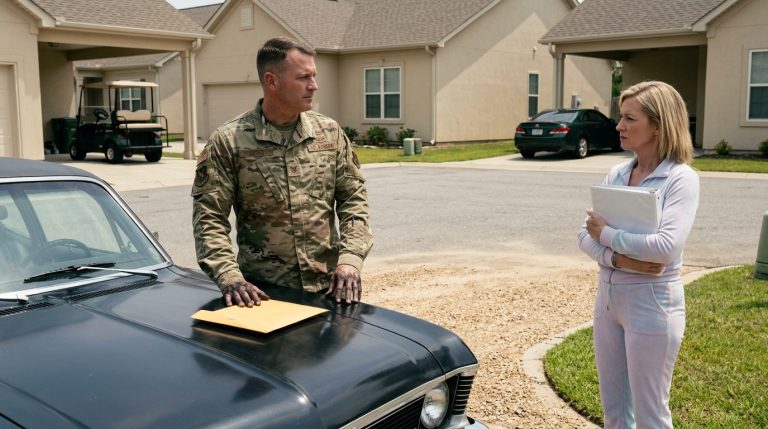
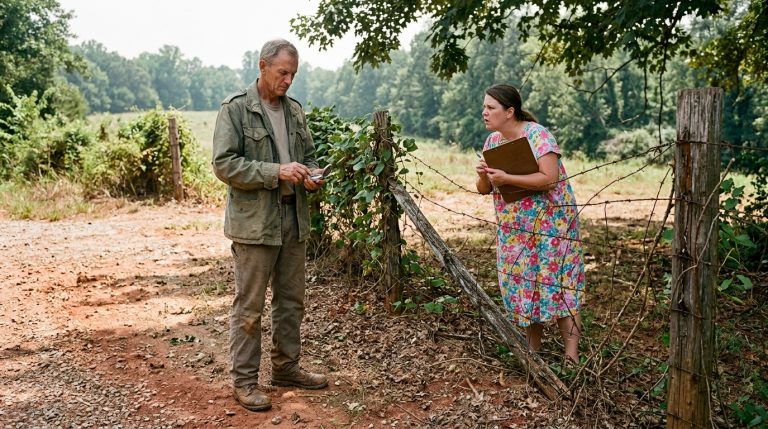
I didn’t blink. I gripped the cedar fence post—a weathered, rough-hewn pillar I’d sunk into the earth with my own blistered hands—and felt the tremor of the earth beneath us. Karen, the self-appointed queen of Oakwood Estates, stood on the other side of the invisible border, her face a shade of crimson that belonged on a warning sign.
Her finger, adorned with a ring that cost more than my first truck, jabbed the air in the direction of Daisy and Buttercup. My Nigerian dwarf goats didn’t care about community standards. They were busy stripping the life out of a thicket of poison ivy, their heads down, tails flickering with satisfied rhythm.
I let her anger burn. I’d spent two decades in environments where silence was a tactical advantage. In the sandbox, a man didn’t shout when he was losing; he waited for the terrain to reveal the enemy’s weakness. Here, the terrain was simple: my property, my terms.
“Ma’am,” I said, my voice low enough that she had to strain to hear me. It forced her to stop screeching and lean forward, invading her own manicured space. “Those goats are on my land. They’re contained by a fence I built to keep them away from your lawn. They are not a threat to you.”
“They’re a menace!” she spat, her breath hitching. “This is a residential community! You’re turning this place into a petting zoo!”
I looked at the fence line. It was crisp. It was clean. My survey maps were tucked safely in my office, showing every square inch of the Holloway Grant. Karen was looking at my goats, but I was looking at the way her manicured grass bled into my untamed brush. She saw a neighborhood; I saw a piece of property currently being occupied by a tenant who had forgotten who the landlord was.
The fuse in my gut, lit the moment she threatened to have my animals ‘put down,’ grew hot. I reached down and stroked Daisy’s neck. She looked up, her golden eyes empty of the malice Karen was projecting.
“You’ll receive a notice,” Karen threatened, her voice shaking. “I run this community. You don’t get to ignore the covenants.”
I didn’t answer. I simply stared at her, unmoving, letting the silence between us stretch until it became an intolerable weight. She wanted a fight over a rulebook, but she didn’t know I had the deed. I turned my back on her, a deliberate, quiet motion, and walked toward the center of my field. Behind me, I heard the sharp, frantic click of her heels retreating. She thought she had won a round by walking away, but she had just stepped onto a battlefield she wasn’t equipped to win. As I reached the shade of the old oak tree, I noticed something odd—the original stone marker at the corner of my property had been shifted. By three inches. Someone had been digging.
CHAPTER 2: THE PAPER TRAIL
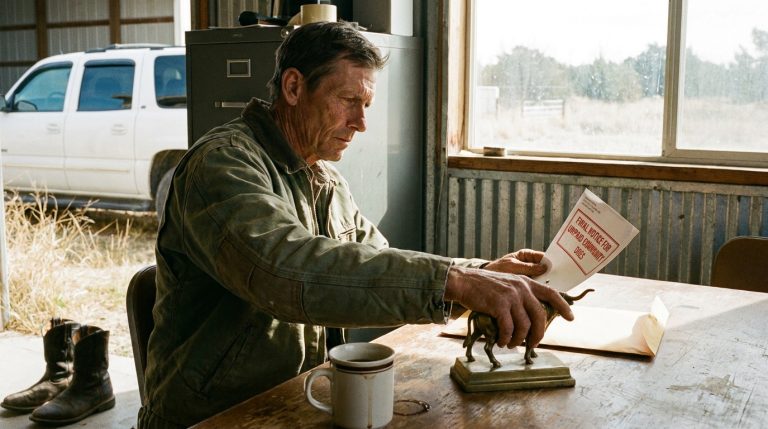
The silence in my office was brittle, fractured only by the rhythmic tick of the wall clock and the sharp rustle of the HOA’s “Official Notice of Covenant Violation.” I sat at the solid oak desk, the same one where I’d planned logistical routes in terrain far more hostile than a Tennessee subdivision.
My hand, resting on the desk, felt the cold grain of the wood. I didn’t look at the notice right away. Instead, I stood up and walked to the window, watching the late afternoon shadows stretch across the pasture. The three-inch shift in the stone marker wasn’t a natural subsidence; it was human-made. Someone had been digging—probing the boundaries, testing the integrity of the line. Karen’s obsession with “standards” had just taken a physical turn that felt less like suburban policing and more like an attempt to find a weakness in the foundation.
I turned back to the desk. The document was a masterpiece of intimidation. Twelve pages of pseudo-legal jargon, stapled with a violence that tore the edges of the high-quality cream paper. It was designed to trigger a specific response: anxiety, followed by rapid compliance. The compounding fines were calculated to be large enough to hurt, but small enough to tempt a quick, quiet payment.
Article 4, Section 2: Architectural Consistency.
Article 7, Section 9: Public Nuisance and Odor Abatement.
I skimmed the text. It was all there—the “latrine pollution,” the “unauthorized livestock,” the “aesthetic degradation.” It was a weaponized list, crafted to make me feel like an outsider, a foreign body in her beige utopia. I picked up a red pen. I didn’t feel anger—anger was a luxury I couldn’t afford. I felt a cold, analytical focus. Every line of this screed was a lie built on the assumption that I hadn’t read the master lease.
Sarah walked into the office, carrying two mugs of coffee. The steam rose in thin, straight ribbons, disappearing into the dim light. She set one down next to the thick stack of papers and looked at my face. She didn’t ask what I was thinking; she knew. She’d seen this look before, usually right before we initiated a complex operation in the field.
“She’s escalating,” Sarah said, her voice quiet. It wasn’t a question.
“She’s panicking,” I corrected, tapping the page referencing the ‘fines.’ “This is a standard template for a neighborhood dispute, but the language is too precise. She’s had someone draft this. Someone with access to the HOA’s legal retainer.”
I took a sip of the coffee. It was hot, bitter, and grounding. I looked at the photos I’d taken of the goats, then at the survey map. The contrast was stark. The HOA’s notice claimed I was violating community standards, but their definition of ‘community’ stopped exactly forty-eight feet from my back patio.
“I’m going to document every single interaction from here on out,” I said, reaching for my notebook. “If she wants to play the legal card, I’ll give her a hand of poker she doesn’t know how to play.”
Suddenly, a memory flickered—an intrusive, sharp image of a perimeter wall in a forgotten sector, the sound of wire being cut under the cover of a moonless night. I shook it off. This wasn’t the field. This was rural Tennessee. But the instinct was the same: the enemy reveals their intent through their movements. The shifted stone marker was a movement.
I began to draft the response. I didn’t use the emotional language of a victim. I used the clinical, detached tone of a landlord addressing a tenant in breach. I cited the specific articles of the bylaws she had quoted, but I inverted them, mapping their own jurisdictional limits against the actual property deed. It was a surgical strike. By the time I finished the draft, the room was bathed in the grey twilight of evening.
My fingers felt stiff. I stared at the page—a rebuttal that stripped away the bureaucratic veneer of the HOA’s authority. I wasn’t just defending my goats; I was defining the boundaries of our war.
Sarah placed a hand on my shoulder. “You’re going to send this tomorrow?”
“Certified,” I said. “And I’m going to make sure the HOA’s legal counsel receives a copy. If she thinks she can intimidate me with paper, she’s about to learn that paper is the one thing I know how to use better than she does.”
The weight of the document felt right in my hand—solid, irrefutable, and dangerously heavy. But even as I sealed the envelope, the nagging thought of that shifted stone marker returned. If they were digging in the dirt, they were looking for something. They were looking for a way to override the deed, or perhaps, they were worried about what lay underneath the soil that gave me the right to own this land in the first place. The fuse wasn’t just burning; it was traveling toward a cache of explosives I hadn’t even fully accounted for yet.
CHAPTER 3: THE STERILE FRONT
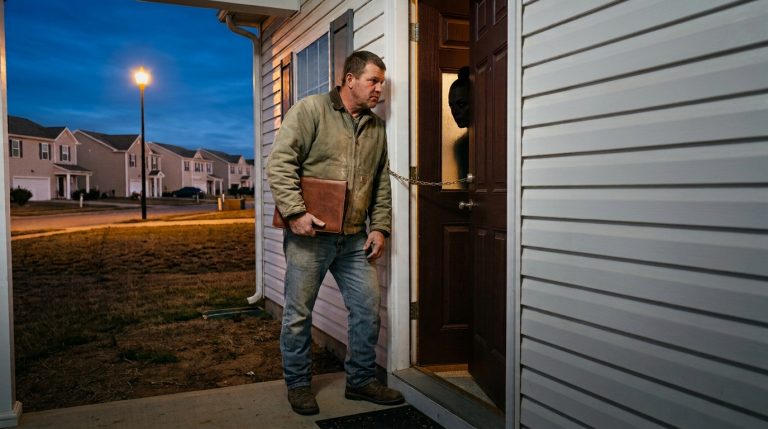
The gravel crunched beneath my boots—a sound that seemed far too loud in the dead-quiet atmosphere of Oakwood Estates. I didn’t head for the main road. Instead, I stayed on the sidewalks, moving with a deliberate, measured pace. It was a reconnaissance walk, the kind I’d done in sectors where the geography was the primary threat. Here, the threat was social, masked by perfect lawns and freshly trimmed hedges.
The neighborhood was a vacuum of personality. Every house was a variation of the same muted beige, every mailbox a carbon copy. It was a community that didn’t just value order; it enforced a visual silence. As I walked, I caught the rhythmic snip-snip of pruning shears. An elderly resident was hunched over a rose bush, his movements stiff and practiced. He glanced up, saw me, and for a fleeting second, his eyes flickered with a raw, unvarnished fear before he looked back down at his roses, suddenly fascinated by a dead leaf.
The paranoia was palpable. It wasn’t just that Karen was disliked; it was that she had successfully cultivated a culture where keeping one’s head down was the only way to ensure survival. I felt the weight of the envelope in my jacket pocket. It was a declaration of war, but standing here, surrounded by the crushing uniformity of the streets, I realized that the war wasn’t against Karen alone. It was against the inertia of a neighborhood that had traded its agency for the illusion of a pristine exterior.
I stopped at the corner of Oakwood Drive. The silence here was different—it felt curated. I checked the tree line where my property met the subdivision’s backyards. My small, discreet security camera sat high in the canopy, a black glass eye looking down at the boundary I’d marked. From this vantage point, I could see the rear of the houses. They were messy, lived-in, and strangely neglected compared to the front-facing facades. It was a classic projection: the front was for the neighbors and the HOA’s inspection, while the back was where the residents actually exhaled.
I needed to find the chinks in that armor. I needed someone who was tired of the performance.
A work van rolled slowly down the street, its engine humming at a low, laboring frequency. It had the logo of a generic lawn service on the side. I watched it pass, noting the way the driver didn’t look at the houses—he just looked at the asphalt. He was an outsider, someone who moved through this world without belonging to it. I realized then that my reconnaissance couldn’t just be about looking; it had to be about listening.
I turned down a narrow lane that led toward the clubhouse. The structure was a low-slung, cinder-block affair painted a shade of ‘eggshell’ that managed to look sickly even in the bright sunlight. I approached it, my eyes tracing the lines of the building. There were no cameras here, but the lock on the side door was a standard-issue tumbler. Easy to bypass if I needed to, but I didn’t need to break in—not yet.
As I circled the building, I heard the muffled sound of voices. A window was cracked open, letting out the scent of floor wax and stale coffee. I paused, my back pressed against the warm, rough stucco of the exterior wall.
“…don’t understand why the landscaping costs went up by another fifteen percent,” a man’s voice said. It was thin, weary. “My fixed income can’t handle the assessment hike, and now they’re saying there’s no money in the reserve for the road repair.”
“Don’t ask,” a woman’s voice replied, sharp and hushed. “You know how she gets when people start looking at the books. She’ll have you cited for a ‘non-compliant’ mailbox by Friday. Just pay it. It’s not worth the trouble.”
“It’s not right, Martha.”
“It’s Oakwood Estates,” she snapped. “We keep our heads down.”
I leaned against the wall, my jaw tight. The conversation confirmed the drift of the rot. It wasn’t just mismanagement; it was extortion, plain and simple. The residents weren’t just followers; they were hostages. I moved away from the window, my steps silent on the manicured grass. I didn’t want to be seen, but I needed to be known.
I walked back toward the front entrance of the subdivision, my mind already calculating the variables. I had the legal documentation to push back, but to truly break the seal, I needed the residents to recognize that the ‘standards’ they were being crushed by were the very tools being used to steal their retirement savings. I needed a catalyst.
I reached the sidewalk that bordered the first few houses. I saw a young man standing in his driveway, staring at a small patch of crabgrass with a look of genuine despair. He looked like he was about to spend his Saturday afternoon crawling on his hands and knees to pull it out, one blade at a time, just to avoid a notice of violation.
I slowed my pace as I neared him. He looked up, his shoulders tense, his eyes darting toward the street to see if any HOA board members were patrolling.
“It’s just grass,” I said, my voice conversational, devoid of judgment.
He blinked, surprised by the lack of accusation in my tone. “It’s a fine,” he muttered, looking back at the ground. “If they see it, it’s a hundred-dollar fine.”
“I’m Jack,” I said, stopping a few feet away. “I live up on the Grant. And if you think a hundred-dollar fine for grass is about aesthetics, you haven’t been looking at where that money actually goes.”
He froze, his hand clutching a handful of weeds. He looked at me—really looked at me—and I saw the flicker of curiosity replace the fatigue. The seed was planted. I didn’t wait for an answer. I kept walking, leaving him to weigh the cost of his lawn against the possibility that he was being played.
As I headed back toward my land, the air grew cooler. I looked back one last time at the beige sea of houses. The sun caught a window, casting a sharp, metallic glare that hit me right in the eyes. I didn’t look away. I had the tools to turn this entire ecosystem upside down, and for the first time, I felt the satisfying, cold certainty of a plan that was moving from theory into kinetic reality.
CHAPTER 4: THE ALLY IN THE SOIL
The walk back to my ridge was longer than it had been an hour ago. The sun was dipping behind the ridgeline, casting long, bruised-purple shadows across the pasture. I didn’t take the road. I tracked the edge of the property line, moving through the tall, unkempt grass that Karen so despised. My boots sank into the damp earth, the scent of crushed clover and wet soil rising to meet me.
As I reached the point where the survey crew had hammered the pink stakes into the ground, I saw him. George.
He was standing near the boundary, his back to me, staring at one of the stakes. He was holding a pair of heavy-duty garden shears, their blades reflecting the dying light. He didn’t turn around as I approached; he didn’t need to. He’d heard the rhythmic crunch of my boots on the dead leaves long before I was within earshot.
“You’re making them nervous, Jack,” he said, his voice low, sounding like gravel being churned.
I stopped ten feet away. “Nervousness is just the first step toward clarity.”
George turned. He looked tired. Not the fatigue of a man who’d finished a long day of work, but the exhaustion of a man who had spent decades watching the wrong things grow in the wrong soil. He looked at the shears in his hand, then at the pink flag fluttering listlessly in the evening breeze.
“The Hendersons,” he said suddenly, naming the family he’d mentioned before. “They were good people. They didn’t have a single blade of crabgrass. They didn’t have a single noise complaint. They just didn’t… fit the aesthetic.” He looked up at me, his eyes sharp and unexpectedly clear. “She doesn’t hate the goats, Jack. She hates that you’re a variable she can’t account for. You’re not a homeowner in the subdivision. You’re the reason the subdivision exists. And that makes you a threat to her narrative.”
I walked closer, my eyes falling on the ground near his boots. A section of the earth looked disturbed, as if someone had been trying to dig a narrow, shallow trench. I looked back at the stake.
“She was out here earlier,” George said, following my gaze. “With a trowel. Looking for the corner marker. She’s desperate to prove that those stakes are wrong—that your land is actually her land.”
“She won’t find anything to contradict the county plat,” I said.
“It’s not about the law,” George sighed. “It’s about what she can convince the others to believe. If she can move the perception of the line, she can move the reality of the fight.”
I reached out and picked up the shears he’d set on a flat stone. The metal was cold, biting into my palm. I looked at the property line—the thin, invisible division that was currently the most contested piece of land in Tennessee.
“She’s been leveraging the HOA’s maintenance budget for years,” I said, deciding to test the depth of his knowledge. “I’ve seen the invoices for landscaping, George. They’re a joke.”
George gave a grim, humorless laugh. “A joke that costs us six percent of our home value in annual assessments. We all know it, but we’re all too scared of the board’s reach. If you cross her, you don’t just get a letter. You get the ‘special inspection.’ You get the city code enforcement showing up for a ‘tip’ about a code violation. She weaponizes the town against us.”
“That stops,” I said. My voice wasn’t a promise; it was an instruction. “I’m not here to play by her rules. I’m here to enforce the ones she’s been ignoring.”
I handed the shears back to him. Our hands touched—his skin was rough, calloused by twenty years of turning this soil, mine was steady, conditioned by years of holding lines that mattered.
“What do you need?” he asked.
“Information,” I said. “Not just about the gardening contracts. I need to know who else on the board is actually voting, and who is just following the script. There’s a hearing in two weeks. I want the room full. Not with people coming to watch a show, but with people coming to take back their voice.”
George nodded slowly. “It’ll be hard. People have been beaten down for a long time. But they’re angry, Jack. They’re just waiting for someone to give them permission to show it.”
As I turned to leave, the sky opened up. A cold, fine mist began to fall, turning the dirt into a slick, dark paste. I looked back at the boundary. The pink flag was dampened, sticking to the wood. The transition from the ‘perfect’ lawn of Oakwood Estates to the rugged, untamed reality of the Grant was no longer just a legal distinction; it was the front line of an insurgency.
I left George standing there in the rain. I didn’t need to look back to know he’d be there tomorrow. I had the legal framework, but he had the map of the people. And as I walked toward the ridge, the cold rain soaking through my jacket, I realized that Karen had made one fatal mistake: she had spent so long building a fortress of fear that she hadn’t realized she was standing inside a powder keg. Every fine she issued, every threat she barked, was just adding more pressure to the seal.
I reached my door, the interior light spilling out onto the porch. Sarah was waiting, her silhouette framed by the warmth of our home. I felt the sharp edges of the day soften just a fraction, but the resolve didn’t budge. I wasn’t going to just win this; I was going to dismantle it, piece by piece, until there wasn’t a single beige brick left standing.
CHAPTER 5: THE BOARDROOM INTERROGATION
The clubhouse was a cavern of beige walls and buzzing, sickly yellow light. It smelled faintly of floor polish and the underlying, sour tang of nervous perspiration. My briefcase, a worn leather relic of my time as an engineer, sat on the folding table before me like a landmine. I didn’t look at the crowd; I felt them. The room was packed with people who had come expecting to watch a spectacle—a defense, or perhaps a surrender. They didn’t know they were sitting in the blast radius of their own history.
Karen sat at the center of the board table, her floral pantsuit a riot of color against the drab background. She was conducting the room with her gaze, silencing whispers with a sharp tilt of her head. She held the gavel like a scepter.
“The meeting is called to order,” she announced, her voice resonating with an authority that felt increasingly hollow. “We are here to address the continued defiance of the covenants by the Holloway Grant owner.”
She didn’t look at me. She addressed the room, her voice polished and practiced. She began a monologue about community standards, the sanctity of property values, and the ‘danger’ posed by non-conforming agricultural activity. It was a well-oiled machine of a speech, designed to invoke fear. She pointed a finger at a slide on the screen behind her—a photoshopped image of a goat that looked suspiciously like a creature from a horror film.
I waited. My pulse was a steady, rhythmic beat in my throat. I didn’t move until she paused for effect, expecting the room to erupt in supportive murmurs. It didn’t. There was only the low, uncomfortable hum of the fluorescent lights.
I stood up. The folding chair scraped against the linoleum—a harsh, screeching sound that turned every head in the room. I walked to the front, my footsteps deliberate and heavy. I didn’t reach for the microphone. I reached for the projector’s power cable.
“Mr. Turner, you are out of order,” Karen snapped, her eyes narrowing as I unplugged the projector. The image of the monstrous goat vanished, replaced by the blank, white glare of the wall.
“The order of this meeting is being dictated by a false premise,” I said, my voice cutting through the stale air. I didn’t raise it; I let the stillness of the room do the work. I opened my briefcase and pulled out the laminated county survey map. I laid it out on the board table, right in front of the gavel.
“This is the legal boundary,” I said, pointing to the thick, unmistakable line of the Holloway Grant. “Everything outside of this fifty-acre parcel is not governed by your covenants. My pasture, my goats, and my home are legally distinct from this subdivision. You aren’t enforcing a rulebook, Karen. You’re trespassing on private land.”
A murmur rippled through the rows of chairs. It wasn’t confusion anymore; it was the sharp, dangerous sound of realization.
Karen’s face flushed, the color spreading from her neck to her hairline. “That map is… it’s irrelevant. The HOA bylaws have governed this area for thirty years.”
“Bylaws are not land deeds,” I countered, pulling out a second document—the original, notarized property deed. I placed it over the map. “You’ve been levying fines based on a fantasy. And you’ve been doing it while the residents you’re supposed to represent are being squeezed for every cent they have.”
I felt the shift in the room. The people in the back were leaning forward, their faces hardened. George, sitting near the door, caught my eye and nodded once.
“What about the reserve funds?” someone shouted from the back. “What about the road repair money?”
Karen froze. For the first time, her hands—the sausage-like fingers that had been so busy pointing and accusing—clutched the edge of the table. “That is an internal financial matter. This meeting is about the livestock violation.”
“It’s about the rot at the core of this board,” I said, my voice dropping an octave. I reached into the briefcase and pulled out a stack of invoices—Prestigecapes LLC, the fountain, the credit card statements. I didn’t hand them to her. I tossed them onto the table.
“I have the records,” I said. “I have the links between your family and the ‘vendors’ you’ve been funneling money to. I have the trail of a community treasury being emptied into your private coffers.”
The silence that followed was suffocating. Karen tried to slam the gavel, but her aim was off; it hit the edge of the survey map, the sound flat and pathetic. She looked around the room, expecting to find the usual wall of blind support, but she saw only faces that were suddenly, violently awake.
“This is a coup!” she screamed, her voice cracking. “These are illegal documents! I’ll have you removed!”
“You don’t have the authority,” I said, and the finality in my tone hit her harder than any physical blow. “Because as of today, your board’s authority isn’t just questioned—it’s being audited by the people you’ve been stealing from.”
I walked back to my seat, my boots sounding like gunshots in the sudden, absolute silence of the clubhouse. I didn’t look back at her. I sat down and looked at the crowd. The fuse had reached the charge. The explosion hadn’t happened yet, but the air was thick with the scent of ozone. Karen was still sitting at the table, clutching her gavel, but she was already a ghost. She just didn’t know it yet.
CHAPTER 6: THE AUDIT
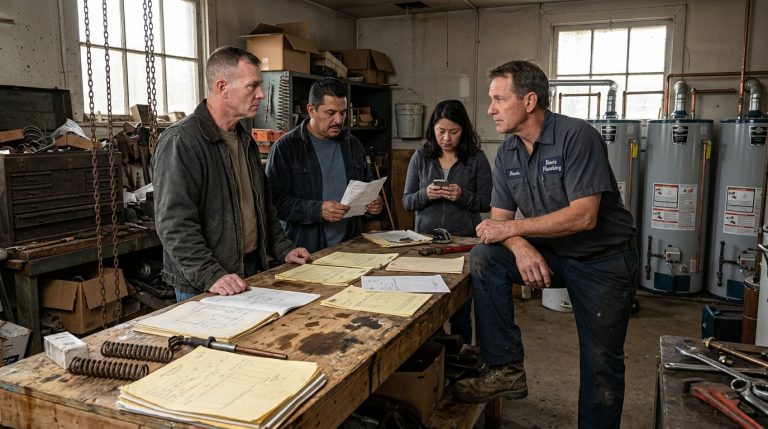
The office of the local auditing firm was tucked into a strip mall on the edge of town, a place of beige carpets and the constant, rhythmic clatter of high-speed printers. I sat across from the auditor, a woman named Elena with spectacles that seemed to focus on nothing but numbers. The air in the room was thin, recycled through an aging HVAC system that hummed with a low, grating vibration.
On the desk between us lay the physical embodiment of Karen’s fall: four boxes of HOA records. They smelled of mildew and stale cigarette smoke—the scent of a secret kept poorly. Elena flipped through a ledger, her pen hovering over a column of figures.
“It’s almost lazy,” she said, her voice devoid of inflection. “She didn’t even try to hide the correlation. Every invoice from Prestigecapes LLC was paid within forty-eight hours of a quarterly assessment collection. And look at the discrepancy in the ‘maintenance’ line items.”
She slid a document toward me. It was an invoice for ‘Tree Removal and Soil Remediation,’ dated for mid-January. I leaned in. The cost was astronomical—eight thousand dollars. I remembered that January. It had been the coldest month in a decade; the ground had been frozen solid, impenetrable.
“You can’t do soil remediation on frozen ground,” I said, the realization settling in my gut with the weight of a stone.
“Exactly,” Elena replied. “This isn’t just graft. It’s phantom labor. She wasn’t just overcharging for work; she was charging for work that never occurred. And look here—the transfer records.” She pulled up a digital spreadsheet, the blue light of the monitor reflecting in her glasses. “The money didn’t just go to a business account. It was routed into a personal holding company registered in a different county. Gerald Paplowski is the principal, but the signatory authorization belongs to Karen Albbright.”
I stared at the screen. The connection was undeniable. The ‘vanity fountain,’ the ’emergency tree removal,’ the ‘seasonal lawn aeration’—it was all a pipeline. She hadn’t just been a tyrant; she had been a parasite, siphoning the equity out of sixty homes to fund a life that existed only on paper.
The weight of it was staggering. Every notice of violation, every fine she’d levied, every threat she’d barked at the widow at number 22—it hadn’t been about standards. It had been about liquidity. She needed to keep the reserve fund empty to justify ’emergency’ assessments, and she needed to keep the residents compliant so they wouldn’t look too closely at where the money was going.
“This is enough to freeze the assets,” Elena said, her pen tapping the ledger. “But there’s a catch. If we initiate a formal freeze, the HOA technically goes into receivership. The responsibility for the subdivision’s ongoing maintenance falls to the legal owner of the ground lease.”
I looked up from the ledger. My eyes met Elena’s. She knew. She had seen the master lease document in our earlier briefing.
“That’s me,” I said.
“Which means if you don’t move immediately to appoint an interim board and restructure, the town council is going to step in. And they won’t care about your survey lines or your goats. They’ll look at the land usage and the zoning. They might just decide to dissolve the subdivision entirely.”
The complexity of the trap I’d set for Karen was now turning back toward me. I hadn’t just exposed her; I had effectively opened the door for a total collapse of the community’s infrastructure. If the HOA folded, the maintenance responsibilities would revert to the landowner—me—and if the town decided the land was better served by rezoning, the homeowners could lose everything.
I stood up, the chair scraping sharply against the laminate. I walked to the window and looked out at the parking lot. A car was idling near the entrance—a familiar SUV. I recognized the silhouette in the driver’s seat. It was Karen. She was watching the building, her face illuminated by the glow of her phone screen. She was waiting to see who walked out, and she was waiting to see if we had the keys to the kingdom.
“She knows,” I whispered.
“She knows the audit is happening,” Elena said, gathering the papers. “But she doesn’t know about the lease. She thinks this is just a financial dispute. She’s trying to hold onto the board seat until the annual meeting, hoping she can suppress the findings.”
I turned back to the desk. “She doesn’t have until the annual meeting.”
I pulled my phone out and dialed George. He answered on the first ring, his voice low.
“She’s calling for a vote of confidence on Thursday,” George said, not bothering with pleasantries. “She’s trying to clear the board of anyone who wasn’t in her pocket. She’s going to declare the audit ‘unauthorized’ and move to seal the records.”
“She can’t seal what’s already being processed,” I said. “Where is she?”
“Sitting in the clubhouse parking lot, probably calling every favor she has left.”
“Tell the homeowners to show up on Thursday,” I said, my voice cold. “Tell them it’s not a board meeting. It’s an eviction notice.”
I hung up. The air in the office felt tight, the humming of the printer now sounding like a countdown. I looked at the boxes of records. We had the evidence, we had the leverage, and now, we had the momentum. But as I watched Karen’s SUV pull slowly away from the strip mall, I knew she had one last card to play. A woman like that doesn’t just fold; she burns the table. And I was standing right in the middle of her path.
CHAPTER 7: THE PINK LINE
The storm didn’t arrive with a warning; it simply collapsed onto the valley. The sky turned the color of a fresh bruise, and the wind began to whip the tall grass of the pasture into a frantic, chaotic dance. I was halfway between the ridge and the subdivision boundary when the first drops hit—heavy, icy pellets that stung the skin. I didn’t seek cover. I had a job to do.
I reached the northern edge of the subdivision, my boots sinking into the saturated earth. I pulled a bundle of high-visibility pink survey flags and a mallet from my coat. I had hired the crew to do the professional work, but this—this was the tactical reinforcement. I needed to ensure that even under the cover of a storm, there would be no doubt where my land began and her fragile, beige facade ended.
I worked with a mechanical, brutal efficiency. Thump. Thump. Thump. The mallet drove the wooden stakes deep into the mud. Each flag was a beacon, a neon-pink exclamation point in the gloom. I moved along the line that bisected her rose garden, ignoring the way the wind lashed at my back.
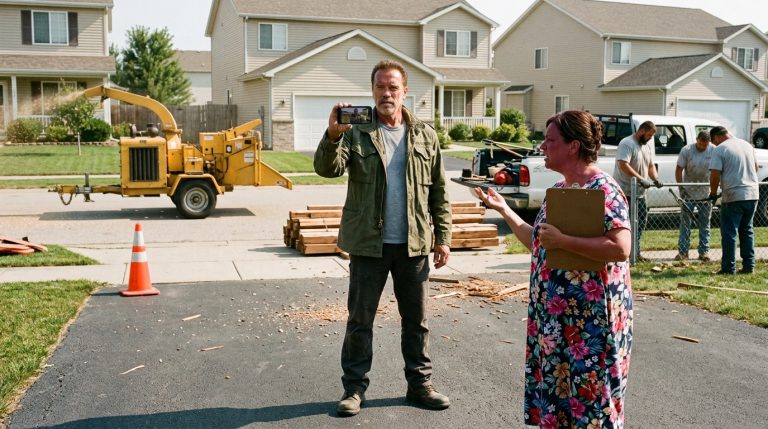
I was halfway through when the back door of the nearest house swung open. It was the young man from the driveway—the one who had been struggling with the crabgrass. He stepped out onto his back deck, holding a mug of coffee, watching me. He didn’t look afraid anymore. He looked curious.
“You’re making a point,” he called out, his voice barely audible over the rising roar of the wind.
I paused, one hand on a stake. “I’m marking the foundation,” I shouted back. “Everything on this side is bedrock. Everything on yours is built on a breach.”
He didn’t pull away. He took a step closer to the railing, his knuckles white against the dark wood. “She’s losing her mind in there,” he said, nodding toward Karen’s house, which sat silent and dark at the end of the line. “She’s been pacing for an hour. I can see her through the blinds.”
“Good,” I said, driving the final stake into the ground. I felt the vibration travel up through the mallet, a jarring, electric sensation. “Fear is a better teacher than logic.”
As I finished, a bolt of lightning split the sky, illuminating the neighborhood in a strobe-light flash of white. For one impossible second, the entire subdivision looked like a movie set—static, hollow, and fragile. Then, the thunder hit, a deep, bone-rattling boom that made the very air vibrate. The rain intensified, turning into a torrential downpour that blurred the lines between the pasture and the manicured lawns.
I stood there for a moment, letting the water soak through my jacket, watching the pink flags whip in the gale. They held. They were anchored in soil that didn’t care about community standards, soil that had been here long before the developer had signed the lease.
My phone buzzed in my pocket—a text from George. The Thursday meeting is being billed as a ‘Community Safety Initiative’. She’s bringing in private security. She knows we have the audit results.
I looked at the house again. Private security. The final, desperate reach of a tyrant who had run out of laws to weaponize. She was trying to turn a boardroom vote into a fortress defense. I turned back toward my ridge, my pace steady despite the slick, treacherous mud. The storm was the perfect cover for the final tactical shift.
I reached the edge of my porch, the wood groaning under the pressure of the wind. I didn’t go inside immediately. I stood on the threshold, looking out at the darkness where Oakwood Estates lay. I had the audit, I had the lease, and I had the people. The only thing left was to watch her realize that her “private security” couldn’t guard against the truth.
The rain slicked the windows of my house, creating a veil between me and the world I was about to reshape. I took a deep breath, the air tasting of ozone and wet iron. The stakes were set. The line was drawn. And as the storm intensified, shaking the frame of my house, I felt a calm, clinical certainty. She had built her kingdom on a foundation of sand, and it was only a matter of time before the weather caught up to her.
CHAPTER 8: THE FINAL DEFAULT
The clubhouse was suffocatingly warm, the air thick with the smell of wet wool and the electric tension of sixty families who finally realized they were holding the leash. Outside, the storm had tapered to a steady, rhythmic drip from the eaves, but inside, the temperature was rising. Karen stood at the podium, flanked by two men in ill-fitting black suits. They looked more like hired laborers than security—an amateur flourish from a woman who had run out of professional options.
“This board meeting is closed,” Karen shouted, her voice thin and reedy, devoid of its usual, practiced authority. “You are all trespassing on HOA property!”
“We are homeowners, Karen,” George said, stepping forward from the back of the room. He didn’t shout. He spoke with the quiet, devastating calm of a man who had spent forty years balancing ledgers. “And we are here to discuss the state of our homes.”
I walked to the front of the room, my boots clicking sharply on the linoleum. The “security” guards shifted, their eyes tracking my movement, but they didn’t move. They had been hired to intimidate, not to commit felony assault, and they could see the math in the room. They could see that the board was alone.
I reached the podium and set a single, thick document down: the Formal Notice to Cure, stamped and signed.
“Karen,” I said, my voice cutting through the noise like a blade. “The ninety-day window has expired. The financial audit is complete. The evidence of embezzlement is already in the hands of the District Attorney.”
She stared at the document, her hands clutching the podium until her knuckles were white. “This is a fabrication. The board—”
“The board is empty,” I interrupted. “The other members resigned three days ago. You are the only one left, and you are currently in material breach of the master ground lease.”
I looked at the residents—the young couple who had been afraid of a basketball hoop, the widow who had been forced to destroy her roses, the man who had been intimidated for his satellite dish. Their fear was gone, replaced by a cold, sharp-edged resolve.
“The ground lease for Oakwood Estates was never renewed,” I said, the words echoing in the sudden, absolute silence of the room. “As of midnight, this subdivision is in default. The land, and everything fixed to it, reverts to the Holloway Grant.”
Karen’s face went slack. The smug, queen-like mask she had worn for years didn’t just crack; it shattered. “You… you can’t. The developers… they promised…”
“The developers dissolved in 2005,” I said. “You were just a tenant who forgot to read the fine print.”
She looked to her ‘security’ for help, but they were already backing toward the exit, sensing the shifting tide. She turned back to the room, seeking a sympathetic ear, but she found only stone-faced silence.
The payoff was not a shout or a victory lap. It was the simple, crushing weight of reality. Karen reached for the gavel to slam it one last time, a final, pathetic attempt to impose her will, but George stepped forward and caught her hand. It was a gentle movement, almost paternal, but it stopped her cold. She stared at him, and for the first time, I saw the truth of her: she wasn’t a villain; she was just a small, terrified woman who had used rules to feel big.
She pulled her hand away, stumbled back from the podium, and turned to leave. She didn’t look at anyone. She just walked out of the room, her floral pantsuit a stark, ridiculous splash of color against the drab, grey reality of her defeat. The door swung shut behind her with a soft, final click.
The cooling-down of the room was immediate. The hum of the lights seemed to fade into a dull, manageable drone. The people didn’t cheer; they breathed. They looked at each other, not as residents of a beige kingdom, but as neighbors.
I walked over to the side table where the discarded gavel lay. I picked it up—a heavy, hollow piece of wood—and set it down in the trash bin. Then, I turned to the board, now composed of Mark, Jessica, and George.
“The lease is being restructured,” I said. “The land is yours to manage. We start fresh tomorrow.”
The denouement was a quiet, almost domestic affair. As the residents filed out, the air outside felt clean, the storm having scrubbed the humidity from the night. I walked back toward the ridge, the quiet rhythm of the valley returning to its natural state. Sarah was waiting on the porch, a lamp casting a warm, amber glow onto the wet boards.
I reached the steps and looked down at the pasture. Daisy and Buttercup were grazing in the moonlight, indifferent to the chaos they had inadvertently triggered. I walked over to the fence—the one I’d sunk myself—and noticed a loose wire near the corner post. I pulled a pair of pliers from my pocket, the metal cold and familiar, and twisted the wire back into place. A small repair. A symbolic act of maintenance.
I looked up at the ridge, then out toward the subdivision. It was still there, but it no longer felt like a prison. It was just a neighborhood, fragile and flawed, but finally, rightfully, their own.
I climbed the porch steps, the weight of the war finally falling from my shoulders. The fight had been a necessity, a calculated maneuver to protect the peace, but the victory was in the quiet. I opened the door, the scent of fresh coffee and home greeting me like a soft, invisible hand. I sat down at the table, the legal documents now just paper, and for the first time in months, I didn’t think about property lines. I didn’t think about covenants. I just watched the moonlight cross the floor, knowing that the boundary was finally, permanently, set.