Unrelenting Veteran Exposes Corrupt HOA President in a Massive Legal Battle for Neighborhood Freedom
CHAPTER 1: THE FIRST NOTICE
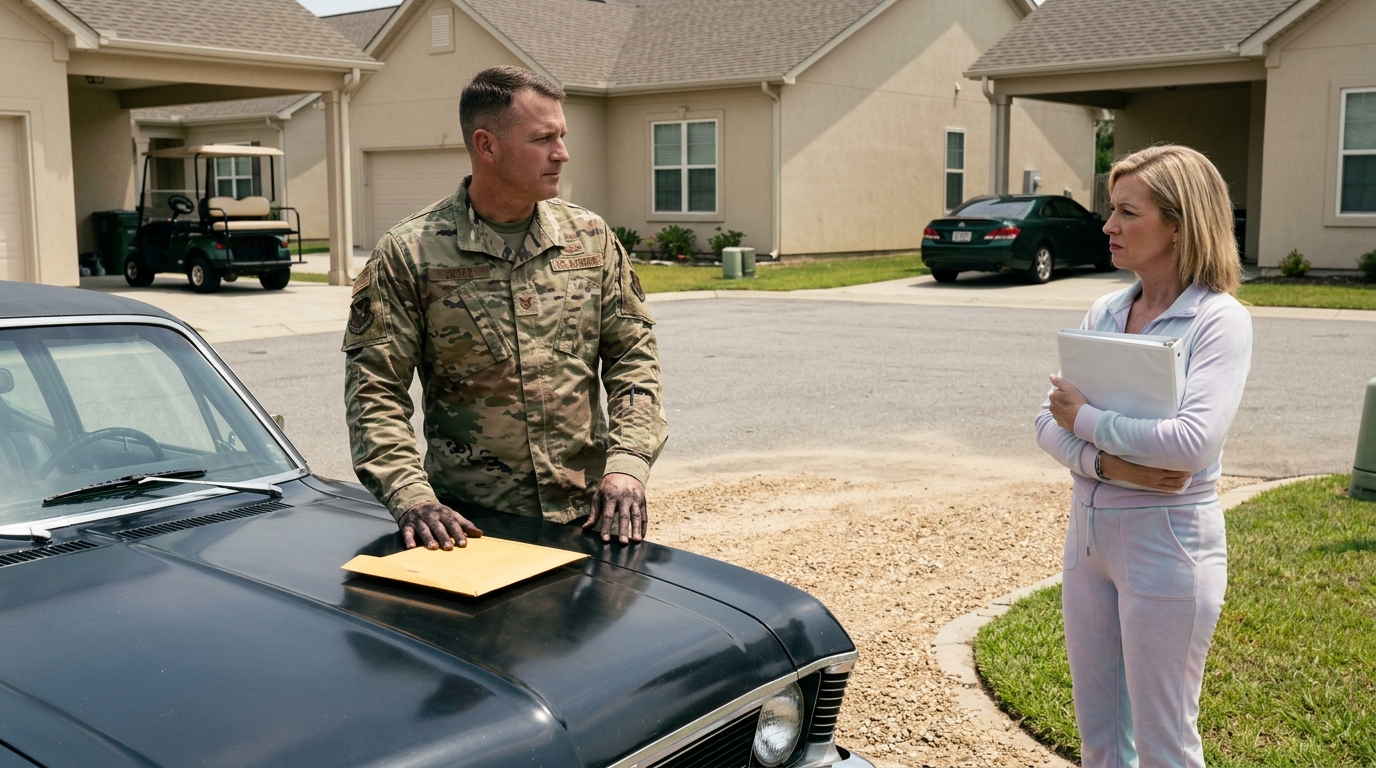
The humid North Carolina afternoon air tasted like cut grass and hot asphalt. My hands were stained black with grease from the lower control arm of the ’68 Chevy, a rusted reminder of the patient mechanics I used to know before the mailbox became a battleground. I didn’t turn around when the soft scuffle of orthopedic sneakers crunched on the gravel driveway. I knew the cadence. I’d heard it every Tuesday for a month.
Karen stood five feet from the edge of my freshly edged lawn, clutching her white three-ring binder like a shield against common sense. Her pastel tracksuit strained slightly around the middle, and her mouth was pinched into that familiar, bloodless line of manufactured authority.
“Master Sergeant,” she said, the title dripping with enough simulated respect to sour milk. “That flagpole is still non-compliant. The fourteen-day grace period expired at noon.”
I wiped my thumb clean on a rag, letting the silence stretch out between us. My shoulder muscles locked into a hard, familiar brace—the same defensive tension I used to manage long before the uniform came off for good. I didn’t raise my voice. A man who spends twenty-five years listening for mortar whistles doesn’t waste breath shouting at someone holding a laminated permit.
“Karen,” I said, keeping my tone flat and level as I rose from my knees. “We talked about this. A twenty-foot pole is standard residential stock. There isn’t an eighteen-foot version made that won’t snap in a coastal squall.”
She tapped her manicured fingernail against the corner of the binder, her eyes narrowing with sharp satisfaction. “By-law section seven, paragraph C, subsection four is explicit. Architectural conformity does not bend for personal history. If it’s over eighteen feet, it comes down, or the daily assessments begin.”
She dropped a crisp, yellow-backed envelope onto the top of my truck’s hood and turned on her heel, executing a sharp, self-satisfied pivot back toward her golf cart. She thought she had established checkmate with a piece of office stationery. She had no idea how many supply lines I had managed in the desert, and she certainly didn’t understand what happened when you pushed a tired man past his last remaining margin of peace.
I picked up the envelope, feeling the thin plastic window bite into my thumb. Inside was the formal notice of a one-hundred-dollar fine, accompanied by an escalating threat of daily penalties. The paper was cheap, but the underlying intent was unmistakable.
I walked slowly up the front steps, leaving the Chevy’s engine cooling in the driveway. Sarah was standing just inside the screen door, her eyes tracking the yellow envelope in my hand with a quiet, exhausted worry. I didn’t make a grand speech. I just walked past her to the desk in the den, pulled out a thick, empty three-ring binder, and slid Karen’s notice into the very first plastic sleeve.
The war didn’t start with a bang. It started with a hole punch and a receipt.
CHAPTER 2: THE PAPER TRAIL
The binder was already three inches thick. Every time Karen drove her green golf cart past the cul-de-sac, another violation notice found its way into our mailbox like a silent tax on existing.
A patch of St. Augustine grass near the curb was allegedly four-and-a-quarter inches high. According to bylaw twelve, subsection nine, the maximum allowable height was four inches.
I didn’t yell. I didn’t storm across the street. I walked out to the lawn with a steel carpenter’s square and a high-definition digital camera.
The grass right against the concrete measured precisely four inches on the mark. I snapped three time-stamped frames, pulled the digital card, and walked back inside to the desk.
Sarah stood in the kitchen doorway, holding a mug of lukewarm coffee with both hands. Her knuckles were white against the ceramic. “Jack, she’s added forty dollars in late fees to the postmark. She’s doing this on purpose.”
“I know,” I said, sliding the printed photographs into a fresh plastic protective sleeve. “She wants a shouting match. She wants to claim harassment so she can call the county sheriff.”
“And what are we going to do?”
“We’re going to pay it.” I opened the checkbook, writing the amount down to the exact cent. “Under protest. Every single dollar has to be tracked. If we miss a payment, she voids our right to dispute under section fourteen.”
The doorbell chimed three short, sharp rings.
I didn’t rush. I finished writing the certified mail tracking number onto the ledger sheet before I stood up. When I pulled the front door open, the porch was empty except for a laminated neon-orange sticky note slapped directly over the brass door handle.
Unauthorized vehicle storage. Commercial truck parked in residential driveway.
It referred to the ’68 Chevy under its canvas cover. The truck was registered, insured, and operational. It just happened to need a new water pump.
I peeled the sticky note off the brass with my fingernail, feeling the heavy adhesive tear slightly against the metal. The sun beat down on the empty street, glaring off the pristine, identical beige stucco of Karen’s house across the cul-de-sac.
I folded the orange paper neatly in half and slid it straight into the back pocket of my jeans. Then I reached for the telephone.
CHAPTER 3: THE RAMP OF SCRUPLES
George’s front porch smelled of damp cedar and old pine needles. The rain had stopped an hour ago, leaving heavy gray puddles pooled at the edge of his driveway where the concrete met the sod.
I stood staring at the bright yellow certified mail slip taped firmly across his screen door like a badge of administrative shame.
The door creaked inward three inches, revealing George’s gray head and eyes clouded with a deep, crushing weariness.
“She says it’s an unapproved structural addition, Jack,” George muttered, his fingers trembling as he clutched the wet paper bag holding the notice. “Martha needs her doctor’s run tomorrow morning. How am I supposed to wheel her down two bare steps without breaking her back?”
I reached out and peeled the plastic bag away from the screen mesh with a sharp, clean pull. “You aren’t taking it down, George. That ramp stays right where it is.”
“The fine is two hundred dollars a day,” he whispered, glancing across the damp cul-de-sac toward the beige fortress where the green golf cart sat parked under the carport. “I can’t fight a municipal lawyer on my pension.”
“You aren’t fighting anyone,” I said, my voice dropping into the quiet, level register I used to brief patrol units before a gate check. “Federal law handles this before any local bylaw ever touches the paper.”
I pulled the printed copy of the Fair Housing Act from my inner jacket pocket, the ink crisp and unsmudged despite the damp air. The text was plain, explicit, and utterly bulletproof regarding reasonable modifications for medical necessity.
We didn’t wait for her next patrol. I helped George draft the formal hearing request right there on his kitchen table, using the exact statutory language David had outlined during our last phone consultation.
When I walked back across the asphalt toward my own driveway, the afternoon light caught the edge of Karen’s windshield across the street. She was sitting behind the steering wheel of her golf cart, watching us through a pair of heavy binoculars with the cold, unblinking focus of a sniper.
I didn’t wave. I didn’t flinch. I just reached into my pocket, pulled out the folded orange sticky note from the Chevy, and dropped it straight into the outdoor garbage bin with a hollow metallic clatter.
CHAPTER 4: THE CLUBHOUSE REVOLT
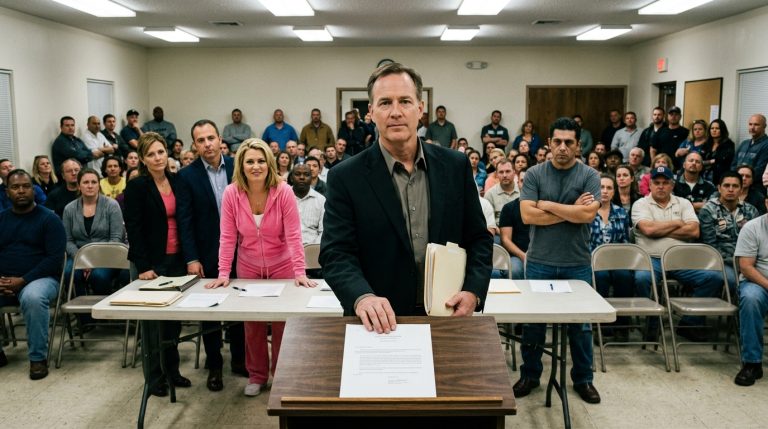
The air in the room was stale, smelling of commercial carpet cleaner and old coffee. Fifty homeowners stood jammed along the perimeter walls, their faces tightened into expressions of reluctant defiance.
Karen sat at the center of the long folding table, flanked by Carol and Frank. Her fingers twitched rhythmically against the edge of a small brass gavel, her eyes darting toward the packed aisles with sharp, visible panic.
She banged the metal against the wood once, the sound cracking thin and sharp. “This is a closed administrative hearing regarding parcel one-twelve,” she announced, her voice pitched higher than normal. “Only registered board members and the designated petitioner may remain.”
I stepped forward, keeping my boots flat and heavy against the scuffed tiles. I didn’t raise my voice. I didn’t need to.
“Karen,” I said, sliding my fourth thick binder onto the metal table with a hollow thud. “By-law fourteen, section F states that a homeowner has the right to designated representation. Furthermore, state statute requires all association board hearings affecting property rights to remain open to the public.”
A murmur rippled through the back row of neighbors.
Karen’s face mottled into a dark, blotchy red. “You cannot record this. You cannot bring an audience—”
“I brought an audience because fifty people in this room have received arbitrary fines for grass heights and welcome mats,” I interrupted, flipping the binder open to a highlighted state statute. “And under federal law, trying to penalize a resident for a medical wheelchair ramp crosses the line from local overreach into a federal civil offense.”
Frank shifted uncomfortably in his plastic chair, his eyes dropping to the polished grain of the table. “Karen… the man brought the actual statutes. Maybe we should listen.”
“Shut up, Frank,” Karen hissed, her teeth bared in a tight, desperate grimace. “We are the authority here. The rules are absolute.”
“The rules don’t cover federal civil violations, Karen,” I said, locking my gaze onto hers until her eyelids flickered away. “So you can either rescind George’s violation right now, or we let the Department of Housing and Urban Development read these exact records tomorrow morning.”
CHAPTER 5: THE FINANCIAL RAID
The manila folders spread across David’s mahogany table smelled of old ink and legal discovery.
I traced a finger down the line of a landscaping invoice from a company called Perfect Petals. The numbers didn’t make financial sense for a standard suburban cul-de-sac.
“Look at the registry address, Jack,” David said, sliding a corporate filing sheet across the smooth wood surface. “It doesn’t go to a commercial nursery. It traces back to a post office box registered under Karen’s married name.”
I felt a cold, steady weight settle into my chest. This wasn’t just petty neighborhood bullying or an obsessive fight over fence heights and flagpoles.
It was structured self-dealing.
“She’s been inflating the contract rates by thirty percent,” I said, my voice dropping into a flat, measured register. “And funneling the excess straight through family-owned shell operations.”
“Not just family,” David corrected, tapping a second document listing the billing records for deck restoration. “Her brother-in-law holds the maintenance monopoly for every shared structure in Oak Hollow. She used the architectural bylaws as a shakedown mechanism to force homeowners into hiring her relatives.”
The pieces clicked into a clean, brutal puzzle. The arbitrary fines, the rejection letters, the manufactured rule enforcement—they weren’t about neighborhood aesthetics at all. They were collection tactics for an illegal monopoly.
I reached down and closed the manila folder with a deliberate, slow motion. The binder in my grip felt heavier now, not because of the paper inside, but because of the trap we had finally managed to spring around her entire operation.
CHAPTER 6: THE FINAL JUDGMENT
Karen sat at the opposing defense table, her posture rigid and her fingers tightly locked around a pristine leather folder. Her attorney leaned in to murmur a final caution, but she brushed his sleeve aside with a sharp, dismissive twitch of her shoulder.
Judge Harrison didn’t look at her lawyers. He looked straight down at the itemized list of eighty-three retaliatory code violations stacked like a masonry wall across the wood.
“The legal process is not a tool for personal vendettas,” Judge Harrison said, his voice carrying an unyielding military cadence through the quiet room. “This court has reviewed every notice, every fabricated fine, and every fraudulent landscaping contract tied to your administration.”
Karen stood up abruptly before the judge finished his sentence, her face flushed a dark, blotchy purple. “The rules were violated!” she shouted, her voice cracking against the courtroom walls. “He put a flagpole up that was two feet too tall! I was only protecting community values!”
“Sit down, counselor,” Judge Harrison barked, his eyes narrowing into cold slits. “Your client is the one on trial here.”
He turned back to the stack of binders, his fingers resting firmly on the final page of the ruling.
“For systematic abuse of process, malicious prosecution, and a verified breach of fiduciary duty involving self-dealing shell companies, the court finds in favor of the plaintiff on all counts,” Judge Harrison announced, striking his gavel once with a clean, definitive crack. “Karen Miller is personally levied a seventy-five-thousand-dollar punitive fine, permanently barred from holding any homeowner association position in this state for life, and referred to the District Attorney for criminal fraud review.”
Karen slumped back into her chair, her hands flying to cover her face as the reality of her total collapse finally caught up with her.
Around us, the courtroom broke into a long, steady sigh of collective relief. George reached out and gripped my shoulder with a trembling hand, his eyes bright with unshed tears.
We walked back out into the bright North Carolina afternoon air, the weight of two years of endurance finally lifting from our shoulders.
Back in Oak Hollow, the green golf cart sat motionless under an empty carport across the cul-de-sac while moving boxes were stacked clumsily onto the back of a rental truck.
I stood in my own driveway with a wrench in hand, tightening a final bolt on the lower control arm of the ’68 Chevy. The engine hummed to life with a deep, effortless rumble that echoed cleanly down the street without a single complaint from a neighbor.
Later that afternoon, George and the Hendersons walked over carrying a brand-new, heavy-duty twenty-five-foot flagpole. We set the concrete together, hoisted the stars and stripes high into the clear blue sky, and watched it flutter proudly in the wind.
The war was over. The neighborhood belonged to the people again.