The Iron Pin Agreement: How One Retired Engineer Dismantled a Suburban Empire of Petty Rules and Built Lasting Peace
CHAPTER 1: THE FIRST NOTICE
The dry heat of late morning pressed down through the canopy of maples, smelling faintly of dust and crushed kudzu.
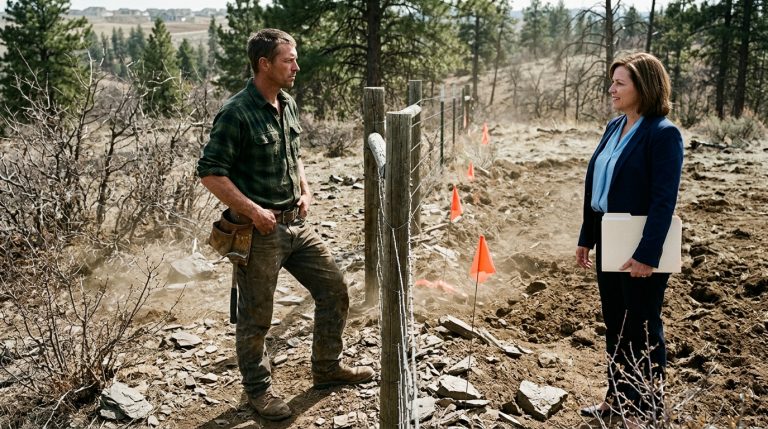
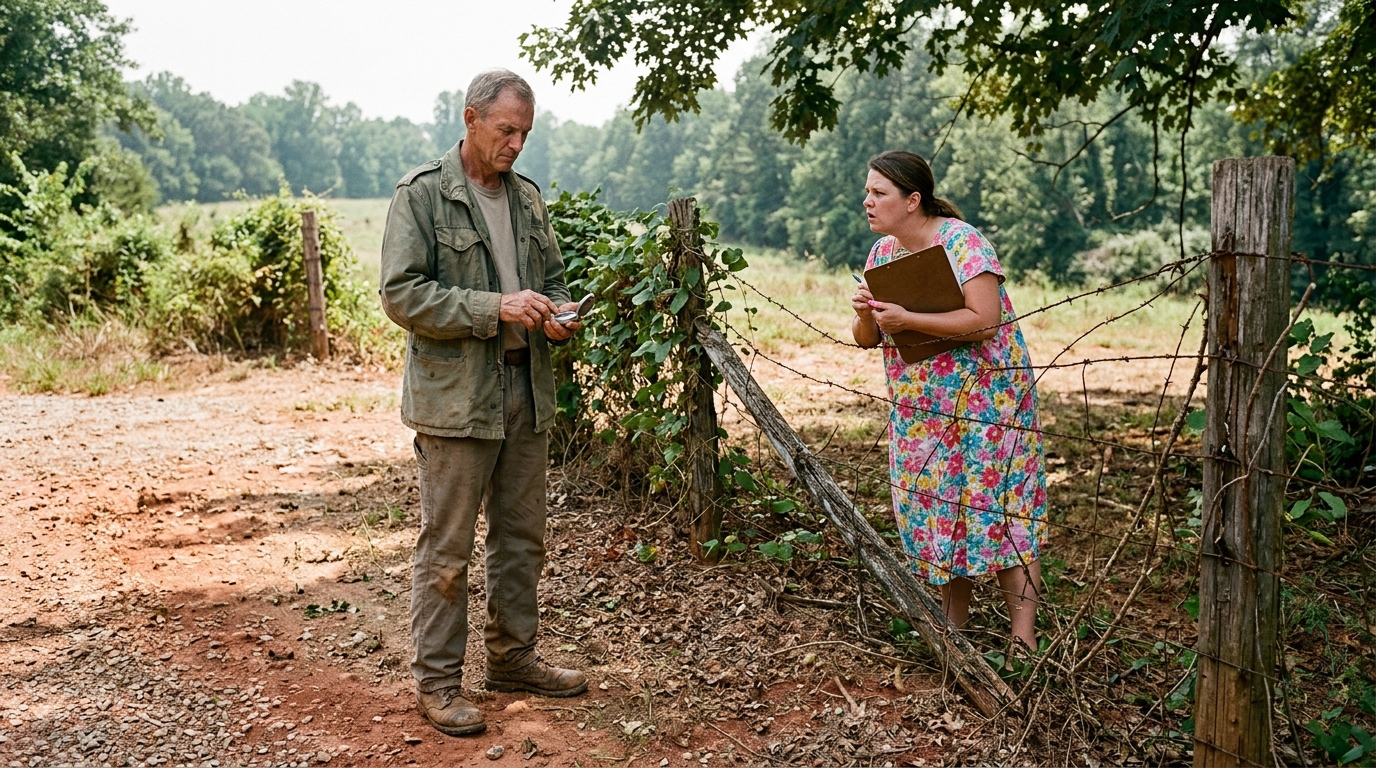
I wiped a smear of red clay off my forearm with the back of my thumb, keeping my eyes fixed on the rusted strands of barbed wire my grandfather had stretched across cedar posts back when Eisenhower was in office.
Footsteps crunched heavily on the gravel drive—heavy, deliberate, and entirely uninvited.
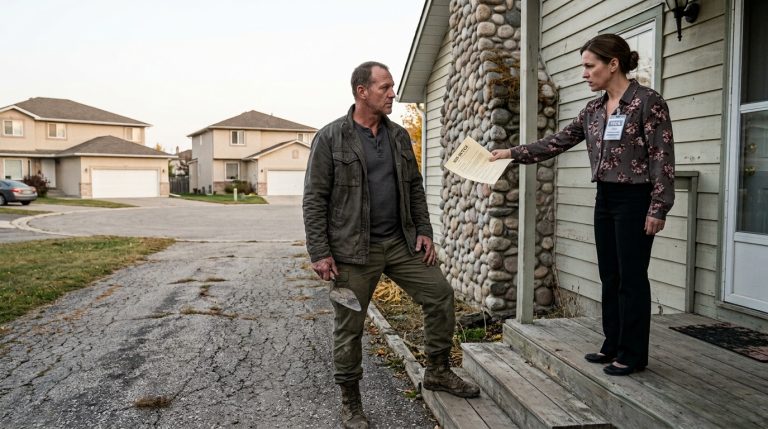
“That ancient rusted wire you call a fence is an illegal encroachment on association property, Mr. Henderson.”
Karen stood near the perimeter marker, her floral-print muumuu straining against her frame as she sucked in a sharp lungful of humid air.
She held a thick vinyl clipboard pressed against her chest like a shield, her small, hard eyes scanning the rolling acreage of timber and overgrown brush that had belonged to my family for three generations.
“According to our bylaws and the plat map filed with the county, you are currently trespassing,” she continued, her voice carrying the practiced, rhythmic cadence of someone accustomed to undisputed authority.
“I have a crew scheduled for Friday morning to remove it and install proper community standard fencing along the correct boundary line.”
I didn’t drop the hand tool I was holding, nor did I stand up too quickly to match her posture.
Instead, I let my thumb graze the cool, scarred metal of my pocket transit compass, feeling its familiar weight settle my pulse against the sudden intrusion.
“You will, of course, be billed for the removal, the new installation, and a series of escalating fines for every day the violation continues, starting retroactively from thirty days ago.”
She tapped the clipboard with a manicured nail, waiting for the predictable flinch of a homeowner intimidated by official stationery and manufactured fees.
She thought she was staring down an aging country resident who would trade his privacy for a quiet life to avoid a stack of legal threats.
What she failed to calculate was the simple, unyielding stubbornness of a man who had spent a quarter-century reviewing structural tolerances for the Army Corps of Engineers.
“My property,” I said, my voice dropping flat and even beneath the drone of cicadas in the high branches. “My rules. Turn your crew around before they cross that tree line, Karen.”
She puffed out her chest, a faint sneer tightening the corners of her mouth as she began jotting a note on her pad.
“We’ll see who’s giving orders by Friday morning, Mr. Henderson.”
CHAPTER 2: THE COURTHOUSE ARCHIVES
The municipal office basement smelled of damp cotton rag and sixty years of ledger bindings left to cure in the dark.
I set my boot heels down on the linoleum floor, listening to the hollow echo bounce off rows of steel shelving that held every land transfer made since the end of the Second World War.
Martha looked up from behind a high counter, her wire-rimmed glasses sliding halfway down her nose as she recognized the faded canvas field jacket.
“Whispering Pines,” she muttered, before I even opened my mouth. “We’ve had more boundary complaints and title search issues with that one subdivision than all the others in the last decade combined. The developer rushed the platting process. I told them then, their survey looked sloppy.”
She didn’t wait for an answer.
Instead, she turned and pulled down a massive leather-bound book from the top shelf, the spine groaning under the dry weight of history.
She cracked the cover open, sending a tiny puff of yellowed paper dust floating into the fluorescent glare.
“Here it is. 1946. Your grandfather’s original purchase.”
Her finger traced a jagged line of faded black ink written in a neat, fountain-pen cursive.
“Thence north 89 degrees 15 minutes west for a distance of 812.5 feet to an iron pin set at the base of a tri-trunked white oak.”
I leaned in, watching the ink catch the light.
An iron pin—a physical, buried piece of steel that, if found, would stand as legally irrefutable proof against any computer-generated subdivision overlay.
Martha slid a modern, glossy computer printout right next to the antique ledger page.
It was the developer’s plat map for Whispering Pines, filed just four years ago with clean, straight digital lines and perfectly uniform lot numbers.
When placed side-by-side, the geometric lie was stark.
Their map showed a rigid, uncompromising grid that ignored the natural undulations of the ridge and sliced a clean twenty-foot wedge straight through the orchard my father planted.
“Find that iron pin, Jack,” Martha whispered, tapping the margin of the 1946 page with a dry fingernail. “Find that pin, and you’ll have them dead to rights.”
CHAPTER 3: BURIED STEEL
Sweat stung the corners of my eyes as I swung the sensor through the dense, neglected brush at the far corner of the property.
The tool screamed a sharp, erratic warble every few feet, picking up discarded wire fragments and rusted fruit cans left behind by careless construction crews from the adjacent subdivision.
Each false positive sent a dull throb through my lower back, reminding me of long hours spent kneeling in wet clay during old engineering jobs.
My grandfather’s 1946 deed rested folded in my back pocket, its descriptions of meets and bounds serving as a mental compass through the thicket.
The ground here was choked with young saplings that had crowded out the historical oaks over the past few decades, turning a once-open cattle lane into a tangled labyrinth of thorns.
I paused, wiping a sleeve across my forehead and shifting the weight of the digging trowel gripped in my calloused hand.
The memory of military discipline kept my movements measured and deliberate, overriding the creeping urge to rush the search just to escape the afternoon humidity.
I adjusted the sensitivity dial on the control box down a notch to cut through the surface clutter of iron nails and rusted bottle caps.
Then I stepped deeper into the shadow of three rotting oak stumps that formed an irregular triangle near the broken remains of the old fence line.
I made one final, slow pass with the detector head, keeping the plastic disc a bare two inches above the matted leaf litter.
The erratic squeal vanished, replaced instantly by a deep, solid, uninterrupted tone that resonated cleanly through the headphones.
Not a scrap of trash, but a heavy, localized mass buried deep within the unyielding subsoil.
I dropped to one knee right there in the dirt, driving the sharp edge of the hand trowel six inches down through root mat and dark topsoil.
CHAPTER 4: THE DEPUTY INTERVENES
Heavy diesel exhaust rolled across the cedar line, accompanied by the rhythmic, mechanical thud of a commercial posthole digger biting into topsoil.
I stood up from the brush line, wiping my palms clean on my denim jeans as I watched a crew set steel posts fifteen feet inside our boundary.
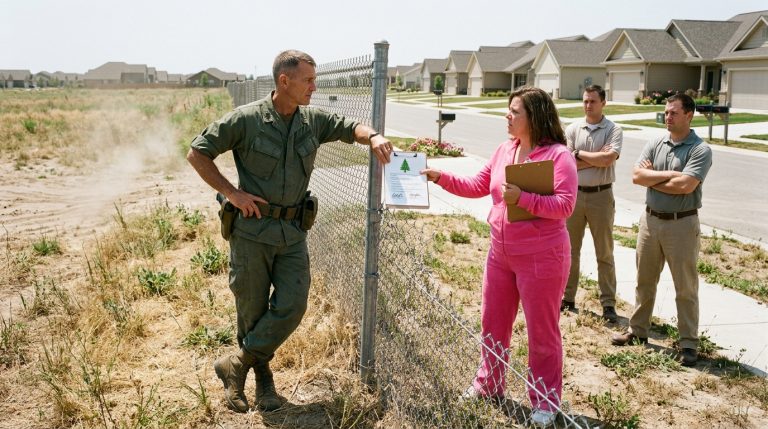
Karen stood near the freshly dug holes, clutching her clipboard and directing the work with sharp hand gestures.
I didn’t yell across the distance or wave my arms in frustration.
Instead, I walked calmly back toward the farmhouse, picked up my phone, and dialed emergency services to report an ongoing trespass on private land.
Ten minutes later, a local patrol cruiser crunched up the gravel drive, its amber light bar flashing silently against the midday glare.
Deputy Miller stepped out of the vehicle, his boots crunching on the stone as he took in the sight of the active construction crew on our side of the old barbed wire.
Karen marched over immediately, her face flushed and her voice pitched high for maximum authority.
“Thank goodness you’re here, officer—this man has been illegally encroaching on association property, and we are simply rectifying the boundary line.”
The deputy looked past her toward the weathered porch, tipping his hat in a quiet gesture of local recognition before turning back to face her.
“Ma’am, do you have permission from Mr. Henderson to be operating heavy machinery on this parcel?”
Karen scoffed, tapping her clipboard against her thigh with mounting agitation.
“We don’t need his permission—our subdivision plat map grants us full authority over these common grounds.”
I walked down the porch steps, holding out a sealed folder containing the county clerk documents and the certified deed records.
“Deputy, they are operating past a seventy-year-old boundary marker backed by recorded county deeds, and I have given them written notice to cease.”
Miller glanced at the fresh concrete footers, then back at Karen’s rigid posture.
“This is a civil property dispute, but right now you’re standing on private land after a formal trespass warning—pack up your equipment and clear these premises immediately.”
Karen’s jaw tightened into a hard, white line as she glared at the uniform.
“This is an outrage, and you haven’t heard the last of this jurisdiction.”
CHAPTER 5: THE MASTERSTROKE MEETING
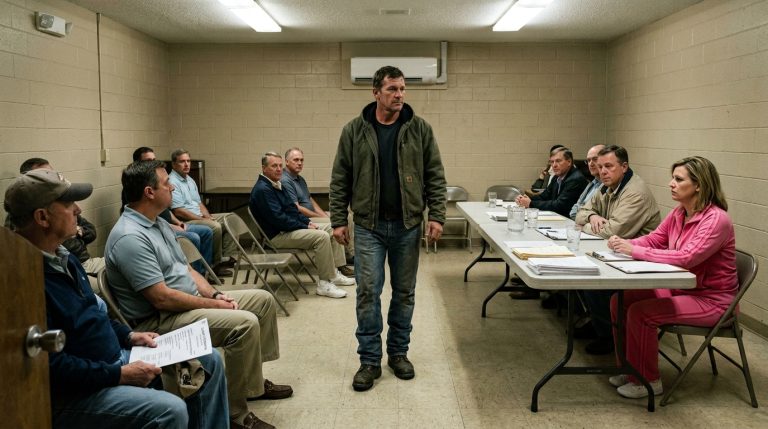
Four members of the Whispering Pines board sat across the mahogany span, their expressions tense and uncertain as they adjusted their ties and coats.
Karen took the center seat at the opposing end, her navy blue pantsuit straining slightly as she crossed her arms and refused to look toward my side of the room.
Marcus remained standing beside a large wall-mounted projector screen, his hand resting casually on the edge of a certified GPS survey map that showed two distinct color-coded boundaries.
“Let’s review the physical evidence,” Marcus began, his voice carrying the dry, methodical precision of a veteran litigator.
He clicked the remote, bringing up a high-resolution scan of the 1946 deed alongside photographs of the iron pin we had uncovered near the old oak stumps.
The board members leaned forward, their eyes tracking the laser pointer as it moved from the historical monument to the modern plat overlay.
“The official boundary, anchored by county-registered monumentation, sits right here,” Marcus said, pausing to let the weight of the data settle over the quiet room.
“Your subdivision’s expansion, however, was calculated from an entirely different temporary benchmark during initial construction four years ago.”
He clicked to the next slide, revealing a complex secondary grid that exposed a systemic fourteen-foot westward shift affecting every single backyard bordering our timberline.
One of the male board members went visibly pale, his hands gripping the edge of the polished wood until his knuckles turned white.
“What does that mean for our property titles and our mortgages?” he asked, his voice cracking into a hoarse whisper.
“It means your developer made a catastrophic surveying error across the entire neighborhood,” Marcus replied, his tone turning cold and absolute.
“None of your backyards end where you think they do, and your HOA president’s aggressive enforcement actions have brought this title disaster out into the open.”
Karen slammed her palm against the conference table, her face flushing to a dark, mottled red as she glared across the room.
“This is an absolute fabrication—you are trying to extort us with a rigged map!”
Marcus simply slid a thick settlement binder across the polished surface toward her, its heavy thud echoing sharply in the silence.
“You can hire your own independent surveyors to confirm it, Ms. Miller, but every week you delay only deepens the financial liability for everyone sitting at this table.”
CHAPTER 6: THE NEW BOUNDARY
The old rusted barbs were gone, hauled away by the same fencing crew that had once dug unpermitted footers into our topsoil.
In their place stood solid timber rails, weathering slowly from pale gold toward a distinguished silver gray that blended right into the surrounding ridge line.
Tom leaned his forearms against the top board, his expression relaxed as he watched a pair of cardinals dart through the low canopy of the newly established community green space behind us.
“The new board has been holding open meetings every Tuesday,” Tom said, shifting his weight against the wood. “No binder of arbitrary rules, no sudden fines—just common-sense neighbors trying to fix the title mess Karen left behind.”
I raised a cold glass of iced tea, letting the moisture cool my palm before taking a slow sip.
“A community shouldn’t need a dictator to keep the grass cut, Tom.”
“Ain’t that the truth,” he murmured, looking across the fifty acres of protected woodland we had recently secured into a perpetual conservation easement.
That massive tract of timber, once vulnerable to bulldozers and another cookie-cutter housing block, was now legally preserved forever.
Through our formal agreement, the families from Whispering Pines had full access to the shaded hiking trails and the old spring-fed pond where my father had taught me to cast a line.
Down the trail, a group of neighborhood children laughed as they skipped smooth flat stones across the water, their voices carrying softly through the dense oak and hickory.
Karen had long since sold her beige-and-brick house at a heavy loss and moved away, her reign of bureaucratic terror erased by the unyielding math of an old iron pin buried deep in the Tennessee clay.
The heavy legal bills and re-platting expenses had been a bitter pill for the subdivision to swallow, but the shared crisis had forged a genuine bond among people who used to communicate only through passive-aggressive notes.
“You know, Jack,” Tom said, clapping a hand gently against the oak rail before pushing off to head home for dinner. “When you first drew that line in the dirt, we thought you were just an old crank protecting his dirt. Turns out you were the only one keeping the place standing.”
I watched him walk back toward the cul-de-sac, the evening light casting long shadows across the grass.
The land was safe, the legacy secure, and the boundary had finally stopped being a wall of conflict and started becoming a place to shake hands.