The Iron Perimeter: A Tactical Defense of Land, Legacy, and the Silent Power of Recorded Law
CHAPTER 1: THE FIRST ARC
The smell of ozone and burnt metal hung thick in the Texas heat—a sharp, industrial scent that signaled progress. I didn’t turn around. I held the welding mask in place, the world reduced to the intense, dancing glow of the bead I was laying down on the steel cattle guard. Behind me, the gravel crunching under designer heels told me the homeowners association had arrived.
“That hideous metal contraption is a lawsuit waiting to happen, Mr. McGregor.”
Karen Thompson’s voice was like ice water in a glass of hot tea—refined, condescending, and dangerously sharp. I finished the weld, the bead glowing a brilliant, dying cherry red, and clicked the torch off. The sudden silence that followed was heavy, punctuated only by the distant lowing of my heifers in the back pasture.
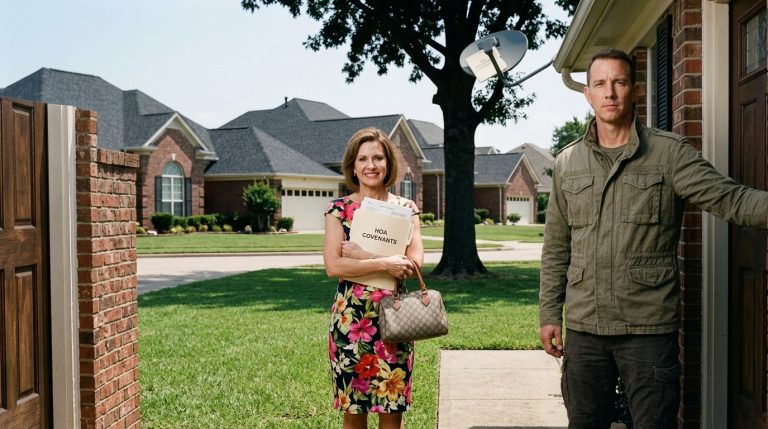
I pushed the mask up, resting it on my forehead. My skin felt tight with sweat, a mixture of grease and Texas dust layering my brow. Karen stood at the edge of the access road, her floral dress an aggressive, pastel insult to the muted browns of my ranch. Gary, her board-member shadow, stood two paces behind, clutching his clipboard like a shield.
“It’s a cattle guard, Karen,” I said, my voice deliberately flat. I leaned against the heavy steel frame, my calloused gloves smeared with oil. “It keeps livestock off the county road. It’s functional. It’s necessary.”
“It is an unapproved, unsightly, and dangerous modification to a shared access point,” she shot back, her chin climbing higher. “Section 7, Subsection B. You are in violation. We demand its immediate removal by Friday, or you will face escalating fines that will make your retirement fund look like pocket change.”
I didn’t blink. I’d spent twenty years in the Army Corps of Engineers looking at blueprints that decided the fate of FOBs in hostile territory. I knew the difference between a real threat and a petty tyrant playing with a three-ring binder.
“This access road is a recorded easement,” I said, my tone as steady as a concrete foundation. “I suggest you check your records before you start issuing threats on private property.”
Karen scoffed, the sound sharp and brittle. “Your records are dusty relics. We have the authority of the Willow Creek Board. Don’t test us, Mr. McGregor.”
As she turned to leave, her gaze swept over the cattle guard with a flash of something I couldn’t quite place—not just anger, but a frantic, predatory intensity. Then, I saw it. Tucked into the edge of Gary’s clipboard, a stray page was partially visible: a ledger sheet, glowing with highlighted red figures that had nothing to do with architectural reviews and everything to do with missing funds.
She wasn’t just defending her neighborhood’s aesthetic; she was terrified of what would happen if anyone looked closely at the money.
CHAPTER 2: THE DUST OF ARCHIVES
The silence of the house after Karen’s departure was not a void; it was a pressurized space waiting for a discharge. Sarah found me in the kitchen, her knuckles white as she gripped a coffee mug. She didn’t have to say anything. The atmosphere in the room was heavy, vibrating with the residual energy of the confrontation. I didn’t reach for my tools or retreat to the garage. Instead, I went straight to the antique oak desk in the corner of the office.
My hands were still stained with the dark, metallic residue of the welding work, but my focus had shifted entirely. I spread the survey map out on the desk, the crinkling paper sounding like a dry forest fire in the quiet room. I looked at the red figures from Gary’s clipboard in my mind’s eye. The erratic, bleeding columns of a balance sheet being cooked over a low flame. It didn’t make sense for an HOA board, even one as petty as Willow Creek, to be this desperate unless the rot went deeper than mere rule-enforcement.
I reached for my phone and pulled up the public meeting minutes from the last three years. The text blurred as I skimmed, my mind filtering for anomalies.
“Mac, what are you doing?” Sarah asked, her voice soft but steady.
“They aren’t just protecting property values, Sarah,” I said, my gaze locked on a line item for ‘Emergency Infrastructure Maintenance’ that lacked a corresponding invoice. “They’re covering a deficit. And if I’m right, that cattle guard isn’t just an annoyance to them—it’s a threat to a revenue stream they need to keep this shell game running.”
The smell of the desert hit me suddenly—not the humid air of the Texas ranch, but the dry, parched wind of an Afghan valley during a site inspection. I remembered the way we’d sniffed out supply-chain corruption in the Corps: follow the discrepancy between what was authorized and what was billed. The sensation was visceral, a phantom prickle on the back of my neck. I wasn’t just a rancher anymore. I was a Major in the Engineers, assessing a failing structure.
I needed the source material. I didn’t need the opinions of the board or the propaganda on their Facebook page. I needed the bedrock. I pulled up the Travis County Records website. The interface was archaic, a digital tomb for real estate history. I started digging into the 1928 filings.
The process was rhythmic. Click, load, scan, reject. Click, load, scan, reject. My eyes burned, but the fatigue was a distant thing, suppressed by the cold, tactical clarity that always took over when the objective became clear. Finally, I found it. Volume 12, Page 45. The original easement grant.
I pulled the physical file from our home-closing documents, my fingers tracing the aged, brittle edges of the original deed. The legal language was a dense, impenetrable thicket of ‘heretofore’ and ‘in perpetuity,’ but as I scrolled to the granting clause, the sharp edge of the truth cut through the legalese.
It wasn’t just a right-of-way. It was an explicit, ironclad authorization to maintain the access point. I leaned back, the leather of my office chair creaking in the stillness. I had the ground. Now, I needed to know what they were hiding in that ledger. I couldn’t just walk into the HOA office; I had to see if the records were as fragile as their ego.
I grabbed my coat. The night air outside was cool, but it felt thin, like the air at high altitude. I looked toward the distant, manicured lights of Willow Creek Estates. They looked orderly from here, but I knew better now. They were a facade held together by fear and creative accounting.
“Where are you going?” Sarah asked from the doorway.
“To the archives,” I replied, my voice steady. “If they want to play by the book, I’m going to make sure I’ve read every page.”
I walked out to the truck, the crunch of the gravel under my boots sounding like a countdown. My hands weren’t shaking. They were cold, steady, and ready to work. The war wasn’t going to be won by shouting matches on the access road. It was going to be won in the sterile, fluorescent-lit rooms where the paper trail led to the inevitable collapse of their little empire. I turned the ignition, the engine’s low rumble blending into the night, and headed toward the county line, the map of the subdivision burning in my memory like a tactical grid.
CHAPTER 3: THE SILENT LEDGER
The archive room was a sensory deprivation chamber of white noise and sterile, recirculated air. I adjusted my position on the hard plastic chair, my back protesting after three hours of motionless scrutiny. The screen in front of me was a flicker of high-contrast black and white, scrolling through years of HOA meeting minutes. It was tedious work, the kind of grunt labor that would break a civilian, but it felt familiar. It was reconnaissance.
Karen Thompson had operated on the assumption that nobody would ever bother to look past the surface. She counted on the apathy of homeowners who were more concerned with the color of their shutters than the integrity of their association’s board. I wasn’t just looking for rules; I was looking for the patterns of power.
I clicked through a June meeting from two years prior. My finger hovered over the ‘Enter’ key. The minutes noted a massive disbursement of funds for ‘Emergency Landscaping Restoration’ following a storm that hadn’t hit the area. I zoomed in on the attached invoice. It was scanned, the ink slightly blurred as if the original had been photocopied multiple times to hide the origin. There was no company letterhead, just a generic header that looked like it had been generated by a home printer.
A soft, electronic hum from the server racks in the corner reminded me of the fragile nature of this truth. I pulled out my own notepad, ignoring the digital temptation to just take a picture. The physical act of writing the numbers down—the dates, the amounts, the missing signatures—anchored the information in my mind.
The pattern was emerging. The HOA wasn’t just being petty; they were bleeding the account dry. The ‘fines’ they issued for trivial violations—the basketball hoops, the gnomes, the trash cans—weren’t about neighborhood standards. They were a secondary revenue stream, a way to keep the cash flow positive while the primary funds were funneled out through these ghost infrastructure projects.
I felt a cold, sharp satisfaction. Karen had been so intent on establishing her domain that she’d left a trail of breadcrumbs in plain sight. Every time she pushed me, she was desperate to silence the one person who wasn’t just reading her rule book, but investigating the ledger it was bound in.
I looked up at the clock on the wall. It was nearly midnight. The records office had been empty for hours, save for the rhythmic clicking of the microfilm machine and the occasional, distant thud of a security guard’s patrol. I wasn’t finished, but I had enough to form the first bridge. I needed to talk to David. He would know how to weaponize this data.
I stood up, my knees popping, and stretched. The fluorescent light above buzzed with an erratic, insect-like energy. I walked to the exit, the sound of my boots on the polished floor echoing through the hallway like rifle shots. As I reached the heavy glass doors, I caught my reflection in the window. I looked tired, the hard angles of my face etched with the kind of focus that hadn’t been there a week ago.
I pushed the doors open, stepping out into the humid Texas night. The air felt heavy, almost suffocating, but it was real. I drove home in silence, the dashboard lights casting a soft, amber glow on the steering wheel. The plan was crystallizing. I didn’t need to fight them in the court of public opinion; I needed to move the fight into the court of law, where their petty rules couldn’t hide the rot.
I reached the ranch and cut the engine, the sudden quiet of the night rushing in. The house was dark, but a single light flickered in the kitchen—Sarah was still up. I watched the window for a moment, the weight of the investigation settling into my chest. This was going to get ugly. Karen wouldn’t go down quietly, and the deeper I dug, the more the board would circle the wagons.
But that was fine. I had the deed from 1928, and now, I had the ghost invoices. I walked toward the front porch, the gravel crunching under my boots with a finality that signaled the end of the defensive phase. The war was officially entering its second stage: the dismantling of their financial legitimacy.
CHAPTER 4: THE FRACTURED VENEER
The cooling fans of the server unit in the records office whirred to a sudden, stuttering halt, followed by a harsh, mechanical click that silenced the room. The monitor flickered once—a dying pulse of blue light—before plunging the archives into an oppressive, cavernous darkness. My heart rate didn’t spike; it calibrated. In the Corps, you didn’t panic when the equipment failed in the field. You adapted.
I leaned back, my eyes adjusting to the gloom. The silence was absolute, a heavy velvet shroud that seemed to press against my skin. I reached into my bag and pulled out a small, high-intensity tactical flashlight, clicking it on to cast a narrow, focused beam across the rows of dusty cabinets. The dust motes danced in the light, suspended in time like static in a graveyard of paper.
I didn’t need the computer anymore. I had the core data memorized, the numbers burned into my retina like a secondary image. But the failure of the terminal felt too coincidental—a physical manifestation of the HOA’s attempt to close the door I had just pried open.
I stood, my muscles stiff from the hours of immobility, and walked toward the exit. The corridor stretched out before me, the tile floor reflecting the beam of my light in long, jagged streaks. As I passed the office of the Chief Registrar, a door stood slightly ajar. I stopped, my boots silent on the waxed linoleum.
Inside, the moonlight filtered through the blinds, casting long, barred shadows across a massive oak desk. On top of the desk sat a ledger, bound in scuffed, heavy black leather. I didn’t hesitate. I pushed the door open, the hinges silent, and swept the room with my light. It wasn’t just a record book; it was the physical manifest of the HOA’s actual treasury, hidden away from the prying eyes of the digital server.
I flipped it open. The handwriting was neat, meticulous, and completely at odds with the frantic, messy entries I’d seen on the digital archives. It was the “real” ledger—the one that tracked the money before it was laundered through fake invoices. My finger followed the lines. There it was: the ‘Emergency Landscaping’ payment, listed not as a maintenance cost, but as a transfer to a private shell corporation registered to a P.O. Box in a city three counties away.
I pulled my phone out and started photographing the pages, the camera shutter clicking softly in the empty office. My movements were rhythmic, professional, and efficient. I wasn’t just gathering information; I was building a case that would turn their own structural arrogance into a scaffold for their downfall.
The weight of the book in my hands felt like lead—the heavy, undeniable mass of a truth that was about to collapse the Willow Creek hierarchy. I closed it, placed it back exactly as I had found it, and exited the room, my shadow stretching long and distorted against the wall behind me.
When I stepped outside, the Texas night was still alive with the sound of crickets and the distant lowing of cattle, but the world felt fundamentally different. I wasn’t the man who had been threatened on his own property forty-eight hours ago. I was the man who now held the key to the entire operation.
I drove home slowly, the headlights cutting through the darkness like twin scalpels. The road ahead felt clear, defined by the sharp lines of the survey map I had memorized. I knew where they were vulnerable. I knew the specific point of failure in their architecture. By tomorrow morning, David would have the images, the timeline, and the proof of the shell corporation.
I pulled into the driveway of the ranch, the headlights sweeping across the cattle guard. It stood silent, stoic, and unmoving—a perfect anchor for the chaos that was about to unfold. I cut the engine and sat in the dark for a moment, listening to the world settle. The HOA was going to strike back soon; the failure of the terminal was just a precursor. But they were fighting a war of appearances, and I was fighting a war of physics. They would realize, far too late, that you cannot evict the truth, especially when it’s buried in the very foundation they paved over.
CHAPTER 5: THE SURVEILLANCE PARADOX
The engine cut out, and for a long moment, I didn’t move. The ranch was silent, a vast stretch of shadow under the Texas moonlight. But as I sat in the driver’s seat, staring out at the silhouette of the cattle guard, I realized that the silence was an illusion. My internal sensors—the ones that had been honed by years of threat assessment—were screaming.
I kept my hands on the wheel, letting my eyes adjust to the darkness outside the pool of the truck’s headlights. There was a disturbance near the perimeter fence, a subtle shift in the shadows that didn’t align with the wind or the movement of the heifers. Someone was watching.
I didn’t reach for my phone to call the police or alert Sarah. Instead, I waited. I watched the way the shadow flickered—not a person moving, but the distinct, jerky rotation of a high-end trail camera’s infrared sensor. Karen wasn’t just using fines anymore; she was moving to active surveillance. The realization wasn’t a shock; it was a confirmation.
I stepped out of the truck, moving with the deliberate, quiet grace of a man who knew he was being observed. I didn’t look toward the fence. I walked directly to the cattle guard, my boots crunching rhythmically on the gravel, and knelt down as if to inspect the support beams I had welded days earlier.
The cold, biting wind whipped at my jacket, but I was focused on the physics of the site. If they were watching the entrance, they were likely monitoring the entire perimeter. I traced the concrete casing of the guard with my fingers, feeling the coarse, grit-heavy texture of the set cement. It was solid. It was permanent.
I stood up and deliberately turned my back to the treeline where I suspected the camera was hidden. I began to talk, my voice low and conversational, aimed not at anyone present, but at the digital eyes I knew were recording every word.
“The structural integrity is sound,” I said, my tone as flat and professional as a project report. “The legal foundation is even stronger. You can watch all you want, but you’re observing a reality you don’t have the clearance to comprehend.”
I walked toward the house, my pace steady. I felt a strange, detached paranoia. Was it really a camera? Or was my own mind, stressed by the weight of the impending legal battle, projecting a threat that wasn’t there? The uncertainty was the most effective weapon in their arsenal. It was designed to wear me down, to force me into a mistake—a late-night outburst, a desperate attempt to catch them in the act, or an impulsive physical confrontation.
I entered the kitchen, the warmth of the house hitting me like a physical wave. Sarah was sitting at the table, a stack of spreadsheets open in front of her. She looked up, her expression tired but expectant.
“Did you get it?” she asked.
I didn’t answer immediately. I walked to the sink and splashed cold water on my face, the sensation grounding me. I saw my reflection in the window above the sink—gaunt, eyes bright with an unnatural, analytical focus. I was becoming the very thing they were: a person who saw the world as a sequence of threats to be mitigated.
“I have the proof, Sarah,” I said, keeping my voice away from the windows. “But they know we’re onto them. The game has shifted from bureaucratic harassment to active intelligence gathering. They’re watching the property.”
“Let them watch,” she said, her voice hardening. “We have the truth. Let them find whatever they want.”
“That’s the problem,” I countered, sitting down across from her. “They don’t care about the truth. They care about the image. And if they realize that we have the ledger, they’re not going to try to reason with us. They’re going to try to neutralize the evidence.”
I looked at the phone on the table. It was a digital treasure chest, a ticking clock of accountability that could blow the Willow Creek board wide open. But tonight, it felt like a liability. I realized then that my focus had been too narrow. I had been mapping the HOA’s financial rot, but I had underestimated the speed of their survival instinct. They weren’t just a board; they were an organization fighting for their life.
I spent the next three hours in the office, not looking at records, but mapping out their potential counter-moves. If I were Karen, how would I discredit the evidence? How would I ensure that the ‘Emergency Landscaping’ scandal never reached the light of a courtroom? I traced the possibilities, my mind moving through the chess moves with the cold, sterile precision of a strategist.
The wind howled outside, a long, low mournful sound that echoed the isolation of the ranch. We were alone here, just the two of us against a machine that had unlimited resources and a complete lack of moral architecture. But as I stared at the screen, I felt a grim sense of peace. I had played this game before, in environments far more dangerous than a suburban subdivision. And the one thing I knew about bullies who rely on secrets is that they are always, eventually, undone by the very thing they try to hide.
CHAPTER 6: THE TRESPASS
The sound wasn’t loud, but in the amplified silence of the Texas night, it hit me like a physical blow: the rhythmic, crunching cadence of boots on the gravel of my access road. I sat up in bed, my eyes already adjusted to the dark. Beside me, Sarah stirred, her breath catching as she sensed the shift in my posture. I didn’t speak. I simply slid out of bed, moving with the practiced, soundless economy of a man who had spent a lifetime anticipating the worst-case scenario.
I dressed in the dark, my clothes cold against my skin. I moved to the office, the floorboards silent under my weight. My hand closed around the heavy, high-intensity flashlight on my desk. I didn’t need a weapon, but I needed the leverage of information and the psychological edge of readiness.
Outside, the darkness was absolute, a thick, suffocating blanket broken only by the dim, pulsing infrared of the trail cameras I had scattered along the perimeter. I pushed the back door open just a crack.
There.
Two figures, cloaked in dark, nondescript gear, were moving with focused intent toward the cattle guard. They weren’t there to vandalize; they were there to neutralize. They moved with the surgical precision of hired labor, carrying heavy-duty cutters and a high-powered winch. They were following the exact sequence of a professional removal—the same one Karen had threatened to execute under the guise of an “official” HOA order.
The rage that surged through me wasn’t hot or frantic; it was a cold, crystalline anger. It was the same clarity I’d felt in the field when a mission was compromised by incompetent leadership. They weren’t just trespassing; they were attempting to destroy the only leverage I had.
I stepped out onto the porch, my presence announced not by a shout, but by the sudden, blinding beam of my flashlight. The light cut through the dark like a blade, pinning the two figures against the steel structure of the cattle guard.
“Step away from the structure,” I said, my voice low and projected, carrying the absolute authority of a man who owned the ground beneath them.
The two men froze, their hands hovering near the tools. One of them squinted against the glare, his face partially obscured by a face mask. He took a half-step back, his body language shifting from professional confidence to defensive uncertainty.
“Mr. McGregor,” the man called out, his voice muffled. “We have a work order from the Willow Creek HOA. We’re just here to do our job.”
“You’re here to commit a felony,” I retorted, descending the porch steps with slow, deliberate strides. I didn’t stop until I was ten feet from them, my flashlight trained on the heavy-duty winch at their feet. “You’ve been warned, and the sheriff’s department has been notified of this specific intent. You have two minutes to pack your equipment, retreat to your vehicle, and get off my property, or the next thing you hear won’t be a warning. It’ll be the sirens.”
The second man looked at his companion, then at the cattle guard, then back at me. He was calculating the risk—not the legal risk, but the physical reality of the situation. He saw the cold, unyielding resolve in my face, the same look that had kept my unit alive in the most dangerous corners of the world.
The psychological phantom hit me then—the memory of a breach in the wire in a hostile sector, the way the air had tasted of ozone and impending violence. This was exactly that. I was the perimeter.
“We’re just contractors, man,” the first guy said, his voice edging toward panic. “We don’t need this.”
“Then leave,” I said, my voice dropping to a whisper that carried more weight than a shout.
They didn’t argue. They turned, scrambling to gather their tools, their movements jagged and uncoordinated. They threw the winch and the cutters into the bed of their flatbed truck, the metallic clatter sounding like an alarm in the stillness. I stood my ground, my flashlight beam never wavering, a stationary sentinel of the law.
As they peeled away, the truck’s tires spinning against the gravel, I stood alone in the dark. My pulse was a steady, rhythmic thrumming in my ears. I hadn’t raised my voice, and I hadn’t broken the law, but I had forced the HOA into an untenable position. They had tried to escalate to physical action, and they had failed.
I looked at the cattle guard. It stood perfectly, its steel geometry untarnished by their clumsy, illegal hands. This wasn’t just a win; it was an invitation. I knew exactly what would happen next. They would try to spin this as an act of aggression on my part. They would use their influence to pressure the board even further.
But as I walked back to the house, the cold wind biting at my face, I knew the game was nearing its end. They had moved to the final tactical option—physical removal—and they had been repelled by nothing more than the cold, hard weight of reality.
I reached the house and locked the door behind me, the mechanical click of the bolt signaling the end of the defensive posture. I was moving to the final stage. The evidence was secured, the witnesses were intimidated, and the board was now trapped in a cycle of their own escalating mistakes. I walked to the office, the screen of my phone glowing with the photos of the ledger, and opened the email to David.
It was time to dismantle the machine.
CHAPTER 7: THE PUBLIC TRIBUNAL
The community clubhouse was a humid, overheated box of stagnant air and nervous energy. I walked in, Sarah at my side, my presence immediately drawing the gaze of a room packed with people I had only ever seen from a distance—the faces of the neighborhood Karen had claimed to protect. The air smelled of cheap coffee and mounting apprehension. Karen Thompson sat at the head of the table, her posture rigid, her face a carefully constructed mask of calm that didn’t quite reach her eyes.
I didn’t take a seat. I stood near the back, my presence a deliberate, silent pressure against the front table. The agenda, a thin sheet of paper, lay discarded near the podium. Everyone knew why we were here. The lawsuit, the injunction, and the rumors of the ‘Emergency Maintenance’ funds had turned this into a volatile powder keg.
“We have a full agenda,” Karen began, her voice brittle. “Let’s move through the routine items quickly so we can address the pending legal matters in executive session.”
“The legal matters aren’t ‘pending’ anymore, Karen,” a voice cut through the silence. It was Susan, the accountant who had been cautiously monitoring the books. She stood up, her hand holding a tablet that glowed in the dim room. “They’ve been escalated. I’ve reviewed the documentation provided by Mr. McGregor, and I have a few questions about these ‘Emergency Landscaping’ invoices.”
The room went deathly silent. The hum of the air conditioner seemed to drop an octave. Karen’s mask didn’t slip, but the muscle in her jaw jumped—a rhythmic, pulsing tic of raw, unadulterated stress.
“Those are confidential records, Susan,” Karen said, her voice dropping to a dangerous, low pitch.
“They’re resident records, Karen,” I spoke up, my voice steady, carrying easily to the front. “And they aren’t confidential. They’re fraudulent. The shell company you’ve been funneling association money into—registered to a P.O. Box in a city three counties away—isn’t an infrastructure provider. It’s a bank account for a board that’s been bleeding this community dry to cover its own mismanagement.”
The room erupted. It wasn’t the roar of a riot; it was the sudden, sharp intake of breath from two hundred people who had just realized they were being systematically robbed. Karen stood up, her hand slamming onto the table with a sound like a gunshot.
“This is a lie! This is an act of harassment!” she screamed, her composure finally shattering into a thousand jagged pieces. She turned to the rest of the board, her eyes frantic, pleading for a solidarity that was already evaporating. “Tell them! Tell them he’s trying to extort us!”
But the other board members were looking down at their own hands, their silence the loudest confession in the room. I walked toward the table, every step measured and heavy, the floorboards groaning under my weight. I reached into my coat pocket and pulled out a single sheet of paper—a copy of the bank transfer record from the ledger I had photographed. I placed it face down on the table, right in front of her.
“The truth doesn’t need to be defended, Karen,” I said, leaning over the table until I was mere inches from her face. I could see the sweat beading on her hairline, the panic of a predator that had finally been cornered by the very environment it thought it controlled. “It just needs to be revealed.”
She looked at the paper, then back at me, her chest heaving. The power trip, the binders, the petty fines—it all evaporated, leaving only a woman whose existence was tied to a role that no longer held any weight. She opened her mouth to speak, but the words died in her throat, strangled by the sheer, cold finality of the evidence.
“I move for a vote of no confidence,” Susan said, her voice clear and ringing in the silence.
The vote was instantaneous, a unanimous, crushing rejection that felt like a physical weight leaving the room. As the motion passed, Karen slumped into her chair, her shoulders finally dropping, her hands shaking as she reached for her bag. There was no grand exit, no final, defiant speech. She simply stood up, looked at the room full of people she had treated as her subjects, and found that she was invisible.
She walked toward the back exit, and I stepped aside, letting her pass. She didn’t look at me. She didn’t look at anyone. She just kept walking, out of the clubhouse and into the cool, indifferent night. The room felt lighter, the air suddenly breathable, as the collective tension of the neighborhood snapped and dissipated.
I looked at Sarah, then at Susan. The immediate tactical conflict was finished. The machines were stopped, the accounts were being frozen, and the history of this neighborhood was being reclaimed from the people who had tried to pave over its soul.
“It’s done,” I whispered.
But as the room began to swirl with the noise of a community waking up, I felt a strange, lingering chill. The legal battle would be long, the audits would take months, and the healing would be slow. This wasn’t the end of the story; it was just the point where the dust began to settle on the battlefield. I walked out to the parking lot, the night air clean and sharp, and breathed in the silence. The cattle guard, miles away, would stay. And the ranch—my permanent, ironclad ground—was finally, truly, mine.
CHAPTER 8: THE SILENT FRONTIER
The parking lot was a sea of shifting headlights, the community dispersing in a frantic, uncoordinated exodus. People weren’t talking; they were reeling. The revelation—that their “fines” and “fees” had been systematically funneled into a private shell company by the very woman who preached aesthetic purity—was a poison pill they were all struggling to swallow.
I stood by my truck, the cold metal of the door handle familiar and grounding under my palm. David was leaning against the bed of his own car, his suit jacket open, his tie loose. He looked like a man who had just finished a marathon.
“You realize what happens now, don’t you?” David asked, his voice drained of its usual professional buoyancy. “The forensic audit is going to take months. The HOA is essentially defunct. Every contract they signed, every lean they placed—it’s all legally toxic.”
“I know,” I said. My eyes were fixed on the distance, toward the dark, rolling hills where my ranch waited. “But they’re finished. That’s all that matters.”
“It’s not just that, Mac. They’re going to try to pin the blame on a ‘rogue actor.’ They’ll try to scapegoat Karen and pretend the rest of the board was just as duped as the residents. You have to ensure they don’t get that narrative win.”
I looked at him, the weight of the last few days finally settling into my bones. The adrenaline was gone, leaving behind a profound, hollow exhaustion. “The evidence is in the ledger, David. They can’t blame her alone. The signatures on those fake invoices belong to three of the board members. They were all in it. They didn’t just stand by; they enabled the embezzlement to protect their own property values.”
We stood in silence for a long moment, the air around us thick with the dust of the parking lot. The clubhouse behind us stood dark now, its facade of community order shattered. It was just a building—a beige shell housing a history of petty, calculated greed.
“Go home, Mac,” David said, clapping a hand on my shoulder. “I’ll handle the DA’s office in the morning. This is no longer your fight. You won.”
I drove the long way back, letting the familiar curves of the county road act as a sedative. The ranch was silent when I arrived, the moon casting long, silver shadows across the pastures. I pulled up to the cattle guard and killed the engine. I didn’t get out immediately. I just sat there, listening to the wind move through the live oaks.
The next morning, the silence of the ranch felt different—not defensive, but settled. I spent the hours before sunrise walking the fence line, my hands deep in my pockets. The cattle were grazing near the front gate, their dark shapes moving with a slow, hypnotic rhythm. I reached the cattle guard and stopped.
I knelt down, the concrete and steel cool and solid beneath my hands. The structure had been the catalyst, the physical point of contention that had forced the HOA’s hand. I took a small wrench from my belt and tightened a loose bolt on the support brace—a minor maintenance task, but one that felt deeply significant. I was repairing the small things, fixing the wear and tear that had accumulated while I was busy fighting the rot.
Sarah joined me, carrying two mugs of coffee. She didn’t say anything, just stood beside me, watching the sun begin to bleed over the horizon. The light transformed the landscape, turning the harsh, jagged edges of the previous days into something softer, more permanent.
“It’s over, isn’t it?” she asked.
“The war is,” I said, rising and taking a sip of the coffee. It was strong, bitter, and perfect. “But the land remains. That’s the difference between what they were doing and what we’re doing. They were trying to manufacture a version of reality. We’re just living in the one that’s actually here.”
I looked out across the hundred acres. There was no more ‘Willow Creek’ in my thoughts, no more ‘Subsection B’ to worry about. The neighbors would eventually form a new board, one that would hopefully understand that a community isn’t built on the exclusion of others, but on the shared respect for the ground they stood on.
I walked back toward the ranch house, the cattle following the movement of the herd. The work ahead was manual, physical, and honest. There were fences to mend, brush to clear, and a future to build that didn’t depend on anyone else’s approval.
I looked back one last time at the cattle guard, catching the glint of the sun off the steel bars. It looked different now—less like a barricade and more like a bridge. I had defended the perimeter, not because I wanted to isolate myself, but because I knew that if I didn’t, there would be no space left for the life I wanted to live. I turned toward the house, my stride steady and unhurried. The frontier was quiet, and for the first time in a long time, it was entirely mine.