The Quiet Steward of Oak Ridge Stands Firm Against an Impudent Suburban Machine
CHAPTER 1: THE SCENT OF CREOSOTE AND AUDACITY
The porch floorboards groaned beneath my boots, a familiar, low note that matched the humidity hanging off the white oaks.
I wiped the tines of my brass soil sampler with an oiled rag, letting the smell of metallic rust and cold dirt settle over the morning air.
A silver sedan pulled into the turn-around, its tires crunching loud and sharp over the unpaved gravel.
The driver-side door swung open, and Alice Strange stepped out, her gray suit tailored so tight it looked painted on.
Two men in identical navy blazers followed her, holding rigid leather portfolios like shields against the damp forest.
“Mr. Sloan,” Alice said, her voice dripping with the bright, practiced warmth of a bank teller denying a loan.
She walked right to the edge of my bottom step, stopping just short of where the rot had taken the pine riser.
“We brought the revised corridor documentation for the Maple Ridge bypass.”
She held out a slick, double-thick folder with a gold-embossed HOA logo stamped on the cover.
I didn’t reach for it. I kept my palm flat against the cool brass handle of the soil sampler resting on my knee.
“I told you on Tuesday,” I said, keeping my tone down where the wood-rot lived. “The property line stays where my grandfather staked it in 1941.”
Alice tilted her head, her sunglasses reflecting the jagged line of my treeline instead of her eyes.
“Thirty-nine years old and running a biological survey operation out of a house with a sagging porch,” she murmured, lowering her voice so the suits behind her wouldn’t catch the edge. “We’re offering five thousand dollars for a fifty-meter easement, Aiden. That is more than fair for brush.”
“It’s three hundred acres of old-growth oak,” I said. “And it isn’t yours.”
She stepped her designer heel directly onto the first wooden step, the leather creaking under her weight.
“We’ll see who has the right,” she whispered, handing the folder to the man on her left. “The city likes paved roads more than moss, Mr. Sloan.”
She turned on her heel, her skirt making a dry, paper-like rustle as she walked back to the sedan without looking back.
I picked up the soil sampler, turned it over in my hand, and felt the iron bite into my knuckles.
Down at the boundary line, right where my moss gave way to their manicured bluegrass, something bright blue glinted in the morning sun.
It was a fresh plastic ribbon tied around the trunk of a sixty-year-old oak, pinned in place with a heavy-duty industrial staple.
My grandfather’s deed was in the iron box inside, but someone was already marking the trees for a saw.
CHAPTER 2: ORANGE STAKES IN BLACK TOPSOIL
I walked down the slope, the heavy brass cylinder of the soil sampler dragging against my hip.
The industrial staple was driven deep into the oak’s outer bark, crushing the damp moss underneath it.
I hooked my thumb under the wire-bound ribbon and pulled until the staple popped out with a wet, splintering crack.
Four days passed before the heavy machinery showed up, but the front guard arrived first.
I was at the boundary line with a wooden crate full of rusted iron survey spikes when three orange stakes appeared fifty feet inside my treeline.
They weren’t county markers; they were bright, clean cedar, freshly split and stamped with the Maple Ridge logo in black ink.
A young guy in a high-visibility vest was swinging a sledgehammer into the soft topsoil, driving the second stake near a patch of wild ginger.
“You’re off your leash, son,” I said, leaning on the long handle of my iron pry-bar.
The hammer stopped mid-air. He wiped a streak of sweat across his forehead with a dirty forearm, his breath coming quick.
“HOA work order,” he said, holding up a laminated sheet clip-attached to his belt. “Phase Four preliminary access clearing. Boundary line was adjusted at the municipal office last month.”
“The county recorder’s office is twenty miles west,” I said, stepping over the cedar stake. “And they don’t adjust three-hundred-year-old land grants for suburban overflow.”
“Look, man,” he muttered, unhooking the clip and offering the paper like it was a shield. “I just drive the stakes. Mrs. Strange said the easement was finalized.”
I took the laminated paper, the plastic cold and stiff between my fingers.
The map printed on the front wasn’t a county plot; it was a cheap graphic overlay, my grandfather’s ridge shaded in light orange and labeled Phase 4 Transit Corridor.
“You’ve got ten seconds to pull those stakes out of my soil,” I said, my voice flat as a dry creek bed. “Or I pull them myself and toss them through Alice Strange’s front window.”
He looked at my boots, then at the iron bar in my right hand, and reached down to yank the cedar out of the dirt before the dirt even settled.
He didn’t wait to grab his toolbox; he just dragged his hammer through the brush, his boots slipping on the wet oak leaves as he retreated toward the asphalt.
I picked up the orange stake he left behind, feeling the rough grain of the cheap pine.
They weren’t just guessing anymore; they were building a paper trail out of thin air, betting I’d get tired of pulling wood out of the mud.
Above the treeline, a small black drone hovered silently against the gray sky, its cold camera lens tilted straight down at my porch.
CHAPTER 3: THE LENS IN THE PINE CANOPY
The rotor buzz was thin and sharp, like a yellowjacket trapped inside a glass jar.
I set the cedar stake against the base of an old white oak and unclipped the brass soil sampler from my belt, turning the handle until the threads hummed.
The drone dipped lower, dropping twenty feet through a gap in the pine branches until its wide-angle lens caught my shadow against the mud.
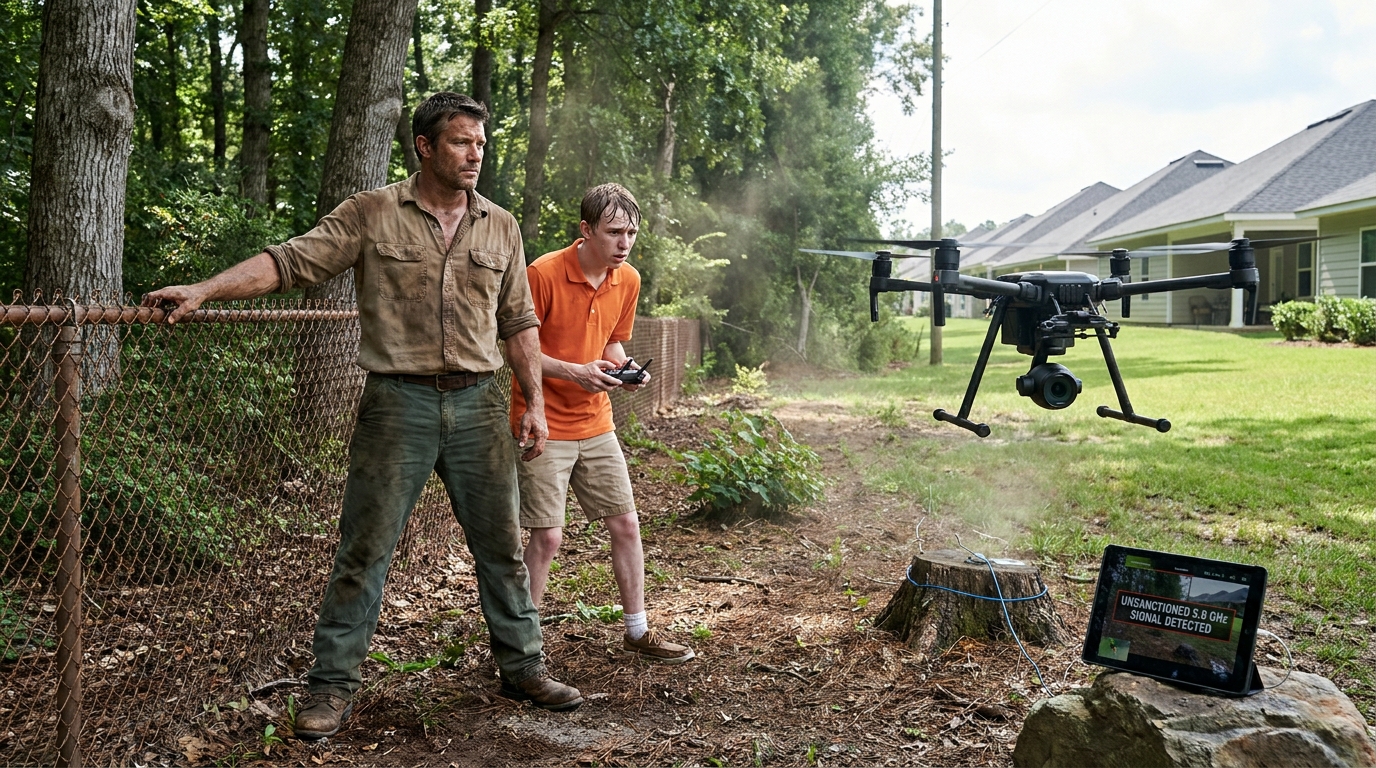
It wasn’t a store-bought toy; the carbon-fiber frame had heavy-lift rotors and a high-frequency transmitter strapped to its underbelly.
I pulled my phone from my canvas jacket and flipped on the local frequency scanner app I used for tracking wildlife tags.
A unsanctioned 5.8 gigahertz signal spiked red on the display, broadcasting a live video feed to a receiving dock less than three hundred yards away.
I didn’t reach for a rock or wave my arms. I stood dead still, letting the camera record my boots planted firmly on my own soil.
Thirty seconds later, the rotors whined as the drone banked hard toward the east, clipping a pine branch before smoothing out over the manicured roofs of Maple Ridge.
I followed the signal line on foot, cutting through the dense brush until I reached the rusted chain-link fence that separated my timber from their paved cul-de-sac.
On the other side of the wire, sitting on a lawn chair next to an open trunk, sat a young guy in an HOA polo shirt, holding a military-grade controller with an iPad mounted to the top.
“That’s a five-thousand-dollar fine for FAA airspace violations over private property,” I said, my hand resting flat against the top rail of the chain-link.
The kid jumped, his thumbs slipping off the joysticks as the drone shuddered in mid-air above his driveway.
“Mr. Sloan,” he stammered, his fingers frantically tapping the screen to cut the recording. “I’m… I’m just doing site mapping for the board. Mrs. Strange authorized the flight path.”
“Alice Strange doesn’t hold an FAA commercial pilot license,” I said, pointing down at the serial number printed on the drone’s belly as it hovered into its landing rig. “And she didn’t file a flight plan over three hundred acres of private forest.”
“It’s just perimeter documentation,” he muttered, unhooking the tablet with hands that wouldn’t stay still. “She said you were obstructing municipal access.”
“Tell Alice to check her mail on Monday,” I said. “Every frame that camera captured on my side of the wire is going straight to my attorney and the county sheriff.”
He swallowed hard, packing the controller into a hard-shell plastic case without making eye contact again.
I turned back into the shade of the oaks, but as I walked, my foot caught on a fresh piece of heavy gauge blue wire wrapped tightly around a low stump.
It wasn’t a standard land survey tag. It was the kind of industrial binding wire contractors use to lock down heavy equipment before a clear-cut.
CHAPTER 4: MAPS DRAWN IN RED INK
The wire was high-tensile steel, the exact grade heavy timber crews use to bind logs before haul-off.
I stood up, wiping damp red clay onto my canvas pants, and pulled the laminated HOA work order from my coat pocket.
Ten minutes later, I was leaning over the hood of my investigator Ben’s truck, watching the rain smudge the dust on his windshield.
Ben unrolled a wide blueprint across the metal hood, pinning the corners down with a pair of brass tire gauges.
“They didn’t just alter the county plat, Aiden,” Ben said, his pointer finger tapping a shaded orange sector along the eastern ridge. “Alice filed a preliminary grading bond with Apex Heavy Civil three weeks ago.”
I squinted at the fine print printed along the margin—Phase 4 Transit Expansion: Approved for Clearing.
“Apex won’t touch unverified land without an indemnity release,” I said, my voice cutting through the steady drip of rain off the pine branches.
“They think it is verified,” Ben said, sliding a second document out of a yellow folder. “Alice presented an affidavit claiming your grandfather signed an option agreement back in 1988.”
I let out a dry, quiet laugh that didn’t reach my eyes.
“My grandfather spent 1988 filing injunctions against the county to keep asphalt off this ridge,” I said. “He’d have burned his own house down before signing a deed over to an HOA board.”
Ben tapped the signature line at the bottom of the release form, where a stiff, shaky scrawl sat next to a red notary seal.
“The notary stamp belongs to the Maple Ridge office secretary,” Ben said, adjusting his coat against the damp wind. “She stamped it four days ago. Alice didn’t just bend the rules—she pledged $400,000 of the HOA’s resident contingency fund to back Apex’s bond if the project got delayed.”
I took the paper, holding the damp corner between two fingers, feeling the full weight of what she’d set in motion.
She hadn’t just bullied a neighbor; she’d gambled her entire suburban community’s treasury on the bet that an old hermit wouldn’t hire a lawyer.
“Call Apex’s legal rep,” I said, handing the paper back to Ben. “Tell them if a single bulldozer tracks mud onto my property line tomorrow morning, they’ll be named as co-defendants in an institutional fraud suit before the ink on their work orders dries.”
Ben picked up his cell phone, his thumb already scrolling through his contacts as he nodded once.
Down at the gate, the low hum of a heavy diesel engine shook the fog, its yellow hazard lights flashing through the white oaks.
CHAPTER 5: THE GAVEL DROPS ON MAPLE RIDGE
The courtroom air smelled of old varnish, wet wool blazers, and floor wax that hadn’t seen fresh polish since the seventies.
I adjusted the collar of my only suit jacket, feeling the rough wool rub against my neck as Ben laid out four thick manila folders across the defense table.
Alice Strange sat across the wooden aisle, her posture rigid as an iron rail, flanked by two corporate attorneys in dark pinstripes and three nervous HOA board members.
Her head attorney cleared his throat, holding up a sleek tablet toward the judge’s bench.
“Your Honor, this is simply a administrative disagreement over municipal access boundaries,” he said, his voice smooth as glass. “The Maple Ridge Association acted in good faith to secure a vital transport corridor.”
“Good faith doesn’t usually require a notary stamp from four days ago on a thirty-eight-year-old release form,” Ben said, stepping forward with a stack of certified county land deeds.
He placed two oversized foam-core boards on the easel in front of the bench.
The left board showed the original 1941 county survey map with my grandfather’s thick red property boundary highlighted in yellow.
The right board showed the doctorred HOA Phase 4 map, where my three hundred acres of old-growth oak had been shaded in light orange and labeled as public easement.
The judge pulled his reading glasses down his nose, leaning forward until his robe stretched tight over his shoulders.
“Mr. Sloan’s private investigator traced the digital signatures on these Phase 4 overlays directly to the HOA president’s personal computer,” Ben continued, setting a sheaf of subpoenaed email records on the bench. “And we have written confirmation from Apex Heavy Civil that four hundred thousand dollars in resident contingency funds were secretly pledged to back this illegal clear-cut.”
Alice’s hands tightened on the edge of her table, her designer pen snapping loud enough to echo off the wood paneling.
“It’s not forgery!” Alice snapped, her voice breaking the tight, polished mask for the first time as she stood up without her lawyer’s cue. “It’s clarification! A biological survey tract has no business blocking three hundred families from highway access! You should be part of our association!”
“Sit down, Mrs. Strange,” the judge said, his voice dropping an octave into pure ice.
She froze, her chest heaving slightly under her tailored suit jacket, before sinking slowly back into her leather chair.
The courtroom went dead quiet, save for the hum of the overhead fluorescent lights.
The judge didn’t even look at her attorney; he flipped through the forensic audit pages Ben provided, his pen making sharp, aggressive checkmarks down the margin.
“The court finds in favor of the plaintiff on all counts,” the judge said, the wooden gavel coming down with a single, sharp crack against the block. “The Phase 4 corridor maps are declared fraudulent and legally void. I am levying $412,000 in direct damages against the Maple Ridge HOA, and forwarding this file directly to the district attorney for criminal fraud review.”
Alice sat paralyzed, her eyes locked on the empty easel, while her two attorneys began hastily packing their leather briefcases without saying a word to her.
CHAPTER 6: THE FENCE LINE AT DUSK
The six-foot cedar posts stood straight and true along the boundary line, anchored three feet down in solid clay and packed gravel.
Every twenty yards, a crisp metal sign glinted in the dying light—Private Property. No Trespassing.
An old man from the Maple Ridge neighborhood walked slowly down the gravel road, stopping just short of the gate.
He didn’t have a clipboard or a suit jacket, just a faded baseball cap and a heavy glass bottle tucked under his arm.
“Mr. Sloan,” he called out, his voice raspy from years of tobacco. He reached over the wire rail and set a bottle of twenty-year single malt on the top post. “You did what the rest of us were too cowed by the board to do.”
“It wasn’t about the board, neighbor,” I said, leaning my back against the porch pillar. “It was about where my fence sits.”
He gave a slow, single nod, touched the brim of his cap, and turned back toward the paved cul-de-sac without another word.
Alice Strange moved out three days after the court ruling; her manicured lawn had already grown an inch past the HOA’s mandatory limit, and nobody came by to write her a citation.
The new board president sent a registered letter offering a formal apology and a waiver for all future boundary reviews, but I didn’t frame it; I filed it in the iron box next to my grandfather’s 1941 deed.
Down in the shaded hollow where the orange survey stakes used to sit, the wild ginger was blooming in small, quiet clusters under the leaf mold.
I took a slow sip of the whiskey, feeling the heat settle deep in my chest as a red-tailed hawk swept low over the canopy, its shadow skimming across three hundred acres of uncut timber.
The house creaked behind me as the evening air cooled, settling firmly into its foundation just like it had for eighty years.
I set the empty glass down on the top stair, picked up my brass soil sampler, and wiped the handle clean with an oiled rag before setting it on the shelf by the door.