The Shadow of the Perimeter: A Dark Resolve on the Texas Borderland
CHAPTER 1: THE SHARP ANGLE
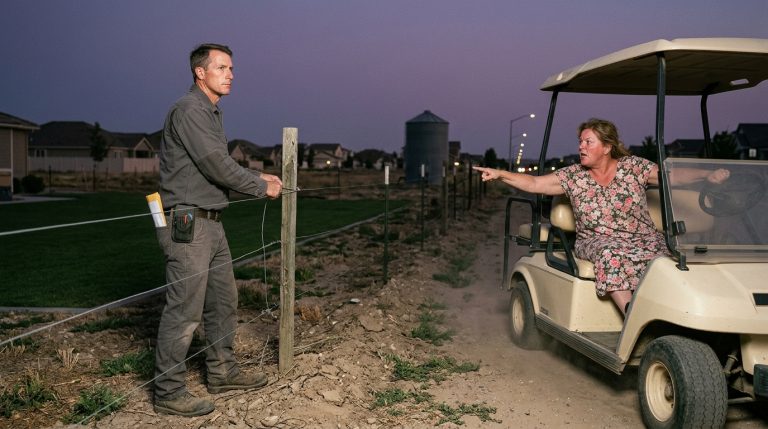
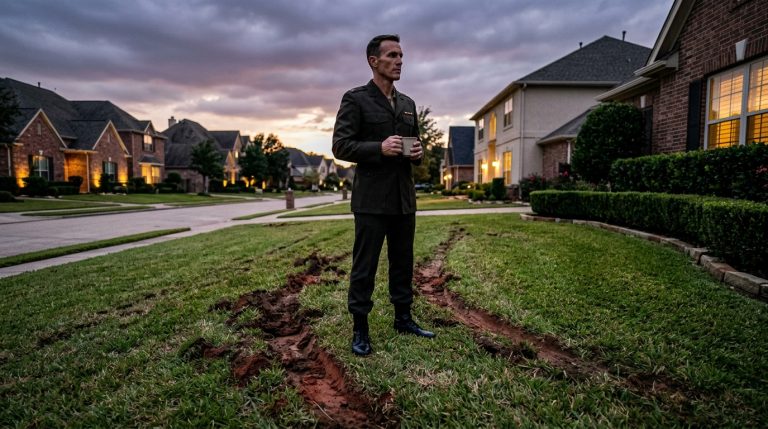
The sun didn’t warm the dust; it baked it until the earth cracked in jagged, geometric lines. I kept my hand flat on the heavy iron fence post, feeling the cold, rigid steel beneath my glove. Shadows from the barb wire stretched across the gravel road like black scalpel incisions.
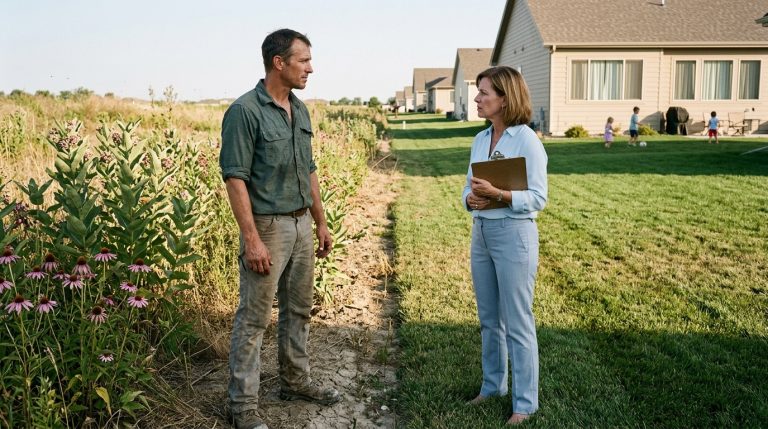
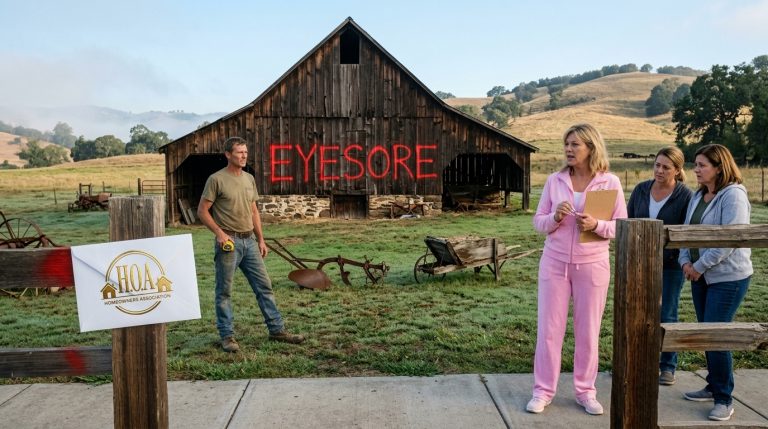
On the other side of the wire stood Karen Miller. Her pastel pink tracksuit was a jarring, angular blot against the gray scrub brush. Her clipboard was clutched in a white-knuckled grip, its metal clip catching the harsh afternoon light and reflecting a blinding sliver into my eyes. Behind her, two board cronies stood like blocky stone sentinels, their arms crossed, their shadows merging into a single, dark weight on the gravel.
“Sign the acknowledgment, Colonel, or we start the lien proceedings before the weekend,” Karen said. Her voice had the thin, grating scrape of a metal trowel on dry concrete. She thrust a stapled document through the gap between the third and fourth wire.
I took the paper. The corners were crisp, the ink fresh, but my eyes didn’t slide to the bold numbers at the bottom. Instead, I analyzed the perimeter of the threat. The total was fifty-two thousand, eight hundred and forty dollars, but the real attack was in the fine print.
“My family’s deed was recorded before this county had a paved road, Karen,” I said, my voice low, dropping an octave into the dry silence. I watched her pupils. They didn’t dilate with anger; they contracted. She was calculating. “You can’t annex a sovereign parcel with a board vote.”
“We can, and we did,” she replied, her silver pen pointing at me like a barrel. “The board voted to absorb the adjacent green space to manage community standards. Your barn is an unapproved agricultural structure. Your truck is a commercial eyesore. If you don’t pay, the county will execute the lien.”
She didn’t wait for my response. She turned with a sharp, mechanical pivot, her sneakers kicking up tiny, jagged chips of limestone as she marched back toward the cookie-cutter roofs of Whispering Pines. Her cronies fell in behind her, their movement synchronous, practiced.
I didn’t watch them go. I looked down at the base of the fence post.
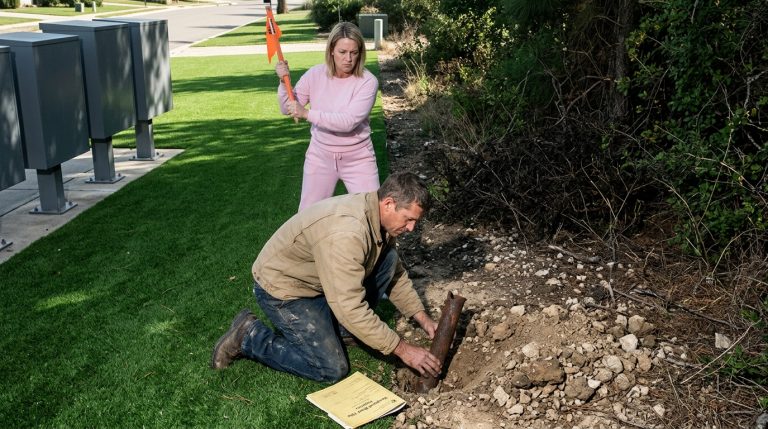
Five feet inside my property line, hidden beneath the sharp, dark shadow of a wild mesquite branch, the earth had been disturbed. A narrow, perfectly square hole had been punched into the hard Texas clay. Tied to a root just inside the hole was a strip of plastic surveyor’s ribbon. It wasn’t the standard orange of a municipal crew. It was a deep, synthetic blue.
I knelt, the dry earth scraping against the knees of my stiff denim jeans. I cleared the loose dirt away, expecting to find a standard brass county marker.
My fingers brushed cold, machined brass. I pulled my flashlight from my pocket, casting a hard, narrow beam into the hole. Stamped into the metal cap of the survey pin was a serial number: 74-EN-902.
My chest tightened. That wasn’t a commercial surveyor’s license number. It was a military identification code. Specifically, it was the decommissioned unit stamp of the 74th Engineer Battalion—my old unit. Only three men alive still possessed the heavy steel die used to strike that specific sequence, and the man who had kept it after our final tour in Kandahar had been buried in Arlington six years ago.
CHAPTER 2: THE COLD ARCHIVE
The brass cap was freezing against the pads of my fingers, despite the dry Texas heat radiating from the clay. The stamped letters—74-EN-902—did not belong in this dirt. They belonged to a motor pool in the Sunni Triangle, to reinforced concrete bastions, to men who knew how to calculate blast radiuses. Seeing them here, pressed into the lime-rich earth of my family’s property, turned the threat from a petty bureaucratic land grab into something far more clinical.
I stood slowly, the joints in my knees popping with a sound like dry twigs snapping. My gaze swept the horizon, tracking the silver-gray ribbon of the highway a half-mile off, then the sharp, uniform rooflines of Whispering Pines Estates. Whoever had driven that pin knew exactly what they were doing. They weren’t just measuring; they were surveying with military precision. And they had used my old unit’s stamp to do it. A warning, or a signature.
I climbed into the cab of the F-250. The ignition caught with a heavy, mechanical roar, the vibration humming through the steering column and into my palms. I didn’t head down the driveway toward the house. I shifted into gear and pointed the truck’s nose toward the county seat. If Karen Miller was redrawing the world on paper, then the county courthouse was the only trench that mattered.
The drive into town was twenty miles of two-lane blacktop, the telephone poles flickering past like fence slats. The air in the cab was thick with the smell of old vinyl and the faint, bitter tang of lukewarm black coffee. I kept my speed locked at exactly fifty-five, my eyes scanning the mirrors. The road was empty, save for a white commercial flatbed truck that trailed three hundred yards behind me for five miles before turning off near an unmarked gravel road. On its side panel, barely legible through a coat of dry gray road-dust, was a faded blue emblem: a stylized mountain peak above the words Vanguard.
I pulled into the gravel lot of the county courthouse, a massive, blocky limestone structure built in the late nineteenth century to withstand Comanche raids and summer droughts. Its thick walls held the cold of the morning, casting a heavy, gray shadow across the entrance steps.
I walked through the double oak doors, the heels of my boots striking the worn stone floor with a sharp, echoing rhythm. The air inside was different—cooler, smelling of floor wax, ammonia, and the distinct, dusty scent of slowly decaying paper. I didn’t need to look at the directory. I knew the way to the records room.
Behind the long, laminated counter sat Brenda. Her silver hair was piled high in its usual gravity-defying beehive, a sharp contrast to the dark, functional steel of the filing cabinets lining the wall behind her. She didn’t look up when the bell above the door chimed, her fingers clicking rhythmically across a mechanical keyboard that had outlived three administrations.
“Morning, Brenda,” I said, placing my gloved hands on the cold laminate.
She paused her typing. Her eyes, sharp and watery behind thick bifocals, slid up to meet mine. The unreadable mask she wore for the public softened slightly, the corners of her mouth twitching upward in a silent greeting.
“Jack,” she said, her voice a dry rasp from forty years of inhaling paper dust. “You look like you’re on a march. What did Karen do now?”
“She tried to hand me a fifty-two-thousand-dollar bill over the wire,” I said. “Says they annexed the southern parcel. My grandfather’s land.”
Brenda let out a short, dry wheeze that might have been a laugh. “That woman wouldn’t know a true legal boundary if it was painted on her living room wall. Hold on.”
She stood, her joints mimicking the dry pop of my own, and disappeared into the back stacks. The shadows in the room were long and cold, cast by the tall, narrow windows that looked out toward the square. I waited, my hand resting on the counter, feeling the heavy, quiet weight of a century of recorded history waiting in the dark behind her.
CHAPTER 3: THE FORGED SEGMENT
Brenda’s soft rubber soles squeaked on the linoleum as she turned toward the heavy iron-reinforced fire door at the back of the room. The door shut behind her with a deep, pressurized hiss, leaving me alone in the cold fluorescent hum of the main office. I stood with my fingers lightly touching the laminate counter, feeling the hard, synthetic edge pressing into my skin. Outside, a crow called from the high stone ledge of the courthouse window, a sharp, metallic sound that seemed to slice through the heavy quiet.
My training didn’t let me stand idle. I watched the dust motes drift through the narrow beams of afternoon light cutting across the room. Everything in this building was designed to be absolute, locked in ink and bound in leather. But paper is only as honest as the hand that slides it into the sleeve.
When the fire door hissed open again, Brenda was carrying a massive, canvas-bound ledger that looked like it had been dragged through a coal mine. She dropped it on the laminate counter between us. A small puff of dry cellulose dust exploded from the seams, settling in the fine lines of her knuckles.
“The original 2005 plat for Whispering Pines,” she murmured, her throat clicking as she swallowed. She didn’t use a mouse; she pointed with a yellowed fingernail at the large, hand-drawn map. “Look at the black ink boundary on the southern edge. That’s your line, Colonel. It’s a triple-weight line, meaning it’s a closed-loop boundary. No shared easements, no municipal overrides.”
“And the amendment they claim was passed?” I asked, my voice barely more than a breath against the cold glass of her counter display.
She didn’t speak. Instead, she pulled a thin, plastic-sleeved document from a yellow folder tucked under her arm. The paper looked too white, too smooth, like it had been run through a modern laser printer on cheap stock.
“Filed six months ago,” Brenda said, her voice dropping into a lower register that forced me to lean in. “A voluntary replat amendment for Section D. Look at the signature block.”
I leaned over the counter, the fabric of my stiff canvas jacket brushing the edge. Stamped at the bottom in thick, black ink was a surveyor’s seal. But the circle wasn’t quite perfect; the outer ring had a tiny, jagged flat spot near the top, like a rubber stamp that had been pressed too hard on a soft desk. Below it, the signature in the notary box was written in a tight, aggressive cursive: Karen Miller.
“She notarized her own board’s petition,” I said, the words tasting like copper in my mouth.
“She did,” Brenda whispered, her gaze shifting toward the frosted glass of the front doors. “And she used a rubber stamp for the county surveyor’s verification. The real surveyor, old man Vance, retired to El Paso three years ago. His physical seal is sitting in a locked drawer in the basement of the municipal building. Someone copied his stamp from an old filing.”
I reached out, my fingers tracing the cold, smooth plastic sleeve of the fraudulent document. My eyes caught a tiny, pale blue stamp in the extreme upper corner of the page, half-obscured by the filing receipt. It read: Vanguard Land Holdings – Internal Review Block.
My breath caught. It was the same name I’d seen on the dusty white flatbed truck on the highway. I didn’t mention it. I let my finger linger on the signature, feeling the hard, raised ridge of the cheap notary seal through the plastic.
“I need certified copies of both, Brenda,” I said, my voice hardening. “The 2005 master, and this piece of fiction. Every page.”
She looked at me for a long beat, her bifocals catching the glare of the ceiling lights so her eyes disappeared behind two blank white disks. “You know what happens if you pull these files into a public record dispute, Jack? Karen’s brother-in-law, Gary, is on the county infrastructure board. If they find out I let you copy an unverified amendment before the quarterly audit, they’ll have my pension before the frost hits.”
“They won’t know it came from you,” I said, my grip tightening on the edge of the counter until the wood groaned. “But we’re not just dealing with an HOA that wants its grass cut. They’ve got a survey pin with a military unit stamp in my dirt. This isn’t a zoning issue. It’s a breach.”
Brenda didn’t answer. She turned her back to the counter, her shoulders rigid under her knit cardigan, and began feeding the heavy sheets into the high-speed scanner. The machine whined, a sharp, piercing sound that filled the room, swallowing the silence.
CHAPTER 4: THE COUNTERBATTERY
The scanner’s green optical bar flickered across the white surface of the forged replat map, casting a momentary, sickly glow over Brenda’s weathered cheeks. She stood with her fingers resting lightly on the plastic output tray, her jaw set tight enough to make the thin muscles in her neck stand out like wire. The scanner finished its high-pitched sweep, and the machine spit the document out with a dry, static hiss.
“There,” Brenda muttered, her gaze remaining fixed on the exit slot as if the paper itself were hot to the touch. “You have your record. Now get those sheets into a folder and get out of my office before someone from the zoning board walks through those front doors.”
“They’re already compiled,” I said, slipping the warm, freshly printed sheets into the manila envelope I had brought.
As I tucked the final sheet away, my eye caught a small, faint smudge on the glass flatbed of the scanner where the original document had rested. It was a sticky gray residue, shaped like a small rectangle. It looked exactly like the adhesive footprint left behind when a corporate security tracking chip is peeled off a sensitive file. My thumb lightly brushed the spot; it was still fresh, tacky with synthetic glue. They weren’t just printing these maps in some back office—they were tracking them with inventory tags.
“Appreciate it, Brenda,” I said, sliding the thick folder into my jacket. “Keep your head down.”
She didn’t answer. She only tapped her keyboard, bringing up a blank template to mask the transaction log.
I turned and walked out of the records office, the heels of my boots matching the steady, measured pace of a patrol. The limestone corridor outside was quiet, but as I reached the heavy glass doors of the building’s main exit, the glare of the street-level windows hit me. A dark sedan was parked at the curb, its engine idling with a low, throating vibration that rattled the old pane. The driver’s side window was rolled down halfway, showing only a hand resting on the frame, fingers tapping a slow rhythm against the dark paint.
I didn’t stop. I walked past the vehicle, my boots crunching on the loose gravel of the courthouse parking lot until I reached the driver’s side of my F-250. I opened the door, climbed inside, and placed the folder flat on the passenger seat next to my heavy three-ring binder.
I sat there for two minutes, letting the heat of the cab build. I didn’t turn the key. I pulled a mechanical pencil from my pocket, opened the binder to the section labeled Legal Records, and began cataloging the details of the scan. I noted the timestamp, the forged notary stamp, and the tiny blue Vanguard Land Holdings watermark in the top corner.
My immediate task was to establish the defensive perimeter. Under the law of the state, an HOA could only claim authority if there was a signed, mutual contract or an uncontested public easement. Karen had attempted to bypass this with her sham replat. Therefore, my counter-move had to be equally formal, leaving no room for her to claim ignorance.
I opened my laptop, powered it on via the auxiliary plug on the dashboard, and began drafting the cease-and-desist letter. My fingers moved with the same methodical precision I’d used to write engineering reports for bridge-building operations in hostile territory.
TO: Whispering Pines Estates Homeowners Association Board of Directors.
SUBJECT: Unlawful Claims of Jurisdiction and Harassment.
I cited the original 2005 plat number Brenda had just pulled. I referenced the exact page and volume of the county ledger. I stated, in clear, unambiguous terms, that my 200-acre parcel remained outside their subdivision, and that any further attempts to assess fines, file liens, or enter the property would be met with immediate legal action for civil harassment and slander of title.
I printed the document to my portable thermal printer, signed it in blue ink, and placed it inside a certified mail envelope. I would drop it at the post office counter across the street before leaving town, ensuring the green return receipt would require Karen’s signature.
I closed the binder. The heavy metal rings snapped shut with a sharp, metallic crack that echoed in the small space of the cab. I looked up at my rearview mirror. The dark sedan at the curb was still there, its exhaust a faint plume of gray vapor in the shimmering heat. They were watching, but they were still behind the line. For now.
CHAPTER 5: THE WATCHED FENCE
The sharp, metallic echo of the binder rings snapping shut had barely faded inside the cab before I turned the key. The starter ground once, twice, and then the diesel engine caught, its heavy vibration shuddering up through the floorboards and settling in my chest. In the side mirror, the dark sedan remained parked on the shoulder, its exhaust casting a thin, oily heat shimmer into the air. They were waiting to see if I’d fold. They were waiting to see if I’d turn back toward the courthouse to file an injunction immediately.
Instead, I pulled out of the gravel lot, pointing the truck’s heavy grille toward the ranch.
The twenty-mile drive back along the highway was a lesson in tactical patience. I watched the mirrors. The sedan didn’t tail me close, but a mile down the road, a silver utility truck with an amber light bar on its cab slid into the gap between us, matching my speed precisely. I didn’t accelerate. I didn’t brake. I kept the F-250’s speedometer needle resting on fifty-five, maintaining a rigid, predictable pattern.
When I turned off the asphalt onto the dirt road leading to my property, the utility truck kept going. But as I crossed the cattle guard at my western boundary, the scent of parched earth and dry cedar filled the cab, bringing a brief, quiet familiar focus.
I parked the truck in the deep shadow of the workshop barn. I did not go inside to make coffee. Instead, I grabbed my leather work gloves from the dashboard, walked to the rear bed, and lifted out my heavy post-hole digger and a spool of replacement wire. It was 14:00 hours. This was the time I usually walked the western boundary line to inspect the cedar posts. I needed to keep my routine exact.
I walked the perimeter road on foot, my boots crunching rhythmically in the dry caliche. The midday heat pressed down on my shoulders like a wet woolen blanket, but my eyes stayed active, tracking the fence line.
Fifty yards from the corner of Section D, where the barbed wire met the newly paved asphalt of Whispering Pines Estates, I stopped.
The cedar post at the corner was ancient, dark and weathered to the color of charcoal. But nailed to its side, just below the second strand of wire, was an object that hadn’t been there when I walked the perimeter forty-eight hours ago. It was a small, grey plastic box, no larger than a deck of cards, styled to look like a standard agricultural fence-line junction. But there were no wires running into it.
I leaned closer, the shadow of my hat brim cutting across the gray plastic.
A tiny, pinhead-sized glass lens sat recessed in the bottom corner of the housing, pointed directly at my 100-year-old barn and the workshop entrance. Directly above the lens, stamped into the molded plastic casing, was a faint, raised mark: V-19B.
A hidden surveillance node. Passive, battery-powered, and transmitting over a cellular band.
I didn’t touch it. If I ripped it down, I would confirm that I knew they were watching, giving them a physical baseline of my counter-intelligence. Instead, I knelt, pretending to adjust the tension on the lower barb-wire strand, my leather-gloved fingers brushing the dry grass.
I looked closer at the base of the cedar post. The dirt here had been trampled by a flat-soled boot—not a work boot, but a rubber-soled athletic shoe, the same narrow pattern I had seen Karen’s board cronies wearing at the fence line. Dropped in the dry weeds near the post was a small piece of torn paper, likely discarded during the installation.
I picked it up with my gloved hand and turned it over.
It was a fragment of an internal requisition slip, printed on heavy bond paper. Only two lines of text were visible on the torn edge:
Project: Blue-Line Segment 4
Auth: Vanguard Land Holdings
The name appeared again, like an persistent thread running through the margins of this land grab. They weren’t just checking my barn or counting my cattle. They were tracking the physical movements of my property, mapping the terrain for an advance.
I stood up slowly, keeping my movements deliberate and unhurried. I picked up my tools, slung the spool of wire over my shoulder, and walked back toward the workshop, leaving the camera exactly where it was. If they wanted a show of a quiet, retiring old man, I would give them exactly what they were looking for while I loaded the real ammunition.
Inside the cool, shadowed interior of the workshop, I sat down at my workbench. The air smelled of mineral spirits, dry oak, and grease. I reached under the bench, pulling out a heavy cardboard box containing four high-resolution, motion-activated tactical surveillance cameras I had purchased last winter for tracking deer.
These cameras didn’t use cellular bands; they recorded directly to internal SD cards and ran on independent battery packs. They were invisible to digital sweeps.
I set the first unit on the wood table, its matte-black casing absorbing the dim light. I opened my notebook and drew a simple grid of the western boundary line. If they were watching me through the gray box on the post, then my first tactical response was simple: I would watch the watchers.
CHAPTER 6: THE QUIET COALITION
The matte-black plastic of the deer camera was cool in my hands as I loaded the lithium cells into the tray. Outside the open workshop door, the afternoon light was dying in long, desaturated streaks of yellow across the dry pasture. The cellular surveillance device on the western corner post remained out there, a tiny, synthetic grey eye watching my perimeter. It was transmitting every five minutes, likely to an off-site server managed by Vanguard Land Holdings. I kept my movements in the shadows, far from the range of its lens, letting the heavy, cool dark of the barn protect my preparations.
I needed to move, but not on my own. To dismantle a campaign of this scale, you don’t just return fire; you isolate the enemy from their local supply lines.
I waited until 20:00 hours, when the sun had completely dipped behind the low scrub oaks and the subdivision road had grown quiet. Carrying only a small, heavy nylon pack containing three of my independent cameras, I slipped out of the workshop. I didn’t use the truck. The rumbling of the diesel engine would have triggered the passive audio on their post. Instead, I walked the dry creek bed along my southern border, my boots finding the soft, damp sand where the limestone had washed away.
I reached the tree-line bordering the edge of the Whispering Pines subdivision. The houses here sat in a neat, clinical row, their large double-pane windows spilling warm, artificial light onto manicured lawns that smelled of synthetic fertilizer.
I saw David first. He was standing in his driveway, his posture rigid under the glare of his motion-activated floodlight, holding a rag and a can of solvent. He was trying to scrub a dark grease mark off his white concrete driveway.
I stepped out from the deep shadow of an old pecan tree. He jumped, his shoulders tensing, the rag freezing in his hand.
“Colonel,” he whispered, his eyes scanning the empty street behind me before settling on my face. “You shouldn’t be over here. Karen’s compliance truck was circling the block ten minutes ago. They’re taking pictures of everything.”
“They’re not just taking pictures, David,” I said, my voice dropping into a low, transactional rasp. I stepped into the dim edge of his garage’s light. “They’ve mounted cellular transmitters along my fence line. Disguised as junction boxes. They’re tracking my property, and they’re tracking yours.”
David’s wife, Emily, appeared in the doorway of the garage, a shadow against the bright interior light. She was holding a stack of laminated papers—more violation letters from Pristine Properties Management. Her face was pale, the lines around her mouth tight with exhaustion.
“They fined us again today,” she said, her voice shaking slightly as she walked toward us. “For leaving the garage door open more than fifteen minutes during our move-in. It’s a thousand dollars. Jack, we can’t keep paying this. People are talking about leaving, selling their homes at a loss.”
“That’s exactly what they want,” I said. I unzipped my nylon pack and pulled out one of the small, matte-black deer cameras, placing it on the workbench near David’s elbow. “This is an independent optical sensor. No wireless signal. It runs on a local loop. I’m mounting three of these along the common boundaries tonight. But I need something from you first.”
David looked at the camera, then up at me, his jaw tightening. “What?”
“I need your logs,” I said. “And the logs of every resident you’ve spoken to. Every violation, every check written to Pristine Properties, every certified letter Karen signed. If we’re going to fight this, we don’t argue about property lines. We show the pattern of systemic extortion. We show where the money is going.”
Emily reached into her pocket and pulled out a small, worn flash drive, its metallic casing glinting in the light. “I started collecting them. Six of our neighbors sent me their digital scans yesterday. Mrs. Gable, the Petersons, the family with the basketball hoop. It’s all on here.”
I took the drive, the cold aluminum surface solid between my fingers. “This is our baseline,” I said. “Keep your garage doors shut. Keep your lawns cut to their standard. Give them absolutely no pretext to write another ticket while we build the file. Let them think they’re winning.”
“And if they find your cameras?” David asked, his hand lingering near the edge of the workbench.
“They won’t,” I said, stepping back into the shadow of the pecan tree. “I don’t map my lines where amateurs can find them.”
I slipped back into the dry creek bed, the cold flash drive heavy in my shirt pocket. The first elements of the coalition were in place. The network was beginning to form, but as I walked back toward my house, the low, distant hum of a large, multi-cylinder engine echoed from the county road, its heavy vibration vibrating through the limestone beneath my feet. A commercial drilling rig, unmarked and silent, was moving slowly in the dark, heading toward the western boundary of Section D.
CHAPTER 7: THE TACTICAL LITIGATOR
The vibrations from the heavy diesel engines of the distant drilling rig travel up through the limestone ledge, humming against the soles of my work boots long after I leave David and Emily behind. I keep to the sandy bottom of the dry creek bed, moving through the deep shadows of the overhanging live oaks until the safety of my own fence line closes around me. The cold aluminum casing of the flash drive sits secure inside my chest pocket, pressed tight against my ribs.
I did not sleep. By 04:00 hours, I had already transferred the digitized records from the residents of Whispering Pines onto my secure, offline drive, compiling their individual extortion letters alongside the fraudulent plat maps Brenda had retrieved for me.
Now, at 09:30 hours, I sit in the office of Arthur Davies. His workspace is located on the second floor of a restored historical building on the town square, a room dominated by towering cedar bookshelves and the distinct, vinegar-sharp scent of old leather-bound legal statutes.
Davies himself sits behind a massive desk of dark, hand-scraped oak. He is a man who moves with deliberate, low-energy efficiency, his white sleeves rolled up twice to reveal thick, hair-dusted forearms. He does not wear the standard silk tie of a city litigator; his collar is open, but his eyes are two cold, polished stones behind thin metal-rimmed spectacles.
“You didn’t just bring me a boundary dispute, Jack,” Davies says, his voice a low, gravelly rasp as he taps the edge of the printed spreadsheet I’ve laid before him. “This spreadsheet shows a systematic, tier-structured collection scheme. Pristine Properties is billing these homeowners for arbitrary code violations, then transferring those exact sums into an account designated as administrative overhead.”
“I traced the business filings,” I say, my forearm resting flat on the cool armrest of the leather chair. “Pristine Properties is registered under Gary Miller. Karen’s brother-in-law. Every signature on the authorization line of these corporate disbursements belongs to Karen.”
“Self-dealing,” Davies says, a small, grim twitch appearing at the corner of his mouth. “A textbook conflict of interest under the Texas Property Code. But they aren’t doing this just to line their pockets with mailbox fines, Jack. Look at the timing of the annexations. They started filing these sham amendments right around the time the state water development board mapped the regional recharge zones.”
Before I can answer, a low, rhythmic rattle vibrates through the window panes of Davies’s office. I stand, my posture automatic, and look down at the street below.
A heavy, triple-axle commercial flatbed truck is crawling past the courthouse square, hauling a load of steel well-casing pipes wrapped in black protective plastic. On the side of the cab, the stylized mountain logo of Vanguard Land Holdings catches the glare of the morning sun.
“They’re moving equipment,” I say, my eyes tracking the vehicle as it turns south toward my western perimeter. “They had a drilling rig on the county road last night. Unmarked.”
“They’re looking for water, Jack,” Davies says, standing up to join me at the glass. He points a blunt finger toward the south. “Specifically, they’re looking for the Edwards Aquifer Blue-Line. The geological map of the subterranean flow. Your 200 acres sit directly on top of the primary fracture zone where the pressure is highest. If they can annex Section D, they secure the easement to drill the high-capacity municipal supply wells. Pristine Properties is just the local hammer they’re using to clear the field.”
My fingers tighten against the cold wooden frame of the window sill. “They’ve already mounted surveillance on my western line. A passive camera disguised as an electrical junction box.”
“Don’t touch it,” Davies warns, his tone dropping into a hard, strategic command. “If they know we’ve spotted their line of sight, they’ll pull back and restructure the shell companies. We need them to believe their local front is completely secure. I’m drafting a final, certified warning to Karen’s board today. It will focus strictly on the Pristine Properties kickbacks. We bait the hook with the decoy financial fraud, let them scramble to cover their tracks, and make them think we’re only looking at the money.”
“And while they’re scrambling?” I ask.
“We load the real artillery,” Davies says, his eyes narrowing as he looks down at the flatbed truck disappearing around the corner. “I’ll petition the district court for an expedited order to produce the original ledger books. Once Gary Miller has to explain his corporate overhead under oath, the entire structure falls.”
I look down at the manila folder on his desk, the edges of the white paper looking like razor blades in the harsh, unfiltered light of the window. The trap is set, but the weight of the steel pipes on that flatbed tells me the enemy has already calculated the cost of the first breach.
CHAPTER 8: THE COMMISSION SPECTRUM
The dark oak wood under my hands was solid, its dense grain cold beneath my fingers as the rumbling of the flatbed truck slowly faded into the street noise below. Arthur Davies did not watch the vehicle disappear. He stood with his hands deep in his pockets, his gaze dropping to the thick stack of papers resting in the center of his desk.
“The petition is signed, Jack,” Davies said, his voice flat, dropping into a tone that signaled the end of the strategic planning phase. “We’re scheduled for the ten-minute public comment window at the county commission tonight. It’s on the docket under code administration. If Karen or her brother-in-law Gary has any tracking on my office filings, they think we’re just complaining about a fence line. They don’t know the full financial audit is sitting in your binder.”
“They’ll know the second I turn on the screen,” I replied, my fingers sliding the thick manila folder into my canvas pack.
“Then we make sure the first strike hits before they can raise a defense,” Davies said. He reached for his coat, the fabric scraping softly in the quiet room. “I’ll meet you at the courthouse chambers at 18:00 hours. Keep the truck out of the main street lot. Use the lower deck.”
I left his office, my boots keeping a steady, measured pace as I descended the wooden stairs. The air outside was turning into a heavy, violet haze, the July heat still radiating from the limestone courthouse walls.
I drove the F-250 down to the basement parking deck beneath the municipal annex, bypassing the brightly lit main lot. The underground bay was cold, smelling of damp concrete and old exhaust. I parked the truck in a far corner, backed against a concrete pillar that blocked the rear view of my bed.
Before I shut off the ignition, I checked the mirrors. A dark SUV had pulled into the entrance ramp, its headlights dimmed to parking lights. The vehicle was completely unmarked, but on the lower corner of the driver’s side windshield, a small, reflective blue decal caught the yellow glare of the overhead sodium lights. It was a serial sticker with a blocky registration: VLH-09-E.
Vanguard. They weren’t just monitoring the fence line; they were marking the perimeters of my movement.
I ignored the vehicle, climbed out of the cab, and slung my pack over my shoulder. I walked up the concrete stairs to the second-floor commissioner chambers.
The room was already half-full when I entered. The air inside was thick with the scent of wet umbrellas, cheap carpet, and old floor polish. On the left side of the room sat David and Emily, their faces pale under the buzzing fluorescent lights. Behind them sat five other residents of Whispering Pines, their shoulders tensed, their hands clenching folders of their own.
And on the right, sitting at the mahogany table reserved for community presentations, was Karen Miller.
She wore a dark, tailored blazer that looked stiff and uncomfortable, her clipboard resting on the table like a shield. Beside her sat her brother-in-law Gary, his heavy jaw resting in his palm, his eyes darting toward the public gallery. He was wearing a gold-plated watch that caught the ceiling glare every time he shifted his sleeve.
“This meeting of the county commission is now in session,” Judge Harris announced from the high bench, his voice muffled by the old microphone system. He tapped his wooden gavel once against the oak block, a sharp, flat sound that cut through the low murmur of the room. “We have a request for public comment from Jack Miller, Colonel, retired, regarding municipal platting on the southern boundary of Section D.”
I stood up, the straps of my pack tightening against my chest, and walked toward the podium. I didn’t look at Karen. I looked at the five commissioners sitting behind the bench, their faces lined with the boredom of a long legislative afternoon.
“Thank you, Judge Harris,” I said, my voice echoing off the limestone panels of the wall behind me. “I am here to present physical evidence of systematic fraud and self-dealing within the boundaries of our county.”
Karen half-stood, her chair legs scraping sharply against the tile floor. “Judge, this is a private neighborhood matter. Mr. Miller is not a resident of our development and has no standing to speak before this body.”
“The documents I am about to present are public filings, Mrs. Miller,” Judge Harris said, his eyes dropping to the sheet before him. “The colonel has the floor. Sit down.”
I opened my folder and laid the first document on the digital projector flatbed.
The massive screen behind the bench flickered, displaying a high-resolution scan of the original 2005 master plat Brenda had pulled. The thick, dark boundary line separating my 200 acres from the subdivision was displayed in stark black and white.
“This is the established boundary,” I said, my voice carrying the steady, rhythmic pace of a tactical briefing. “Now, look at the amendment filed six months ago.”
I slid the second sheet onto the glass. The thin, altered loop of Section D appeared, showing my land completely absorbed.
“This amendment was filed with a forged surveyor’s seal and was notarized by Karen Miller herself, a direct beneficiary of the annexation,” I said, pointing to the jagged flat spot on the rubber-stamp seal.
The room went completely silent. The only sound was the low, steady hum of the projector’s cooling fan. Gary Miller shifted his weight, his sleeve sliding back to reveal his watch again, his fingers tapping a fast, nervous rhythm against the mahogany table.
“But this isn’t just a boundary dispute,” I continued, sliding the spreadsheet Emily had compiled onto the glass. “This is the financial ledger of Pristine Properties Management LLC. Over the last five years, this company has assessed over three hundred thousand dollars in arbitrary code fines against the residents of Whispering Pines. And every check issued by this entity was signed by Karen Miller, transferring those funds directly to accounts owned by her brother-in-law Gary.”
“This is slander!” Karen shouted, her face blotching red under the white lights, her pen clattering against the table as she stood. “These are standard management fees!”
“The county records show no such business license for Pristine Properties under municipal zoning,” I said, my eyes locking onto Gary’s pale face. “These are unregistered corporate transfers. And the survey pins driven into my dirt were stamped with military codes belonging to a decommissioned engineer battalion. Someone is trying to force an easement, and they’re using this HOA as a shield.”
Judge Harris leaned forward, his hands flat on his desk, his brow furrowed as he stared at the financial flow chart on the screen. “Colonel, where did you get these corporate records?”
“They were produced under a direct order from the district court, Judge,” Arthur Davies said, stepping forward from the public gallery and placing a certified legal packet on the clerk’s desk. “And we are formally requesting this commission to invalidate the sham plat amendment immediately and refer these financial logs to the state attorney general’s office.”
Karen’s shoulders slumped slightly, her fingers clenching the edge of her clipboard so hard the plastic began to bend. Gary did not look at her. He was staring at the floor, his jaw tight, his breathing shallow and rapid.
“The commission will take this evidence under immediate review,” Judge Harris said, his voice dropping into a hard, cold register. He looked down at Karen, his expression unreadable. “Mrs. Miller, you and your board have exactly forty-eight hours to produce the original physical ledgers to the county clerk’s office. This session is recessed.”
The gavel came down with a heavy, final thud. The room erupted into a wave of whispers, but I didn’t stay to listen. I packed my folder into my bag, turned my back on Karen’s stunned silence, and headed toward the exit. The first line of their defense had collapsed, but as I reached the doors, I knew the real fight would not be fought in this chamber. It would be fought on the dirt road leading to my well-house.
CHAPTER 9: THE ULTIMATE BOUNDARY
The double doors of the municipal annex had barely hissed shut behind me when the distant roar of a heavy flatbed engine traveling down the bypass vibrated through my boots. I did not take the highway. I drove the F-250 along the unimproved utility road running parallel to the dry creek bed, pushing the suspension hard across the deep, jagged ruts of dry caliche. My knuckles were white against the steering wheel. If Gary and Karen were running out of time, they wouldn’t wait for the forty-eight-hour county audit. A cornered beast does not draft motions; it cuts the fence.
When I rounded the final bend of my driveway, the headlights of my truck illuminated a massive, commercial-grade wrecker parked idling directly across the western property line.
Karen Miller stood in the glare of its high-beams, her face pale but her teeth bared in an aggressive grimace. Beside her, Gary was directing the driver of the flatbed as he backed the heavy iron ramp toward my grandfather’s restored 1952 Ford 8N tractor. The tractor sat fifty feet inside my boundary line, its freshly painted gray-and-red chassis catching the cold halogen light.
“Stop right there!” Karen screamed over the mechanical whine of the winch, her fingers digging into her clipboard. “This vehicle is an unapproved industrial nuisance parked on designated green-belt common property! Under section twelve of the corporate bylaws, we are executing an emergency administrative seizure!”
I killed my engine, stepped out of the cab, and let the heavy door slam shut behind me. The sound was like a rifle shot in the quiet pasture. I walked toward them, my strides even, my hands open but low.
“You’re trespassing on private agricultural land, Karen,” I said, my voice dropping into a flat, dangerous register. “The county commission invalidated your sham plat amendment three hours ago. You have no jurisdiction here.”
“The amendment is undergoing secondary administrative review!” Gary snarled, his heavy hand resting on the wrecker’s steel controls. “We have an active, signed contract with Vanguard Land Holdings for a public water utility easement along this exact coordinates block. The corporate authorization is tied to Water Easement File 19-B. This equipment is obstructing the utility corridor. Hook it up!”
The tow truck driver hesitated, his gloved hand hovering over the heavy iron hook.
“If you touch that iron,” I said, looking directly at the driver, “you are acting as an accessory to felony grand larceny and organized corporate fraud. The state attorney general’s office has already been served with the forensic financial logs of Pristine Properties LLC.”
Karen’s face went from pale to a mottled, dusty red. “You think your lawyer can stop this? Vanguard owns the water rights under the Edwards Aquifer Blue-Line. This whole valley is being municipalized. Your little two hundred acres are nothing but an impediment to progress!”
“It’s not an impediment, Karen,” I said, my eyes tracking the shadow of a vehicle moving fast down the county road. “It’s the boundary.”
Two blue-and-gold sheriff’s department cruisers cleared the rise, their high-intensity strobes painting the dry cedar branches in rapid, rhythmic flashes of crimson and blue. They slid to a halt on the gravel shoulder, dust billowing from their tires and settling over the hood of the wrecker.
Deputy Miller—no relation to Karen—stepped out of the lead vehicle, his hand resting on his utility belt, his eyes scanning the scene with the cold, professional appraisal of a veteran peace officer.
“Shut down the engine on that rig,” the deputy ordered, his voice cutting through the mechanical hum. He looked at Gary, then at Karen, who was holding her clipboard like a weapon. “We received a complaint of an unauthorized vehicle seizure and criminal trespass on the Miller ranch.”
“Deputy, I am the president of the Whispering Pines Homeowners Association!” Karen said, her voice rising an octave as she stepped toward him. “We are clearing an illegal obstruction from a designated utility easement under Water Easement File 19-B!”
“That file was flagged by the district attorney’s office two hours ago, ma’am,” the deputy replied. He reached into his breast pocket and pulled out a thick, white legal packet. “And your easement was declared null and void when the county commissioners struck the fraudulent plat amendment. Gary Miller, Karen Miller—you are hereby served with a temporary restraining order prohibiting you from entering within five hundred feet of this property.”
He handed the papers to Gary, who let his hands drop from the tow controls, his face suddenly empty of color.
“Furthermore,” the deputy continued, his voice dropping into a flat, official drone, “I have a warrant for your arrest on charges of felony document forgery, notary fraud, and systemic civil extortion under the organized crime statutes of this state. Put your hands on the side of the truck.”
The tow truck driver slowly backed his rig away, the steel cable clattering against the flatbed as he shifted into gear and pulled onto the road, leaving Karen and Gary standing alone in the cold glare of the police lights. Gary offered no resistance, his heavy shoulders slumping as the metal cuffs clicked shut around his wrists. Karen stood frozen, her clipboard dropping into the dry dust of my driveway, the paper corners curling in the hot night breeze.
I stood by the front tire of my grandfather’s tractor, my hand resting on the cold, solid iron of the steering column. The metal was cool, holding the memories of a hundred years of hard labor, of roots dug deep into the dry Texas clay. They had tried to redraw the world with cheap paper and corporate lies, but the land didn’t recognize their ink. It only recognized the iron.
CHAPTER 10: THE FORTRESS SECURED
The plastic clipboard lay motionless in the dust, its cheap silver clip reflecting the relentless, alternating pulses of red and blue light. Gary was already inside the rear of the first cruiser, his head bowed, the silhouette of his shoulders blocky and defeated against the wire mesh. But Karen remained on the gravel road. Her chest rose and fell in shallow, violent gasps, her fingers clawing at the air as if she could physically tear the legal documents from Deputy Miller’s hand.
“This is a mistake!” she shrieked, her voice cracking into a thin, desperate register that shattered the quiet of the valley. “You don’t have the authority to halt the utility deployment! Vanguard Land Holdings already has the state-level clearance! The filing under Water Easement File 19-B overrides any county-level zoning!”
She lunged forward, not toward the deputy, but toward the passenger side of her idling sedan, her fingers reaching for a black leather portfolio resting on the dashboard. It was the desperate, visceral lunge of a cornered beast trying to secure her leverage before the door slammed shut.
Deputy Miller caught her forearm, his grip firm and unyielding as he turned her back toward the cruiser. “Step back, ma’am. Do not reach into the vehicle.”
“The documents are already executed!” she screamed, her face twisting as she glared at me over the hood of the patrol car. “You think you won, Jack? Pristine Properties is just the operator! Vanguard needs the access corridor to tap the Edwards Aquifer Blue-Line! Your two hundred acres are the only gap in their deep-well network! They will buy your debt from the bank! They will freeze your assets!”
“They won’t buy anything, Karen,” I said, my voice steady, carrying the weight of an absolute, unshakeable truth. I stepped away from the red fender of the tractor, my boots crunching softly on the dry caliche. “Because Vanguard Land Holdings doesn’t have an active contract anymore. Arthur Davies spent the afternoon filing the county injunction. Once the court recognized that Pristine Properties was a fraudulent shell set up to funnel homeowner dues into Gary’s accounts, the entire easement petition under Water Easement File 19-B was flagged for corporate racketeering.”
The deputy pulled her wrists behind her back, the sharp, metallic ratchets of the handcuffs clicking into place with a cold, final precision.
The core truth of their operation was now laid bare under the flashing strobes. Karen and Gary hadn’t simply been greedy; they had been proxies. Vanguard Land Holdings had designed the entire Whispering Pines development as a surface block to encircle my property. By using Pristine Properties to systematically assess impossible fines, they intended to force the surrounding landowners into foreclosure, allowing Vanguard to claim absolute control over the Edwards Aquifer Blue-Line—the critical subterranean water system that fed three counties. My family’s pasture was the crown jewel of that geological map, and their sham annexation was the weapon designed to seize it.
But they had underestimated the depth of my foundation.
“Watch your head, ma’am,” the deputy said, placing his hand on Karen’s shoulder as he guided her into the rear seat of the second cruiser.
The heavy door slammed shut with a solid, pressurized thud. The tow truck driver had already disappeared around the bend, the low rumble of his diesel engine fading into the dry cedar hills. The two patrol cars slowly turned around, their tires kicking up a fine curtain of gray dust that hung in the headlights before settling back onto the parched grass.
The silence that followed was total. It was the deep, heavy quiet that only comes when the engines are cut and the perimeter is secure.
Three months later, the dust had fully settled.
The state attorney general’s office had acted with relentless, bureaucratic momentum. Pristine Properties LLC was dissolved by court order, its assets frozen and redirected into a restitution fund managed by the county. Karen and Gary’s plea deals had stripped them of their personal properties, their names permanently recorded in the state’s registry of convicted felons. The very bylaws Karen had weaponized were turned against her; under the joint liability clauses of the original HOA charter, the courts held her and Gary personally responsible for the half-million dollars in back taxes and IRS penalties triggered by the audit.
I stood at the western boundary line, the late October wind blowing cool and clean from the north, carrying the sharp scent of cedar and damp earth. The hot, oppressive glare of the summer was gone, replaced by the soft, golden light of autumn.
I knelt by the corner post. The blue plastic surveyor’s ribbon Vanguard’s crew had tied to the live oak branch was gone, replaced by a clean, zinc-coated wire tensioner. I took my fencing pliers from my back pocket, gripped the loose strand of the bottom barb wire, and pulled it taut against the cedar post.
The metal groaned under the tension, the sharp barbs lining up in a perfect, straight angle. I drove a heavy steel staple into the wood, locking the wire in place.
The boundary was restored. The four strands of steel were tight, hummed softly in the wind, a physical barrier that no cheap paper could ever cross.
“Dad,” a voice called from the driveway.
I looked up. Sarah was walking down from the porch, carrying two mugs of hot tea, her boots brushing through the dry, fallen leaves of the pecan trees. She didn’t look worried anymore; the tight lines around her eyes had smoothed out, replaced by a quiet, relaxed warmth.
“Davies just called from town,” she said, handing me a heavy ceramic mug. The warmth of the tea seeped through my leather gloves, a comfortable heat that settled into my palms. “The receiver completed the final transfer. The new HOA board has officially struck every code violation on David and Emily’s property. The subdivision is ours again. Or rather, they’re just neighbors now.”
I took a slow sip of the tea, the bitter, herbal flavor grounding me in the quiet of the afternoon. “They were always just neighbors, Sarah. They just forgot what the wire was for.”
We walked back toward the porch together, our strides synchronous and unhurried. Behind us, the old 1952 Ford tractor sat gleaming inside the weathered barn, its iron red paint clean, its engine silent but ready. The shadow of the live oak trees stretched long and soft across the hayfield, painting the land in deep, peaceful textures of gray and gold.
I sat down on the heavy oak swing my grandfather had built, the chains creaking softly under our weight. The air was clean, the sky a vast, unbroken blue that stretched all the way to the horizon. We had held the line. The legacy was secure, and the frontier was finally quiet.