The Property Line Is Not a Line in the Dirt; It Is a Wall of Certified Iron
CHAPTER 1: THE STAKES ON THE RIDGE
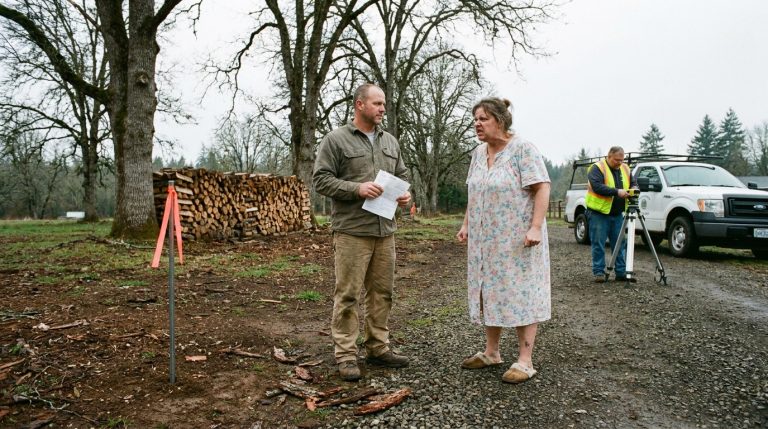
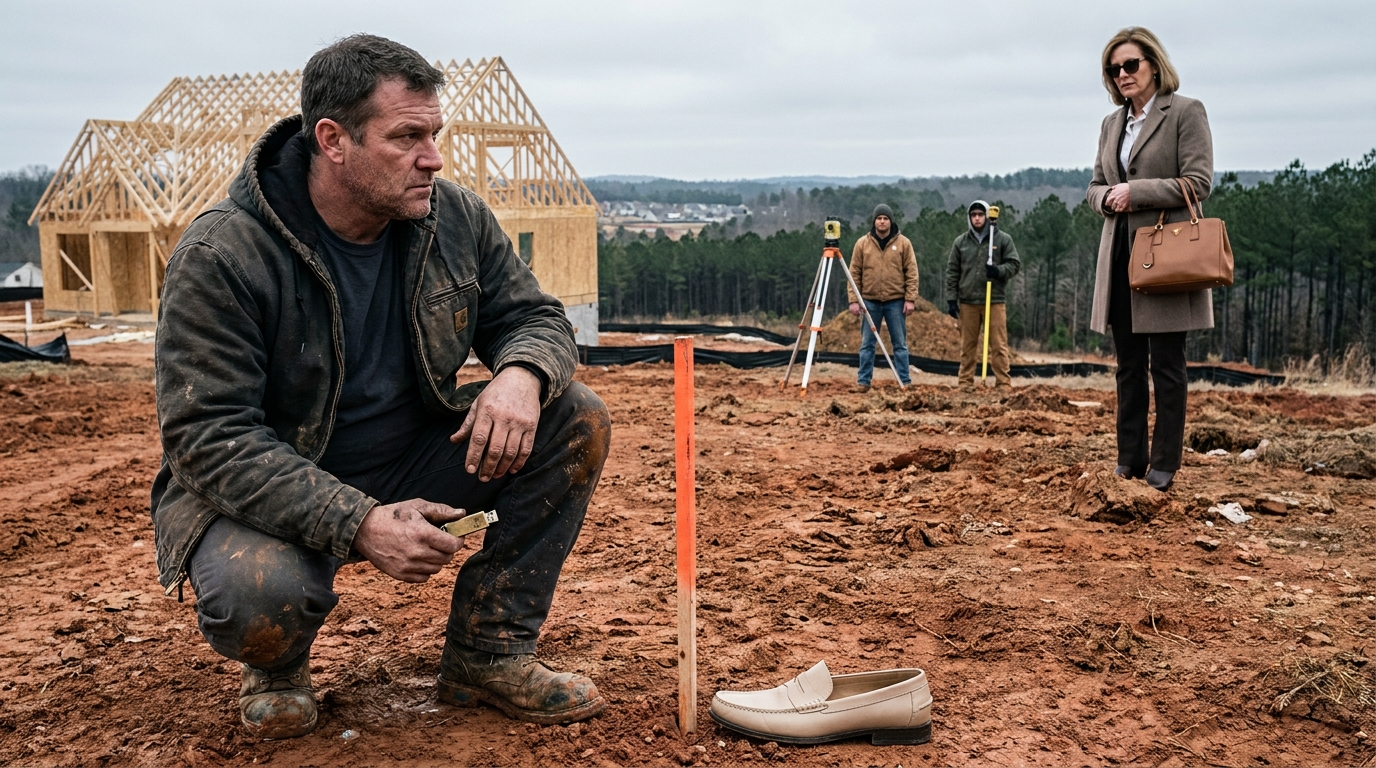
The orange stake was two inches left of the property marker, driven into the red clay with a hammer that left fresh crescent scars on the pine. Frost clung to the cold steel of my framing square. The wind coming up the valley tasted of wet pine and distant diesel.
I didn’t raise my voice. I crouched, pulled a scarred brass thumb-drive from my jacket pocket, and tapped it twice against my knee. The metal was freezing, a solid counterweight to the sudden spike of adrenaline in my throat. Down the slope, a diesel truck idled with a heavy, rhythmic shudder.
Two survey techs stood by their tripods, their posture stiff, eyes darting between the property pin and the woman standing near the truck’s rear fender. Karen didn’t wear muddy boots. Her loafers were pristine, entirely unsuited for the slate and shale of the upper ridge.
“You’re off the line,” I said.
The younger tech dropped his clipboard against his thigh. “We’re staking the view buffer.”
“Whose buffer?”
“HOA scenic committee instruction.”
Karen stepped forward, her sunglasses hiding whatever calculation was running behind her eyes. Her thumb twitched against the strap of her leather handbag—a micro-movement of nervous authority. “You were notified, Mr. Vance. The ridgeline is protected under community bylaws.”
“My parcel is bound by county zoning, not your subdivision newsletter,” I said. My thumb rolled mechanically over the scored casing of the brass drive in my pocket.
“The county honors historical environmental agreements,” she said, her voice smooth, rehearsed. “That framing line ruins the sightline for the entire western slope.”
“The easement ended three hundred feet downhill three decades ago,” I replied. I didn’t look at her face; I watched her hands. When people lie about boundaries, their fingers stop moving. Her fingers had frozen dead still. “You didn’t check the active plat map, did you?”
“We have our directives,” the tech muttered, reaching for a measuring rod.
“Leave the rod,” I said, my voice dropping an octave, flat and unyielding.
Karen didn’t blink. She tilted her chin, looking past my shoulder toward the half-framed skeleton of the house behind me. “You can fight the paper all you want, Mr. Vance. But every week you spend arguing with the recorder’s office is another week your lender reviews your contingency clauses.”
The threat was clean, delivered with the casual cruelty of someone who had broken three contractors before breakfast. My jaw tightened, my teeth grinding a quiet rhythm against the cold air. I didn’t snap. I just let the silence stretch until the tech looked away, uncomfortable with the math happening in my head.
“Let’s see what the portal logs say about who pulled that file,” I muttered, turning my back on them to pull out my phone.
Karen didn’t answer. She just climbed back into the passenger seat of the truck, slamming the door hard enough to rattle the chassis.
CHAPTER 2: THE PORTAL INTRUSION
The truck’s exhaust rattled against the frost-bitten pines, leaving a cloud of gray, sulfurous air hovering over the red dirt. I didn’t watch it go down the ridge. My eyes stayed locked on the screen in my left hand while my right thumb mechanically rolled the cold brass drive across my knuckles.
The county permit portal interface was brutally simple: a monochrome layout from 2012 that hadn’t seen a code update in a decade. But the numbers didn’t lie.
Under the entry for Parcel 408-B, my permit dashboard showed three separate administrative flags flagged for “Scenic Overlay Compliance.” The first flag was stamped at 08:14 AM. The second at 08:25 AM. Eleven minutes apart.
I leaned against the icy steel bumper of my pickup, the cold biting through my canvas jacket. The IP address logged for the access was an internal network tag: GS-ESTATES-INTERNAL-04. It wasn’t a public query. It was a administrative credential meant purely for Golden Summit Estates’ internal architectural reviews, routed through a local escrow entity listed as Crestline Title.
They weren’t just watching my parcel. They were using a shared subdivision administrative backdoor to trigger flag automated holds on county planning queues before the county clerks even sat down with their morning coffee.
“They’re going to push a freeze,” a voice said behind me.
I didn’t flinch. Miller, my framing foreman, came up the bank carrying a thermos and a claw hammer. His boots were caked in red mud, his beard stiff with frozen breath. He spat a dark stream of tobacco juice into the dirt near the displaced survey stake.
“Lender called ten minutes ago,” Miller said, nodding toward my phone. “First National’s compliance officer wanted to know why there’s an active environmental encumbrance check on the draw request.”
“It’s not an encumbrance,” I said, my voice flat, clipped. “It’s an inquiry.”
“Inquiries freeze the draw,” Miller said. He tapped the hammer head against his palm—thump, thump, thump. “No draw means the lumber yard stops delivery by Thursday. I’ve got six guys on the joists up there. They don’t work on promises, Vance.”
“The draw clears Friday,” I said. “Keep them on the joists.”
I tapped the screen, taking a high-resolution capture of the IP logs and saving the session state directly into the encrypted partition on the brass drive in my palm. The cost of this delay was already mounting—four hundred dollars a day in idle crew time, plus the compounding interest on the construction line if the lender held the transfer. Every minute Karen stalled me was money hemorrhaging from my contingency reserve.
“You’re fighting a board with a legal fund,” Miller grunted, looking up at the sky where snow clouds were stacking heavy against the peaks. “They got retainer money. You got what, a thumb drive and a bad attitude?”
“I have the plat map,” I said.
I walked past him, stepping over the orange stakes, and headed straight for my truck’s cab. I threw the door open, grabbed my binder of certified county documents, and pulled the land records binder I’d pulled during the initial purchase.
Tucked behind the deed was a single sheet I’d requested from the county recorder’s vault—a sub-file labeled Zoning Override Index. On line fourteen, an old entry from seven years ago listed an attempted annexation of my parcel by an entity called Ledger-9 Development. The annexation had failed for lack of contiguity, but the title clearing had been handled by the exact same firm listed on the portal login: Crestline Title.
Karen wasn’t just acting as an angry neighbor who liked her evening view. She was using a ten-year-old administrative pipeline to create artificial paper friction.
I pulled out my phone and hit the speed dial for my attorney, Sarah Vance—no relation, just the sharpest real estate litigator within fifty miles who didn’t take retainer checks from the Golden Summit HOA.
She picked up on the second ring. “Tell me you didn’t touch her survey stakes.”
“I filmed them driving them,” I said, sliding into the driver’s seat and pulling the door shut against the wind. “They pulled the portal trick. Used the GS-ESTATES login to drop three flags on my framing permit.”
A pause on the line. I heard the crisp snap of a manila folder closing on her desk.
“They’re setting up a preliminary injunction,” Sarah said. Her tone was cold, analytical. “If they can show a pending dispute on the record when the judge sits on Wednesday, they’ll ask for a thirty-day stay to review the sightline impact.”
“A thirty-day stay kills my lumber contract,” I said. “The price locks expire on the fifteenth.”
“Then we don’t let them reach Wednesday with a clean record,” Sarah replied. “I need the portal logs, the metadata on the photos she sent your lender, and whatever you have on that old scenic easement sheet.”
“I’m heading to the county clerk’s office now,” I said, slipping the brass drive into the truck’s dash port. “I’m pulling the original 1994 plat filings for her lot.”
“Bring cold coffee,” Sarah said. “It’s going to be a long night.”
I clicked the phone off, threw the truck into gear, and spun the tires in the wet red clay, leaving the orange survey stakes standing crooked in the rearview mirror.
CHAPTER 3: THE HYPOCRISY ARCHIVE
The printout was still warm from the laser printer, smelling faintly of heated toner and ozone. Sleet drummed a relentless, hollow tattoo against the windshield of the truck, but inside the cab, the only sound was the sharp rasp of my thumb tracing the blue embossed seal at the bottom of the certified plat map.
Golden Summit Estates—Phase 2 Overlook Lot. Certified Recording Date: June 14, 1994.
I adjusted the overhead dome light. The paper was crisp, stiff, eighty-pound archival stock. Across the center of the site plan, right along the surveyed northern boundary where Karen’s house sat down the ridge, the original architect had drawn a clean, uninterrupted fifty-foot setback line.
No structures. No improvements. No sightline modifications.
I flipped to the second sheet in the certified package—the county inspection logs I’d forced the clerk to pull from the basement rolls. There it was. Two years ago, the Golden Summit HOA board had authorized a massive, twelve-hundred-square-foot stone pavilion directly on that overlook lot. They’d built two heavy timber pergolas that reached twelve feet into the sky, cutting squarely into the exact western horizon Karen claimed was sacred ground.
Neither structure had a county building permit on file. Neither structure had undergone a sightline impact assessment.
They hadn’t just built into the skyline; they had committed a blatant zoning violation while lecturing me about visual harm.
My phone vibrated in the cup holder. The caller ID showed County Planning – Desk 4.
I picked it up, keeping my breath steady, my eyes scanning the setback dimensions on the map. “Vance.”
“Mr. Vance, this is Miller in records,” the clerk said, his voice laced with the flat, neutral fatigue of a bureaucrat who wanted to go home before the roads iced over. “I ran that cross-reference on the portal complaints you asked for before you walked out.”
“And?”
“The original complaint flagged on your framing permit this morning—the one claiming the scenic trail encroachment—didn’t come from a resident portal account.”
I shifted the binder onto my lap, my knuckles white against the edge of the paper. “Whose account was it?”
“It came through an automated queue assigned to Crestline Title under a secondary reference tag: Zoning Override Index – Ledger-9,” the clerk said, paper rustling on his end of the line. “It was routed using an administrative bypass code meant for municipal infrastructure updates. It’s an old credential, Mr. Vance. It shouldn’t even be active.”
“Who signed off on keeping it active?”
A long pause. The sound of sleet sliding down the glass outside filled the silence.
“The board liaison on file for that system access,” Miller said quietly, “is Karen Vance-Holloway.”
“Send me the certified transmission log,” I said. “Include the IP headers.”
“It’s already in your inbox,” he said, and hung up.
I didn’t smile. Revenge in property disputes isn’t about feeling good; it’s about closing doors so hard the latch breaks. Karen hadn’t just used the HOA to harass me. She was using a dormant municipal bypass code linked to a failed land syndicate to simulate official county friction, desperate to drag out my construction clock until my lender choked on the draw delays.
My phone buzzed again—an incoming email notification from my builder, Miller.
I opened it. Attached was a forward from the survey firm Karen had hired to drive those orange stakes on my ridge earlier that morning. It was an internal email thread where the lead technician had accidentally replied-all to the construction distribution list:
From: West Slope Surveying
To: Karen Holloway (HOA Board)
Subject: Re: Ridge Buffer Staking
Karen, do you want us to use the older scenic easement sheet? Recorder says it’s inactive and doesn’t match the 1994 master plat.
Reply from Karen Holloway:
Use the older one for field purposes. We just need enough to pause him until the injunction hearing on Wednesday.
I stared at the three lines on the glass. We just need enough to pause him.
That single sentence shattered Layer 1. This was never a genuine legal dispute over an easement. It was an intentional, bad-faith maneuver to falsify evidence in the field and manipulate a court into granting a temporary hold.
I saved the email, exported the thread header, and transferred the file straight into the root directory of the brass drive. My fingers were cold, stiff from the cab’s dropping temperature, but my movements were precise.
I started the engine, shifted into drive, and pulled out into the swirling ice, heading straight for Sarah’s law office. We had thirty-six hours before the injunction hearing, and for the first time since the first orange stake hit my soil, I had the hammer.
CHAPTER 4: THE INJUNCTION MANEUVER
Sarah’s red pen didn’t move for five long seconds. The ink pooled on the printed email thread, a bright crimson dot soaking into the word pause. Outside her second-floor window, the sleet had turned into heavy, wet flakes that slapped against the glass with a dull, wet impact.
“They filed thirty minutes ago,” she said. Her voice was too quiet, the kind of calm that precedes a systemic tear-down. She didn’t look up at me; her eyes were tracking the IP header alignment on the portal printout. “Karen’s counsel submitted an emergency motion for a temporary restraining order. Hearing is set for nine tomorrow morning.”
“On what grounds?” I leaned forward, my elbows resting on the edge of her mahogany desk. The brass drive in my palm felt heavier now, warm from the friction of my fingers.
“Sightline impairment and tortious interference with community value,” Sarah said, tapping the pen against her desk pad—click, click, click. “They attached an affidavit signed by Karen as HOA president, claiming your roofline reduces the western panorama equity for seven adjacent lots by at least twelve percent.”
“She pulled that percentage out of thin air,” I said.
“It doesn’t matter where she pulled it from if the judge signs the order before we present counter-evidence,” Sarah replied. She slid a thick, blue-backed document across the desk toward me. “If Judge Miller signs this tomorrow, your site is locked for thirty days. The county sheriff enforces it. If your framing crew drives a single nail after ten a.m., you’re in contempt.”
I reached out and flipped the cover sheet. My thumb caught the edge of the second page. Embedded in the exhibit list was a reference to a preliminary title search issued by Crestline Title, citing an active encumbrance review under file Ledger-9.
The breadcrumbs weren’t just falling anymore; they were leading straight into a trap.
“Look at page four,” I said, pointing with the scarred edge of the brass drive. “That’s not an equity study. That’s a syndicate valuation.”
Sarah picked up her reading glasses, her brow furrowing as she leaned closer to the lamp. “They’re using a commercial appraisal template. Why would an HOA use a commercial expansion template for a residential view dispute?”
“Because Karen isn’t trying to protect her view,” I said, the cold truth finally settling into my chest with the weight of an iron beam. “She’s trying to force a cloud on my title. A thirty-day freeze breaks my lender draw. When First National pulls the construction line, the parcel defaults back to the secondary lien holder.”
Sarah looked up, her eyes sharp behind the lenses. “Who holds the secondary note on your parcel’s old access road?”
“Crestline,” I said. “Which means if I default on the construction timeline, they don’t just stop my house. They take the driveway access for the entire upper ridge.”
The room went completely quiet except for the hum of the radiator against the wall. The price of this fight was no longer four hundred dollars a day in crew costs. If I lost tomorrow morning, I lost the land.
Sarah didn’t hesitate. She grabbed her red pen, drew a heavy line straight through Karen’s affidavit exhibit list, and pulled a blank motion draft from her desk drawer.
“We aren’t defending against their injunction,” Sarah said, her voice dropping into a razor-thin register. “We’re filing a cross-motion for bad-faith litigation and administrative fraud. I’m attaching the portal login timestamps, the survey firm’s email, and the unpermitted pavilion records.”
“Will Miller hear a cross-motion on an emergency docket?” I asked.
“Judge Miller hates two things,” Sarah said, her lips curving into a hard, humorless smile. “He hates people who waste his time on neighbor squabbles, and he hates officers of the court who lie on certified filings. We aren’t just going to contest the injunction, Vance. We’re going to make Karen stand under oath and explain why she used a dormant municipal code to stall a private builder.”
She thrust the revised motion toward me. “Sign the verification page. Page six.”
I took her pen. My hand was steady, but the ink felt heavy on the page. Signing it meant there was no quiet settlement left on the table. No compromise over rooflines or recessive paint colors. This was a total war of documentation, and once we walked into that courtroom at nine a.m., somebody was leaving with a felony referral.
“Get some sleep,” Sarah said, taking the signed paper back and stamping it with her firm’s seal. “Tomorrow morning, you wear a suit, you sit still, and you don’t say a word until I give you the signal.”
I stood up, slid the brass drive into my coat pocket, and walked out into the freezing stairwell.
CHAPTER 5: THE BENCH DECISION
The double oak doors of Courtroom 3B opened with a heavy, muffled latch click that echoed through the marble rotunda. Karen didn’t look up as she snapped her leather briefcase shut. Her movements were sharp, mechanical, rehearsed. But as she stood, her ring finger tapped twice against the polished brass latch—a micro-tremor of doubt.
“Remember,” Sarah whispered, stepping past me into the well of the courtroom, her leather briefcase dragging slightly against the carpet. “Let them lay their foundation first. The higher they stack the paper, the harder it falls.”
I took my seat behind the defense table. The bench was old mahogany, scarred by decades of county disputes. Sunlight cut through the high, arched windows, carrying specks of dust that drifted lazily in the cold air. Across the aisle, Karen sat beside her attorney, a junior associate from a regional firm who had three color-coded binders arranged in a neat, aggressive line.
Judge Miller didn’t look like a man interested in community vision statements. He entered without flourish, his black robes rustling as he adjusted his glasses and pulled the emergency docket sheet toward him.
“Item three,” Judge Miller muttered, his voice gravelly, dry as chalk. “Golden Summit Homeowners Association versus Vance. Motion for emergency temporary restraining order.”
Karen’s lawyer stood up immediately, resting his palms on the counsel table. “Your Honor, this is a straightforward matter of irreparable harm. Mr. Vance’s ongoing framing construction directly violates the established sightline overlay of the Golden Summit master plan, reducing neighboring property values—”
“Counsel,” Judge Miller interrupted, his pen hovering over the paper. “Is this parcel part of the Golden Summit subdivision?”
“It sits on the contiguous ridge slope, Your Honor, subject to historical environmental sightline expectations—”
“I didn’t ask about expectations,” the judge snapped, leaning back in his chair. “I asked about the parcel chain.”
The associate hesitated. His thumb flicked the corner of his top binder. “The parcel chain is separate, Your Honor, but—”
“Then you are asking this court to recognize an encumbrance created out of thin air?” Judge Miller looked over his glasses, his tone dipping into dangerous quiet. “Are you seriously asking this court to recognize ownership over what someone happens to see from patio furniture?”
A brief, suffocating silence fell over the room. I felt the air leave the space between the pews. Karen didn’t move, but the color drained from her cheeks so fast it left her face looking gray in the morning light.
Sarah stood up calmly, unbuttoning her jacket. She didn’t open a binder. She held a single, slim manila folder containing the brass drive’s verified printouts.
“Your Honor,” Sarah said softly, her voice carrying easily in the silent room. “We move for immediate dismissal of the motion and request sanctions under Rule 11. We have filed certified county IT transmission logs proving the applicant accessed the county permit dashboard using a dormant municipal credential assigned to Crestline Title under file Ledger-9.”
Karen’s lawyer froze. He looked sideways at Karen, whose hands were now clamped flat against the wood of her table.
“Furthermore,” Sarah continued, sliding a single sheet across to the bailiff, “we submit an email thread originating from the applicant’s personal account, explicitly instructing her field surveyors to use an inactive, outdated easement map specifically—and I quote—’just enough to pause him until the hearing.'”
Judge Miller took the paper from the bailiff. He read it once. Then he read it again. The silence in the room stretched until the radiator against the wall gave a loud, metallic clink.
Then, the judge laughed.
It wasn’t a polite chuckle. It was a short, sharp burst that echoed across the high ceiling like something brittle snapping in half. He dropped the paper onto his bench and leaned forward, his eyes locking directly onto Karen.
“That,” Judge Miller said, “is disappointment dressed up as doctrine.”
He grabbed his pen and brought it down on the order sheet with a heavy, decisive scratch.
“The motion for a temporary restraining order is denied with prejudice,” the judge stated, his voice flat and absolute. “The court finds the filing initiated in bad faith. The applicant is ordered to clear all administrative flags on the respondent’s permit dashboard before five p.m. today, pay all accrued legal fees, and submit a formal retraction to the respondent’s construction lender.”
He brought the wooden gavel down with a sharp crack.
“Next item.”
Karen didn’t move as her lawyer began hastily gathering his binders. She sat rigid, staring straight ahead at the empty judge’s bench, the reality finally setting in that her paper mountain had collapsed under its own weight.
I didn’t cheer. I didn’t smile. I just reached into my pocket, my fingers brushing against the cold, familiar brass casing of the drive, and stood up to leave.
CHAPTER 6: THE DUSTY DECK
The glass bottle was cold enough to make my palm ache. Condensation ran down the brown label, dripping onto the rough-sawn Douglas fir decking beneath my boots. Below the ridge, the rooflines of Golden Summit Estates caught the last amber light of the setting sun—a grid of manicured lawns, identical copper gutters, and long shadows stretching east across the valley.
Miller leaned his shoulder against the unfinished corner post, holding his own bottle by the neck. The smell of fresh cedar shavings and cured concrete hung thick in the cool evening air. Up here, six hundred feet above their newsletter jurisdiction, the wind sounded different. It didn’t rattle windows; it just swept cleanly across the ridge.
“Inspection sign-off came through at four,” Miller said, taking a slow sip. He didn’t look at me; his eyes were fixed on the valley floor. “County stamped the framing, structural load, and full setback compliance. Clean slate.”
“No flags on the portal?” I asked, my thumb tracing the raised lettering on the glass.
“Portal’s dead quiet,” Miller grunted. “Word from the lumber yard is Karen resigned from the HOA board on Tuesday. Sold her place to a holding group last night. Didn’t even wait for the spring listing season.”
I took a drink. The beer was cold, bitter, grounding.
The brass thumb-drive wasn’t in my pocket anymore. It was sitting in Sarah’s safe deposit box downtown, right alongside the certified transcripts of the audit that unravelled the rest of Karen’s operation.
When Judge Miller ordered the portal logs unsealed, the paper trail didn’t stop at a local neighbor dispute. The administrative bypass code she had used—the one tagged to Crestline Title under Ledger-9—wasn’t just an old file name. It was the vestige of a syndicate second mortgage Karen had taken out three years ago to finance her position on the Golden Summit expansion board. She had leveraged her own home to secure a quiet buy-in with the developer, counting on a municipal Zoning Override to force my un-annexed parcel into a tax-default auction.
She hadn’t been fighting for a sunset view. She had been drowning in debt, desperately trying to trigger a construction default so her financial partners could claim the access road at fifty cents on the dollar.
The view wasn’t her sanctuary; it was her leverage. And when the court severed that leverage, her entire position collapsed under its own weight.
A gravel truck rumbled up the access road, its headlights cutting through the twilight as it backed into the turnout to dump a load of crushed granite for the driveway base. The driver gave two short taps on the horn, waved through the dust, and turned around to head back down the mountain.
“Your lawyer’s here,” Miller said, nodding toward the lower turnaround.
Sarah’s sedan came to a stop beside my pickup. She stepped out, her heels clicking against the gravel before she reached the timber stairs leading up to the deck. She had swapped her court suit for a heavy woolen coat, her breath blooming in faint white clouds against the darkening sky.
She walked up the steps, didn’t say a word, and leaned her elbows against the cedar handrail next to me.
“For the record,” she said, looking out over the glowing grid of the subdivision below, “that might be the dumbest case I’ve ever enjoyed winning.”
“It wasn’t dumb,” I said softly. “It was just expensive.”
“Their legal retainer paid your framing costs, Vance. And the court clerk verified their fee transfer cleared your account at noon.” She looked at me, a brief, sharp glint in her eyes behind her glasses. “Karen’s syndicate partners closed their local office this morning. Crestline Title surrendered their municipal portal credentials to the county prosecutor.”
“Good,” I said.
I set my bottle down on the flat top of a deck post. I reached into my pocket, pulled out my carpenter’s pencil, and picked up a scrap piece of two-by-four lying near my boots. The wood was raw, clean, fragrant with pine resin.
I drew a single, thick pencil line down the center of the scrap—straight, unyielding, measured to the millimeter.
“What’s that?” Sarah asked, glancing down at the timber.
“A boundary,” I said. “Some people spend their lives confusing what they like to look at with what they actually own. They think if they stand on a porch long enough, the whole horizon belongs to them.”
I threw the scrap into the scrap bin by the door frame. It landed with a dull thud among the offcuts and sawdust.
“The line between taste and control is a property line,” I said, looking out over the ridge as the first stars showed through the cold twilight. “One of those things is an opinion. The other is the law. And only one of them survives when you bring the paper.”
Miller chuckled, taking a final drink and heading down the stairs toward his truck. Sarah stayed for another ten minutes, quiet, just listening to the valley settle into the dark, before her heels clicked back down the steps to her car.
I stayed on the deck alone. The wind picked up from the west, cold and clean, carrying no sound from the houses down below. Just the solid frame of the house at my back, built on concrete, bound by certified steel, and settled permanently into the quiet rock of the mountain.