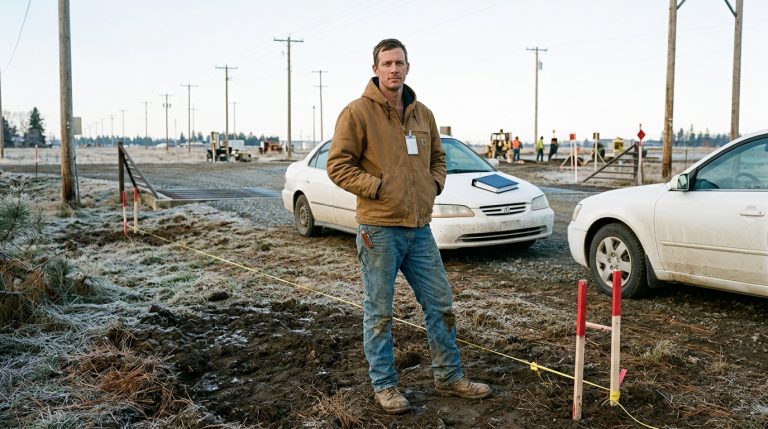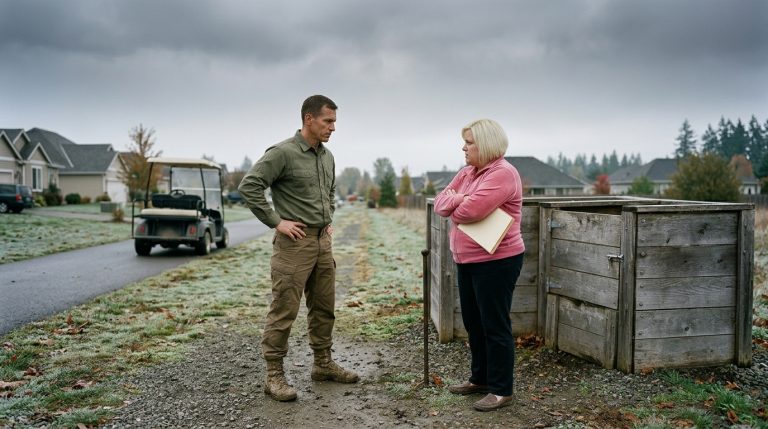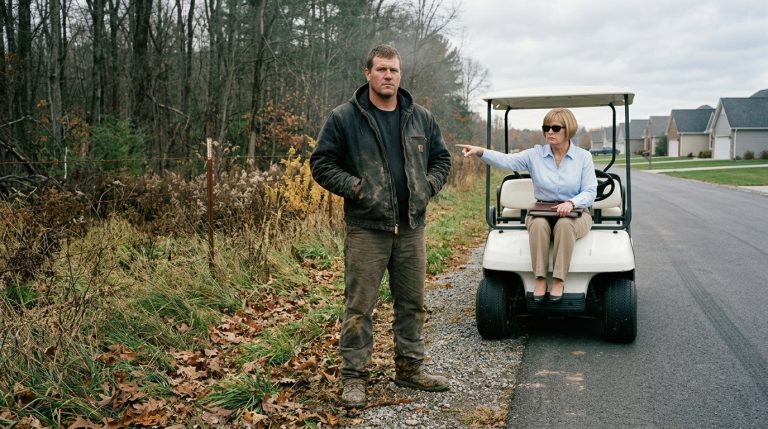
The Quiet Siege of Harmony Creek: How a Retired Combat Engineer Dismantled Suburban Tyranny
CHAPTER 1: THE LINE IN THE GRAVEL
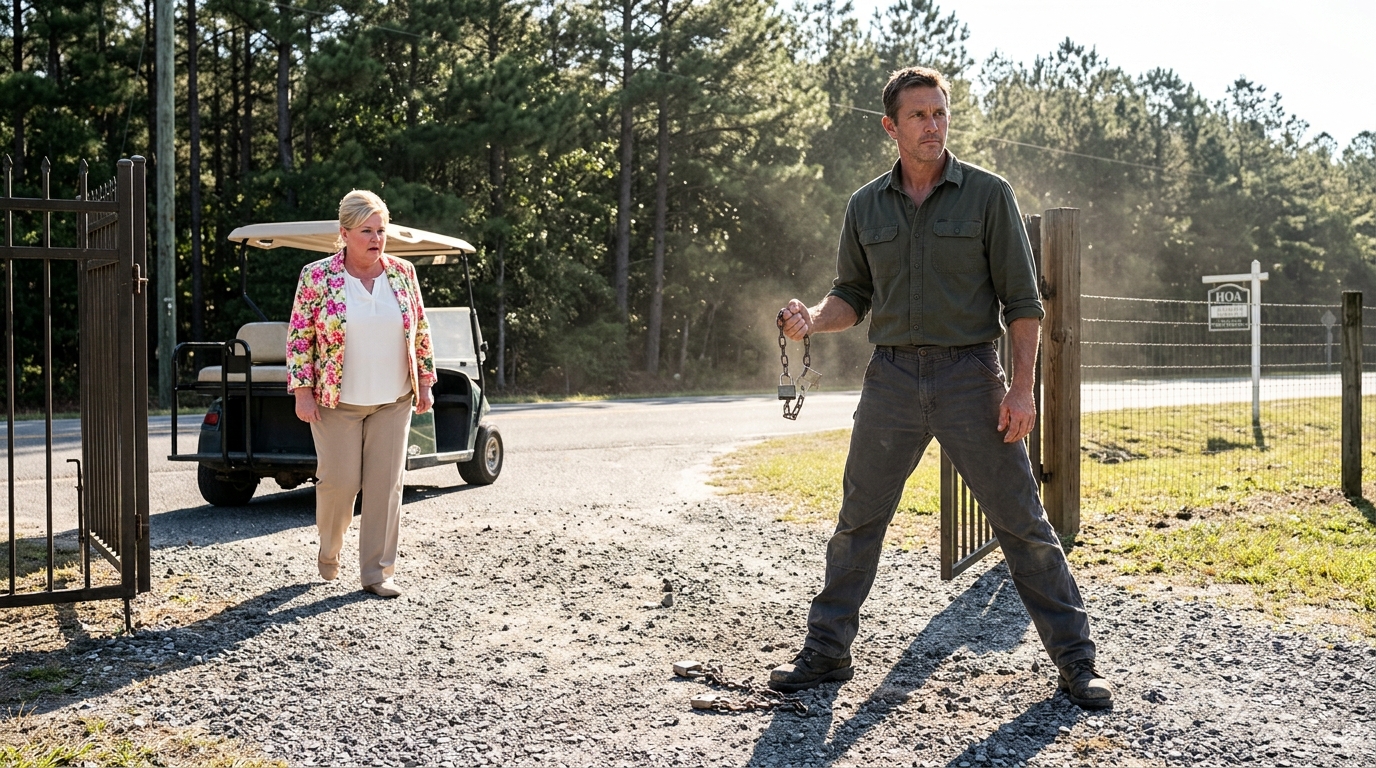
The heavy-duty padlock clicked shut with a sharp, iron ring that echoed off the tall pines lining the gravel driveway.
Karen Peterson adjusted the lapels of her pastel pink tracksuit, her hands resting squarely on her hips as she admired the heavy steel chain now binding my main gate. She turned her head slightly, offering a saccharine smile that failed to reach her cold, calculating eyes.
“This gate is now the property of the Harmony Creek Homeowners Association,” she said, her tone dripping with unearned authority. “Any attempt to remove this lock will result in a $5,000 fine and immediate legal action. Consider this your final warning, Mr. Davidson.”
I stood five feet back on the public asphalt, my running shoes coated in fine grey dust. My house keys dangled uselessly from my right hand, the brass keyrings cold against my sweaty palm. My truck sat inside the five-acre boundary, idling nowhere; my wife’s sedan was parked beside the workshop.
“This is private property, Karen,” I said, keeping my voice flat and low.
“Not anymore,” she replied, waddling toward her electric golf cart. “The board maintains absolute authority over all perimeter access points.”
She stepped into the cart and hummed away down the cul-de-sac, leaving a small puff of dust in her wake.
I didn’t chase her. In the desert outside Fallujah, screaming never cleared an obstacle; clear thinking did. I walked up to the gate, resting my knuckles against the cold, powder-coated steel bars. The chain was thick, zinc-plated, and wrapped three times around the latch post. The brand-new lock gleamed mockingly in the bright morning sun.
Sarah walked down the gravel path from the front porch, her brow furrowed into a deep crease. She stopped on the inside of the fence, her hand touching the metal bars right opposite mine.
“Jack? What did she just do?” she whispered, looking down the empty road.
“She declared war,” I said, my gaze locked on the brand-new shackle. “And she picked the wrong terrain.”
“Don’t do anything reckless,” Sarah said, her voice trembling slightly. “Please.”
“Reckless is running a chain without checking who owns the land,” I told her, stepping back. “What I’m going to do is strictly procedural.”
I walked toward the detached workshop behind the garage, the smell of sawdust and motor oil meeting me at the door. On the wall hung a heavy pegboard holding row after row of hand tools, each cleaned and oiled after every use. I reached for the bottom rack and lifted the 36-inch bolt cutters. The heavy forged-steel handles were cold, the jaws bearing a tiny notch from a forgotten job years ago. I rolled the rubber grips in my palms, feeling the solid, mechanical weight.
I retrieved my smartphone from the workbench, walked back to the gate, and tapped the record button.
Starting from the public road sign fifty feet down, I panned the camera slowly across the property markers, the HOA signpost, the fence line, and finally zoomed in on the unbranded padlock holding my gate shut. I spoke clearly into the microphone, stating the date, time, and exact GPS coordinates, establishing that no county or state seals were present on the lock.
Setting the phone against a fence post to record the angle, I picked up the bolt cutters.
I set the hardened jaws against the shackle of the padlock, adjusted my stance, and braced my shoulders. I squeezed the long handles together. The metal groaned under the pressure, the jaws biting deep into the hardened steel, until a sharp, metallic crack split the quiet morning.
The two halves of the lock dropped into the gravel with a dull thud.
I unwound the heavy chain, pulled the gate open, and stepped back onto my land. I picked up the severed pieces, placed them inside a clear plastic bag from my workbench, and marked the date on the front with a permanent marker.
Five minutes after Karen drove away, the entry point was clear again.
I walked into my home office, pulled a clean black three-ring binder from the shelf, and labeled the spine in crisp block letters: KAREN PETERSON / HOA. I opened my laptop, brought up a blank document, and began typing the first formal notice to the board of directors.
The war had begun, but the first round wasn’t fought with anger—it was logged on paper.
CHAPTER 2: THE PAPER TRAIL
The county clerk’s office smelled of stale coffee and decaying paper bindings.
I leaned over the wide oak counter, the fluorescent light flickering overhead as the clerk—a woman with thick glasses named Brenda—thumped a heavy cardboard file folder onto the surface.
“Harmony Creek subdivision,” Brenda muttered, wiping a thumb across her ink-stained apron. “Original plat maps, covenants, and the 1988 county land survey.”
I opened the folder, the dry paper whispering against the laminate counter. Pages of legalese spilled across the wood—standard restrictions on mailbox colors, fence heights, and commercial vehicles. But three layers down, folded into a crisp four-panel blueprint, was the original surveyor’s map predating the development by two decades.
My index finger stopped on a faint red dotted line running along the northern boundary of my five acres.
20-foot public utility and access easement. Recorded August 14, 1988.
The HOA’s territorial authority, established twenty years later, explicitly ended where my deed began. The gate wasn’t inside their jurisdiction. It sat squarely within a county-recorded easement that Karen’s board had zero legal right to govern, let alone lock.
I pulled out my phone, snapped three high-resolution photos of the seal, and slid the original back into the file. I didn’t cheer. You don’t celebrate finding the enemy’s blind spot; you document it until it’s airtight.
An hour later, I was walking the perimeter line that bordered the main neighborhood road.
Three houses down, an elderly man was bent over a flower bed near his mailbox, pulling weeds with gnarled, arthritic fingers. The mailbox post wasn’t the mandated HOA beige. It was painted a rich, dark forest green.
I stopped at the edge of his turf. “Afternoon. That’s a fine-looking garden.”
The man straightened up slowly, wincing as his lower back locked. His eyes were wary, searching my face before softening slightly. “Keeps me busy,” he said, wiping soil onto his jeans. “Arthur Henderson.”
“Jack Davidson,” I said, holding out a hand over the wooden fence rail. “Over on the old Miller plot.”
Arthur’s eyebrows shot up. “Ah. The fortress. Heard Karen Peterson locked you out of your own driveway this morning.”
“News moves fast,” I said.
“She’s been fining me two hundred dollars a month for three years over this post,” Arthur said, his voice dropping into a dry, bitter rasp. He patted the green wood. “My wife Eleanor painted it before she passed. Karen sent the first violation notice four days after the funeral.”
I felt a cold, familiar knot tighten in my stomach—the kind that comes when you realize an adversary isn’t just power-hungry, but malicious.
“Did you pay them?” I asked.
“At first,” Arthur murmured, looking down at his dirt-caked gloves. “Then she threatened a lien on the house at a public meeting. Said if I couldn’t follow basic rules, maybe I belonged in an assisted living facility. I’m seventy-eight, Jack. I don’t have the stomach to fight a woman like that alone.”
“You aren’t fighting her alone anymore, Arthur,” I said quietly, tapping the edge of the leather notebook tucked under my arm. “Gather your violation notices. All of them.”
By evening, Arthur had brought me to David’s house—a thirty-something software engineer two streets over who had been slapped with a thousand-dollar commercial fine because FedEx delivered his work servers to his front door.
David sat at his kitchen table, laptop screen reflecting off his wire-rimmed glasses, scanning the stack of documents Arthur and I had brought.
“She’s running a classic information blockade,” David said, his fingers flying across the keyboard. “She keeps everyone isolated so nobody realizes how many people are actually getting hit. But look at this.” He turned the screen toward us.
A Google Earth satellite image showed the HOA common park areas side by side across three years. The grass was patchy, the wooden benches rotting.
“The HOA pays Green Leaf Landscaping forty thousand dollars a year for common area maintenance,” David said, zooming in on the residential streets. “So why is the Green Leaf commercial truck parked in Karen’s private driveway three days a week?”
I stared at the high-res image. In her backyard, half-hidden by a line of arborvitae, was a brand-new stone patio build in progress, complete with stacked pavers and a commercial excavator.
“Because we’re paying for her backyard,” I said, my voice dangerously calm.
“We need proof before the quarterly meeting,” Arthur whispered, looking between us. “If we accuse her without receipts, she’ll shut the floor down.”
“We have the receipts,” I said, reaching into my pocket and pulling out the certified mail green card from the county clerk’s office. “And now we have the map.”
CHAPTER 3: THE EXPOS
The air in the community center meeting room was stale, thick with the smell of scorched coffee and floor wax.
Over fifty residents filled the metal folding chairs—four times the usual turnout. Karen sat behind the long plastic head table alongside the four other board members, her chin tilted up, hands folded over a thick manila folder. She wore a bright floral jacket that stood out against the drab drywall like an alarm.
“We will now move to new business,” Karen announced, tapping her wooden gavel twice against the table. “I remind everyone that comments are limited to two minutes per homeowner, and personal grievances will not be entertained.”
I stood up from the middle aisle, my leather binder held flat against my side.
“Jack Davidson, 142 Miller Road,” I said, my voice cutting cleanly through the murmur of the room. “I have a presentation regarding community financial oversight and boundary enforcement.”
Karen’s smile froze, her fingers twitching against her folder. “Mr. Davidson, as I stated, personal complaints regarding your illegal gate structure must be submitted through the standard written appeal process.”
“This isn’t an appeal,” I said, taking two steps toward the front row. “And it’s not a personal complaint. David, if you would.”
At the back of the room, David hit the spacebar on his laptop. The digital projector hummed to life, beaming a ten-foot image onto the white wall behind the board’s table.
It was a side-by-side breakdown of the HOA’s annual line-item budget next to county property tax assessments.
A quiet murmur swept through the rows of chairs.
“What is the meaning of this?” Karen demanded, rising halfway out of her chair, her knuckles turning white against the plastic table edge. “This is an unauthorized disruption of an official board meeting. Turn that projector off immediately!”
“The board allocated forty thousand dollars this year for common area landscape maintenance,” I continued smoothly, ignoring her gavel as it slammed down. “Yet the park turf hasn’t been reseeded in three years, and the playground fence remains compromised.”
I gestured to the wall as David clicked to the next slide.
A high-definition photograph filled the screen—a Green Leaf Landscaping truck parked in Karen’s personal driveway, workers unloading stone pavers into her backyard while an excavator dug out a fountain pool.
Gasps rippled through the audience. Arthur stood up near the front, pointing a trembling finger toward the wall.
“That’s where our dues went!” someone shouted from the back row.
“This is slander!” Karen shrieked, her voice cracking as she slammed the gavel down three times in rapid succession. “That work was contracted under a private agreement! You have no right to display photos of my private residence!”
“The invoices match the exact dates billed to the association’s emergency reserve fund,” I said, keeping my tone strictly conversational. “And as for jurisdiction…”
David clicked the slide again. The 1988 county surveyor map appeared, the red dotted easement line flashing in bold yellow highlight directly over my gate entry.
Frank, the board treasurer sitting two seats down from Karen, leaned forward, his face draining of color as he read the county clerk’s official seal at the bottom of the blueprint. He looked from the wall to Karen, his jaw slack.
“The board never had legal authority over that perimeter,” I said, closing my binder with a solid, echoing thud. “Which means every fine, every threat, and every charge levied against my property—and others in this room—is legally void.”
Karen stood frozen behind the table, her breathing heavy, her blotchy red face reflecting the bright blue light of the projector screen behind her.
“This meeting is adjourned!” she spat, shoving her papers messily into her bag. She glared down the aisle straight at me, her eyes burning with pure, unadulterated venom. “You think you’re clever, Davidson. You think you’ve won something here.”
“I don’t think,” I replied quietly. “I document.”
She turned on her heel and marched out the side door, leaving the remaining four board members staring at the screen in horrified silence.
CHAPTER 4: THE TRAP COLLAPSES
Three days after the meeting, the road back from my VA appointment was completely clear until I reached my property line.
I slowed the truck down a hundred yards out. Something was wrong with the gate’s silhouette against the afternoon sun.
I pulled onto the gravel shoulder and killed the engine. Wrapped around the steel gate posts was a thick, greasy logging chain—the industrial kind used for skidding massive timber logs. It was wound tightly through the bars a dozen times, secured by three massive commercial-grade padlocks.
A laminated red sign flapped against the steel: NO TRESPASSING. PERMANENTLY CLOSED BY ORDER OF THE HOA BOARD OF DIRECTORS.
My phone came out instantly. I stepped out of the cab, panning the lens over the three locks, the unwashed grease on the chain, and the sign’s fraudulent claim of board authority.
Arthur’s sedan pulled up behind my truck. He opened his door, his face pale as he looked at the barricade. “Jack… she brought a commercial rig out here this morning. Spent half an hour wrapping it.”
“She’s desperate,” I said, tapping the record button to save the video clip. “When a bully loses control of the room, they use bigger locks.”
A distant siren shrieked through the valley, growing louder by the second.
A county ambulance crested the hill, its red lights flashing against the tree canopy. It made a hard, engine-roaring right turn onto the residential cul-de-sac adjacent to my land—the road where Karen lived.
Through the thin tree line separating our properties, I watched the ambulance screech to a halt in front of her house. Two paramedics leaped out, pulling a gurney toward her front porch.
The winding subdivision loop added nearly three minutes to their transit time. My driveway was the straight, wide, direct access path from the main highway—a route first responders regularly relied on for rapid entry.
Karen ran out onto her front lawn, her arms waving wildly toward the paramedics. She turned her head, her frantic gaze sweeping across the tree line until her eyes locked onto me, Arthur, and the chained gate.
Her face drained of color.
She looked from the gurney being wheeled into her house, to the winding road the emergency crew had been forced to navigate, and finally to the dense web of logging chains blocking my gravel road.
The phone in her hand slipped from her trembling fingers and crashed onto the asphalt. She took a step backward, her mouth opening, but no sound came out.
“Arthur,” I said, my voice dropping into a hard, flat tone. “Call Deputy Miller. Tell him we have an active public safety obstruction on a recorded easement.”
I walked back to the bed of my truck, unlatched the tool storage box, and lifted my portable gas generator onto the tailgate. Beside it, I set my heavy angle grinder, clicking a fresh masonry cutting wheel into the spindle.
Karen had built her wall out of spite, but she was about to discover what happens when emergency services are forced to wait on a tyrant’s vanity.
CHAPTER 5: UNCONDITIONAL SURRENDER
I adjusted my safety goggles, gripped the rubber handles of the angle grinder, and stepped toward the barricade.
Sparks erupted into the dark twilight as the cutting wheel bit into the first commercial padlock. The screaming whine of metal against metal echoed down the cul-de-sac. Deputy Miller stood five feet back, his flashlight beam pinning the chain against the steel gate posts while Arthur held his breath beside the patrol car.
The first lock snapped in two, clattering onto the gravel.
“Ma’am, step back to your porch,” Deputy Miller called out, his voice stern over the grinder’s roar.
Karen stumbled forward across her lawn, her face blotched and eyes bloodshot from crying. “You can’t let him cut that! That’s association property! He’s destroying community security!”
“Your mother was just transported in an emergency vehicle that lost four minutes negotiating your blockade, Ms. Peterson,” Deputy Miller said, writing in his notepad without looking up. “Mr. Davidson is clearing an illegal obstruction across a recorded public easement. I suggest you remain quiet.”
The wheel sliced through the final link of the logging chain. The thick steel web collapsed to the ground with a heavy, metallic thud. I kicked the pile aside, swung my gate wide open, and drove my truck straight through to my workshop.
By seven o’clock the following evening, the community center room was packed to capacity.
All four remaining board members sat behind the long table, their shoulders hunched, staring at the five identical manila folders laid out in front of them. The legal demand letter from my attorney, Jessica Riley, sat on top of each stack, accompanied by certified copies of the 1988 county land survey.
The side door opened slowly.
Karen walked in, her arms wrapped around her midsection, her steps hesitant and uneven. The room went dead silent. Over sixty neighbors watched her every move, nobody offering a greeting or moving an inch to clear a path.
Frank, the board treasurer, slid a single sheet of paper across the table toward the empty head seat.
“Sign it, Karen,” Frank said, his voice flat, devoid of its usual compliance. “Your resignation, effective immediately. If you don’t sign, all four of us resign tonight and turn the accounting ledgers over to the county prosecutor ourselves.”
Karen reached for the pen, her hand trembling so violently the plastic barrel rattled against the wood. She looked out over the crowd—at Arthur sitting straight in the front row, at Maria, at David, and finally at me standing near the back wall with my black binder tucked under my arm.
She tried to speak, her throat working silently before she uttered a weak, raspy gasp.
“This… this isn’t fair,” she whispered, her voice cracking as she tried to cling to a ghost of her former authority. “I protected this community…”
“Sign the paper, Karen,” Arthur said from the front row, his voice firm and steady.
She pressed the pen tip to the line, scribbled her name in a jagged, panicked scrawl, and pushed the sheet back toward Frank. She turned without picking up her purse and fled through the side exit, her hurried footsteps fading down the corridor.
Frank stood up, adjusted his microphone, and cleared his throat into the silence of the hall.
“Effective immediately,” Frank announced into the speaker, “Karen Peterson has resigned from the board. All outstanding fines issued under her tenure are hereby nullified, and an independent forensic financial audit will begin on Monday morning.”
The room erupted into a thunderous wave of applause. Arthur turned back toward me, giving a slow, meaningful nod.
CHAPTER 6: THE QUIET NORMAL
The forensic audit report arrived in three heavy, coil-bound volumes.
It exposed eight years of systematic embezzlement totaling just over $180,000. Karen Peterson had funneled association dues into personal grocery accounts, online shopping sprees, and luxury home upgrades—including the $40,000 stone patio in her backyard billed as common-area park maintenance.
The county district attorney filed multiple felony counts for grand larceny and fraud.
In her personal life, the collapse was equally total. Her mother’s family initiated a civil suit for gross negligence over the emergency response delay caused by her barricade. The house with the unapproved stone patio went up for sale, a bright yellow lien notice tacked to the front door alongside the real estate sign.
In Harmony Creek, the transition was quiet and absolute.
The community held an emergency election in the same room where Karen used to bang her gavel. Arthur Henderson was elected president by unanimous vote.
His very first official order was to declare his dark forest green mailbox post a protected neighborhood landmark, to the resounding applause of every resident in attendance.
I didn’t take an official role on the new board. My job had been to clear the obstacle, not run the post.
Sarah stepped out onto the porch, leaning against the railing beside me as the evening sun dipped below the tree line. Down near the open fence line, Arthur waved as he walked his dog along the gravel edge.
I took a slow sip of coffee, feeling the warm ceramic against my palm. The five acres lay peaceful and still in the twilight.
The gate stood wide open—not as a point of conflict, but as a simple, quiet entrance to my home.