The Weight of the Survey Line: How a Quiet Landowner Dismantled an HOA Empire Through Cold Strategy and Silence
CHAPTER 1: THE FIRST STAKE
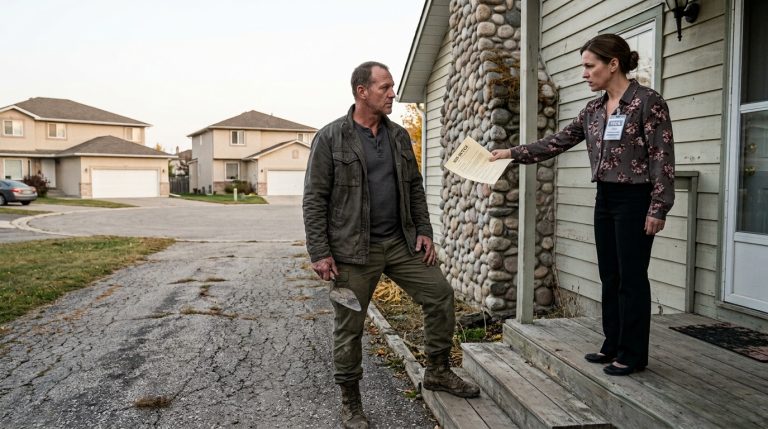
The metal point drove into the soil with a single, practiced blow. Behind it, a yellow nylon cord unspooled in the thin morning air, cutting a straight, arrogant line across grass that had belonged to the Callaway family before the subdivision next door had even been drawn on a napkin.
I did not raise my voice. Raising a voice is an admission that the other person controls the acoustics of the room. Or, in this case, the acreage.
“Pull that stake,” I said.
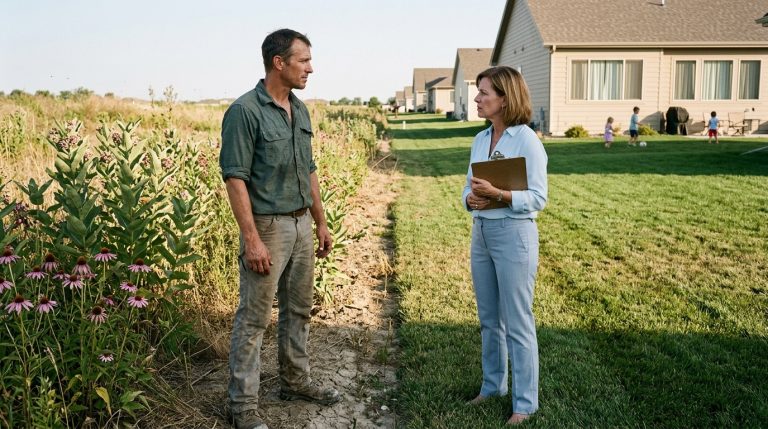
The man holding the hammer didn’t stop until his wrist completed the arc, driving the steel another inch into the dark, damp earth of my grandfather’s pasture. He looked over his shoulder at the woman standing by the white sedan. She had a navy blue binder tucked under her arm like a shield and a silver badge pinned to her lapel that didn’t belong to any county office I recognized.
Sandra Briggs didn’t look at my face. Her eyes were fixed on the clipboard in her hand, scanning rows of numbers that existed only in the parallel universe of the Crestline Ridge Homeowners Association.
“We’re inspecting the utility corridor,” she said, her voice flat, scrubbed of any inflection that might suggest a human being was speaking to another human being. “Routine maintenance access. Section four, subsection B of the master covenant.”
“You’re thirty feet inside my fence line,” I said.
“We have an easement,” she replied, finally lifting her chin. Her gaze was not hostile; it was administrative. It was the look of a person who believed paperwork was a physical force field. “Twelve years recorded with the county. Crestline Ridge holds perpetual right-of-way for power infrastructure servicing three hundred and forty homes. Sir, I don’t think you understand how easements work.”
That was her second mistake. Her first had been driving past the cattle guard without a phone call or a knock.
My thumb hooked into the pocket of my canvas work shirt, brushing against the edge of a folded pocketknife I had no intention of drawing. Violence is clumsy. It leaves debris. Paperwork, on the other hand, is clean, silent, and permanent. And for the past eight months—ever since my grandfather’s heart stopped in the middle of his morning coffee—I had done nothing else but read the paperwork. Every deed, every transfer, every carbon-copied margin note going back to the Nixon administration.
There was no easement. There had never been an easement. There was an unsigned draft from 1983, a polite letter of intent from a developer who went bankrupt before the asphalt cooled, and eleven years of institutional laziness.
“You’re standing on private land, Sandra,” I said softly, letting the silence between us stretch until the wind rustling the dry winter brush sounded loud. “And your paper is expired.”
She blinked once, a slow, micro-adjustment of her eyelids. A faint line appeared between her brows, not of anger, but of minor irritation, the kind you feel when an automated teller machine rejects a card that has always worked before.
“The county records speak for themselves,” she said, turning her back to signal her worker to drive the second stake.
The hammer came down. Clang.
The sound carried across the open pasture, flat and bright in the cold air, vibrating straight up through the soles of my boots. My internal ledger calculated the distance to the property line, the exact weight of the steel, and the precise moment three weeks from now when every single post she was hammering into the dirt would be pulled out and stacked in a neat, worthless pile by the gate.
“Keep driving them,” she told the worker without looking back at me.
I watched the red plastic ribbon on the top of the stake flutter against the gray sky. The air smelled of crushed grass and cold iron.
“Go ahead,” I whispered to the empty space between us.
She turned back to her car, her hand already reaching for the door handle, entirely unaware that the trap had just clicked its first tooth.
CHAPTER 2: THE PAPER TRAIL
The silence inside the ranch house was different from the silence out in the pasture. Outside, the quiet was vast and heavy with the weight of open acreage, indifferent to human property lines. Inside, the quiet was dense with history. It smelled of old cedar floorboards, boiled coffee, and the faint, dry musk of paper that had not seen direct sunlight in decades.
I set the heavy cardboard storage box on the kitchen table. The cardboard groaned, its corners frayed from years of being shoved into the deep recesses of the hall closet behind winter coats and spare fencing wire.
My grandfather had been a man of few words, but he had been a man of terrifyingly specific documentation. When he bought the 1,700 acres back in the seventies, he hadn’t trusted handshakes or county clerks. Every boundary dispute, every handshake agreement gone sour, every informal accommodation he made for a neighbor—it all went into the archive.
I pulled out the first file folder. The manila paper was soft, worn thin at the creases like an old work glove.
V-2 (The Psychological Phantom): A sudden memory flickered behind my eyes—not of my grandfather yelling, but of him sitting at this exact table under the hum of the yellow overhead bulb, a stub of a yellow pencil in his calloused fingers, carefully measuring the exact distance between a fence post and a drainage ditch. He had always said that a man who doesn’t know his own boundaries is just renting space from whoever is loudest.
I opened the folder. Inside lay a carbon copy of a letter dated October 14, 1983.
The text was typed on a mechanical typewriter with a slightly crooked lowercase ‘e’. It was addressed to the initial planning board of what would eventually become Crestline Ridge. My grandfather had written it in response to an early request for a utility line variance.
“…permissive access granted for temporary construction power line corridor along eastern pasture edge, subject to formal recorded conveyance prior to permanent installation…”
Permissive access.
I traced the faded purple typewriter ink with the pad of my thumb. In property law, permission is a poison pill for adverse possession or prescriptive easements. If you give someone permission to use your land, their use is licensed, not hostile. And a license can be revoked at any time. More importantly, the sentence ended with a clear condition: subject to formal recorded conveyance.
That conveyance never happened. The developer went belly-up six months later when the local savings and loan crisis hit, the project was sold off to a larger corporate umbrella, and the informal power line quietly became permanent because nobody bothered to check if the ink ever dried on a county deed.
Eleven years of corporate entities trading parcels like baseball cards, and not a single one of them had pulled the 1983 file to verify the chain of title. They trusted the poles. They trusted the hum of the transformers. They trusted Sandra Briggs’s clipboard.
I pulled out my phone and laid it beside the ledger. The screen was dark, but I knew what was waiting out there. Sandra wasn’t going to let go because a few metal stakes were pulled out of the dirt. People who build their entire authority on administrative theater don’t retreat when the curtain wobbles; they double down. They find a formal letterhead, a terrifying fine, or a legal subcommittee to draft a threat.
My cell phone buzzed against the wood table, startling the dust motes dancing in the kitchen window’s slanting afternoon light.
An unknown number. Area code local.
I let it ring three times, listening to the hollow electronic chirp echo off the bare kitchen walls. On the fourth ring, I slid my thumb across the glass and pressed it to my ear.
“Ray Callaway,” I said.
There was a brief pause on the other end, the faint hiss of a digital switchboard, and then a woman’s voice cut through the static. It wasn’t Sandra. This voice was colder, polished by twenty years of corporate mediation and billable hours.
“Mr. Callaway. My name is Elizabeth Vance. I represent the Crestline Ridge Homeowners Association legal committee.”
I didn’t lean back in my chair. I kept my weight centered over my boots, my eyes fixed on the 1983 carbon copy.
“You’re calling the wrong number, Ms. Vance,” I said evenly. “If you have something to communicate regarding my property, my attorney is Patricia Owens. Her office is downtown.”
“Ms. Owens represents you for general real estate inquiries,” Vance replied, her tone sliding into that practiced, patronizing cadence common to people who bill by the tenth of an hour. “This isn’t a real estate inquiry, Mr. Callaway. This is a formal notice of operational interference. Your obstruction of the Crestline utility corridor is currently threatening the power grid for three hundred and forty residential parcels. We are prepared to file for an emergency injunction in county court by tomorrow morning if formal access is not immediately restored.”
She paused, waiting for the flinch. Waiting for the sudden spike of panic that usually hits a landowner when they hear the word court or injunction or liability.
I didn’t flinch. I reached out, picked up a red pen, and slowly drew a neat circle around the phrase subject to formal recorded conveyance on my grandfather’s forty-year-old carbon copy.
“An emergency,” I said quietly, letting the silence stretch until I could hear the faint, irritated tap of her artificial fingernail against a desk on the other end of the line. “Is that what you’re calling it?”
“It is a matter of public safety, Mr. Callaway.”
“Then I suggest you check your files for a recorded easement before you waste the judge’s time,” I said. “Because if you walk into Judge Hail’s courtroom tomorrow morning without a liber and page number, you aren’t going to get an injunction. You’re going to get a very expensive lesson in local geography.”
“Mr. Callaway—”
I tapped the red pen twice against the table and disconnected the call.
The screen went black, reflecting my own expression—neutral, unyielding, entirely devoid of haste. I picked up the next box from the floor, pulled off the lid, and reached for the next layer of dust.
CHAPTER 3: THE ESCALATION
Three days after Elizabeth Vance dropped her thin, paper-thin threat over a digital line, the formal violation notice arrived in the metal mailbox at the end of the long gravel drive.
I didn’t open it immediately in the truck. I carried it back to the house, placed it beside the cold coffee mug from the morning, and used a dull-edged letter opener to slice through the certified green-and-white seal. Inside sat a pristine, heavy-stock letterhead from the Crestline Ridge HOA legal subcommittee.
Fine assessed: One thousand five hundred dollars.
The bold text stared up at me with all the artificial gravity a corporate printer could muster. Below it, clauses and citations from bylaws that applied strictly to subdivision members were marshaled together to create the illusion of jurisdiction. They wanted me to feel cornered. They wanted the financial penalty to sting enough that I would pick up the phone, negotiate a quiet compromise, and sign away a strip of my eastern pasture just to make the letters stop coming.
Instead, I took out my smartphone, opened the camera app, and shot a high-resolution frame of every line, capturing the crisp black ink and the signature block of a subcommittee member I had never met.
The front screen of my phone flashed with a text message preview from Tom Greer. Sandra’s calling another meeting for Thursday. Word is she’s telling everyone you’re putting emergency power at risk.
I set the phone down and walked to the front window. Beyond the glass, the morning light hit the distant line of wooden utility poles cutting across the edge of the property. The metal wires hummed faintly, an ambient vibration that carried through the dry earth. For eleven years, that hum had been accepted as a permanent fixture of the landscape, a neighborly accommodation grandfathered in by silence. But silence isn’t a deed. Silence doesn’t hold up when you look at the county clerk’s book and find empty pages where an instrument should be.
I reached for my jacket, pulled it over my shoulders, and stepped out onto the porch. The air was sharp, smelling of dry pine needles and frost-bitten grass.
There was no sense in waiting for them to make the next move entirely on their terms. If Sandra wanted to escalate through formal paperwork, I would give her a response that mirrored her own precision—cold, mechanical, and entirely unyielding.
I climbed into the cab of my truck, turned the ignition, and drove twenty minutes down county road fourteen toward Patricia Owens’s office.
Her office was tucked behind the old brick municipal building, sandwiched between a bail bondsman and a title abstractor. The frosted glass door bore a hand-painted nameplate that had begun to flake around the edges. Inside, the room was a monument to paper: stacks of case files rose like sedimentary rock formations across every available surface, and the air smelled faintly of old toner and black-and-white printouts.
Patricia didn’t look up immediately when I pushed the door open. She was running a highlighter down a multi-page title search report, her lips pressed into a thin, critical line.
“You’re early,” she said without raising her head.
“The mail arrived,” I said, dropping the HOA’s violation notice onto the center of her desk.
Patricia stopped the yellow marker. Slowly, she lifted her gaze over the rim of her reading glasses. She didn’t touch the paper right away; she just looked at it, reading the corporate letterhead with the practiced indifference of someone who had seen a thousand desperate paper tigers.
“Fifteen hundred dollars,” she murmured, a dry edge to her voice. “They’re escalating from phone threats to financial penalties. Classic containment strategy.”
“They’re betting I don’t want to deal with the paperwork,” I said, pulling out a wooden chair and sitting down without waiting for an invitation. “Or the threat of a lien.”
“An HOA can only place a lien on property within their legal jurisdiction,” Patricia said, leaning back and folding her hands over the report. “You’re outside their boundaries. You’re not a member, you never signed their covenants, and your parcel predates their entire subdivision by four decades. They have about as much legal authority to lien your ranch as they do to tax the county courthouse.”
“Then why send it?”
“Because intimidation doesn’t need to be legal; it just needs to look heavy enough to make you flinch.” She tapped the violation notice with a fingernail. “If you pay even a fraction of this fine—even out of convenience—they use that payment as an admission of jurisdiction. It resets the board. Suddenly, your informal accommodation becomes a recognized obligation.”
“I’m not paying a dime,” I said. “And I’m not signing their draft.”
Patricia offered a thin, sharp smile that didn’t reach her eyes. “Good. Because I finished drafting our response this morning.”
She reached beneath a stack of briefs and slid a two-page document across the desk. It was clean, unembellished, and brutally structured. It listed the exact statutory requirements for an enforceable utility easement under state law, noted the complete absence of any recorded instrument in the county clerk’s archives matching their parcel identifier, and formally demanded that the HOA provide a valid recording reference number within twenty-one days—or begin the complete removal of all unpermitted infrastructure from my land within ninety days.
I read through it twice, checking the section numbers, the dates, the precise legal phrasing. There was no anger in it. No emotion. Just the unyielding weight of property law.
“Send it certified,” I said, sliding it back toward her. “To Sandra directly, and copy every name listed on that legal subcommittee.”
“It’s already queued for mailing,” Patricia said, picking up her pen. “And Rey? When Sandra gets this, she isn’t going to back down. A person who builds an empire on an unrecorded draft doesn’t fold because someone handed them a statute. She’s going to double down. Expect her to take this to the community.”
“Let her,” I said, standing up from the chair. “The more noise she makes outside the courtroom, the less ground she has to stand on inside it.”
I walked out of the office and got back into the truck. As I drove back toward the ranch, the sun dipped lower behind the ridge, casting long, sharp shadows across the eastern pasture where Sandra’s survey stakes still stood like lonely sentinels. The paper war had just graduated from threats to timelines, and neither of us had any intention of missing a deadline.
CHAPTER 4: THE COURTROOM CHESS MATCH
The county civil courtroom smelled of floor wax, damp wool, and the faint, metallic tang of old radiators fighting a losing battle against a wet winter morning.
I sat on the wooden bench three rows back from the well, my hands resting flat on my thighs. Up front, Sandra’s lead counsel was already adjusting a thick stack of color-coded tabs on the mahogany table, whispering quietly to an associate who clutched a leather portfolio like a shield. Sandra herself sat rigidly upright, her navy blazer buttoned precisely, her gaze fixed straight ahead toward the empty bench of Judge Marian Hail. She looked like a woman who had never lost an argument that mattered, because she had never allowed herself to play on a board where the rules weren’t written by her own committee.
When the side door clicked open and the bailiff called the room to order, Judge Hail walked in with the brisk, unhurried stride of someone who had heard every variation of human stubbornness and was thoroughly exhausted by all of them. She didn’t waste time on pleasantries. She settled her reading glasses on the chain around her neck, flipped open the top folder, and looked out over the room.
“Docket item civil twenty-four dash twelve,” Judge Hail said, her voice dry and level. “Crestline Ridge Homeowners Association versus Callaway. Emergency injunction application. Counsel, you may proceed.”
Sandra’s lead lawyer stood up, smoothing his tie with a practiced, sweeping motion. He stepped toward the center of the well, his posture projecting absolute, unshakeable urgency.
“Your Honor, we are appearing today to seek immediate injunctive relief,” he began, his voice resonant and polished for a gallery that wasn’t there. “We represent three hundred and forty residential parcels whose electrical infrastructure is currently subject to arbitrary, uncooperative obstruction by the defendant. A critical utility corridor—established by long-standing community reliance—is being blocked. Without an immediate court order granting access for emergency maintenance, this community faces catastrophic power instability.”
He used the word emergency six times in the first three minutes. I kept my eyes on the back of his head, listening to the cadence of manufactured panic. It was a well-oiled performance designed to trigger a judge’s instinct to protect public safety before checking the underlying paperwork.
When he finally sat down, smoothing his papers with an air of triumphant inevitability, Judge Hail didn’t blink. She turned her gaze across the well.
“Ms. Owens?”
Patricia rose slowly. She didn’t stride or posture; she simply stood, her posture relaxed, her leather folio resting un-opened on the table. She walked two steps forward, her voice dropping the room’s temperature by ten degrees through sheer quiet delivery.
“Your Honor, the petitioner’s argument rests entirely on the existence of an emergency and a legally established utility corridor,” Patricia said, her tone conversational yet razor-sharp. “We have submitted four documents to the court this morning that address both claims.”
She walked back to her table, picked up a single sheet of paper, and placed it on the clerk’s rail before handing copies to the bench.
“First, the certified county clerk’s search verifying that no easement instrument has ever been recorded against this parcel in forty years of public record. Second, the petitioner’s own written correspondence from three weeks ago, explicitly admitting that their access relies on a verbal, mutual agreement—which legally destroys any subsequent claim to a prescriptive easement under state statute.”
Sandra’s attorney stiffened at the table, leaning over to whisper something sharp to his co-counsel.
Patricia didn’t pause. She picked up the final piece of paper, her fingers crisp against the edge. “And finally, Your Honor, we subpoenaed the formal operational log and dispatch records from the regional power utility company—the actual corporate entity responsible for the Crestline Ridge grid. According to their sworn filing submitted forty-eight hours ago, there has not been a single documented fault, failure, or maintenance requirement on that corridor in the past ninety days.”
Judge Hail’s hand stopped moving. She looked down at the utility provider’s document, her eyes tracking slowly across the official corporate seal and the timestamped dispatch logs.
The silence in the courtroom grew heavy, dense with the realization that the engine driving the petitioner’s emergency had just run out of fuel.
Judge Hail slowly took off her glasses, letting them dangle by their chain against her black robe. She raised her eyes from the paper and looked directly at Sandra’s lead counsel.
“Counsel,” the judge said softly, the lack of volume making the word feel like a dropped anvil. “Your clients have filed an emergency motion alleging an imminent threat to residential power infrastructure. I am looking at a sworn statement from the utility company itself confirming zero faults or emergency maintenance tickets for three months.”
The attorney stood up, his polished composure cracking around the edges. “Your Honor, preventative maintenance is—”
“Preventative maintenance is not the standard for emergency injunctive relief,” Judge Hail interrupted, her voice dropping into a register that brook no debate. “You have asked this court to bypass standard civil procedure based on a crisis that does not exist, supported by an easement that has never been recorded.”
She picked up her stamp, pressed it down onto the cover sheet with a solid, definitive thud that echoed off the high ceiling.
“Motion denied.”
She didn’t look up as she closed the file. “Next case.”
I didn’t turn around to look at Sandra as I stood up from the bench. I gathered my coat, walked out into the bright, cold hallway, and let the heavy oak doors swing shut behind me. The bluff had been called, but the board was still full of pieces, and Sandra Briggs was not the kind of player who knew how to walk away from a losing game.
CHAPTER 5: THE COLLAPSE OF AUTHORITY
The gravel in the parking lot of the Crestline Ridge management office crunched with a brittle, frozen sharpness under the tread of my boots. I didn’t rush. Speed looks like panic, and panic is the one thing a person like Sandra Briggs feeds on.
Inside the single-story brick building, behind frosted glass panels bearing the faded gold-leaf lettering of the homeowners association, an emergency board session was already underway. Tom Greer had called me twenty minutes after we left the courthouse, his voice low over the line. She’s inside, Rey. She locked herself in the back conference room with her outside counsel. But two of the board members walked out ten minutes ago.
I pushed open the heavy glass front door. The blast of overheated, dry air hit my face, carrying the stale scent of commercial carpeting and bad coffee.
The reception desk was empty, but the door to the primary conference room down the hall stood slightly ajar. A sliver of yellow light cut across the gray linoleum floor. From inside came the low, rhythmic murmur of an argument—one voice sharp and rising, cutting through the heavy timber of a man’s attempt to restore order.
I didn’t knock. I walked down the hall, my boots clicking with measured, unhurried cadence against the floor, and stopped directly outside the cracked door.
“…cannot make decisions without legal counsel present!” Sandra’s voice rang out, tight and metallic, stripped of its usual smooth administrative veneer. “I am the president of this board. Every action taken regarding that utility corridor was executed under the explicit assumption of community protection!”
“Protection from what, Sandra?” a man’s voice replied—steady, weighted with an exhaustion that had been building for years. Dennis Halt, the board chair who had spent twelve months watching from the back row. “We just spent three weeks listening to a judge ask why we filed an emergency injunction for an emergency that didn’t exist. And now we find out there isn’t even a recorded easement in the county book. Eleven years, Sandra. Eleven years of running lines across private land on a draft document.”
“It was an administrative oversight!” she snapped back. “The county clerk’s office misfiled it. Everyone knows their record-keeping is a disaster—”
“I spoke with the county clerk personally this morning,” Dennis interrupted, his voice dropping an octave, turning the room into a tomb. “They didn’t misfile it, Sandra. Because it was never filed. You never executed it.”
A heavy, suffocating silence swallowed the room.
I pushed the door open the rest of the way.
The hinges gave a soft, dry squeak. Three board members sat around the scarred mahogany table, their faces pale under the flickering fluorescent tubes. Sandra stood at the head of the table, her navy blazer slightly askew, her fingers gripping the edge of the wood so tightly her knuckles had gone pure white. Her eyes snapped toward the doorway, locking onto mine with a sudden, naked flash of malice that she didn’t bother to mask behind her clipboard anymore.
“You,” she whispered, the word like dry leaves scraping across concrete. “This is private property. You have no business—”
“My name is Ray Callaway,” I said, stepping fully into the room, my voice flat and even, carrying the cold weight of the eastern pasture. “And I own the land your power lines are sitting on. The court reviewed the records this morning. The county reviewed them. Your own utility provider reviewed them.”
I reached into my coat pocket, pulled out a single certified copy of Patricia’s latest filing—the notice of counter-claim detailing abuse of process, tortious interference, and unpermitted trespass—and laid it squarely in the center of the mahogany table, right over Sandra’s leather binder.
“You don’t have an easement, Sandra,” I said, looking straight into her eyes. “And you don’t have a board left to cover for you.”
Dennis Halt looked down at the formal legal header on the paper, then slowly raised his eyes to meet mine. He didn’t ask me to leave. He didn’t defend her. He simply reached out, pulled the document toward himself, and read the first paragraph.
Sandra stared at the paper as if it were a physical blow. Her chest rose and fell in short, rigid breaths. She looked around the table at the other board members—faces turned away, eyes fixed on their blotters, hands folded in silent abandonment.
“This is a coup,” she muttered, her voice trembling slightly as she grabbed her briefcase from the chair. “You’re letting an outsider dictate the governance of this community.”
“No, Sandra,” Dennis said quietly, not looking up from the counter-claim. “We’re just finally reading the paperwork.”
She didn’t answer. She snatched her folder, turned on her heel, and walked toward the side exit, her heels clicking a sharp, furious rhythm against the linoleum. As she passed me, she didn’t look up, but the air around her smelled of cold panic and defeated theater.
The door swung shut behind her with a dull, heavy thud.
The room settled into an absolute, profound quiet. Dennis Halt let out a long breath, rubbed his eyes beneath his glasses, and looked across the table at me.
“Mr. Callaway,” Dennis said, his voice flat and tired. “Let’s sit down and talk about how we fix this.”
CHAPTER 6: THE BOUNDARY MARKER
The gravel drive crunched beneath my tires as I turned the truck back into the Callaway Ranch, the engine humming a low, steady baseline against the silence of the late afternoon. Across the passenger seat sat a thick, blue-backed bundle containing the finalized utility agreement, bearing the clean, notarized seal of the county clerk and the signatures of both Patricia Owens and Gerald Foss.
Eleven years of unrecorded ambiguity, eleven months of archival digging, and three weeks of calculated legal pressure had finally been compressed into a single, permanent instrument filed in the proper drawer of the county courthouse. No handshakes, no informal allowances, no corporate shortcuts. Just measurements, boundaries, and law.
I parked near the barn, killed the engine, and stepped out into the sharp, metallic air.
The eastern pasture stretched out toward the distant ridge, flat and golden under the slant of the setting sun. The cedar post where Sandra Briggs had driven her first survey stake months ago stood exactly where my grandfather had set it fifty years prior—weathered, gray, and wrapped in rusted wire.
My phone buzzed in my pocket. I pulled it out, expecting Patricia’s office or Tom Greer with another update from the subdivision. Instead, it was an email notification from the county recorder’s office: Document recorded successfully. Liber 1412, Page 804.
I slid the phone back into my pocket and walked out across the dry grass toward the boundary line.
There was no sudden rush of triumph, no dramatic cinematic wind sweeping through the trees. Just the steady, physical reality of the earth under my boots and the heavy, reassuring weight of competence. Sandra Briggs had tried to turn an administrative omission into an empire of leverage, betting that nobody would ever look past the clipboard or question the volume of her threats. But authority built on unrecorded paper collapses the moment someone takes the time to check the book.
I reached the old cedar post, resting my palm flat against its rough, dry surface. The wood was cold, smelling of sap and old iron.
Down the line, the power lines hummed with their familiar, low-frequency current, carrying electricity to three hundred and forty homes over the ridge. But the hum was different now. It wasn’t an encroachment; it wasn’t an unpunished trespass born of institutional laziness. It was an agreement—measured, defined, and anchored in truth.
A truck door slammed in the distance. I turned my head to see Tom Greer’s dusty pickup rolling slowly along the fence line on his side of the property, stopping just short of the corner marker. He killed his engine, stepped out, and leaned his forearms against the top wire of his fence, looking across the pasture toward me.
He didn’t shout across the acreage. He just raised one hand in a slow, level gesture—a quiet acknowledgment between two men who understood that land is something you maintain, not something you fake.
I raised my hand in return, watching the sun dip below the jagged silhouette of the western hills, pulling a long, clean shadow across the grass. The boundary was marked. The paperwork was closed. And the ranch would stay right where it was, exactly as it had always been, waiting for whoever came next.