The Concrete Line: How a Retired Engineer and a Rusted Spade Brought Down an HOA Tyrant
CHAPTER 1: THE FIRST STRIKE
The voice carried over the raw earth, smelling faintly of cheap lilac and unchecked authority.
I didn’t look up from the trench right away. I kept my weight centered on the shovel handle, letting the damp chill of the morning air settle into my shoulders.
“That’s common ground, mister,” the voice snapped, cutting through the quiet Saturday. “And this unapproved landscaping project of yours is over. I’m taking it out myself.”
I straightened my back, feeling the familiar, dull pinch along my spine.
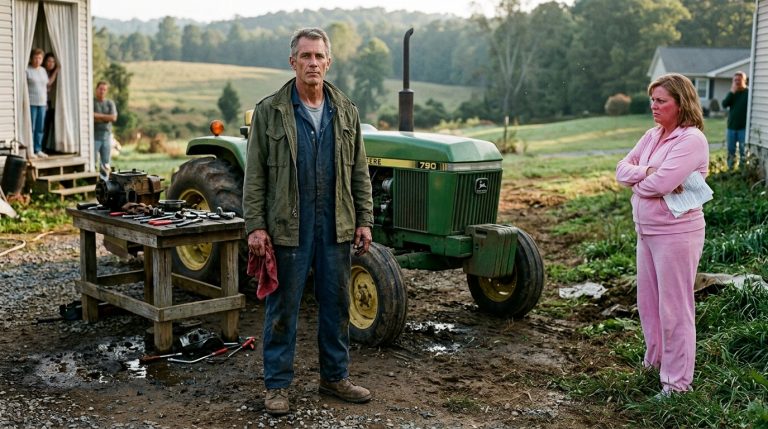
Karen stood at the edge of the freshly dug ditch, her bright pink tracksuit straining against her frame. Her face was locked in a familiar mask of grievance.
In her hands, she gripped a rusted spade like a scepter, its sharpened tip hovering directly over the shallow channel I had spent the last two hours leveling.
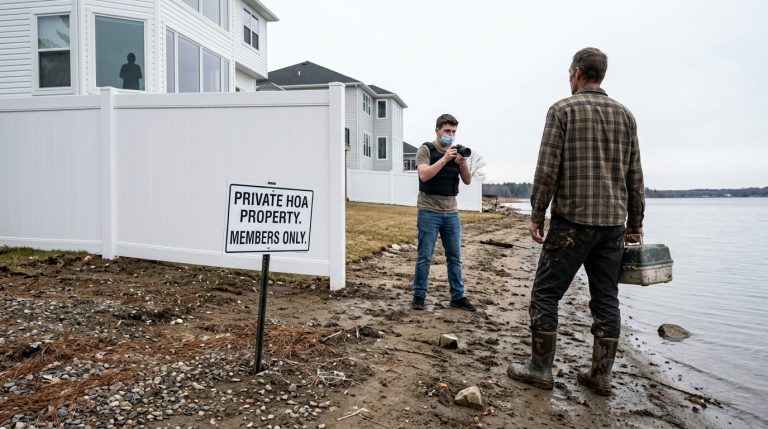
I had lived in Pleasant View Estates for exactly sixty-seven days.
In that time, my mailbox had accumulated more violation notices from her than hot meals after a three-week field exercise.
This particular morning’s offense was a French drain and sprinkler system designed to keep water away from my foundation—a project backed by county surveys, despite her claims.
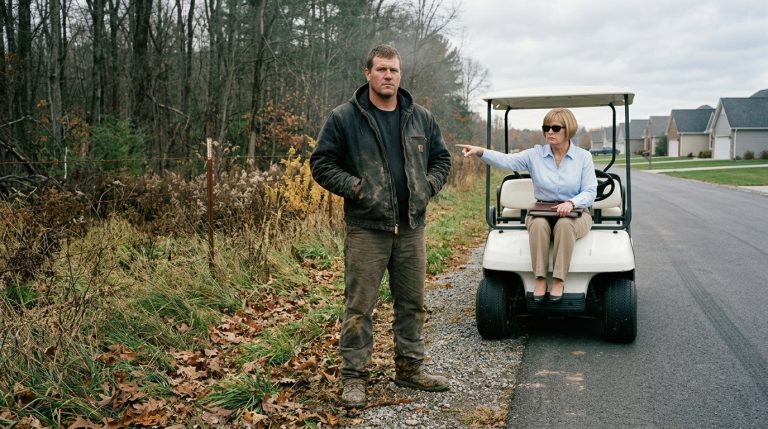
“Karen,” I said, keeping my tone flat and measured. “We’ve been over this. The survey markers are ten feet that way.”
I pointed toward the orange flag fluttering near the curb.
She scoffed, a dry sound like air escaping a punctured tire. “The official survey is wrong. The board considers this strip an easement for community aesthetics. Your ditch is an eyesore.”
She didn’t wait for an answer.
She raised the heavy spade over her shoulder and brought it down with a grunt.
The impact wasn’t loud. Just a sickening, deadened thunk as steel met buried PVC.
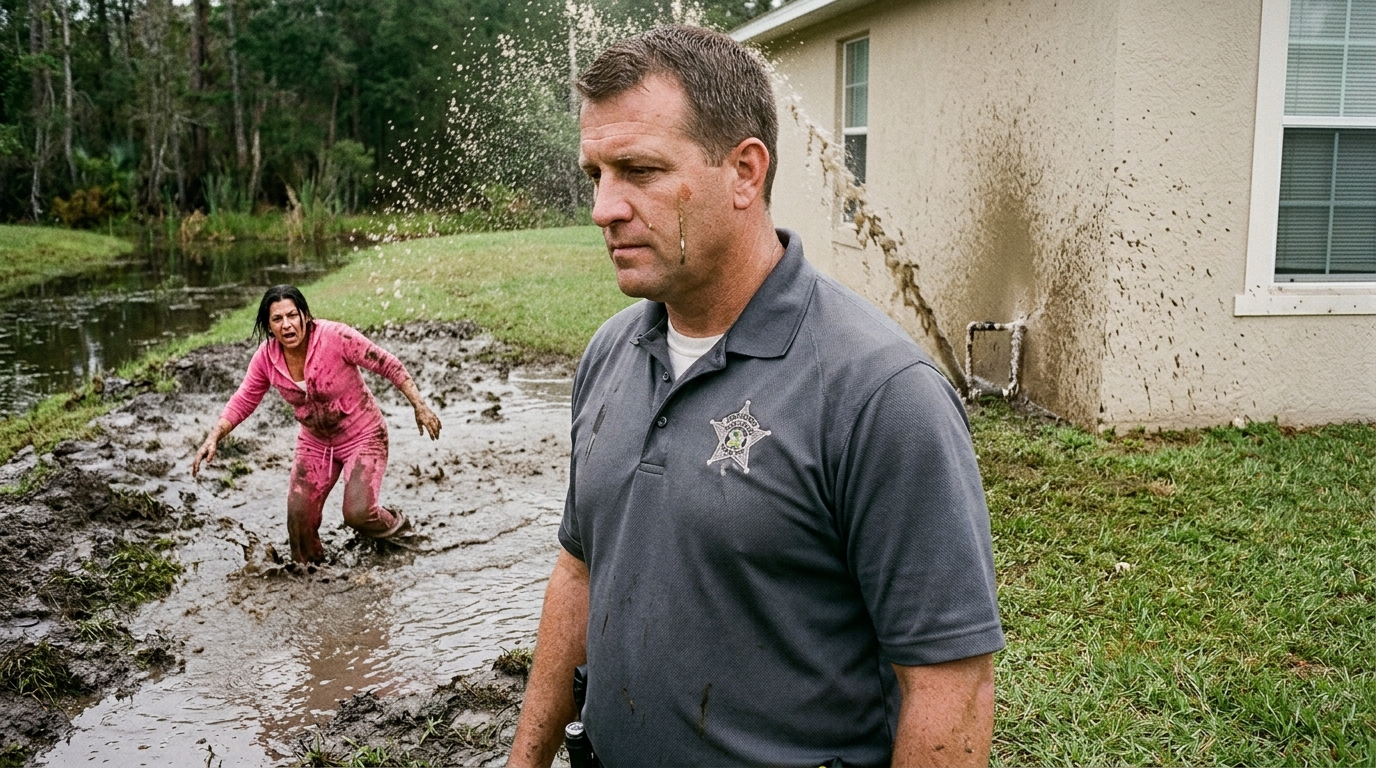
For a fraction of a second, nothing moved. Then the earth beneath her boots swelled, darkening instantly with pressurized moisture.
Before I could shout a warning, a thick brown geyser erupted from the trench, shooting fifty feet into the morning air.
The blast caught Karen square in the chest, launching her backward into a rapidly widening pool of mud.
The rusty spade tumbled end over end before clattering onto her pristine driveway.
The water didn’t just fall back down; it arced in a perfect, violent stream directly toward her beige stucco facade, hammering against the glass and pouring straight into the grated window well of her basement.
A muffled shriek echoed from behind the flooded glass just as the water choked the lower level.
I stood ankle-deep in the sudden swamp, wiped a stray drop of muddy water from my cheek, and felt the heavy, rhythmic thrum of my pulse steady.
Game on.
CHAPTER 2: THE PAPER FORTRESS
The kitchen table smelled of cold black coffee and damp paper.
Sarah slid the heavy legal envelope across the wood grain, her knuckles white where she pressed them against the edge.
“They didn’t waste any time,” she said, her voice tight. “It arrived twenty minutes ago.”
I picked up the thick cream-colored letterhead from Dewey, Cheatham, and Howe.
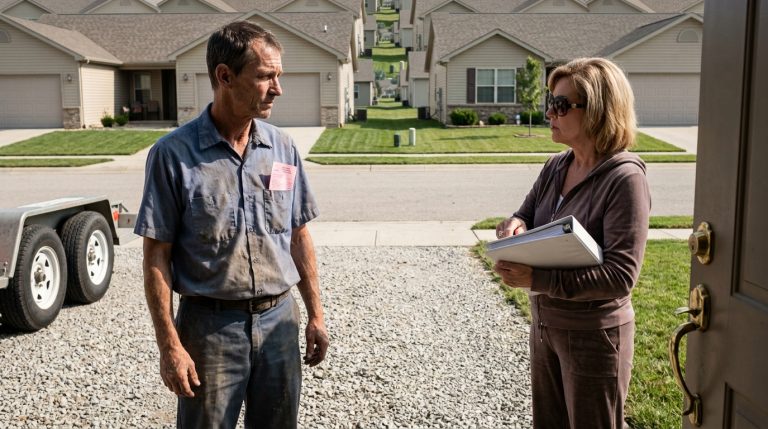
The prose was a masterpiece of manufactured outrage, demanding a ten-thousand-dollar fine for covenant violations and threatening immediate arbitration for the structural damage to Karen’s stucco facade.
It was a scare tactic designed to trigger panic before the mail carrier even made it down the block.
I set the letter down beside Sal’s signed plumbing report, the ink crisp and undeniable.
“They’re betting we’ll write a check and apologize for getting our yard in the way of her shovel,” I said, reaching for my waterproof notebook.
I didn’t call a lawyer immediately.
I walked out to the truck, retrieved the original closing documents from the glove box, and laid the plat map flat under the overhead light.
The survey lines were inked in permanent black, showing the property boundary sitting a full fifteen feet clear of the municipal easement where Karen had swung her blade.
My primary safety net—the city-stamped utility permits—had been stripped from my tactical options by circumstance, leaving me to build a case entirely from scratch using county deeds and cold logistics.
A sharp rap at the front door cut through the quiet hum of the refrigerator.
I didn’t answer it right away; I took two slow turns walking to the entry, listening to the heavy, deliberate tread of boots on the porch.
When I pulled the door open, the afternoon sunlight caught the brass frame of a pair of reading glasses held tightly in a trembling hand.
George stood on the mat, his retired teacher’s cardigan buttoned unevenly, holding a manila folder against his chest like a shield.
“I saw the mail truck leave,” George said without preamble, his eyes darting toward the street before locking onto mine. “If she’s sending those letters to you, John, it means she’s terrified—and a terrified bureaucrat is about to do something reckless.”
CHAPTER 3: THE WHISPERED LEDGERS
George didn’t wait for an invitation to the kitchen.
He unclipped his reading glasses, letting them hang from a cord around his neck, and set the manila folder right on top of the Dewey legal threat.
“She’s been keeping track of everyone for years, John,” George said, his voice dropping to a dry, raspy whisper. “And by keeping track, I mean she’s been building files to ensure nobody ever questions her authority again.”
I opened the folder, my thumb catching on the corner of a yellowed paper invoice dated three summers ago.
It was a bill for five thousand dollars from a commercial painting contractor, addressed to the Miller family down the block.
The violation note attached to it cited an unauthorized shade of beige on their exterior siding.
“They didn’t even use the wrong color,” George muttered, leaning his weight against the back of a kitchen chair. “They used the exact swatch Karen handed out at a board meeting—until she changed her mind retroactively and claimed it didn’t match the afternoon light.”
This wasn’t just petty neighborhood oversight; it was a systematic pattern of intimidation designed to drain bank accounts and crush morale.
I traced the edge of the invoice, feeling the cold weight of the paper against my skin.
“Did anyone else keep copies?” I asked, looking up.
“Half the street has boxes of notices in their attics,” George replied, his jaw tightening. “They’re just too tired and too scared of liens on their houses to do anything about it. But when word got out about your yard geyser… well, people started talking.”
A faint knock sounded at the front door, interrupting the hum of the refrigerator.
I didn’t wait for George to finish; I walked back down the short hallway and pulled the heavy wood door open.
Mrs. Miller stood on the porch, clutching a worn leather handbag like a lifeline, her eyes wide with a mixture of fear and long-suppressed anger.
“George said you were building a real file,” she whispered, stepping past me into the house before I could offer a hand. “I brought my paint receipts—all of them.”
CHAPTER 4: THE BASEMENT ALLIANCE
Mrs. Miller pulled a thick stack of folded papers from her purse, smoothing the creases against the wood grain with trembling fingers.
“I kept every single notice,” she said, her voice dropping as she glanced toward the front window facing the street. “Even the ones she made me take down after I paid the fines.”
I didn’t interrupt.
I picked up the top paper—a formal reprimand regarding an unapproved flower box—and noted the date stamped in the corner.
It matched the pattern George had laid out, but seeing the physical ink and signatures brought the scale of Karen’s control into sharp focus.
“She told us our mortgage rate would double if we fought her in court,” Mrs. Miller whispered, a bead of sweat tracing down her temple under the kitchen light. “We were scared, Mr. Carter. We have kids in college.”
Across the table, George adjusted his reading glasses and slid an empty manila folder toward her.
“You aren’t alone anymore, Martha,” George said, his tone softening with quiet solidarity. “John mapped the county records. That strip of land isn’t an easement, and her authority ends where the public right-of-way begins.”
That evening, the rest of our small coalition converged quietly through the side gate, slipping into George’s dim basement out of sight of the main road.
Mr. Lee, the stoic engineer who had lost his son’s treehouse to Karen’s arbitrary aesthetic rules, crossed his arms and stared at the projection screen I had set up near the workbench.
“If we move against her board, we need to strike all at once,” Mr. Lee said, his jaw locked tight against the memory of his family’s lost weekend. “She still has the other two board members wrapped around her finger.”
I set my waterproof notebook down on the workbench, the pages heavy with documented dates and times.
“They aren’t loyal to her; they’re loyal to their own comfort,” I said, looking around the circle of weary faces. “When we present the county plat maps and the plumber’s report simultaneously, that comfort evaporates.”
CHAPTER 5: THE COUNTERBOMBARDMENT
David Ramirez flipped open the multi-tabbed folder on his mahogany desk, his eyes scanning the certified mail receipts with clinical satisfaction.
“We don’t just reply to their scare tactics,” David said, sliding a fresh set of legal demands across the wood grain. “We bypass their corporate firm entirely and hit every layer of their institutional cover at once.”
The letters weren’t headed toward the HOA’s friendly local counsel.
They were addressed directly to Karen Jensen, with immediate copies dispatched to the association’s insurance carrier and Karen’s personal homeowner policy adjuster.
The prose dismantled her entire defense by citing county plat maps and itemizing the exact financial cost of her unauthorized trespass.
“Her D&O policy protects her for official board decisions, not individual criminal acts,” David added, tapping a pen against the margin. “The moment we frame her spade strike as a malicious personal trespass, her own insurance company drops her defense.”
A heavy silence settled over the office as the weight of the strategy took hold.
This wasn’t a request for mediation; it was an unyielding financial and legal siege designed to strip away every layer of insulation she had used to bully the neighborhood.
“And if she ignores the ten-day deadline?” I asked, keeping my voice level.
“Then we hand the entire three-volume binder straight to the district attorney’s office,” David replied, a thin smile touching the corner of his mouth. “Property destruction past the felony threshold doesn’t clear up with a neighborhood apology.”
CHAPTER 6: THE CLUBHOUSE RECKONING
Karen stood at the podium at the front of the hall, her severe navy blue blazer pulled tight across her chest.
She scanned the fifty seated homeowners with a look of practiced martyrdom.
“I called this emergency session to address the malicious actions of a rogue homeowner,” Karen announced, her voice ringing off the drop-ceiling tiles. “A homeowner who has shown a flagrant disregard for our community safety and our shared property.”
She launched into her prepared narrative, painting herself as the primary victim of an unprovoked structural disaster.
The crowd murmured, some heads nodding in conditioned agreement, entirely unaware of the three-volume binder resting in the briefcase at my feet.
I remained seated in the second row, my gaze locked on the rigid line of her shoulders.
David Ramirez stood up slowly from the aisle seat, his presence commanding immediate silence across the room.
“A question, Ms. Jensen,” David said, his voice cutting through the quiet like a blade. “When you stated the damaged water line sat on a common easement, did you consult the official county plat records?”
Karen narrowed her eyes, her fingers tightening around the edges of the wooden lectern.
“That is common knowledge to the board,” she snapped.
“Then let’s look at the actual map,” David replied, signaling toward the projector screen behind her.
The high-resolution scan of the county recorder’s plat flashed across the wall, rendering her narrative down to a complete fiction.
David used a laser pointer to trace the exact boundaries of lot 47, proving the land was private property.
“That map is outdated,” Karen stammered, her face losing color beneath the fluorescent glare.
“Let’s check the video evidence instead,” David said, hitting play.
The screen flickered to life with the footage of Karen swinging the rusted spade and the resulting geyser engulfing her basement.
The room erupted into sudden shouting as the neighborhood realized the truth.
Karen grabbed the edges of the podium, her knuckles stark white against the dark wood, refusing to yield an inch.
CHAPTER 7: THE CRACKING CROWN
The insurance adjuster’s formal reservation of rights letter sat squarely in the center of the mahogany table, its terms absolute and merciless.
The association’s legal counsel, a sharp-eyed corporate litigator named Wes, adjusted his tie and refused to look in Karen’s direction.
“Our policy coverage strictly excludes individual willful misconduct and criminal trespass,” Wes said, his voice flat and detached. “The board cannot absorb personal liabilities incurred outside official duties.”
Karen sat across from them in a drab gray cardigan, her authority stripped away alongside her navy blue blazer.
Her fingers twitched against the fabric of her lap, a rare crack in her rigid composure as the full weight of the financial exposure settled onto her shoulders.
“The association will be filing a cross-complaint to recover damages,” Wes added, sliding a second document across the wood.
Karen looked down at the pages, her breath catching in a shallow gasp as she realized the organization she had ruled for eight years was now preparing to sue her into bankruptcy.
She opened her mouth, trying to launch into her usual defense of rules and compliance, but no words came out.
The room remained dead silent, save for the hum of the overhead vents pushing cold air across her shoulders.
Her defense had evaporated into thin air, leaving her entirely exposed to the wreckage of her own making.
David Ramirez leaned back, folding his arms without a trace of triumph—only the cold satisfaction of professional geometry.
“The ten-day window closes tomorrow, Karen,” David said quietly. “You can settle the personal claims now, or you can face the district attorney’s office with the full binder.”
CHAPTER 8: THE NEW GROUND
The moving truck idled at the curb, its diesel engine rumbling a low, heavy vibration against the asphalt.
Karen didn’t look back as she heaved the final cardboard box into the cargo bay, her movements mechanical and drained of authority.
Her beige stucco house stood across the street with a fresh patch of mortar sealing the lower foundation, carrying the permanent watermark of a system that had finally collapsed under its own weight.
She slammed the truck doors shut and climbed into the passenger seat without a single parting word, leaving Pleasant View Estates behind for good.
I kept my hands planted in the dirt, packing the dark soil firmly around the base of the maple sapling.
The French drain and sprinkler system ran beneath the lawn without interference, keeping the green grass steady against the seasonal rain.
George took over the interim president role with a single, unyielding rule—leave each other alone and maintain common sense.
The HOA meetings had transformed from shouting matches into quiet, productive garage gatherings where neighbors actually spoke over the fence.
Sarah walked down the front path, carrying two mugs of coffee, and stopped beside the young tree.
“The settlement checks cleared for the Millers and the Lees,” she said quietly, handing me a warm ceramic cup. “And the new bylaws went out in the mail this morning.”
I took a slow sip, letting the heat settle in my chest as I looked down the street.
The kids down the block were laughing inside a safe, city-approved treehouse, and the neighborhood hummed with an ordinary, hard-earned peace.
It had taken a trench, a shovel strike, and an unyielding wall of facts to restore the balance, but the ground beneath our feet was finally our own.
I set the mug down on the grass, wiped my palms on my jeans, and stood up to watch the afternoon sun settle over a quiet, unbothered street.