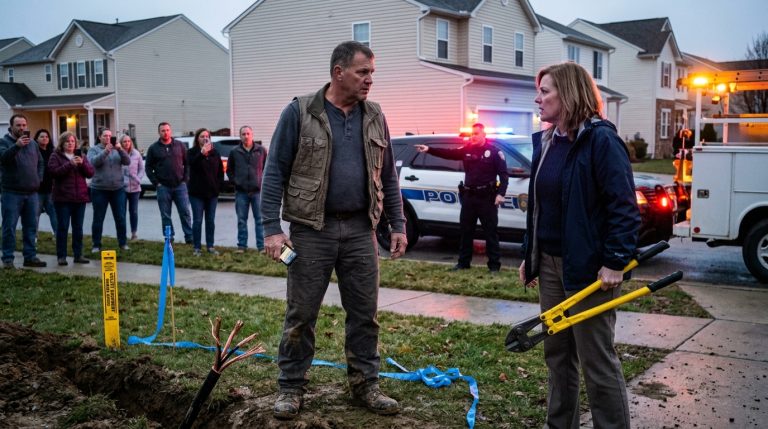
The Legacy Boundary: How an Army Engineer Turned a Suburban HOA’s Arrogance Against Them
CHAPTER 1: THE FORENSIC AUDIT
The glow of the computer monitor cut through the dark kitchen, throwing sharp shadows against the oak dining table.
I rolled the heavy brass Army Corps challenge coin over my knuckles, the smooth metal clicking softly against my wedding ring with every pass.
On the screen, page forty-two of the Whispering Pines Homeowners Association corporate filing stared back at me.
My eyes locked onto the bottom corner of the document where the county stamp sat crooked over the margin.
The notary block was blank—no signature, no seal, just a light gray placeholder line where a state official should have certified the 2023 bylaw amendments.
I leaned closer, the mug of cold coffee completely forgotten beside my elbow.
Karen had used those exact 2023 amendments to justify the five-thousand-dollar livestock penalty she tried to stick on my chest this morning.
A quiet vibration rattled the table as my phone lit up with a text notification from an unknown local number.
“Final Notice: Non-compliance inspection scheduled for 0800 hours tomorrow. Access to north perimeter required.”
I set the brass coin down on top of my grandfather’s 1946 property deed with a dull, heavy thud.
They weren’t just trying to bully a farmer; they were operating on an unratified paper tiger.
I opened a blank spreadsheet, minimized the PDF, and began typing the first document reference code into the log.
CHAPTER 2: THE BOUNDARY LINE
At 0755, the high-pitched whine of an electric motor echoed up the gravel driveway.
I stood on the front porch with a lukewarm cup of black coffee in my hand, watching Karen’s red golf cart bounce over the cattle guard.
Dennis, her quiet husband, sat behind the wheel with both hands glued to the steering column, looking strictly at the gravel ahead.
Karen sat in the passenger seat, a clip-board held vertically against her sternum like a shield and a high-vis plastic tape measure sitting on her lap.
“Mr. Miller,” she called out before the cart had even come to a full stop. “We are executing our right of entry under Section 4.2 of the Whispering Pines Land Use Standards.”
She stepped off the cart, her wedge heels sinking two inches into the soft, rain-soaked earth near the gravel line.
I didn’t move down the steps. I took a slow sip of coffee and let the silence stretch until Dennis turned off the ignition, leaving only the hum of the cicadas in the live oaks.
“Section 4.2 applies to lot owners within the subdivision,” I said, keeping my voice down in my chest. “You’re thirty feet past the Whispering Pines property line.”
“This entire perimeter is subject to visual compliance,” she said, her red fingernail tapping the aluminum clip of her board. “Your unpainted cedar posts create a blight on the eastern view corridor of Lot 114. Furthermore, your livestock animal—”
“Patches,” I interrupted.
“—represents a clear health hazard under the updated 2023 sanitary guidelines,” she pushed on, stepping over a patch of Texas dandelion right up to the stone fence my grandfather laid in 1948. “Dennis, measure the distance from the barn wall to the stone line.”
Dennis hesitated, his eyes flicking toward me for a fraction of a second before he reached for the yellow casing on Karen’s lap.
“Dennis,” I said, my voice quiet, landing flat between us. “You touch that latch, and you’re trespassing on private agricultural property certified under Texas Natural Resources Code 143.”
Karen’s face twitched, a tiny ripple of stress breaking through the thick layer of powder on her cheeks. “Don’t you threaten my husband! The board has full authority to assess compliance and levy civil attachment!”
She reached out with her left hand, her manicured fingers physically grasping the top rail of my wooden gate to push it open.
I set my mug down on the porch railing with a deliberate, metallic clink.
“You’re relying on a document filed on May 14th of last year,” I said, stepping down the first wooden stair, my boots hitting the gravel. “The one certified by the county clerk’s office.”
Karen froze, her hand still gripping the cedar rail, her eyes narrowing as she tried to calculate how a retired soldier knew the exact filing date of her internal paperwork.
“The bylaws are public record,” she spat, though her grip on the wood loosened just enough for the latch to drop back into place with a sharp snap. “And they are fully enforceable.”
“We’ll see how enforceable they are at six o’clock tomorrow evening,” I said, stopping three feet from the fence line, looking down at her. “At your open monthly board meeting.”
She pulled her hand back as if the wet wood had burned her palm, shuffling her feet out of the mud with a wet, suction sound.
“You don’t have speaking privileges,” she declared, her chin snapping up as she retreated toward the cart. “You aren’t an HOA member.”
“I don’t need speaking privileges to hand the county sheriff a document request,” I said softly.
Dennis didn’t wait for her command; he turned the key and slammed the accelerator down, the golf cart spraying a thin shower of wet gravel as it executed a jerky U-turn back toward the paved suburban road.
CHAPTER 3: THE PAPERWORK AMBUSH
The Whispering Pines clubhouse smelled of fresh carpet adhesive and polished pine.
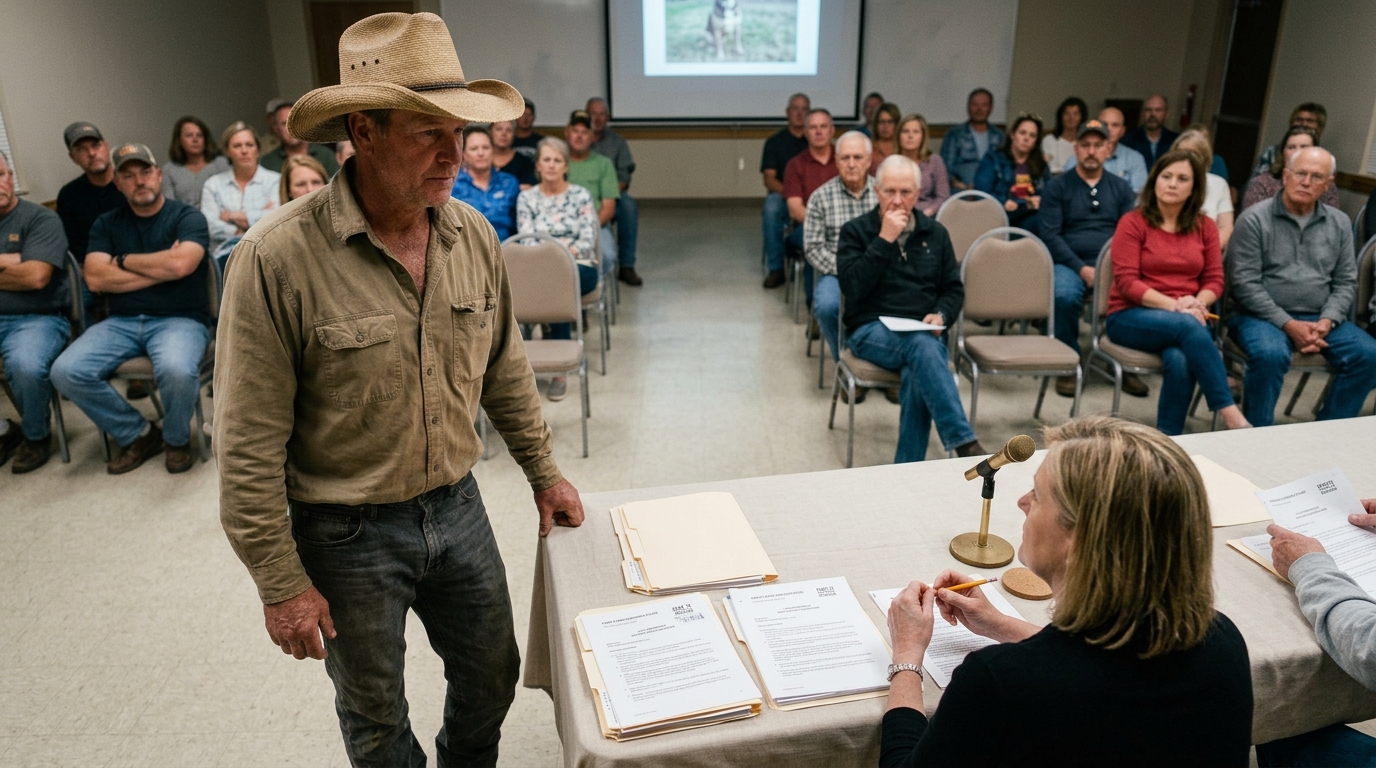
At 1800 sharp, forty homeowners sat in padded metal chairs, facing a long folding table where Karen presided behind a brass microphone.
I stood near the back wall with my arms crossed over my chest, the brass challenge coin sitting heavy in my right pocket.
“Moving on to Item Four,” Karen announced, tapping her gavel once against a cork coaster. “Persistent perimeter violations and non-compliant agricultural hazards along our western sector.”
A murmur rippled through the front rows as a slide showing a blurred photo of Patches near the barn flashed onto the projector screen.
“The board has issued a five-thousand-dollar compliance assessment under the 2023 amended charter,” she continued, not once looking toward the back of the room. “Continued refusal will trigger an immediate lien proceedings process.”
I walked down the carpeted center aisle, my work boots making silent, steady contact with the floor.
“Point of order, Madam President,” I said, stopping five feet from the head table.
Karen’s hand tightened around her pencil until her knuckle skin turned waxy white. “This is an executive board session, Mr. Miller. Non-members do not have floor privileges.”
“I’m not requesting floor privileges,” I replied, opening my manila folder and placing three stapled copies flat on the linen tablecloth. “I’m submitting a formal notice of procedural defect.”
Dennis, sitting two seats down from her, blinked hard and reached for one of the packets.
“Don’t touch that, Dennis,” Karen snapped, her voice cracking slightly under the sudden silence of forty watching homeowners.
“Page twelve of the county recorder’s filing,” I said, pointing a finger at the top sheet without raising my voice. “The 2023 amendment requires a sixty-percent quorum of voting homeowners to legally alter land restrictions.”
Karen leaned back, her mouth setting into a thin, pale line. “The quorum was met by proxy votes.”
“The notary block on page forty-two is unexecuted,” I said, stepping half an inch closer. “Without state certification, those proxy votes were never legally entered into the public record. Every fee assessed under those amendments is null and void.”
A whisper broke out in the third row, followed by the dry cough of an older man near the center aisle.
Karen grabbed the microphone, pulling it so close a sharp spike of feedback squealed through the ceiling speakers. “This meeting is adjourned!”
CHAPTER 4: THE COUNTERESCALATION
At 0915 the following morning, the crunch of heavy tires on gravel drew me out to the barn.
A white county truck with the Animal Control seal on the door sat parked directly in front of Patches’ stall enclosure.
An officer in a tan uniform stood by the rear bumper, holding a silver clipboard while Karen pointed at the wooden fence posts from inside her parked golf cart.
“Mr. Miller?” the officer asked, stepping forward as I wiped my hands on an old grease rag. “We received an anonymous urgent report regarding an aggressive, uncontained animal presenting an active public safety risk.”
“Aggressive?” I stopped by the gate, looking past him at Patches, who was currently chewing a flake of alfalfa in the shade.
“The report claims the horse broke containment twice this week and lunged at pedestrians near the subdivision boundary,” the officer said, his pencil hovering over a red incident form.
Karen leaned out of the golf cart, her voice ringing across the driveway. “The county ordinance clearly states that any animal involved in a public safety complaint must be impounded for a mandatory fourteen-day observation period at the owner’s expense!”
Fourteen days in a concrete county pen meant three hundred dollars a day in municipal boarding fees, plus a mandatory veterinary clearance requirement.
I reached into my pocket, my fingers finding the cool edge of the challenge coin, and pulled out my phone instead.
“Officer,” I said, keeping my voice steady and low. “Before you unhook that trailer hitch, I’m going to ask you to verify the geographic coordinates on your dispatch order.”
The officer frowned, turning his clipboard toward the light. “Section 4, Whispering Pines Sector B.”
“This property is Parcel 104-A, unincorporated county agricultural land,” I said, tapping the screen to display a high-resolution GIS map from the county appraisal district. “Whispering Pines ends at the stone fence line. If you enforce a municipal HOA complaint on registered agricultural land without a court order signed by a district judge, you’re executing an illegal seizure under Texas Agriculture Code 143.”
The officer looked at the map on my screen, then turned to look at the stone fence thirty feet behind his truck bumper.
“Is this true, ma’am?” the officer asked, turning toward the golf cart. “Did you place this dispatch request under a municipal subdivision address?”
Karen’s mouth opened, her throat working silently for two full seconds before she found her voice. “The danger extends to our residents! It’s a public health emergency!”
“Officer,” I said, stepping between his truck and the barn latch. “I’d suggest you note on your log that the complainant filed a false emergency dispatch report across jurisdictional boundaries.”
The officer clicked his pen shut, looking at Karen with a flat, exhausted expression. “Ma’am, step out of the cart or clear the driveway. If I get called out here again on a civil boundary dispute presented as an animal threat, I’m issuing a citation for misuse of county emergency services.”
CHAPTER 5: THE MIDPOINT UNCOVERING
By mid-afternoon, the sun had baked the topsoil along the eastern fence line into a pale, hard crust.
I walked the length of the old stone wall with a surveyor’s transit tripod slung over my shoulder, my boots crunching through dried oak leaves.
Near the south corner, where the ranch property met the back slope of Lot 114, a thick patch of wild bermuda grass looked unusually dark and lush despite two weeks without rain.
I set the tripod down, knelt in the dirt, and pushed back a tangle of overgrown greenbrier vines.
A four-inch corrugated PVC pipe protruded directly through the base of my grandfather’s stone wall, buried six inches below the legal boundary line.
A steady trickle of gray, murky runoff leaked from the lip of the pipe, cutting a dark channel straight down into our stock pond drainage path.
I pulled my pocket knife out, scraped away the wet silt packed around the plastic fitting, and exposed a stamped municipal manufacturing mark.
Whispering Pines hadn’t just built up to their eastern boundary; their developer had routed the entire subdivision’s storm-water overflow straight onto Miller Ranch land to bypass county retention pond requirements.
Karen had been so desperate to force us off this hundred acres because our deed predated their drainage plan.
If we maintained legal possession, county environmental inspectors could force Whispering Pines to re-engineer their entire storm basin at a cost of hundreds of thousands of dollars.
I reached into my pocket, rolling the brass coin across my knuckles as I stared at the illegal pipe.
They thought a livestock fine would make us surrender before anyone looked closely at the mud.
CHAPTER 6: THE FRICTION SHIFT
At 1930, a pair of headlights swept across our kitchen window, cutting off right outside the porch steps.
I sat at the oak table, rolling the brass challenge coin between my palm and the polished wood, watching the screen door latch rattle twice.
Dennis stood on the porch mat alone, holding a manila envelope against his windbreaker, his throat working hard as he swallowed.
“Mr. Miller,” Dennis said through the wire mesh, his voice barely carrying over the hum of the porch light. “Karen doesn’t know I came.”
I opened the door six inches, holding the brass coin resting flat across my knuckles. “Step inside, Dennis.”
He walked in, his rubber soles squeaking wetly against the floorboards, and placed the envelope beside a glass jar containing four ounces of murky runoff from the south fence line.
“The board received a legal notice this afternoon from the county water district,” Dennis said, his eyes dropping to the silt settled at the bottom of the jar. “They’re investigating an unauthorized storm-basin discharge onto agricultural acreage.”
I took a sip of lukewarm coffee and didn’t offer him a chair. “That’s a civil engineering issue between Whispering Pines and the developer.”
“The developer handed full operational liability over to the HOA board three years ago,” Dennis whispered, his hands trembling slightly as he pulled a folded sheet of paper from his pocket. “If the county issues a cease-and-desist or forces a basin overhaul, the board members are personally named in the covenant indemnification clause.”
“Because the 2023 amendment wasn’t certified,” I said quietly.
Dennis looked up, his jaw tightening as he nodded once. “Without that notarized corporate shield, we aren’t protected by the HOA insurance policy. If the ranch sues for easement encroachment, Karen signed those documents under personal authority.”
“She thought she was levying fines on a farm,” I said. “She didn’t read the liability rider.”
Dennis wiped a bead of sweat from his forehead with the back of his sleeve, leaving the manila folder on the oak table between us. “Three board members are calling an emergency executive session at the clubhouse tomorrow morning. They’re going to demand her resignation.”
CHAPTER 7: THE TRAP CLOSES
At 0900 the following morning, the Whispering Pines clubhouse double doors stood wide open.
Four board members sat behind the long mahogany table, but Karen wasn’t in the center chair.
She stood five feet to the side, her floral mumu replaced by a rigid navy blazer, clutching a three-ring binder to her ribcage while three county sheriff’s deputies leaned against the back wall.
“This emergency session was called without proper forty-eight-hour board notice!” Karen yelled, her voice echoing off the high pine rafters. “Any vote taken today is a direct violation of parliamentary procedure!”
Dennis stood up from his seat at the center of the table, pulling a certified document packet from his leather briefcase.
“The notice was served under Section 8 of the Texas Business Organizations Code,” Dennis said, his voice quiet but remarkably steady. “When a board officer exposes the corporation to unindemnified civil liability, a quorum of directors may convene immediately.”
I walked through the back entrance, setting a thick blue binder onto the podium near the deputies.
Karen’s head snapped toward me, her heels clicking violently on the hardwood floor as she took two steps forward. “You have no standing here! Deputies, remove this trespasser!”
The lead deputy didn’t move an inch; he simply shifted his weight, keeping his hands resting flat on his duty belt.
“The county water district completed their site verification at seven this morning,” I said, opening the blue binder to a certified engineering survey map. “The four-inch drainage pipe crossing the south boundary line constitutes an unpermitted discharge into agricultural waters under State Utility Code 13.”
A gasp went through the fifteen homeowners seated in the front rows.
“That was installed by the original developer!” Karen shrieked, her thumb digging into the vinyl cover of her binder so hard the plastic creaked. “The HOA is not responsible for infrastructure layout!”
“Page sixteen of the developer transfer agreement,” I replied, pointing to a highlighted paragraph stamped by the county clerk. “Signed by Karen Mitchell as Board President in March 2022. You accepted full operational liability for the storm basin in exchange for a fifty-thousand-dollar road maintenance credit.”
One of the board members beside Dennis stood up, sliding his chair back with a harsh wooden scrape. “Is this true, Karen? Did you sign an indemnity transfer without board authorization?”
Karen’s face drained of color, her lower lip trembling as she looked from the board member to the three deputies standing in silent judgment.
“The 2023 bylaws were never notarized,” Dennis added, sliding a formal resolution across the mahogany wood. “Which means the board’s corporate liability shield is void. Every dollar of remediation falls directly on the signatories of that transfer agreement.”
Karen dropped her binder onto the floor with a heavy, hollow thud, her knees buckling slightly before she caught herself against the edge of the table.
CHAPTER 8: THE QUIET BOUNDARY
The sun cut through the branches of the live oak by the creek, drawing long golden lines across the cedar fence rails.
I leaned against the top post of the pasture gate, resting my arms over the weathered wood, watching Patches lower his head to graze in the tall green grass.
Emily walked up beside me, slipping a leather halter over her shoulder, her boots making a soft, rhythmic crunch on the damp earth.
“Dad,” she said, leaning her head against my arm for a second. “Are they ever coming back over the fence?”
“No,” I said, my voice steady in the quiet morning air. “They aren’t coming back.”
The HOA had formally dropped every fine, dissolved the unratified 2023 bylaws, and hired a licensed utility contractor to seal the illegal drainage line on their side of the stone wall.
Karen had resigned from the board before noon yesterday, her house going up for sale by nightfall with a fresh red-and-white sign planted in her manicured lawn.
I reached into my pocket, pulled out my grandfather’s brass Army Corps coin, and held it out on my palm.
The morning sun caught the raised ridges of the brass, warm against my thumb.
Emily reached over, tapped the edge of the coin once with her finger, and let out a long, quiet breath that sounded like peace.
“Come on,” she said, unclipping the lead rope. “Patches wants his apple.”
I slid the coin back into my pocket, turned toward the barn, and stepped into the shade of the doorway to grab the feeding bucket.
The latch slid into place with a sharp, solid click, and for the first time in two years, the ranch was completely quiet.