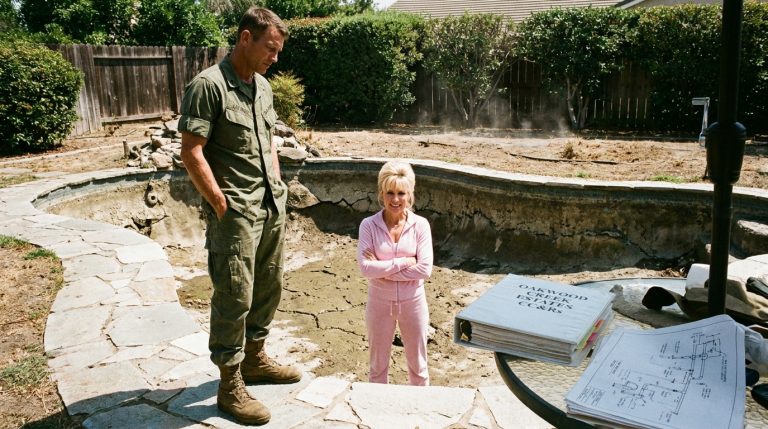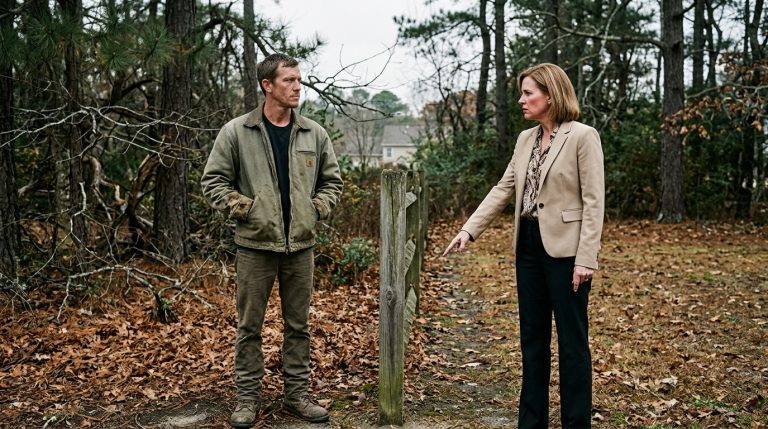
The Iron Easement: A Combat Engineer’s War for the Integrity of Oak Creek Estates
CHAPTER 1: The Cut Line
The engine of my truck ticked as it cooled, a rhythmic, metallic heartbeat that did nothing to settle the cold pressure building behind my eyes. I stood at the edge of the property line, staring at the trench. It was a shallow, sloppy scar in the earth, and in its center, the arterial supply to my livelihood lay butchered.
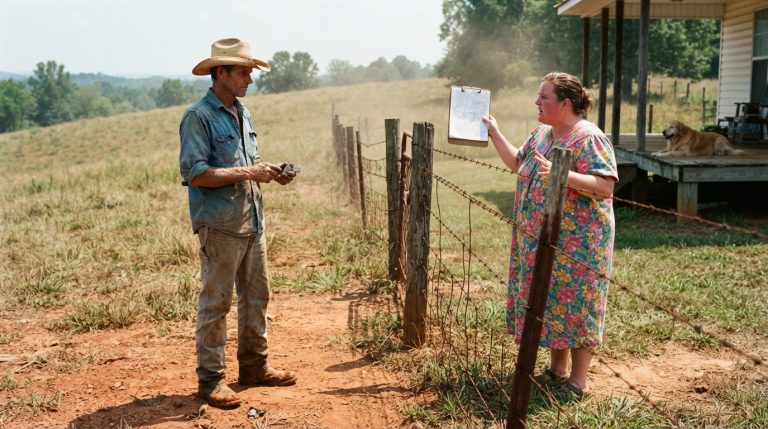
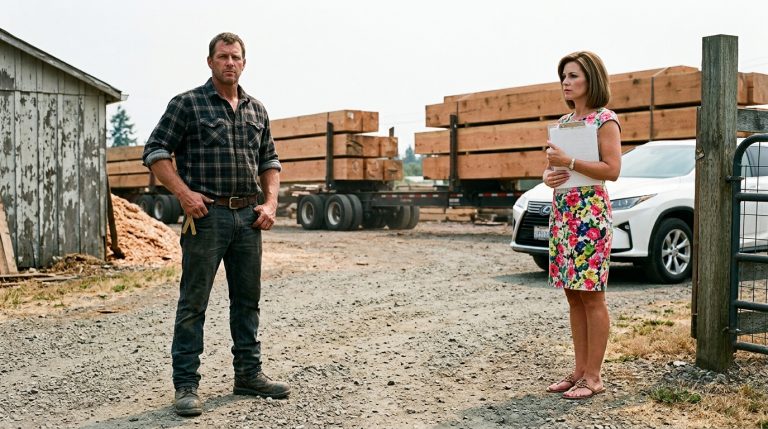
Karen Peterson stood over it. She held a pair of industrial-sized yellow bolt cutters with the kind of smug, self-satisfied grip someone usually reserved for a garden tool used on weeds. She looked at me, then at the cable, then back at me, waiting for the applause.
The casing was split. The heavy-gauge copper wires, which I had personally verified during my due diligence phase, were splayed out like the entrails of a sacrificial animal. The smell of disturbed, damp earth mixed with the sharp, acidic tang of ozone—a scent that shouldn’t have been there, not with the breaker tripped at the substation, but it was there, hovering in the stagnant air of the subdivision.
“This unsightly cable was violating common area aesthetics, Mr. Miller,” she said. The voice was oily, grating. “You should have used an approved contractor for a buried line, not this aerial monstrosity.”
I looked at the bolt cutters. There was a faint, jagged deformity on the leading edge of the blades—a chip in the hardened steel. It suggested the cutters hadn’t just sheared through; they had hit something harder than expected, or perhaps, they had been forced at a precise, mechanical angle that didn’t match a simple snip. It was a precise, violent action.
My pulse slowed, dropping into the rhythmic cadence of a combat engineer surveying a breach. I didn’t see a neighbor. I saw a failure in the perimeter.
“Karen,” I said, the word coming out flat, devoid of the heat I expected to feel. “Put the tool down. Step away from the trench. You have no idea what you’ve just done.”
She smirked, a twitch in her cheek that didn’t reach her eyes. She dropped the cable ends, the weight of the copper thudding against the dirt. “I know exactly what I’ve done, Mr. Miller. I have enforced our community standards.”
I didn’t answer. I reached into my pocket for the phone, the screen already cold against my thumb. As I fumbled to open the camera, a small, out-of-place detail caught my eye: a piece of blue plastic tape, the kind used to mark survey lines, was snagged on the handle of her cutters. It wasn’t my color. It was the specific shade of blue used by the county engineering department for the Utility Easement 104-B markings I’d had placed weeks ago.
It wasn’t a coincidence. She hadn’t just wandered out here on a whim. She had been scouting the property line with a level of precision that felt less like a nuisance and more like a tactical clearance.
The realization hit me with the weight of wet concrete. She didn’t just want the cable gone; she wanted the easement clear. I turned the camera on, the red recording light blinking like a single, judgmental eye. I wasn’t just recording a neighbor dispute anymore. I was documenting the first phase of an eviction, and I was the one being evicted.
I held the phone steady, capturing the way the sunlight hit the jagged, severed ends of the copper. I needed to see the path of the trench again, and then I saw it—the line wasn’t just cut. It was severed precisely where the easement crossed the drainage runoff, right where a construction vehicle would need to turn to access the wooded lot behind the houses.
“You’re not just enforcing standards, Karen,” I said, my voice dropping to a low, serrated edge. “You’re clearing a path.”
Her smile faltered. For a heartbeat, the mask slipped, revealing not a petty HOA president, but a panicked operator whose operation had just hit a snag.
CHAPTER 2: The Command Center
The silence that settled between us was heavy, broken only by the sharp, metallic ping of the truck’s manifold contracting in the cool evening air. Karen’s hand remained frozen near the bright yellow bolt cutters on the grass, her fingers twitching slightly against the worn plastic grip. The blue marker tape from Utility Easement 104-B fluttered against the steel jaw of the tool, a tiny, accusing flag in the desaturated gray dusk.
She didn’t reach for the wire again. The calculation in her eyes had shifted from the blind authority of an HOA ledger to the survival instinct of a cornered animal.
“You’re out of your depth, Karen,” I said, my thumb remaining steady on the phone’s recording button. My camera captured the slight tremor in her chin, the way her weight shifted back toward her heels, preparing for a retreat that didn’t exist.
“This is an association matter, Mr. Miller,” she sputtered, though the grating condescension had leaked out of her voice, replaced by a thin, reedy vibration. “We have the right to abate non-compliant structures. The board—”
“The board doesn’t override a county-registered utility easement,” I cut her off, my voice maintaining the low, level cadence used for clearing minefields. “You didn’t just snip a line. You bypassed a federal marker. Look down.”
Before she could look, the high-pitched wail of an approaching siren sliced through the quiet of Oak Creek Estates. The sound grew larger, bouncing off the pristine vinyl siding of the surrounding cul-de-sacs. Within ninety seconds, red and blue strobes washed over the manicured lawns, turning the green grass into a pulsing, desaturated purple. A white utility truck with the county power emblem followed immediately behind the cruiser, its heavy diesel engine rumbling as it pulled onto the gravel shoulder.
The police officer who stepped out was squared-away, his boots hitting the pavement with a clean, deliberate thud. He took in the parameters of the site in a single glance: the shallow trench, the severed three-phase copper sinews weeping grease into the dirt, the industrial bolt cutters, and the phone in my hand.
“Step away from the ditch,” the officer ordered, his hand resting naturally near his duty belt. He wasn’t looking at me; his eyes were locked on Karen’s gloved hands.
Karen immediately stepped forward, her hands flailing in a wide gesture that lacked its previous administrative weight. “Officer, thank goodness. This resident has installed an unpermitted industrial service line through the common green space. As the president of the association, I am performing emergency maintenance to protect—”
“Ma’am, stop talking,” the technician from the utility truck called out, his voice sharp with genuine alarm as he approached with a long voltage detector wand. He didn’t look at her paperwork; he looked at the physics of the hole. “You cut a two-0-0 amp commercial feed with hand tools? You’re lucky the ground is dry enough not to have turned you into a carbon arc. Officer, secure the perimeter. This line needs a physical isolation verification from the substation before anyone touches this strip.”
I stepped back exactly three paces, keeping my movements predictable and visible. I pulled the laminated survey map from my truck’s side pocket and held it out, the thick plastic corner catching the strobe lights. “Officer, Frank Miller. Owner. Retired Marine Corps combat engineer. The line is inside a ten-foot registered corridor. I have the county plat records right here. The damage exceeds the felony threshold.”
The officer took the map, his eyes tracking the red boundaries of Utility Easement 104-B down to the exact spot where the dirt was piled. He looked up at Karen, whose face had gone a mottled shade of ash gray. The metallic click of the officer’s utility belt expanding was the loudest sound in the driveway.
“Ma’am,” the officer said, his tone entirely devoid of neighborhood diplomacy. “Put the tools down and turn around.”
The neighborhood was waking up. Down the block, garage doors floated open in silence, the faint glow of interior lights revealing the silhouettes of residents watching the queen of the association get steered toward the rear door of a cruiser. My workshop remained dark behind me, its cold machinery waiting for power that wouldn’t come tonight, but the first breach had been held.
CHAPTER 3: The First Salvo
The heavy door of the cruiser clicked shut, sealing the low hum of the police radio behind reinforced glass. Through the desaturated tint of the rear window, Karen’s outline sat rigid, her silhouette framed by the rhythmic, alternating pulses of red and blue light. The neighborhood residents lingered along the edge of their asphalt driveways, their murmurs drifting through the damp air like exhaust fumes before slowly dispersing.
The responding officer finished securing the survey document in his tactical folder, the plastic sleeve rustling against his uniform jacket. “The state utility investigators will be out by sunrise, Mr. Miller,” he said, his thumb flicking a speck of gravel dust off his notebook. “Keep your footage preserved. The county prosecutor handles infrastructure vandalism with strict adherence to the book.”
I nodded once, my posture rigid as I watched the two utility trucks begin deploying safety pylons around the trench. The bright orange plastic cones marked a temporary perimeter over the mangled remains of Utility Easement 104-B. The technician with the voltage wand was already running thick yellow warning tape from my rusted iron fence post to the utility box at the corner of the lot.
The immediate tactical threat was contained, but the logistics of survival were already breaking down.
When the last vehicle cleared the cul-de-sac, leaving only the amber caution lights blinking over the open earth, I walked toward the dark silhouette of the detached workshop. The massive sliding door felt heavier than usual without the mechanical assist of the main line. The interior space was a cavern of silent iron; the plasma table sat like a dead slab, and the fluorescent tubes overhead were dark strips against the rafters.
“Frank?” Sarah’s voice came from the side entrance, the low beam of a battery-powered lantern illuminating her boots as she crossed the threshold. She stopped near the main breaker box, the smell of damp concrete and motor oil rising between us. “The kids are asleep. I called the equipment yard in town. They have an industrial generator available at dawn, but it’s three hundred a week.”
“Reserve it,” I said, my voice flat as I adjusted a crescent wrench on the metal workbench. The steel tool felt cold, its surface coated in a fine layer of grinding residue. “We can’t let the fabrication deadlines slip. If the lathe stays dark past Thursday, the classic car contract defaults.”
“We’ll put it on the commercial line of credit,” she replied, her palm resting briefly against the iron frame of the plasma cutter. “But look at this. I found it tucked under the front windshield wiper of the truck right after the transport vehicle pulled away.”
She handed me a folded sheet of high-weight bond paper. It wasn’t the typical hastily photocopied notice Karen left on doors. This was an official administrative instrument, complete with a legal header from a firm downtown.
I unrolled the page under the narrow white glare of the lantern. The text cited a summary fine of one hundred dollars per day for the placement of unapproved industrial machinery within the residential boundary, specifically targeting the diesel generator we hadn’t even picked up yet.
But my attention stopped on the bottom margin. Next to the standard signature block for the architectural review committee, a tiny administrative string was printed in pale gray ink: REF: Rezoning Application 99-X – Prelim Site Clearance.
The code didn’t belong on a standard residential citation. The HOA guidelines used a standard five-digit residential compliance index, not a municipal land use classification. I ran my thumb over the text, feeling the slight indentation of the laser print against the paper. The association wasn’t just reacting to a violation; they were using an existing filing template from an entirely separate corporate or municipal action.
“They’re anticipating the hardware,” I muttered, the strategic picture shifting slightly in the dark. The counter-move was already printing before the initial breach had even gone to arraignment.
“What does the reference mean?” Sarah asked, her light catching the edge of the laminated survey map still lying on the steel table.
“It means Karen isn’t working from the association binder,” I said, my jaw tightening as I locked the workshop’s iron security latch into place. “She’s working from a project layout. The citation was drafted before she ever brought the bolt cutters to the grass.”
CHAPTER 4: The Resistance
“It means Karen isn’t working from the association binder,” I said, my jaw tightening as I locked the workshop’s iron security latch into place. “She’s working from a project layout. The citation was drafted before she ever brought the bolt cutters to the grass.”
Sarah watched me as I lowered the heavy iron latch, her face caught in the pale yellow glow of the battery lantern. The silence that followed was thick, smelling of old iron and the faint, dry scent of dust. We didn’t sleep much that night. By five the next morning, the high-capacity diesel generator was bolted to the bed of my utility trailer, its green-painted chassis vibrating with a heavy, rhythmic roar that filled the corner lot. The noise was within municipal limits, but it was a declaration of presence. I ran a temporary, heavy-duty insulated trunk line from the trailer, across the dry gravel path, and directly into the shop’s sub-panel.
Within three days, the paper storm intensified. Every trip to the mailbox yielded a fresh, crisp envelope. A fine for an uncoiled hose. A fine for a quarter-sized spot of rust-colored transmission fluid on the concrete driveway. Each notice bore the same layout, the same clean printing, but they lacked the unique code prefix I had spotted on the first sheet.
I sat at my wide metal workbench on Thursday evening, the industrial lathe behind me spinning down with a low, metallic whine. The generator outside suddenly coughed—a sharp, choking skip in its cylinder rotation. The lights overhead flickered, the steady white glare of the halogen tubes dropping to a dim orange wire-glow.
My boots hit the concrete before the engine could stall completely. I grabbed a clean shop rag and a flathead screwdriver from the magnetic strip on the wall, stepping out into the cold night. The exhaust from the generator was heavy, smelling of sulfur and unburnt diesel. I popped the service panel latch on the unit, checking the secondary filter; the fuel line was clogged with a thick, dark sediment that looked like tank-bottom residue. I began working the bleed valve, the hot metal of the exhaust manifold radiating heat against my forearm.
“Need a hand, Frank?”
I didn’t turn around immediately. I recognized the low, cautious voice. It was Tom, my next-door neighbor. He stood just on the margin of my property line, his hands stuffed deep into the pockets of a worn canvas jacket. His eyes darted toward the street, tracking the headlights of a passing sedan before he stepped into the shadow of the trailer.
“Fuel line’s choking on sediment,” I said, my fingers working the manual primer pump. “It’ll run clean in a second.”
“I brought something,” Tom said, stepping closer. He pulled a rolled-up legal folder from beneath his coat. “It’s not just you. She fined us five hundred dollars last month because our kids’ playset slide was blue instead of ‘desert sand.’ My wife cried. We couldn’t afford the legal fees to fight it, so we bought the sand-colored plastic one. But look at this.” He unrolled a document. It was an invoice for the replacement slide, stamped with a small logo: Prestige Greenscapes Ledger.
My thumb froze on the fuel pump. “Prestige Greenscapes? They’re the HOA landscaping contractor.”
“Yeah,” Tom whispered, his voice dry. “And the invoice address is a P.O. Box that matches the one on the back of Karen’s personal tax assessment notice from three years ago.”
Before I could answer, another figure materialized from the darkness near the woodpile. It was Dave, the retired Air Force veteran from two doors down. He walked with a slight, measured limp, his canvas cap pulled low. He didn’t say hello; he just dropped a heavy, metal-bound ledger onto the trailer’s steel fender with a dull clank.
“She made me take my flagpole down last spring,” Dave said, his jaw set so tight the muscle in his cheek twitched. “Said it was a hazard. I’ve lived here fifteen years, Frank. I’ve flown the colors every day since my son didn’t come back from the Gulf. I kept the old minutes from the executive board sessions before she took over. They used to be open. Now, they’re private.”
Mrs. Gable, the elderly widow from the corner, stepped into the light of the workshop door, holding a small thermos of black coffee. The steam rose in the cold air, smelling of chicory. “She’s trying to fine me out of my house, Frank. My roses are three inches over the walkway. She sent me a notice saying she would hire a contractor to clear them at my expense.”
I wiped my grease-slicked hands on the rag, looking at the three of them gathered around the vibrating green generator. The engine suddenly caught, its exhaust clearing with a sharp bark as the line ran clean. The bright halogens inside the shop surged back to life, casting long, sharp shadows across the concrete.
“She’s been taking us out one by one,” I said, my voice carrying the steady, cold weight of a strategic briefing. “Because we’ve been fighting her one by one. That ends tonight. Bring the files inside.”
We walked into the workshop, the iron sliding door closing behind us with a heavy, definitive latch-click that shut out the neighborhood.
CHAPTER 5: The War Room
The iron door settled into its track with a low, bone-deep thud that vibrated through the concrete floor, cutting off the rhythmic, muffled thump of the diesel generator outside. In the sudden containment of the workshop, the silence was absolute.
Tom, Dave, and Mrs. Gable stood in a tight semicircle near the edge of the steel fabrication table. The narrow beam of the battery lantern crossed with the harsh overhead glare of the flickering halogens, throwing their long, distorted shadows against the unfinished drywall. Dave set his heavy, metal-bound folder down on the grease-stained metal. The corner of the binder scraped against the steel with a high, metallic shiver.
“We aren’t just looking at petty fines anymore, Frank,” Dave said, his hand remaining on the metal rivets of his folder, his knuckles white. “This goes back years. Before your power line was ever laid.”
I didn’t answer immediately. I pulled a set of clean wooden sawhorses over and laid a thick sheet of unfinished plywood across them, creating an impromptu sorting deck next to my plasma cutter. “Lay it out,” I said, my voice quiet, matching the tactical gravity of the room. “No stories. Just the paper.”
Tom unrolled his documents first, his fingers trembling slightly as he flattened the blue sand-colored slide invoice. My eyes skipped past the personal hand-written notes and locked on the transaction ledger code at the top. It was formatted exactly like the citation under my windshield wiper, but the prefix was different: ARC-04-A-PRESTIGE.
“Arthur’s coming,” Mrs. Gable murmured, her small hands clutching the warm thermos of coffee like a shield. “He said he’d bring the certified bank statements from the two years he served as treasurer before Karen forced him out.”
Right on cue, three short, rhythmic taps rattled the small side pane of the workshop’s security window. I slid the viewport slide aside. Arthur’s face—lined, pale, and damp with sweat—pressed against the glass. I unlocked the deadbolt, slipping him through the narrow gap. He was carrying a cardboard banker’s box that smelled of dry basement dust and decaying wood pulp.
“They didn’t shred the ledger,” Arthur gasped, his breathing shallow as he set the box down with a dull, heavy puff of dust. “They thought because the archives were archived under old county road specs, nobody would pull them. But look at this.”
He pulled out a thick, yellowed spreadsheet—the Prestige Greenscapes Ledger from 2024. His pencil point hovered over a column marked Disbursement-Misc. “Every month, ten thousand dollars was marked as ‘soil remediation.’ But look at the account destination routing number.”
He slid a second sheet—a copy of a state rezoning index—next to it. The routing number matched the corporate clearing account listed on Rezoning Application 99-X, the exact file prefix I had seen on my windshield ticket.
“They’re siphoning the maintenance reserves to pay the filing fees for the development easement,” I remarked, the cold logic of the operation resolving in my mind. My index finger traced the red boundary line of my laminated survey map. “But there’s an anomaly here.”
I leaned closer to the ledger, my eyes catching a line item that didn’t fit. A major transaction of seventy-five thousand dollars had been routed through a secondary subsidiary called Vanguard Infrastructure Partners—a name that had never appeared in any residential correspondence.
“What is Vanguard?” Tom asked, his eyes scanning the columns.
“It’s not a landscaping firm,” I said, my voice hardening as the true scale of the defensive line became visible. “They’re a private excavation contractor. They specialize in clearing heavy utility obstructions.”
Before Dave could speak, the flickering halogen tube directly above us hummed violently and went dark, plunging the center of the room into a deep, shadow-choked twilight. Only the pale white beam of the battery lantern remained, casting the splayed documents on the table into stark, razor-sharp relief.
The decoy of aesthetic compliance was gone. The paper in front of us wasn’t a record of neighborhood rules—it was a blueprint for a hostile takeover, and my workshop was the final barricade.
CHAPTER 6: The Presentation
The darkness of the center workshop space was vast, thick, and smelling of cold iron dust. Under the single, narrow cone of white light from the lantern, the characters on the spreadsheet seemed to vibrate. Nobody moved. The silence was absolute, save for the dry, shallow rasp of Arthur’s breathing.
Then, a low, metallic thrum shuddered through the concrete floor.
It wasn’t the generator. This was a deep, resonant hum that vibrated the heavy galvanized conduits running along the rafters. A sharp crack of electrical static popped inside the sub-panel on the wall, followed by a faint, hot smell of copper. The municipal utility crew down the block must have energized the primary line for a diagnostic load test. The sudden vibration made the tools hanging on the magnetic board behind me rattle like small teeth.
“Frank,” Dave whispered, his eyes tracking the shadows dancing near the steel ceiling beams. “The line’s getting warm. We’re running out of quiet hours.”
“We don’t need quiet,” I said, my voice cutting through the vibration with the hard, flat weight of an iron stake. “We need leverage. And we have it.”
I leaned down, my rough fingers pinning the edge of the Prestige Greenscapes Ledger against the cold plywood. The seventy-five thousand dollar transfer to the subsidiary listed under Rezoning Application 99-X was documented, black ink on white pulp. But there was a physical discrepancy on the document itself. The signature authorizing the release of those funds wasn’t Karen’s usual aggressive, sweeping handwriting. It was a neat, mechanical stamp, authorized under a special municipal proxy clause.
“She didn’t sign this,” I remarked, pointing to the purple ink mark. “She couldn’t. This required an administrative signature from someone with county-level clearance to bypass Utility Easement 104-B.”
Arthur reached into the cardboard box, his liver-spotted hand retrieving a smaller, blue-lined ledger. “Because it’s not a standard HOA project. The county planning commission has been receiving direct payments from a clearing account registered to Karen’s husband’s practice. But the developer—the corporate developer—is the one pulling the wire.”
“Then she’s just the field engineer,” Dave said, his jaw tightening as he adjusted the canvas strap of his cap. “The one they sent to clear the obstacle. Your workshop is the obstacle.”
“Therefore, she had to cut the line,” I said, the causality lock dropping into place. “If she could prove the service was inactive and non-compliant, the developer could claim the easement was abandoned. But she made a mistake. She didn’t calculate the physical permanence of the county filing.”
“What do we do now?” Tom asked. His hands had come out of his pockets, his knuckles resting flat against the steel layout table. “We can’t just sit here and watch them run an excavation crew through your yard.”
“We call the special meeting,” I said. “Tonight. We have the fifty-eight signatures. We’ve got the school cafeteria booked under the civic outreach ordinance. We don’t wait for her to make bail and coordinate with her legal team. We deploy the evidence while she’s still in the system.”
I began rolling the laminated maps and securing the ledgers in my heavy canvas field pack. The zinc zipper rasped in the quiet room, a dry, metallic sound that signaled the transition from reconnaissance to direct assault.
“Dave, get the transport ready. Tom, notify the block captains on the messaging app. Tell them we have the financial disclosure. Arthur, you’re on the projector.” I buckled the brass clips of the pack, the metal snapping shut with a definitive, clean clack. “We’re going to show the neighborhood exactly what their five-hundred-dollar fees have been buying.”
The generator outside gave one last, deep throb as I reached for the main breaker switch, locking the workshop down for the deployment.
CHAPTER 7: The Coup
The heavy black toggle of the workshop’s secondary breaker clicked into the off position under my thumb, killing the hum of the auxiliary line and dropping the rear yard into the cold, silent dark. Only the tiny, flashing orange lights of the utility crew’s distant barricades broke the shadows of the cul-de-sac.
“Let’s move,” I muttered, my boots crunching against the dry, frozen gravel as we crossed toward my truck.
Dave already had the tailgate of his utility pickup down, his bad knee stiff as he secured the heavy banker’s boxes with elastic cords. Tom was sitting in the passenger side of my cabin, his fingers dancing across the screen of his phone as he sent the final coordination coordinates to the block captains. Nobody spoke on the six-minute drive through the winding, manicured loops of Oak Creek Estates. The streetlights passed overhead in monotonous, rhythmic increments, illuminating the desaturated green of lawns that had been funded by the very siphoning we were about to expose.
When we pulled into the gravel lot of the local elementary school, the sheer volume of parked cars told the story. The neighborhood had emptied into the building.
The air inside the school cafeteria was thick, smelling of old floor wax, industrial detergent, and the sour scent of collective anxiety. Over eighty residents occupied the folding metal chairs, their voices rising in a disorganized, nervous buzz. At the front of the room, behind a long wooden table normally used for school lunches, sat Karen Peterson, Carol Thatcher, and Patricia Gable.
Karen’s face was a tight, pale mask under the harsh, humming cafeteria tube lights. Her fingers drummed against the plastic surface of her clipboard, her knuckles white. Next to her, their attorney—a man in a cheap polyester suit—shuffled a stack of papers with rapid, nervous motions.
“We have no record of this meeting being authorized by the executive board,” the attorney squawked as I stepped into the center aisle, my heavy canvas pack hanging from one shoulder. “This is an administrative intrusion.”
I didn’t slow down. My boots hit the vinyl tile floor with a steady, military cadence. I unbuckled the brass fasteners of my pack, the metal snapping open with a clean, loud ring that cut through the room’s chatter.
“The signatures are verified under Section Twelve of the bylaws, Counselor,” I said, my voice projecting easily across the crowded space. “Fifty-eight registered deed-holders. That’s forty-eight percent of the community. We are legally constituted.”
Arthur was already at the side projector, his fingers shaking slightly as he aligned the lens with the white plaster wall. He clicked the first slide into place.
The projection filled the wall: a high-resolution scan of Rezoning Application 99-X, side-by-side with the private financial transactions from the Prestige Greenscapes Ledger.
The room went completely, violently silent. You could hear the distant, high-pitched whistle of the school’s ventilation unit.
“This is the property line of my workshop,” I said, pointing a metal scaling rod at the bright red line representing Utility Easement 104-B. “And this blue-shaded corridor is the proposed access road for a one-point-two-million-dollar development. Karen Peterson cut my power line not because it was non-compliant, but because its physical existence legally blocked the county rezoning approval. She used your annual maintenance fees to pay the development’s preliminary excavation fees.”
A collective gasp swept through the rows of chairs.
Karen rose from her seat, her chair scraping against the tile with a high, shrieking squeal. Her face had turned a deep, blotchy red. “This is a fabrication! These are unverified, stolen internal records!”
“They were delivered under a court-ordered subpoena, Karen,” Ms. Evelyn Reed’s voice cut in from the back of the room. My lawyer walked forward, her heels clicking with absolute authority against the floor. “And your brother-in-law’s signature is on the land transfer agreement. Sit down.”
The attorney whispered something urgent into Karen’s ear, pulling her sleeve, but she shoved his hand away, her eyes locked on me with a raw, impotent fury.
Dave began passing out the ballots, the white paper slips rustling as they went from hand to hand. The process was silent, clinical, and total. The tyranny of Oak Creek Estates wasn’t ending with a physical struggle; it was being dismantled by the quiet stroke of eighty-nine pencils against paper.
The final count was tallied on the chalkboard behind the lunch table. When the last name was written, the room erupted into a deafening roar of relief. The board was gone.
CHAPTER 8: The Dusty Road
The chalkboard dust drifted down in a pale, dry cloud, settling on the varnished lunch table where the board members had sat only minutes before. The chalked numbers—eighty-nine to four—remained etched in bold, aggressive white lines. Behind me, the cafeteria doors swung back and forth, their rubber gaskets whispering against the frames as the crowd of neighbors began to spill out into the chill of the evening.
I picked up my canvas pack from the floor. The metal brass clips cold against my fingers. I didn’t join the celebrating groups gathered near the water fountains. Instead, my eyes tracked the three figures moving in a tight, defensive cluster toward the side exit.
Karen Peterson was already at the door, her fingers white as they gripped the horizontal brass panic bar. She pushed it open, the cold outdoor air rushing in to meet the humid, wax-scented heat of the school. Her lawyer followed, his polyester suit jacket bunched at the shoulders, clutching his leather briefcase like a shield.
I stepped through the door behind them, my work boots crunching onto the damp gravel of the parking lot.
The security lights from the school cast long, desaturated shadows across the vehicles. Waiting near the edge of the asphalt stood Detective Russo, his trench coat unbuttoned, his frame motionless against the pale glare of a nearby sodium lamp. Beside him, a young process server stood holding a thick sheaf of legal papers secured by a blue backing strip.
Karen stopped, her heel catching in a shallow pothole in the gravel. The physical jar of it seemed to ripple through her entire posture. Her face, illuminated by the cold amber light, looked hollowed out—the sharp, predatory certainty she had carried for years entirely gone, leaving only a dry, wrinkled fatigue.
“Ms. Peterson,” the process server said, stepping forward. He didn’t raise his voice. He simply extended the folder. “You’ve been served. Civil summons from the chambers of the County District Court.”
She didn’t reach for it. Her hands remained pressed against her sides, her fingers twitching against the wool of her coat. The server placed the papers gently on the hood of her parked sedan, the crisp bond paper rustling against the cold metal.
Detective Russo stepped into the light. “The Grand Jury returned the indictment this afternoon, Karen. Felony criminal damage under section forty-four, and reckless endangerment for the live line. Your attorney has the booking schedule.”
Karen’s lawyer grabbed the folder from the hood of the car, his jaw working in a tight, silent calculation. He looked at me, then down at the papers, and finally at his client. “Don’t say a word,” he muttered, his voice barely a breath. “We’re leaving.”
She turned her head slowly, her gaze locking onto mine. For a second, the dry wind caught her hair, blowing it across her eyes. There was no rage left in her expression, only a flat, empty recognition of the boundary line she had crossed. She had tried to treat the land, the easement, and the people who lived on them as numbers on a ledger to be erased. Now, the ledger had closed on her.
She got into the passenger seat of her car, the door shutting with a heavy, ungreased clank that echoed across the empty lot.
Ten days later, the real power came back.
I stood in my workshop, the large sliding door pushed completely open to let the crisp afternoon air circulate. Outside, the orange utility barricades were gone, replaced by a neat patch of fresh seed and straw over the scar of Utility Easement 104-B. The heavy-duty three-phase cable was buried five feet deep now, encased in reinforced steel conduit that would outlast the house itself.
Inside, the halogens hummed with a clean, steady white light. The industrial lathe sat polished, its cast-iron bed free of rust, waiting for the first piece of steel.
I walked over to the magnetic tool board, reaching for a small, rusted steel rod—a scrap piece of reinforcing bar left over from the day Karen cut the line. I secured it in the three-jaw chuck of the lathe. I flipped the power toggle; the machine surged to life with a deep, confident roar that vibrated through the soles of my boots. I brought the cutting tool down, the sharp carbide edge shearing through the oxidized outer layer of the steel, sending a bright, hot shower of blue-gray spirals tumbling into the metal tray below.
Sarah stepped into the shop, a cold bottle of beer in her hand. She didn’t speak. She just set the bottle down on the clean wood of the workbench and leaned against the frame of the plasma table, watching the steady, deliberate movement of my hands.
From the wooded green space behind our property, the sound of children laughing drifted through the open door, clear and unbothered by the strict rules that had once kept them silent. Dave’s flagpole was visible through the window, the halyard clicking against the aluminum tube as the colors rippled in the dry afternoon breeze.
The old boundaries had been broken, but the foundation was secure. I shut down the lathe, the heavy metal spinning to a silent, perfect rest.
“It’s clean,” I said, running a finger along the newly turned steel.
“Yes,” Sarah replied, a quiet smile easing the tension around her eyes. “It is.”
The battle was over. The peace had been paid for in full, and the work could finally begin.