The Line We Draw: A Hardboiled Story of Protection, Pride, and the Sanctuary We Defend
CHAPTER 1: THE BREACH AT DAWN
The drywall stud beside my head vibrated three times before the glass frame dropped.
I caught the picture by instinct—cold glass, tarnished brass frame, two inches off the hardwood floor. My pulse stayed at sixty, but my right thumb automatically swept the edge of the side table, searching for the matte-black polymer grip of my Glock 17.
It wasn’t there.
Leave. Day three.
I set the framed commendation back on the console table and listened. This wasn’t heavy artillery or a blown transformer. It was a 60-hertz sub-bass wave hitting the exterior cedar siding of my house with enough force to hum through the floorboards of my living room.
I didn’t reach for a weapon this time. I grabbed a worn cotton t-shirt, pulled it over my shoulders, and stepped to the front window.
My driveway was gone.
Two hundred feet of crushed limestone—paid for with six years of state trooper overtime and a mortgage contract explicitly free of Homeowners Association signatures—was buried under seventy yards of heavy crimson felt.
A balloon arch, sagging slightly to the left, was tied off on my white oak fence posts. Near my hydrangeas, a man in a sweat-stained polo shirt was wrestling with the rusted gear-housing of a commercial cotton candy machine, his boots trampling my drip-irrigation lines.
In the center of the driveway stood a woman in four-inch heels. She wore oversized aviator sunglasses and a glittery silk sash that caught the sharp morning light: HOSTESS.
The clock on my stove read 9:02 AM.
I didn’t grab coffee. I opened the heavy oak front door, feeling the humid morning air hit my face, and walked down the porch steps in grey joggers. My boots crunched off the edge of the red carpet and onto the grass.
The woman didn’t stop shouting at the man with the cotton candy machine until my shadow fell over her clip-board. She turned slowly, her heels sinking an inch into the soft loam beside my gravel edge. Her eyes drifted down my shirt, past my faded gym shorts, and landed on my bare ankles.
“You can’t park that there,” she said. Her voice had the dry, practiced rasp of someone who spent eight hours a day yelling over low-grade PA systems.
I didn’t move. “Park what?”
“That truck.” She pointed a manicured fingernail toward my black F-250, sitting parked four feet in front of my closed garage bay. “It’s blocking the main procession entrance. Move it around back.”
“That truck has been parked there for two years,” I said. My voice stayed flat, dropped into the register I used during midnight traffic stops on Highway 9. “This is my driveway.”
She scoffed, flicking a wrist wrapped in cheap gold-plated bangles. “We cleared the spatial access with the HOA. The access lane is communal during event hours.”
“There is no HOA.”
She blinked once behind the dark lenses, her lips tightening into a thin, painted line. “Well, someone said we could use it.”
“Who?”
“Derek,” she snapped, checking her phone screen. “Derek in coordination.”
“Who is Derek?”
“My event planner’s cousin.” She stepped closer, invading my space with a heavy wave of synthetic floral perfume. “Look, mister. This is a private charity gala for regional awareness. We have sixty guests arriving at ten. If your vehicle ruins the staging aesthetics, I’ll have security clear it.”
Behind her, a white cargo van backed up my gravel approach, its rear tires grinding into the roots of my shade trees. Two men in black shirts began hauling a four-hundred-watt loudspeaker stack out of the rear doors, heading straight for my front lawn.
I pulled a brass key ring from my pocket, sliding the heavy metal edges between my knuckles. Click. Click.
“Ma’am,” I said, leaning in just enough so she could see her own reflection in my eyes. “You have sixty seconds to turn that van around, pack that carpet, and clear off my deeded property.”
She backed up half a step, her hand flying to her throat as if I’d drawn a blade. “You’re being extremely aggressive right now.”
“I’m standing on my land.”
“You need to leave this perimeter,” she shouted, her voice jumping an octave to catch the attention of the van drivers. “This is a professional function! I am calling the police!”
I stared at her for two seconds, the brass keys cold against my palm. A slow, dark amusement settled deep in my chest.
“Do it,” I said. “Use nine-one-one.”
Her thumb jabbed at her phone screen like she was stabbing an enemy. “Ten minutes. You’ll be in handcuffs in ten minutes.”
I sat down on the top step of my porch, crossed my arms, and waited.
Exactly nine minutes later, the blue-and-white strobe lights of two county patrol units flashed through the treeline at the end of my lane.
The driver’s side door of the lead cruiser popped open, and Officer Rojas stepped out, adjusting his duty belt. He took three steps toward the red carpet, paused, and looked at the balloon arch tied to my mailbox. Then his eyes drifted to me, sitting on the porch in my t-shirt.
Rojas cleared his throat. “Trooper Marshall?”
Karen marched right between us, her heels clicking like small-arms fire against the asphalt apron.
“Officer!” she announced, her voice echoing across my yard. “This trespasser is refusing to clear the staging area for an authorized charitable operation! I want him removed immediately!”
Rojas looked at her. He looked at the margarita machine hum-powering off my exterior wall socket. Then he looked back at me.
“Marshall,” Rojas said quietly. “This your place?”
“It is.”
“Did you give this lady a land-use waiver?”
“No.”
Karen’s head snapped toward Rojas, her sunglasses sliding down the bridge of her nose. “You know this man?”
“He’s a State Trooper, ma’am,” Rojas said, pulling his leather notepad from his pocket with agonizing slowness. “And you’re currently standing on his private residential lot.”
The silence that followed was heavy enough to hear the cotton candy machine spinning in the grass. Karen didn’t blush. She didn’t apologize. She simply pulled her sash straight, glared at my truck, and adjusted her clipboard.
“Well,” she whispered, her voice cold as iron. “We’ll just see what the county board says about that tomorrow morning.”
CHAPTER 2: THE PAPERWORK PARADOX
The silence lasted four seconds.
Rojas’s ballpoint pen clicked once in the humid morning air. A crow called out from the high pine behind my woodshed, its shadow cutting across the bright red carpet running up my driveway.
Karen didn’t pull her phone back. Her thumb remained pressed against the glass, her dark aviator lenses reflecting the blue-and-white strobe lights still painting the underside of my oak trees. She expected a reaction. She expected Rojas to flinch, or me to step down off the porch and bargain.
I didn’t move an inch. I reached into my pocket, my fingers finding the cool, notched teeth of my truck key. I rolled it against my palm, letting the cold brass ground me.
“County board office opens at eight-thirty tomorrow,” I said, my voice low enough that only she and Rojas caught it over the rumble of the patrol car. “You’ll want desk four. Ask for Miller.”
Karen’s chin jerked up. “I don’t need your advice.”
“I’m not giving advice,” I replied. “I’m telling you who files the civil nuisance citations. You’ll save yourself twenty minutes in line.”
Rojas swallowed a grin, turning his body slightly to screen his face from her. He stepped between Karen and the blue-and-white hood of his car, pulling his notepad flat against his forearm.
“Ma’am,” Rojas said, his tone shifting into the measured, rhythmic cadence of an officer filling out a field report. “I need to see the municipal land-use permit. The one issued by the county.”
“It’s right here.” She snapped her wrist, thrusting the aluminum clipboard toward his chest.
I stayed on the porch, but my eyes locked onto the metal board. The top page was a standard green-tinted form—County Form 104-B. But the corner was missing its heavy brass filing clip. It was bound by a cheap, unbranded wire staple that had already begun to rust against the damp paper.
Right under the header, stamped in faded violet ink, was a tracking code: Project Cinder / Sub-Unit 4.
My mental database clicked. Project Cinder wasn’t a county charity initiative. It was an old regional forestry designation used for brush clearing three years ago.
Rojas adjusted his glasses, his thumbnail running over the seal. “This isn’t an active event permit, ma’am. This is an informational filing stub.”
“It has the seal!” Karen shouted. Her composure, carefully held behind the designer sunglasses and silk sash, cracked just enough to let a raw, shrill edge through. “Derek gave me that sheet himself yesterday afternoon!”
“Who signed it?” I called out from the porch.
She turned toward me, her heels twisting in the soft dirt beside the carpet edge. “The event supervisor!”
“Name,” Rojas said, pen ready.
“Derek W.,” she said, her chest heaving slightly under the glittery sash. “He works out of the regional land administration building. He told us this parcel was under public utility easement pending the highway expansion!”
Rojas stopped writing. He looked up at the sky, then at the thick oak line marking my northern property boundary, then back at Karen. “Ma’am, Highway 9 is four miles east. There is no public easement here. This is private agricultural land.”
“Then your maps are wrong!” she hissed. She turned, her red soles cutting deep gouges into my grass as she marched toward the white van. “I am not cancelling this gathering. We have caterers on the interstate. We have three local news teams arriving at eleven!”
She didn’t wait for Rojas to answer. She pulled open the van’s side door, reached inside, and dragged out a folded metal chair, slamming its legs down directly onto my hydrangeas.
Rojas looked at me, a tight, exhausted line appearing between his eyebrows. “Marshall. I can issue a warning citation for unauthorized entry, but until code enforcement puts a physical orange tag on the property line, my hands are tied on immediate physical removal if she claims a civil land dispute.”
“I know the code, Rojas,” I said, stepping down off the porch. My boots hit the gravel with a hard, dry crunch. “You did your job. Go back on patrol. I’ll handle the paperwork side.”
“Don’t do anything stupid,” he muttered, though he knew better.
“I’m on leave,” I said flatly. “I have all day.”
I didn’t argue with Karen while she arranged twelve folding chairs in a neat semicircle facing my front porch. I didn’t stop the two men when they hauled a eight-foot inflatable swan out of the back of a second truck, plugging its yellow extension cord directly into my porch outlet.
I let the air compressor hum. I let the swan inflate until its ridiculous vinyl neck towered over my gutter line.
I walked inside, closed the heavy oak door, and locked it.
I went straight to my desk in the back den, pulled out a yellow legal pad, and opened my laptop. I pulled up the county property registry portal—the one I used when running background checks for state highway investigations.
I typed in the tracking code from her clipboard: Project Cinder.
The screen loaded slowly, the wheel spinning against the county’s outdated server. When the page finally opened, it didn’t show an event permit. It pulled up a cross-referenced property tax flag attached to my parcel.
A secondary document was linked in the system logs, marked under a pending status code: Deed-Lock 7.
I leaned back in my chair, my thumb automatically reaching for the brass key ring on the desk. Click. Click.
My deed wasn’t just being infringed upon by a loud woman with an inflatable swan. Someone inside the county office had flagged my property identification number for an administrative title review—the kind of quiet, bureaucratic hold that gets placed right before a tax parcel is sold off at a forced municipal auction.
And the clerk who had authorized the hold forty-eight hours ago was listed as D. Vance.
Outside, a fresh wave of bass rattled the windowpane behind my desk, harder this time. The margarita blender roared to life on my porch wall socket, pulling enough amperage to make the overhead light in my den flicker once.
I picked up my phone and dialed a direct number I hadn’t called in fourteen months.
“County Code Enforcement, Nate speaking.”
“Nate,” I said, staring at the blue light of the monitor. “It’s Marshall. Grab your clipboard, a couple of utility lockout tags, and get out to my place. I’ve got a commercial operation running off my residential breaker.”
Nate paused on the line. “Marshall? You’re on leave. What kind of commercial operation?”
“A circus,” I said, looking out the narrow den window just in time to see a third delivery truck back over my mailbox. “And bring the civil fraud forms. We’re going to need them.”
CHAPTER 3: THE INFLATABLE SWAN INCIDENT
The sound of four-inch yellow pine snapping was louder than the generator.
I didn’t reach for my keys this time. I opened the front door, stepping past the roaring margarita blender just as the truck’s rear bumper cleared my shattered mailbox. A cloud of fine wood dust settled over the hood of my F-250.
The delivery driver didn’t get out. He threw the truck into drive, the rear dualies tearing a two-foot trench through my gravel shoulder before disappearing down the county road.
I stood on the porch, looking down at the heavy black extension cord wrapped three times around my porch railing. It stretched across forty feet of ruined turf, straight into the air intake of the twelve-foot inflatable swan now swaying above my roofline.
Karen was standing beside a folding table, meticulously aligning a row of gold-trimmed plastic wine flutes. She caught my eye and didn’t even flinch.
“That post was rotted anyway,” she called out, her voice carrying over the high-pitched whine of the swan’s blower motor. “We’re doing you a favor clearing the sightline for the media shuttle.”
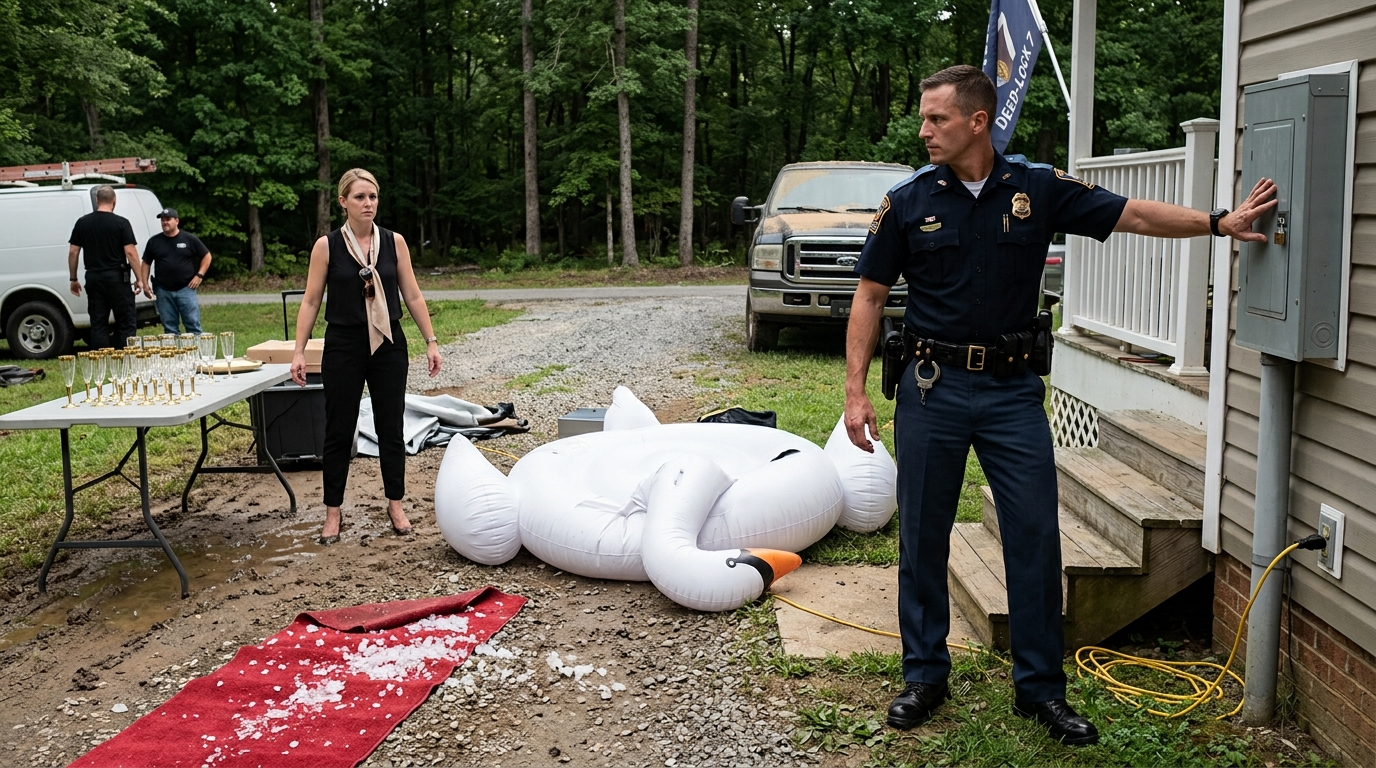
I walked down the steps, my boots sinking into the wet mud where her caterers had dumped three bags of crushed ice. I reached the side of my house, flipped open the gray plastic cover of the exterior breaker panel, and gripped the main 50-amp toggle switch.
Clack.
The silence hit like a physical weight.
The margarita blender sputtered and died mid-whir. Across the lawn, the giant swan gave a long, mechanical sigh as its vinyl neck crumpled, folding over in a slow, pathetic arc before collapsing directly across my gravel approach.
Karen dropped a stack of napkins. “What do you think you’re doing?”
“Cutting my power,” I said, snapping the steel padlock through the breaker box clasp. Click. “The outlet is private infrastructure. You’re pulling twelve amps without a commercial metering permit.”
She marched across the carpet, her sunglasses hanging by one arm from her silk sash. “We have three hundred dollars worth of frozen cocktail base in that machine! Turn it back on!”
“No.”
“I am running a sanctioned event!”
“You’re running an illegal tap on a private transformer,” I said. “And every second that cord stays plugged into my box, the meter log inside my kitchen records another felony count of utility theft.”
Behind her, a white county pickup truck turned off the asphalt, its yellow safety lights flashing rhythmically against the trees.
Nate stepped out of the cab before the engine fully idle-stopped. He was holding a thick metal clipboard, a pair of bright orange lockout hasp locks swinging from his belt loop, and a rolled-up surveyor’s map tucked under his arm.
Karen pivoted instantly, her heels clicking against the exposed gravel as she intercepted him near the fallen swan.
“Finally!” she declared, her arms opening wide. “An official who understands municipal compliance! This man has just sabotaged a regional charitable gathering! He pulled the main power breaker during food preparation!”
Nate didn’t look at her. He looked at the shattered mailbox post. Then he looked at the twelve-foot vinyl swan lying dead across my driveway. He let out a slow, long breath that smelled faintly of stale diner coffee.
“Ma’am,” Nate said, unrolling the surveyor’s map across the hood of his truck. “I’m the Senior Code Enforcement Officer for District Four. Who issued your temporary site authorization?”
Karen pulled a crumpled paper from her pocket—the same one with the rusty staple I’d spotted earlier. “Derek W. Regional Administration.”
Nate took the sheet, held it up to the morning sun, and ran his thumb along the bottom edge where the county seal was stamped. He didn’t even look at the signature line.
“This seal is a high-resolution inkjet print,” Nate said flatly. “And the parcel code listed here—Vanguard Ledger / Parcel 88—doesn’t exist on the county tax rolls. It’s a placeholder entry used in dry-run software testing.”
Karen’s jaw tightened, her hands clenching into tight fists against her sides. Her thumb pressed so hard into her palm that her fingernails left deep white crescents in her skin.
“Derek gave me that documentation in the lobby of the municipal building,” she insisted, her voice dropping into a dangerous, quiet register. “He had a county badge.”
“Derek W. was fired eighteen months ago for selling forged zoning waivers,” Nate replied, pulling an orange red-tag sticker from his clipboard. “And this property isn’t a public easement. It’s a private homestead owned by Trooper Daniel Marshall.”
Nate stepped past her, walked straight to the fallen swan’s air intake, and slapped the heavy orange sticker directly across the power plug.
“Ma’am,” Nate continued, pulling out a yellow citation book. “You have thirty minutes to clear every piece of non-attached equipment off this acreage. If this carpet is still on this gravel at twelve-fifteen, I’m calling county impound to haul it all to the scrap yard.”
Karen didn’t yell this time. She stood frozen in the middle of her fake red carpet, watching Nate walk toward my porch with his clipboard.
Her eyes drifted to me. For the first time since nine o’clock this morning, the arrogance was gone from her face, replaced by a cold, calculating stillness that felt far more dangerous than her loud shouting.
She pulled her phone from her pocket, dialed three numbers, and held it to her ear.
“It’s me,” she said into the receiver, her eyes never leaving mine. “The owner isn’t playing along. He brought in code enforcement. Run the secondary lock on the deed now.”
She hung up without waiting for a reply.
I walked up to Nate as he began filling out the structural entry log on my porch railing.
“Nate,” I said quietly, looking at the screen of her phone still reflecting the sky as she walked back toward her van. “What’s a Vanguard Ledger placeholder?”
Nate stopped writing. His pen hovered an inch above the yellow carbon paper.
“It’s an old digital filing folder,” Nate whispered, leaning in so the caterers couldn’t hear. “Used during the property re-evaluation back in ’22. It’s supposed to be permanently locked. The only people who have read-write access to those files are in the county clerk’s private vault.”
He looked back at Karen, who was now calmly gathering her gold-trimmed plastic cups, her face completely void of expression.
“Marshall,” Nate added, his voice dropping another octave. “She’s not here to host a party. She’s staging a physical occupation to prove continuous public use.”
CHAPTER 4: THE TOXIC LEAK
Nate’s words hung in the humid air between us, heavier than the exhaust from his idling pickup.
“Physical occupation to prove continuous public use,” I repeated, my voice dropping into a razor-thin whisper.
My fingers tightened around the iron porch railing. The cold rust bit into my palm, a sharp, grounding prick of pain that cut straight through the morning heat. Memory hit me like a flash-bang—three years ago, an arson investigation on Highway 9 where a family farm burned overnight after a fraudulent boundary claim sat unchallenged for thirty days. Different county. Same signature.
I looked across twenty feet of flattened grass at Karen. She had dropped the silk sash into a plastic trash bag. She wasn’t playing the offended socialite anymore. She was moving with a cold, economical speed, stacking folding chairs into the back of her white van with the rhythmic precision of a quartermaster clearing a staging area.
“Nate,” I said, my gaze locked on her hands. “Pull the county tax portal on your dash tablet. Search under Deed-Lock 7.”
Nate hesitated, his boots crunching on my porch steps as he retreated to his truck door. He leaned into the cab, his thick fingers tapping rapidly against the ruggedized touchscreen mounted beside his radio. The screen flickered, casting a pale blue glow over his weathered chin.
“Searching,” Nate muttered, his jaw working side to side. “It’s protected. Requires administrative override…” He tapped three times. “Wait. It’s opening. There’s a secondary file attached to your parcel ID.”
“Read it.”
Nate squinted at the monitor, his eyebrows drawing together into a deep, jagged V. “It’s an automated cloud-filing from six-fifteen this morning. A temporary adverse possession lien. Applicant name… Project Cinder Trust.”
“Who’s the signatory?”
“D. Vance,” Nate said, his voice trailing off into a raspy exhale. “And there’s a sub-clause attached. It cites an unrecorded land boundary transfer based on an active survey map filed under the Vanguard Ledger.”
The decoy secret—the idea that this was just a dirty municipal cash-laundering scheme by some disgraced former clerk named Derek—shattered right there on my porch. Derek was just a front-facing ghost. A disposable name printed on cheap gas-station paper.
The real threat was running directly through the county registry office, systematically weaponizing municipal loopholes to strip rural landowners of their deeds before they even realized a paper war had been declared. My driveway wasn’t a charity venue. It was a target coordinates test.
I stepped off the porch and walked straight toward the white van.
Karen heard my boots hit the gravel. She didn’t turn around immediately. She placed a folded metal table into the cargo bay, adjusted its latch until it clicked shut, and then slowly wiped her hands on a linen hand towel. When she finally turned, her dark aviators were tucked into her collar, revealing eyes that were completely flat, grey, and calm.
“You’re out of your depth, Trooper,” she said softly, her voice entirely stripped of the theatrical drama she’d used for Officer Rojas. “You think this is about a noisy speaker and a margarita machine.”
“It’s about parcel eighty-eight,” I replied, stopping three feet from her bumper. “It’s about the boundary transfer you filed at six-fifteen this morning while standing on my grass.”
Her left eyebrow twitched—a micro-fraction of an inch—before her composure locked back into place. “You have a house on a nice plot of land. But paper moves faster than gravel. By noon tomorrow, the county record will show an unresolved title encumbrance. You won’t be able to sell, mortgage, or defend this boundary until the civil court clears it in two years.”
“Two years is a long time to keep an inflatable swan on my lawn,” I said.
“It won’t be a swan tomorrow,” she murmured, leaning in slightly, her voice dropping so low the wind in the pine trees nearly swallowed it. “Tomorrow it will be a fencing crew. Then a security team. By the time your leave ends and you go back to shifting traffic on the highway, this driveway will be a registered access road for the entire district.”
“You made one mistake, Karen,” I said, pulling my brass key ring from my pocket and letting the heavy keys clink against my palm.
“Oh?” She smiled, a cold, brittle expression that didn’t reach her eyes. “And what’s that?”
“You assumed I’d fight you in a civil court.”
I turned my back on her, walking straight past Nate, who was still staring at his dash tablet in absolute disbelief.
“Nate,” I said, opening the driver’s door of my F-250. “Call Sheriff Langston. Tell him to get a county investigator down here with a formal impound warrant for utility fraud and land-deed falsification. Tell him we’re locking the gate.”
“Marshall,” Nate called out, stepping away from his truck. “What are you going to do?”
“I’m going to park my truck across the foot of my driveway,” I said, slamming my cab door shut. “Nobody leaves this parcel until the Sheriff arrives.”
CHAPTER 5: THE CLIMAX AT THE GATES
The heavy iron door of the F-250 slammed shut with a dense, pressurized thud.
I turned the ignition key. The diesel engine roared to life, its low-frequency rumble rattling the side mirrors as I dropped the transfer case into four-wheel drive. I didn’t accelerate fast. I let the torque carry the three-ton steel frame forward, pivoting thirty degrees until my heavy front brush-guard wedged squarely between the two concrete boundary pillars at the foot of my gravel lane.
Total block. Three inches of clearance on either side.
In the rearview mirror, Karen dropped a stack of plastic clipboard binders against her van’s rear bumper. The calm, calculated composure she’d displayed thirty seconds ago shattered instantly. She marched down the gravel path toward my driver’s side window, her designer heels kicking up small grey clouds of crushed limestone.
“You are obstructing a commercial transport corridor!” she screamed, her voice cracking against the quiet morning air. “Move this vehicle or I will have federal marshals seize it under emergency lien protocols!”
I rolled the window down two inches. The smell of hot diesel exhaust and damp pine filled the cab.
“Federal marshals don’t respond to fraudulent filings marked under Project Cinder,” I said, my hand resting flat against the leather steering wheel. “And they certainly don’t enforce liens backed by a defunct test entry like the Vanguard Ledger.”
She froze mid-step, her right hand reaching into her jacket pocket. Her fingers twitched, pulling out a small flash drive wrapped in black electrical tape—the physical key used to push unauthorized data packets through county clerk terminal overrides.
“You think you’re clever because you wear a state badge?” she hissed, stepping right up to the door panel. “You’re a civil servant living on a debt-backed parcel. In two hours, the regional server will auto-execute the boundary transfer attached to Deed-Lock 7. Your name won’t even appear in the county registry by sunset.”
“It won’t execute,” a deep voice boomed from the treeline.
Sheriff Langston stepped out from behind Nate’s code enforcement truck. He wasn’t alone. Beside him stood Senior Investigator Vance from the State Attorney General’s Special Crimes Unit, holding a leather folder packed with printed wire-intercept logs and property title affidavits.
Behind them, two unmarked state cruisers pulled across the drainage ditch, blocking the outer apron of my property line.
Karen’s head snapped toward the treeline. Her chin dropped a quarter of an inch, her hand instinctively tightening around the black flash drive before trying to slide it back into her coat lining.
“Karen Miller,” Sheriff Langston said, pulling a pair of heavy steel handcuffs from his utility belt with a slow, rhythmic clack. “Or whatever alias you used on the survey filings in the adjacent three counties.”
“This is a civil boundary dispute!” Karen shouted, stepping back toward her van. She raised her phone high in the air, trying to address the two caterers still standing near the deflated swan. “They are executing an illegal warrantless search on a charity operation! Record this!”
Investigator Vance didn’t raise his voice. He opened the leather folder and held up a certified copy of an arrest warrant bearing a blue state judicial seal.
“It stopped being a civil dispute when you used forged administrative codes to alter property titles in the county’s digital vault,” Vance said flatly. “We’ve been tracking the Project Cinder access signatures across six rural townships. You weren’t running a charity. You were staging physical occupations to force quick out-of-court quiet-title settlements from elderly landowners.”
Karen didn’t surrender. She pivoted on her heel, threw her weight against the white van’s side door, and lunged inside toward a portable shredder sitting on the passenger seat.
I unlatched my truck door, stepped down onto the gravel, and took three fast, calculated strides.
I caught the steel frame of the van door before she could slam it, my boot jamming against the lower runner. The kinetic force of the impact rattled the side panel. She whipped around, her face twisted in a silent, desperate fury, attempting to smash the flash drive down onto the metal floorboard under her heel.
I grabbed her forearm—not with violence, but with the unyielding, mechanical leverage of a trained officer locking a pivot point. The flash drive slipped from her fingers, clattering onto the rubber floor mat.
Sheriff Langston reached in, secured her wrists, and clicked the steel cuffs into place behind her back.
The silence that settled over my driveway was immediate, deep, and total.
The only sound left was the quiet, steady idle of my truck engine and the wind rustling through the high branches of my white oak trees.
Karen didn’t look back as Langston guided her toward the rear seat of the lead cruiser. Her shoulders slumped, her silk HOSTESS sash lying crumpled in the damp grass beside a crushed paper cup.
Investigator Vance picked up the black flash drive from the van floor, sealing it into an anti-static evidence bag. He looked up at me, offering a short, respectful nod.
“Good call blocking the exit, Marshall,” Vance said. “If she’d reached the main road with that drive, it would have taken us six months of forensic server tracing to undo the title lock on your deed.”
“It’s my land,” I said simply, reaching into my pocket and rolling the cool brass key ring across my knuckles. “Nobody takes it.”
CHAPTER 6: THE IRON SIGN
Investigator Vance zipped the anti-static evidence pouch shut, the plastic teeth meeting with a sharp, synthetic click.
He slid the bag into his heavy leather coat, gave me a final curt nod, and stepped into his sedan. The doors closed in unison. Within two minutes, the flash of red and blue light vanished beyond the bend in Highway 9, leaving only the quiet hum of dragonflies hovering over my damp lawn.
Nate walked down the porch steps, holding his yellow carbon pad. He tore off the top sheet and pressed it into my hand.
“The county clerk purged the Deed-Lock 7 hold twenty minutes ago,” Nate said, wiping a streak of road dust from his forehead. “Vance’s office cleared the digital trail. The Vanguard Ledger file is wiped, and the administrative entry for Project Cinder has been re-indexed as state’s evidence for the fraud trial.”
I looked down at the paper. The blue ink was clean, crisp, and stamped with the permanent, verified seal of the District Court. Unencumbered. Fully deeded. Mine.
“Thanks, Nate,” I said.
He offered a rare, tired smile, tapping his clipboard against his thigh. “Keep your mailbox reinforced, Marshall. Next time someone tries to plant an inflatable swan out here, just call me before you cut their main power breaker.”
I watched his truck roll down the lane, its tires churning softly over the crushed limestone until the sound faded into the tree line.
A month passed.
Four weeks in courtrooms and deposition chambers went by like a slow, grey tide. Karen’s legal team tried three separate times to challenge the physical evidence gathered at my driveway, but the paper trail was airtight. The forged permits, the stolen electric draw logged by my kitchen meter, the illegal site occupation, and the digital access keys recovered from her flash drive sealed the outcome. Guilty on all counts. The deed-theft ring spanning three counties collapsed before the first jury panel was even selected.
The morning sun hit my porch at eight-fifteen on a Saturday.
There was no sub-bass rattling my drywall studs. No diesel vans blocking my approach. Just the cool mountain air carrying the scent of pine needles and damp earth across seventy yards of clean, newly raked gravel.
I sat on the top wooden step with a mug of black coffee in my left hand. In my right, I held a quarter-inch drill bit and a heavy cast-iron plate I’d forged down at the local metal shop on Tuesday. The iron was cold, thick, and painted with three coats of matte-black rust inhibitor.
High-contrast white lettering stood out across the center:
PRIVATE PROPERTY
PARCEL 88
UNAUTHORIZED TRESPASSERS WILL BE PROSECUTED AND FEATURED IN COUNTY EVIDENCE FILES
My neighbor from down the road, Old Man Miller, pulled his battered red tractor up to the shoulder of the gravel lane. He leaned over the fender, looking at the balloon arch remnants I’d turned into tomato stakes behind my garden bed.
“Hear you’re hosting a gathering today, Daniel,” Miller called out, his voice gravelly over the tractor’s slow idle.
“Just the neighborhood,” I said, setting my coffee cup down on the oak plank. “Smoked brisket, local cider, and no entry permits required.”
“The bakery in town’s selling those glitter cupcakes again,” Miller chuckled, shaking his head. “They’re calling ’em ‘The Gala Special.’ Sells out by noon every week.”
“Let ’em sell,” I said.
I picked up the cordless driver, positioned the cast-iron plate against the newly installed oak post at the mouth of my driveway, and set the first lag bolt into the pilot hole.
Whir-clack.
The steel screw bit deep into the dense heartwood, drawing the iron flush against the grain until it locked solid. No give. No wobble. A permanent boundary anchored deep into the ground I owned.
I stepped back, setting the driver down on the tailgate of my truck. The sun caught the white letters on the black metal, sharp and unyielding against the backdrop of my quiet home.
I picked up my coffee, took a slow sip, and listened to the silence of my land.