The Sovereign Parcel: A Veteran Stands His Ancestral Ground Against a Corrupt Suburban Empire
CHAPTER 1: THE TRESPASS ON OLD FARM ROAD
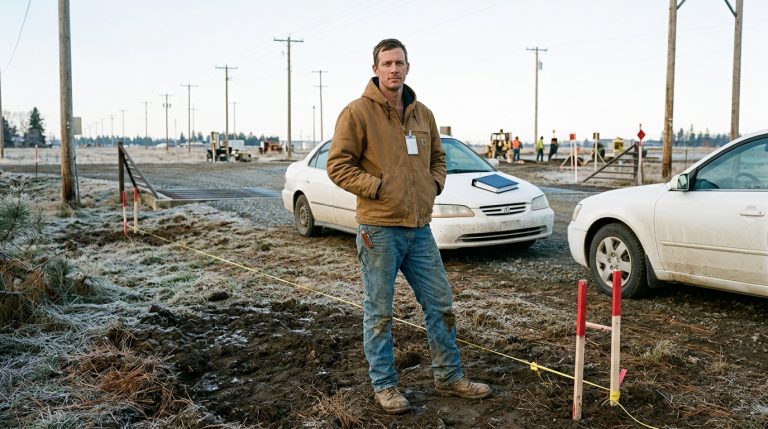
Mornings on Old Farm Road always started the same way: black coffee in a ceramic mug, steam rising into the damp air, and the smell of fresh cedar shavings.
I stood on the edge of my porch, watching the sunlight hit the fieldstone walls of my new smokehouse. Three months of weekend sweat, laying every stone by hand to honor my grandfather’s memory, sat quietly near the treeline a hundred yards back.
The heavy thud of car doors slamming shattered the morning stillness.
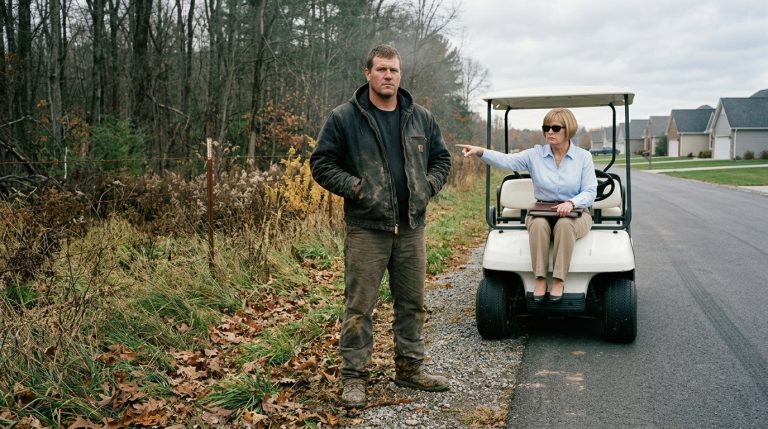
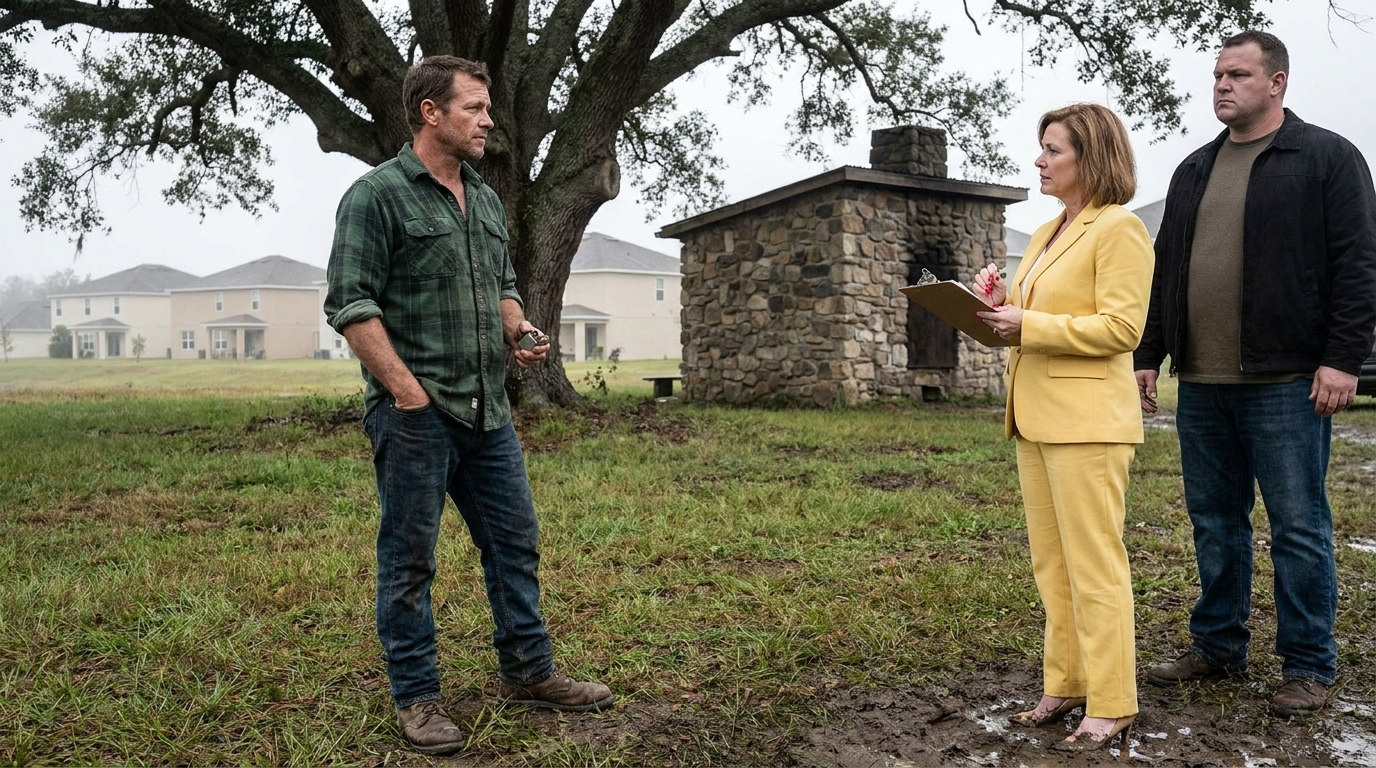
A bright yellow pantsuit cut across the lawn, heels digging aggressive holes into my grass. Karen walked with the practiced posture of a petty tyrant marching into conquered territory, flanked by a pinched-faced woman named Carol and a thick-necked man holding a metal clipboard.
They stopped right at the shadow of the gnarled oak tree that marked my property line—a tree that had stood on this dirt fifty years before the first tract home of Oakwood Preserve was framed.
“That structure has to go, and you will pay a ten-thousand-dollar fine for erecting it without approval, Mr. Miller.” Karen’s voice was a grading mix of saccharine condescension and absolute certainty.
I didn’t raise my voice. I didn’t reach for an insult. I thumbed the polished steel of my grandfather’s heavy brass Zippo in my pocket, feeling the cold metal hinge against my skin.
“I think you’re mistaken,” I said, letting my voice sit low and steady. “You are standing on my property, that smokehouse is on my property, and neither has anything to do with your association.”
Karen let out a short, sharp laugh that sounded like a startled crow. She tapped a red-manicured fingernail against the top of her clipboard.
“Article Seven, Section Four of the Covenants clearly states any outbuilding over one hundred square feet requires pre-approval from the architectural review committee,” she said. “Which I chair. You never submitted a plan, and you never paid the fee.”
Carol nodded in tight, silent rhythm behind her, clutching her clipboard like a shield.
“The fine is ten thousand dollars, plus five hundred dollars per day until the unapproved structure is completely removed,” Karen added. Her eyes drifted toward the woods, dismissing me entirely.
I looked past her shoulder at the neat, identical rows of beige stucco houses lining the subdivision street thirty yards away.
“Karen,” I said, stripping the name of any polite title. “My property is not part of your association. You have no authority here.”
Her smile vanished instantly. The fake warmth burned away, leaving a flat, cold stare.
“We’ll see what the county court says about that when we place a lien on your home for failure to pay,” she said, turning on her heel with a sharp flick of her wrist. “Remove it, or we will.”
They marched back toward the pristine suburban pavement in tight formation, leaving their threat hanging in the quiet morning air.
I didn’t chase them down. I didn’t yell across the grass. I simply brought the cold ceramic mug to my lips, took one last sip of bitter coffee, and snapped the brass Zippo shut in my pocket with a quiet, decisive click.
They wanted a war fought on paper and authority. They just didn’t know whose paper was sitting in my office.
CHAPTER 2: THE VAULT OF PAPER
The screen door slammed behind me with a sharp crack that rattled the glass pane.
Sarah was standing at the kitchen island, her hands wrapped around a dishtowel, her knuckles white against the dark granite. She’d watched the whole three-ring circus unfold from the front window.
“What did Queen Karen want this time?” her voice was tight, thin with the quiet fatigue of three years of suburban harassment.
“She wants the smokehouse demolished,” I said, setting my cold coffee mug down on the counter. “And she wants ten thousand dollars.”
Sarah’s eyes widened. “Ten thousand? She can’t be serious.”
“Dead serious,” I grunted, pacing the length of the kitchen floorboards. “Threatened a daily fine and a lien on the house.”
I walked straight past the kitchen, down the hallway, and into my office. Sarah followed silently, her soft steps trailing me to the closet at the back of the room.
I knelt on the rug, reaching into the dark space beneath the hanging shirts until my fingers hit iron-bound wood. The old cedar footlocker hadn’t been pulled into the light since my father’s funeral six years ago.
The iron latch groaned as I flipped it open, releasing the deep, dry scent of aged wood and old oil. Inside, beneath my grandfather’s framed service medals and a faded stack of high school yearbooks, sat a dark leather portfolio.
I lifted it out carefully, setting it flat on the big oak desk under the lamp.
Inside, tucked safely behind a heavy sheet of yellowed vellum, lay the document: United States Land Patent Number 78,432. The paper was thick as canvas, the ink dark and elegant, bearing the official seal of the General Land Office and the bold signature of President Theodore Roosevelt, dated March 2, 1903.
Sarah leaned over my shoulder, her fingers lightly brushing the edge of the vellum. “Elias Miller,” she read softly. “To his heirs and assigns forever.”
“A direct grant from the federal government,” I said, my thumb tracing the embossed seal. “My great-grandfather cleared this dirt before this county had a paved road, let alone a subdivision developer.”
I pulled up the original 2001 plat map from Sterling Homes—the developer who built Oakwood Preserve around my family’s acre—and pointed at the glaring white cutout right in the middle of Phase Two.
The label on my property didn’t list a lot number. It read simply: Non-Included Parcel.
“They don’t own the ground under our feet,” I said, pulling my phone from my pocket to take three high-resolution photographs of the patent and the boundaries. “Karen thinks she’s enforcing a neighborhood rule. She has no idea she’s trespassing on sovereign paper.”
CHAPTER 3: THE CERTIFIED VOLLEY
My thumb tapped the screen. The image file sent with a soft chime.
Two minutes later, the desk phone vibrated against the dark wood, sliding half an inch across the surface.
“Jack,” Dave’s voice came through instantly, stripped of any greeting. “Tell me you have the original in a fireproof box.”
“In a cedar trunk,” I said, thumbing the cold brass hinge of the Zippo. ” signed by Theodore Roosevelt’s clerk in 1903.”
A long pause echoed over the line, followed by the dry rustle of papers on Dave’s end.
“They filed a formal threat on HOA letterhead, right?” Dave asked, his tone shifting into the sharp, rhythmic cadence he used when we were calculating convoy routes in Ramadi. “Listen to me closely. Do not talk to them. Not on your lawn, not on the sidewalk, not on the phone. Everything goes on paper.”
“I’m not looking for a shouting match, Dave.”
“Good, because we’re going to give them a legal masterclass,” Dave said. “Draft the response today. State the facts without emotion: Parcel ID, Land Patent number, case law citations for sovereign grants. End it with two words.”
“Govern yourselves,” I said.
“Govern yourselves accordingly,” Dave corrected softly. “Then send seven copies. One for each board member, one for their attorney, one for the management company. Certified mail, return receipt requested.”
The next morning at the post office counter, the clerk stamped seven green cards with a heavy, rhythmic thud. Ninety-four dollars and fifty cents in postage.
Each green card was a small, physical tether. When Karen signed her name on that return slip, she would officially bind herself to the paper trail—and close the door on any claim of ignorance.
CHAPTER 4: THE CAMPAIGN OF NUISANCE
A cell phone camera glinted behind the tinted passenger window of the sedan.
Bob sat in the driver’s seat, engine idling, staring straight ahead while his passenger snapped photos of my driveway. I didn’t hide behind the curtain. I took a slow sip of coffee, lifted my free hand, and gave them a calm, two-finger wave.
The car lurched forward, tires kicking up gravel as it sped back into the manicured loop of Phase Two.
The escalation moved fast over the next ten days. My trash cans vanished from the end of the driveway on collection morning, only for a hundred-and-fifty-dollar replacement bill to appear in my mailbox three days later.
Then came the county animal control cruiser, its engine idling near my porch while a tired officer walked up to check on a report of “a pack of dangerous feral dogs.” Buster, my thirteen-year-old Labrador, didn’t even lift his chin off the rug when the officer knocked.
“Sorry to bother you, Mr. Miller,” the officer sighed, looking down at Buster’s grey muzzle. “Anonymous tip. We have to clear the ticket.”
“Karen?” I asked.
The officer just shook his head and walked back to his truck.
That evening, Mark from three doors down dropped by under the cover of dusk. He stood on my back porch, hands shoved deep into his jacket pockets, eyes darting toward the street.
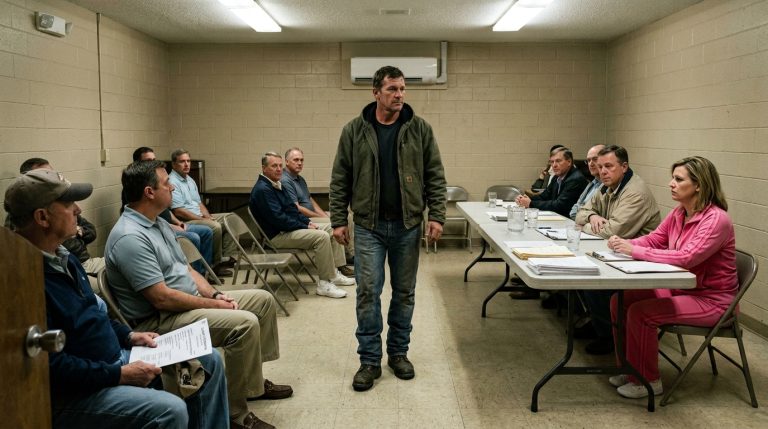
“She called an emergency meeting last night, Jack,” Mark said, his voice barely above a whisper. “Waved your certified letter around like it was crazy talk. Said you were trying to destroy property values.”
“And the board bought it?”
“Carol looked terrified, but Bob and Todd—that slick lawyer she hired—backed her up completely,” Mark said. He stepped inside, pulling a folded sheet of paper from his coat. “She’s pushing through a lien notice by Friday. But I talked to George and Maria. We’re sick of it. George got slapped with a grand for an oil drip on his own driveway. We want in on whatever you’re planning.”
I looked at the folded paper—a list of eight neighbors who had signed their names and phone numbers in tight blue ink.
“Tell them to meet at your place tomorrow,” I said, my fingers closing around the brass Zippo in my pocket. “And tell them to bring their violation notices.”
CHAPTER 5: THE PAPER CARPETBOMB
“This line right here,” I said, pointing a finger at the heavy black border drawn on the vintage paper, “was recorded before any of these houses existed.”
George, the retired accountant, leaned in close, his reading glasses perched on the tip of his nose. “And Sterling Homes knew it?”
“They labeled it a non-included parcel in two thousand one,” I said. “Karen filed an illegal twenty-two thousand five hundred dollar claim on a piece of property her organization has zero jurisdiction over. That is slander of title.”
Maria let out a low whistle. “She did what?”
“And tomorrow morning,” I continued, leaning both hands against the edge of the poker table, “she gets served.”
Dave Jensen didn’t just draft a civil response; he built a legal carpet-bomb. We sued the HOA as a corporate entity, but the real strike was piercing the corporate veil: we named Karen, Carol, Bob, and their attorney Todd individually as defendants.
Their personal homes, their savings accounts, and their credit ratings were now directly on the line for filing a fraudulent encumbrance.
Tiny, a six-foot-four former Marine turned process server, picked up the thick stacks of court summonses from my desk at five o’clock the next evening.
“Deliver them at dinner,” I told him, flipping open the brass Zippo and snapping it shut. “Make sure they’re sitting at their kitchen tables.”
Tiny grinned, sliding the manila envelopes into his leather bag. “Consider it done, Jack.”
By six-thirty, my phone buzzed with a text from Tiny containing a photo of Bob standing on his porch in a stained undershirt, clutching his summons with a look of pale, frozen panic.
Ten minutes later, another text arrived: Karen had been served in her neon pink tracksuit mid-power-walk, screaming at Tiny on the sidewalk while he politely documented her tirade for the court affidavit.
The shield of their petty authority didn’t just crack—it shattered into dust in front of the entire neighborhood.
CHAPTER 6: THE SLOWSMOKED VICTORY
The sweet, rich scent of hickory smoke drifted across the lawn, carrying over the fence toward the quiet streets of Oakwood Preserve.
I pulled the steel tray closer to the cutting board. Behind me, the backyard was full of noise—laughter from Dave’s kids chasing Buster around the oak tree, the clinking of iced tea glasses as Sarah talked with Maria, and George showing Mark a copy of the court-ordered forensic audit report.
The audit had uncovered fifty thousand dollars in misappropriated funds, leading straight to criminal embezzlement charges against Karen.
The entire board had folded within forty-eight hours of service. Their insurance carrier refused to cover intentional malice, forcing a total surrender: the twenty-two thousand dollar lien was expunged, every penny of my legal fees was covered, a six-figure settlement was paid into our bank account, and a permanent injunction was recorded at the county courthouse declaring my acre forever free from HOA interference.
A loud hydraulic hiss echoed from the street.
Across the lawn, past the boundary line, a yellow moving truck sat parked at the curb in front of Karen’s house. Movers were loading the last rolled rug into the back.
Karen stood near the passenger door, dressed in a faded cardigan, her face drained of its old iron fury. She looked small against the backdrop of the suburban houses she used to rule.
Her eyes drifted across the hundred yards of grass, locking onto mine.
I didn’t smile. I didn’t raise a glass or motion toward the crowd gathered around my porch.
I simply held her gaze for a single, quiet second—a calm nod of finality—before turning back to the work in front of me. She climbed into the truck, the door slammed shut, and the engine pulled away into the afternoon sun.
I pressed the edge of my grandfather’s carving knife into the dark crust of the brisket. The blade slid through with effortless ease, releasing a warm cloud of steam into the clear air.
My land was quiet again. My family was safe. And the ground beneath my feet remained exactly what it had been since 1903: mine.