The Legacy Cutout: How a Retired Engineer Used Common Sense and Boundaries to Break a Suburban Tyrant
CHAPTER 1: THE LINE IN THE GRAVEL
The gravel driveway crunched beneath my heavy work boots as I took two measured steps forward, stopping exactly four inches short of the property line.
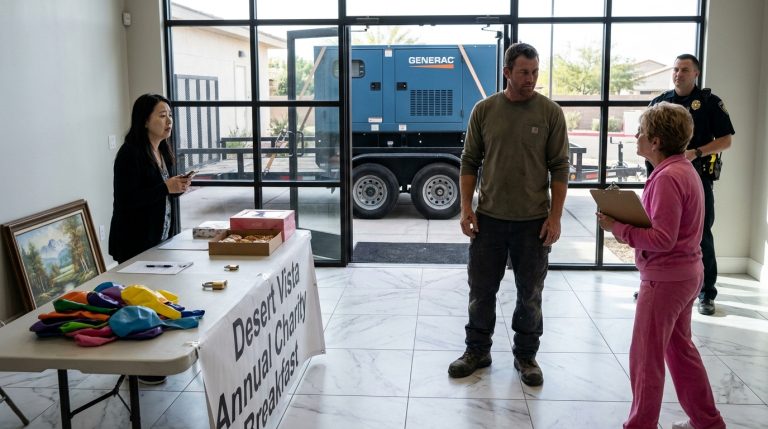
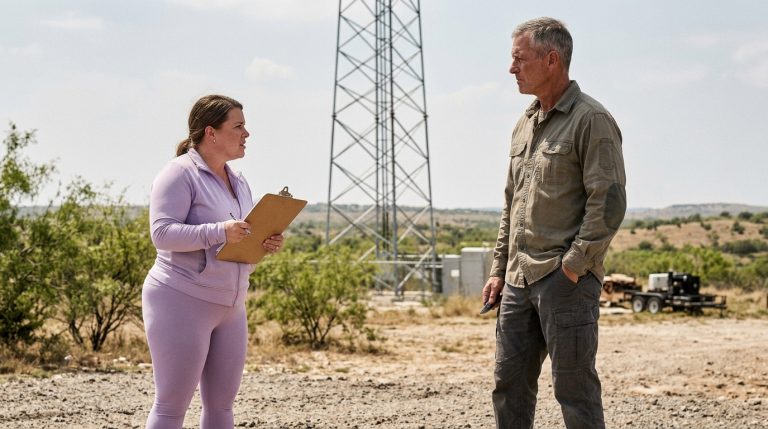
Karen adjusted her visor, her pink tracksuit sleeve catching the morning glare as she jabbed her clipboard toward the pallet of roofing shingles.
“You can stand there and glare all you want, Mr. Harrison,” she said, her voice piercing the quiet morning air. “The lien papers are being drawn up as we speak.”
I didn’t offer a word, nor did I lower my gaze.
Instead, I slipped my right hand into my coat pocket and felt the cold, notched brass of my grandfather’s carpenter calipers resting against my fingers.
I slid the slide bar back with a dry, metallic click, letting the small brass jaw drop into place before pulling it shut again.
“The shingles sit on private, deeded land,” I said, keeping my voice even, low, and level. “That pallet isn’t touching your pavement, Karen.”
“It’s within sight of the street, which makes it a visual nuisance under Section 4, Clause B,” she snapped, her manicured thumb pressing hard against the metal latch of her clipboard. “You’re ruining the aesthetic harmony of Serenity Lakes.”
“Serenity Lakes was built around this dirt in 1998,” I said, watching a thin sheen of sweat break along her hairline despite the morning chill. “My grandfather laid these oak roots in sixty-eight.”
“Times change, and so do regulations,” she spat back, taking a half-step toward my gravel boundary before catching herself and planting her feet on the asphalt. “You pay the twenty thousand dollars in accrued fines by Friday, or the HOA board takes formal possession of the title.”
She turned on her heel, her sneakers squeaking against the dry street as she marched back toward her idling golf cart.
I stayed completely still on the gravel, listening to the hum of the electric motor fade down the curve of the cul-de-sac.
My thumb rubbed the worn ridge of the brass caliper in my pocket, feeling every microscopic scratch etched into the metal over fifty years of hard work.
I walked over to the stack of roofing shingles, reached down, and peeled the white violation slip off the plastic tarp covering the top row.
Down in the bottom left corner, printed in faded dark ink, sat the receipt number for the penalty fee.
My eye caught the string of digits—a mismatched, eight-character sequence that didn’t match the format on the original mailbox notices sitting on my kitchen table.
I folded the paper precisely in half, slipped it into my pocket alongside the calipers, and turned back toward the house.
CHAPTER 2: THE PAPERWORK TRENCH
The porch light flickered once against the settling dusk, casting long shadows across the weathered oak trim my grandfather had hand-sanded fifty years ago.
I looked down at the paper in my hand.
The invoice serial number on the daily fine didn’t just look wrong—it was formatted using an entirely different typeface than the original mailbox notice from six weeks back.
I stepped inside, letting the screen door slam shut behind me with a solid, familiar wooden thud that cut through the quiet house.
My kitchen table was already buried under three months of laminated community bylaws, property maps, and crisp white envelopes.
I laid the new violation notice flat beside the oldest fine, running the tip of my thumb over the bottom left corner of both documents.
The original notice read SER-2026-0041, typed in standard Courier font.
The slip Karen had personally delivered this morning read SL-INV-9904, stamped in a heavy, slanted ink that looked like it belonged to a private collection agency rather than a residential board.
I pulled my laptop from the counter, opened the county clerk’s public records portal, and typed in my grandfather’s parcel ID.
The screen refreshed with a dry click, displaying fifty years of unbroken land ownership.
1968: Harrison, Arthur E. — Original Deed.
1998: Serenity Lakes Estates Subdivision Development Agreement — Historical Parcel Exemption (Carveout).
I scrolled past the land plot boundaries and opened the public tax assessments for the adjacent HOA parcels.
A red flag immediately caught my eye on the developer’s amendment filed four years ago.
Attached to the municipal boundary filing was a signature from the county zoning board’s review committee—a signature written in a tight, aggressive cursive.
Dennis Miller.
I leaned back, the wooden chair creaking under my weight as my eyes locked onto the name on the screen.
Dennis Miller wasn’t listed on the Serenity Lakes HOA board directory.
He was the quiet guy who drove the gray sedan down the main avenue every morning at six, the husband Karen treated like an assistant whenever they stepped out onto their front lawn.
I opened a second browser window and cross-referenced Dennis Miller’s name with the county board’s public conflict-of-interest registry.
The registry was completely empty—no disclosures, no carved-out voting abstentions, no recorded property ties to Serenity Lakes.
Yet six months ago, Dennis had personally signed off on a local zoning ordinance proposal aimed at reclassifying non-HOA historical carveouts into high-density municipal compliance zones.
I picked up the brass calipers from the table, sliding the metal bar back and forth in a slow, rhythmic motion that filled the silent kitchen.
Karen wasn’t just trying to bully me over a stack of shingles.
She was leveraging her husband’s seat on the zoning board to squeeze my deed from both sides—bureaucratic fines from the front, municipal code reclassification from the back.
I tapped my trackpad and downloaded the full, itemized transaction logs for the county clerk’s office, matching each record against the serial numbers printed on my stack of fines.
Three of the serial numbers—the ones issued directly after I refused to sign her voluntary annex agreement—didn’t exist in the county’s official municipal logging system at all.
They were ghost invoices.
I printed the clerk’s verified index page, folded it neatly into three equal sections, and tucked it into the inner pocket of my heavy canvas jacket.
Outside, a low rumble of thunder rolled across the oak trees at the edge of the property line, shaking the windowpanes in their wooden frames.
I grabbed my keys off the counter, set my jaw, and walked toward the front door.
It was seven fifteen on a Tuesday evening, which meant the monthly Serenity Lakes HOA board meeting was currently convening at the community clubhouse down the block.
CHAPTER 3: THE PUBLIC TRAP
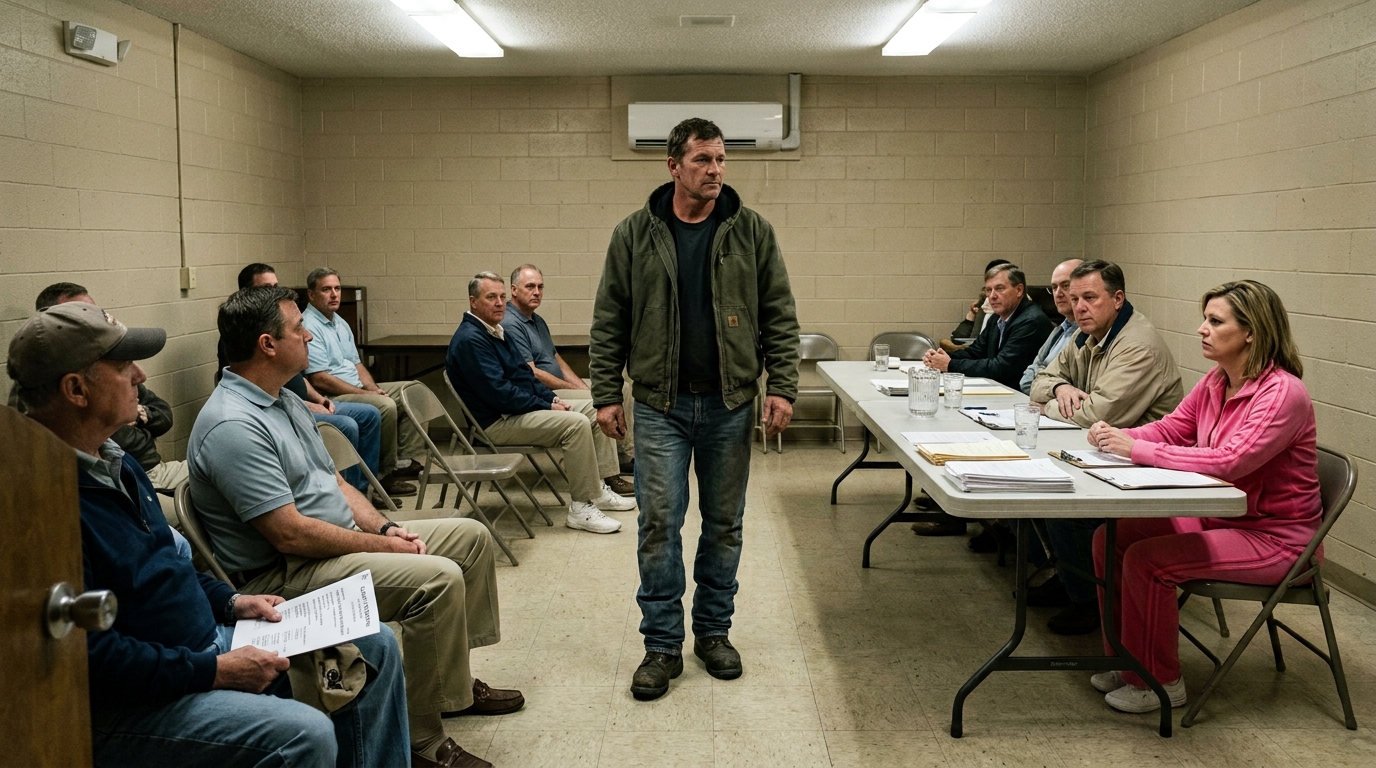
I pulled the double doors open, the wet rubber seals letting out a sharp suction sound that cut straight through the drone of the air conditioner.
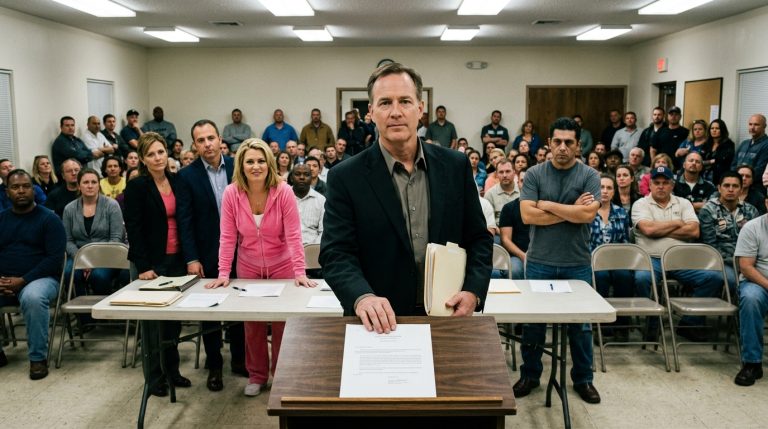
Twenty pairs of heads snapped toward the doorway.
Karen’s hand froze mid-air above her laminated agenda stack, her pink tracksuit jacket rustling loudly against the table edge.
“Mr. Harrison,” she said into the microphone, her voice booming off the linoleum floor with an unpleasant static crackle. “This is a closed meeting for Serenity Lakes covenant members in good standing.”
I didn’t answer right away.
I took three measured steps down the center aisle, my wet canvas jacket heavy across my shoulders, until I reached the front row of metal folding chairs.
Mr. Henderson sat three seats down, his eyes fixed firmly on his lap, his knuckles white where he gripped his ballcap.
“Public assembly rules under county statute 12-A require open doors when discussing municipal infrastructure impact,” I said, my voice unhurried, resting comfortably beneath her microphone’s feedback. “Section four of your agenda lists road drainage easements.”
Karen’s lips thinned into a tight, pale line as she checked her clipboard, her thumb digging so hard into the plastic frame that her nail turned white.
“You are not a member of this association,” she said, leaning forward into the goose-neck mic. “You have no floor rights, no voting rights, and no right to address this board.”
“I don’t need a vote to ask a simple administrative question,” I said.
I reached into my inner jacket pocket, pulled out the folded paper from the county archives, and laid it flat on the head table right beside her water glass.
Dennis Miller, sitting two chairs down in a beige windbreaker, shifted uncomfortably in his seat, his eyes darting from the printed county header to my face.
“Which specific account receives the payments for fines marked with the SL-INV serial prefix?” I asked, pointing a finger at the top line of the document.
Karen didn’t look down at the page.
“All penalties are processed through the standard operating reserve,” she said instantly, her tone dripping with rehearsed condescension. “As outlined in the bylaws you continuously refuse to respect.”
“The county clerk’s index doesn’t list SL-INV under standard reserve filings,” I replied, keeping my eyes fixed directly on hers. “It registers that prefix as a private municipal contractor ledger.”
A quiet murmur rippled through the row behind me; someone shifted in their chair, the metal legs scraping harshly against the floorboards.
Karen slammed her palm flat against the table, the sharp whack echoing off the cinderblock walls.
“This meeting is adjourned,” she barked, grabbing her microphone and flicking the toggle switch off with a violent click. “Security will escort you off the premises if you remain in this building for another thirty seconds.”
She didn’t wait for her fellow board members.
She shoved her wooden chair back, snatched her clipboard, and marched toward the side exit door, her sneakers squeaking frantically against the floor.
Dennis lingered for three seconds, his jaw working silently as he stared at the printed paper I’d left on the table.
He didn’t touch it.
He pulled his collar up around his neck, turned his back, and followed his wife out into the rain.
CHAPTER 4: THE COUNTERATTACK
A lean man in a tan uniform stepped out of the county truck, holding an electronic tablet wrapped in a heavy rubber casing.
Karen stood three feet behind his shoulder on the paved cul-de-sac, her arms folded tightly across her pink tracksuit chest, her visor pulled low against the morning drizzle.
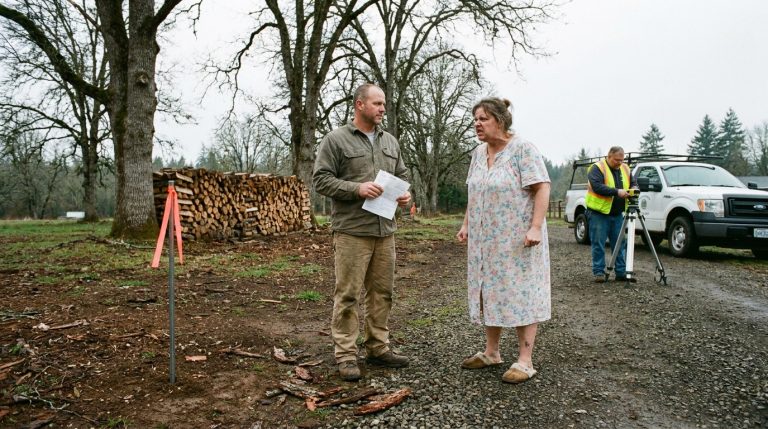
“Mr. Harrison?” the officer asked, stopping right at the survey marker pin driving into the dirt. “I’m Inspector Vance, County Code Compliance. We received an emergency report regarding illegal commercial storage on a residential drainage easement.”
“The lot is a deeded historical carveout,” I said, stepping off the porch with my hands resting loosely at my sides. “Section 12 parcel.”
Karen jabbed a finger toward the pallet of shingles.
“The easement runs ten feet back from the curb, Inspector,” she interjected, her voice sharp enough to draw Mr. Henderson out onto his porch across the street. “That debris impedes emergency watershed runoff during rain events.”
Inspector Vance tapped his stylus against the glass screen, looking past me toward the pallet.
“Mind if I take a direct measurement, sir?” he asked.
“Go ahead,” I said, pulling the brass calipers from my coat and sliding the jaw open with a faint click. “The property line pin is right under your left boot.”
Vance looked down, unclipped a metal tape measure from his belt, and hooked the tab onto the steel survey stake.
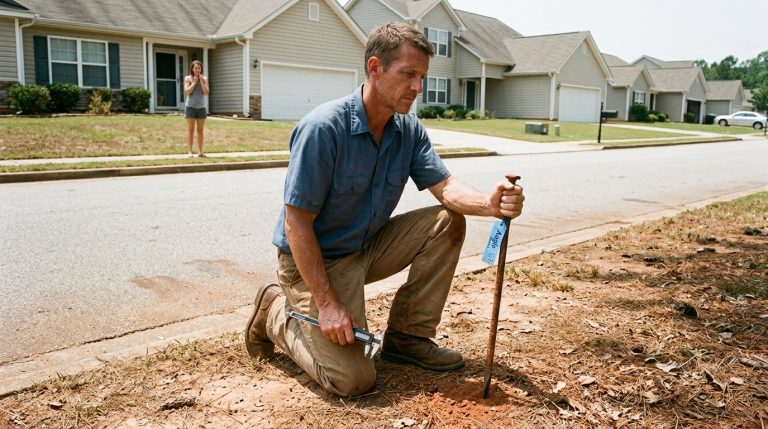
He unreeled six feet of yellow tape across the gravel, kneeling down into the wet mud to sight the line against the corner of the pallet.
Karen stepped forward onto the dirt, her eyes fixed on the yellow tape with an eager grin.
“That’s six feet four inches from the county curb line,” Vance murmured, squinting at the scale.
Karen’s smile broadened.
“Which is a clear violation of the ten-foot setback!” she declared, turning toward Vance’s tablet. “Issue the stop-work order immediately.”
“Except the county road dedication for this sector was recorded in 1968 at thirty feet wide, not forty,” I said, handing Vance the laminated survey plat I’d pulled from my attic box. “The HOA paved four feet past your right-of-way easement when they built the cul-de-sac in ninety-eight.”
Vance froze on one knee, staring at the old ink drawing before snapping his tape back into its casing with a loud clack.
He stood up, laid his tape across the edge of the asphalt street, and measured back toward Karen’s golf cart.
“He’s right,” Vance said, turning to look at Karen with a flat expression. “Your asphalt is encroaching four feet onto his private property line.”
Karen’s face flushed a blotchy, dark crimson, her mouth dropping open before she caught herself and snapped it shut.
“That’s preposterous!” she sputtered, taking a jerky step backward onto the pavement. “Our engineering firm approved those road boundaries twenty-five years ago!”
“Then your engineering firm paved over private land,” Vance replied, tapping a quick note into his tablet. “I’m not issuing a violation for this pallet. But I am filing a road encroachment flag with county public works.”
He turned back toward his cruiser, leaving Karen stranded on the edge of the road, her sneakers caked in dark mud from my property line.
CHAPTER 5: THE MIDPOINT CRACK
Karen slammed the accelerator pedal down, her golf cart whirring loudly as she jolted backward onto the asphalt and sped off toward the cul-de-sac curve.
I picked up Vance’s yellow measurement tape—left sitting on the grass edge—and walked back into my house, the screen door latching firmly behind me.
My kitchen table was still littered with tax assessments and printed county indexes, but my focus was now locked on the zoning board filings.
Layer 1 was finally breaking open.
Dennis Miller’s name on that four-year-old amendment wasn’t an isolated signature; it was part of an organized pattern.
I pulled up the county clerk’s public audio archives for the December 2024 zoning board meeting and clicked play on the three-hour recording.
Through the tinny computer speaker, the voice of the board chairman echoed into my quiet kitchen.
“Agenda item four: Proposal by Board Member Miller to fast-track municipal code enforcement on unincorporated historical carveouts adjacent to master-planned communities.”
Dennis’s flat, quiet voice followed immediately after.
“Mr. Chairman, these unannexed properties create regulatory dead zones that drag down surrounding tax assessments. We need to grant neighboring HOA boards temporary administrative standing to enforce compliance before county intervention.”
I paused the recording, my thumb sliding the jaw of my brass caliper open and shut against the grain of the wooden table.
Dennis had personally authored the exact administrative loop Karen was using to paper my door with illegal fines.
It was a quiet, inside job—a local official using his public appointment to construct a legal wedge, giving his wife’s HOA unconstitutional reach over my private deed.
I clicked over to the county ethics board public complaint portal, selected the form for conflict-of-interest violations, and attached the audio transcript alongside Dennis’s signed zoning amendment.
A sudden, sharp knock at my side kitchen door rattled the glass pane.
I stood up, walked to the door, and pulled the wooden handle back.
Dennis Miller stood on my back porch under the dripping overhang, his beige windbreaker soaked around the shoulders, his hands shoved deep into his pockets.
“Mr. Harrison,” he said, his voice barely carrying over the sound of rain hitting the tin gutters. “We need to talk about what you brought up at the clubhouse.”
I didn’t step back to invite him inside.
“I’m listening, Dennis,” I said, leaning my arm against the doorframe.
Dennis took a quick glance back toward the oak trees bordering my property line before lowering his tone even further.
“Karen doesn’t always consult me on how she handles the HOA board,” he muttered, his fingers twitching inside his jacket pockets. “She’s… passionate about maintaining order. But you poking around in county zoning records isn’t going to help your house.”
“It’s helping me understand why my property line has four feet of HOA asphalt sitting on it,” I replied, keeping my eyes locked on his pale face. “And why your name is on the ordinance that gave her a clipboard.”
Dennis swallowed hard, his throat moving nervously against his zipped collar.
“Drop the ethics inquiry, Mr. Harrison,” he whispered, stepping closer to the porch screen. “Or I promise you, county public works will rezone this entire two-acre plot for municipal drainage runoff by the end of the month.”
CHAPTER 6: THE FRICTION POINT
“That sounds like an extortion threat, Dennis,” I said, my voice dropping an octave lower into a flat, steady rumble.
Dennis didn’t answer.
He took two quick steps backward off my porch, pulled his hood over his thinning hair, and retreated into the dark line of oak trees bordering my gravel drive.
I pulled the kitchen door shut, snapped the heavy deadbolt into place, and walked over to my desk.
At two fifteen in the morning, a sudden, sharp screech of metal grinding against iron shattered the silence outside my front window.
I grabbed my heavy flash lantern, stepped onto the porch, and swept the white beam across my yard.
A commercial tow truck with its side lights blacked out was backed halfway up my gravel driveway, its winching arm lowered directly over my grandfather’s steel mailbox post.
Karen stood near the driver’s cab in her pink tracksuit, holding a yellow flashlight, pointing frantically toward the concrete base.
“County code obstruction!” she screamed over the diesel engine idle, her voice wild and breathless. “Remove it now!”
I jumped off the porch steps, my work boots sinking into the wet mud as I covered thirty yards in five long strides.
“Get off my property line!” I ordered, stepping directly between the tow truck’s rear bumper and the steel post.
The driver leaned out his window, his face pale in my lantern light.
“Look, man, she said this was an emergency municipal utility clearing,” he stammered, pulling his hands off the hydraulic controls.
“She lied,” I said, turning my lantern directly into Karen’s eyes until she flinched and threw her hand up to block the glare. “This is private, deeded land outside HOA jurisdiction. Touch this post and you’re committing criminal trespass with a commercial vehicle.”
Karen took two jabbing steps forward, her jaw trembling with unvented rage.
“You think you can just ignore the rules, Harrison?!” she shrieked, her passive-aggressive mask shattering completely into a raw, ugly tantrum. “You don’t belong here! This neighborhood belongs to people who care about standards!”
“Your husband already tried threatening me with county rezoning three hours ago,” I said, stepping closer until I stood over her on the gravel. “It didn’t work then, and this tow truck isn’t working now.”
The tow driver didn’t wait to hear another word.
He slammed his truck into gear, the diesel engine roaring as he hauled his rig backward out of my driveway, leaving his tire tracks gouged deep into the mud.
Karen stood alone under the rain, her pink sleeve dripping wet, her yellow flashlight shaking in her fist as she stared at me.
“You’re going to lose everything,” she whispered, her voice tight and venomous. “I will sign the bank foreclosure papers myself.”
She turned and stumbled toward her golf cart parked down the street, her wet sneakers splashing through the dark puddles.
I stood by the steel mailbox, wiped the rainwater off my face, and shined my flashlight down at the gravel where her cart had been parked.
Lying in the mud near the street curb was an unsealed white envelope that had fallen from her clipboard during her outburst—a stamped bank deposit slip bearing the name of an off-shore commercial holding company.
CHAPTER 7: THE FINANCIAL DISCREPANCY
The holding company was registered as Crestview Management LLC.
I walked back into my house, wiped the wet mud off the slip with a paper towel, and laid it directly beside my stack of ghost fine notices.
Layer 2 was no longer leaking through the cracks—it was wide open.
The account number on the deposit slip matched the destination routing digits printed at the base of every single SL-INV penalty notice I had received over the past ninety days.
Karen wasn’t funneling those twenty thousand dollars in fines into the Serenity Lakes operating reserve or municipal code compliance accounts.
She had created a dummy management shell company to divert fine collections directly into her personal legal defense fund.
I logged into the state Secretary of State corporate registry, paid the five-dollar public filing search fee, and pulled the articles of incorporation for Crestview Management LLC.
The primary officer listed on the state filing was Karen Miller.
The registered agent address was a private post office box three miles outside the subdivision boundary.
Every dollar extorted from my non-HOA property, alongside hundreds of petty fines slapped on terrified neighbors like Mr. Henderson, had been funneled straight into that shell account to cover past boundary lawsuit settlements she’d hidden from the board.
I printed the full corporate registry filing, the bank deposit routing slip, and the cross-referenced serial index onto three crisp sheets of paper.
A sharp tap echoed against my front window glass.
I looked up to see Mr. Henderson standing on my front porch, his rain jacket zipped to his chin, holding an unsealed white envelope in his shaking fingers.
I pulled the front door open.
“Mr. Harrison,” Henderson said, his voice unsteady as he held out the paper. “She just taped another three-hundred-dollar fine to my door for my lawn flag. She says if I don’t pay by noon tomorrow, she’s placing a lien on my mortgage.”
“Come inside, Mr. Henderson,” I said, stepping back to let him in. “Take a look at where that money actually goes.”
Henderson stepped into the warm kitchen, setting his wet cap on the corner of the table while I pointed to the matching routing numbers on the screen.
His eyes widened as he tracked the digits from his own receipt to the Crestview Management filing.
“She’s… she’s taking it for herself?” he whispered, his jaw dropping as the reality hit him.
“Every penny,” I said, pulling my grandfather’s brass calipers from my pocket and setting them firmly on top of the printouts. “And tomorrow morning at nine, the county state’s attorney receives this complete file.”
CHAPTER 8: THE QUIET TIPPING POINT
At eight forty-five the following morning, two marked county sheriff cruisers and an unmarked state investigator’s sedan pulled up along the cul-de-sac curb.
I stepped out onto my porch, watching Mr. Henderson walk across his yard with a folder of matched payment receipts tucked under his arm.
Karen marched out of her front door wearing her pastel polo, her clipboard raised like a shield as she confronted the lead state investigator on her lawn.
“This is private community property!” she shrieked, her voice cracking across the silent neighborhood. “You have no warrant to be on this street!”
The investigator didn’t raise his voice or reach for his belt.
He pulled a folded, blue-stamped document from his coat, un-clipped the clipboard directly from her trembling hands, and handed her the court order.
“Karen Miller, you are being served with a freeze order for Crestview Management LLC,” he said clearly, his voice carrying straight to where half a dozen neighbors stood on their porches watching. “And county public works is issuing an immediate cease-and-desist regarding illegal road encroachment on parcel twelve.”
Dennis stepped out from behind their front door, his face completely drained of color, his beige windbreaker hanging limp off his shoulders.
He didn’t say a word as the second investigator handed him a formal subpoena for county ethics board review.
Karen dropped her visor onto the grass, her knees visibly shaking as she stared at the bank routing numbers printed on the investigator’s warrant sheet.
“It was for the community…” she whimpered, her arrogant posture collapsing as she looked around at the silent crowd of residents staring back at her. “I was maintaining standards…”
Nobody spoke up to defend her.
Mr. Henderson simply turned his back, walked across his driveway, and carefully placed his college football flag back into his flowerbed.
By noon, the emergency county road crew arrived, painting fresh yellow boundary lines four feet back into the asphalt—officially marking the perimeter of my grandfather’s two acres.
I walked out to the edge of the driveway, carrying a fresh tube of black caulking and a hand tool.
I knelt down on the gravel, pressed my thumb against the cool, heavy steel frame of my grandfather’s mailbox post, and tightened the mounting bracket back into place.
I pulled my grandfather’s brass calipers from my pocket, wiped the faint trace of road dirt off the slide bar, and slid the jaw shut until it clicked flush.
The air was quiet, carrying only the soft rustle of oak leaves overhead and the steady, uninterrupted sound of rain drying on the clear gravel line.