The Hydraulic Line: A Grounded Engineer’s Stand Against Suburban Bureaucracy and Systemic Overreach
CHAPTER 1: THE SEDIMENT LINE
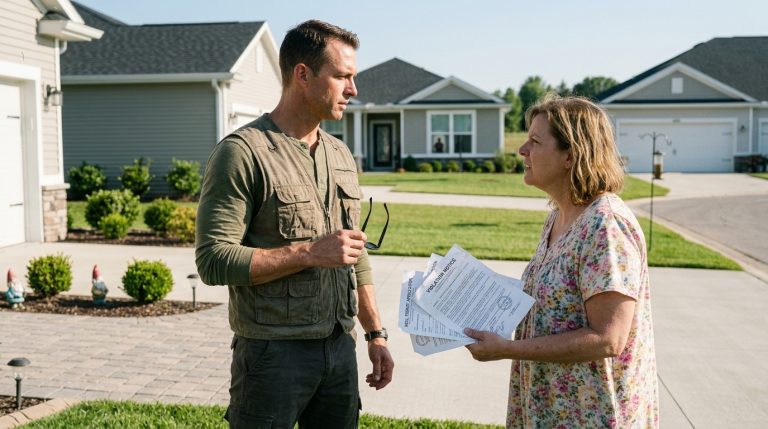
The heavy cream paper didn’t bend under my thumb. It bore the raised, gold-leaf seal of the Oakridge Meadows Homeowners Association, crisp and unblemished despite the humidity hanging off the front porch.
“A penalty of $1,200 has been assessed for persistent and egregious violation of aesthetic standards,” I read aloud, my voice flat against the damp morning air. “Specifically, the accumulation of mud and debris on your driveway.”
Below the sum ran the signature: Karen Bishop, Board President.
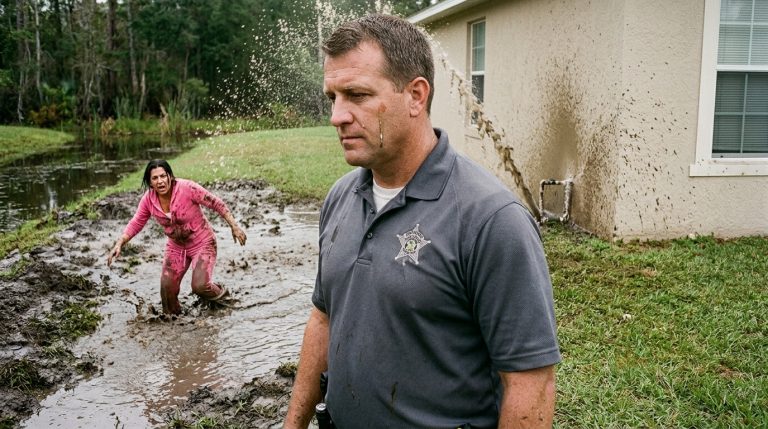
Eight inches of rain had dumped across the county over twelve hours. The storm had ripped gutters off roofs, turned culverts into rivers, and left half the township digging out of saturated silt. Yet here was a four-figure bill for the brown streak spanning my front gravel slope.
I let my thumb slide down to the worn brass pocket caliper in my trousers, feeling the cool notch of the slide ruler. Twenty-five years in the Army Corps of Engineers teaches you to suppress the immediate surge of heat in your throat. You don’t fight a flash flood with anger; you look at the gradient.
I stepped off the wooden porch onto the gravel driveway. The air still held the sharp, metallic tang of wet pine and overturned earth. The fine claimed the mud was runoff from the public access road—a failure of basic maintenance on my part.
I knelt beside the brown crust, setting my brass caliper directly into the silt margin. The depth measured nearly three inches near the grass line, tapering down toward the road.
That was the first lie. Road runoff leaves a high-volume, wide-angle dispersion pattern near the crown of the asphalt. This sediment wasn’t coming down from the street.
It was fanning outward from the eastern property line, sweeping past my woodpile and pooling down the gravel toward the house.
The silt contained dense red clay and pulverized river rock—compositionally distinct from the dark, organic loam lining the road ditch. It came from deeper down. It came from the back five acres near the seasonal creek.
“Mark?” Sarah’s voice came from the screen door, followed by the soft creak of the hinges. “Is that another notice from the board?”
“It’s a bill,” I said, rising and wiping my thumb against my jeans. “Twelve hundred for the storm debris.”
She paused on the top step, her mug of black coffee holding steady. “The whole ridge washed out yesterday. Everyone has debris.”
“Not everyone has a four-figure fine attached to it,” I said. I handed her the paper, taking the brass tool back between my fingers. “Look at the edge of the driveway near the oak stand.”
She glanced down at the paper, her brow furrowing, then looked across the yard toward the trees. “It’s thicker over there.”
“It’s a delta,” I said. “The water didn’t fall from the sky and stay here. It was pushed.”
I turned toward the tree line at the eastern edge of the property, where the ground sloped upward toward the HOA common land. The sound of trickling water was still loud—too loud for a creek that usually dried to a trickle three hours after a cloudburst.
I didn’t reach for a pressure washer or a shovel. I walked back inside, set the letter flat on the oak dining table, and pulled my topographical survey maps from the bottom drawer of the desk.
The map showed the natural contours of the five acres we’d bought after my retirement—a gentle slope, a natural rock bank, and a clear drainage basin designed to handle a hundred-year flood without touching the foundation.
Karen Bishop saw a driveway that violated Section 7.4 of the covenant. I saw a hydraulic anomaly that didn’t match thirty years of topographical records.
I grabbed my heavy leather work boots from the mudroom and pulled them on, pulling the laces tight until the leather bit into my ankles.
“Where are you going?” Sarah asked from the kitchen doorway.
“Upstream,” I said.
CHAPTER 2: THE WEAPONIZED STREAM
My boots sank two inches into red clay that hadn’t been here three months ago.
The air near the eastern boundary smelled sharply of torn roots and stagnant water.
I paused, leaning my weight into the slope, and pulled the brass caliper from my pocket. I didn’t need to measure the mud here. I needed to see what moved it.
The natural curve of the seasonal creek was gone.
In its place ran a straight, brutal trench cut into the hillside, its banks stripped of vegetation and raw with fresh track marks.
I walked twenty yards up the new ditch, the mud clinging to my soles until every step felt like dragging an anchor.
There it was.
A crude, heavy berm of packed earth and jagged riprap stone sat wedged into the old channel. It blocked the natural horseshoe bend that used to absorb the high-volume storm runoff and funnel it toward the county drainage basin.
Instead, the water had been turned ninety degrees. It was aimed directly at my back fence like the nozzle of a pressure washer.
I stopped at the edge of the berm, the cold rain dripping off the brim of my hat and hitting the back of my neck.
To my left, across the newly cleared common ground, sat a fresh wooden pavilion and two pristine picnic tables anchored in fresh green sod.
“Patriots Perch,” I muttered.
They wanted a dry lawn for their ribbon-cutting. So they dug a ditch and dumped the flood onto my gravel.
A heavy diesel engine grumbled somewhere near the main access road, but I didn’t turn around.
I pulled my phone from my coat pocket, set my thumb against the lens to clear a smear of moisture, and began taking pictures.
I shot the berm from three angles. I shot the raw track prints embedded in the clay—wide-track treads from a ten-ton mini-excavator, not a commercial riding mower.
I dropped to one knee, ignoring the cold soak through my canvas trousers, and held the brass caliper next to a gouge in the earth to give the photo a scale reference.
This wasn’t an act of God. It was an unpermitted structural diversion of a natural watercourse.
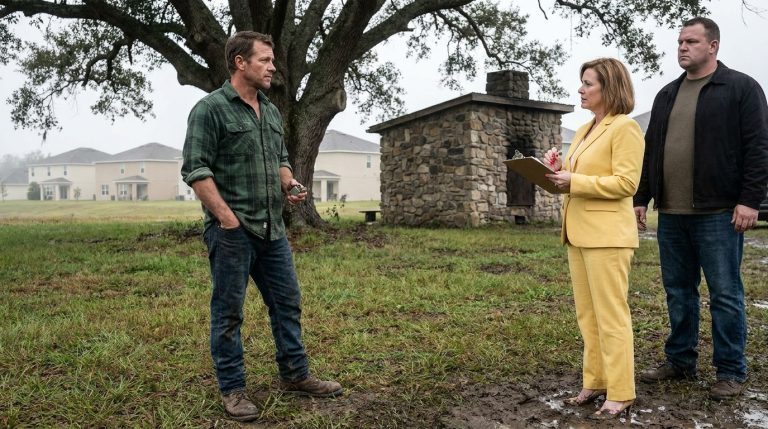
“You’re trespassing on common property, Mark.”
Karen Bishop’s voice didn’t carry warmth. It hit like a dull blade.
She stood twenty feet away on the upper ridge, wrapped in a bright yellow windbreaker, her golf cart idling quietly on the gravel path behind her. She held a black clipboard against her chest like a shield.
I didn’t rush to my feet. I finished framing the shot of the excavator tread, tapped the screen to lock the focus, and stood up deliberately.
“This berm altered the flow line,” I said, pointing the end of my phone toward the stone wall. “You redirected the creek.”
“We improved the drainage for the neighborhood park,” she said, her pursed lips barely moving. She didn’t look at the ditch. She looked at my mud-stained boots. “The board authorized land maintenance. That is entirely within our authority under Bylaw Four.”
“Bylaw Four doesn’t override state water rights, Karen. You turned six hundred gallons a minute onto my property line.”
“Your driveway was a mess before the storm, Mark.” She stepped closer, her golf shoes clicking on a flat piece of fieldstone. She tapped the clipboard twice with a manicured fingernail. “The fine stands. Twelve hundred dollars. Plus the cost of the cleanup crew if you don’t have that gravel swept by Monday.”
“You built an illegal dam,” I said, keeping my voice low, below the sound of the rushing water.
“It’s a landscape feature,” she replied, her chin tilting up. “And this conversation is over. Pay the fine, or we place the lien on the deed. The association doesn’t negotiate with non-compliant owners.”
She turned on her heel, her yellow jacket bright against the dark gray woods, and climbed back into the golf cart.
I didn’t argue. I didn’t raise my voice.
I watched the cart hum away down the paved path, then turned back to the phone in my hand.
I opened the video camera, pointed it straight down into the roaring red water of the new channel, and began recording.
“October twelfth,” I said clearly into the microphone. “Location: Oakridge Meadows eastern boundary. Unpermitted hydraulic alteration resulting in direct property damage.”
CHAPTER 3: THE BOARDROOM TRAP
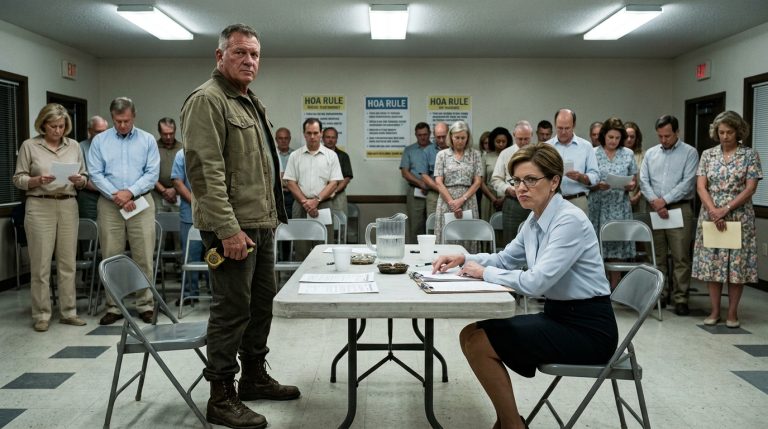
The clubhouse smelled of lemon floor wax and lukewarm coffee.
Fourteen homeowners sat on metal folding chairs behind me, their hushed whispers rustling like dry leaves.
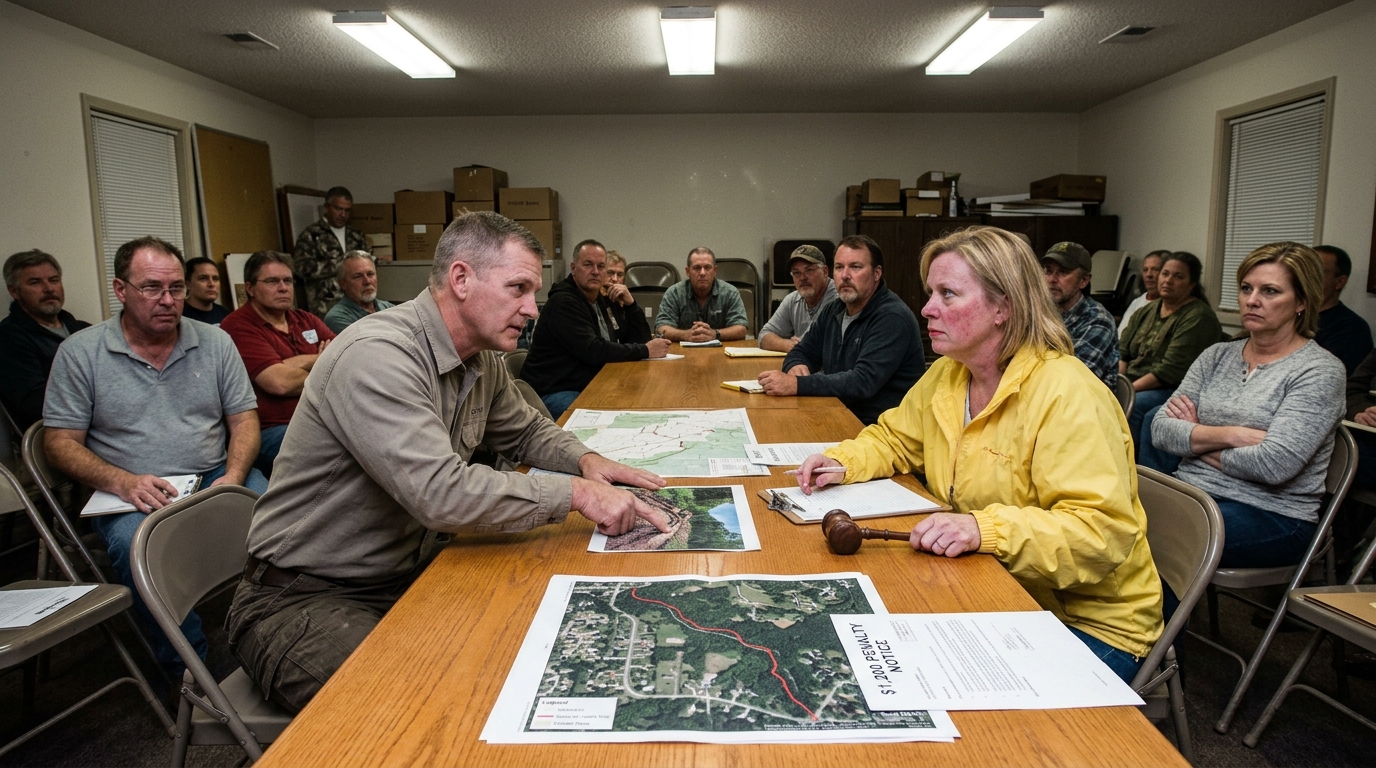
Karen Bishop sat at the head of the long table, flanked by Gary—who was frantically shuffling a stack of blank sign-in sheets—and Brenda, who sat with her arms crossed tight against her chest.
“First item on the agenda,” Karen announced, tapping the head of her small wooden gavel once against the wood. “Outstanding covenant violations. Mr. Henderson, as you are present, we will address the twelve-hundred-dollar assessment for your driveway.”
A smirk touched the corner of her thin lips. She leaned back, expecting a plea for an extension or an argument over the storm severity.
I didn’t offer either.
I flipped the leather portfolio open and turned it around so the three board members could see the top print.
It was an eight-by-ten glossy photograph of my gravel drive, caked in brown silt.
“This is the condition in question,” I said, my voice dropping into the flat, even register I used for site inspections. “Section 7.4. Aesthetic harmony.”
“It’s a disgrace,” Karen snapped, her eyes narrowing as she looked at the print. “It ruins the curb appeal for the entire lane. The fine stands.”
“I agree it’s a mess,” I replied, sliding the first photo to the side.
The second image showed a high-resolution satellite map of the neighborhood from two years prior, the creek highlighted in bright blue along its natural, curved channel.
“This is the watercourse as designed,” I continued, pointing a finger at the blue line. “It curves naturally around the common area, well away from any residential property line.”
Gary leaned forward, his glasses slipping down his nose. He squinted at the blue line, his tongue darting out to wet his lip.
“And this,” I said, placing the third photo flat beside the second, “is the current satellite overlay taken yesterday morning. Note the red line.”
The room behind me went still.
The red line ran straight as a pencil stroke, cutting off the natural curve and pointing directly down the slope.
“The stream was artificially straightened,” I said, looking Karen dead in the eye. “A heavy berm was thrown across the old bed on HOA land. That diversion created a high-velocity hydraulic channel aimed straight at my eastern border.”
“This is absurd,” Karen interjected, her cheeks flushes with splotchy red patches. She slapped her palm onto the table. “We conducted necessary grounds maintenance for Patriots Perch. It has nothing to do with your driveway.”
“Did that maintenance include a permit from the County Department of Environmental Protection?” I asked.
Gary froze, his hand stopping mid-air over his papers.
“Did it include a hydrologic impact assessment?” I stepped closer to the table, pressing two fingers onto the photograph of the excavator tracks. “Or did the board simply hire a backhoe to dump stone into a public waterway to keep a picnic lawn dry?”
“We do not need county permission to manage our own property!” Karen shouted, her voice cracking as her knuckles went white around the handle of her gavel. “You are deflecting from your own negligence, Mark. Pay the fine by Friday, or we file the lien on your home!”
She slammed the gavel down hard enough to rattle her coffee cup.
I picked up the black portfolio, sliding the prints back into their sleeves without breaking eye contact.
“You built an illegal channel, Karen,” I said quietly, letting the words carry to the back row of folding chairs. “And then you billed me for the silt it threw on my house.”
I turned my back on the table and walked toward the exit, leaving the room dead silent behind me.
CHAPTER 4: PAPERWORK AS WARFARE
David Miller uncapped his own fountain pen, his knuckles dragging across a stack of official county cover sheets.
“If we file just the county complaint,” Dave said, without taking his eyes off the grid maps spread across my table, “they stall it in committee. Karen knows the zoning clerk. She’ll bury it under a ninety-day review.”
“Then we don’t just file with the county,” I replied. I clicked my pen back into its sheath and laid it flat beside the brass caliper. “We go higher.”
Dave leaned back, his chair legs scraping against the hardwood floor. He rubbed the back of his neck, a sharp, tired grimace tightening his mouth.
“You’re calling in the state water authority over a four-hundred-foot trench?”
“It’s an unpermitted diversion of a designated feeder branch,” I said. “The moment that excavator touched common land without an environmental impact statement, it stopped being a private HOA quarrel. It became a regulatory violation.”
Dave picked up the county Freedom of Information Act template I had filled out. He scanned the lines, his thumb tracing the broad wording I’d used under the request scope.
“You asked for every financial transaction, invoice, and board email mentioning ‘drainage’ for twenty-four months,” Dave noted, a slow, thin grin breaking his tired expression. “You’re building a net.”
“I’m giving them room to hang themselves,” I said. “Karen thinks her board operates like a sovereign state. She believes her bylaws sit above municipal code.”
“They’ll counter,” Dave warned, setting the form down. He leaned over the table, tapping his index finger against the fresh certified letter from the HOA’s legal counsel that had arrived an hour ago. “Look at this. They’ve already added five hundred dollars in late fees and threatened an expedited lien. They’re pressing hard because they think you’ll fold before the court date.”
“Let them press,” I said.
I picked up the formal complaint packet—complete with my scaled survey overlays, GPS coordinates of the berm, and color prints of the track gouges—and slid it into a heavy manila envelope.
I smoothed the flap down, pressing the clasp tight.
“The county intake officer knows my name from my time with the Corps,” I added, looking up at Dave. “When I hand her a civil engineering failure report with structural documentation, she’s not going to treat it like a neighbor squabble over unmowed grass.”
“What about the rest of the street?” Dave asked, watching me stamp the address line. “You can win your civil defense alone, Mark. But Karen still holds the gavel over thirty other doors.”
“They’re tired of paying for her ego,” I said, rising from the chair and taking the manila envelope in my hand. “They just don’t have the blueprints yet.”
I turned toward the hallway, picking up my truck keys off the counter.
“Where are you dropping the FOIA?” Dave called after me.
“County clerk’s desk,” I said, pulling my jacket off the rack. “Before the afternoon mail goes out.”
CHAPTER 5: THE PAPER TRAIL
The clock on the stove read 1:14 AM.
The dining room table had vanished under three distinct piles of paper: meeting minutes on the left, bank disclosures in the center, and vendor correspondence on the right.
Dave leaned over my shoulder, a mug of cold black coffee held balanced in his hand. Sarah sat across from us, running a yellow highlighter down a column of board signatures.
“Look at the proposal header,” I said, laying the sheet flat under the overhead light.
It was a single-page document from K&G Landscaping and Excavation. The line item was circled in faded blue ink: Reroute Pesky Creek to improve drainage for new sod — $4,500.
There was no engineering schematic attached. No county permit number. Just a hand-drawn sketch on the back of the invoice showing a straight line cutting through the old horseshoe bend.
“Four thousand five hundred dollars out of the common maintenance fund,” Dave murmured, setting his coffee down. “Signed by Karen Bishop and Gary Miller.”
“Check the vendor registry,” Sarah said, her voice sharp as she pulled a sheet from her own stack. “The annual disclosure form. Board members are required to list familial conflicts of interest.”
She dropped the disclosure form beside the invoice.
The conflict section was left completely blank.
“Karen’s maiden name was Gable,” Sarah pointed out, her thumb resting against the emergency contact line at the bottom of the page. “Her sister married Kevin Gable. K&G Landscaping.”
Dave let out a low whistle, pulling his glasses off and wiping them on his sleeve. “She funneled four grand of association dues directly to her brother-in-law to dig an illegal ditch.”
“And when that ditch flooded my driveway,” I said, picking up the brass caliper off the table and sliding the ruler open and shut, “she issued a twelve-hundred-dollar fine to cover the footprint.”
“It’s not just a civil dispute anymore,” Dave said, his eyes fixing on the signed check copy attached to the back of the proposal. “This is breach of fiduciary duty and self-dealing. She used board funds to pay a relative for unpermitted work that damaged private land.”
“We don’t just file this in court,” I said, setting the brass tool down with a clear, solid metallic click. “We show the neighborhood where their dues went.”
“The emergency meeting is tomorrow night,” Sarah reminded us, her hand resting on the stack of signed citizen petitions. “She thinks she’s calling the meeting to vote on a legal defense fund against you.”
“She can call the meeting,” I said, sliding the K&G invoice into a clear plastic sheet protector. “We’ll supply the agenda.”
CHAPTER 6: THE MASTER CLASS IN CONSEQUENCES
Over forty residents stood packed shoulder-to-shoulder along the back wall of the clubhouse, their voices rising in a single, chaotic swell.
Karen slammed her wooden gavel down three times, the hollow thuds drowned out entirely by the noise.
“Order!” she shrieked, her hand trembling so violently she dropped the gavel onto the laminate floor. “This is an emergency meeting regarding a hostile lawsuit! Mr. Henderson has no standing to present—”
“Four thousand five hundred dollars,” I said into the microphone, my voice cutting cleanly through the room.
I pointed behind her to the big screen. The invoice line item from K&G Landscaping filled the ten-foot projection, every misspelled word and crude hand-drawn ditch line stark under the high-lumens bulb.
“Paid out of your general maintenance dues,” I continued, sliding the second document into place on the projector glass. “Signed by Board President Karen Bishop. Issued to her brother-in-law, Kevin Gable.”
A collective shout tore through the room.
Gary shrank into his chair, pulling his chin down into his collar, while Brenda shoved her papers away and turned her head to avoid the front-row cameras.
“This is a smear campaign!” Karen screamed, standing up so fast her metal chair scraped backward and collapsed against the wall. She pointed a frantic, shaking finger at me. “He’s manipulating financial records! We acted in good faith to save the community park! I am the president of this association!”
“You’re an unpermitted contractor’s relative,” a voice called out from the back. Mr. Miller stood up, holding a stack of recall petitions high above his head. “And we have sixty percent of the neighborhood on this sheet!”
Before Karen could raise her voice to fire back, the heavy rear doors of the clubhouse swung open.
A man in a navy polo shirt bearing the county crest stepped inside, carrying a thick clipboard and a sealed envelope. Beside him stood Jessica, the local newspaper reporter, her camera shutter clicking twice in rapid succession.
The county officer walked down the center aisle, stopping right beside my podium.
“Ma’am,” the officer said, looking directly at Karen. “I’m with the County Department of Environmental Protection. We’ve completed our initial site inspection of the eastern common boundary.”
Karen stopped breathing, her lips parted, her face turning a dark, splotchy purple under the fluorescent lights.
“A stop-work and remediation order has been issued,” the officer announced calmly into the quiet room. “The association has been assessed a fifty-thousand-dollar fine for unpermitted alteration of a designated watercourse, along with an order to restore the original channel within ninety days.”
Karen’s hands fell limply to her sides. She looked from the investigator to the projector screen, then across the sea of enraged, familiar faces staring back at her.
The entitlement that had powered her clipboard for three years evaporated in a single, silent second. She didn’t say another word. She picked up her leather handbag and walked out the side exit with her head down, her heels clicking rapidly against the tile until the heavy door shut behind her.
Three months later, the morning air was crisp and dry.
I stood on the edge of my front porch with a hot cup of black coffee in my right hand, feeling the solid wood of the railing under my knuckles.
Down at the eastern tree line, the heavy machinery was gone. The crude earth berm had been completely removed by a certified engineering crew, the stream bank stabilized with tons of natural river stone and planted native grasses. The water moved through its gentle, historical horseshoe curve, clear and steady, well away from my line.
My gravel driveway ran clean and wide down to the main road, the resurfaced stone smooth and graded to a perfect two-percent shed.
The mailbox flag was down. No embossed envelopes. No four-figure bills.
I took a slow sip of coffee, listening to the quiet, natural murmur of the creek running down the ridge, right where it belonged.