A Weary Widow Stands Her Ground Against Greedy Family and the Poison Buried Beneath Her Dirt
CHAPTER 1: THE WEIGHT OF SILVER
The spoon clicked against the porcelain cup. Marissa didn’t drink the tea, she just kept moving the silver in small, precise circles, the sound drilling straight into the base of Eleanor’s neck.
“That land is too much responsibility for one person now,” Marissa said, her face locked into a tight, practiced mask of concern. “Winter is coming again, Eleanor. The maintenance alone.”
Eleanor didn’t look at her daughter-in-law. She looked at Lucas, whose eyes remained fixed on the scarred wood of the diner booth. He had his father’s broad jaw, but none of the iron behind it. Between Eleanor’s thumb and forefinger, the heavy silver thimble—scratched and dull from decades in an old sewing basket—rolled over and over, its cold ridges pressing into her skin.
“I have lived on that hill for forty-one years, Lucas,” Eleanor said, her voice dry, level, and entirely devoid of the tears they seemed to be waiting for. “I know exactly where the roof leaks, and I know how to fix it.”
“Mom, please,” Lucas muttered, finally looking up, his forehead bunching into lines of soft frustration. “The taxes are climbing. If you have an accident out there, nobody is going to find you for days. We’re just looking at the reality.”
“The reality,” Eleanor repeated, the thimble stopping dead against her knuckle.
Before Lucas could deploy the rest of his rehearsed speech, a shadow fell across the grease-stained oilcloth of the table. A woman stood there, mid-fifties, wearing a heavy wool coat that smelled intensely of wet pine and cheap tobacco. Her iron-gray hair was pulled back so tight it strained the skin around her unblinking eyes.
“Eleanor Hayes,” the woman said. It wasn’t an inquiry.
Lucas blinked, his mouth half-open. “Excuse me, we’re having a family—”
The woman ignored him entirely, her gaze pinned to Eleanor with a fierce, heavy stillness. She reached into her deep pocket and slid a thin, unmarked manila envelope across the wood. Her finger trembled slightly as she let go, the paper whispering against the varnish.
“You will need this tonight,” the stranger whispered, her voice a low, raspy scraping sound. “Whatever you do, do not open it here.”
Eleanor reached out, her calloused fingers touching the edge of the paper. It felt surprisingly cold. By the time she lifted her chin to ask the first logical question, the woman had already turned on her heel, her heavy boots clicking toward the glass double doors of the diner, disappearing into the gray Oregon drizzle before the bell above the frame even stopped ringing.
“Mom? Who was that?” Lucas’s voice rose, a sharp spike of dynamic anxiety breaking through his calm facade.
Eleanor didn’t answer. She slid the envelope into her canvas bag, her fingers tightening around the silver thimble in the dark cavity of the purse.
CHAPTER 2: THE MIDNIGHT WHISPER
The yellow glare of the kitchen bulb reflected off a cold cup of untouched black tea. Eleanor sat rigid in the silence, her eyes fixed on the ceramic mug while her thumb methodically rolled the scratched silver thimble against her knuckle. The farmhouse always creaked in the late autumn wind, but tonight every groan of the timber felt amplified, heavy with the weight of what Lucas and Marissa had left behind in the diner.
She reached into her canvas bag, her fingers bypassing the silver to pull out the thin manila envelope. It felt impossibly light for something that carried such an ominous warning. Her dry wit flared briefly through the exhaustion—forty-one years of raising a son, dealing with failed crops, and burying a husband, and now she was playing hide-and-seek with paper in her own kitchen. She didn’t open it immediately. She waited, letting the grandfather clock in the hall count down the minutes until the shadows outside grew long and absolute.
At exactly 8:47 p.m., she slid her finger under the adhesive flap. The paper tore with a sharp, dry rasp. Inside lay a small brass key, its head smoothed down by decades of friction, wrapped tightly in a single strip of lined notebook paper. Eleanor unfolded the page beneath the harsh yellow light of the sink bulb.
11:32 p.m. Answer: Do not call back.
Her throat went dry as sand. She checked the digital display on her microwave. 8:51 p.m. Nearly three hours of dead air stretched ahead of her. She rose, moved to the back door, and turned the heavy deadbolt—a lock she hadn’t touched since the funeral. The wood resisted, swollen from the damp Oregon humidity, forcing her to throw her shoulder into the frame to make the iron tongue click into place.
She spent the remaining hours folding laundry she had already dried twice, her hands moving with rigid efficiency while her mind mapped the property boundaries. The north slope, the old logging trail, the parts her husband, Arthur, had suddenly declared off-limits two years ago. Anomaly detection had always been Arthur’s strength; he noticed every broken branch, every shifted stone.
At 11:31 p.m., Eleanor sat back down at the table, placing her phone face-up on the scarred wood beside the brass key. The silence in the house became suffocating, the kind of quiet that precedes a roof collapse under heavy snow. Her eyes tracked the digital clock as the numbers shifted.
11:32.
The phone vibrated violently, the electronic ring shattering the kitchen’s stillness like a stone through ice. Eleanor didn’t flinch. She picked it up on the second pulse, pressing the glass to her ear without checking the display.
“Hello,” she said, her voice dropping into a low, flat register.
At first, there was only the sound of heavy, rhythmic breathing, filtered through a harsh, metallic distortion that grated against the receiver. Then, the distortion cleared just enough for a low, gravelly cadence to break through—a cadence she had listened to across breakfast tables, in tractor cabs, and during hospital vigils for over four decades.
“Eleanor,” the voice rasping through the speaker said.
Her fingers tightened so hard around the phone that the plastic casing groaned. Her mind rejected the frequency instantly, common sense screaming against the impossibility of the vibration in her ear. Arthur was six feet under the damp coastal soil. She had signed the certificate herself.
“Do not trust Lucas,” the distorted voice continued, ignoring her sudden lack of breath. “Do not trust Marissa. And whatever you do, do not trust the local police. You are sitting on the only thing keeping them from the title.”
“Who is this?” Eleanor whispered, her knuckles turning stark white against the dark canvas of her lap. “This isn’t a funny joke.”
“The truth is under your feet, Eleanor,” the voice crackled, the signal dissolving into violent static as if being dragged away by the storm outside. “And you have very little time left before they—”
The line went dead with a flat, electronic click. Eleanor kept the cold glass pressed to her cheek for three full minutes, listening to the hollow hum of the dead connection while the kitchen bulb flickered once above her head.
CHAPTER 3: UNANNOUNCED INSPECTIONS
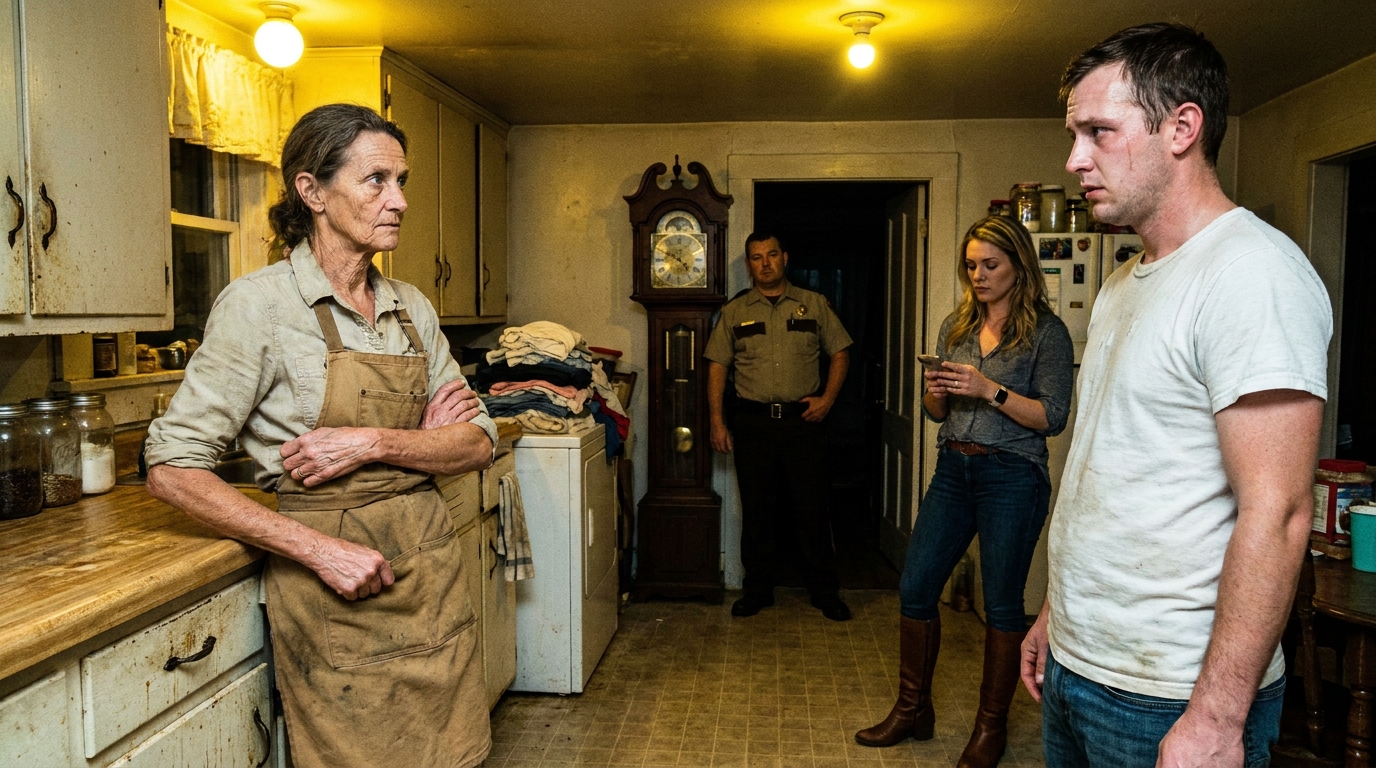
Eleanor stood unmoving by the counter. She had not slept, her eyes dry and strained under the morning sun leaking through the pine trees. Instead of hiding the envelope or the worn brass key, she kept them buried in her apron pocket, her left hand wrapped tightly around the scratched silver thimble for grounding.
The back door unlocked without a knock. Lucas walked in first, carrying two steaming paper coffee cups and a tight, defensive smile that didn’t reach his twitching eyes. Marissa flanked him, already scanning the countertops like a health inspector assessing a failing business. Her expensive leather boots left dark, damp smudges on Eleanor’s freshly swept linoleum.
“Morning, Mom,” Lucas said, setting one cup down on the table with an aggressive pretense of warmth. “You look exhausted. Did you even sleep?”
“I slept as well as a woman can when her family treats her like an expiration date,” Eleanor said. She stayed standing, arms crossed, refusing to touch the offered drink.
Marissa scoffed, her fingers tapping a rapid, impatient rhythm against her smartphone screen. “Eleanor, please. We don’t have time for the defensive attitude today. I spent the last twelve hours reviewing your bank records—specifically the local tax assessments and your recent savings drawdowns.”
“You don’t have the legal authority to touch my accounts, Marissa.”
“As Lucas’s spouse and your potential legal proxy, I made it my business,” Marissa said, her chin lifting with absolute entitlement. “The math doesn’t lie. You are burning through cash at an alarming rate just to keep this ancient roof over your head. It’s practical financial suicide.”
Eleanor watched a single bead of sweat slide down Lucas’s temple, carving a clean line through the dust on his face. He wouldn’t look at the door to Arthur’s old office, which remained closed and locked down the hall.
“Farms are dangerous places for isolated people, Mom,” Lucas inserted, his voice adopting a low, rehearsed gentleness that made Eleanor’s stomach drop. “A sudden fall out by the timber line, a medical episode—nobody would hear you scream. We need to talk about executing a temporary guardianship document. Just until we stabilize the estate.”
“Guardianship,” Eleanor whispered, her thumb pressing so hard into the ridges of the silver thimble inside her pocket that the metal bit into her flesh.
“It’s just a legal safeguard,” Marissa snapped, taking a predatory step closer, her perfume choking out the scent of old cedar. “If you cooperate and let us list the acreage for development, all of this strain disappears. If you don’t, we will be forced to file the competency paperwork with the county clerk without your signature.”
The threat hung naked in the cold morning air, a blatant display of unearned audacity. They weren’t trying to save her; they were trying to evict her.
Eleanor stood her ground, her spine rigid against the kitchen counter as she looked directly into her son’s hollow gaze. “Get out of my kitchen, Lucas. Both of you.”
CHAPTER 3: THE AMBUSH AT THE TREELINE
The light didn’t move away. It held steady, pinning me against the dark slope of the shed while the engine roar of a heavy utility vehicle vibrated through the damp earth beneath my boots.
“Mom, stay right there!” Lucas’s voice cut through the dark, distorted by the wind blowing off the ridge. He stepped into the edge of the glare, his silhouette tall, heavy, and unfamiliar. “Don’t make this any worse than it already is.”
I didn’t answer. I backed into the shadow of the woodpile, my fingers gripping the rough bark of a split fir log. My lungs burned with the cold air, but my mind was icy and quiet.
A second figure moved out from behind the vehicle’s high beams. Deputy Collins walked with his hand resting flat against his belt, his yellow rain slicker gleaming in the light. He wasn’t wearing his badge cover; he wasn’t acting on a radio dispatch.
“Mrs. Hayes,” Collins called out, taking two deliberate steps toward the woodpile. “We have a welfare call from your family. They’re concerned you aren’t capable of managing the hazards on this property tonight.”
“My property ends at the county line, Deputy,” I said, stepping sideways where the mud gave way to gravel, keeping the woodpile between us. “And you’re fifty yards past your jurisdiction without a signed warrant.”
Marissa’s voice came from inside the idling vehicle, sharp and echoing through the open window. “She’s erratic, Collins! Just secure the perimeter so we can file the emergency transfer!”
Lucas took another step forward, his boot sinking deep into the clay. “Mom, just give us the keys to Dad’s office. You don’t know what kind of trouble he left behind out here. You’re out of your depth.”
“Your father knew this land down to the bedrock, Lucas,” I said, my voice cutting through the hum of the engine. “And he knew exactly what kind of snake sneaks onto it after dark.”
Collins lunged forward to grab my arm, but I didn’t try to outrun him on the open driveway. I turned sharp to the left, ducking under the low, sweeping branches of the old hemlock tree where the fence line rotted into the ditch. I knew every root, every hidden dip in the soil—I’d mended that wire for forty years while Lucas was still in school.
Collins stumbled into the brush, his heavy boots skidding over wet needles as he cursed under his breath. The spotlight swung wildly, slicing through the hemlocks, but the dense branches threw long, chaotic shadows across the ravine.
I didn’t head for the road. I went deeper into the dark, following the quiet trickle of the creek down toward the north slope survey marker.
CHAPTER 5: SHADOWS ON THE NORTH SLOPE
A heavy, dark pickup truck moved at a crawl along the property boundary line. It didn’t have its standard running lights engaged, only the blinding white aftermarket high-beams cutting through the freezing Oregon mist. Eleanor stayed absolutely still, her fingers checking the bulk of the thin folder she had wedged inside her waistband, the cold plastic edge scraping her hip.
The wind had shifted from the south, bringing a sharp, freezing rain that rattled against the glass like birdshot. Through the distorted pane, she watched the vehicle brake near the logging trail that descended toward the north slope. The driver didn’t get out. The truck simply sat idling, the exhaust plume rising in heavy, pale clouds under the white glare of the lights.
They weren’t trying to hide anymore. The weaponized audacity of Lucas and Marissa’s threats that morning had evolved from legal jargon into a physical perimeter. They were mapping her movements, waiting for the exact moment the cold or the pressure forced her to break.
Eleanor dropped into a kitchen chair, refusing to illuminate a single bulb. Her internal monologue didn’t spin into a panic; instead, a hard, dry common sense took over. She had spent decades managing this soil through droughts, equipment failures, and lean winters. Lucas thought her age made her weak, but he had forgotten that old timber doesn’t bend easily under a light wind.
Her phone vibrated in her apron pocket, a low, single pulse. A text from the same unlisted number that had contacted her after the diner encounter lit the dark room.
Do not confront them. They are watching the gates. The lane is no longer clear.
Eleanor cleared the screen with a flick of her thumb, her breath creating a small circle of fog on the kitchen glass. She reached into her pocket, her skin finding the comforting weight of the silver thimble, rolling the textured metal against her index finger while she calculated the distance through the back timber. If the road was closed to her, she would have to use the paths that vehicles couldn’t navigate—the narrow, muddy tracks where Arthur had spent his final days trying to keep the truth from swallowing their life.
The truck suddenly surged forward, its tires tearing deep ruts into her grass as it turned sharply and sped toward the dark woods, the red taillights bleeding into the freezing downpour.
CHAPTER 5: THE SHOWDOWN IN THE MUDROOM
Lucas came in first, his jacket dripping water onto my braided rug, followed closely by Deputy Collins. Marissa pushed past both of them, her hair plastered to her forehead, her eyes sharp with absolute fury.
“You’ve completely lost your mind, Eleanor,” Marissa spat, stepping toward the table. “Hiding in the woods like a wild animal? Deputy Collins is filing an emergency protective custody hold right now.”
I didn’t back up. I reached down and tapped the open oilskin notebook sitting beside her gold pen.
“Section Four, Paragraph B of the county land register,” I said, my voice steady. “Arthur placed this entire parcel under an irrevocable forestry trust thirty-eight years ago.”
Lucas froze in his tracks, his eyes darting down to the stamped deed. “What are you talking about?”
“It means if any unrecorded commercial transit or structural transfer happens on this property, title doesn’t go to you, Lucas,” I said, looking him dead in the eye. “Ownership instantly forfeits to the state conservatory. The moment you file that conservatorship, the state seizes the deed, inspects the tunnels, and freezes every asset attached to the parcel.”
Marissa’s jaw worked silently, her face flushing deep crimson. She grabbed the paper, her fingers trembling as she scanned Arthur’s carbon-copy logs—the exact record of truck weights and dates matching the private account numbers listed in her own name.
“This isn’t real,” Marissa snarled, her voice rising to a screech as she tore at the corner of the document. “You think some fifty-year-old piece of paper stops a court order? Collins, take her into custody!”
Deputy Collins didn’t move. He stood near the door frame, his eyes fixed on the logged license plate numbers—including his own personal pickup truck listed six times over the past four months. His hand dropped away from his belt.
“I’m not touching this, Marissa,” Collins muttered, his voice cracking. “If that land trust is active on the county register, any enforcement action without a circuit court ruling puts me directly on the civil indemnity list.”
“You coward!” Marissa screamed, turning on him. “We paid you to keep the perimeter clear!”
Lucas backed up until his shoulder hit the doorframe, his face completely drained of color as he looked at his wife, then at me. “Mom… we were just trying to clear the debt…”
“You sold your father’s memory to cover your own greed,” I said, picking up the heavy brass key from the counter and laying it right on top of Arthur’s logs. “Now take your papers and get off my land before I hand this entire tin directly to the state forestry clerk in the morning.”
CHAPTER 6: THE UNBROKEN BOUNDARY
The surveyor stepped out into the pale morning light, holding a high-precision GPS tripod and a thick leather-bound ledger. He didn’t come to negotiate, and he didn’t ask where Lucas or Marissa were.
The county clerk had received the original trust filing at seven-thirty sharp. By eight, the land’s commercial access rights were formally revoked, the unauthorized tunnel entry was slated for concrete encapsulation, and the private debt agreements Lucas had signed were declared legally void against the property title.
Marissa had tried one final, desperate maneuver at the county office—demanding an immediate mental capacity hearing and accusing me of hiding Arthur’s financial records.
The clerk had simply handed her a copy of the 1984 forestry trust deed. The document was clear: Arthur hadn’t left me a fortune to defend; he had left a ironclad barrier that dismantled their leverage the moment they tried to force a sale.
Lucas called twice from his car before noon. He didn’t shout, and he didn’t demand the keys. He spoke in quiet, broken fragments, asking if I needed help hauling the winter firewood stacked near the shed.
“The wood is already stacked, Lucas,” I said, my hand steady on the receiver. “And the fence line is clear.”
“Mom… Marissa’s lawyer says the indemnity claim is going to wipe out our savings,” he whispered. “We might lose the house in town.”
I looked out the window toward the north slope, where the tall pines stood motionless against the gray sky.
“You made your choices when you brought an officer onto my porch after dark,” I said gently. “Your father loved you, Lucas. But he didn’t build this place so you could sell it off to the highest bidder.”
I hung up the phone without waiting for an answer.
The house didn’t feel hollow anymore. The creaks in the floorboards were just old wood settling into the cold earth, solid and unyielding.
I walked out to the back porch, pulled the brass key from my coat pocket, and dropped it into the small tin box resting on the window sill beside Arthur’s work gloves. I didn’t lock the door behind me as I walked out into the yard to clear the morning frost off the garden bed.
The land was mine, quiet and unbroken, exactly as it had always been.
CHAPTER 8: WHAT RESTS IN THE DIRT
The plastic container sat wide open on the table, its contents exposed to the morning glare. Marissa didn’t move toward it; she stood completely paralyzed as Eleanor slid the final, binding land trust agreement across the wood.
“You’re tracking dirt onto my floor, Marissa,” Eleanor said, her voice dropping like an iron grate. “And that’s the last thing you’ll ever take from this property.”
Marissa’s mouth twisted, her posture instantly breaking from arrogant entitlement into a desperate, cornered tantrum. “This isn’t legal, Eleanor! You’re an old woman out in the timber—you can’t lock up a commercial zoning boundary on a dead man’s scribble! Collins, break the latch on that side case!”
The deputy lunged forward, his heavy hand catching the edge of the table, his boots slipping against the linoleum. Eleanor didn’t move away. She shifted her weight, throwing her shoulder straight into the heavy oak table frame, forcing the wood to jam violently against the deputy’s shins with a dull, sickening crack of bone against timber. Collins groaned, his knees buckling into the mud-stained floorboards as his unearned authority dissolved into raw, panting breath.
“Mom, please—” Lucas croaked, his hands trembling violently as he reached for the folder, his face entirely white. “We were just trying to keep the estate from going under.”
“You were trying to dig out the pipeline your father died protecting, Lucas,” Eleanor said, her thumb pressing into the final ridge of the silver thimble before she dropped the heavy metal piece onto the wood with a sharp click. “The county clerk already received the electronic trust copy through the private satellite link Arthur paid for two years ago. The title is permanently locked. You have exactly three minutes to get off my dirt before the automated trespass boundary triggers the county forfeiture.”
Marissa shrieked, a raw, ugly sound of complete defeat, grabbing Lucas’s sleeve as she dragged him toward the shattered exit. Their entitlement had spectacularly collapsed under its own weight, leaving nothing but deep ruts in the wet gravel outside as their car surged away into the trees.
The house fell completely silent. Eleanor didn’t watch them go. She picked up the old silver thimble, slid it back into her canvas apron pocket, and reached for the broom behind the refrigerator. The morning sun lit the kitchen floorboards as she methodically swept the dark red clay back out into the grass, her hands steady, her spine straight, and the acres beneath her feet completely quiet at last.