The Price of Marble and Cold Iron: A Hard-Earned Vindication at the Sterling Hotel
CHAPTER 1: THE SERVICE GATE
The security guard didn’t even look me in the eye when he stepped into the light of the Sterling Hotel’s glass canopy.
He smoothed down the lapels of his dark suit, adjusted his earpiece, and held a black plastic clipboard like a shield between us. Behind him, the double glass doors reflected the warm yellow glow of crystal chandeliers. Guests in tailored tuxedos and evening gowns drifted across the polished marble floor inside, their laughter muffled by the heavy glass.
“Name?” he asked. His voice was flat, practiced.
“Pamela Seard.”
His finger dragged down the printed sheet. It stopped near the bottom. A faint twitch in his jaw was the only signal that he’d hit the note.
“You’ll need to use the service entrance, ma’am,” he said, not lifting his eyes.
“The service entrance?”
“Around the back. Past the dumpster bay, through the kitchen corridor.”
I didn’t step back. The autumn wind pulled at the hem of my simple black dress, but I kept my hands folded together, feeling the cool, notched metal of an old brass master key rolling slowly against my palm.
“Who issued that directive?” I asked cleanly.
“The event organizer.” He shifted his weight, his rubber-soled shoes squeaking against the wet granite steps. “I’m just following the protocol on the sheet.”
Past his shoulder, fifteen feet inside the heated lobby, a woman stood by the tall brass umbrella stand. Victoria Seard wore dark emerald velvet that caught the overhead spotlights. Her chin was tilted up, her posture rigid as a iron fence.
She was looking right at me through the glass.
She didn’t wave. She didn’t move her hands. A thin, slow smile spread across her face—not a nervous twitch or a mother’s soft greeting, but the sharp, cold satisfaction of someone watching a nuisance get swept off a porch. Ten yards behind her, near the double doors of the grand ballroom, my sister Natalie laughed into a glass of vintage prosecco, her cream silk dress trailing on the floor while her fiancé Bradley held her elbow.
Natalie glanced toward the doors, caught my eyes for a fraction of a second, and turned back to her circle without missing a beat.
“Ma’am,” the guard repeated, his tone dropping an octave. “The loading dock is around the east corner. I can’t leave the main entrance blocked.”
A young bellhop near the concierge desk—Thomas, who had worked the front desk rotation for three years—turned toward the glass. His eyes went wide as he recognized me. He took two fast steps toward the entrance, his hand reaching for the door handle, but the security guard raised a quick hand and shook his head once. Thomas froze, looked at the floor, and stepped back behind the counter.
I rolled the brass key over my knuckles one more time, letting the bite of its teeth press into my skin.
“Fine,” I said. “The service entrance.”
I turned on my heel, my heels clicking a steady rhythm against the damp pavement as I walked away from the golden light of the lobby and into the dark alley along the side of the building.
CHAPTER 2: KITCHEN HIERARCHY
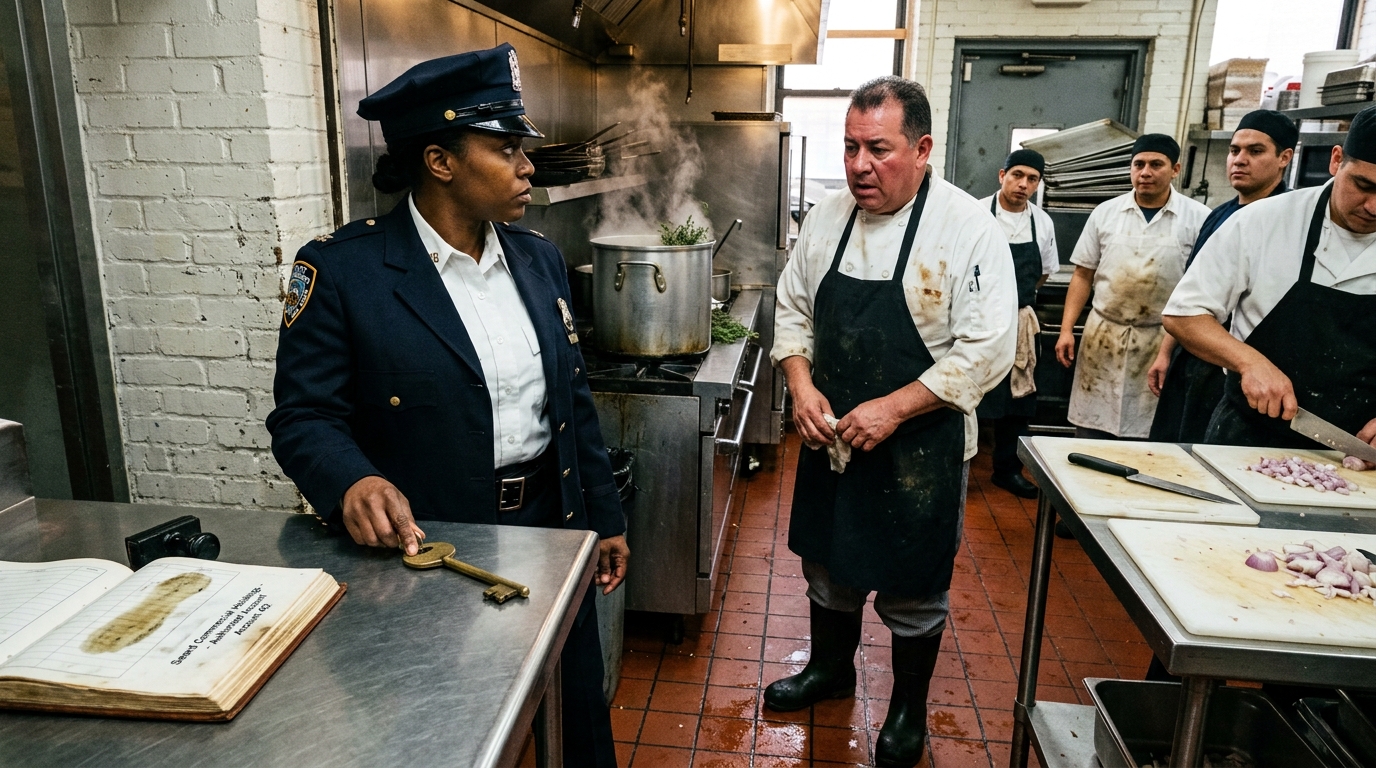
Humming fluorescent tubes buzzed thirty feet overhead, casting a hard white glare off the stainless-steel prep tables. Steam rose from a thirty-gallon stockpot against the brick wall, carrying the heavy scent of simmering veal bones and fresh thyme.
A prep cook holding a broad chef’s knife went completely still over a board of diced shallots.
Across the pass, Chef Rivera stopped mid-sentence, his arm frozen in the middle of pointing toward an unwashed sheet pan. He dropped his hand, wiped his palms slowly down the front of his apron, and stared at me.
“Miss Seard,” Rivera said. The noise of clinking sheet pans and running water died instantly down the entire line. “We… we weren’t expecting you to come through the back.”
“I took the scenic route, Chef,” I said. My voice didn’t carry an edge, just the plain weight of someone asking for a glass of water. “Don’t let me disrupt the line.”
Rivera didn’t return to his work. He stepped around the central island, his rubber boots thumping against the damp red tile. He looked past my shoulder at the heavy steel door, then back at my black dress.
“The guest manifest came down from the front desk two hours ago,” Rivera said in a low voice, his eyes dropping to the floor before returning to mine. “The note on the third page. We all saw it.”
I walked toward the main pass, pulling the brass master key from my pocket and setting it quietly on the stainless edge. The brass made a single sharp clink against the steel.
“Then you know the menu for the main hall,” I said.
Rivera swallowed. He reached out, his thumb touching the worn rim of the master key without picking it up. “The party requested the wild Atlantic salmon. Two hundred covers. But the shipment arrived forty minutes ago—gills were dull, flesh didn’t spring back. I refused the sign-off.”
“Good,” I said. “What’s in the deep cold?”
“Reserve Alaskan King,” Rivera answered, his shoulders unknotting half an inch. “I held it for the weekend dinner service. If I pop those cases for her party, we’re wiped clean for Sunday.”
“Pop them,” I said. “And drop the dill sauce. Run the citrus reduction instead.”
Rivera glanced down at the logbook resting on the corner of the pass—a thick, leather-bound register used for physical delivery tracking. On the yellowed corner of the open page, half-covered by a smear of grease, an old rubber stamp caught my eye: Seard Commercial Holdings – Authorized Account 402. The ink was faded, but the hand-written signature beneath it was unmistakable. My father’s jagged script, dated seven years ago—two years after he passed away, and six months before my mother suddenly had forty thousand dollars in cash for Natalie’s first apartment.
I didn’t reach for the book. I didn’t touch the paper. I just let my eyes rest on the ink for two seconds before looking back up at Rivera.
“Miss Seard,” Rivera said quietly, stepping closer so the prep cooks couldn’t hear. “The front office manager… he said we take orders strictly from the party host tonight. That’s your sister.”
“My sister is renting space for four hours, Chef,” I said. “I own the bricks, the steel, and the stove you’re standing in front of. Substitute the salmon.”
Rivera took a slow, deep breath, reached out, and picked up the brass key. He slid it across the stainless counter back toward me.
“Citrus reduction,” Rivera said, turning toward his line. “Move!”
I picked up the key, slipped it back into my palm, and walked toward the double doors leading into the service corridor behind the grand ballroom.
CHAPTER 3: THE SHADOWED CORNER
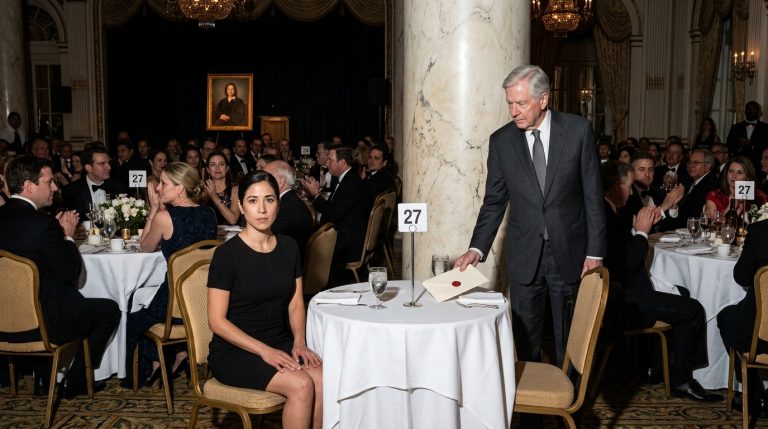
The string quartet’s opening movement washed over the room, soft and precise, competing with the quiet clink of lead crystal. Velvet drapes muffled the harsh echoes of the high ceilings, creating a warm, golden bowl of light where two hundred people drank forty-dollar-a-bottle champagne.
I leaned back against the dark oak paneling beside a tall ficus, well out of the main line of sight.
Across the parquet floor, my mother stood near the gift table. Her glass rested lightly between two fingers, her shoulders squared with that practiced posture she used whenever high society was in arms’ reach.
“Natalie has always understood how to present herself,” Victoria’s voice carried over the violin notes, smooth as polished glass. She was speaking to a woman in a grey silk jacket whose husband held the city’s commercial zoning board chair. “Some children naturally find their footing. Others just drift until life forces them to settle.”
The woman nodded, taking a slow sip. “And your younger daughter? Pamela, wasn’t it?”
Victoria adjusted her silk shawl, her lips setting into a flat line before reviving her smile. “Pamela does what she can. She’s still figuring out the basics. We try not to press her.”
Ten feet away, Marcus—the general manager—stood by the service corridor entry with his hands clamped behind his lower back. His posture was military, but his knuckles were pale against his jacket tail. He kept shifting his gaze from the front entry doors toward the shadow where I stood.
I rolled the brass master key once across my fingers, catching his eye in the mirror behind the bar. I gave him a tiny, horizontal shake of my chin.
Marcus held his breath, cleared his throat, and remained in place.
“Excuse me,” a voice rasped softly to my left.
Daniel stood there, holding two glasses of mineral water. He didn’t look like an attorney tonight; his collar was open, his dark blazer unbuttoned over a plain cotton shirt.
“You took the service route,” Daniel said, handing me a glass. “Chef Rivera looked like he was preparing for a federal raid when I walked through the pantries.”
“The kitchen runs clean,” I said, taking a sip. “How does the room look?”
“Like an eighty-five-thousand-dollar illusion,” Daniel murmured, leaning against the paneling beside me. “The Harringtons are sitting at Table One. Eleanor Harrington hasn’t touched her food once. She’s been watching your mother for twenty minutes like she’s auditing a tax return.”
“She’s verifying the pedigree,” I said. “Victoria sold them on an old-money legacy.”
“And you’re standing in the corner wearing a four-hundred-dollar dress with no paper trail in your purse,” Daniel noted quietly. He took a slow swallow of water. “No corporate records, no deed certificates. You came in completely naked, Pam.”
“I don’t need a folder of paper to prove the floor beneath their feet belongs to me,” I said.
Across the room, a silver spoon tapped three times against a crystal flute. Bradley Harrington stepped up onto the low wooden riser near the cake table, taking the microphone from the stand.
The room fell quiet. Beside him, Natalie adjusted her veil, her smile radiating pure triumph under the warm overhead spots.
CHAPTER 4: THE CHECKMATE
Bradley’s microphone hummed once with feedback. He smoothed down his lapels, smiling down at Natalie before addressing the front tables.
“We want to thank everyone for coming tonight to help us celebrate,” Bradley said into the mic. “Especially my mother, Eleanor, and Victoria, who worked so hard to pull this venue together.”
A round of polite applause rippled through the room. Victoria raised her glass, bowing her head with practiced modesty.
Natalie took the microphone from Bradley’s hand, her veil swinging slightly across her shoulder. “Family is about showing up,” Natalie said, her voice amplified across the high ceilings. “I’m so grateful for the people here who truly care about commitment—even if not everyone in my family understands what it takes to build something stable.”
A quiet rustle swept through Table Two. Two of Bradley’s aunts exchanged a brief, uncomfortable look. I didn’t move an inch. Beside me, Daniel lowered his glass of water, his jaw tightening into a hard line.
Before the applause could fade, Victoria stepped onto the riser, taking the mic from Natalie without asking.
“When Natalie was born, I knew she was special,” Victoria announced, her voice booming over the speakers. “Raising a daughter like her has been my absolute greatest joy. Watching her join a respected family like the Harringtons…”
A woman at Table Four leaned toward her husband, her voice carrying across the hush. “I thought there were two daughters?”
Victoria caught the remark. Her spine stiffened for a split second, her eyes sweeping over the room before settling into a cold, practice-tested smile.
“Natalie is my pride,” Victoria said smoothly into the microphone. “Pamela is still finding herself.”
The dismissal hung over the ballroom floor like wet smoke. Natalie smirked into her champagne glass.
Marcus stepped out from the rear corridor, his black executive jacket tailored sharp against his frame. He didn’t look at the crowd. He walked directly toward the head riser, stopping three feet from Victoria and holding a leather-bound daily operational tablet in the crook of his arm.
“Excuse me, ma’am,” Marcus said. His voice was unamplified, but in the quiet ballroom, it carried straight across the front four tables. “We have an immediate operational issue in the main line. Chef Rivera requires executive clearance on the seafood menu substitution.”
Victoria blinked, holding the mic away from her mouth with a sharp flick of her wrist. “Handle it yourself. Can’t you see we are mid-toast?”
“I cannot, ma’am,” Marcus replied, his tone as level as a spirit level. “The contract requires explicit sign-off from property management.”
“Then find the management!” Victoria snapped, her face flushing red under the stage lighting. “Stop interrupting us!”
Marcus turned his shoulders ninety degrees, looking straight past the head table toward the shadowed corner by the ficus.
“I am standing right in front of the management, Mrs. Seard,” Marcus said clearly, stepping back and inclining his head toward me. “Miss Seard, Chef Rivera is waiting on your decision regarding the Alaskan King salmon.”
The ballroom went completely, utterly silent. The string quartet cut out mid-bar.
Victoria’s hand froze mid-air, her microphone tilting sideways. Natalie’s blush vanished, her skin turning the gray color of wet newsprint.
“What did you just call her?” Natalie whispered into the dead air.
“I addressed Miss Pamela Seard,” Marcus said, his voice ringing crisp across the marble. “The owner of the Sterling Hotel.”
CHAPTER 5: THE UNRAVELING
The carpet seemed to absorb every breath in the room.
Victoria’s hand trembled, the microphone head clattering against her pearl necklace with a sharp, hollow thump. Her eyes darted from Marcus’s silver lapel pin straight to my face, wide and unblinking.
“This is ridiculous,” Natalie shouted, her voice dropping its smooth polish as she took two fast steps toward the edge of the low riser. “She’s lying! Marcus, who paid you to say that? She doesn’t own anything! She runs a rundown bed and breakfast upstate!”
“Miss Seard acquired the Sterling six months ago,” Marcus said, keeping his hands folded behind his back. He didn’t raise his voice by half a tone. “Her signature holds sole operational authority over every contract, vendor clearance, and security protocol on this property.”
Victoria’s face drained of color, her mouth working without sound before she found her footing. “Pamela… why didn’t you tell us?”
“You never asked,” I said, stepping out from the shadow of the ficus. My heels made a clean, single strike against the polished parquet. “For eight years, every family dinner was about Natalie’s apartment, Natalie’s promotions, Natalie’s social calendar. When I asked for a business loan ten years ago, you told me I drifted. So I stopped sharing the map.”
“You did this on purpose,” Natalie hissed, her fingernails digging into the oak banister of the stage. “You let me plan my engagement party here just to stage some sick power play!”
“You picked the venue, Natalie,” I said, setting my glass of water down on a nearby side table. “And when my name came up on the guest manifest three days ago, you personally scribbled instructions to redirect me through the loading dock past the trash compactors.”
A sharp gasp echoed from Table One.
Eleanor Harrington rose from her seat, her silk skirt falling in smooth, heavy folds. She didn’t look at Natalie. Her sharp, dark eyes fixed entirely on Victoria.
“Victoria,” Eleanor said, her voice cutting through the hushed ballroom like cold iron. “You told us your family’s assets were settled in traditional holdings. You told us Pamela was… struggling to find employment.”
“Eleanor, please—” Victoria started, taking an awkward step forward, her shoe catching on the hem of her velvet dress. “It’s a family misunderstanding. Pamela has always been secretive—”
“She isn’t secretive,” Eleanor interrupted, her tone flat and devoid of warmth. “She’s the owner of a thirty-million-dollar historical property. And you had her routed through the kitchen doors while you stood in the lobby.”
Eleanor turned to her son, who was standing frozen beside the cake table with his mouth slightly open. “Bradley. Collect your coat. We are leaving.”
“Mom, wait—” Bradley stammered, looking between Natalie’s flushed, furious face and his mother’s icy posture.
“Now, Bradley,” Eleanor repeated.
Natalie lunged off the stage steps, her cream silk dress whisking against the carpet as she reached for Bradley’s arm. “Bradley, look at me! It’s still my night! She’s trying to sabotage us because she’s bitter about her divorce!”
Bradley pulled his sleeve out of her grip, his face pale under the chandeliers. He couldn’t bring himself to meet her eyes.
Victoria turned back to me, her chest heaving as she pointed a trembling finger toward the front entrance. “You ruined her life, Pamela! You brought down your own sister out of pure spite!”
“I didn’t ruin anything, Mom,” I said cleanly, holding my ground without shifting an inch. “I just stopped hiding.”
CHAPTER 6: THE NEW NORMAL
Early light filtered through the broad bay windows, illuminating sawdust floating in the cool morning air. Sanded pine, fresh primer, and dried linseed oil smelled clean—real, solid, and completely devoid of ballroom polish.
The phone beside my blueprint roll vibrated across the raw grain.
I lifted the mug, taking a slow sip before tapping the screen. I didn’t set it to speaker.
“Pamela,” Victoria’s voice came through, raspy and thin, missing its usual stage projection. “The Harringtons revised the prenuptial terms. Bradley’s mother added seven separate asset restrictions before she’d allow the wedding date to stand.”
I looked out at the stone porch where two carpenters were fitting cedar railing. “That sounds like a conversation between Natalie and Bradley, Mom.”
“She’s crying in her old room, Pamela,” Victoria said, a desperate edge sharpening her tone. “She says you set a trap for her. You could have called Eleanor. You could tell her that our family… that we just had a communication gap.”
“I don’t lie for people anymore, Mom,” I said cleanly. “And I don’t smooth over edges that were cut to hurt me.”
A long, heavy silence stretched across the line. Through the receiver, I could hear the faint tick of the mantel clock in the house I’d grown up in—the one bought years ago after my father’s ledger accounts were quietly emptied to fund Natalie’s private schooling while I paid eighteen percent interest on a ten-room fixer-upper.
“I didn’t think you’d build all this,” Victoria whispered, her voice dropping into an unscripted, fragile quiet. “You never said anything.”
“You never asked,” I replied softly. “Not once in ten years. You looked at me and only saw what you wanted to believe.”
“Are you… are you coming home for Sunday?”
“No,” I said, setting my coffee mug down on the wooden table. The porcelain made a solid, grounded tap against the oak. “When you’re ready to talk to me as a daughter instead of an afterthought, my front door is open. But I won’t step back into your shadow.”
I didn’t wait for her to find a sharp response. I tapped the red button, locked the screen, and set the phone face down next to my tape measure.
Out on the porch, the lead carpenter tapped a cedar spindle into place with a wooden mallet, testing the fit. It sat flush, tight, and immovable against the grain.
I picked up my pencil, unrolled the floor plan for the main lobby, and went back to work.