The Canvas of Memory: Clara Miller and the Echoes of Light in the Pendleton Gallery
CHAPTER 1: THE WEIGHT OF THE GLASS
The penthouse library held the scent of beeswax and centuries-old ambition, a fragrance that had become the backdrop of Clara’s new life. It was a soft, enveloping aroma that masked the sterile reality of the scanners and monitors humming in the corner.
Arthur sat in his usual chair, his focus drifting toward the afternoon light filtering through the floor-to-ceiling glass. He wasn’t the man who had sat in the auction house, broken and weary; he moved with a renewed, albeit fragile, purpose. He watched Clara, his eyes tracing her movements as she adjusted the height of her desk lamp.
“The light is changing,” he said, his voice barely above a whisper. “Does it affect the reading?”
Clara didn’t look up immediately. She was focused on the Dutch market sketch, a piece the foundation had acquired through an estate sale in Brussels. It was a minor work, supposedly authentic, but it sat differently in the tray than the others. She tilted the lamp, letting the beam cut across the paper’s surface.
“It shouldn’t,” she replied, her voice steady. “But the texture feels wrong. It’s too uniform. Like someone smoothed out the memory of the paper.”
She pressed her eye to the lens of the spectral scanner, the screen in front of her pulsing with soft, iridescent light. She was looking for the pentimenti—the artist’s corrections—the living history of the piece. But the digital read-out was flat. It was perfect. And that, as her great-grandfather had drilled into her, was the first sign of a calculated deception.
Her heart rhythm remained steady, but her fingers grew cold. She reached for her notebook, the worn leather familiar against her palm, and flipped to a page of sketches she’d made of genuine Dutch sketches from the period. There was a discrepancy—a small, jagged line near the lower corner of the market scene that looked like a hesitation, but when she checked the scanner again, the line was gone. Not hidden, but absent.
It was as if the paper had been scrubbed clean of its own history.
“Arthur,” she said, her voice catching just enough to signal the change in temperature in the room. “The restoration report on this piece claims it was untouched for fifty years.”
“That’s the record,” he replied, turning his chair toward her.
“Then the record is lying,” she said, pointing to the spot on the screen where the spectral scan refused to show any depth. “Someone didn’t just preserve this. They erased it.”
She looked at the sketch, then out at the hazy London skyline, feeling a sudden, sharp pang of uncertainty. She had been tasked with protecting history, but it felt as though the history was slipping through her fingers like sand. She glanced at the monitor, and for a split second, the reflection of the room behind her caught in the screen showed a shadow moving near the library entrance—a figure who had been listening.
She turned, but the doorway was empty. The silence that followed was heavy, pressing against her ears, and for the first time since the auction, she felt the phantom presence of someone who knew exactly how to hide in plain sight.
CHAPTER 2: THE ERASURE OF INTENT
Clara did not turn around again. Instead, she anchored her gaze to the spectral monitor, her knuckles whitening against the edge of the mahogany desk. The screen was still displaying the Dutch market sketch, but the void where the jagged line had been felt like a puncture wound in the air.
“Arthur?” she murmured, her voice sounding small in the vast, vaulted expanse of the penthouse library.
Arthur had risen from his chair, his movements deliberate and quiet. He crossed the room, the soft thud of his loafers on the Persian rug the only sound in the suffocating stillness. He stood behind her, his reflection appearing in the glass of the scanner—a tall, imposing silhouette framed by the darkening windows of the London skyline. He didn’t ask what she’d seen; he simply placed a hand on the back of her chair, a gesture of grounding support.
“You saw something,” he stated. It wasn’t a question.
“It wasn’t a shadow,” Clara whispered, her eyes fixed on the digital topography of the paper fibers. “It was… an erasure. Look.” She adjusted the spectral filters, pushing the frequency higher. The monitor flickered, struggling to resolve the depth of the paper. For a fleeting second, the ghost of that jagged mark reappeared—a thin, deliberate tear that had been meticulously filled with a microscopic paste, then buffed until the surface tension of the paper was perfectly level.
A memory, sharp and jagged, sliced through her focus: her great-grandfather, Sergeant Jack Miller, sitting in his damp basement workshop, his fingers stained with graphite as he held a piece of rescued canvas. Truth doesn’t just disappear, Clara, he had told her, his voice a low, gravelly rasp. It’s buried. And when someone goes through the trouble of burying it, it’s because they’re terrified you’ll start digging.
“This isn’t an antique repair,” Clara said, the realization settling into her bones like the chill of a winter draft. “This is structural interference. Someone is scrubbing the provenance out of these sketches before they hit the secondary market.”
“But why?” Arthur asked, his brow furrowing. “If these are minor works, the profit margin for such an elaborate sabotage seems illogical.”
“It’s not about the margin,” Clara said, turning to look at him. Her eyes were bright, the exhaustion of the last few hours eclipsed by a cold, sharpening focus. “It’s about the vacancy. If they erase the history, the provenance becomes a vacuum. And in this market, you can fill a vacuum with anything you want—provided you have the right signatures.”
She stood up, moving away from the desk. She needed to walk, to feel the physical world beneath her feet to counteract the disorienting, fragile world of digital evidence. She paced the length of the rug, her fingers brushing the spines of the leather-bound volumes lining the walls. The air here usually smelled of history, but tonight, it felt thin, like the oxygen had been pulled out by some unseen force.
“We need the original acquisition records for the entire Brussels estate,” Clara said.
“Richard has them,” Arthur replied, though his tone was hesitant. “But they’ve already been audited by three separate firms, Clara. If there were issues, they would have been flagged.”
“Audits look for numbers,” she countered, stopping before a portrait of Eleanor. She looked at the woman’s painted eyes, searching for that same hidden layer of deceit. “They don’t look for the deliberate omission of trauma. This wasn’t an audit oversight. It was a surgical strike.”
She reached out, touching the cold, smooth glass covering the portrait. The texture was unyielding. She thought of the figure at the door. If someone was watching, they weren’t just watching the art—they were watching her. They were measuring her capacity to see. The weight of the foundation, the expectation of Arthur, the ghost of her grandfather—it all coalesced into a singular, heavy pressure on her chest.
She realized then that the decoy wasn’t the forgery; the decoy was the legitimacy of the entire acquisition process. They were letting her believe she was a detective, while they were treating her like a test subject.
“I need to go to the storage facility,” she said, her voice dropping into a register of quiet authority.
Arthur’s eyes widened, a flicker of protective instinct crossing his features. “Clara, it’s nearly midnight. The facility is secure, but—”
“If it’s secure, then why am I seeing shadows in my own house?” she cut him off, her gaze meeting his with an intensity that made him pause. “I need to see the physical inventory. The digital logs can be scrubbed. The paper… the paper remembers.”
She turned back to the scanner, her shadow stretching long and distorted across the floor. The sketch remained on the screen, a silent, static prisoner. Somewhere in the deep, unyielding archive of the foundation, she knew there was a thread that, if pulled, would unravel not just this sketch, but the very foundation of the “Truth” she had been hired to curate. She felt a phantom chill, a sensation of being watched from behind the very walls she had learned to call home. The hunt had begun, and she was no longer just the hunter; she was the bait.
CHAPTER 3: THE RESTORATION GHOST
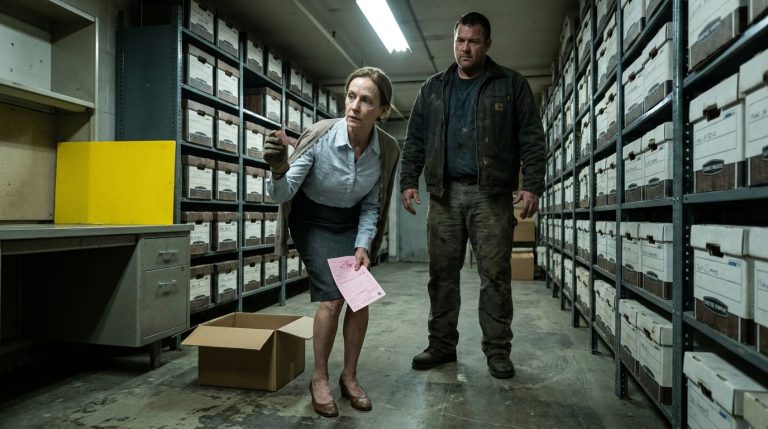
The transition from the warmth of the penthouse library to the subterranean climate of the storage facility was a violent shift in sensory reality. The air here was thin, recycled through HEPA filters and scrubbed of any organic moisture that might threaten the collection. It hummed with the steady, aggressive drone of the ventilation system. Clara followed Arthur down the narrow, industrial corridor, her footsteps echoing against the concrete with a hollow, rhythmic beat that felt far too loud in the deadened space.
Arthur punched a code into the keypad. The heavy steel door groaned, a sound of grinding metal that set Clara’s teeth on edge. As it slid open, the temperature drop was instantaneous, a sharp, crystalline cold that made the skin on her arms prickle.
“Richard is already here, cataloging the Brussels acquisition,” Arthur said, his voice dampened by the massive shelving units that reached toward the ceiling. “If there’s an irregularity, it will be in the transfer logs.”
As they stepped inside, a sudden, metallic clack-hiss echoed from the ceiling. The ventilation unit shuddered, and the steady drone dropped an octave, replaced by a rhythmic, stuttering pulse. A thin layer of frost began to form on the overhead pipes, and the lights overhead flickered, dimming to a sickly, jaundiced yellow.
“Climate control is spiking,” Arthur murmured, his composure wavering as he checked his watch. “The pressure balance is failing.”
Clara didn’t wait for him to finish. She was already moving toward the back of the room, toward the rows of climate-sealed crates holding the Brussels intake. She didn’t need a map; she could feel the geometry of the archive, the way the shelves seemed to form a trap. She reached the section marked 17B, her gloved fingers trembling slightly.
“Clara, the system is going into emergency lockdown,” Arthur warned, but she ignored him. She pried the seal of the nearest crate. Inside, the sketches lay wrapped in archival tissue, dormant and pale. She pulled one out, discarding the gloves to feel the texture of the paper against her bare skin.
It was too cold. That was the first thing she noticed. Genuine 17th-century rag paper retained a specific, dense thermal mass. This paper felt synthetic, thin, and brittle, like it had been bleached into submission.
“Arthur, look at the edges,” she said, holding the sketch up to the dying light. “The deckle edges aren’t naturally frayed. They’ve been sheared.”
Just then, a figure stepped out from behind a massive unit of storage racks. It was Richard, his face obscured by the flickering, stuttering light. He held a tablet in his hand, his posture relaxed, almost too still for the chaos of the failing climate system.
“You shouldn’t be down here, Clara,” Richard said. His voice was smooth, devoid of the alarm one would expect from a security breach. “The environment is unstable. It’s hazardous for the inventory.”
“The inventory is already compromised, Richard,” Clara replied, her voice steadying as the adrenaline surged. She stepped toward him, the paper held firmly in her grasp like a shield. “Who authorized the shear-trimming on the Brussels lot? This isn’t conservation; it’s mutilation.”
Richard didn’t move. The clicking of the failing ventilation system sounded like a countdown. He looked at Arthur, then back at Clara, a thin, ghost of a smile touching his lips. “Conservation is a matter of perspective. We were told to preserve the essence of the art, not the debris of its past. Some things are better off forgotten, wouldn’t you agree?”
“The ‘essence’ isn’t what you’re preserving,” Clara said, her heart hammering against her ribs. She glanced at the tablet Richard held—the screen was displaying a live feed of the penthouse library, showing the very sketch she had been examining moments ago. “You’re building a shadow archive. You’re using the original paper to create a base for something else entirely.”
Richard took a step forward, his movements feline and precise. “You were hired to look, Clara. Not to interrogate.”
“I was hired to find the truth,” she shot back, stepping back toward the relative safety of the crate rows. “And the truth is, you aren’t just an assistant. You’re a technician.”
The ventilation unit gave a final, agonizing metallic shriek, and the overhead lights died completely, plunging the storage room into absolute, suffocating darkness. Clara stood frozen, her eyes straining against the black, her breath hitching as she heard the sound of a soft, measured intake of air right in front of her.
She felt a hand brush against her shoulder, not to grab, but to guide—or perhaps to measure.
“Be careful, Clara,” Richard’s voice came from the dark, whispered and intimate. “If you dig too deep into the foundation, you might find that it’s hollow.”
She tightened her grip on the sketch, the cold, brittle paper feeling like the only real thing left in a world of ghosts. In the dark, the scent of ozone—the smell of a machine about to burn out—became overwhelming, a sharp, acidic sting that hinted at the destruction yet to come. The storage room was no longer a sanctuary of history; it was a cage, and the lock had just turned.
CHAPTER 4: THE FRACTURED ARCHIVE
Clara didn’t move. In the absolute void of the storage vault, her senses heightened to a painful degree. She could hear the rhythmic thrum-thrum of the failing cooling system, a dying mechanical heart, and the faint, unsettling rustle of fabric as Richard shifted his weight. He was close—too close. The scent of him, a sharp, clinical blend of antiseptic and expensive cologne, was a stark contrast to the stagnant, metallic dust of the vault.
She gripped the sketch tightly, the edges of the paper biting into her palms. She needed to break this stalemate. Her mind raced, filtering through the layouts she’d memorized during her weeks of study. If she moved toward the shelving, she risked tripping the heavy, motorized racks; if she stayed still, she remained a target.
“You’re very quiet, Clara,” Richard whispered, his voice vibrating through the dark. “That’s one of your most dangerous traits. Most people, when faced with the truth, feel the need to fill the air with noise. They plead, they bargain, they demand.”
“I’m not bargaining, Richard,” Clara said, her voice a low, steady anchor. She kept her eyes wide, searching for the slightest variance in the darkness—a ghost of a reflection, a shift in the air density. “I’m looking for the break in the pattern.”
She felt a slight movement in the air near her left hand—the displacement caused by a sudden, swift reach. She dropped to a crouch, the momentum of the movement sending her sliding across the smooth concrete floor. Her hand struck the side of a heavy metal storage crate, and she felt something odd—a raised, textured ridge along the bottom trim. She pressed her thumb against it. It wasn’t metal; it was plastic. A non-archival magnetic strip, hidden beneath the industrial coating.
“Clever,” Richard said, his tone bordering on amused. “But discovery is only half the battle. Possession is the rest.”
Clara didn’t hesitate. She ripped the strip from the crate’s lining—a jagged, sharp sound in the quiet—and as she did, the emergency lighting system groaned, stuttered, and finally flickered to a low, blood-red glow. The vault bathed in a rhythmic, pulsing crimson.
She saw him then. Richard stood six feet away, his face unreadable, his hand hovering over the release mechanism of a high-pressure fire suppression system. He wasn’t reaching for her; he was reaching for the room’s defenses.
“If you trigger that,” Clara said, her voice sharp as she brandished the magnetic strip, “the entire archive is flooded with chemical suppressants. You’ll destroy the very work you’ve been ‘preserving.’ Is that the cost of your arrogance?”
Richard’s gaze flickered to the strip in her hand. For the first time, the polished mask of his composure cracked. The color drained from his face, leaving him looking older, jagged. He hadn’t expected her to find the secondary transmission node—the very thing he used to report the ‘integrity’ of the sabotage to his unseen handlers.
“The work is already a lie, Clara,” Richard retorted, his voice strained. “The ‘truth’ you defend is just a consensus. I’m just providing a better narrative.”
The floor beneath them shuddered as the emergency power kicked in, the sound of pressurized gas beginning to hiss through the overhead nozzles. They had seconds before the room became a sealed, hazardous chamber. Clara scrambled backward, her eyes locked on his. She realized then that he wasn’t just an infiltrator; he was a true believer in the decay. He didn’t want to steal the art—he wanted to prove it had no meaning beyond its market value.
“You’re not a restorer,” she breathed, the realization cold and absolute. “You’re a cynic.”
“I’m a realist,” he snapped, his hand tightening on the release lever.
Clara stood, her legs aching, her heart a frantic bird against her ribs. She didn’t look for an exit. She looked for the weakness in the rack system. If she could disrupt the alignment, the magnetic emergency locks would disengage. She threw the magnetic strip into the narrow gap between the tracks of the motorized shelving. The feedback loop was instantaneous.
A high-pitched, electric whine tore through the vault, and the racks shuddered, tilting violently. The red emergency lights strobed, turning the room into a frantic, chaotic blur of steel and shadow. Richard was thrown off balance as the floor shifted, his hand slipping from the lever.
Clara dove for the gap in the closing door, her lungs burning, the smell of ionized dust and fire-retardant chemicals choking her. She didn’t look back to see if he was trapped. She hit the control panel on the exterior wall, overriding the manual lock with her own override key, and watched as the heavy doors slammed shut, sealing the vault in a final, resounding clang of metal on metal.
She slumped against the wall, the silence rushing back in, heavy and thick. She was alive, but the piece of paper in her hand—the proof of the sabotage—was smeared with the grime of the vault, a testament to the fact that the ‘truth’ was never clean. And as she caught her breath, she felt the cold, sinking weight of a new fear: Richard was inside, yes, but he had been expecting her. She hadn’t defeated him; she had merely forced his hand.
CHAPTER 5: THE ARCHITECTURE OF DECEIT
Clara pressed her forehead against the cool, vibration-dampened steel of the vault door, her breath coming in short, ragged plumes in the freezing air of the facility. The silence behind the door was worse than the sound; it was an emptiness that suggested Richard hadn’t just been trapped—he had been waiting for the door to seal. She slid the magnetic strip into her pocket, the hard plastic edge pressing into her thigh like a jagged tooth. She had the evidence, but as she looked down the long, industrial corridor, the fluorescent lights flickering in rhythmic, dying pulses, she realized she had no one to give it to.
The facility’s intercom crackled to life, a low, distorted static that coalesced into the sound of someone humming—a soft, melodic tune she recognized from the Dutch sketches she had been studying for weeks. It was a fragment of a lute song, haunting and archaic.
“You have a remarkable instinct for patterns, Clara,” Richard’s voice drifted through the speakers, tinny and artificial. He didn’t sound like a man trapped; he sounded like a man who had successfully navigated the labyrinth. “But you’re looking at the brushstrokes while ignoring the frame.”
Clara didn’t answer. She kept moving, her steps silent on the rubberized flooring. She needed to reach the security terminal in the main office, but the hallway seemed to stretch, the distance distorting as if the architecture itself were reacting to her presence. She reached into her bag for her access badge, but her fingers brushed something else—a small, triangular piece of paper she’d picked up from the floor of the vault just before the lights had died.
She pulled it out, holding it up to the dim glow of the corridor lights. It wasn’t trash. It was a fragment of the Brussels inventory report, printed on high-density archival stock. She unfolded it, and the breath caught in her throat. The entire document was covered in tiny, microscopic annotations—not notes, but a map. A topography of the foundation’s internal digital infrastructure, drawn in the same erratic, jagged lines she had seen on the sketch.
It wasn’t a log of the art. It was a blueprint for a digital heist.
She stumbled, her back hitting the wall as the reality hit her. She hadn’t been fighting a single forger; she had been engaged by an entire system designed to exploit the very foundations of authentication she was trying to build. Every piece of work she had ‘authenticated’ in the last six months—every painting she had pronounced real—was a node in a vast, interconnected web of false provenance. They weren’t just forging art; they were forging history, building a library of “authentic” fakes that would eventually overwrite the real record of the world’s heritage.
A sudden, sharp warmth radiated from the wall behind her. She pushed off, her senses on high alert. The entire facility was warming up. The climate control system, meant to preserve the delicate items, was ramping up to levels that would buckle the very canvases they were meant to protect. It was a scorched-earth policy.
“You’re not going to stop the update, Clara,” Richard’s voice came again, this time from the speakers directly above her. “You’re merely the final check. Once you confirm the digital footprint of the Brussels lot, the server reconciles the history. The fake becomes the original. The past becomes a memory of our choosing.”
She reached the main office door, her hand hovering over the override switch. If she cut the power, she would erase the server, but she would also lose the only evidence she had of the manipulation—the data required to prove the foundation had been breached. If she didn’t, the network would solidify the forgery as fact.
She looked at the magnetic strip in her pocket, then at the blueprint in her hand. She realized she couldn’t win by playing the game of authentication. The system was rigged. She had to break the connection entirely. She pulled the emergency fire-suppression lever she had avoided before, not to trap someone, but to trigger the absolute, manual purge of the entire floor’s digital network.
The sound of the purge was like a freight train, a sudden, violent rushing of inert gas that ripped through the ceiling panels and turned the hallway into a swirl of white, blinding fog. The electronics in the hallway screamed, a chorus of short-circuiting chips, and then, suddenly, everything went dead.
She stood in the center of the fog, the silence absolute once more. She had destroyed the connection, but she knew the cost. She had effectively burned the archives to the ground. She turned toward the exit, the taste of ozone and plastic heavy on her tongue. The battle for the art was over, but the battle for the truth had just moved from the canvas into the cold, gray reality of the law. She took a step forward, her legs heavy, feeling as though she were walking out of a dream—or perhaps, finally stepping into a nightmare that was hers to resolve.
CHAPTER 6: THE SILENT ARCHITECT
Clara emerged into the pre-dawn light, her boots crunching on the wet pavement. Her chest heaved with each breath, the air tasting of sulfur and wet concrete. Behind her, the facility was a tomb of silent technology, its servers purged, its internal network—the architecture of the fraud—severed. She stood for a long moment, shivering, watching the city lights blur into streaks of amber and gray.
She wasn’t running. She had nowhere to run. She walked toward the edge of the park, her pace slow and deliberate. Her mind felt hollowed out, a space where adrenaline had once been, now filled with the cold, sharp clarity of the aftermath.
She found Arthur waiting near the gate, his coat pulled tight against the damp morning. He looked older than she remembered, the light from a nearby streetlamp etching deep lines into his face. He didn’t ask questions. He walked to her, his movements stiff with a mixture of fear and relief. When he reached out to take her arm, he felt the dampness of the suppression chemicals on her jacket, the grit of the archive dust on her skin.
“It’s gone,” Clara said, her voice raspy. “The Brussels network. The server reconciliation—it’s over, Arthur.”
Arthur nodded, his gaze shifting past her toward the facility. “Richard is in custody. The local authorities are already sweeping the site. They found… everything.” He paused, his expression shifting into something that wasn’t relief, but a quiet, aching sadness. “They found the archive, Clara. The one he built. Not of art, but of us.”
Clara felt a sudden, sharp chill that had nothing to do with the wind. “Us?”
“He was collecting,” Arthur said, his voice dropping into a register of disbelief. “He wasn’t just infiltrating the foundation. He was documenting our reactions. Every check, every scan, every ‘truth’ you uncovered—he was measuring us. He was a protégé of Hoffman, yes, but he was more than a student. He was an architect of the very doubt we were trying to cure.”
They walked in silence toward the waiting car. As they drove, the city began to wake, the hum of traffic replacing the unnatural quiet of the archive. Clara looked at the magnetic strip she had salvaged from the vault. She reached into her pocket, felt its hard, cold edge, and pulled it out. She turned it over in her hands, the small, unassuming piece of plastic that had cost her so much.
She realized then the true extent of the betrayal. It wasn’t just about the money or the forgeries. Richard had wanted to prove that integrity was just another texture, something that could be peeled back and replaced with a better, more convincing imitation. He had wanted her to lose her faith in her own eyes.
“We have to rebuild,” Arthur said softly, his hand resting on hers for a brief, steadying moment. “Not the archive. The foundation. A clean slate.”
“There is no clean slate,” Clara replied, looking out the window at the familiar buildings, now seen through a lens of suspicion. “There’s only the work of restoration. We don’t hide the cracks, Arthur. We show them. We show exactly where the damage was and how we repaired it.”
When they arrived back at the penthouse, the library was exactly as she had left it. The Dutch sketch, still resting on the scanner, looked different now. It was no longer a puzzle to be solved, but a piece of history that had survived its own destruction. Clara walked over to it, picking up the small, worn journal of her great-grandfather. She opened it to the last page, the paper soft and yellowed, the ink faded into a pale, translucent gray.
She took a pencil and added a single line to the bottom of the page—a record of what had happened, a testament to the fact that the truth had been tested and had, by some miracle, remained. She felt a quiet, grounding peace, a sense that she had finally stopped trying to be the hero her grandfather had been and had started to become the curator of her own reality.
She walked to the desk and placed the archive keys down, the metal clinking softly against the polished mahogany. She turned to Arthur, who was watching her from the doorway.
“I’m going to finish the cataloging,” she said, her voice steady and clear. “But not for the foundation. For the record.”
Arthur smiled—a genuine, tired, but hopeful expression—and nodded. The library, once a place of sterile, guarded perfection, finally felt like a home. The morning light spilled through the windows, catching the dust motes as they danced in the air, a chaotic, beautiful, and entirely authentic pattern. She sat down at her desk, picked up the magnifying glass, and began to work, her hands steady, her eyes clear, ready to look at the world for what it truly was.