The Dusty Driveway of Willow Creek: How One Retired Veteran Dismantled a Tyrant’s Empire Without Firing a Single Shot
CHAPTER 1: THE ORANGE LINE
The brass Zippo clicked open in my palm. I didn’t strike it. I just rolled the cold metal edge back and forth between my thumb and forefinger, letting the familiar friction anchor my breathing.
A jagged strip of fluorescent orange cut straight across my freshly sealed asphalt, stopping two inches short of the garage door.
“That’s a five-hundred-dollar fine for an unapproved surface alteration,” Karen said, her flowery muumuu straining against her frame as she lowered the spray can. “And another five hundred for every day it stays non-compliant.”
My brand-new F-250 sat parked twenty feet away, its custom lift kit casting a long, unbothered shadow in the morning sun. I kept my hand resting on the open truck door, my knuckles locked.
Thirty years in the Corps of Engineers taught me one immutable law: when an adversary overextends their supply lines, you don’t charge the barricade. You let them exhaust their ammunition in the dirt.
“Rectified,” I said, my voice dropping into that flat, gray register that used to make junior officers check their map grids twice. “You stepped onto private property, Karen. You committed criminal mischief.”
She puffed her chest, her face flushing a dull, mottled red under the humid morning glare. She wanted a shouting match. She wanted the validation of seeing me lose my temper, stomp my boots, and hand her the emotional high ground she needed for her little clipboard.
I didn’t give it to her. I closed the Zippo with a dull, heavy snap.
“You have twenty seconds to get off my concrete,” I said, looking right past her shoulder at the empty cul-de-sac. “After that, I stop talking.”
The sheer lack of drama froze her mid-sentence. She blinked, her mouth opening to deploy another rehearsed bylaw citation, but the cold weight of my silence caught her off guard.
She turned on her heel, her sandals slapping against the pavement as she retreated toward her modified golf cart.
The little electric motor whined as she spun it around, leaving me alone with the smell of cheap floral perfume and fresh aerosol hanging heavy in the damp air.
I looked down at the orange stripe slicing through my blacktop. It was ugly, loud, and entirely temporary.
I reached into my pocket, pulled out a small notepad, and clicked my pen. The first phase of the operation was complete. She had just shown me exactly where her perimeter was weak.
CHAPTER 2: THE MANILA FOLDER
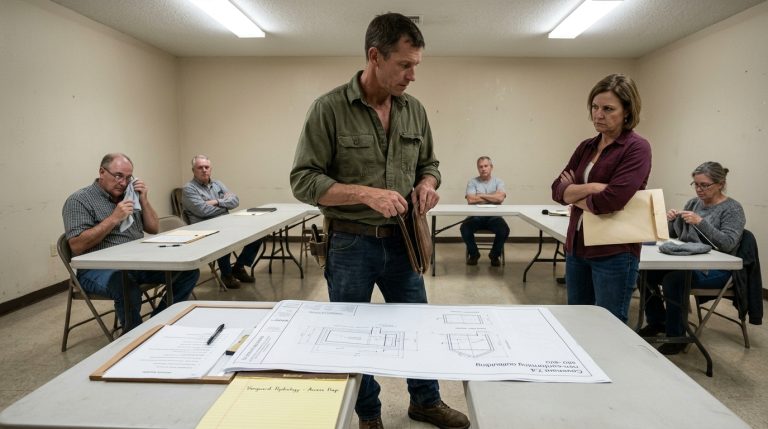
The fluorescent lights of the community clubhouse hummed with a flat, institutional buzz that reminded me of every supply depot audit I ever sat through in uniform.
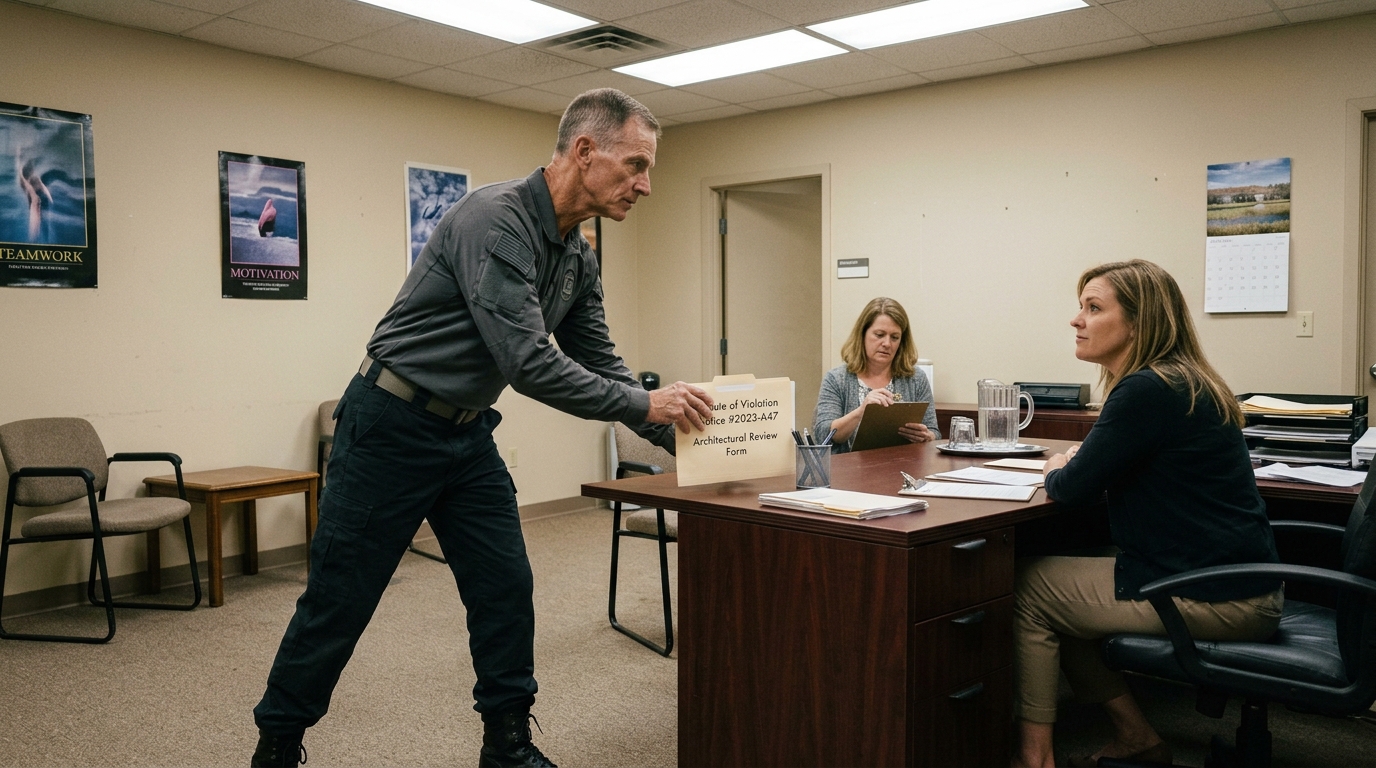
Karen sat behind her oversized mahogany laminate desk, flanked by Carol, who was nervously folding and unfolding a corner of her clipboard.
“Major McTavish,” Karen said, her tone dripping with the forced sweetness of someone who assumed victory before the briefing even started. “Here to discuss your little problem?”
I didn’t blink. I laid the manila folder flat on the cold wood surface, the thick cardboard sliding two inches before stopping dead against her chrome pen holder.
“I’m here to file a formal dispute of violation notice number 2023-A47,” I said, keeping my voice level and devoid of any rising inflection. “As you can see from the documentation, the work was pre-approved under standard maintenance guidelines.”
I slid the first sheet forward—the original architectural review form bearing her own spiky, distinctive signature at the bottom.
Carol shrank back in her chair, refusing to look down at the paper as if it might detonate.
Karen didn’t even glance at the signature block. She just pushed the folder back across the desk with one manicured fingernail.
“The committee has reviewed the situation,” she said, leaning forward to close the physical gap between us. “The initial approval was for a standard seal, not a specialty high-gloss reflective coating. We’ve had complaints.”
“Complaints from whom?” I asked, my fingers resting lightly against the edge of the manila folder.
“The sources of complaints are confidential,” she snapped, her chin lifting with defensive authority. “The decision of the Architectural Control Committee is final. You can appeal to the full board in three months, but the daily fines will continue to accrue.”
It was a closed loop designed to exhaust anyone who didn’t know how to read the administrative margins.
I didn’t raise my voice. I didn’t pound my fist on her laminate desk.
I simply pulled the folder back toward myself, squared the edges with a sharp tap against the wood, and tucked it back under my arm.
“Thank you for your time,” I said, turning away before she could formulate her next rehearsed reprimand.
As I walked out into the hazy afternoon heat, I felt the familiar, cold clarity of a perimeter being mapped.
She thought her little office was a fortress, but every wall she built was just another boundary line waiting to be surveyed.
CHAPTER 3: GROUND RECONNAISSANCE
Arthur settled into the old wicker rocker across from me, the springs groaning under his weight. He looked over the rims of his reading glasses at the manila folder resting on my knee.
“Queen Karen didn’t give you the standard speech about community harmony, did she?” he asked, swirling the ice in his own glass.
“She told me the decision of the committee was final,” I replied, taking a slow sip of the tea. “She thinks a rubber stamp and a laminated binder make her untouchable.”
Arthur gave a dry, raspy chuckle that didn’t reach his eyes.
“She’s been running this subdivision like a fiefdom for five years,” Arthur said, leaning forward. “And nobody ever looks past the surface because most folks just want a quiet retirement. But if you want to know where the bodies are buried, you don’t look at the bylaws. You look at the vendor checks.”
He tapped a weathered finger against the armrest.
“Prestige Property Management,” Arthur murmured. “That’s the name you want. They handle every blade of grass and every gallon of pool water in Willow Creek Estates, and their prices are twenty percent higher than anyone else in the county. Nobody questioned it until I started digging through old budget disclosures.”
I set my glass down on the side table, the condensation leaving a dark ring on the wood.
“And who owns Prestige?” I asked, though I already knew the answer.
“Daniel Petrov,” Arthur said quietly. “Karen’s brother-in-law. Registered out of a post office box six miles from here.”
The pieces locked into place with the clean precision of a breech-block sliding home.
She wasn’t just a petty tyrant flexing over lawn heights and paint shades; she was running an internal revenue machine using community dues as fuel.
I pulled my notepad from my shirt pocket and clicked the pen, noting the corporate registry details.
“Paper trails don’t lie, Arthur,” I said, looking out toward the cul-de-sac where her modified golf cart was idling by the mailbox kiosk. “And a manila folder only holds so many pages before it starts to split at the seams.”
CHAPTER 4: THE RAGTAG PLATOON
Mr. Garcia walked through the front door first, his shoulders tight with the kind of tension that comes from years of swallowing petty insults.
Behind him came Lisa, clutching a worn manila envelope of her own, and Arthur, who closed the wooden door firmly behind them.
“We got your notices,” Mr. Garcia said, dropping a stack of certified envelopes onto the laminate tabletop. “Every single one of us has a binder full of arbitrary fines for things that don’t violate a single county ordinance.”
“She fined my son because his basketball net was the wrong shade of blue,” Lisa added, her voice shaking slightly as she pulled out a photograph of the driveway hoop. “She told me it ruined the neighborhood aesthetic while her own brother-in-law gets no-bid contracts.”
I pulled out a spare chair for Lisa and sat down opposite them.
“That’s because the rules were never about the neighborhood,” I said, sliding the state business registration for Prestige Property Management across the table. “They were about protecting a revenue stream.”
Arthur leaned over the papers, his glasses sliding down his nose as he scanned Daniel Petrov’s name listed as the sole proprietor.
“The shell company,” Arthur muttered, a slow, grim smile forming at the edge of his mouth. “She didn’t just build a petty kingdom. She built a toll booth.”
The room fell silent as the full weight of the documentation settled over them.
These weren’t isolated grievances anymore; they were individual data points forming an unmistakable, prosecutable pattern of systematic harassment.
“So what’s our move, Mac?” Mr. Garcia asked, looking straight at me.
“We don’t shout, and we don’t argue on her turf,” I replied, tapping the edge of the corporate filing. “We pool every notice, every violation, and every canceled check into a single, synchronized response.”
CHAPTER 5: THE CERTIFIED TRAP
“Paid under duress and protest,” I muttered, squaring the ink block against the paper.
The total came out to seven thousand five hundred dollars in accumulated fines—an extortionate figure designed to trigger immediate panic and default.
Instead of panic, it triggered a legally binding obligation.
I slid the check into a crisp window envelope alongside a two-page formal demand letter drafted with surgical precision.
The letter cited state statute 720.305 and Willow Creek Estates Bylaw 11.3, locking the board into a mandatory public hearing within fourteen calendar days.
If Karen ignored it, she faced immediate personal liability and state real estate board intervention.
If she accepted it, she would have to stand in a room full of the people she had bullied and answer for every missing signature and inflated vendor fee.
I walked down the hallway and handed the envelope to Sarah, whose fingers brushed mine with a quiet, lingering tension.
“Is this the final move?” she asked, her eyes searching my face.
“It’s the corner piece,” I said, putting on my coat. “Now we see if she walks into the trap on her own two feet.”
I walked out to the mailbox at the end of the driveway, lifted the red metal flag, and slid the envelope inside.
The green return receipt card would come back in three days bearing her spiky, indignant signature.
She thought she was collecting tribute; she was actually signing her own subpoena.
CHAPTER 6: THE DUSTY GRAY COLLAPSE
Karen sat behind the center table, her usual self-satisfied smirk replaced by a rigid, frantic glare as she faced the packed room.
David Chen stood beside me, sliding a thick binder across the laminate surface directly in front of her committee seat.
“Madam President, let’s review the active vendor disbursements,” David said, his voice cutting through the murmurs of the crowd like a knife.
He projected the corporate filings for Prestige Property Management onto the pull-down screen behind her, revealing the brother-in-law’s name and the inflated three-year billing cycle.
Karen slammed her palm onto the table, her face flushing a dark, mottled red.
“This is an unauthorized proceeding,” she shrieked, her voice cracking under the sudden weight of the exposure. “You have no authority to question the board’s operational contracts!”
“We have the authority of every homeowner in this room,” Arthur Pendleton declared, standing up from the front row with absolute calm.
David didn’t raise his voice; he simply turned to the final tab of the binder and laid out the missing signature block on the unauthorized landscaping rider, alongside the unrecorded proxy votes that invalidated their quorum.
Karen scrambled to grab her papers, her hands trembling as she tried to shout over the rising tide of neighborhood dissent.
She attempted her final, desperate counter-move—pointing a shaking finger at me and claiming harassment, threatening immediate police intervention for trespassing.
The room didn’t flinch. Nobody backed down.
Henderson, the sole remaining board member flanking her, slowly stood up, raised his hands in surrender, and walked away from the table.
Stripped of her proxy votes, her shell company contracts, and her manufactured authority, Karen sat utterly isolated under the glare of the overhead lights.
Arthur called for a motion from the floor for an immediate vote of no confidence and a full recall election.
A forest of hands shot up across the room, sealing her defeat with a near-unanimous roar.
Karen gathered her scattered papers with shaking fingers, shoved past the front row without another word, and fled through the side exit into the night.
A week later, a professional paving crew arrived at the end of my driveway, grinding away the old sealant and the last faint remnants of the orange line.
They laid down a smooth, immaculate layer of fresh blacktop under the afternoon sun.
I sat on the front porch with a glass of iced tea, watching the Garcias’ son bounce a basketball down the quiet, level cul-de-sac.
Arthur walked over, handed me a fresh glass, and looked out at the pristine pavement without a trace of friction left in the air.
The scar was gone, the community was restored, and the boundary lines were finally at peace.