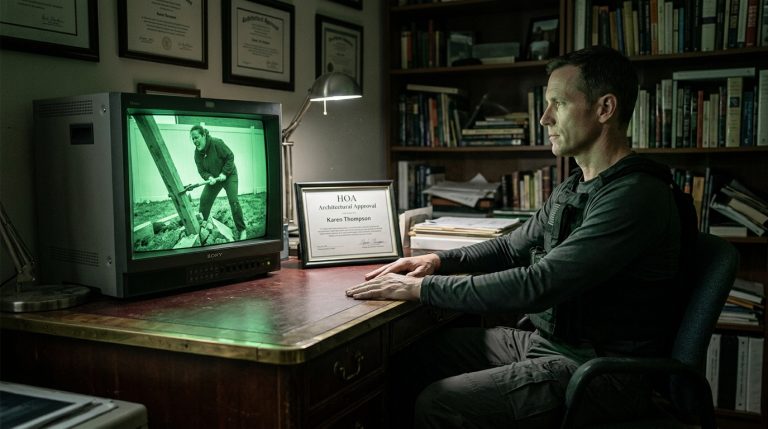
The Iron Bridge: How One Veteran Took On a Powermad HOA and Won
CHAPTER 1: THE STANDOFF AT THE CREEK
The smell of raw diesel fumes cut straight through the crisp morning scent of damp pine and wet zoysia grass.
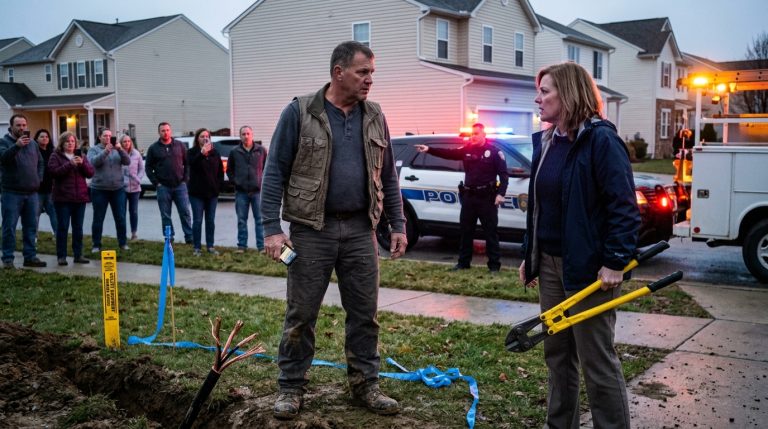
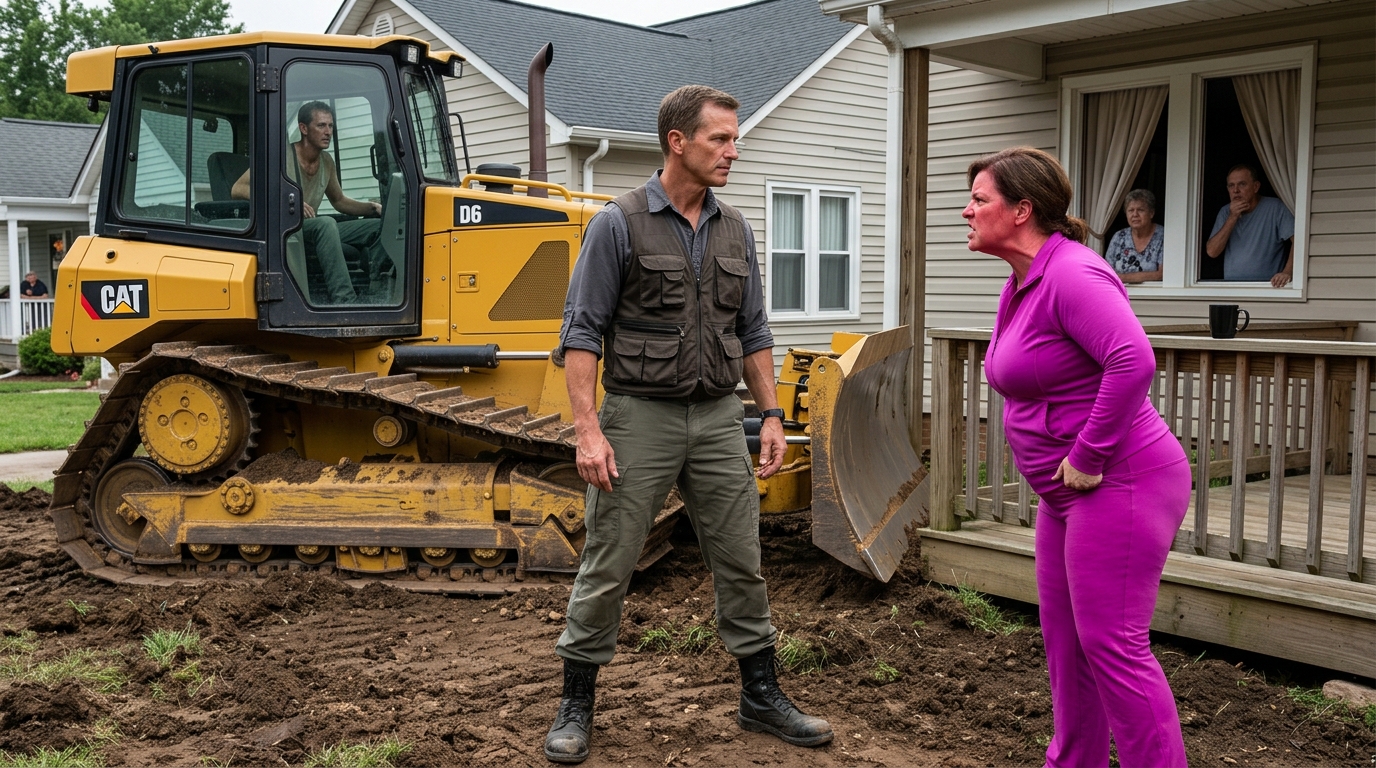
I stood on the edge of my lawn with a mug of black coffee in my hand, watching the steel tracks of a CAT D6 bulldozer crush the border edge of my flowerbed.
Behind the idling yellow monster stood Karen Miller, president of the Whispering Pines Estates Homeowners Association, her hands jammed into the waist of a bright magenta tracksuit that looked painted on.
“That bridge is an unauthorized, aesthetically displeasing eyesore, Mr. Sterling,” Karen barked over the guttural rumble of the engine, her voice a harsh rasp that rattled like gravel in a tin can. “I will see it torn down today even if I have to pay this operator out of my own pocket.”
I didn’t yell. I didn’t drop my coffee. I took one slow sip, set the ceramic mug down on the wooden porch railing behind me, and walked straight toward the machine.
The lanky operator in the cab wiped his sweating forehead with a stained flannel sleeve, his eyes darting nervously between my steel-toed boots and Karen’s shaking, sausage-like pointer finger.
“Karen,” I said, keeping my voice down in the low, flat register I used when clearing unexploded ordnance in Helmand Province. “You are trespassing. That machine is on private land. You have ten seconds to put it in reverse before I call the county sheriff.”
Karen let out a loud, barking laugh that made the birds in the hemlocks go quiet. “Oh, don’t you threaten me, you… you renter! You think you can just drift into our community and build illegal timber monstrosities without architectural approval?”
“I own five acres,” I said, stopping three feet from her. “My deed was stamped at the county recorder’s office before your developer poured his first slab of concrete. You have zero jurisdiction past the creek.”
“Section seven, subsection B!” she screeched, stepping into my physical space until I could smell her stale mint perfume. “All exterior structures require committee review! I am the committee! Operator, clear that timber!”
The driver hesitated, his hands hovering over the hydraulic levers. “Ma’am… he says it’s his dirt. If I drop this blade on private property without a municipal warrant, I lose my commercial insurance.”
“I am indemnifying you!” Karen shouted, her face turning the exact shade of her lurid tracksuit. “Tear it down!”
I pulled my cell phone from my belt clip, held the screen up so the operator could see the glowing digits of the local police dispatch line, and pointed silently at his ignition key.
The operator didn’t waste a second. He pulled the throttle back, killed the diesel engine, and threw his hands up in the air.
The silence that settled over the yard was heavy, broken only by the tick of the cooling engine block and Karen’s ragged, furious breathing.
She leaned in close, her eyes narrowing to tiny black slits in her flushed face. “This isn’t over, Sterling. I will fine you until you’re bankrupt. I will put a lien on this house. I will make your life an absolute hell until you beg me to take that bridge down.”
I didn’t answer her with words. I just stood my ground, my feet planted wide on my own dirt, until she turned on her heel and stomped back toward her SUV.
CHAPTER 2: THE PAPERWORK CITADEL
The silence left behind by the bulldozer’s engine felt heavy, almost unnatural.
Sarah opened the screen door behind me, the aluminum hinges squeaking softly in the morning heat. Her hand rested on the doorframe for balance, her knuckles white, her left leg stiff as she stepped out onto the porch.
“Jack,” she said, her voice barely above a whisper, eyes fixed on the churned-up dirt at the edge of the lawn. “Did she… is she coming back?”
“She’ll try,” I said, turning to give her a calm, steady look. “But she won’t bring that machine back today.”
I picked up my cold coffee from the rail, took a swallow, and walked past her into my study.
Two days later, the cream-colored envelopes started hitting my mailbox like mortar rounds.
The first one contained an invoice for $3,000, alleging thirty days of retroactive fines for an “unauthorized wooden structure.” The second arrived forty-eight hours later, adding $500 for “impeding official HOA operations.”
The third letter—hand-delivered by a nervous board member named Bob, who sprinted back to his Lexus the second he dropped it on my mat—charged me for the heavy machinery Karen herself had hired.
I didn’t yell, and I didn’t rip up the papers. I drove twenty minutes into town, bought a heavy-duty black three-ring binder, and labeled the spine in bold permanent marker: HOA K. Miller.
Every fine went into a clear plastic sleeve. Every response I typed was printed, dated, and logged into a spreadsheet before being sent back via certified mail with return receipt requested.
On Thursday afternoon, I walked into the dusty town planning office, where Carol sat behind a laminate counter that looked untouched since 1984.
“Jack,” Carol said, sliding her reading glasses down her nose as I laid my survey map on the counter. “I heard Karen Miller was parading around your creek with heavy equipment.”
“She’s claiming my property falls under section seven of the Whispering Pines covenants,” I said, tapping the official county seal on the corner of the map. “I need certified copies of the original parcel split.”
“Karen knows darn well that creek is your boundary,” Carol muttered, stamping three fresh sheets of parchment with a heavy rubber thud. “Her developer tried to buy that strip back in ninety-eight and got turned down flat. She’s just trying to break you.”
She handed me the stamped papers, but as she did, her thumb caught on a supplemental county map tucked behind the deed.
I leaned over the counter, my eyes catching a thick yellow line highlighted across the edge of my back five acres—a line pointing straight toward a newly installed gold-embossed emergency gate at the far end of the Whispering Pines development.
“Carol,” I said, pointing at the yellow line. “What’s that easement mark?”
“Oh, that?” Carol frowned, adjusting her glasses. “That’s an old logging road. Karen filed a temporary emergency vehicle route permit last winter… wait a minute.”
She stopped, looking from the map to my face, her mouth dropping open slightly as the math hit her.
The emergency gate led straight to the edge of the creek, directly where my bridge now stood—and without my bridge, there was no way across the water.
CHAPTER 3: THE SECRET COALITION
“She built a gate to an unpaved ditch,” I murmured, watching Carol trace the property line with a blue ballpoint pen. “And then she tried to bulldoze the only structure that makes her emergency exit usable.”
“She didn’t think anyone would look at the official filings, Jack,” Carol said, pulling a yellowing binder from beneath the desk and sliding a certified copy of the easement map across the laminate. “People like Karen rely on everyone being too tired to double-check the paperwork.”
I folded the stamped copy, slipped it into my heavy black binder, and snapped the rings shut with a loud, metallic thud.
That evening, a soft, hesitated knock rattled the glass panel of my front door.
I pulled it open to find Margaret, a frail woman in her late seventies who lived near the development’s entrance, clutching a crumpled cream-colored envelope in her trembling hands.
“Mr. Sterling,” she whispered, her eyes darting toward the dark street as if an HOA patrol car might round the corner. “I… I heard you stood up to her bulldozer.”
“Come inside, Margaret,” I said, stepping back to let her pass into the warm light of the foyer.
Sarah brought out two mugs of chamomile tea, her limp quiet on the hardwood floor as she set the tray on the coffee table and sat beside the older woman.
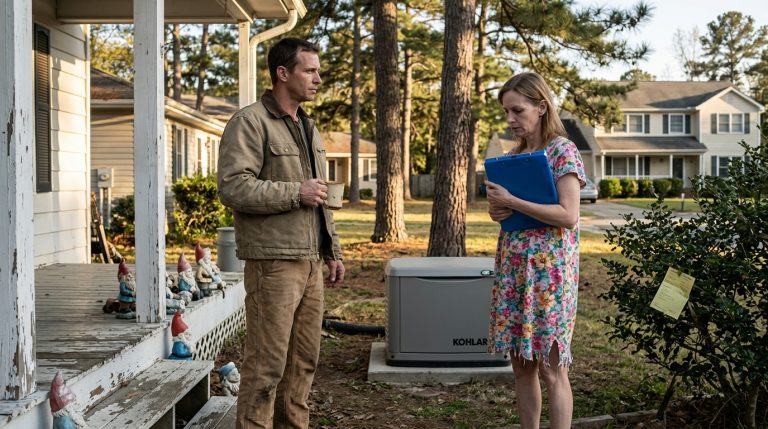
Margaret smoothed the crushed paper on her knee, revealing a typed violation notice demanding two hundred dollars for “unauthorized plastic garden ornaments.”
“They were a gift from my late husband,” Margaret said, her voice catching as her thumb rubbed the embossed gold HOA logo at the top of the sheet. “Seven little gnomes in my rosebushes. I’ve had them out there for twelve years, Jack.”
“Don’t pay it,” I said, setting my black binder on the table between us. “Don’t send them a single dime.”
“She said she’ll put a lien on my cottage if I don’t clear the yard by Friday,” Margaret whimpered, a tear tracing a dry crease in her cheek. “I live on Arthur’s pension. I can’t afford a lawyer.”
“You don’t need a lawyer yet,” I said, opening the binder and pulling out a blank plastic sleeve. “Give me the notice. We’re going to document every single demand she’s made across this entire neighborhood.”
Margaret handed over the paper, her shoulders dropping two inches as the weight shifted off her frame. “Arthur was Navy. He always said you don’t let a bully rule the deck just because they shout the loudest.”
“Arthur was a smart man,” I said, sliding her violation notice right behind my certified property survey. “And Karen Miller is about to find out how many people on this street are tired of listening to her shout.”
By midnight, the black binder contained three more entries—a fined plastic toddler slide from the Garcia family down the road, an illegal flagpole notice sent to a retired Air Force colonel, and Margaret’s seven garden gnomes.
Karen thought she was isolating me on my five acres.
Instead, she was handing me an army.
CHAPTER 4: THE LEGAL FLANK
Amelia Davis didn’t look like a standard suburban property attorney.
She sat behind a wide glass desk, tailored grey suit jacket crisp at the shoulders, watching me with sharp, dark eyes as I slid my binder toward her.
“Marines,” she said, her lips curving into a brief, iron-hard smile as she flipped open the cover. “You people always have the best paper trails.”
For forty minutes, the only sound in the office was the steady turn of plastic sleeves—my certified letters, Karen’s unhinged demands, town permits, property surveys, and Margaret’s gnome violation notice.
When Amelia finally reached the copy of the emergency gate easement map, her fingers paused on the glass.
“Mr. Sterling,” she said, leaning back in her leather chair and steepling her long fingers. “On a scale of one to ten, where ten means they have a legitimate legal claim, Karen Miller’s case against you is a negative four.”
“She’s threatening an eleven-thousand-dollar lien,” I said, my hand resting flat on the mahogany desk. “And she sent a bulldozer onto my grass.”
“To place a lien, an HOA has to prove a valid debt in court,” Amelia said, tapping her fountain pen against the binder. “If she files this, a judge will sanction her for frivolous litigation before lunch.”
She pulled a pad of yellow legal paper toward her and began scribbling notes with swift, practiced strokes.
“We aren’t just going to defend, Jack,” she said, looking up with a glint in her eye that reminded me of my old platoon leader. “We’re going to dismantle her entire operational structure using her own bylaws.”
“What’s the play?” I asked.
“Step one: I draft a formal cease-and-desist sent via certified mail to every single member of her board, personally,” Amelia said, her pen making a sharp scratch against the yellow paper. “If they ignore it, they lose their director’s liability protection.”
She turned the legal pad around, showing me three bullet points underlined twice.
“Step two: we continue paying your fifty dollars a month in regular HOA dues for that tiny fifty-square-foot lawn strip by the main road to prove good faith,” she continued. “Step three: we turn her emergency gate into a trap.”
“How?”
“She designated that gate as a critical egress route without securing a legal crossing over your creek,” Amelia said, her voice dropping into a cold, lethal register. “If a fire breaks out, that board is liable for criminal negligence. We’re going to let the town fire chief explain that to her in person.”
CHAPTER 5: THE CHIEFS AMBUSH
Karen’s white SUV pulled up on the grass behind the engine, spraying dry sod and dust into the autumn air.
She slammed her door, wearing a tailored navy suit that strained at the arms, and marched toward us with a smug grin, flanked by Bob and two visibly anxious board members.
“Chief O’Connell!” Karen called out, her voice loud and sweet as honey over a nest of hornets. “Thank you for coming out so quickly to inspect this illegal, non-compliant eyesore.”
Chief O’Connell—a broad-shouldered man with a weathered face and ice-blue eyes—didn’t offer his hand.
He unclipped a metal clipboard from his belt, stomped his heavy turnout boots onto the fir timbers of the bridge, and walked clear across to the far side without saying a word.
He grabbed the heavy timber handrail, hauled his two-hundred-pound frame against it, and looked down at the reinforced concrete footings I’d anchored four feet deep into the bedrock.
“Mr. Sterling,” O’Connell rumbled, stepping back onto the grass. “You were Marine Corps combat engineers, right?”
“Yes, Chief,” I said, keeping my posture straight.
“Thought so,” O’Connell said, slapping the cedar post with a thick hand. “You could park this fire truck right in the middle of this span and it wouldn’t even creak.”
Karen’s smile froze, her jaw twitching as her painted eyebrows pulled together. “Chief… the architectural review committee never approved—”
“Ma’am,” O’Connell interrupted, turning his full height on her. “Is that gate at the back of your subdivision your designated emergency egress point?”
“Yes,” Karen sputtered, pointing a trembling, manicured finger toward the metal barrier behind the creek. “We installed it for resident safety—”
“And your official emergency response plan requires vehicles to cross this creek right here to reach the county road?” O’Connell pressed, his voice dropping into a dangerous, quiet growl.
“Well… yes, but this structure—”
“Then can you explain to me,” O’Connell said, leaning down until he was eye-to-eye with her, “why your HOA board hired a bulldozer to demolish the only functional piece of emergency infrastructure between your neighborhood and the main highway?”
The air went dead still.
Bob took a fast, involuntary step backward, completely disowning her on the spot, while the other two board members suddenly found their shoes fascinating.
“I… I am enforcing community standards!” Karen shrieked, her voice cracking as her face turned a dark, blotchy crimson. “The bylaws—”
“Your bylaws don’t override municipal safety codes, state law, or common sense,” Chief O’Connell snapped, writing two sharp lines on his official inspection pad. “As of ten o’clock this morning, this bridge is recorded as a critical town emergency access point.”
He slapped the carbon copy into Karen’s limp hand.
“If you so much as touch a timber on this bridge, Miss Miller, I will personally file charges for reckless endangerment of public safety,” O’Connell said. “Am I clear?”
Karen stood frozen on the creek bank, holding the pink carbon sheet, her mouth opening and closing like a landed bass as the chief turned and walked back to his engine.
CHAPTER 6: THE RECKONING RESTORATION
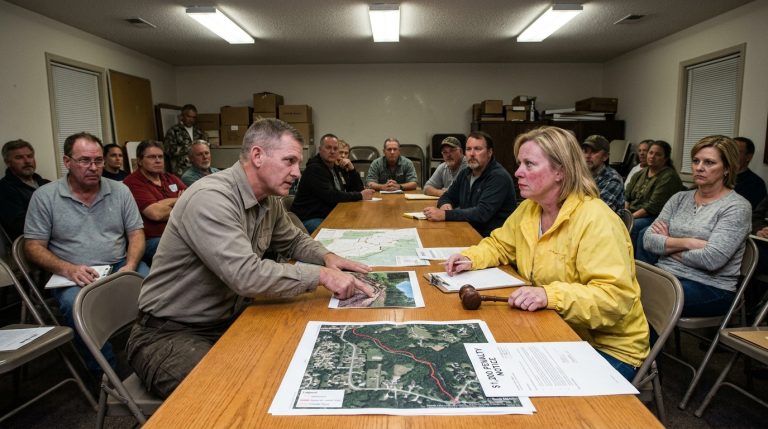
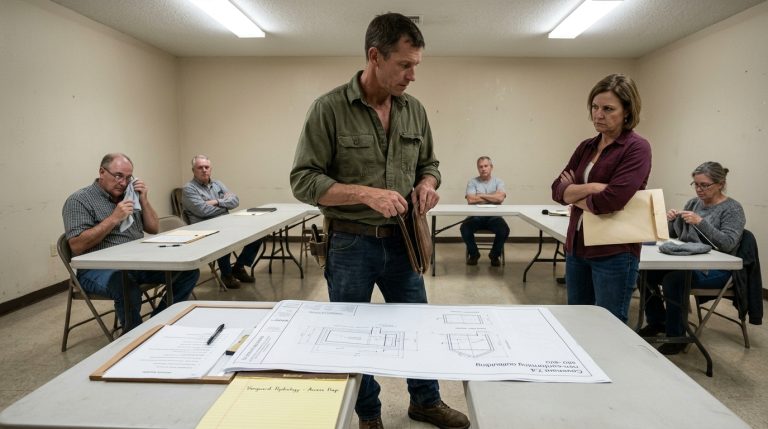
The room held seventy-five residents, three board members who looked like they were facing a firing squad, and Karen Miller, who sat rigid in the front row with her arms crossed over her navy suit jacket.
Arthur cleared his throat, adjusted his reading glasses, and tapped his microphone twice.
“Over the past three weeks,” Arthur said, his dry accountant’s voice echoing clearly through the speaker system, “our independent forensic team reviewed six years of Whispering Pines financial records.”
He opened the folder, pulling out a single balance sheet that brought absolute, pin-drop silence to the hall.
“We found over forty thousand dollars in unitemized consulting fees paid directly to entities owned by Mrs. Miller’s family members,” Arthur stated without a trace of emotion. “We also uncovered seven thousand dollars in HOA funds spent on legal consultations specifically to file an ungrounded lien against Mr. Jack Sterling.”
A collective gasp rippled through the audience.
Karen leapt to her feet, her chair scraping violently against the linoleum floor as her face turned dark red. “This meeting is illegal! As president, I declare this gathering out of order! You are all ungrateful, unruly—”
“Karen, sit down!” Bob called out from the board table, leaning into his own microphone. “We’re uninsured as of midnight because of you! The D and O policy refused renewal!”
The room erupted into shouts.
Air Force Colonel Vance stood up near the front, raising a hand. “I move for an immediate vote of no confidence to remove Karen Miller and dissolve the current board!”
“Seconded!” Margaret yelled from the third row, holding one of her painted garden gnomes high in the air like a trophy.
The vote took less than two minutes. Every hand in the room went up except Karen’s.
Karen stared at the sea of raised hands, her lips trembling in shock as her power structure crumbled into dust around her. Without another word, she grabbed her purse, shoved past a group of neighbors at the door, and walked out into the night.
Two days later, Arthur Henderson was officially elected board president.
The first motion passed by the new board was a formal written apology rescinding every single fine levied against my property, along with a full refund of Margaret’s gnome penalties and the Garcias’ slide assessment.
By the following month, Karen’s house had a “For Sale” sign stuck in the front yard.
This morning, the air smelled of autumn cedar and damp hemlock needles.
I stood on the bridge I’d built with my own hands, watching the sunlight bounce off the clear water of the creek.
Sarah walked down the gentle slope from the deck, her gait steady on the smooth, wide fir planks. She didn’t use a cane, and she didn’t limp as she reached out to touch the newly mounted cedar plaque hanging over the archway: The Sarah Grace Crossing.
“It’s quiet, Jack,” she whispered, leaning her head gently against my shoulder as we looked across to the sunlit meadow on our back five acres.
“Yeah,” I said, putting my arm around her waist and taking a deep breath of clean pine air. “It is.”