Beyond the Red Line Where the Jungle Ghosts Carve Silence Out of Green Chaos
CHAPTER 1: THE IRON CANOPY
The moisture-warped pages of the field notebook resisted my thumb. I scraped a fingernail along the edge to separate the damp paper, keeping my eyes fixed on the low-hanging fern line ahead.
My boots had lost their black polish two weeks ago, caked in a grey-brown sludge that smelled of rotting vegetation and stagnant iron.
Behind us, the American perimeter faded into a distant, muffled concussive thud of heavy ordnance. Out here, noise was a liability.
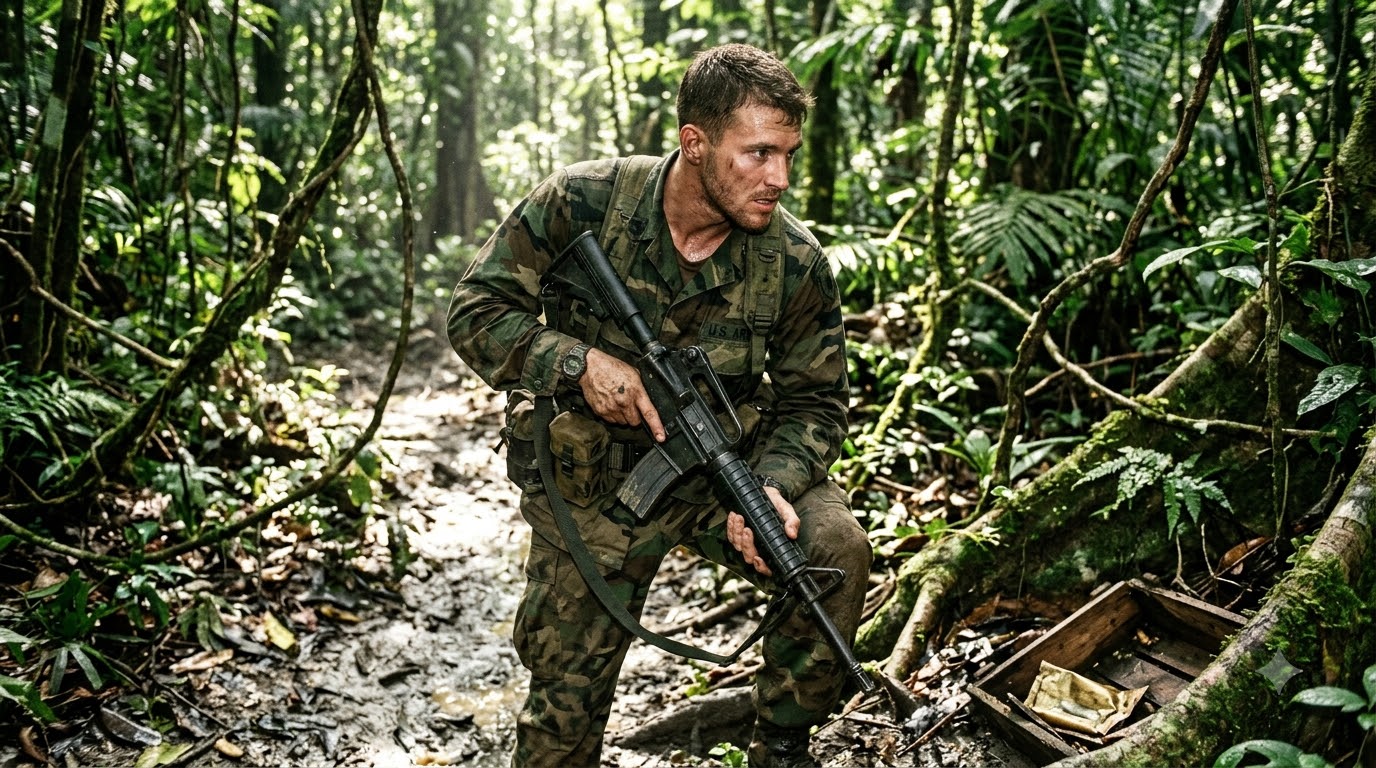
Corporal Evans didn’t look back when he took his step. He placed his boot down with the careful, flat-footed precision of a man walking on broken glass.
The humidity clamped around my throat like a wool scarf soaked in warm water. Sweat trickled down the bridge of my nose, stinging the corner of my eye before dropping straight onto the canvas strap of my rifle sling.
We weren’t hunting glory. We were just calculating the cost of the next hundred meters.
Evans froze mid-stride, his right foot suspended an inch above the moss. His shoulders stiffened beneath the damp webbing.
I stopped instantly, locking my knees to keep my weight balanced over my heels. The jungle around us held its breath, the cicadas humming in a steady, metallic drone that filled the silence between our heartbeats.
CHAPTER 2: THE HUNDRED METER HOUR
I didn’t reach for the brass casing. In the green tunnel, an unprompted motion could turn a shadow into a target.
Evans shifted his weight an eighth of an inch, his boot heel settling deeper into the spongy humus without a sound. His jaw was clenched tight, a faint twitch of muscle working the skin just below his right cheekbone.
We had spent forty minutes covering twelve paces.
The air smelled intensely of wet iron and crushed fern fronds, heavy enough to coat the roof of the mouth with a bitter film. Across the narrow ravine, a vine twitched once—not from the wind, which never reached this deep beneath the triple canopy, but from a displaced weight.
Someone else was moving just as slowly as we were.
I raised my left hand two inches, holding the palm flat toward Evans. He stopped breathing; I could tell by the total stillness of the webbing across his chest.
A single, damp brass cartridge wrapper lay half-buried under a rotting root three feet off the trail, completely out of alignment with any standard supply drop. It wasn’t American, and it certainly wasn’t ours.
It was a deliberate marker, left behind by someone who wanted to see if we were paying attention or if we were just another loud patrol waiting to be boxed in.
Evans let out a slow, silent exhale through his nose, his eyes locking onto the dark gap between two massive buttress roots across the clearing.
CHAPTER 3: THE BROKEN TRAIL
The bamboo thicket to our right didn’t rustle; it simply parted an inch before snapping back into place with the precision of a trap closing.
Evans dropped his weight onto his left knee, his rifle barrel resting low and parallel to the wet loam, his breathing shallow enough to keep his collar from shifting.
— That’s not a natural line, — he whispered, his voice dry and raspy against the humidity.
The footprint in the mud wasn’t ours, nor was it heading toward the main base perimeter. It traced an intentional arc around the ridge, looping directly back toward the settlement we had cleared yesterday morning.
The village wasn’t neutral; the supply logs were leaking right through the floorboards of the local huts while we slept.
I didn’t answer him, choosing instead to trace the edge of the flattened fern stems with my thumb, feeling the cold weight of the deception settle into my stomach.
— We follow it back to the thatch roofs, — I said, levering myself up without making a sound.
CHAPTER 4: THE CHECKMATE RIDGE
The woven bamboo door didn’t slam shut, but the woman standing behind it let go of the latch with a deliberate, slow release that carried more warning than a shout.
Evans brought his rifle up an inch, his shoulders locked against the humidity, staring past the porch posts where baskets of unhusked rice sat drying in the damp air.
— They knew we were tracking the loop before we crossed the creek, — he muttered, wiping a streak of grey sweat from his forehead with the back of his bare wrist.
Underneath the floorboards of the raised hut, a faint scuffling sound confirmed what the logistics logs refused to spell out: the village wasn’t a victim of the occupation; it was the structural heartbeat of it.
I kept my weight balanced on my heels, refusing to let the tension crack my posture while the elder stepped forward onto the porch, her face carved from decades of silent survival.
— You carry no radios and no thunder from the hills, — she said, her voice dropping flat into the damp space between us. — You think patience makes you owners of this dirt.
— We just came to check the math on who’s feeding who, — I answered, stepping closer until the wooden threshold creaked under my weight.
CHAPTER 5: THE GREEN SILENCE
She didn’t raise her voice when the hatch beneath our feet began to shift, relying instead on the quiet, unyielding insolence of a system that believed foreign boots would eventually pack up and leave.
— You break the floor, but you cannot change who owns the rice, — she hissed, her fingers tightening around the edge of a woven basket.
Evans kept his weight planted squarely over the sealed planks, his rifle sling taut against his chest as the damp air rushed up from the dark cavity below.
The logistics network didn’t collapse because of a grand speech or a sweeping tactical directive; it collapsed because we simply refused to move until every hidden crate was dragged out into the daylight.
We didn’t call for artillery or wait for an overhead escort because we didn’t need them to hold an immovable line.
— The math just caught up with you, — I said, lifting my boot an inch to let the morning sun hit the dark grain of the exposed timber.
The village fell completely silent, the metallic hum of the cicadas returning to fill the empty space as the last shred of entitlement evaporated into the green canopy.