A Concrete Siege: How One Father’s Tactical Precision Decimated a Suburban Tyrant’s Empire of Rules
CHAPTER 1: The Porcelain Line
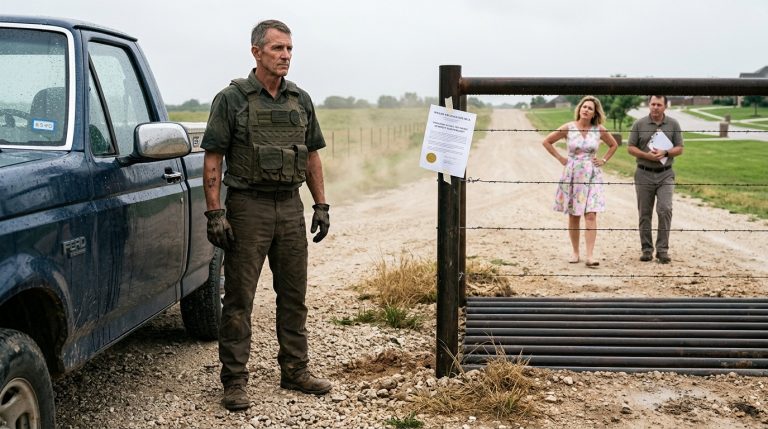
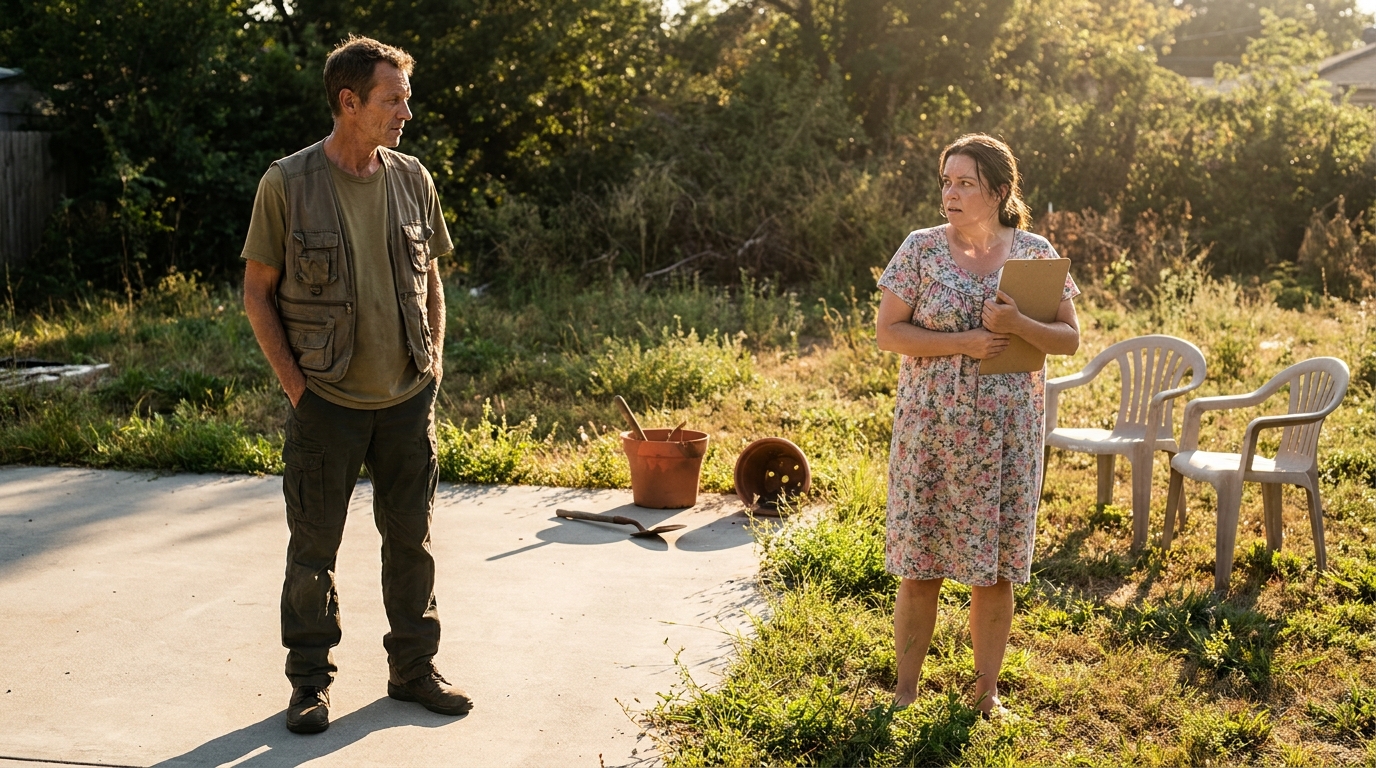
The heat was a physical weight, pressing against the back of my neck as I stood on the edge of the freshly poured concrete pad. It was perfect—smooth, cured, and functional—a quiet, gray monument to the only thing that mattered. Then came the rhythmic click of heels against the pavers.
Karen.
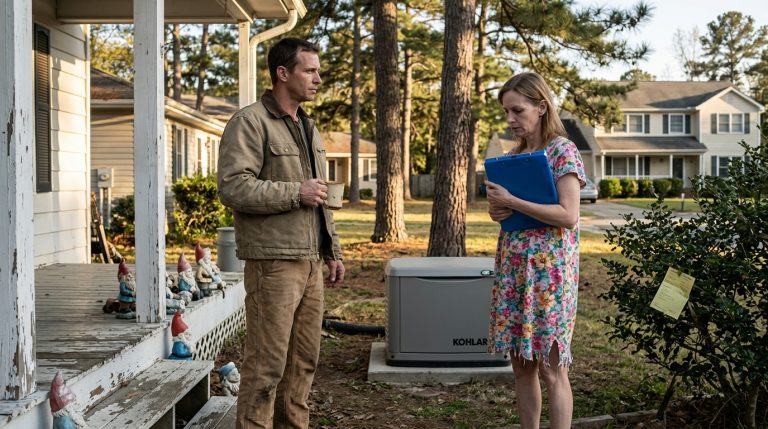
She stood at the boundary of my porch, her floral mumu damp with sweat, her clipboard held like a ballistic shield. She didn’t look like a neighbor. She looked like an auditor sent to condemn a structure before the foundation had even fully hardened.
“Mr. Riley,” she began, the syllables clipped and sharp, cutting through the low-frequency drone of the afternoon cicadas. “That generator is a class 3 violation. You have forty-eight hours.”
I didn’t blink. I focused on the way the sunlight hit the edge of her clipboard. It was a sharp, clean white, contrasting with the muddy, overgrown chaos of her own lawn visible over her shoulder. My hand remained in my pocket, fingers tracing the cold metal of my keys—a habit from a different life, a different kind of terrain.
“I have the paperwork, Karen,” I said, my voice steady, stripped of the reflexive apology most men would have offered. “Certified mail. Received and signed by you two months ago.”
She smiled, but it didn’t touch her eyes. The skin around them was tight, pulled into a mask of righteous, calculated disdain. “The board deems the concrete hue… incompatible.” She tapped a manicured nail against the paper. A tiny, rhythmic tap that felt designed to aggravate. “Section C, paragraph 12. Unapproved modification.”
There was no negotiation here. I could see the way she held her breath, the way her posture remained locked in a predatory tilt. She wasn’t looking at the generator. She was looking for a reaction. She wanted the crack in the armor.
I took a slow, deliberate breath, scanning the perimeter of her stance. She was leaning slightly to the left, a tell for someone who had practiced this speech in a mirror until it felt like law. But she had made a fundamental error in calculation. She had assumed I was another resident looking for a quick surrender.
She didn’t know I had spent years studying the structural integrity of things far more volatile than a concrete pad.
“Forty-eight hours,” she repeated, turning on her heel. The fabric of her mumu fluttered behind her, a mockery of a victory flag.
I watched her walk away, noting the way she deliberately stepped over the boundary line of my property as if the soil itself were contaminated. My phone buzzed in my pocket—a notification from the security camera I’d hidden in the holly bushes. As she turned the corner toward her house, she stopped, pulled out a second, smaller notepad, and began writing with a furious, jagged intensity.
She wasn’t just enforcing rules. She was documenting a target.
I looked down at the generator, its quiet, heavy presence the only thing standing between my daughter and a life dictated by the grid’s inevitable failure. Karen thought she was the one holding the gavel, but as I watched her disappear into the shade of her porch, a cold, hard clarity washed over me. She had just provided the first crack in her own foundation. And I knew exactly how to make it widen.
CHAPTER 2: The Architecture of Extortion
The silence in the yard was not empty; it was pressurized. Karen’s pen continued its aggressive dance across the paper, a sound that drilled into the space between my shoulder blades. In my memory, the sound shifted—for a split second, it wasn’t a ballpoint on a pad, but the sharp, mechanical reset of a firing pin on a cold, oil-slicked weapon. I shoved that memory into a dark, locked compartment in my mind, the same way I used to stow gear before a mission.
I didn’t turn around. I didn’t give her the satisfaction of seeing me track her movements. I kept my gaze fixed on the concrete pad, on the precise, clean lines where the gray slab met the manicured grass.
“Section C, Paragraph 12,” she murmured to herself, loud enough for the sound to carry across the ten feet of lawn separating us. “Unauthorized structural addition.”
I turned, my motion calculated and slow. Karen was still there, her posture rigid, the clipboard now pressed against her chest like a shield. She looked smug, but underneath that, there was a jittery, nervous energy—the way her eyes tracked the side of my house, bypassing the windows and focusing instead on the electrical conduit running along the brickwork. She wasn’t just measuring the generator; she was mapping the house’s nervous system.
“You’re making a mistake, Karen,” I said, my voice pitched low, calibrated for a controlled delivery. “That isn’t a structure. It’s a medical necessity. And the paperwork—which you signed—clearly outlines the specifications.”
“Paperwork,” she scoffed, a thin, triumphant sound that reminded me of dry leaves skittering on pavement. “Paperwork is a guide for those who lack the vision to see the impact on our community’s aesthetic. You think a cold, industrial box belongs here? You think you can just bring the outside world, with all its noise and, frankly, its lack of refinement, into our sanctuary?”
She tapped the clipboard again. The plastic edge caught the late afternoon sun, throwing a bright, blinding flash against my retinas.
“My property values,” she added, her voice dropping into a register of faux-tragedy, “depend on uniformity. This… thing… is a stain.”
She turned and marched away, her gait brisk, purposeful. She didn’t look back, but she didn’t need to. The challenge had been issued, not through a loud decree, but through that final, deliberate tapping of her pen—a warning of the paperwork war to come.
I walked back into the kitchen, the door clicking shut behind me with a solid, heavy finality. Sarah was at the table, her hands folded tightly around a mug of cold tea. She looked up, her eyes wide, tracing the line of my jaw, looking for the stress she knew was there.
“She’s not going to stop, is she?” Sarah whispered.
I didn’t answer immediately. I moved to the dining room table, where I had already cleared a space. I began to lay out the documents—the original HOA Covenants, the city ordinance printouts, the professional installation invoices. The paper felt heavy, substantial. I spread the HOA’s own rulebook across the oak surface, my fingers finding the index.
“She’s not just angry about a generator, Sarah,” I said, my voice taking on the clinical tone of a briefing. “She’s afraid.”
“Afraid of what?”
“Of losing the only thing she has left to control.” I pointed to a paragraph in the Covenants regarding architectural review authority. “Look at this. She’s invoking powers she doesn’t actually have. She’s overreaching. If I fight her on the rules, I lose. If I fight her on the intent—if I force her to document every move—she’ll have to commit a mistake. And when she does, I’ll be ready.”
I grabbed my laptop and began to build the master file. My first entry was simple: Target: Karen Smith. Case: Breach of Bylaws. Method: Documentation. I knew the rhythm of this now. It was the same rhythm as clearing a sector: identify the threat, map the defensive lines, and wait for the enemy to expose their flank.
I looked back at the window. The sun was dipping below the horizon, casting long, sharp shadows across the street. Karen’s house sat in the distance, a dark shape against the dying light. I noticed something then, a detail I had missed before: a delivery truck—heavy, unmarked, bearing no logistics company branding—was idling in her driveway. A man in a plain gray uniform was hauling a heavy, crate-sized box into her garage.
It was a commercial freezer. I knew because I’d spent weeks researching equipment tolerances, and the profile of that unit didn’t fit a residential garage. It was massive, likely high-draw, and almost certainly against the very aesthetic statutes she was currently using to destroy my peace of mind.
A cold, grim satisfaction settled in my chest. She wasn’t just a tyrant; she was a hypocrite with a weak point. I opened my spreadsheet and entered a new line: Observation: Unapproved equipment delivery. Status: Documented.
The war wasn’t coming; it had already started. And as I stared at the screen, I realized that Karen wasn’t just playing a game of rules. She was playing a game of ego, and she had just handed me the first piece of leverage I needed to start dismantling her kingdom, piece by piece.
CHAPTER 3: The Reconnaissance of Shadows
The cursor on my screen blinked with a steady, metronomic cadence. It felt less like a tool and more like an impatient pulse. Below it, the spreadsheet sat open, a sprawling grid of numbers and dates—my attempt to reconstruct the HOA’s hidden map.
I looked up from the glow of the monitor. The room was dark, illuminated only by the faint, blue-tinged light spilling from the screen. Outside, the neighborhood was settling into the uneasy quiet that follows a confrontation. Through the window, I watched the house across the street. It was a silhouette of rigid, unyielding angles. The delivery truck was gone, leaving behind only the impression of deep tire tracks in the damp soil of the driveway.
I turned back to the desk. The evidence was anecdotal at best, but in my experience, details were rarely accidental. The unmarked truck, the massive freezer, the way Karen had practically lunged at her own paperwork to hide her irritation—it was a pattern.
I heard the floorboards creak behind me. Sarah stepped into the light, a silhouette wrapped in the soft, muted colors of her robe. She didn’t speak, but her gaze went immediately to the screen.
“You’re still digging,” she said, her voice a low murmur.
“I’m tracing the architecture,” I replied, my fingers ghosting over the keyboard. “Karen isn’t just acting on whim. She’s acting on a schedule. If she’s bringing in equipment like that, it means she’s preparing for something she thinks is coming.”
“And the board?”
“They’re the infrastructure,” I said, hitting a key that expanded a sub-menu of archived HOA budgets. “But the infrastructure is rotting. Look at this.”
I pointed to a series of line items under ‘Miscellaneous Legal Fees.’ They were astronomical—thousands of dollars drained from the community fund for ‘consultations’ that lacked any supporting documentation or identified counsel. It wasn’t just incompetence. It was a vacuum, siphoning resources into a black hole.
I felt a familiar, sharp tightening in my chest. This wasn’t just about my generator anymore. It was about identifying the pressure points of an entire system. I needed to move, not against Karen, but against the foundation she stood on.
I grabbed my jacket. The air outside was cold, cutting through the thin humidity of the night like a blade. I didn’t head for the streetlamp-lit front paths. I moved toward the shadows, hugging the perimeter of the adjacent properties, keeping my movements low and measured. My destination was the communal clubhouse, the heart of the HOA’s records.
The clubhouse was a single-story structure at the center of the development, built with high-arched windows that now stood dark and reflective under the moon. I circled the perimeter, my boots making no sound on the manicured grass. I needed to see what they were hiding, what kind of records were kept in the physical archive that didn’t make it to the digital spreadsheets.
I reached the service entrance—a metal door usually reserved for maintenance. It was locked, but the hinges looked neglected. A quick inspection with my penlight revealed a simple latch system that hadn’t seen maintenance in years. With a small, precise movement of my multi-tool, the spring tension gave way, and the door swung open with a dry, metallic protest.
I slipped inside. The air was heavy with the smell of floor wax and stale, recirculated oxygen. I walked toward the back office, my flashlight beam tight and controlled, cutting a narrow path through the darkness. The filing cabinets were arranged in an archaic, inefficient system—a sign of a lack of oversight.
I started pulling folders. The first few were mundane: landscaping contracts, pool maintenance receipts, property transfer forms. Then, I found it. A folder tucked behind a thick stack of invoices, bound with a rubber band that snapped at the slightest touch. It contained bank statements for a separate account—one I hadn’t seen referenced in any public report.
As I scanned the figures, the cold in my chest solidified. The account was bleeding cash, massive withdrawals happening bi-weekly, labeled as ‘Security and Oversight.’ But the routing numbers? They weren’t associated with the security firm the HOA claimed to use. They were traced to a private, boutique logistics firm—the same kind that would operate unmarked trucks.
I pulled out my phone, the camera shutter silent as I captured every page. The evidence was clear: someone was using community funds to sustain a private operation.
A sudden, sharp sound echoed through the hallway—the rhythmic, metallic click of a deadbolt turning.
I froze. The light from my phone screen felt like a beacon in the pitch-black office. I tucked the device into my pocket, my heart rate steady, my breathing slowed to a crawl. I didn’t panic. Panic was for the unprepared. I pressed myself into the corner behind the heavy oak desk, my hand finding the edge of a heavy paperweight—my only leverage if things went south.
The door opened. A beam of white, aggressive light swung across the room, illuminating dust motes dancing in the air. Footsteps followed—heavy, measured, deliberate.
I didn’t move. I tracked the sound, my mind already calculating the distance to the exit and the layout of the corridor. Whoever was here wasn’t a patrol; they were looking for something specific. And as the light hit the cabinet I had just disturbed, I knew I was no longer the only one hunting in the dark.
This wasn’t just a dispute about a concrete pad. This was the moment the hunt turned, and I was now the one being tracked through the architecture of their secrets.
CHAPTER 4: The Calculus of Exposure
The light didn’t just illuminate the room; it colonized it, stripping away the comfort of the shadows and leaving me exposed in the stark, industrial glow. I pressed my back against the cold, unyielding surface of the oak desk, the edge biting into my shoulder blades. The paperweight in my hand felt heavy—a kinetic potential that I wasn’t ready to release unless forced.
The footsteps stopped. A boot heel clicked sharply against the floorboards. It was a rhythmic, arrogant sound.
“I know you’re in here, Riley,” a voice said. It wasn’t Karen. It was deeper, flatter—the sound of someone who didn’t care about rules, only about the completion of a task. It was the voice of a man who worked for the logistics firm. “You’re a long way from home for a simple neighborhood dispute.”
My pulse was a steady, rhythmic drum against my ears, but my hands remained perfectly still. I wasn’t just hiding; I was observing. Through the gap between the desk and the wall, I caught a glimpse of the man’s shadow. He was tall, his silhouette jagged against the light. He wasn’t holding a weapon, but he was holding a radio, his thumb hovering over the push-to-talk button. He wasn’t alone.
The realization hit me with the force of a physical blow: Karen hadn’t hired a private security firm; she had outsourced her tyranny to people who operated in the grey space of the law. They weren’t there to enforce aesthetic statutes. They were there to ensure the silence of anyone who looked too closely at the HOA’s books.
He moved toward the desk, the beam of his light sweeping across the files I had scattered. “You’re making a mistake, Mark. This is a private community. We don’t like trespassers. And we definitely don’t like people who dig.”
He stopped, his light resting on the empty cabinet I had ransacked. He didn’t look angry; he looked disappointed. He shifted, his boot scraping against a stray sheet of paper.
I waited. The ‘Butterfly Detour’—my path to the service entrance—was now blocked. The security patrol had shifted their patrol route, forcing me to improvise. I looked down at the paperweight in my hand, then at the layout of the room. The only other exit was a high, narrow ventilation window located three feet above the filing cabinet. It was a long shot, but the only one left.
I moved. I didn’t lunge at him—that would be a tactical error against an opponent whose range I didn’t know. Instead, I threw the heavy paperweight toward the opposite wall. It struck a stack of metal storage bins with a deafening, discordant clang.
The man reacted instantly, his beam jerking toward the noise. In that micro-second of distraction, I vaulted onto the desk, my fingers finding the edge of the filing cabinet, and scrambled upward. The air in the room felt electrified, a sharp scent of ozone and dust filling my lungs. I reached the window, my grip straining against the painted-shut frame, and pushed with everything I had. It gave way with a sharp, splintering crack of dry wood.
I squeezed through, the jagged edge of the frame catching the fabric of my jacket, and tumbled out into the cold, damp night air. I didn’t pause to catch my breath. I hit the ground running, my boots silent on the grass as I sprinted into the dense, overgrown hedge line that separated the clubhouse from the main road.
Behind me, the clubhouse door swung open, and the white beam of the flashlight cut through the darkness, sweeping the field where I had been standing only seconds ago.
I kept moving, my chest heaving, my eyes locked on the familiar silhouette of my own house in the distance. The cool air stung my throat, a sharp reminder of the cost of being right. I hadn’t just confirmed the financial fraud; I had drawn blood, or at least caused enough of a stir to put a target on my back.
I reached the cover of my own driveway and slipped into the garage, closing the door behind me with agonizing slowness. I was safe, but the weight of the phone in my pocket—the digital evidence of the HOA’s rot—felt heavier than ever. I hadn’t just crossed a line; I had dismantled the boundary between a neighborly dispute and a high-stakes tactical conflict.
I looked at the light flickering in Karen’s kitchen window across the street. She was watching, or waiting, or perhaps both. But I had the records, and I had a name for the logistics firm that was laundering the HOA’s money. The hunt had moved from the shadows of the clubhouse into the open, and for the first time, I felt the sharp, intoxicating edge of the advantage.
CHAPTER 5: The Static in the Walls
The garage door settled into its track with a sound that seemed abnormally loud in the quiet of the night. I stood in the darkness for a long second, my lungs burning, the taste of copper—the iron tang of overexertion—coating my tongue. My hands were scraped, a thin line of blood beading on my left palm where the window frame had bitten deep.
I didn’t turn on the main lights. I navigated by the faint, ambient glow of the security console’s indicator, a small green LED that usually brought comfort but now pulsed with a mocking, rhythmic consistency.
I moved to the kitchen, every floorboard under my boots a potential alarm. Sarah was asleep, or trying to be; the quiet in the house felt brittle. I reached the table and pulled out the phone I’d used to snap the photos at the clubhouse. My fingers were shaking, a fine, tremor-like vibration caused by the adrenaline dump. I unlocked the screen, opening the files.
The numbers were there. Clear, damning, and cold. The boutique logistics firm—‘Aegis Property Solutions’—wasn’t just moving equipment. It was a shell. The payments from the HOA were being funneled into a series of real estate holding companies that had, according to the bank statements, been defaulting on their property taxes for months.
I leaned back, the chair groaning under the shift in weight. The pieces weren’t just falling into place; they were forming a picture of systemic collapse. Karen wasn’t just bullying residents; she was trying to keep the HOA afloat with her own private, illegal tax by bleeding us dry. The generator, the fines, the landscaping ‘buffers’—it was all a desperate attempt to maintain an illusion of solvency while the bedrock beneath us crumbled.
A sound stopped me cold.
It was a low, mechanical hum—a static-like buzz, faint but persistent, emanating from the wall near the pantry. It wasn’t the hum of the refrigerator. It was the sound of an electrical load shifting, a subtle, rhythmic feedback that shouldn’t have been there.
My training flared. I moved to the wall, pressing my ear against the plaster. There, hidden behind the light switch panel, was a faint warmth. I carefully unscrewed the faceplate. Behind the wiring, tucked into the cavity, was a small, black-cased device, its LED blinking in a sequence that matched the pulse of my own heartbeat.
Someone hadn’t just been watching the house. They had been inside.
I pulled the device out, the wires snapping with a soft, clean sound. It was a high-grade transmission relay—not something you picked up at a hardware store. This was military-grade hardware, the kind used for remote surveillance and signal interception.
My paranoia, which had been a low-level static during the escape, suddenly spiked. I looked toward the porch, the light flickering once again. Was it just the faulty wiring, or was the light being triggered by the relay’s proximity? If they were monitoring the house, they knew I had been at the clubhouse. They knew I had the files.
The silence of the house, which had been a comfort, now felt like a cage. I walked into the living room, looking toward the hallway where Lily was sleeping. The threat had crossed the threshold of the property line and moved into the very fabric of our lives.
I went to the safe in the study, my movements efficient, shorn of any wasted effort. I pulled out my laptop, but instead of opening the file again, I began to wipe the drive, migrating the data to an encrypted, off-site server Frank had set up weeks ago. If they were looking for a physical source of information, I would give them a ghost.
As I worked, I heard it again—the sound of a vehicle engine turning over on the street. It was low, diesel-heavy, idling just outside the driveway. No headlights. No movement. Just the idling pulse of a machine that was meant to be invisible.
I didn’t rush to the window. I stayed in the dark, watching the reflection in the glass. The truck was parked directly beneath the streetlamp, its paint non-reflective, its windows tinted to near-black. It was a shadow parked in the middle of our lives.
They were waiting for me to react, to move, to expose the files. They were counting on the fear to make me reckless.
I closed the laptop and sat in the chair, the weight of the paperweight from the clubhouse still in my jacket pocket. The power grid might be failing, and the HOA might be a hollow shell, but I wasn’t going to be the catalyst that broke the illusion until I was ready to ignite the whole thing.
The static in the walls had stopped, but the tension in the room remained, a taut wire stretched to the point of snapping. I waited for the truck to leave, my mind racing through the next sequence of moves. If the house was compromised, then the clubhouse was only the beginning. The next fight wouldn’t be on their terms; it would be on a field of my choosing, where the rules of the HOA wouldn’t protect them from the consequences of their own design.
CHAPTER 6: The Friction of Truth
The storm arrived not as a whisper, but as a violent, atmospheric wall. Within minutes, the street was a chaotic blur of gray, the rain hammering the asphalt with enough force to turn the drainage pipes into miniature geysers. I sat in my truck, the engine barely ticking over, watching the driveway across the street. The idling diesel truck I’d tracked the night before had moved, its hulking frame now parked near the entrance of the cul-de-sac.
I had been planning to drive into the city to meet Frank. I had the encrypted drive, the photos, and the notes. But the storm had turned the local artery roads into flooded bottlenecks. I was trapped in the neighborhood, and apparently, so was the crew from Aegis Property Solutions.
I watched through the rain-streaked glass as two men climbed out of the truck. They weren’t wearing the uniforms from the day before. They wore heavy, high-vis rain gear, carrying equipment cases that looked disturbingly like the relay device I had pulled from my wall. They weren’t just monitoring homes; they were systematically sweeping the perimeter of the entire block.
My stomach tightened. They weren’t just protecting Karen’s secret—they were reinforcing it.
I checked my watch. I had sixty minutes before Frank would expect me at his firm. If I stayed, I was a sitting duck in a neighborhood that was rapidly becoming a restricted zone. If I moved, I had to pass their truck.
I put the truck in gear, my movements fluid, tempered by the necessity of silence. I crawled forward, the tires biting into the slick, muddy asphalt. As I approached the cul-de-sac, the men stopped. One of them, a man with a broad, scarred face, turned toward me. He didn’t move to block the road, but he stood still, his hand resting on the radio at his belt.
I didn’t stop. I kept my gaze fixed ahead, my speed constant. As I passed them, I saw the equipment case on the ground. It was open. Inside, a series of signal displays were active, their lights pulsing in a familiar, rhythmic sequence. It was a grid—a live, real-time map of the entire neighborhood’s electrical and signal activity.
They weren’t just sweeping; they were building a localized blackout grid.
A sudden, sharp flash of lightning illuminated the cul-de-sac, and for a split second, I saw Karen standing on the porch of the clubhouse, a cell phone pressed to her ear. She was watching the street, her expression one of predatory focus. She was the one directing them.
The realization hit me with more force than the rain. She wasn’t just hiding financial instability; she was weaponizing the neighborhood’s infrastructure to isolate anyone who didn’t toe the line. If I left now, I was leaving the Gables, Dave’s family, and everyone else in this grid.
I steered my truck onto the shoulder, the vehicle lurching as the mud gave way, and came to a stop fifty yards past the crew. I couldn’t go to Frank yet. Not with this.
I grabbed my camera, checked the lens, and started to back up, my movements erratic, simulating a loss of control on the slick road. I rolled the window down just enough to capture the scene. I needed the grid map. I needed the visual confirmation of the surveillance.
The man with the scar watched me. His hand left his belt and moved toward the driver’s side door of their truck. He was starting to move—not in a hurry, but with a predatory certainty.
I snapped the photos—rapid-fire, shutter clicking in sync with the thunder. I caught the map, the men’s faces, the logistics company’s logo on the side of the truck. It was enough.
I shifted into reverse, the tires spinning, searching for traction on the sludge. The man in the rain gear started to run, his movements surprisingly fast for the conditions. I slammed the truck into drive, the engine roaring as I fought for purchase, and lunged forward, the rear bumper fishtailing wildly before gripping the road.
I didn’t head for the city. I turned into a narrow side-street, a labyrinth of tight turns and overgrown fences that I knew from years of running these loops with my daughter. I was lead-footing it, the windshield wipers struggling to keep pace with the deluge, my eyes darting to the rearview mirror.
Two sets of headlights cut through the rain behind me—bright, high-intensity LEDs that belonged to the logistics truck. They weren’t just following; they were closing the gap.
The neighborhood had become a trap, and the storm was the perfect cover for them to finish what they had started at the clubhouse. I took another turn, the truck sliding sideways, the frame shuddering as I clipped a wooden fence post. I was moving too fast, but the adrenaline had pushed the friction of the road out of my mind.
I was no longer just building a case. I was in a race against the very people who had been managing our lives from the shadows. And as the headlights grew brighter in the mirror, I knew that the next turn wasn’t just about escape—it was about survival.
CHAPTER 7: The Club House Siege
The headlights didn’t waver. They tracked me with the precision of a predator, the high-intensity LEDs carving through the deluge and painting the interior of my cab in harsh, strobe-like flashes. I pushed the truck into a drift, the tires finding purchase on the slick, muddy shoulder of the clubhouse access road. I had to get inside. If I could reach the clubhouse before the truck blocked the entrance, I could trigger the alarm system—a move that would alert the entire neighborhood, not just the HOA board.
I slammed the truck into a hard right turn, the vehicle groaning as it crested the curb. I didn’t stop until I had slammed the bumper into the reinforced gate of the clubhouse parking lot. It didn’t break, but it buckled, the metal shrieking in the storm. I bailed out, the rain hitting me like a physical weight, the cold biting into my exposed skin.
Behind me, the logistics truck skidded to a halt. The doors swung open. Two figures stepped out, their silhouettes framed by the harsh light of their vehicle. They weren’t moving with the same caution as before; the pretense of neighborhood security had been replaced by the raw, kinetic energy of a closing trap.
I ran. The grass of the clubhouse lawn was a quagmire, each step requiring a deliberate, muscular effort to prevent me from slipping. I reached the service door, my hand fumbling for the key I’d taken from the file desk on my first visit. My fingers were numb, the skin of my palm burning where the window had cut it, but I felt the key slide into the lock.
The mechanism turned—click, clack—and I shoved the door open, stumbling into the dry, stale air of the clubhouse interior. I didn’t lock it behind me; I jammed a heavy janitorial cart in front of the frame, a makeshift barrier to buy me seconds.
I sprinted toward the main board room, the space where Karen held her court. I needed the emergency override for the neighborhood-wide alert system—a feature that existed in the original charter but had been disabled months ago, presumably by Karen herself.
The office was exactly as I’d left it, the air still thick with the scent of floor wax. I scrambled to the terminal, my breath coming in ragged, shallow gasps. My fingers danced over the keys, the screen glowing with a soft, persistent amber. Access Denied.
Of course. She’d locked the administrative account.
I grabbed the paperweight from my jacket, the weight of it grounding me. I bypassed the terminal and popped the panel off the server rack in the corner, exposing the manual bypass switch. It was archaic—a physical lever that forced the alert system into manual override.
I heard the heavy, rhythmic thud of boots against the clubhouse floorboards. They were inside.
“Riley!” the voice boomed, echoing in the cavernous room. “You’re done. There’s no legal defense for this. There’s no neighborhood to save.”
He was close. I could hear the rain dripping from his high-vis gear onto the carpet, a steady, rhythmic tap-tap-tap. I didn’t turn around. I gripped the lever, the cold metal biting into my skin, and pulled.
The clubhouse erupted.
Not with sound, but with light. The emergency sirens, silent for years, wailed to life, a high-pitched, piercing shriek that rattled the windows and shook the walls. Simultaneously, every porch light on every house in the neighborhood pulsed, turning the entire street into a strobe-lit display of alarm.
The man in the doorway stopped, his light beam wavering. He wasn’t looking at me; he was looking at his radio, his face a mask of sudden, frantic realization. The neighborhood was awake. The silence that Karen had used to keep her kingdom under wraps had been shattered.
I stood up, the adrenaline fading into a cold, focused resolve. The man took a step toward me, his hand reaching for his belt, but he hesitated. He knew as well as I did: the sirens were the ultimate signal. Within minutes, the neighborhood wouldn’t just be awake—it would be a witness.
“It’s over,” I said, my voice steady, the cold of the room no longer affecting me. “You’re not the ones in control anymore.”
He looked at me, a flicker of something—not fear, but pure, unadulterated frustration—crossing his face. He turned and bolted, his heavy boots thundering back toward the exit. He didn’t want to be caught when the residents arrived.
I leaned against the server rack, the siren’s wail filling the room, a relentless, deafening sound of vindication. I looked out the window. Down the street, lights were coming on, one by one. Shadows were moving. The neighborhood was reacting to the beacon.
I had the files, I had the truth, and I had broken the silence. The siege was over. Now, the aftermath began.
CHAPTER 8: The Clearing of the Fog
The sirens cut out as abruptly as they had begun, leaving a ringing void in my ears. I stayed by the server rack, my breathing slowly evening out as the first patrol car swung into the clubhouse lot, its rotating blue lights painting the room in clinical, rhythmic pulses. I didn’t move. I didn’t need to. The doors were already being pushed open, the heavy, practiced stride of uniformed officers signaling the end of the maneuver.
Karen was the first to enter, flanked by the board members I had spent weeks studying. She looked smaller than she had on the porch, her floral mumu damp and clinging, her face a pale, strained mask of disbelief. She searched the room, her eyes locking onto mine, and in that gaze, I saw the exact moment the delusion fractured. She wasn’t looking at a neighbor anymore; she was looking at the person who had pulled the threads of her entire reality.
“Mr. Riley,” she began, her voice a reedy, thin approximation of authority. “This is an illegal disruption of—”
“Save it, Karen,” I said. My voice sounded foreign—calm, detached, and final.
I stepped away from the server rack as the officers moved past me, their hands on their holsters, their attention focused on the board members. I handed the encrypted drive to the lead officer. “Everything is on there,” I said. “The shell accounts, the Aegis logistics contracts, the misappropriated funds. It’s all documented. The property taxes haven’t been paid for two fiscal quarters. They’ve been insolvent since before the generator was installed.”
The room went deathly silent. One of the board members—Stan, the accountant—slumped into a chair, burying his face in his hands. The ‘Layer 2’ truth, the one I had only suspected, hit the room like a physical weight: the neighborhood wasn’t just losing its aesthetic appeal; it was legally defunct, an empty hollow being held together by Karen’s escalating extortion.
Karen looked at me, her mouth working soundlessly. She turned to the lead officer, her hands raised. “I did what I had to do! The community had to stay… maintained! It was the rules!”
“The rules were a smoke screen,” I said, my gaze level. “You weren’t preserving property values. You were hiding the fact that you’d already spent the community into bankruptcy. You used the generator, the fines, and the ‘Aegis’ crew to silence anyone who asked why the clubhouse was empty or why the maintenance budget was gone.”
The officer stepped forward, pulling a pair of cuffs from his belt. The metallic click as they locked around Karen’s wrists was the most precise sound I had ever heard. It wasn’t the sound of victory—it was the sound of a system resetting.
I walked out of the clubhouse as the rain began to taper off into a soft, steady mist. The neighborhood was transformed. Porch lights were on everywhere, and residents were spilling out onto their lawns, the confusion of the siren-wail shifting into a guarded, collective relief. I saw the Gables standing on their porch; Mrs. Gable caught my eye and gave a small, tremulous nod.
I reached my truck and sat inside, the silence of the cab a sudden, welcome contrast to the chaos. I took out my phone. The screen was dark. I didn’t check the news, and I didn’t look for the inevitable social media fallout. It didn’t matter.
I drove home, the streets feeling narrower, more grounded. When I pulled into my driveway, the concrete pad was waiting. The generator was silent now, its job done. I got out, walked to the porch, and took the small piece of metal I’d used to wedge the generator’s access panel—the one I’d fixed after the initial installation—and tightened the last bolt.
It was a small, physical act of maintenance, a quiet, tactile closure to the frantic machinery of the last few weeks.
Sarah was waiting at the door, the living room lights cast behind her. She didn’t ask questions. She simply stepped out, the cool, damp air settling between us, and held my hand.
I looked back at the neighborhood, at the lights, at the people beginning to reclaim their own space. The sun was starting to bleed over the horizon, a thin, clean line of gold that stripped away the shadows of the night. It was going to be a long process to rebuild the legal and financial foundations of the HOA, and the neighborhood would have a lot of scars to show for it. But the tyranny of the clipboard was over.
I leaned against the porch railing, the wood cool and solid beneath my hands. The morning air smelled of wet earth and ozone—a world washed clean. Lily’s laughter echoed from the backyard, a bright, clear sound that anchored me completely. The fight hadn’t been for a generator or a concrete pad. It had been for the right to breathe, to live, and to be left in peace.
I finally understood the weight of it. We weren’t just neighbors anymore; we were a community forged in the fire of an unnecessary war. I let out a long, slow breath, feeling the tension drain from my shoulders, and stepped inside, closing the door on the night and opening it to the first, fragile light of a quiet, reclaimed day.