The Gold-Leaved Fracture: Healing a Broken Community in the Shadow of the Quiet Sentinel
CHAPTER 1: THE FRAYING EDGE
“That generator is a class three violation of the community aesthetic and acoustic statutes, Mr. Riley. You have forty-eight hours.”
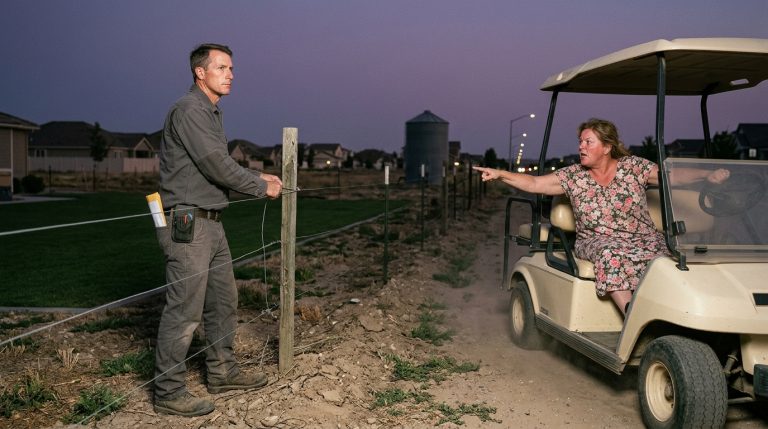
Karen stood on my porch, the late afternoon sun catching the frayed hem of her floral mumu and turning the loose threads to gold. She held a thick blue clipboard against her chest like a shield, but as she spoke, I noticed the slight tremor in her knuckles, the way her skin looked thin and translucent, like parchment left too long in the sun.
Behind her, the Kohlar generator sat in the quiet shadow of the holly bushes. It was a soft, matte gray, resting on the clean concrete pad we had poured last month. To me, it wasn’t an engine; it was a promise. It was the silent heartbeat that would keep my eight-year-old daughter Lily’s medicine cool when the grid finally gave way under the summer storms.
“The board,” she continued, her voice carrying a practiced stiffness that didn’t quite hide the exhaustion etched around her eyes, “deems it an unapproved modification. The concrete pad is a non-compliant natural hue. Code seven-point-four. And your landscaping buffer does not meet the aesthetic requirements.”
I held my ceramic mug, feeling the warmth of the coffee seep into my palms. My eyes drifted past her to the chipped whitewash on her own front porch, to the collection of faded garden gnomes that marched across her lawn like weary soldiers. There was a quiet decay creeping through our little corner of the world, a slow, shared fraying that none of us wanted to admit.
“I sent the board the paperwork two months ago, Karen,” I said softly, keeping my voice gentle, matching the quiet rustle of the dry oak leaves above us. “Certified mail. It’s quiet. Quieter than a running dishwasher.”
“The rules are the rules, Mr. Riley,” she replied, but her gaze flickered down to her clipboard, her thumb brushing against the worn corner of her papers. “They exist to protect our property values.”
For a second, the defensive armor she wore seemed to slip, revealing a hollow, desperate worry. She wasn’t just a neighbor enforcing a code; she looked like someone standing on a crumbling levee, trying to hold back the water with her bare hands.
“Fines begin Friday,” she said, her voice dropping as she turned away, her sandals clicking softly against the concrete path.
I watched her walk back toward her house, her small frame swallowed by the long, heavy shadows of the pine trees. As I turned to go inside, a slip of yellow paper caught my eye, wedged in the lower branch of the holly bush next to the generator pad. It had fallen from her clipboard.
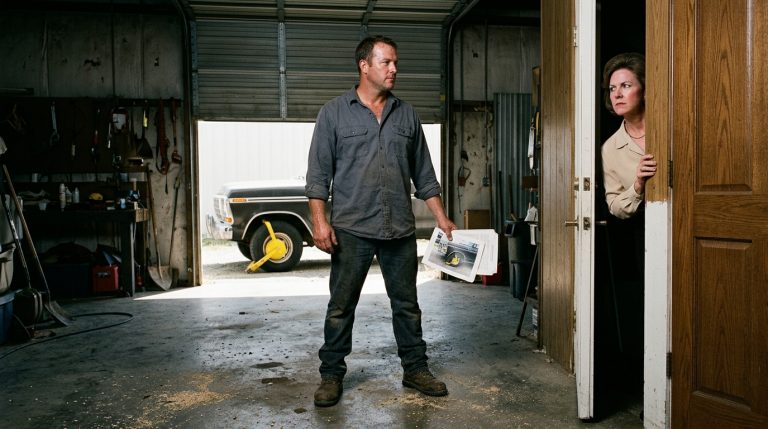
I reached down and smoothed out the creases. It wasn’t an HOA citation. It was a printed transit manifest, stamped with a bold, violet seal that read: The Aliquot-9 Ledger. Underneath, typed in precise, clinical font, was the exact delivery schedule for Lily’s biologic medication—information we had never shared with the neighborhood association, alongside a handwritten margin note in Karen’s tight, looping script: Secure buffer before the Caldecott inspection.
CHAPTER 2: SHORED FOUNDATIONS
The yellow slip of paper felt rough, almost fibrous, against my thumb as I pulled it from the spiked embrace of the holly bush. The texture was cheap, the kind of low-grade pulp used for internal corporate routing slips rather than standard municipal notices, but the purple ink of the stamp—The Aliquot-9 Ledger—was crisp, fresh, and slightly raised.
I stood frozen beside the gray metal casing of the generator, the quiet rustle of the dry oak leaves overhead suddenly sounding like static. My gaze remained locked on the handwritten margin notes. Secure buffer before the Caldecott inspection.
My chest tightened with a cold, calculated focus. The certified mailing receipt I had received back from the board weeks ago had been signed with Karen’s loopy, illegible scrawl, but this paper contained things she had no legal right to know. Lily’s pediatric rheumatologist was located three cities over. The prescription was filled through a specialized, closed-loop military insurance pipeline. To have these specific serial numbers, the exact refrigeration tolerances, and the arrival dates meant someone had bypassed the standard security firewalls of our shipping carrier. Or someone within the system was feeding her the data.
I folded the slip carefully, tucking it into the deep pocket of my canvas work pants. The cold metal edge of the generator’s pad pressed against the heel of my boot as I turned and walked back toward the house. The wood of the porch steps groaned softly under my weight, the peeling white paint flaking off in tiny, dry scales under the pressure.
Inside, the house smelled of lavender soap and the faint, warm yeast of the bread Sarah had left to rise on the counter. The kitchen was washed in the soft, amber glow of the dying sun, casting long, dusty shadows across the hardwood floor.
“Did she leave?” Sarah asked, her voice low as she stepped into the hallway. She was holding a worn dish towel, her knuckles slightly red from scrubbing the cast-iron skillet.
“She left,” I said, keeping my voice even, pulling the folded yellow paper from my pocket. I laid it flat on the wooden dining table, smoothing the creases with the side of my hand. “But she dropped this.”
Sarah walked over, her brow furrowing as she read the typed lines. I watched her eyes widen slightly when she reached the section detailing the precise chemical stability window of Lily’s vials. “Mark… how does she have this? This has the specialty pharmacy’s internal routing codes. Why would the HOA have our shipping manifests?”
“They shouldn’t,” I said. “And look at the note at the bottom. The Caldecott Protocol. I read the neighborhood covenants cover to cover before we signed the mortgage. There is no Caldecott Protocol in the bylaws.”
I pulled out a wooden dining chair, the legs scraping softly against the floor, and sat down. I opened my laptop, navigating to the scanned directory of the neighborhood’s public financial audits from the last three years. The files were buried in a poorly indexed subdomain on the community’s legacy website, a digital filing cabinet of scanned PDFs that most residents never bothered to click.
My eyes scanned the balance sheets. I wasn’t an accountant, but in the military, you learned how to track supply chains and locate where resources were being diverted. In the margins of the 2025 ledger, there was a recurring line item listed simply as Project H-D Recovery. It was small at first—just a few hundred dollars marked as “landscaping maintenance”—but by early 2026, the transfers had ballooned into thousands, all routed to an unlisted municipal engineering firm called Hesperus Associates.
“She’s shifting money,” I murmured, pointing at the screen. “Look at the communal maintenance fund. They’re nearly dry, but the fine collections have tripled. She isn’t trying to make us take the generator down because of how it looks. She’s desperate for the cash.”
Sarah leaned over my shoulder, the faint scent of her hand cream a brief comfort against the chill settling in my chest. “But why Lily’s medicine, Mark? Why track us?”
“Because if we can’t keep her medicine safe here,” I said, my voice hardening into a cold, flat certainty, “we can’t stay in this house. She isn’t trying to make us comply. She’s trying to make us leave.”
CHAPTER 3: SHARED SCARS
The blue light of the laptop screen casting across Sarah’s face seemed to freeze the air in our small dining room. I let my hand linger on the plastic edge of the computer casing, then pushed it down until it latched with a quiet, dull click. The silence that followed was heavy, broken only by the soft, rhythmic sighing of the wind catching the screen door down the hall.
“I’m going to find Dave,” I said, my voice barely more than a murmur in the twilight.
Sarah didn’t try to hold me back. She simply nodded, her fingers tracing the edge of the yellow slip of paper left flat on the wood. “Be careful, Mark. If she’s tracking the shipments, she’s watching the house.”
I stood up, the old floorboards yielding under my boots with a familiar, dry groan. I grabbed my canvas jacket from the peg by the door, the worn fabric smelling faintly of motor oil and sawdust. Walking out into the cooling air of the evening, the world felt desaturated, painted in shades of charcoal and deep slate. The gravel of the driveway crunched dryly under my soles as I crossed the asphalt toward Dave’s garage across the street.
His garage door was rolled up halfway, revealing a wedge of dim yellow light that spilled across the oil-stained concrete. Inside, the rhythmic, metallic clanking of a hand wrench against iron echoed into the quiet street. I ducked beneath the steel header, the smell of mineral spirits and damp earth instantly settling over me.
Dave was hunched over a disassembled lawnmower engine, his knuckles covered in dark grease. But as my shadow broke the light, he paused. His shoulders didn’t tense, but his grip on the socket wrench tightened. When he looked up, the harsh fluorescent bulb overhead caught the deep lines around his eyes, emphasizing the silver hair at his temples.
“Mark,” he said, wiping his palms on a rag that had seen better days. “You look like you just dug up an unexploded shell.”
“Worse,” I said, stepping closer to the wooden workbench. I reached into my pocket and pulled out the folded yellow transit slip, laying it on the grease-stained surface beside a row of rusted brass sockets. “Karen dropped this on my porch. Take a look at the margin note at the bottom.”
Dave picked up the paper, his rough, scarred fingers holding it delicately. He squinted in the bad light, his lips thinning as he read. “The Caldecott Protocol. What the hell is that?”
“I don’t know yet,” I replied, leaning against the cold metal frame of his tool chest. “But there’s more. The ledger on the HOA site shows thousands of dollars being routed to a firm called Hesperus Associates. It’s listed under something called Project H-D Recovery. They’re draining the reserve accounts, Dave. That’s why she’s coming after me for the generator fines. She needs the cash flow to cover the missing money before whoever is running this ‘inspection’ shows up.”
Before Dave could answer, a loud, violent shudder rattled from the back of the garage. The old air compressor he used for his pneumatic tools let out a dying hiss, its belt slipping with a high-pitched whine before seizing completely. The sudden silence that followed felt absolute, leaving only the smell of hot rubber and scorched copper winding in the air.
Dave cursed softly, tossing his wrench onto the bench. “Pressure switch is shot. It’s been acting up all week, but I can’t get the replacement parts until the distributor in the city opens on Monday.” He shook his head, looking at the dead machine. “We can’t talk here. If she’s out walking her rounds, she’ll notice the silence. Let’s move to the back alley. There’s less light.”
I followed him through the side door of the garage into the narrow, unpaved utility lane that ran behind our properties. The ground here was soft, overgrown with wild blackberry brambles that snagged at our trousers. The air was cool and smelled of wild honeysuckle and wet dirt.
“She tried to do this to Mrs. Gable last winter,” Dave said, his voice dropping to a harsh whisper as we walked along the chain-link fence. “They wanted her porch ramp gone. Said it violated the neighborhood visual continuity code. Her son had to threaten a federal housing discrimination suit to get them to back off. But I never figured out why Karen was so aggressive about it. It felt personal. Like she wanted the Gables out of that house.”
“Maybe she did,” I said, stopping near the rusted iron post of the utility gate. “If they force out the older folks and the people who won’t play along, who buys the properties?”
Dave paused, his hand resting on the top of the fence wire. The metal was cold, oxidized flaking off against his skin. “The investment group. The one that’s been cold-calling the neighborhood for six months. Every time someone gets hit with a string of fines, they get a letter in the mail offering a cash buyout.”
The pieces were beginning to align, not like a random collection of petty disputes, but like a coordinated flanking maneuver.
“We need proof,” I said, looking back toward the dark silhouette of Karen’s house. “We need to know what Hesperus is recovering, and what they’re trying to hide before the Caldecott inspection.”
“I’ve got a contact at the county clerk’s office,” Dave said, his eyes reflecting the distant amber glow of the streetlights. “I’ll see if I can get the plat maps for the neighborhood. There might be something underneath these houses they aren’t telling us.”
We turned back toward his garage, our boots sinking quietly into the damp earth, the shadow of the quiet sentinel of my generator still guarding the horizon.
CHAPTER 4: THE GUARDED INQUIRY
The cold flaking rust of the iron post left a dark smudge across my palm as I pulled my hand back. I stood in the soft dirt of the narrow utility lane, the distant low hum of a highway the only sound bridging the space between Dave and me.
“County clerk’s office,” I said, my voice barely carrying over the dry rustle of the surrounding blackberry brambles. “Start there. I’ll get Frank on the line tonight. We need to formalize this inquiry before she realizes we aren’t just resisting the fines—we’re tracking the money.”
Dave nodded once, his shoulder shifting against the chain-link fence. “I’ll head out first thing in the morning. Watch your back crossing the road, Mark. She’s still sitting by her window.”
I didn’t answer. I stepped out of the shadow of the utility lane, my boots pressing into the soft dirt before finding the hard, dry asphalt of the street. The night air had turned cool, carrying the sharp scent of damp pine needles and the faint, sulfurous tang of the old retention pond at the edge of the development.
Inside my kitchen, the yellow glare of the range hood light felt warm, almost too bright after the darkness of the alley. Sarah was standing by the sink, slowly drying a ceramic plate with a threadbare towel. She didn’t ask what Dave had said; she just looked at the way I held my hands, noticing the dark grease and rust smeared across my skin.
I walked straight to the small desk in the corner of the den, where the landline sat next to a stack of old home maintenance records. I pulled out my cell phone and dialed Frank Peterson’s personal number.
He answered on the third ring. His voice was a low, resonant rumble, free of the frantic energy most lawyers carried at this hour. “Mark. I was looking over the timeline you emailed. It’s thin on leverage, but heavy on administrative overreach.”
“It’s getting heavier,” I said, sitting down and sliding a clean sheet of paper toward me. The brass casing of my desk pen felt cold and heavy in my hand. “We found a dropped routing slip. It has Lily’s prescription serial numbers on it under a stamp marked The Aliquot-9 Ledger. And there’s a margin note referencing something called the Caldecott Protocol.”
There was a long silence on the other end of the line. I could hear the faint, dry scrape of a fountain pen sliding across a notepad.
“That’s a specialized medical tracking log,” Frank said, his tone shifting into the analytical calm he used when dissecting a complex military contract. “It’s not public. An HOA president accessing that kind of data is a severe statutory violation of privacy laws. But more importantly, the Caldecott Protocol is a state environmental monitoring standard for industrial runoff. Why is that attached to your neighborhood files?”
“The neighborhood reserve funds are being routed to Hesperus Associates,” I explained, my fingers tightening around the pen. “The ledger lists it under Project H-D Recovery. Dave thinks they’re preparing the ground for a buyout. If Karen can squeeze the residents with unpayable compliance fines, she forces them to sell to the investment group.”
“She’s building a legal wall,” Frank said. “But she made a critical error by putting her signature on those fine notices. We’re going to force her to explain her authority in writing. I’m drafting three formal inquiry letters tonight.”
“What’s the angle?”
“We aren’t going to accuse her of fraud yet,” Frank replied. “We’re going to ask for clarification. We’ll demand a point-by-point justification for the natural concrete hue variance fine under Section Seven-point-Four. We’ll cite the Americans with Disabilities Act regarding the generator, and we’ll demand a full disclosure of the past three years of architectural reviews to prove selective enforcement. If she ignores the request, she violates state transparency laws. If she answers, she binds herself to a single, legally reviewable narrative.”
“And the Caldecott reference?” I asked, looking down at the yellow slip of paper still resting on the corner of the desk.
“We leave that out of the formal letters,” Frank said. “Let her think we’re only fighting the generator. Let her believe she’s dealing with an angry homeowner, not an investigation. I’ll mail them certified tomorrow morning. All we do now is wait for the green return cards.”
“Understood,” I said, hanging up the phone.
I leaned back in the chair, the old wood creaking beneath me. I looked out the window toward the dark silhouette of Karen’s house. A single, weak light flickered behind her blinds, casting a distorted shadow across her overgrown lawn. She was still awake, still calculating her next move, entirely unaware that the first quiet lines of our counter-offensive had already been laid.
CHAPTER 5: THE BREATH OF THE STORM
The plastic hand-receiver clicked into its cradle, but the hollow silence of the house didn’t return. Instead, a low, metallic vibration shuddered through the den’s window glass. I pressed my palm flat against the cold pane, feeling the deep hum of the atmosphere. Outside, the pine branches were no longer whispering; they were bowing, swept flat toward the west as the leading edge of Hurricane Melissa began to pull the air out of the valley.
“Frank’s on it,” I said, turning back toward the kitchen doorway where Sarah stood. The amber glow of the range light caught the faint lines of worry bordering her eyes, casting her silhouette in soft, melancholic relief. “But the weather is going to outrun the mail. The storm is coming in fast.”
“The radio said the eye is tracking further inland,” she said, her voice quiet, almost lost to the sudden rattle of the screen door. She reached out to tighten her grip on the dry dish towel. “They’re calling for voluntary evacuations. George Gable’s wife was on her porch five minutes ago. She looked terrified, Mark.”
“I’ll go check on them,” I said, pulling the zipper of my canvas jacket up to my chin. The fabric felt stiff, smelling of woodsmoke and the faint copper scent of tools. “And I need to run a diagnostic on the Kohlar. If the lines go down tonight, we can’t afford a single second of hesitation.”
I stepped out of the kitchen door and onto the back porch. The world was cast in a bruised, violet hue, the sky so heavy and low it felt like a physical weight pressing against the rooftops. The air was thick, damp, and smelled of ozone—the distinct, electric warning of a hard system drop.
I made my way down the steps, my boots sinking into the dry grass that had begun to flatten under the wind. At the corner of the house, the generator sat silently on its natural concrete pad, its gray metal housing cool to the touch. I unlocked the side hatch, the oxidized brass latch releasing with a dry click. The diagnostic lights were a steady, quiet green.
As I initiated the manual test cycle, the engine coughed once, a brief puff of gray exhaust carrying the sharp scent of clean propane, before settling into a smooth, rhythmic purr. At fifty-eight decibels, it was barely louder than the dry rustling of the holly bushes beside it, but as I stood there, a sudden flash of headlights cut through the gloom of the street.
A utility truck with the logo of the regional water authority was idling near the entrance of our cul-de-sac. A man in a high-visibility vest was standing by the curb, holding a heavy iron T-wrench over the water main valve box. I watched him through the gaps in the holly leaves as he bent low, his boots slick from the rising humidity, and turned the iron valve with a slow, heavy strain.
I closed the generator hatch, the latch snapping shut. I walked toward the edge of my lawn, the wind catching the collar of my jacket and whipping it against my neck.
“Everything alright with the line?” I called out, my voice fighting the low whistle of the wind through the pines.
The worker didn’t look up immediately. He finished his turn, his gloved hands sliding off the rusted iron tool. When he finally turned his head, his face was obscured by the dark brim of his hard hat, but I saw the label affixed to his clipboard: The Caldecott Protocol – Emergency Shutoff.
“Standard pressure check,” he muttered, his voice flat, devoid of the local accent. He threw the heavy iron wrench into the bed of the truck, the metal-on-metal clang sounding like a gunshot in the heavy air. “Pre-storm precaution. Go inside, mister. It’s going to get wet.”
He didn’t wait for a reply. He climbed into the cab and pulled away, the tires spitting loose gravel against the curb.
I stood there on the grass, my hands buried deep in my pockets, watching his tail-lights disappear into the gathering dark. He hadn’t checked the residential meters. He had shut down the secondary feeder line—the one that bypassed the neighborhood reservoir.
A cold droplet of rain hit my forehead, followed by another, heavy and flat against my skin. The storm was here. And as the streetlights flickered once, twice, and then went completely dark, the quiet purr of my generator was the only light left preparing to breathe.
CHAPTER 6: THE SHARED HEARTH
The sudden, absolute blackness was a physical impact. On the lawn, the wind tore the breath straight from my mouth, carrying the sharp, bitter scent of sheared pine branches and wet clay. Down the street, the violent flash of the transformer’s death-shriek had burned an emerald streak across my retinas, leaving the world cold, blind, and roaring.
For three long seconds, the only sound was the gale. Then, the soft, mechanical heartbeat of my generator flared. The Kohlar purred, a muffled, low-frequency rhythm that barely registered above the storm’s howl but immediately sent a steady, warm beacon of light spilling from our kitchen window onto the glistening holly leaves.
I didn’t waste a heartbeat. My boots slid slightly on the slick, rain-heavy grass as I dragged the heavy-gauge outdoor extension cord from the covered porch hook. The thick orange casing felt cold and stiff, coiled like an iron wire in the damp draft. Walking in a half-crouch to fight the wind, I ran the line through the gap in our side fence, heading straight toward the dark, silent silhouette of the Gables’ home.
By the time I hammered on their back door, the rain was coming down in solid, horizontal sheets that stung like buckshot. Mrs. Gable opened it, her small frame nearly lost in the darkness of her kitchen. Her face, illuminated only by the weak, yellow flame of a single melting wax candle on the counter, was drawn with a quiet, hollow terror. Behind her, the rhythmic, mechanical sighing of George’s backup oxygen concentrator was absent, replaced by the shallow, manual rasps of a man resting on his final reserve tank.
“Mr. Riley,” she whispered, her voice trembling as she reached for my wet sleeve. The fabric of her sweater was worn, thin, and smelled faintly of old lavender and dust.
“I’ve got you,” I said, my voice low and steady. I didn’t wait. I pulled the heavy-gauge line over her threshold, connecting the three-prong plug into their primary terminal box. A second later, the concentrator let out a reassuring, high-pitched beep, and its steady, low hum joined the rhythm of the storm.
Relief washed over her face, soft and sudden, like light through a cracked window. “Thank you. Oh, thank you, Mark.”
“Keep the door locked,” I said, checking the seals on the window frame. “I’ll be right across the street.”
I stepped back out into the deluge. As I rounded the corner of my own driveway, my boots splashing through the fast-rising water, I saw a figure huddled under the partial shelter of my porch.
It was Karen.
The wind whipped her wet hair across her face, plastering the damp, floral fabric of her mumu to her shoulders. The arrogant posture, the plastic clipboard, the hard, unyielding clip of her heels—all of it had been stripped away by the raw, indifferent violence of the storm. She was shivering, her hands tucked deep into her armpits, her eyes wide and bloodshot as she stared at the bright, warm windows of my home.
“Mark,” she croaked, her voice cracking under the weight of the cold draft. “My… my phone is dead. Everything is dark. I need… I have things in the freezer. The Omaha cargo. It’s going to spoil.”
The sheer, staggering smallness of her worry—worrying about premium beef while George Gable’s lungs fought the dark—settled deep into my joints like old frost. The flickering orange light of the candle I had seen at the Gables’ window flashed in my mind, triggering a sudden, intrusive memory of a field-hospital brownout in Al-Anbar, the suffocating heat, the low, desperate hum of failing batteries. I knew what happened when the perimeter failed.
I looked down at her, my face a mask of wet stone. The rain dripped from the brim of my cap, tracing the sharp line of my jaw.
“It’s a liability, Karen,” I said, my voice flat, carrying the exact clinical distance of the letters she had signed. “The Kohlar is calibrated for my home’s specific load. Running lines to other properties in these wet conditions violates the manufacturer’s safety recommendations. And, of course, Section Seven-point-Four doesn’t allow for unapproved external connections.”
She flinched as if I had struck her, her lips parting, but no sound came out. The rules she had spent months weaponizing to tear down my fortress had just turned their rusted edges back toward her.
“I can’t help you,” I said softly, stepping past her and pulling the heavy wooden door shut, the deadbolt clicking into place with a definitive, final snap.
CHAPTER 7: THE MENDED VESSEL
The solid iron deadbolt settled into its brass strike plate with a heavy, final thud that vibrated through the frame of my hand. Behind the thick wooden door, the roaring howl of the rain became a muffled, distant wash. I stood in the small entryway, my chest rising and falling in the quiet dark, listening to the steady, rhythmic purr of the Kohlar generator working just outside. The immediate perimeter was safe.
But safety was a fleeting line in the dirt. Over the next forty-eight hours, the storm slowly exhausted its fury, leaving the neighborhood in a state of damp, warm isolation. The grid remained black, but the rising sun of the third morning brought a different kind of heat. It was the heat of a community that had been pushed to its absolute threshold.
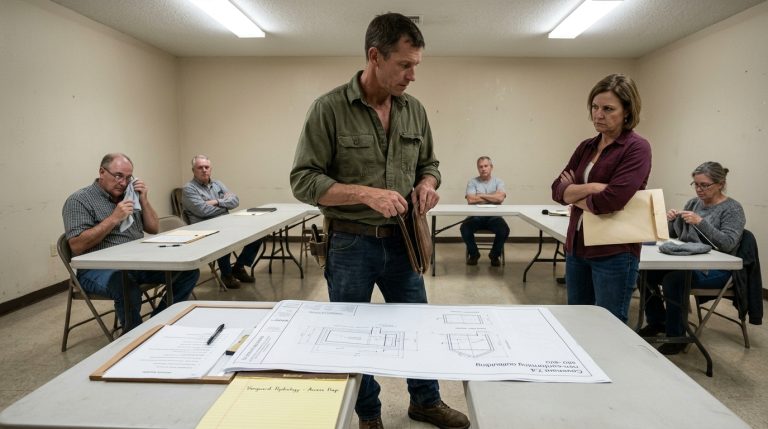
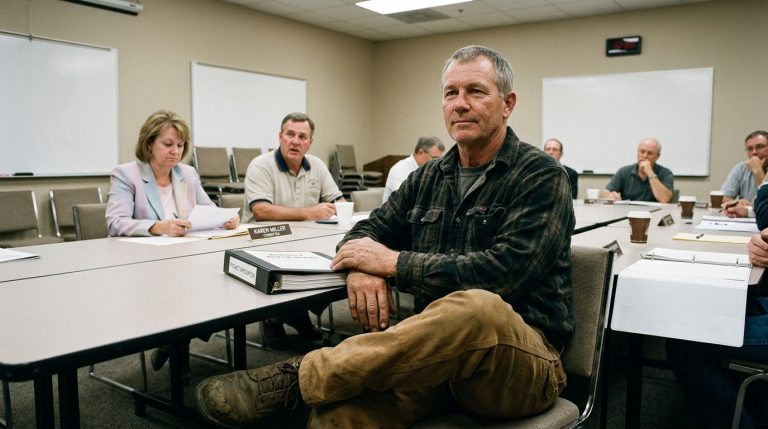
When the emergency HOA meeting was called at the neighborhood clubhouse, the air inside the communal room was thick and humid, smelling of old damp carpet, floor wax, and the quiet desperation of fifty families who had spent three days in the dark. The overhead fluorescent tubes flickered weakly, powered by the clubhouse’s small, struggling emergency circuit.
Karen sat at the center of the long wooden folding table at the front of the room. The polished blue clipboard was gone, replaced by a stack of loose, water-stained sheets. She looked smaller, her face pale under the harsh tubes, her fingers twitching continuously against the edge of a plastic pen. Her eyes darted toward me as I walked in, flanked by Dave and Mrs. Gable’s son, Arthur, who carried a heavy leather briefcase.
“We are here to address the outstanding compliance issues and the catastrophic failure of our communal assets,” Karen began, her voice carrying a reedy, desperate strain that lacked its old, unyielding edge. “The board must maintain the visual integrity of the—”
“The board is bankrupt, Karen,” Arthur interrupted, his voice calm, carrying the precise weight of a man holding an inescapable trap. He stepped forward, his boots clicking softly on the linoleum floor, and laid three bound folders onto the table. “And so is every homeowner in this room if we don’t act today.”
The room erupted into a low, anxious murmur.
“This is an unapproved disruption,” Karen stammered, her knuckles turning white as she pressed her hands flat against her papers. “The agenda is locked.”
“The agenda is the Caldecott Protocol,” I said, stepping up beside Arthur. I looked out at the faces of our neighbors—people who had waved nervously from their driveways, who had watched in silence as Karen’s fines piled up. “And the shadow buyout that’s been targeting our homes.”
Arthur opened the first folder, revealing a copy of the Aliquot-9 Ledger we had recovered. “For eighteen months, Karen has been using selective code enforcement to levy thousands of dollars in fraudulent fines against targeted residents—specifically our veterans, our elderly, and families with medical vulnerabilities. But those fines weren’t going into the neighborhood maintenance reserves.”
He pointed to a column of figures, his finger tracing a line of systematic transfers. “They were being funneled directly to Hesperus Associates under a shell project. Why? Because the communal water reservoir beneath our homes failed a state inspection under the Caldecott Protocol two years ago. The aquifer is contaminated with industrial runoff, and instead of disclosing the defect to the state or the homeowners, Karen was trying to quietly buy out the targeted properties on behalf of an investment syndicate.”
The murmuring in the room died instantly, replaced by a heavy, suffocating silence.
“If the homeowners can’t afford the compliance fines, they are forced to sell,” Arthur continued, looking directly at the remaining board members, whose faces had drained of all color. “And once the syndicate owns a majority of the plots, they can execute the Hesperus Directive—dissolving the HOA, sealing the aquifer, and selling the entire development to a logistics company for a massive profit. Every single board member who signed these fine notices is personally liable for conspiracy, fiduciary fraud, and housing discrimination.”
Stan, the board accountant sitting to Karen’s left, let out a shaky breath, his pen slipping from his fingers and rolling across the table. “She told us it was a recovery fund. She said the state would condemn the neighborhood if we didn’t patch the system ourselves.”
“You signed the letters, Stan,” I said, my voice cold and level. “You signed the letter telling me my daughter’s medicine wasn’t a priority compared to the color of my concrete pad.”
Karen stood up, her chair scraping violently against the floorboards. Her face was a mottled, furious red, her breathing ragged as she looked around the room, realizing the perimeter of her control had completely dissolved. “This is my community! I saved this place! If the state found out about the water, your property values would have been zero! I did what was necessary!”
“No,” Mrs. Gable said from the front row, her small voice cutting through the tension with a quiet, undeniable clarity. “You did what made you feel powerful, Karen. And you left us in the dark to do it.”
Stan looked down at his hands, then turned toward the rest of the board. “I move for an immediate vote of no confidence in the President. And a motion to authorize Arthur to negotiate a settlement with the state using the recovery funds to clean the aquifer.”
The second came from three board members simultaneously. When the hands went up, it was a landslide. Nearly every palm in the room raised toward the flickering fluorescent lights—a silent, collective reclamation of the ground they had almost lost.
Karen sat back down, her face blank, her gaze dropping to the water-stained papers in front of her. The crown was gone, the kingdom dismantled, leaving only a bitter, silent woman in a humid room.
CHAPTER 8: GOLDEN SEAMS
The sea of raised hands in the hot clubhouse slowly lowered, a collective, heavy exhale rustling through the crowded room like wind through dry reeds. Karen remained frozen at the center of the folding table, her fingers locked around the plastic casing of her pen until it let out a tiny, sharp crack. Nobody moved toward her. Nobody spoke. The silence of fifty families was absolute, a clean, quiet boundary drawn in the stale air.
Stan slid a clean sheet of paper toward Arthur, his hand trembling slightly against the dark wood grain of the table. “I’ll cooperate. We’ll provide every bank transfer, every email exchange with the Hesperus Associates team. Just keep my name off the state’s attorney general filing.”
“We’ll see what you deliver first, Stan,” Arthur said, sliding his leather briefcase onto his lap and closing the brass latches with a heavy, double metallic click.
I turned away from the table, my shoulder brushing against Dave’s canvas sleeve. The crowd was already beginning to drift toward the double exit doors, their footsteps flat and slow on the linoleum, their hushed whispers filling the space where fear had ruled for eighteen months. The weight that had held this neighborhood hostage was finally dropping, breaking apart into harmless fragments.
I walked out of the clubhouse and into the soft, amber light of the late afternoon. The storm was a memory now, leaving only the washed, clean smell of wet pine resin and damp earth. Walking down the street, I felt the rhythmic crunch of the road gravel under my boots, a grounding, real-time pace. No shortcuts, no sudden victories—just the slow, steady work of reclaiming our home.
When I reached my driveway, the sun was casting long, copper shadows across the lawn. The Kohlar generator sat silently in its nook behind the holly bushes, its gray metal housing catching the golden light. It was no longer a monument to a private war; it was just a quiet sentinel, a piece of solid engineering resting on a concrete pad that was exactly the shade of gray it was meant to be.
Sarah was sitting on the wooden steps of the back porch, her hands wrapped around a warm mug of tea. Lily was a few yards away in the grass, her laughter rising in the quiet air as she chased a blue dragonfly through the clover.
“Is it over?” Sarah asked softly, her eyes searching my face as I walked up the steps.
“It’s over,” I said, sitting down on the step beside her. The old wood groaned in its familiar, comforting voice. “The state is stepping in under the Caldecott Protocol. The buyout is dead, the funds are being returned to fix the reservoir, and Karen is packing.”
She leaned her head against my shoulder, her hair smelling faintly of lavender and dry wind. “We made it.”
“We stood our post,” I murmured.
I reached into my pocket and pulled out my multi-tool, unfolding the small steel file. I stepped down to the bottom porch step, where the wind had loosened a brass screw on the handrail, leaving a sharp, snagging edge. I knelt in the warm dirt, the scent of cedar rising around me, and began to slowly, methodically file the rough metal down until it was smooth, clean, and safe for Lily’s hands. Each stroke of the file was a quiet, physical stitch, mending the small breaks in our world, ensuring that the fortress we had fought for would remain whole, warm, and unbroken in the fading light.