The Architect of Silence: A Battle for the Backbone of Home in a Rusting World
CHAPTER 1: THE INCURCION
The smell of diesel and pine dust hung heavy in the humid North Carolina air. It was a familiar scent, one that usually signaled a productive afternoon of milling, but today it was punctured by the sharp, sterile scent of exhaust from the luxury SUV parked squarely across my gate.
Karen stood on the gravel edge of the property line, her floral-print mumu looking like a bright, insulting flag in a yard that valued the muted, rusted tones of work. She held a clipboard against her chest like a shield, her face a mask of practiced, suburban superiority.
“That pile of sawdust is a registered biohazard, Jack,” she called out, her voice thin and piercing. “Your noise pollution is a violation of Covenant 7.4B. You have thirty days to cease all commercial operations, or I will see to it that this land is condemned.”
I didn’t turn the engine off. I let it rumble, a low, mechanical growl that vibrated through the frame of the truck and into my boots. The sound of it—a visceral, earthy thrum—was the only reply she deserved. My gaze drifted from her pinched, frantic expression to the 10,000lb stack of Douglas fir beams sitting on the flatbed behind me. These weren’t just boards; they were architectural bones for a client who understood the value of a legacy, a man who preferred the honest grit of custom-milled wood to the soulless, beige perfection of the Whispering Pines development that sprawled behind her.
A memory surfaced, unbidden—the smell of diesel and heat on a different terrain, the distinct, cold clarity that comes when you’re staring down a threat that thinks it has the upper hand because it has the rulebook. I had spent thirty years learning to read the lie of the land, both the physical earth and the invisible lines people drew in the air to define ownership and power.
She didn’t know it yet, but she hadn’t just parked a car in my way. She had stepped onto a foundation that had been poured a century before her subdivision was even a developer’s fever dream.
“You’re blocking my truck, Karen,” I said, my voice quiet, cutting through the idle of the engine.
“I’m doing my duty,” she retorted, her grip on the clipboard tightening until her knuckles whitened. “This neighborhood has standards. Your mill is an unsightly blemish, and I’m going to make sure it’s erased.”
I looked at her—really looked at her—and saw the tremor in her hands. She wasn’t standing on the edge of a property dispute. She was standing on the edge of a mistake that would strip away the illusion of her control, piece by piece. She thought this was a battle of rules. She had no idea she’d just declared war on a man who had built bridges while under fire, and who knew that the most dangerous enemy is the one who believes their own propaganda.
She turned on her heel, her sandals crunching awkwardly on the gravel, and climbed into her Lexus. I watched her go, the dust settling slowly around the gate, and in the silence that followed, the weight of what was coming began to settle into the marrow of my bones.
CHAPTER 2: THE LOGISTICS OF WAR
The dust kicked up by Karen’s Lexus settled slowly, coating the needles of the ancient pines in a thin, grey veil. I stood at the gate for a moment, letting the heavy, rhythmic thrum of the idling diesel engine fade from my ears until the only sound was the creek whispering over the rocks at the edge of the property. The house—the farmhouse my great-grandfather had built—stood silent, its timber frame weathered by decades of sun and storm, a sturdy, defiant structure in a world that was becoming increasingly fragile.
Inside, the house felt cool, smelling faintly of cedar and the sharp, clean scent of Sarah’s dried lavender. I walked to the dining room. The oak table dominated the space, a massive, singular slab I’d hewn myself from a fallen giant ten years back. It was scarred, uneven, and solid—the kind of surface that didn’t just hold objects, but demanded respect.
Sarah was already there, a pot of coffee steaming on the trivet. She was staring at the thick, crisp white envelope that lay in the center of the wood, its edges perfectly straight against the organic grain of the oak. She looked up as I entered, her eyes reflecting a mix of familiar concern and the hard-won clarity of an army nurse. She had seen chaos, but she knew the difference between a crisis you could treat with a field kit and a crisis that required a complete tactical overhaul.
“She’s not just grandstanding, Jack,” Sarah said, her voice quiet. She pushed the envelope toward me. “The language in these citations—it’s designed to bury us in process. They’re claiming we’re a commercial contaminant.”
I pulled out a chair, the wood scraping harshly against the hardwood floor, a sound like a blade being drawn. I sat, my hands resting on the rough, hand-planed surface of the table. The grain was deep, tracing the years of growth that had gone into the tree—the droughts, the winters, the slow, unrelenting march toward maturity. My father’s voice, a quiet, methodical cadence, echoed in the room, reminding me that you don’t fight a flood by trying to stop the water; you build a levy that channels it somewhere else.
I opened the envelope. Five pages of single-spaced legalese, filled with references to HOA covenants, county ordinances, and vague, looming threats of five-hundred-dollar-a-day fines. It was a masterpiece of intimidation. The font was sharp, the margins narrow, all of it calculated to overwhelm, to turn a homeowner into a defendant, to make the act of living on one’s own land feel like a transgression.
“She’s counting on us to get angry, Sarah,” I said, tracing the signature at the bottom—a flamboyant, aggressive loop of ink that seemed to carve itself into the paper. “She wants a reactive, emotional play. She wants us to start screaming about property rights so she can paint us as the aggressors to the rest of the neighborhood.”
My mind shifted gears. I stopped reading the words and started reading the structure. I began to deconstruct the document, analyzing each claim as a vector of attack. Every rule cited was a potential weakness, but every rule also defined the boundaries of the adversary’s power. I saw the citations not as threats, but as a map—a set of coordinates that showed exactly where she thought she had authority, and where, consequently, she would be most vulnerable to a counter-assertion.
I pulled out my notebook, the leather cover worn smooth by years of use, and opened it to a clean page. I began to log the threats, cross-referencing them against the county’s actual, rather than imagined, municipal codes. It was cold, methodical work, the kind of labor that required the same patience as turning a rough log into a precision beam.
“She’s not looking at the law,” I continued, my pen scratching across the paper in a steady, rhythmic cadence. “She’s looking at the perception of authority. She’s betting that a binder full of rules, regardless of whether they’re enforceable, will be enough to make us fold.”
Sarah leaned in, her gaze sharpening. She had seen this process before—the way I would dismantle a complex engineering project by breaking it down into its fundamental, structural dependencies. “And if we don’t fold?”
“Then we don’t just win,” I said, looking up from the paper to meet her eyes. “We expose the fact that the entire foundation of her power is built on a bluff.”
I stood up and went to the heavy, iron-bound filing cabinet in the corner, pulling out the folder that contained the original subdivision plat map. I laid it out on the table, overlapping the legal notice. The contrast was stark—the thin, pretentious white paper of the HOA versus the aged, detailed, authoritative map of the county. I didn’t see the conflict as a disruption to our life anymore; I saw it as a tactical exercise in reclaiming the sovereignty of our own soil. The coffee sat cold in the pot, the afternoon sun shifted toward the tree line, and in the quiet of the farmhouse, the first, subtle threads of a counter-strategy began to weave together, invisible to anyone who wasn’t looking for the architecture of the truth.
CHAPTER 3: THE STRIP MALL THRONE
The air in my pickup cab was still stale from the morning’s tension, smelling of old upholstery and the persistent, metallic tang of diesel. I drove into town, keeping my speed steady, my hands locked at ten and two on the steering wheel. I wasn’t going to the courthouse. That would be too predictable, a move Karen would have anticipated and padded with legal roadblocks. Instead, I headed for the industrial strip mall on the outskirts of the county seat, a place where the air was thick with the exhaust of idling delivery trucks and the faint, chemical scent of the nail salon next door.
The HOA headquarters was tucked between a vape shop and a windowless tax consultancy. It was a space that prioritized function over form, the antithesis of the curated “Whispering Pines” facade. I stepped out of the truck, the gravel crunching under my boots—a sharp, dissonant sound against the hum of a distant highway. I checked my satchel. The legal documents from the morning were tucked inside, but it was the plat map—the heavy, rolled-up cylinder of paper—that felt like the real weapon.
I pushed open the glass door. A bell chimed, thin and pathetic, signaling my entry into the kingdom of beige and particle board. The room was illuminated by flickering fluorescent lights that washed out the color of everything, turning the cheap laminate desk in the center into an island of artificiality.
Karen was there, sitting behind the desk. She was midway through a phone call, her voice clipped and sharp, but when she saw me, she didn’t hang up. She kept the receiver pressed to her ear, watching me with a look of predatory curiosity. She was the queen of this shabby throne, surrounded by stacks of paper that served as her armor, but her gaze lingered on my face, looking for the telltale signs of the stress she’d been trying to cultivate.
I didn’t speak. I walked to the front of the desk and set my satchel down, the heavy thud of it making a statement that the silence in the room couldn’t match. I didn’t reach for the documents yet. I let the silence stretch, forcing her to acknowledge the shift in the dynamic. She finally lowered the phone, her fingers tapping against the plastic casing.
“Mr. Peterson,” she said, her voice dripping with a practiced, condescending tone. “I assume you’re here to sign the cessation agreement? I don’t have time for a drawn-out discussion regarding your lack of compliance.”
“I’m here for the truth, Karen,” I said, my voice steady, stripped of any aggression. “I’m here for a certified copy of the HOA’s articles of incorporation, the full recorded covenants, and the original subdivision plat map filed with the registrar.”
She blinked, the smugness faltering just enough to reveal a flicker of genuine surprise. This wasn’t the reaction of a man drowning in fines; it was the reaction of a man who had already started to build a dam. She shifted, her posture changing from dismissive to defensive. She gestured vaguely to the stacks of paper surrounding her, a chaotic landscape of bureaucratic busywork.
“That’s a significant amount of paperwork,” she huffed, her eyes darting to a filing cabinet behind her. “There’s a copying fee. A steep one, given the administrative burden you’re placing on the board.”
I reached into my pocket and pulled out a folded hundred-dollar bill. I laid it on the laminate surface, the green edge perfectly aligned with the grain of the cheap table. “I’m aware of the cost,” I said. “I expect a receipt for the fees and an estimated time for delivery. I’ll wait.”
The next hour was a slow, agonizing exercise in passive aggression. She huffed, she puffed, she slammed drawers—a pantomime of indignation designed to make me feel small, to make me feel like a nuisance. I remained unmoved. I sat in one of the rigid plastic chairs, my posture relaxed, my eyes scanning the room. I noticed the way she moved when she thought I wasn’t looking, the way she kept checking a specific folder tucked beneath her keyboard.
She finally shoved a thick, haphazard stack of papers across the desk, along with a heavy, rolled-up tube of architectural drawings. It was all there, the sum total of the HOA’s legal footprint. I took the documents without a word, feeling the weight of the map—a heavy, dense tube that held the literal coordinates of my land and its status.
“It’s all there,” she snapped, not bothering to hide the venom in her voice. “Now, if you’ll excuse me, I have an actual community to run. Try not to get any sawdust on the documents.”
I turned, the documents clutched under my arm, and walked out. I didn’t look back. I reached the door and pushed it open, the chime echoing one last time. As the strip mall parking lot greeted me, the sun was beginning to dip, casting long, sharp shadows across the cracked asphalt. I didn’t rush. I walked to my truck, my mind already dissecting the stack of paper, calculating the next move. She thought she had given me a pile of administrative chores. She had actually handed me the blueprints for her own undoing.
CHAPTER 4: THE INTELLIGENCE BREACH
I spread the map across the oak table, the paper wanting to curl back into its cylindrical prison. I pinned the corners down with heavy brass weights—the kind used on drafting tables decades ago. It was a massive, single-sheet document, a detailed bird’s-eye view of the land that had defined three generations of my family’s survival. I switched on the overhead lamp, the warm, yellow pool of light illuminating the intricate lines and shaded blocks that represented the Whispering Pines subdivision.
Sarah brought me a mug of black coffee, her footsteps soft on the hardwood, but she didn’t say a word. She saw the way I was looking at the map—not as a picture of land, but as an enemy operations order. I had a magnifying glass in my hand, its glass slightly scratched but clear enough to pierce through the dense, sprawling ink of the survey notes.
I started at the periphery, working my way toward the eastern fence line where the Whispering Pines development encroached on my woods. My finger traced the thick, bold outline of my sixty-acre plot, designated as Parcel 7B. I remembered the developer’s original sales pitch—promises of “uninterrupted tranquility” and “harmonious integration.” It was all standard marketing filler, the kind of corporate noise that usually meant nothing. But there, in the legend at the bottom right corner, tucked away in the finest print I’d ever seen, was a block of text that made my pulse hitch.
Parcel 7B exempt: Pre-existing agricultural/light industrial use. Subject to non-binding variance per County Ordinance 1998-A.
It was a legal fortress. My family’s sawmill, the yard, the storage area—it was firewalled. The HOA’s covenants were essentially attempting to exert jurisdiction over land that had been explicitly severed from their control before the first shovelful of dirt was turned for their gatehouse.
But as I adjusted the magnifying glass, something didn’t align. I looked at the survey markers—those tiny, precise circles etched into the parchment. I pulled out my notebook and began to cross-reference the markers with the current tax maps I’d printed from the county records office the week prior. There was a discrepancy. The current subdivision boundary lines, as claimed by the HOA in their violation notices, pushed nearly thirty feet into my northern timber line.
It was a deliberate, calculated error—a “map shift” that only a surveyor or a man who knew every tree and boulder on this land would notice. By subtly moving their theoretical boundary on paper, they were effectively encroaching on the very soil they claimed was a biohazard. I felt a cold, jagged edge of anger slide into place. It wasn’t just harassment; it was a land grab, masked by the pretentious language of “aesthetic standards.”
I leaned back, the chair groaning under the weight of my shift. The implications were immense. If the boundaries were fraudulent, the entire justification for the “contamination” claims fell away. They weren’t concerned about my sawdust; they were concerned about a thirty-foot strip of mature, high-value timber that they needed to complete their third phase of construction.
“They’re not just trying to shut us down, Sarah,” I whispered, the sound feeling loud in the quiet of the room. “They’re trying to erase our footprint. They’ve been falsifying the boundaries, hoping I’d be too busy fighting off the fine notices to actually look at the survey markers on the ground.”
I grabbed a red marker and circled the discrepancy on the map, the color standing out like a fresh wound against the aged paper. The realization settled over me with a heavy, grounding finality. This wasn’t about Karen’s ego. That was just the surface—the decoy secret. The reality was much more mercenary: it was about profit, leverage, and the cold, unyielding mechanics of development expansion.
I looked at the notes in my logbook. The “noise pollution” complaints, the “environmental hazards,” the “unapproved roof colors”—they were all a smokescreen. They were intended to make the land-use status seem like a legal grey area, to exhaust me until I accepted a “compromise” that would have seen me voluntarily ceding that thirty-foot strip.
I checked my watch. It was past nine, the house settling into the cool, dark comfort of the evening. I took a deep breath, the smell of old paper and the metallic tang of coffee filling my lungs. I reached for the phone. It was time to stop gathering intel and start preparing the terrain for a confrontation that would make their little HOA meetings feel like a child’s tantrum. I needed allies who understood the weight of land, and more importantly, I needed the men who were currently funding the very development that was trying to eat my woods alive.
The strategy was shifting. I wasn’t just defending a sawmill anymore; I was preparing to dismantle a corporate machine that had forgotten that some ground—and some men—could not be moved. I sat at the table, the map spread out before me like a battlefield, and began to draft the list of builders I needed to bring into the fold.
CHAPTER 5: THE BUILDERS ALLIANCE
The shriek of the kiln fan was a jagged, piercing sound that cut through the low-frequency hum of the woods. It was the sound of a machine under stress, the kind of mechanical protest that usually meant a seized bearing or a burnt-out motor. I dropped my pen, the ink blotching the paper, and scrambled down from the farmhouse porch. My hands were already mapping out the repair: disconnect the power, bleed the pressure, strip the casing.
Every second spent with a wrench in my hand was a second lost from the logistical offensive I’d just begun, but the mill was the heart of the operation. If the mill went down, the deliveries—the very leverage I needed to force the builders to listen—would stop. It was a cruel, perfectly timed reminder that no matter how complex the legal war became, the physical world always demanded its due.
I reached the mill floor, the air thick with the smell of sawdust and overheating grease. I worked with the methodical, grinding intensity of a man who had cleared minefields in the dark. My movements were stripped of waste, every twist of the wrench calculated to maximize torque and minimize fatigue. As I pulled the housing off the fan, my knuckles scraped against the rusted steel, a familiar, gritty sting that helped sharpen my focus.
The bearing had seized, just as I’d suspected. It was a clean, catastrophic failure. I reached for the spare, my mind racing. I was expecting Mark Harrington, Dave Miller, and Paul Jessup in less than an hour. They were men of business, men who lived by the clock, and if they arrived to find a broken-down operation, the optics would be disastrous. I couldn’t afford to look like an amateur struggling to keep the lights on; I had to look like a commander holding a fortress.
I replaced the part, my fingers slick with grease, the cold metal biting into my skin. I spun the blade—smooth, silent, perfectly balanced. I threw the power switch. The fan roared to life, a steady, low-frequency hum that vibrated through the floorboards. I exhaled, the heat of the mechanical stress leaving my body, and looked at the clock. Twenty minutes.
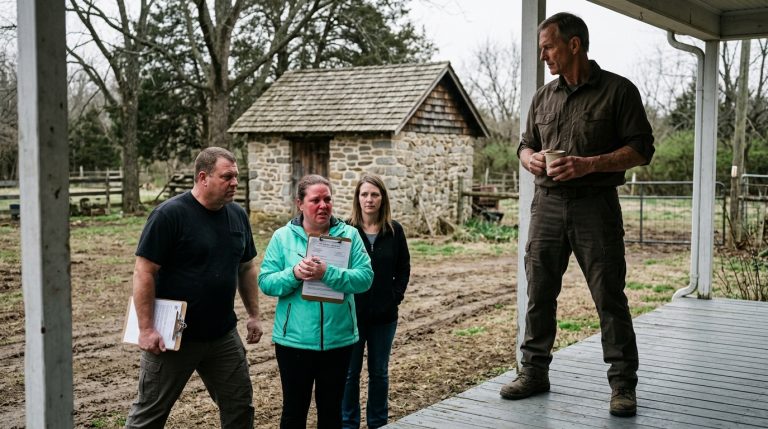
I hurried to the farmhouse, stripped off my grease-stained coveralls, and swapped them for a clean, pressed shirt. I checked my reflection in the mudroom mirror—still looked like a man who spent his life in the woods, but the eyes were sharp, focused. The builders arrived right on schedule. Three mud-splattered Ford F250s pulled into the driveway, their arrival heralded by the crunch of gravel and the heavy thud of truck doors closing.
I met them on the porch. Mark Harrington stepped out first, his face set in a grim, professional mask. He was a man who preferred a handshake to a contract, and he didn’t waste time with pleasantries. He walked up the steps, his boots heavy on the wood, and looked at me—really looked at me—not as a supplier, but as a potential ally in a war he hadn’t known he was fighting.
“You said you had a situation, Jack,” he said, his voice a low, gravelly baritone that carried over the wind. “Harrington Homes doesn’t like surprises. If there’s an issue with the cedar supply, I need to know now.”
“It’s not the supply, Mark,” I said, gesturing toward the house. “It’s the environment. Come inside.”
I led them into the dining room. I had the map spread out, the red-marked boundary discrepancy stark and undeniable under the warm light. I didn’t offer them coffee; I offered them the truth. I laid out the case—the legal harassment, the fraudulent survey lines, the systematic abuse of the homeowners, and the looming financial collapse of their third-phase expansion.
Dave Miller of Blue Ridge Builders, a man who had built his reputation on the precision of his timber framing, leaned over the map, his finger tracing the red line I’d drawn. He didn’t look at me; he looked at the evidence. Paul Jessup from Apex Construction joined him, their heads together, the collective, silent expertise of the room thickening.
“She’s moving the property lines on the tax maps,” Dave said, his voice a low, disbelieving hiss. “That’s not just a violation, Jack. That’s a felony.”
“She thinks she can hide it in the fine print,” I replied. “She thinks that because the subdivision is big, no one will bother to check the math.”
Mark Harrington stood back, his arms crossed, his gaze fixed on the map. He wasn’t looking for a legal loophole; he was looking for a way to break the gridlock. “So, the HOA meeting is in two weeks. They’re planning to vote on a lien. They want to bury you under the cost of legal fees so you’ll give up the land before they get caught.”
“They’re counting on me to be a lone operator,” I said. “They’re counting on the fact that no one else in this neighborhood has the capacity to see the fraud for what it is.”
Mark turned to me, a predatory, calculated glint in his eye. “We’ve got a massive stake in phase three, Jack. If the HOA succeeds in shutting down your mill, our supply chain is severed, and we’re looking at hundreds of thousands in penalties. We don’t care about their bylaws. We care about the integrity of our projects.”
“Then let’s make it public,” Paul Jessup added, his voice sharp. “Let’s bring the bomb to the town hall. If the community understands that their HOA president is actively destroying their own property values and inviting a massive lawsuit from the builders, she won’t just be outvoted. She’ll be evicted.”
The consensus in the room was chillingly efficient. We weren’t just discussing a legal defense; we were coordinating a total, surgical strike against the power structure of the HOA. We spent the next hour mapping out the meeting, assigning roles, and hardening our evidence. As they eventually left, the roar of their trucks fading back into the woods, the house felt different. It wasn’t a sanctuary anymore; it was a war room. I stood on the porch, watching the twilight bleed into the dark, feeling the weight of the coming confrontation—the moment where the machinery of their control would meet the unyielding, rusted reality of the truth.
CHAPTER 6: THE PUBLIC TRIBUNAL
The community center room was suffocating, the air thick with the smell of floor wax and the charged, frantic sweat of two hundred people who had just realized they’d been played. Karen stood at the podium, a solitary figure in a sea of rising voices. Her gavel, usually her scepter of control, hung limply in her hand, the sound of her frantic, rhythmic pounding swallowed by the roar of the room. She was looking for an exit—a physical door, a verbal justification, anything—but the exit was barred by the wall of homeowners who finally understood the price of her “aesthetic standards.”
David Chen, my counsel, stood beside me. He didn’t look triumphant; he looked like a man who had successfully performed a delicate, high-risk surgery and was now watching the patient wake up. He leaned toward me, his voice a low, steady thread in the chaos. “This is where the structure fails, Jack. The fraud is documented, the builders have drawn their line, and the community is finished with the deception. Watch her.”
I looked toward the front. Mark Harrington, Dave Miller, and Paul Jessup stood in the front row, their presence acting as a physical anchor for the room’s anger. They didn’t need to speak again. Their threat—the absolute cessation of construction—had already done the work. People were shouting about bank loans, resale values, and the stolen clover patches of widows. The veneer of “community values” had been stripped away to reveal the raw, ugly reality of financial exploitation.
Karen’s face, once composed in a mask of rigid, bureaucratic certainty, was now a map of desperate, crumbling denial. She tried to point at the screen where my plat map was still projected, her finger trembling as she jabbed at the red-lined boundary discrepancy. “This is… this is a misunderstanding!” she cried, her voice cracking. “The zoning records are complex! It’s not fraud, it’s a clerical error!”
The room didn’t buy it. The laughter that rose from the crowd was harsh, dismissive, and fatal. I didn’t feel the urge to stand up. I didn’t feel the need to argue. The truth, once laid bare, didn’t require me to champion it. It simply occupied the space, pushing the falsehoods aside until there was nowhere left for them to stand.
David nudged me, and we stepped toward the front. The room parted. People looked at me not with the suspicion they’d shown just days ago, but with a sudden, dawning recognition. They saw the sawmill owner, the “renegade,” as the man who had pulled the curtain back on the machine that was consuming their investments. I reached the podium, the wood cool and solid under my palms. I didn’t look at Karen. She was already irrelevant, a ghost haunting a position she no longer held.
“This board’s authority is based on a foundation of selective enforcement and intentional obfuscation,” I said, my voice projecting across the silent hall. “We have the audit. We have the proof of financial self-dealing. And more importantly, we have the truth about the land. Whispering Pines is a community, not a profit extraction scheme.”
The vote of no confidence was less a ballot than an eviction. It was a roar of voices—a single, overwhelming sound that rendered the previous order null and void. Karen didn’t wait for the count. She dropped the gavel, grabbed her purse, and left through the service door, her heels clicking rapidly against the linoleum—a final, frantic retreat.
The aftermath was quiet. The weeks that followed weren’t marked by victory laps, but by the slow, methodical process of reconstruction. The independent audit confirmed every irregularity David had suspected, turning the board’s own record-keeping into the evidence for their undoing. The district attorney’s office took over, the weight of the state replacing the petty tyranny of the HOA.
I spent my mornings in the mill. The hum of the saw blade was the same, but the rhythm felt different—it was no longer a battle beat, but a cadence of recovery. One afternoon, George Henderson, now the acting president, stopped by. We sat on the porch, the air crisp with the approaching winter, and watched the trucks move through the gate.
“The audit’s done,” George said, handing me a thin, official-looking document. “The new board has passed the resolution. You’re exempt, Jack. Your property, your mill—it’s yours, by right and by record. The harassment is over.”
I took the paper. It was just a document, but it felt like a heavy, significant weight—the closure of a loop that had started with a blocked gate and ended with a restored boundary. I went to the workbench in the back of the shop, where a small, broken section of a hand-hewn chair I’d built years ago sat waiting for repair. I picked up a chisel and a block of oak, the wood smooth and familiar under my thumb.
I didn’t think about Karen, or the Lexus, or the cold, sterile light of the strip mall office. I thought about the grain, the way the wood reacted to the steel, and the simple, profound act of making something whole again. The sawmill outside roared to life, the sound of production filling the yard. The land was quiet, the trees stood tall, and for the first time in a long time, the future wasn’t something to be defended—it was something to be built.