A Stitch in the Soul: How One Lost Wallet Rewove the Fractured Lives of Two Solitary Souls
CHAPTER 1: The Weight of a Brown Fact
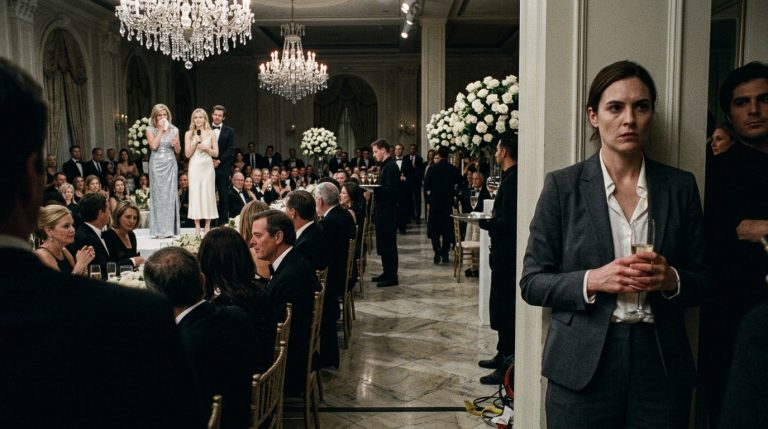
Maria Elena Vasquez moved with the precision of a woman who had learned that silence was a survival strategy. Every movement in the Callaway estate was a calculation. At 31, her joints often ached with the fatigue of a forty-five-year-old, but she kept her spine straight, her eyes on the marble, and her heart tucked away in a place where it could not be bruised by the opulence around her.
In the corner of the supply closet, tucked behind a stack of industrial-sized detergent, Sophia slept. She was curled on a folded towel, her thumb near her mouth, her small hand clutching the single-eyed rabbit she called Bun Bun. The rabbit was a patchwork of history, its fur matted and its seams held together by mismatched thread—a testament to Maria’s nightly efforts to mend what time had frayed.
Maria backed out of the closet, pulling the door to a whisper-quiet latch. She had the morning tasks carved into her mind: East bathroom, library windows, the expansive, hollow kitchen.
She turned the corner of the hallway, her mop clacking rhythmically against the stone. She was muttering the list to herself, a quiet litany against the vast, empty air of the mansion, when her cart’s front wheel struck something. It wasn’t the soft resistance of a stray thread or the scuff of a sneaker. It was a heavy, dull sound—the sound of something substantial hitting marble.
She halted. The cart gave a small, protesting groan and settled.
There it lay. A brown leather wallet, thick and overstuffed, lying flat in the center of the walkway as if it had been discarded by someone in a profound hurry.
Maria froze. She didn’t reach for it. She didn’t drop to her knees. She simply stood, a woman in a uniform she could never afford to own, looking down at an object that represented more money than she had earned in two years of scrubbing floors.
She felt the air in the hallway shift. It was a subtle pressure, the way the air changes before a storm. Her gaze lifted, not to the walls, but to the crown molding where the ceiling met the shadows. She couldn’t see the lens, but she knew the feeling of being observed—the itch on the back of her neck that occurred whenever she worked in the library or near the master suite.
She didn’t know the layout of his security, but she knew Richard Callaway’s house was a place where nothing was ever truly lost; it was only placed.
She bent down, her movements measured, and lifted the leather. It was warm—or perhaps that was just the sudden, frantic heat in her own hands. She placed it on the top of her cart, beside her cleaning spray and a stack of microfiber cloths. She did not open it. She did not hide it in the deep pocket of her apron. She placed it out in the open, a dark, brown fact sitting squarely on the stage of the hall.
She resumed her work. She cleaned the East bathroom, scrubbing the porcelain until it shone like a mirror, all while the wallet watched her from the cart. It was a silent witness, a piece of someone else’s life left behind like a test question. She finished the bedroom, wiped the baseboards, and walked toward the kitchen.
But as she neared the doorway, she stopped. A realization began to bloom in her chest, sharp and cold as a winter morning. She looked at the wallet again. She had lived long enough to know when a mistake was not an accident. And she had lived long enough to know exactly what happened when you ignored a question that was meant to be answered.
She set the cart in the center of the hall, pulled the wallet from the top, and finally, deliberately, she opened it.
The cash was neat, precise—an absurd amount of paper for one man to carry. She saw the black cards and the folded slip of paper. Her heart hammered against her ribs, but her fingers, stained with the gray residue of the day’s labor, remained steady as she pulled the note free.
Keep it. No one is watching.
Maria read the words, and the cold feeling in her chest didn’t dissipate; it sharpened. She looked up at the ceiling again, her lips thinning into a line of quiet, weary defiance.
“Someone is always watching,” she whispered to the empty, echoing air.
She realized then that this was not a gift, and it certainly wasn’t a mistake. It was a mirror. And she had no intention of letting it reflect the person he clearly thought she was.
CHAPTER 2: The Geometry of a Trap
The hallway seemed to stretch, the polished marble floor extending like an infinite sheet of ice. Maria stood in the center of it, the leather wallet now a heavy, singular point of gravity in her palm. The silence of the mansion was different now. It wasn’t just empty space; it felt occupied, watchful. The air hummed with the faint, rhythmic ticking of a clock she couldn’t see, a sound that amplified the racing of her own pulse.
She didn’t move toward the kitchen immediately. She needed a moment to reset the rhythm of her own breathing. An intrusive memory flickered at the edge of her mind—a morning eight years ago, sitting in a church shelter, clutching a plastic bag that held everything she owned in the world, trying to hide the tremble in her fingers so the woman in the next cot wouldn’t see she was afraid. She had been tested then, too, by the cold, by the hunger, by the sharp, judging eyes of a world that didn’t know her name. She had survived by making herself small, by keeping her eyes down and her hands busy.
But this was different. This was a deliberate construction. A trap built of silk and fine leather.
She looked at the wallet again. It was a brown, folded secret. The note inside—Keep it. No one is watching.—was not an invitation; it was a gauntlet.
She began to walk. The sound of her rubber-soled shoes on the marble was soft, almost apologetic. She didn’t want to alert whoever was on the other side of that camera that she was anything other than a cleaning woman performing her duties. She passed the library, the rolling ladders silhouetted against the morning light like skeletons, and kept her eyes locked on the floor.
She had to find him.
She checked the dining room first. It was cavernous, the mahogany table polished to such a high sheen that it reflected the crystal chandelier above like a dark, inverted sky. Empty.
The sitting room was next, all velvet and hushed colors. Empty.
Her heart began to climb into her throat. She had been in this house for three months, and she had never actually seen Richard Callaway outside of the fleeting, ghost-like glimpses he afforded his staff. He was a man who moved through his own home as if he were avoiding his own reflection.
She took a sharp breath, her fingers tightening around the wallet. She felt the edges of the credit cards through the leather. They were smooth, cold, and utterly detached from the reality of her life, where every cent was accounted for in the tight, aching ledger of her mind.
Therefore, she thought, if he is not in the rooms, he is in the center.
She turned toward the back of the house, toward the study—the room she had been told, on her first day, was strictly off-limits. She had never breached that boundary. But today, the rules felt shifted. The wallet in her hand wasn’t just property; it was a piece of his intent.
She moved with a deliberate slowness, forcing herself to maintain the steady, rhythmic pace of her work. If there were cameras, they needed to see a woman doing her job, not a woman hunting. She stopped near the supply closet for a second. She reached out, her hand hovering just inches from the door.
Sophia, she thought. You watch me. You see how I handle the shadows.
She didn’t knock. She didn’t open the door. She just stood there, drawing strength from the proximity of the little girl, the one person in this world who relied on her to be the bridge between survival and life. She took the final step toward the study door.
It wasn’t locked.
The heavy wood swung inward with a faint, smooth sigh of hinges. The room was bathed in the cool, blue-gray light of early morning. Monitors lined one wall, a glowing, grid-like tapestry of the house’s interior.
And there he was.
Richard Callaway sat at a desk in the center of the room, his back to the door, hunched over a steaming cup of coffee. He was watching a feed—a feed of the hallway she had just walked through. He was watching the empty space where she had been only moments before.
He hadn’t heard her enter, but the movement of the air or the sudden change in the room’s quality caused him to freeze. His shoulders went rigid, the posture of a man who suddenly realized the game had changed.
He didn’t turn around yet. He simply sat there, staring at the screen.
“I found this,” Maria said. Her voice was steady, clearer than she had ever allowed it to be in his presence. She didn’t wait for an invitation. She walked forward until she stood just behind his chair, and she placed the heavy, brown wallet down on the desk beside his coffee.
The silence that followed was dense, almost physical. It was the silence of two people standing on the edge of a precipice, realizing that the ground underneath them had finally, irrevocably, given way.
CHAPTER 3: The Intersection of Gazes
Richard Callaway did not move for several seconds. The mouse sat beneath his palm, the cursor on the primary monitor blinking rhythmically against a live feed of the hallway—the same hallway Maria had just traversed. He looked at the wallet, then at his own reflection in the darkened corner of the glass screen, and finally, he rotated his chair.
He was not the monster she had expected. He looked tired. It was a deep, bone-weary fatigue that pulled at the corners of his eyes, an exhaustion that had nothing to do with sleep and everything to do with the relentless, looping nature of his own suspicions.
“You read the note,” he said. His voice was lower than she anticipated, lacking the sharp authority she had braced herself to encounter. It was merely a question.
Maria kept her hands clasped tightly in front of her apron. She didn’t look at the screens. She didn’t look at the expensive, imported leather of his chair. She looked at a point just past his left shoulder, maintaining the necessary distance that kept her own dignity intact.
“I read it,” she replied.
“And?”
“And it was not mine to keep.”
He let out a short, hollow sound that might have been a laugh if there was any mirth behind it. He turned back to the monitors, his fingers ghosting over the keyboard. With a few deft taps, the screen showing the hallway flickered and died. The room seemed to grow darker, the only illumination coming from the soft, blue glow of the remaining active feeds.
“Most people would have found a way to justify taking it,” he murmured, more to himself than to her. “They would have told themselves it was a windfall. A correction of fortune. They would have rationalized it until it felt like an act of justice.”
“Perhaps,” Maria said. She felt the heavy, stifling weight of the room pressing in on her. Everything here was designed to be observed, analyzed, and categorized. It was a space built for data, not for people. “But I have a daughter who watches what I do. I do not have the luxury of rationalizing my actions.”
Richard went still. He shifted his gaze toward her, really looking at her for the first time. It wasn’t the analytical, clinical appraisal of a man checking a feed. It was the look of someone trying to reconcile two disparate realities.
“Your daughter,” he repeated.
“She is in the supply closet,” Maria said, her tone flat and uncompromising. She didn’t wait for him to ask. She needed to anchor this conversation in the only truth that mattered to her. “She is three years old. She sits on a folded towel because I have nowhere else for her to be. She is my daughter, and she is the only person whose opinion of me carries any weight in this house.”
The confession hung in the air, unvarnished and raw. She saw the flickers of movement in his face—the tightening of his jaw, the subtle narrowing of his eyes. He wasn’t evaluating her honesty; he was processing the sheer, brutal weight of her situation.
“I didn’t know,” he said quietly.
“You know now,” she replied.
He looked back at the desk. The wallet sat there like a foreign object, a relic of a game that suddenly felt small and profoundly misguided. He reached out and pushed it aside, clearing the space as if the mere presence of the money had become an embarrassment.
“I have been here for three months,” Maria continued, the words coming not from anger, but from a sudden, desperate need to be known, to step out of the category of ’employee’ and into the reality of a human being. “I have scrubbed these floors. I have polished these mirrors. I have done my work because I am a woman who keeps her promises. But I have always felt like I was working for a ghost. A man who watches, but never sees.”
The silence returned, but it was different now. It was no longer pressurized; it was heavy with the possibility of collapse.
Richard stood up. He was taller than she imagined, and there was a slight stoop to his shoulders, as if he had been carrying the weight of his own security systems for far too long. He walked to the window, staring out at the expansive, manicured gardens that stretched toward the edge of the estate.
“I stopped believing that there was anything worth seeing,” he said softly, his back to her. “I have built a life of walls, Maria. I have spent years perfecting the art of keeping people at a distance, precisely because I didn’t want to see what they were capable of when they thought I wasn’t looking.”
“And did you find what you were looking for?” she asked.
He turned, and for a fleeting, terrifying moment, his mask slipped completely. The calculation, the detachment, the sharp edges of his corporate persona—it all dissolved, revealing a man who was deeply, achingly lonely.
“I found exactly what I expected to find,” he admitted, his voice barely a whisper. “And it has left me with nothing.”
He looked at her then, not as an observer, but as a person. The air in the room seemed to lose its static, replaced by a quiet, unfolding realization. Maria felt the tension in her own chest loosen, just a fraction. She didn’t trust him—that would take time, and she was a woman who guarded her trust like a rare, finite resource—but she saw the fraying threads of his composure, and for the first time, she saw a point of connection.
“I have to go back to the supply closet,” she said, her tone softening, though not by much. “My daughter will be waking up soon. She needs her mother, not a lecture on integrity.”
Richard nodded, a slow, solemn movement. “Of course. Go.”
He didn’t move as she turned to leave. He stood by the window, the blue light of the monitors casting long, distorted shadows across the floor. As she reached the door, she paused, her hand on the frame. She looked back at the wallet on the desk—that brown, heavy fact of their shared misunderstanding.
“Sundays,” she said, remembering the promise she had made to Sophia about the rabbit. “Sundays are for fixing things, Mr. Callaway. Even if you have to do it more than once.”
She closed the door behind her, leaving him in the silence of his own making, the echoes of her voice lingering in the cool, clinical air of the study. She walked down the hallway, the marble once again feeling cold beneath her feet, but her pulse was steady. She had stepped across a line today, and for the first time in three months, she didn’t feel like a ghost—she felt like the only real person in the house.
CHAPTER 4: The Unseen Breach
Maria did not look back. She navigated the corridor with a practiced, measured gait, though her heart felt as if it were beating in a space far larger than her own chest. The encounter with Richard Callaway had been a collision of two worlds that were never meant to touch: the world of the observer and the world of the observed.
She reached the supply closet and pulled the handle. The wood groaned—a small, abrasive protest that sounded like a gunshot in the near-silent mansion. Inside, the air was warmer, smelling faintly of lemon polish and the lingering scent of soap. Sophia was sitting on the towel, her back against the wall, Bun Bun resting on her lap. She looked up, her eyes wide and dark, unburdened by the weight of the conversation Maria had just finished.
“Mama?”
“I’m here, baby,” Maria whispered, stepping inside and pulling the door until it was nearly closed, leaving only a sliver of the world outside visible. She sat down on the floor, the cramped space feeling suddenly like a sanctuary. She took the rabbit from Sophia, her fingers tracing the gold-threaded seam she had meticulously sewn on Sunday.
It wasn’t just a repair; it was an act of defiance against the fragility of their circumstances.
As she worked the fabric, her thoughts drifted back to the study. Something was missing. She had felt it the moment she stepped inside, a subtle dissonance in the room’s rhythm. She remembered the monitors, the way they had glowed like a digital nervous system. One of them—the one furthest to the right—had been flickering with a distorted, gray static. It hadn’t looked like a malfunction; it had looked like an interruption.
Why would the owner of a surveillance-heavy empire have a camera feed that was breaking down?
She pushed the thought away, but it lingered, a sharp splinter in her consciousness. She was a woman who noticed things because her life depended on it—the slight tremor in a client’s hand, the way a door didn’t quite latch, the specific tone of voice that meant ‘get out’. The monitor in the study was a detail that didn’t fit the narrative of a man who controlled everything.
She glanced at her watch. It was nearing time for the lunch cycle. She stood, her knees popping in the quiet closet. She kissed Sophia’s forehead and pressed a piece of dry cracker into her hand. “Stay here, Bun Bun needs you to be brave.”
Sophia nodded, her tiny hand gripping the rabbit tight. “I’m always brave, Mama.”
Maria exited the closet, intending to return to the kitchen to finish the routine cleaning she had abandoned earlier. She wanted to reclaim the rhythm, to bury the conversation with Callaway under the familiar, grounding motions of her work. But as she walked past the study door, she paused. It was slightly ajar.
She shouldn’t have stopped. Every instinct she possessed screamed for her to keep moving, to keep her head down and her life invisible. But the curiosity—that dangerous, blossoming feeling she had tried to prune back for years—won out. She didn’t enter the room. She just stood by the threshold, listening.
Inside, there was a sharp, metallic sound, followed by the low, strained exhale of a man struggling with something heavy. There were no voices, only the sound of movement.
Maria shifted, and her heel caught the edge of a floorboard, making it creak. The movement inside the room stopped instantly.
“Maria?” Callaway’s voice came from inside, thin and guarded. “Is that you?”
She stepped into the doorway, her posture rigid. Richard was standing by the desk, but he was no longer sitting. He was bent over, reaching into the knee-hole of the desk, his hands obscured by the shadows. He looked up, his expression guarded, a flash of something unreadable crossing his eyes.
“I… I forgot my supplies,” she lied, the words feeling heavy on her tongue. She pointed toward the corner of the room where she had left her caddy earlier.
He didn’t move from the desk. “I thought you were going back to the closet.”
“I was,” she said, her voice cool. “But I realized I left the cleaning solution near the desk when I came in to… to give back the wallet.”
He stood up slowly. His hands were empty, but there was a smudge of dark dust on his knuckles. He looked at the floor, then back at her. The atmosphere in the room had shifted again; it was no longer heavy with intimacy, but sharp with the scent of secrecy.
“It’s over there,” he said, gesturing vaguely.
She walked past him, keeping her distance, and retrieved the spray bottle. She didn’t look at the desk. She didn’t look at the monitors. She kept her gaze fixed on the plastic handle of the caddy. But as she turned to leave, she caught a glimpse of the far wall. The screen she had noticed before—the one with the static—was now black. Completely off.
He hadn’t fixed it. He had disconnected it.
“Mr. Callaway?”
He was watching her, his eyes unblinking, like a bird of prey perched in the center of his own silence. “Yes?”
“You said you wanted the truth,” she said, her voice a low, steady thread in the room. “But it seems you are still hiding parts of your own house.”
He didn’t get angry. He didn’t defend himself. He just watched her, his expression revealing nothing, until he finally spoke. “Some truths aren’t meant to be seen by everyone, Maria. Even those who earn their place.”
She left the study, the weight of his words following her down the hall like a cold shadow. She had come here to fix a moment, but she realized, as she walked toward the kitchen, that she had stumbled into the foundation of his architecture, and it was far more broken than she had ever imagined.
CHAPTER 5: The Fragile Equilibrium
The walk back to the kitchen felt like traversing a minefield. Maria moved with her head down, her hands tight around the plastic caddy, but her mind was elsewhere. She was replaying the flicker of the monitors, the way Richard’s hands had looked covered in that fine, dark dust, and the unsettling finality in his voice. “Some truths aren’t meant to be seen by everyone.”
It was a dismissal, but beneath it, she felt a jagged edge of desperation.
She reached the kitchen and began her work, the familiar tasks—wiping the counters, polishing the sink, organizing the pantry—acting as a necessary ballast against the rising tide of her own suspicion. But the rhythm was broken. Every time a floorboard creaked in the hallway or the HVAC system kicked on with a heavy, mechanical shudder, she flinched. She wasn’t just working anymore; she was listening.
She reached for the pantry door, but a heavy shadow fell across the threshold before she could grasp the handle. She stopped, her breath catching. Standing there was Elias, the estate’s groundskeeper. He was a man of few words, usually seen through the windows, a silent figure tending to the hedges and the roses. He looked out of place in the sterile, high-end kitchen, his heavy boots caked in fresh mud, his face hidden beneath the brim of a worn cap.
“Mr. Callaway isn’t accepting visitors today,” Elias said, his voice like gravel grinding together. He didn’t look at her; he was staring at the doorway leading to the study.
Maria’s hand tightened on the caddy. “I work here, Elias. I don’t need an appointment to clean the house.”
“There’s cleaning,” he said, finally lifting his gaze to meet hers. His eyes were pale, watery, and disconcertingly sharp. “And then there’s poking around where the light doesn’t reach. Mr. Callaway is a generous man to those who respect the boundaries of his shadows. He isn’t so kind to those who try to illuminate them.”
“I’m just doing my job,” Maria said, her tone steady despite the sudden spike of adrenaline in her chest.
“Are you?” Elias took a slow step forward, the smell of damp earth and rot clinging to his coat. “Because word around the estate is that you’ve moved past the floors. Word is you’ve been seen near the study. Twice.”
The threat was implicit, a cold, hard fact dropped into the conversation. Maria didn’t back down. She stood her ground, her chin level, her expression a mask of professional neutrality. She had spent a lifetime navigating the dangers of men who thought they owned the spaces she walked in; she knew how to weather a storm without letting it break her.
“If you have something to say to me, Elias, say it,” she said, her voice dropping into the same quiet, firm cadence she had used with Richard. “Otherwise, I have floors to finish.”
Elias stared at her for a long, uncomfortable moment, the silence between them filled only by the distant, muffled rumble of thunder. The weather outside was shifting, the sky darkening to the color of a bruised plum. Finally, he gave a short, curt nod.
“Keep your eyes on your work, Maria,” he warned. “Some secrets in this house have teeth.”
He turned and lumbered out of the kitchen, his heavy footsteps retreating down the hallway toward the mudroom. Maria let out a breath she didn’t realize she had been holding. Her hands were shaking. She set the caddy down on the counter with a clatter, the sound sharp and jarring.
She needed to talk to Richard. Not because she trusted him, but because the danger had expanded beyond the study. If Elias was watching her, if the staff was whispering, then the “truth” Richard was protecting wasn’t just a private matter—it was a contagion.
She abandoned the kitchen. She bypassed the supply closet, trusting that Sophia was still occupied with Bun Bun, and walked straight back to the study door. She didn’t hesitate this time. She knocked once, sharp and loud.
There was no answer.
She knocked again, more forcefully. “Mr. Callaway?”
Still nothing. She reached out and pushed the door open. The room was empty. The lights were off, the monitors were dark, and the desk was clear. But as she stepped inside, she noticed something that made her blood run cold.
The rug near the desk had been kicked aside, revealing a small, brass-edged hatch embedded in the hardwood floor—a seam in the architecture she had never noticed in three months of cleaning. It was slightly ajar.
She walked toward it, her movements slow, cautious, as if the floor itself might give way. She knelt, the wood pressing into her knees, and gripped the handle. She didn’t have to pull hard. It slid open with the ease of a mechanism that had been used recently. Beneath it wasn’t a crawlspace or a storage bin.
It was a staircase, descending into a cool, damp darkness that smelled of dust, old paper, and something metallic—like the taste of iron on the tongue.
She peered down, her breath hitching. At the bottom of the stairs, a single, flickering light illuminated a workbench covered in documents—not foundation files, but photographs, blueprints, and records that didn’t belong in a philanthropist’s study. They were records of names, dates, and locations that she recognized from the very foundation programs she was supposedly hired to help.
The decoy secret—the foundation itself—was starting to look like a cover for something much, much darker. And as the distant thunder rolled again, shaking the floorboards beneath her, Maria realized she hadn’t just stumbled into a secret; she had fallen into a labyrinth.
CHAPTER 6: The Architects Shadow
Maria didn’t move. She couldn’t. The air rising from the depths was heavy with the scent of ozone and drying ink—a smell that had no business being in a private residence. Her hand, white-knuckled, gripped the edge of the floorboards. Below, the flickering light revealed rows of metal cabinets that looked less like a private library and more like the central nervous system of a machine designed to track, categorize, and control.
She took the first step down. The wooden tread groaned, a sharp, piercing sound that made her heart stutter. She waited for a reaction from above, for Elias or Richard to burst through the door, but the house remained eerily silent, save for the rhythmic, muffled thrum of the storm gathering strength outside.
She descended carefully, her eyes fixed on the workbench. The documents weren’t neatly filed; they were spread out in a chaotic, desperate sprawl. She reached the bottom step and felt the grit of concrete beneath her feet. The space was tight, cramped by the sheer volume of paper that covered every horizontal surface.
She focused on a stack of files directly under the light. They were intake records from the foundation. Maria recognized the forms—she had handled hundreds of them over the past year. But these weren’t the clean, digitized copies she worked with in the office. These were annotated with handwritten notes in the margins: Asset potential. High risk. Dependent. Controlled.
Controlled. The word seemed to pulse in the low light.
She moved to the next pile. It was a ledger. She opened it, the pages brittle, and saw her own name.
The entry was dated six months before she had ever stepped foot in the Callaway estate. There were notations about her arrival in the country, her time at the church shelter, the specific diner where she had first worked for cash. It wasn’t a background check. It was a blueprint.
She turned the page, her breath catching. There were photos. Not just of her, but of Sophia. Sophia at the park. Sophia walking to school. Sophia playing with the one-eyed rabbit in the sunlight. The images were dated and stamped with the same cold, analytical precision she had seen in the study’s monitor feeds.
Richard hadn’t “discovered” her. He hadn’t tested her because of some vague, altruistic hunch. He had groomed her. He had selected her, watched her, and orchestrated the conditions of her life to ensure she would fit the specific mold of the “perfect recipient.”
The realization hit her with the force of a physical blow. The foundation, the job, the childcare—it wasn’t a hand extended in grace. It was a cage. A gilded, comfortable cage designed to keep her within reach, within his sight, within his control.
A floorboard creaked above.
Maria didn’t think; she acted. She swept the ledger under her arm and grabbed the file with her name on it. She lunged for the staircase just as the overhead light to the study was cut. Darkness swallowed the room, absolute and suffocating.
She scrambled up the stairs, her feet finding the familiar wood with desperate, frantic urgency. She hit the edge of the hatch and shoved it upward, the brass edge scraping loudly against the floor. She rolled out into the study, the moonlight from the window casting long, jagged shadows across the room.
She didn’t stop. She didn’t look back to see if he was there. She tore through the study door, her heart hammering against her ribs like a trapped bird. She needed to reach the closet. She needed Sophia.
She sprinted down the hallway, the polished marble feeling slippery, treacherous. Every shadow looked like a figure, every gust of wind against the house sounding like a shout. She reached the supply closet and threw the door open, not caring about the noise.
“Sophia!”
The girl was curled on the towel, Bun Bun tucked under her chin, eyes wide and alert. She didn’t cry. She stood up immediately, her trust in Maria absolute, and reached out her hand.
Maria grabbed her, the weight of her daughter a desperate anchor in the storm. She didn’t wait for her gear. She didn’t grab the caddy. She turned toward the servant’s exit at the end of the hall—a path she had only ever used for trash.
“Mama, where are we going?” Sophia whispered, her voice tiny in the vast, hollow mansion.
“We’re going home, baby,” Maria said, her voice shaking but her resolve as hard as flint. “We’re going somewhere where we are the ones who decide what happens next.”
She burst through the servant’s exit into the freezing, rain-lashed night. The storm was in full fury, the wind whipping her hair across her face, stinging her skin. She didn’t care. She didn’t look back at the looming, silent monolith of the Callaway estate.
But as she reached the gate, a pair of headlights flickered to life in the driveway, casting two long, blinding beams that pinned her to the spot. The engine hummed—a low, predatory growl. The car didn’t speed up; it rolled forward with a slow, agonizing deliberation.
Richard Callaway was sitting behind the wheel. The passenger door clicked open, the sound mechanical and cold.
“Get in, Maria,” his voice drifted through the rain, calm, controlled, and utterly devoid of surprise. “You have no idea what you’ve just taken, and if you leave with it, you will lose far more than just a job.”
CHAPTER 7: The Weight of the Mirror
The rain hammered against the roof of the sedan, a frenetic, irregular rhythm that mirrored the frantic drumming of Maria’s heart. She stood on the edge of the driveway, the file tucked so tightly under her arm that the corner dug into her ribs, a physical reminder of the evidence she held. Sophia was shivering against her leg, a small, damp weight that pulled at Maria’s resolve.
“Get in, Maria,” Richard repeated. His voice was not an order; it was a flat, inevitable fact. He didn’t look at her. He kept his eyes fixed on the dark stretch of the estate gate, his hands gripping the steering wheel with a tension that turned his knuckles white.
Maria didn’t move. She looked at the interior of the car—the clean, brushed aluminum, the dark leather, the scent of expensive cologne that felt alien, almost sickening, in the wet night air. For a second, the image of the church shelter surfaced: the smell of damp coats, the shivering of women who had lost everything to the same kind of cold, calculated indifference he had just revealed.
“You didn’t help me because you wanted to,” Maria said, her voice rising above the wind, ragged but firm. “You helped me because you needed an experiment that worked.”
Richard finally turned. His face was a mask of exhausted clarity. In the harsh glare of the dashboard lights, he looked older, the lines around his mouth carved by a lifetime of defensive maneuvering. “Does the motive matter if the result is a life better than the one you had?”
“It matters to the person being experimented on,” she spat back, the fury finally breaking through her fear. She felt the heavy file beneath her arm. “I saw the ledger, Richard. I saw what you’ve been doing. You didn’t give me a job. You gave me a script.”
“I gave you a reality that worked,” he countered, his voice surging with a sudden, sharp intensity. “Do you think the world is built on kindness, Maria? Do you think the programs you run, the families you help—do you think they survive because someone felt sorry for them? They survive because I engineered the variables to ensure they did.”
“By controlling them?”
“By protecting them from a system that would have discarded them the moment they became a liability,” he said. He leaned toward the open door. “Get in. If you walk out that gate with those files, you won’t just destroy the foundation. You’ll dismantle the entire safety net that thousands of people, including your daughter, rely on to eat, to sleep, to exist. Is that the ‘truth’ you want to deliver to them?”
The question was a blade, and he knew exactly where to twist it. He was offering her a choice: her own moral autonomy, or the fragile, synthetic security of the life she had built for Sophia. It was the same choice she had faced every day of her life, stripped of its nuance and laid bare in the rain.
Maria looked down at Sophia. The child’s eyes were wide, filled with a trust that was both her greatest strength and her most dangerous vulnerability. Maria felt the crushing weight of the file. She had spent years working to be the kind of mother who lived by her own light, not by the shadows cast by a billionaire’s ledger.
“I didn’t take these to destroy them,” Maria said, her voice dropping to a whisper that seemed to carry the weight of everything she had endured. “I took them to prove to myself that I wasn’t just a part of your design.”
She didn’t get into the car. Instead, she took a step back, pulling Sophia closer. “You think you’ve succeeded, Richard. You think you’ve made me. But you made a mistake. You forgot that people like me aren’t just variables. We’re people who know how to survive in the cold.”
Richard’s face tightened. He looked as if he might get out of the car, as if the carefully constructed equilibrium of his world was about to shatter, but he stopped. He stayed behind the glass, behind the leather, behind the safety of his own creation.
“If you walk away,” he said, his voice barely audible over the roar of the rain, “there is no going back. The resources, the child care, the safety… it all goes with the script.”
Maria stood in the rain, the water soaking through her cheap blazer, the cold seeping into her bones. She looked at the car one last time—the tomb of his intentions—and then she turned toward the gate.
“I would rather starve in the truth,” she said, her voice hardening, “than live in a lie you built for me.”
She began to walk. The gate stood ahead, a silhouette against the storm. She didn’t look back to see if he followed. She just kept walking, her grip on Sophia’s hand iron-clad, her stride deliberate. She was leaving the estate, but she was carrying the rot with her, and for the first time, she felt the exhilarating, terrifying lightness of a woman who had finally stopped playing the game and started setting the rules.
CHAPTER 8: The Architecture of Grace
The engine ticked, cooling down, the only sound in the sudden, expansive silence. Richard didn’t move. He kept his hands on the wheel, his silhouette framed by the dim interior light. Maria, standing in the deluge, felt the chill reaching her skin, but for the first time in years, it was a cold she owned. It wasn’t the manufactured chill of an estate designed to keep people out; it was the honest, biting cold of the world she had chosen.
“You’re not going to stop me,” she said, her voice steady against the wind.
Richard sighed—a long, ragged sound. He opened the driver’s side door and stepped out, not with the predatory grace of a master, but with the weary hesitation of a man who had finally realized he was lost. He didn’t carry an umbrella. He stood in the rain, the water matting his hair, his expensive suit darkening into a shapeless heavy mass.
“I didn’t come to stop you,” he admitted. He looked at the gate, then back at Maria, his eyes unclouded for the first time. “I came because I couldn’t bear to let you go thinking that the only thing you were to me was a variable. You were right about the ledger, Maria. It was a prison. But I built it because I couldn’t figure out how to live in a world where I didn’t hold the keys.”
He reached into his pocket. Maria tensed, her hand shielding Sophia, but he pulled out nothing but a small, worn piece of paper. He didn’t approach her. He left it on the hood of the car. “That’s the legal dissolution of the foundation’s surveillance protocols. I signed it ten minutes ago. I’m shutting it down. All of it.”
Maria stared at him, her heart thumping against her ribs. “Why?”
“Because,” he said, and his voice cracked, “watching you… watching you with her… I realized I wasn’t studying a subject. I was watching someone live the life I threw away. You proved my test wrong, Maria. You didn’t just pass; you transcended it. You made the ‘no one is watching’ clause irrelevant because you carried your own light.”
He turned away, looking toward the sprawling, silent mansion behind them. “The money is real. The programs are real. They will continue, but without the strings. I’m leaving the board. I’m letting the world be messy again.”
He walked toward his car, then paused. “The file you have—keep it. Use it if I ever change my mind. Use it to hold me accountable. That’s what a friend would do, isn’t it?”
He drove away, the taillights bleeding into the darkness like distant, fading embers. Maria stood in the silence, the rain finally slackening to a gentle drizzle. She looked at Sophia, who was watching her with calm, steady eyes. She knelt, the mud soaking through her trousers, and pulled her daughter close.
One year later.
The morning sun spilled across the wooden floor of their new, smaller home—a space that was never quiet, but was always, fundamentally, theirs. Maria sat at the kitchen table, the air filled with the scent of coffee and the sounds of Sophia in the garden outside.
On her desk sat a framed photograph: Sophia at the gate of her preschool, grinning, Bun Bun held high. Beside it lay a small, gold thread—the leftover piece from the last time she had mended the rabbit’s ear.
She picked up the thread and tied it around her wrist, a thin, shimmering bracelet that served as a reminder. She had learned that people were indeed disappointing, but she had also learned that the only way to heal the world was to mend the pieces one at a time, with patience and honest hands.
The door opened. Sophia ran in, breathless, holding a handful of wildflowers. She climbed into Maria’s lap, her face bright with the simple, unvarnished joy of a child who knew she was loved.
“Look, Mama,” she said, handing over the flowers.
Maria took them, the stems cool and earthy against her palm. She looked out the window at the garden, at the way the light played off the leaves, and felt the deep, resonant peace of a life lived without walls. She had survived the test, not by force, but by refusing to let her own spirit become rusted by the bitterness of the world. She reached out, brushed a stray lock of hair from Sophia’s forehead, and smiled.
The weight was gone. The architecture of her life was finally, perfectly, her own.