Cold Water and Iron Will: How an Ex-Soldier Dismantled a Tyrannical HOA and Won Back His Land
CHAPTER 1: THE BLEACH LINE
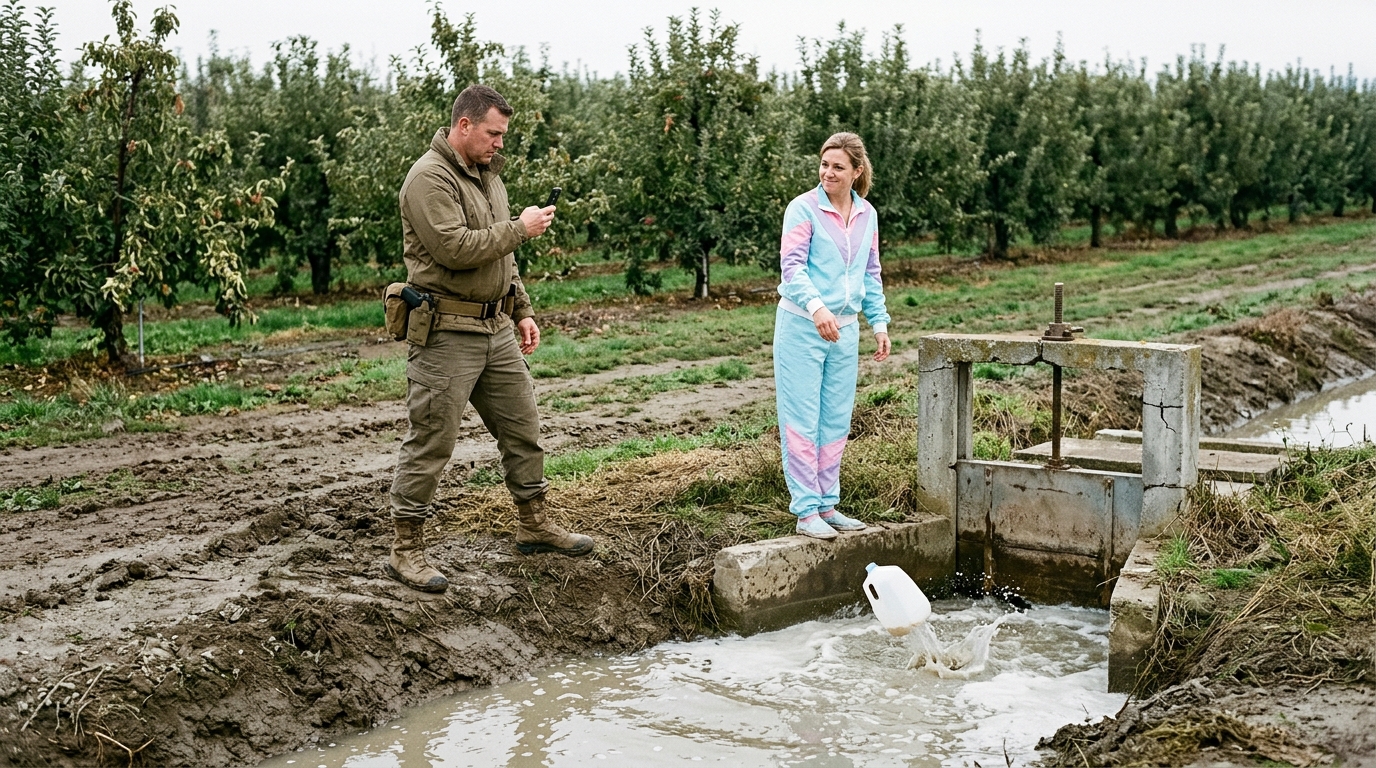
My thumb rested hard against the smooth metal casing of the irrigation headgate.
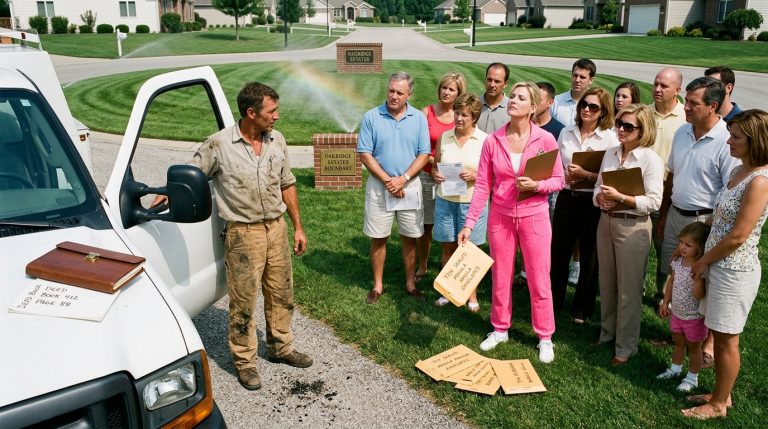
Across the property line, outside any legitimate jurisdiction she had ever possessed, Karen stood in her pastel tracksuit.
She lowered an empty gallon-sized laundry jug with a slow, deliberate drop.
The milky, chemical swirl in the century-old ditch began to churn toward my two hundred heirloom apple trees.
She flashed a triumphant, practiced smirk that suggested she had just won a ribbon at a county fair.
I didn’t yell.
Twelve years of combat engineering taught me that shouting at a minefield only wastes breath.
My pulse spiked, hot and sharp, but I forced my fingers to remain steady on my phone screen, recording every single frame of her movement.
“That’ll teach you to respect the covenants, conditions, and restrictions, Mr. Miller,” she called out, her voice dripping with the casual cruelty of someone accustomed to absolute compliance.
I lowered the phone without a word, my face locked into a blank, unreadable mask.
She blinked, her smug little grin faltering for a fraction of a second as she waited for the screaming match she had rehearsed.
I turned my back on her and walked toward the farmhouse, leaving her standing alone in the early morning silence.
CHAPTER 2: EVIDENCE IN THE COOLANT
Sarah stood by the back porch steps, her fingers twisted into the fabric of her apron.
The air near the orchard already carried a faint, unnatural bite that didn’t belong in an agricultural valley.
I popped the cooler latches open to verify the three glass seals before making the two-hour drive to the state-certified environmental testing lab.
“The leaves on the young Honeycrisp are already curling at the edges,” she said, her voice dropping into a flat, dangerous register.
“I know,” I replied, sliding the metal lid shut with a dull thud. “They won’t be the only things curling if this report comes back clean.”
The truck engine turned over on the first try, a heavy diesel hum that vibrated straight through the floorboards.
I didn’t look back at the HOA boundary fence as I turned down the gravel drive.
A two-hour transit through empty asphalt highways gave me plenty of time to calculate the exact weight of a federal violation.
The lab receptionist didn’t blink when I placed the insulated box on her laminate counter and pushed the chain-of-custody paperwork across.
“Expedited panel for sodium hypochlorite and volatile compounds,” she noted, tapping a pen against her clipboard.
“Forty-eight hours,” I said.
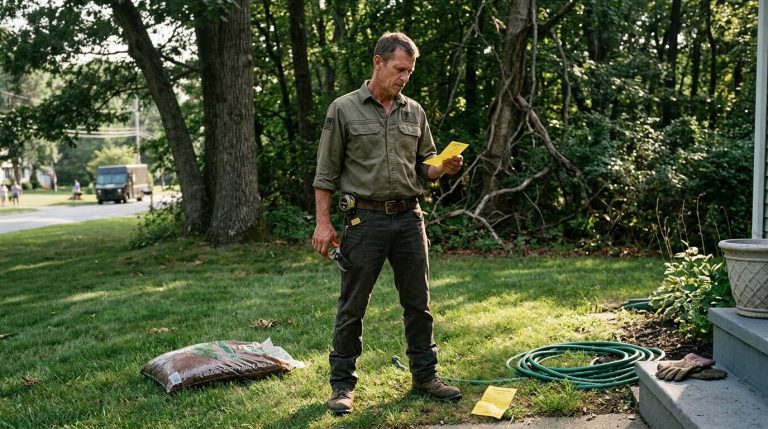
“Forty-eight hours,” she confirmed, handing me the yellow duplicate slip.
The drive back felt twice as long, every mile eating away at the quiet insulation of the cab.
When I pulled back up to the farmhouse, the sun was sitting low behind the barn, casting long, fractured shadows across the unpaved drive.
That was when I noticed the mud on the threshold.
A heavy, wet bootprint marked the bottom step of the back porch—a print belonging to a textured rubber sole that didn’t match anything in my boot rack.
CHAPTER 3: THE QUIET COALITION
I didn’t wipe the mud away.
It served as an immediate, physical reminder that the perimeter had been breached while my attention was two hours away on an asphalt highway.
Sarah met me at the kitchen table, her hands wrapped around a cold ceramic mug.
“Mrs. Gable called while you were on the road,” she said, her voice dropping into a flat, exhausted register. “Another fine notice. Fifty dollars for a bird feeder.”
“Pack the sourdough,” I replied, grabbing a clean loaf from the counter. “We’re walking down.”
The gravel road crunching beneath our boots was the only sound in the valley as we bypassed the paved cul-de-sacs of Oak Hollow Estates.
When we reached Mrs. Gable’s cottage, the frail widow opened the door before I could even lift my knuckles to the wood.
Her eyes were bloodshot, fixed on the stack of cream-colored envelopes clutched in her thin fingers.
“She threatened a lien this morning,” Mrs. Gable whispered, her voice trembling as she invited us past the threshold. “I live on a fixed income, Jack. I can’t fight a law firm.”
“You aren’t fighting them alone,” I said, setting the sourdough loaf down on her floral tablecloth.
She disappeared into the back hallway for a long, quiet minute before returning with a battered cardboard shoebox overflowing with canceled checks and pink violation slips.
I flipped through the pages, noting the repeating signature of the board president on every single demand.
“She’s been running an extortion racket disguised as landscaping rules,” I muttered, sliding the shoebox into my canvas field bag.
Mrs. Gable caught my wrist, her grip surprisingly firm for someone half my age.
“Make it stop, Jack,” she said, her gaze locking onto mine with absolute, desperate clarity.
CHAPTER 4: THE CERTIFIED POISON
I pulled the vehicle to a dead stop beside the barn before tapping the screen.
The PDF attachment opened with a heavy jolt of dense scientific data that didn’t leave room for doubt.
Sodium hypochlorite concentrations sat at toxic levels, but the footnote at the bottom of page four carried the real weight.
Traces of heavy metals—mercury and lead—were stamped across the analysis with the unmistakable signature of older industrial compounds.
Mrs. Gable’s shoebox of extortion slips on the passenger seat suddenly looked like baseline practice compared to an environmental felony.
The phone vibrated in my palm with an immediate reply from Marcus.
“We got her,” the text read in stark, capital letters. “Time to load the cannon.”
I didn’t smile.
I picked up the physical shoebox and the printed lab report, sliding both into a thick manila envelope before locking it inside the truck’s steel glove box.
The trap was fully baited, and the formal request for a meeting agenda had already been dispatched to the board’s PO box.
A sharp rap against the farmhouse door interrupted my calculation.
Sarah stood in the hallway, holding a fresh cup of black coffee while her eyes tracked the driveway toward the paved section of the cul-de-sac.
“She just drove past,” Sarah said, her voice entirely flat. “Slowed down right in front of the mailbox.”
CHAPTER 5: THE ANNUAL TRAP
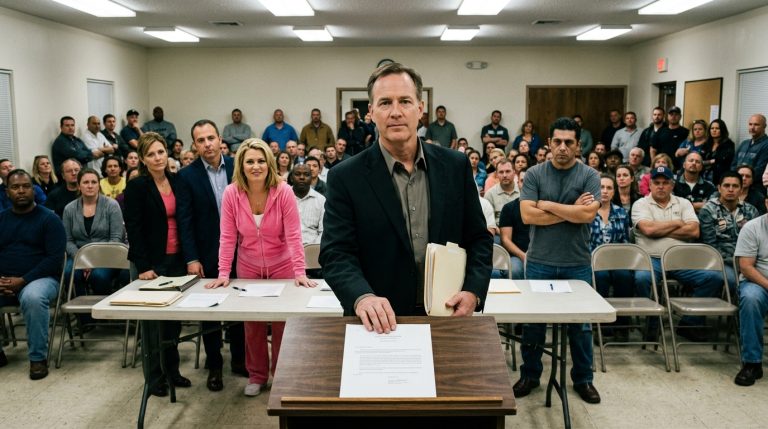
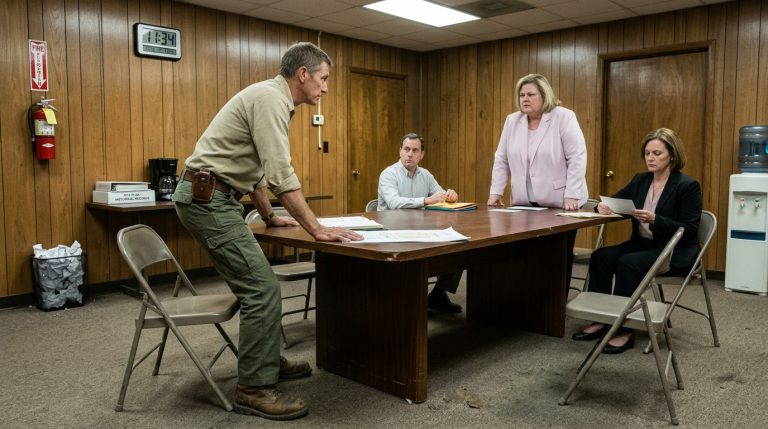
The community clubhouse was packed to the doors with fifty residents crammed beneath buzzing fluorescent lights.
Sarah’s hand gripped mine tightly in the second row as Karen banged her wooden gavel at the front table.
“The board proposes a special assessment of twenty thousand dollars against Mr. Miller’s property,” Karen announced, her voice dripping with triumphant condescension as she surveyed the quiet room.
I stood up before a single hand could be raised in agreement.
“Point of order, Madam President,” I said, my voice cutting cleanly through the stale air.
Karen’s face mottled into a dark, furious red as she slammed the gavel down again.
“You are out of order, Mr. Miller—sit down right now.”
“According to Article Three, Section Four,” I replied, pulling the projector cord from my black briefcase, “any member facing an assessment has five minutes to address the floor.”
I plugged the small unit into the wall outlet and aimed the lens at the collapsible white screen.
The digital video loop flickered to life instantly, projecting the crisp, high-definition footage of Karen’s pastel tracksuit and the white plastic jug dumping poison into the ditch.
A collective gasp sucked the air right out of the room.
“That was Tuesday morning,” I said, advancing the slide to display the certified lab summary with its highlighted heavy metal signatures. “Industrial-grade bleach, mercury, and lead poured directly into a federally protected watershed.”
Karen scrambled to her feet, her chair scraping harshly against the linoleum floor.
“This is a complete fabrication—it’s a malicious lie!” she shrieked, her voice cracking under the sudden weight of the unblinking projector light.
Arthur the dentist and Brenda the realtor stared straight down at their clipboards, refusing to meet her frantic gaze.
CHAPTER 6: FEDERAL COLLAPSE AND ROOTS
Two federal agents in dark jackets bearing bold yellow lettering stepped past the threshold.
Agent Sterling scanned the paralyzed rows before his gaze locked onto the pale figure trembling behind the front table.
“Karen Brewster?” his voice cut through the stillness with absolute, unyielding authority.
She offered a pathetic, jerky nod of her head as the steel cuffs clicked shut around her wrists with a sharp, metallic bite.
No one spoke.
No one moved to defend her.
As the agents led her past my row toward the exit, her eyes met mine for a fleeting second—empty and completely bewildered.
Arthur and Brenda slumped further into their chairs as Agent Sterling turned his attention directly toward them.
“You two aren’t leaving either,” he said, demanding immediate cooperation while the rest of the community exhaled a decade of accumulated fear.
Six months later, the legal settlement funds had cleared, the corrupt board had dissolved forever, and the new neighborhood committee was busy rebuilding from the ashes.
I stood in the center of the apple orchard on a crisp autumn evening, watching the clear water run fast through the repaired stone ditch.
Sarah stepped up beside me, resting her hand lightly against my arm as the golden sun dipped low behind the ridge.
The young saplings planted by our neighbors were firmly taking root in the rich soil, completely free of chemical blight.
Peace wasn’t an empty place devoid of friction or entitled adversaries.
It was the quiet, immovable strength of a hardworking man standing his ground alongside people who refused to break.