The Weight of a Survey Pin: How a Cold War Veteran’s Legacy Broke a Neighborhood’s Iron Tyranny
CHAPTER 1: THE VANGUARD AT THE WIRE
The sunlight hit the chrome of the white Lexus before it hit the gatepost.
Jake Thornton did not move from the second-story window of his grandfather’s office. His palm rested flat against the cold, condensation-streaked glass, feeling the vibration of the heavy idling engine fifty yards down the drive. Down below, Karen Westfield stepped out onto the caliche gravel with the calculated precision of someone accustomed to stage directions. Her tailored white trouser suit looked entirely out of place against the sun-baked timber and rusted barbed wire of the Thornton Ranch, a pristine antiseptic note in a landscape built on sweat and engine grease.
Behind her flanked the locksmith—a man with grease-stained knuckles and a hollow, transactional look in his eyes—carrying a red canvas tool bag that swung heavily against his thigh. Flanking them both were two members of the Ridgeline Estates board, men who wore their golf club memberships like invisible epaulets, keeping their chins tilted upward to avoid the dust kicking up from the tires.
They were moving with the deliberate, slow-march rhythm of an eviction crew.
Jake’s thumb traced the edge of the wooden window frame, worn smooth by seventy years of his grandfather’s calloused hands. Samuel Thornton had built this room out of reclaimed oak after coming home from Normandy with eighty dollars and a pair of boots that fell apart before he reached the county line. Samuel hadn’t built it to be looked at through the lens of a ring camera or weighed by the committee meetings of a subdivision that didn’t exist when the foundation was poured.
The locksmith dropped his bag. The sound was sharp, flat, final.
Down in the driveway, Karen tilted her chin, pulling a pair of oversized tortoiseshell sunglasses down her nose just enough to survey the perimeter with narrowed, analytical satisfaction. She reached into her leather portfolio, extracted a folded document with a bright blue legal backer, and tapped it against her thigh as if checking the tempo of an approaching execution.
She thought she was closing a loop. She thought the three hundred and forty acres stretching out toward the timberline were just an irregular shape on a developer’s zoning overlay, a loose thread waiting to be snipped by an administrative penalty.
She didn’t know about the survey pin buried six inches deep under the ironwood stump by the southern fence line. She didn’t know that the county recorder’s office in the state capital had sealed the original 1987 deed correction in a vault that didn’t clear through municipal zoning boards.
The locksmith raised the long, red-handled bolt cutters, positioning the hardened steel jaws against the antique brass padlock that Samuel had welded shut during the Carter administration.
Jake pulled his hand away from the glass. The air in the office was cool, smelling faintly of old paper, gun oil, and dried sage. He did not rush. In engineering and in civil litigation within contested zones, haste was the primary indicator of a tactical error. You let the adversary overextend their supply lines before you sever the bridge.
The steel jaws closed. The padlock gave way with a sharp, metallic ping that bounced off the corrugated tin roof of the machine shed.
Karen smiled—a thin, tight movement of the lips that didn’t reach her eyes—and stepped forward to push the iron gate wide open, welcoming her little army onto land that had never belonged to her.
As the gate swung inward, a single blue plastic grocery bag, caught in the late-summer updraft from the dry creek bed, lifted off a fence post and tumbled end-over-end across the hood of the Lexus, snagging momentarily on the windshield wiper before blowing away into the brush—a sudden, dissonant flicker of motion in an otherwise rigid tableau.
CHAPTER 2: THE DIGITAL SMEAR AND THE FIRST SIEVE
The dust settled slowly around the white Lexus tires, kicked up by the sudden turn of the locksmith’s red tool bag. Jake did not step back from the window, nor did he blink. In the military, you didn’t react to the first volley; you watched where the enemy dropped their primary markers to gauge their formation.
Karen did not look at the house. Her eyes swept past the porch, past the weathered cedar beams of the main lodge, tracking directly toward the historic tractor shed and the line of guest cabins undergoing renovation. Her shoulders were set with the confident rigidity of someone accustomed to moving pieces on a chessboard without the pieces talking back. Behind her, the two board members—men who looked like they spent more time negotiating golf handicaps than property lines—spread out, one pulling out a smartphone to snap photos of a pile of seasoned cedar lumber stacked neatly beside the barn.
“Keep rolling,” Jake murmured to the empty room.
He turned away from the glass, his boots hitting the wide plank flooring with a dull, deliberate thud. The office was quiet, save for the hum of the old refrigerator downstairs and the distant, rhythmic ticking of his grandfather’s Seth Thomas clock on the mantel. He walked down the narrow wooden stairs, each step carrying the physical weight of the silence that precedes an impact.
By the time he reached the ground floor and stepped out onto the wide, shaded front porch, the Lexus had already rolled fifty feet past the cattle guard, parking right in front of the main entrance like an uninvited guest taking the head of a banquet table.
Karen didn’t wait for an invitation. She stood by the driver’s side door, her sunglasses pushed back up onto the bridge of her nose, her expression hardening into that practiced, bureaucratic mask of aggrieved civic duty.
“Captain Thornton,” she called out, her voice carrying over the dry grass with a crisp, clipped cadence. “I trust you received our prior notifications regarding the structural non-compliance of this facility.”
Jake didn’t answer immediately. He stopped at the edge of the porch, resting his hand casually on the rough-hewn cedar railing. The wood was warm from the morning sun, rough against his palm. He let the silence stretch for three full heartbeats—just long enough to force the second board member to shift his weight uncomfortably from foot to foot.
“You’re trespassing, Mrs. Westfield,” Jake said, his voice flat, modulated, completely devoid of heat. “The county road ends at the cattle guard. Everything past this post is private agricultural land.”
Karen gave a short, dry laugh that sounded like dry leaves scraping across concrete. “Private agricultural land doesn’t exempt you from county health codes, Mr. Thornton, nor does it give you the right to maintain a commercial boarding house in the middle of a residential buffer zone. We’ve given you fair warning. If you won’t cooperate with the neighborhood association voluntarily, the county inspectors will be paying you a visit before noon.”
She turned sharply on her heel, signaling her little detail to re-enter the vehicle. They didn’t come to inspect today; they came to plant the flag. They came to establish a physical precedent, a recorded footprint on the property that their attorneys could later reference as an implied right of access.
As the Lexus reversed with a sharp beep and threw a spray of caliche gravel against the base of the porch steps, a sudden, intrusive memory cut through Jake’s focus—his grandfather, Samuel, standing right on this exact spot in the scorching summer of 1987, shotgun broken over his arm, telling a parish surveyor from the county seat that if he crossed the fence line again, he’d have to explain his map to the local sheriff. Samuel hadn’t raised his voice either. He just stood his ground until the surveyor packed his transit and left.
Jake watched the dust cloud drift toward the tree line and dissipate into the dry basin. He didn’t chase them. He didn’t shout.
Instead, he turned back inside, walked straight to his grandfather’s oak desk, and pulled the blank three-ring binder from the bottom drawer. He opened the heavy cardboard cover, clicked a fresh black ballpoint pen into place, and wrote the date and timestamp at the top of the first clean sheet: September 14, 09:14 AM. First physical breach. Trespass confirmed.
He knew what came next. In the playbook of institutional harassment, a physical scouting mission was invariably followed by an immediate digital escalation—a salvo designed to poison the well before the legal paperwork even cleared the printer.
Twenty-four hours later, the notification pinged.
It was a Tuesday morning, the air crisp with the smell of autumn frost burning off the pond. Jake was down in the north pasture helping Miguel secure a loose strand of barbed wire when his phone buzzed in his breast pocket—once, twice, then a continuous, vibrating stutter that didn’t stop.
He pulled the phone out. His screen was flooded with alerts. A local community app notification: New post in Ridgeline Estates Community Watch.
Jake swiped it open. The title stared back at him in bold, aggressive type: Concerned about unlicensed commercial operation near our community.
Below it were three photographs—taken from the public road, but angled deliberately to maximize distortion. One showed the old John Deere tractor with its rusted bucket parked near the equipment lean-to, making the working farm look like an abandoned auto salvage yard. Another captured a stack of weathered pallets and construction tarps over the guest cabin renovations, framing them as a dilapidated health hazard.
The text was a masterpiece of municipal gaslighting. Karen had written it with the clinical precision of a former attorney, avoiding direct names while dropping enough geographical markers that everyone within a five-mile radius knew exactly whose land she was pointing at. She spoke of “unvetted individuals coming and going at all hours”—a carefully coded smear directed straight at the veterans attending his quarterly healing retreats, framing men who had bled for the country as transient security risks.
The comment section was already a feeding frenzy. Within two hours, thirty-two replies had accumulated. Neighbors he had waved to at the hardware store were suddenly weighing in on agricultural zoning violations and property depreciation.
“I’ve driven past that place. It looks sketchy as hell.”
“Isn’t there a county ordinance against running boarding houses out there?”
“If it brings down property values, the board needs to file an emergency injunction.”
Jake locked his phone, the glass screen cold against his thumb. He didn’t type a word. He didn’t log into the app to defend himself, knowing that engaging with an online lynch mob was like wrestling a greased pig—you only end up covered in mud, and the pig enjoys the spectacle.
Instead, he walked back to the truck, tossed the phone onto the passenger seat, and drove straight to the feed store in town.
The shift in the air was palpable the moment he walked through the screened front door. The bell above the lintel chimed, a bright, cheerful sound that clashed violently with the heavy silence that instantly swallowed the room. Old man Henderson, who usually tossed a bag of salt blocks into the back of Jake’s truck with a friendly nod and a weather report, suddenly found an inventory sheet on the counter utterly fascinating. He kept his head down, running a grease-stained thumb over a column of figures.
“Morning, Jake,” Henderson muttered, his voice tight, refusing to look up from the paper. “Ah… cash only from here on out. Corporate policy change. We can’t extend open accounts for agricultural supplies anymore.”
Jake didn’t blink. He looked past Henderson’s shoulder at the rows of stacked grain sacks, feeling the cold, methodical logic of the squeeze tightening around his operations. Karen hadn’t just posted online; she had been whispering in ears, seeding doubt, cutting off his logistical lines one by one before the real legal papers even hit the mailbox.
“Put it on the truck, Tom,” Jake said quietly, laying a stack of crisp bills on the counter—exact change for a fifty-pound bag of high-protein feed. “And print the receipt.”
Henderson looked up then, his eyes fleetingly meeting Jake’s with a look of quiet, miserable apology, before quickly glancing away. He took the cash, punched the register, and shoved the receipt across the laminate counter without a word.
Jake scooped up the bag, hoisted it onto his shoulder, and walked back out into the sun. The air was dry and smelled of dust and diesel. The trap was springing shut exactly as planned, but as he tossed the feed into the back of the Ford, his hand brushed against the three-ring binder resting on the floorboards.
Let her build her paper mountain. Every fabricated complaint, every blocked account, every whisper in a feed store aisle was just another exhibit for a trial she assumed he would never have the funds to reach.
CHAPTER 3: THE THREERING BINDER AND THE RISING LEDGER
The cab of the truck was stifling, smelling faintly of diesel fumes and dry leather. Jake did not immediately unload the feed. He sat behind the steering wheel with the engine idling, his hands resting lightly on the cracked rubber of the steering rim while his gaze fixed on the corner of the front porch where the three-ring binder lay waiting on the heavy oak desk inside.
Henderson’s words back at the feed store—corporate policy change, cash only—reverberated in his mind with the cold, calculated ring of a coordinated campaign. It wasn’t an accident. A local hardware supplier didn’t alter a six-month credit agreement because of routine bookkeeping adjustments; they did it because someone had whispered poison into an ear, casting doubt on a neighbor’s solvency just long enough to choke off his basic supply lines.
He pushed the truck door open, the old metal hinge groaning in protest against the dry heat. Hoisting the heavy feed sack back onto his shoulder, he walked past the water trough and up the wooden steps, each movement deliberate and measured.
Inside the office, the air was several degrees cooler. He dropped the bag by the door with a dull thud that rattled the baseboards. Without pausing to wipe the dust from his palms, he walked straight to the desk, pulled out the black ballpoint pen from its resting place, and flipped open the heavy cardboard cover of the binder.
The first page already bore the timestamp of the morning trespass. Below that, in sharp, angular handwriting that mirrored the drafting notes he used to sketch bridge reinforcements in conflict zones, Jake began to log the feed store incident.
11:35 AM. Town Supply. Account terminated verbally without prior written notice. Proprietor (T. Henderson) cited unverified solvency concerns traceable to neighborhood association inquiries.
He didn’t write out of anger. Anger clouded peripheral vision; it made a man swing wide when he needed to keep his blade tight. He wrote like an engineer logging stress fractures in a concrete pier under heavy load—dispassionate, structured, fatalistic. Every canceled credit line, every curtailed delivery, every cold shoulder from a local merchant who had smiled at him a week ago went onto the paper. By the time he finished, the page was dense with annotations, forming a clear, undeniable ledger of tortious interference.
The phone on the corner of the desk rattled against the wood.
It was a local number, but not one saved in his directory. Jake let it ring twice, watching the digital display flash with sterile indifference, before he picked up the receiver.
“Thornton,” he said.
“Captain Thornton?” The voice on the other end was clipped, feminine, carrying the brisk professional polish of a paralegal working late in a downtown high-rise. “My name is David. I’m calling from the office of Tom Chin. We received your message regarding the preliminary collection notice you pulled from your mailbox yesterday.”
Jake leaned back in the creaking leather chair, his eyes tracking a single dust mote floating through the shafts of sunlight slicing across the floorboards. “It’s not a collection notice. It’s an extortion attempt wrapped in letterhead stationery. Ridgeline Estates just billed me forty-seven thousand dollars for a fence violation that doesn’t exist on land they don’t own.”
A brief pause crackled down the line—the sound of papers being shuffled, followed by the dry, humourless intake of breath.
“Tom read through the summary you dropped off,” David said, his tone dropping into a lower, more cautionary register. “He wants you to understand the exposure here, Jake. Even if these fines are completely fictional—and from what we can see, they are—if they actually file that lien with the county recorder, your title becomes clouded. You won’t be able to refinance, you won’t be able to secure operating loans for the ranch, and clearing a fraudulent lien through standard civil channels takes six to twelve months.”
“And thousands in legal fees,” Jake finished for him.
“Substantial fees,” David confirmed. “That’s precisely what they’re banking on. They aren’t trying to win a judgment in a courtroom. They’re using the administrative machinery of the county to bleed your liquidity until you either sell the ranch or sign away your grazing rights out of sheer exhaustion.”
Jake looked down at the open binder, his fingers tracing the edge of the stiff cardboard cover. Across the room, through the window, he could see Miguel down by the machine shed, methodically cleaning the blades of a disc harrow, his silhouette dark against the bleached straw of the pasture.
“What happens if we hold the quarterly veteran retreat this weekend?” Jake asked quietly. “The twenty guys are already booked. Their permits are filed under agricultural hospitality exemptions.”
Another long silence stretched across the line. When David spoke again, his voice had thinned out, carrying the cautious weight of legal counsel stepping gingerly around a live wire.
“Technically, you’re within your rights. But legally right and financially survivable are two different battlefields, Captain. If they file for an emergency injunction claiming public nuisance or commercial code violations, you’ll be fighting an emergency hearing while twenty vets are sitting on your front porch. It’ll cost you three grand just for the initial consultation and opposition filing.”
“Hold the event,” Jake said, his voice dropping an octave, steady and absolute. “Document every interaction. If they want to push paper, we’ll give them a mountain to climb.”
“It’s your funeral, Captain,” David sighed softly. “Or rather, your ledger. Let me know the second they drop that lien.”
The line went dead with a sharp click.
Jake lowered the receiver into its cradle. He stood up, walked to the window, and stared out toward the southern boundary line where the wire fence cut through the dry scrub brush. A sudden, distorting wave of paranoia flickered at the edge of his thoughts—was Henderson right? Was the whole valley quietly turning against him, whispering behind their screen doors while he sat out here clinging to a deed from 1987? He shook his head violently, clearing the mental static, refusing to let the psychological warfare take root.
He grabbed his hat from the peg by the door, pulled it low over his brow, and stepped back out into the blinding September heat. The real fight hadn’t even started yet, and the ground beneath his boots was still his.
CHAPTER 4: THE CLOSEDDOOR CONSULTATION AND THE RETAINER
The screen door slammed shut behind him with a sharp, metallic crack that punctuated the quiet afternoon heat. Jake walked down the front steps, his boots striking the caliche path with an unhurried, rhythmic cadence. He didn’t head for the truck this time; instead, he cut across the open yard toward the edge of the south paddock where the rusty wire of the perimeter fence met the municipal buffer zone of Ridgeline Estates.
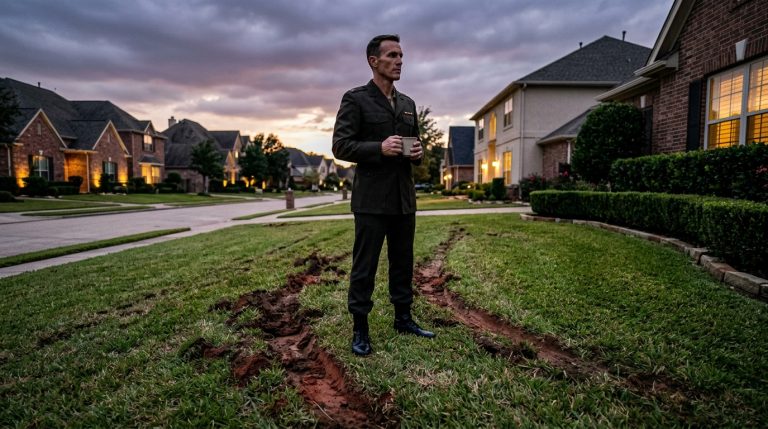
The contrast between the two properties was stark. On one side lay seventy years of weathered cedar, native bluestem grass, and the quiet dignity of a working homestead; on the other, manicured turfgrass, uniform colonial-style mailboxes, and the sterile hum of central air conditioning units humming behind brick facades.
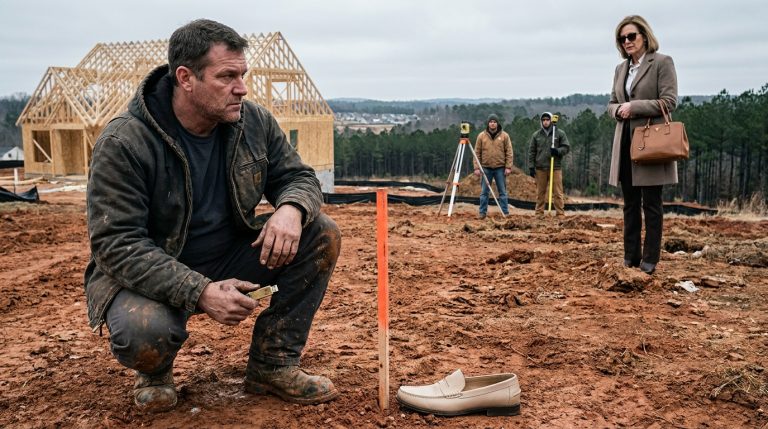
As he walked the fence line, his eyes caught a flash of unnatural color snagged deep in a clump of dry brier brush. He stopped, crouching down to inspect it. It was a bright blue plastic survey flag, crumpled and sun-faded, bearing the logo of a commercial engineering firm out of the county seat—the exact firm that had supposedly processed the re-mapping requests for Karen’s committee. A plastic marker planted illegally across a private boundary line, dropped by someone too careless to clean up their administrative footprints.
Jake reached out, his calloused fingers snapping the plastic stem, and slipped the flag into his back pocket. Another exhibit. Another piece of physical debris proving that the encroachment wasn’t an accident of geography, but an intentional, premeditated push.
He turned his truck toward the state capital the following morning.
The offices of Brennan and Associates occupied the fourteenth floor of a glass-and-steel tower overlooking the riverfront. The waiting room smelled of fresh espresso and expensive wool, a far cry from the dust and engine oil of the ranch, but the legal architecture waiting inside was designed for a very specific type of warfare.
Rebecca Brennan didn’t waste time on pleasantries. When Jake walked into her corner office, she was already standing by the floor-to-ceiling windows, her gray hair pulled back into a severe knot, her black suit jacket sharp enough to cut glass. She gestured toward a leather chair opposite her desk without looking up from a thick stack of printed municipal filings.
“Mr. Thornton,” she said, her voice dry and clipped. “Tom Chin briefed me on your situation. Forty-seven thousand in fabricated HOA fines, a pending lien on agricultural land that hasn’t touched their jurisdiction since the Reagan administration, and an escalating campaign of local harassment designed to dry up your operational cash flow.”
Jake sat down, placing his hat brim-down on his knee. “They’re trying to turn an administrative annoyance into a structural foreclosure. If that lien hits the county recorder’s office next week, my bank freezes the operating line.”
Rebecca turned from the window, walked over to her desk, and sat down. She didn’t offer sympathy; she offered a predatory, analytical grin.
“Then we don’t wait for them to file it defensively,” she said, tapping a manicured fingernail against the corner of a blank retainer agreement. “In civil litigation, the best defense against a predatory nuisance suit isn’t a shield. It’s a counter-battery. We hit them with a federal multi-count complaint before their ink even dries on the county ledger.”
She slid the contract across the polished mahogany surface. The bold header stared back at him: Standard Legal Retainer Agreement — Professional Services. Below it, the initial retainer figure was printed in clear, unyielding typeface: $50,000 upfront.
Jake looked at the paper, then up at Rebecca’s sharp, assessing eyes. Fifty thousand dollars meant draining the remaining cash reserves he had set aside to fix the northern barn roof and purchase the winter hay supply. It meant taking out a secondary signature loan against his military pension.
“If we file,” Jake said, his voice entirely steady, “how long before her attorney tries to block discovery?”
“Her attorney is a local patent lawyer named Simmons who buys his suits out of a catalog,” Rebecca replied smoothly, a cold edge entering her tone. “He’ll file a motion to dismiss within ten days, claiming neighborhood privilege and administrative jurisdiction. And the moment he does, federal judge Margaret Harding will look over her reading glasses, recognize the bad faith, and strip their legal immunity raw. I’ve broken three HOA boards in this state, Mr. Thornton. They rely on people backing down because litigation is expensive. But they’ve never gone up against a client who knows how to read a survey map better than their hired guns.”
Jake reached into his coat pocket, pulled out a heavy steel pen he had carried through two overseas deployments, and clicked it open. He didn’t hesitate. He signed his name at the bottom of the page with firm, deliberate strokes, anchoring his legacy to the line.
Rebecca pulled the document back, glancing at the signature with a nod of sharp approval. “Good. Now, Mr. Thornton, let’s start unearthing every single piece of paper, email, and text message that woman has generated in the last eighteen months. We’re going to bury her in discovery.”
CHAPTER 5: DISCOVERY AND THE PAPER MOUNTAIN
The return drive from the capital to the valley took three hours through the lengthening afternoon shadows. The dashboard of the Ford was quiet, save for the low hum of the air conditioner fighting the dry heat radiating through the windshield. Jake kept his hands steady at ten and two, his mind replaying every line of the retainer agreement and the aggressive scope of discovery outlined by Rebecca’s senior partner. They weren’t just defending a boundary line anymore; they were launching a full-scale legal reconnaissance into the administrative machinery of Ridgeline Estates.
When he turned onto the ranch road, the gravel crunching beneath the tires felt different—heavier, more deliberate. The historic barn stood tall against the fading orange sky, its corrugated tin roof catching the last glint of sunlight like a rusted blade.
The following Tuesday, the first wave of federal subpoenas hit the Ridgeline Estates administrative office.
Jake was standing by the corral fence when Miguel drove the flatbed tractor past, hauling a load of fence posts toward the north pasture. The morning air was crisp, smelling of frost and damp earth. A blue sedan belonging to a local courier service rolled slowly down the public lane, pausing briefly at the cattle guard before turning back toward the subdivision. The paperwork avalanche had begun.
Over the next three weeks, the scale of the counter-offensive materialized in boxes and digital case files arriving weekly at Brennan and Associates’ downtown office. Rebecca invited Jake back down to review the initial document dumps.
The conference room looked like a war room. Tables were covered in color-coded folders, financial statements, and digital printouts of municipal correspondence. David, the young associate, stood by a rolling whiteboard covered in timeline markers and financial flowcharts.
“We started with their general ledger,” David said, tapping a dry-erase marker against a cluster of green and red boxes. “The HOA collects roughly two hundred and forty thousand annually in dues and special assessments. On paper, it balances. But when we cross-referenced their legal expense line items with actual court filings and county dockets over the past eighteen months, a very interesting pattern emerged.”
Jake leaned forward, resting his forearms on the cold glass table. “Ghost billing.”
“Precisely,” David nodded, clicking his marker. “Sixty-three thousand dollars paid out to a patent law firm operated by Richard Westfield—Karen’s husband. When we subpoenaed the underlying work product for those invoices—consultations, document reviews, regulatory analysis—most of it didn’t exist in any official municipal file. It was money being laundered out of the HOA operational account and routed through family channels.”
Rebecca walked in from her adjoining office, holding a thick manila folder stamped with red confidential markers. She dropped it onto the table in front of Jake with a sharp slap that echoed in the quiet room.
“That’s the financial padding,” Rebecca said, her eyes glinting with cold satisfaction. “Now look at the real engine driving your harassment.”
Jake opened the folder. Inside were printed email chains pulled from the HOA’s internal server archives via federal discovery orders. The earliest entries dated back nearly a year, originating from an outside corporate entity registered three counties away: Prestige Summit LLC.
He scanned the text, his eyes locking onto a specific paragraph penned by a corporate vice president: ’Karen, if you can acquire or facilitate acquisition of the Thornton property, we’re prepared to offer the HOA a two point three million dollar community improvement grant. Additionally, we’d be happy to structure a personal consulting agreement for your administrative services.’
Below it sat Karen Westfield’s concise, unhesitating reply: ’I’ll handle Thornton. Give me six months.’
The room seemed to shrink, the air growing dense and quiet. A sudden, sharp memory flared in Jake’s mind—his grandfather kneeling by the southern fence line in 1987, pressing a heavy brass transit level into the damp clay to establish the true grade before pouring the foundation for the tractor shed. Samuel had always said that men who wanted other people’s dirt were never honest about why they were digging.
“She wasn’t protecting property values,” Jake said quietly, his voice tight with controlled friction. “She was clearing the board for a commercial golf and condo expansion.”
“And she was using your ranch as the primary obstacle,” Rebecca added, leaning against the edge of the table. “She thought she could bury you in municipal fines and force a distressed sale before you realized the HOA didn’t even have standing to cite you. But by filing that fraudulent lien and clouding your title, she crossed from civil harassment into federal jurisdiction.”
David flipped to another section of the whiteboard, revealing a printed email exchange with a local surveyor named Dennis Palmer. ’I need a survey that shows the Thornton fence encroaching onto HOA common area,’ Karen had written. ’Doesn’t need to be perfect. Just needs to look official enough to justify our enforcement actions.’
The trap was unwinding. Every fabricated violation, every Nextdoor smear post, every engineered barrier at the feed store—it all traced back to a desperate, coordinated push for a developer’s payout, funded by the very neighbors Karen claimed to protect.
Jake closed the manila folder, the heavy cardboard sliding smoothly across the polished wood.
“She thinks she’s running an executive boardroom,” Jake said, standing up and buttoning his coat. “She doesn’t realize she’s just walking deeper into a crossfire of her own making.”
“Let her keep walking,” Rebecca smiled thinly. “Discovery closes in thirty days. When we take this in front of Judge Harding, we aren’t just going to ask for a dismissal. We’re going to ask for the whole structure.”
CHAPTER 6: THE DEVELOPERS PAPER TRAIL
The elevator doors closed with a soft, pneumatic hiss, shutting off the sterile corporate scent of the capital office tower. Jake stepped out into the underground parking garage, his boots clicking rhythmically against the oil-stained concrete. The air down here was stagnant, smelling of exhaust fumes and damp asphalt, a dense atmospheric weight that mirrored the digital paper trail he had just helped map upstairs.
Karen Westfield hadn’t been acting as an overzealous neighborhood volunteer protecting property values; she had been acting as an advance scout for a corporate acquisition team. Every fabricated code violation, every engineered late-night health inspection, and every malicious whisper planted in a feed store aisle was part of a structured buyout strategy designed to squeeze an unyielding homestead out of existence.
He pulled his keys from his pocket, unlocked the door of the Ford, and climbed into the cab. He didn’t turn the ignition immediately. Instead, he sat in the half-light of the concrete stall, pulling out the printed copy of the email exchange between Karen and Prestige Summit LLC that Rebecca’s team had cleared for client review.
Two point three million dollar community improvement grant. That was the price tag the developers had attached to the HOA’s cooperation, sweetened with a personal consulting kickback earmarked directly for Karen’s administrative oversight. To a corporate real estate firm looking to clear 340 acres of working ranch land for luxury condos and a championship golf course, the Thornton property was just an irritating punctuation mark at the end of a long zoning sentence.
He slid the paper back into his inner coat pocket, turned the key, and backed the truck out of the stall.
The drive back to the ranch took him through the winding two-lane state highway, past the outskirts of Ridgeline Estates where the uniform brick walls and manicured green lawns stood in sharp, artificial contrast to the wild, rugged timber of the surrounding hills. As he approached the turnoff for the ranch road, a sudden shift in the autumn weather caught him off guard—a sharp, descending drop in temperature that carried the dry, metallic scent of falling pine needles and impending frost down from the northern ridge.
When he pulled through the cattle guard, Miguel was waiting by the front porch, leaning against the fender of the flatbed truck with a cup of black coffee steaming in his hand. The older worker looked up as Jake stepped down from the cab, reading the expression carved into the hard lines of Jake’s jaw.
“Look like you found something down in the city, boss,” Miguel said, taking a slow sip of his coffee.
“We found the balance sheet,” Jake replied, his voice flat and controlled as he walked toward the porch steps. “She wasn’t running an HOA committee, Miguel. She was running a brokerage service for a development firm out of the county seat.”
Miguel let out a dry, humorless huff, shaking his head. “Figures. People who spend all their time worrying about what color your fence is usually got something heavy hidden behind their own garage doors. What’s the next move?”
“We wait for discovery to close,” Jake said, pausing at the top of the porch to look out over the sun-bleached pastures rolling toward the southern fence line. “Rebecca’s filing the expanded motion tomorrow morning. Once Judge Harding gets eyes on that developer correspondence and the ghost billing invoices, the illusion of municipal authority is going to shatter all at once.”
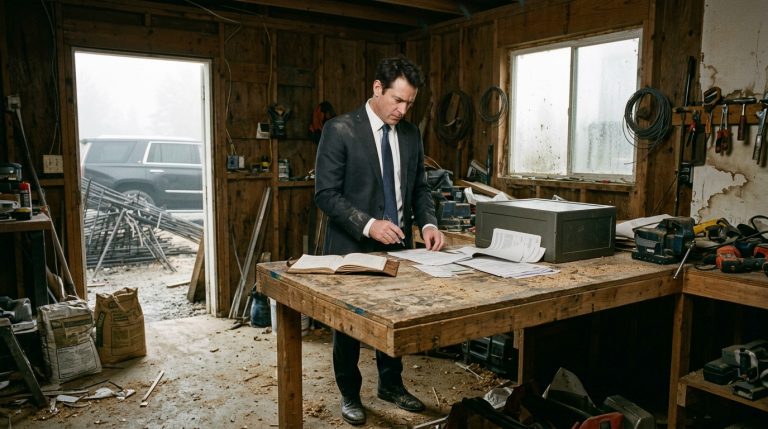
The afternoon faded into a long, quiet evening. Jake spent the remaining hours down in the historic barn, walking the length of the wide plank floor where his grandfather had stored decades of hand tools, ledger books, and spare parts. He stopped by the southern corner, his hand resting on the smooth wood of an old oak workbench.
The physical paper trail was piling up, and the trap was slowly tightening around Karen Westfield’s administrative empire. But beneath the fraudulent liens and the corporate buyout offers, the true leverage—the foundational linchpin that would ultimately determine who stayed and who went—was still resting quietly in the county vault, waiting for the exact moment to be deployed.
CHAPTER 7: THE 1987 EASEMENT DISCOVERY
The morning sun did not break clean over the eastern ridge; it filtered through a thick, yellowed haze of dry dust kicked up by a passing utility truck on the outer county road. Jake stood in the county recorder’s basement archive room, the fluorescent lights overhead humming with a high-pitched, metallic whine that vibrated behind his temples. The air smelled of old paper, vinegar, and decades of compacted dust trapped in steel filing cabinets.
He wasn’t looking for municipal liens or tax assessments this time. He was looking for the bedrock.
His fingers flipped through the heavy, linen-bound grantor-grantee index books from the late nineteen-eighties, the pages thick and yellowed at the edges. His grandfather Samuel’s precise handwriting appeared periodically throughout the entries—sharp, architectural drafts recording boundary adjustments and minor parcel sales to neighboring homesteads.
Then his finger stopped on an entry dated October 14, 1987.
Grantor: Samuel Thornton. Grantee: Ridgeline Land & Development Co. Access Easement.
Jake pulled the physical deed jacket from the drawer, unlacing the cotton string that held the folded vellum and onion-skin copies together. He laid the documents flat on the metal examination table, smoothing out the creases with the side of his palm. The language drafted thirty-nine years ago by a local attorney who had long since retired was remarkably brief, clear, and absolute.
’Grantee shall have right of access across Grantor’s property for agricultural and residential use only. Grantee may not alter, expand, or utilize said easement for commercial, industrial, or heavy transit purposes without the express written consent of Grantor or his legal heirs.’
Below that paragraph, stamped in faded purple ink by the county clerk’s office, was the legal description of the access road—the very same asphalt and gravel ribbon that currently served as the primary and only ingress/egress corridor for all two hundred homes in Ridgeline Estates.
When Ridgeline Estates had been subdivided and expanded over the subsequent decades, the developers had treated that easement as a permanent public dedication. They had routed heavy cement mixers, landscaping flatbeds, and construction machinery over the private roadway every single day, assuming that a suburban subdivision automatically inherited unrestricted commercial transit rights across agricultural land.
They had never secured written consent. They had never updated the deed terms. They had simply assumed that time and asphalt would erase the fine print.
Jake pulled out his phone, framing the vellum page in the camera lens, and captured three high-resolution images of the stamped text before sliding the documents back into their jacket. He didn’t smile. Victory in a land dispute wasn’t a celebration; it was a loaded weapon placed quietly on the table.
He walked out of the county building into the harsh midday glare, his truck waiting by the curb. He dialed Rebecca Brennan’s direct office line before he even pulled out of the parking stall.
“Rebecca,” Jake said when the line connected.
“Tell me you found it,” she answered without a greeting, the sound of keyboard clacking stopping abruptly on her end.
“1987 easement deed,” Jake said, his voice level and cold. “Restricted strictly to agricultural and residential traffic. Explicitly prohibits commercial use without written grantor consent. And Ridgeline Estates has been running heavy construction and delivery trucks over it for five years.”
A sharp, breathless laugh crackled down the line—the sound of an experienced litigator recognizing an absolute checkmate.
“Are you telling me…” Rebecca started, her voice dropping into a low, incredulous cadence.
“They’re landlocked,” Jake finished for her. “Every single house in that subdivision relies on an access road that runs across my property under terms they’ve been violating every day since construction began. If we revoke the easement for breach of conditions, two hundred families lose their legal way in and out.”
“Jesus, Jake,” Rebecca breathed, the tactical weight of the discovery finally settling over her. “That isn’t just leverage. That’s a structural demolition charge. If we drop this into the federal summary judgment motion, Judge Harding won’t just toss their fraudulent lien—she’ll give you complete control over their entire infrastructure.”
“File the amended motion,” Jake said, his eyes fixed on the open highway stretching out ahead of his windshield. “Make sure it lands on their desk by four o’clock this afternoon.”
“Consider it done,” Rebecca said.
Jake ended the call, tossed the phone onto the passenger seat, and pressed down on the accelerator. The engine roared, a deep, mechanical growl that echoed off the guardrails as he headed back toward the ranch. The paper mountain Karen Westfield had built to bury him was about to collapse inward under its own weight.
CHAPTER 8: FEDERAL COURT AND THE JUDGES GAVEL
The federal courthouse downtown smelled of floor wax and old stone, an austere, heavy atmosphere that made every footstep echo with absolute finality. Jake walked down the granite corridor behind Rebecca Brennan, his shoulders squared inside the dark wool of his suit jacket. Through the tall, narrow windows flanking the hallway, the midday sunlight slanted sharply across polished marble floors, casting long, geometric shadows that felt as rigid and uncompromising as the federal code itself.
When they entered Courtroom 3B, the room was already half-filled. Karen Westfield sat at the defense table in a pristine white trouser suit, her posture stiff, flanked by her attorney Roger Simmons, who was nervously shuffling a stack of yellow legal pads. Karen did not turn around as Jake took his seat at the plaintiff’s table, but the rigid set of her shoulders signaled an acute, defensive awareness of his presence directly behind her.
The bailiff’s sharp rap brought the gallery to silence. “All rise for the Honorable Judge Margaret Harding.”
Judge Harding entered from the side chambers with brisk, practiced authority. In her early sixties with iron-gray hair and sharp, assessing eyes behind wire-rimmed glasses, she seated herself with a quiet rustle of judicial robes and immediately opened the case file before her.
“Good morning,” Judge Harding said, her tone devoid of judicial pretense. “We are here for the matter of Thornton versus Ridgeline Estates HOA, docketed under civil and federal code violations. Let’s dispense with pleasantries. Mr. Simmons, your client filed an eighty-four-thousand-dollar lien against property that county records demonstrate has never fallen within your municipal boundaries. Explain to this court on what legal foundation you justify that action.”
Roger Simmons scrambled to his feet, fumbling with his papers. “Your honor, the association relied on historical mapping interpretations and administrative jurisdiction—”
“Counsel,” Judge Harding interrupted, her voice cutting through the courtroom like a cold blade. “I have reviewed the certified surveys dating back to 1952. The Thornton property predates your subdivision by over half a century. A fabricated survey commissioned last year by your client does not override a county deed.”
She didn’t wait for Simmons to flounder further. She turned her gaze directly toward the prosecution’s table, where Rebecca stood up smoothly.
“Your honor,” Rebecca began, her voice calm and carrying effortlessly through the room. “We have submitted supplementary exhibits into discovery this morning. These include internal server communications proving that the defendant, Karen Westfield, knowingly utilized fraudulent documentation not to protect community standards, but to execute a private real estate acquisition deal with a third-party developer, Prestige Summit LLC, in exchange for personal consulting kickbacks.”
David projected the email exhibits onto the courtroom monitor. The words—’Karen, if you can acquire or facilitate acquisition of the Thornton property, we’re prepared to offer a two point three million dollar community grant and a personal consulting agreement’—stared back from the screen in stark, undeniable black and white.
A low, collective murmur rippled through the gallery where several Ridgeline Estates residents sat watching. Karen went rigid, her hands gripping the edge of the mahogany table so tightly her knuckles whitened.
“Furthermore, your honor,” Rebecca continued, stepping forward toward the bench, “we have verified an additional structural violation concerning the primary access road serving the defendant’s subdivision. Under the 1987 recorded easement deed, access across my client’s property is strictly restricted to agricultural and residential transit. Commercial and heavy industrial use is explicitly prohibited without express written consent. The defendant and her board have systematically violated these terms for years.”
Judge Harding leaned forward, her eyes narrowing as she reviewed the digital file transferred to her terminal. “Are you asserting that the primary ingress for an entire residential development sits on a revocable agricultural easement?”
“It does, your honor,” Jake spoke up, standing beside Rebecca. His voice was low, measured, carrying the steady resonance of command. “And my client reserves the legal right to revoke that access immediately due to ongoing, premeditated breach of contract.”
Karen could no longer contain herself. She surged to her feet, her face flushed with sudden panic. “That’s an outrage! He’s trying to hold two hundred families hostage! This court cannot allow—”
“Sit down, Miss Westfield,” Judge Harding’s voice boomed across the courtroom, sharp enough to crack glass. “You will remain silent or I will have the bailiff remove you from this room. Do you understand me?”
Karen stared up at the bench, her chest heaving, the pristine corporate mask finally fracturing completely under the weight of unvarnished reality. Slowly, trembling with suppressed fury, she sank back into her chair.
Judge Harding adjusted her glasses, her expression hardening into absolute granite as she looked down at the defense table.
“The court finds the lien filed against Mr. Thornton’s property to be entirely fraudulent, malicious, and executed in bad faith,” Judge Harding declared, her voice ringing clear in the quiet room. “The lien is hereby stricken from all county records with prejudice. Furthermore, the defendants are ordered to pay four hundred and twenty-seven thousand dollars in compensatory damages, alongside full legal fees amounting to one hundred and eighty thousand dollars, assessed personally against Karen Westfield due to abuse of municipal authority.”
She paused, lifting her pen with finality. “Additionally, I am formally referring this matter to the United States Attorney’s Office for federal criminal investigation into wire fraud, conspiracy, and embezzlement of association funds. Court is adjourned.”
The gavel came down with a sharp, thunderous crack that echoed off the wood-paneled walls. The long war was over.
CHAPTER 9: THE SETTLEMENT TABLE AND THE NEW FOUNDATION
The heavy oak doors of Courtroom 3B swung shut behind the departing spectators, cutting off the muffled chatter of reporters and displaced residents. Inside, the air was cooling down, smelling faintly of paper dust and polished wood. Jake remained seated at the plaintiff’s table for a long moment, watching Roger Simmons hastily pack his empty folders into a discounted briefcase while Karen Westfield was escorted out through the side corridor by federal marshals.
A heavy shadow fell across the edge of the mahogany table.
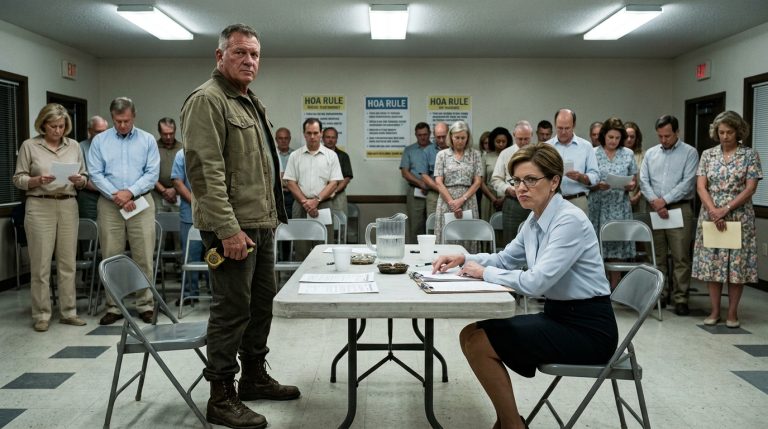
Jake looked up. Tom Morrison, flanked by a woman with tired, pragmatic eyes named Susan, stood in the aisle. Tom was holding a thick manila folder against his chest like a shield. His expression was a mixture of profound exhaustion and reluctant relief.
“Captain Thornton,” Tom said, his voice quiet, carrying the gravelly restraint of a man who had just inherited a burning ship. “We just held an emergency board meeting in the corridor outside. Ridgeline Estates has voted unanimously to strip Karen Westfield of all remaining administrative authority and dissolve her executive committee.”
Jake didn’t stand immediately. He let the silence stretch for three slow heartbeats, keeping his posture grounded and neutral. “You’re a bit late on the cleanup, Mr. Morrison. Your community’s governing board spent eighteen months funding a proxy war built on fraudulent municipal liens and developer kickbacks.”
“We know,” Susan interjected, stepping forward with a steady, unflinching gaze. “Most of us had no idea what she was doing behind closed doors. She used fear and manufactured code violations to keep everyone quiet. But that doesn’t excuse our complacency. We want to make it right before this goes any further.”
Tom laid the manila folder on the table, sliding it across the polished surface toward Jake. Inside lay a formal written apology, a certified cashier’s check covering the court-ordered compensatory damages in full, and a secondary addendum allocating a fifty-thousand-dollar contribution directly to a regional veteran housing charity in Samuel Thornton’s name.
“The court awarded four hundred and twenty-seven thousand in damages,” Tom said, resting his palms flat on the table. “We’ve covered the full balance, alongside your legal fees. And regarding the access easement… we aren’t here to litigate, Captain. We know we have zero leverage. That road is the only way two hundred families get in and out of their homes. What will it take to keep it open?”
Jake looked at the check, then up at the two people standing before him. He could have closed the gate permanently. He could have severed the asphalt ribbon, cut off their heavy transit, and watched the subdivision choke on its own isolation. It was within his legal right, stamped and sealed by a 1987 deed.
Instead, he pulled a pen from his breast pocket, flipped open the cover of his weathered pocket notebook, and wrote down three precise terms.
“Five thousand a month paid into a dedicated maintenance escrow to repair the road surface your heavy construction traffic has torn up over the last five years,” Jake said, sliding the notebook across the table. “No further expansion westward toward the ranch boundaries. And the moment a single complaint or fraudulent notice is filed against my property by anyone in your association, the easement terminates permanently without warning.”
Tom scanned the written terms, looked up into Jake’s steady, unblinking eyes, and nodded without hesitation. “Deal. We’ll sign the amended easement papers at your attorney’s office tomorrow morning.”
As Tom and Susan turned and walked out of the courtroom, the heavy oak doors clicked shut behind them. The administrative siege was broken. The corporate buyout had collapsed under its own fraudulent weight.
Later that afternoon, the drive back to the ranch felt remarkably clear. The sun was dipping below the western ridge, painting the sky in deep shades of gold and bruised purple. When Jake pulled through the front gate, Miguel and the crew were waiting by the porch, their faces split with wide, victorious grins.
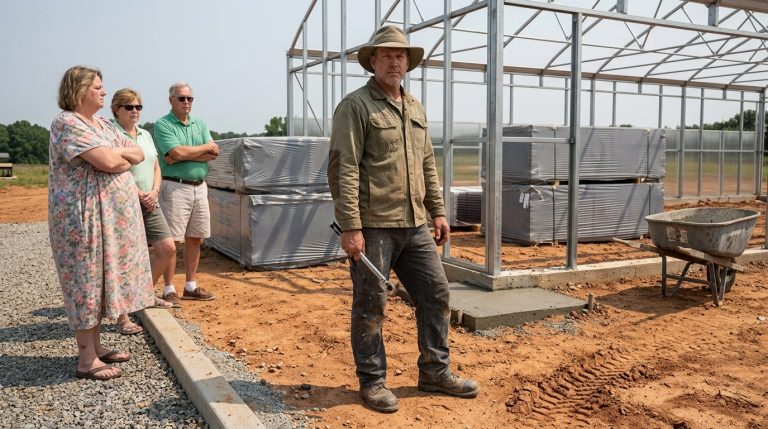
Jake stepped out of the truck, walked over to the historic barn, and pulled a weathered wooden sign from the workbench—the one the retired Marine had mailed him months ago. With steady hands and a heavy hammer, he nailed it securely to the rough-hewn cedar post beside the main entrance.
The sign read simply: Don’t tread on this ranch.
He walked out to his grandfather’s grave on the hill overlooking the pond, the dry September grass crunching softly beneath his boots. He knelt down beside the weathered stone, resting his palm flat against the cool granite.
“We won, old man,” Jake said quietly into the evening breeze. “The ranch is safe. The legacy holds.”
CHAPTER 10: THE POND AT SUNSET
The sun was dipping low behind the western timberline, throwing long, amber shadows across the surface of the stock pond where the water caught the dying light like hammered copper. Jake walked slowly up the incline from the cemetery plot, his boots making a dry, rhythmic scuff against the packed earth. Behind him, the rolling pastures of the 340-acre homestead stretched out in quiet, unbroken symmetry, silent witness to the months of legal attrition and quiet tension that had finally bled out of the valley.
The three-ring binder—four inches thick, dense with timestamps, evidentiary logs, and certified municipal subpoenas—rested permanently on the bottom shelf of his grandfather’s oak desk. It would stay there, closed and locked, not as a weapon, but as a permanent architectural drawing of what happens when a system built on manufactured intimidation collides with an immovable foundation.
On the porch, Miguel and Sarah were sitting on the edge of the wide wooden bench, quietly talking over a clipboard tracking the upcoming weekend’s veteran retreat registrations. The numbers were up—tripled since the regional news outlets and legal networks picked up the story of how an independent homestead held its ground against a corporate-backed municipal squeeze. Down by the historic barn, the restored timber frame stood tall against the twilight, its corrugated tin roof catching the final orange flare of day.
Jake stepped onto the porch, the old boards giving a familiar, welcoming creak beneath his weight. He didn’t carry the heavy, defensive exhaustion that had weighed down his shoulders for the past year. The air smelled of woodsmoke drifting from the kitchen chimney and the sharp, clean scent of dry grass cooling under a clear September sky.
A set of headlights swept across the cattle guard as a dark sedan turned down the long gravel drive, moving at a measured, respectful pace. Elena’s truck pulled up beside the front steps, her engine idling down with a soft, mechanical sigh before clicking completely silent.
She stepped out into the crisp evening air, carrying a small leather bag, her eyes catching his across the porch rail with a warm, steady recognition. There were no apologies left to make, no shadowed misunderstandings born of rumor or neighborhood whispers. Just the clear, grounded reality of two people choosing to build their future on soil that had been defended with patience, law, and absolute resolve.
Jake walked down the steps to meet her, his hand sliding smoothly into hers as they stood together at the edge of the gravel drive, watching the last sliver of the sun slip below the ridge. The flag on the pole his grandfather had raised in 1952 snapped crisply once in the evening breeze, a sharp, metallic sound of tension and release.
The land remained. The records were straight. And the gate stayed open only by right, by law, and by design.