The Weight of Concrete and Spite: How a Quiet Widower Systematically Dismantled a Suburban Empire
CHAPTER 1: THE FIRST NOTICE
The gravel in the driveway crunched under the heavy dual tires of the U-Haul, a dry, protesting sound that carried across the neat, identical lawns of Pinewood Grove. Roland did not look up from the cardboard box cradled against his chest. Inside were four porcelain plates and a chipped mug that had survived two decades of quiet kitchens in Columbus.
The morning sun cut through the windshield of the white SUV idling curbside, glinting off vanity plates that spelled out authority in clean, embossed chrome. A door slammed—heavy, deliberate, timed to interrupt.
“You’re outside the aesthetic compliance window,” a voice cut through the hum of the idling diesel.
Roland set the box down on the tailgate, the wood groaning under the sudden weight. He straightened slowly, wiping the fine cardboard dust from his palms. Darlene Pritchard stood at the edge of his property line, her oversized sunglasses reflecting the manicured perfection of a lawn that had never known drought. The air around her smelled of chemical lavender and old lacquer, an aggressive scent that pushed past the dust of the road.
“The charter specifies moving windows must be registered forty-eight hours in advance,” she said, tapping a thick, white binder against her thigh. The pages inside were tabbed with yellow sticky notes, a fortress of forty-seven rules bound in plastic. “We take community standards very seriously here, Mr. Vance. Pinewood Grove isn’t a storage yard.”
Roland looked past her shoulder at the row of houses behind her—identical ranches painted in varying shades of sanctioned beige, all facing the same empty street with their garage doors sealed tight against the light. There were no bicycles on the asphalt. No hoses coiled near the foundation. Just the steady, rhythmic drone of central air conditioning units fighting a losing battle against the July heat.
“It’s a Tuesday,” Roland said. His voice was flat, stripped of the reflexive politeness he used to offer software clients in Indiana before the hospital room had gone quiet two years ago. “The movers couldn’t come on Saturday.”
“The day of the week is irrelevant to the bylaws,” Darlene replied, her chin lifting slightly as she adjusted the collar of her velour tracksuit. “Section four, paragraph two explicitly protects our sightlines from commercial transport vehicles exceeding twenty feet. That truck is twenty-two.”
She reached into her binder, extracted a pre-printed pink slip with a pre-filled fine amount, and pressed it firmly beneath the heavy brass handle of his front door, securing it with a strip of yellow caution tape she seemed to carry by habit.
“First offense is one hundred and fifty dollars,” she said, her smile remaining fixed, smooth, and entirely devoid of warmth. “Payable to the association treasurer by Friday noon. Failure to comply results in a secondary notice and a mandatory review by the board.”
She turned on her heel, her sneakers making a soft squeak against the pristine concrete of the sidewalk, and climbed back into the Lexus. The engine didn’t roar; it hummed with expensive, insulated silence before pulling away down the empty street.
Roland walked up the three concrete steps, his boots leaving faint, gray prints on the swept stoop. He pulled the pink slip from beneath the tape. The ink was fresh, the timestamp crisp: 10:14 AM.
He didn’t throw it away. Instead, he folded it twice, squared the edges with his thumb, and slipped it into the breast pocket of his work shirt, right over his heart, where the cardboard dust had left a pale smudge.
CHAPTER 2: THE LEDGER OF IRON
The kitchen of the three-bedroom ranch smelled of polyurethane and old corrugated cardboard. Outside, the Indianapolis twilight bled through the vertical blinds, painting long, barred shadows across the linoleum floor. Roland did not turn on the overhead light. He sat at the center of a scarred oak dining table that had survived three military base relocations with his father and two decades of suburban compromise in Ohio.
Before him lay the laptop screen, casting a cold, blue rectangular wash over his weathered face. Beside it sat Darlene Pritchard’s welcome packet—all forty-seven pages, tabbed and clipped like a pathologist’s report.
He unfolded the pink slip from his pocket and laid it flat next to the trackpad. The fine was $150. To an active-duty software manager pulling mid-six figures before the buyout, it was negligible—a rounding error on a corporate expense report. But looking at the typography, the precise spacing of the type-printed violation code (Section 4.2: Commercial Transport Exterior Bounds), he recognized the architecture. This wasn’t about aesthetics. It was about friction. It was about creating an abrasive, unlivable surface until the occupant slid off.
The screen of his laptop hummed softly. He opened a blank spreadsheet, naming the file Grove_Baseline.csv.
“You’re burning daylight, son,” a raspy voice murmured from the hallway.
Pop stood in the doorway, leaning heavily against the doorframe. The old man’s shoulders were permanently rounded from thirty years in naval logistics, his flannel shirt buttoned to the top despite the July heat. In his right hand, he held a warm can of cheap domestic beer, the condensation dripping onto the threshold.
“Not burning it,” Roland said without looking up. “Cataloging.”
“That woman’s got eyes like a drill sergeant on inspection day,” Pop muttered, shuffling into the kitchen to pull out the opposite chair. The wood scraped harshly against the floor. He dropped into it with a soft grunt, his bad knee clicking. “Saw her pacing by the cul-de-sac forty minutes ago with a clipboard. She ain’t looking at grass blades. She’s looking for tracks.”
“Let her look.” Roland’s fingers tapped a steady, rhythmic staccato against the mechanical keyboard. Row 1: 142 Pinehurst Lane. Fine: $150. Date: July 21. “She thinks everyone who moves in here is running on empty. She’s used to widows and fixed-income retirees who fold the second they see pink paper.”
A sharp, intrusive memory flickered behind Roland’s eyelids—the sterile, fluorescent hum of the oncology ward, the crisp white pages of the discharge coordinator’s binder, the way grief had made him sign away power-of-attorney without reading the fine print. He had spent eighteen months nodding, swallowing, and retreating into the quiet corners of a house that felt too large. But the moment Darlene’s synthetic lavender perfume had hit his threshold, the fog hadn’t made him compliant. It had made him cold.
“You checked the county records yet?” Pop asked, taking a slow sip from the can.
“County recorder’s office is closed until eight tomorrow morning,” Roland replied, his eyes locked on the blinking cursor. “But I pulled the plat map online before the movers left. Pinewood Grove isn’t an independent municipality. It’s an unincorporated subdivision tied to a master covenant from 1998. That means the HOA board operates under state corporate code, not local ordinance.”
“Corporate code,” Pop grunted, a dry, humorless sound rattling in his chest. “Means there’s a paper trail. Men who hide behind rules always leave a signature where the money changes hands.”
“Exactly.” Roland clicked open a browser tab containing the Indiana Secretary of State business search portal. Pinewood Grove Homeowners Association, Inc. Filed as a non-profit domestic corporation. Registered agent: Darlene Pritchard. Principal office address: 114 Pinehurst Lane—her own front door.
He didn’t search for her name next. Instead, he pulled up the neighborhood directory Darlene had so proudly shoved into his hands in the welcome packet, flipping to the back where the list of property owners was indexed. Out of twenty-two homes, eight were marked with asterisks. Absentee Investor.
He cross-referenced the names against the county tax assessor’s database. Four of those eight investment properties shared a single mailing address: a post office box in Bloomington registered under a shell entity called Vanguard Management Group.
Roland leaned back, the cheap plastic chair groaning under his weight. He reached out and tapped the corner of Darlene’s 47-page binder with his index finger. The paper made a hollow, heavy thud against the wood.
“She’s not just enforcing rules, Pop,” Roland said softly, the blue light of the screen sharpening the hard lines around his mouth. “She’s weaponizing them. If a homeowner gets hit with three consecutive violations and misses the payment window, the bylaws trigger an automatic lien process under Section 12.4. Within ninety days, the board can force a pre-foreclosure arbitration.”
Pop narrowed his eyes, the beer can pausing halfway to his lips. “And who buys the debt when the house goes to the association’s private tax sale?”
“Vanguard Management Group,” Roland said. “Which shares a registered agent ID with Darlene’s maiden name.”
Silence settled over the kitchen, broken only by the low hum of the refrigerator and the distant, rhythmic chirping of crickets outside in the dry Indiana grass. The air felt thick, heavy with the realization of a closed loop—a trap designed to grind down anyone who lacked the energy to fight back.
Roland closed the laptop lid with a sharp, definitive click that cut the blue light from the room, leaving them in the dim, amber glow of the hallway overhead bulb.
“She wants a compliant neighborhood,” Roland said, standing up and sliding the pink violation slip back into his pocket. “By Friday, she’s going to find out what happens when the math doesn’t work in her favor.”
Pop watched him for a long moment, a faint, grim smile touching the corners of his mouth. He raised the beer can slightly in a silent salute. “Get some sleep, son. Tomorrow, we start digging.”
CHAPTER 3: THE ASSEMBLY OF SHADOWS
The heavy metal garage door rose with a dry, rattling shudder of rusted tracks, letting in the cool, iron-smelling draft of the pre-dawn Indiana morning. Roland didn’t turn on the overhead fluorescent tubes. Instead, he worked by the pale beam of a battery-powered drop light suspended from the garage rafter, casting sharp, jittery shadows across stacks of unopened cardboard boxes and the dusty fender of Pop’s camper.
A low, muffled knock sounded against the side service door leading directly from the driveway.
Roland crossed the concrete floor in three unhurried strides, his boots making a dull, flat slap against the unsealed slab. He unlatched the deadbolt, the internal mechanism sliding back with a heavy, oiled clack.
Marcus stepped inside immediately, ducking his head beneath the low frame. The young parallegal wore a rumpled gray suit jacket over a loosened tie, carrying a heavy canvas briefcase that looked stuffed to the point of structural failure. His breath came in shallow, hurried puffs, carrying the faint tang of black coffee from a roadside thermos.
“Driveway was clear,” Marcus whispered, though the street outside was entirely silent. “No white Lexus parked at the cul-de-sac. But Darlene’s got a ring camera trained directly on the main entrance of Pinehurst. I had to loop through the drainage ditch behind the properties to get back here without tripping her motion alerts.”
“She’s wasting bandwidth,” Roland said, turning back toward the folding table set up near the workbench. “A camera only records what passes in front of the lens. It doesn’t tell her who’s already inside the perimeter.”
Marcus dropped the canvas briefcase onto the folding table. The zipper gave a loud, metallic zip as he tore it open, spilling a thick stack of manila folders, printed property deeds, and handwritten notes onto the scarred wooden surface. The air smelled of dry paper and printer toner.
“You were right about Vanguard Management Group,” Marcus said, pulling a single authenticated document from the top of the pile. His fingers were slightly stained with blue ink. “I pulled the corporate filings from the Secretary of State’s archives before the office opened. Vanguard isn’t an independent out-of-state holding firm. It’s a domestic LLC incorporated three years ago. The registered agent address matches a UPS store in Bloomington, but the physical banking liaison is routed through a local credit union right here in the county.”
Roland leaned over the table, his fingers tracing the sharp, folded edge of a deed transfer. The paper was stiff, cold to the touch. Under the weak amber glare of the drop light, the names of previous homeowners—widows, retirees, families who had quietly vanished from Pinewood Grove over the past twenty-four months—seemed to blur into a single, uniform column of displaced equity.
“And the acquisition cost?” Roland asked, his voice low, steady as an idling motor.
” Pennies on the dollar,” Marcus muttered, tapping a column of figures with the eraser end of a pencil. “Darlene hits them with cumulative violations—lawn height, unapproved paint tones, unauthorized commercial vehicles parked past sunset. When the fines hit the threshold under Section 12.4, she triggers an emergency arbitration hearing behind closed doors. No quorum requirements met, no independent witnesses. Just an association-backed lien that forces the owner into pre-foreclosure. Once the title enters default, Vanguard steps in with a cash buyout that clears the debt and leaves the family with barely enough to cover moving truck expenses.”
“While she takes a cut on both ends,” a low, gravelly voice rumbled from the darkened corner near the camper.
Pop stepped out of the shadows, holding a chipped ceramic mug of black coffee. His face was carved in harsh relief by the downward angle of the drop light, the deep lines around his eyes set in hard, unyielding stone.
“I saw that playbook in supply logistics forty years ago,” Pop said, taking a slow sip. “You don’t break the enemy by attacking their front gate. You starve their supply lines until the garrison surrenders from the inside out. How many votes do we hold as of midnight?”
Roland reached into his shirt pocket, pulled out a small, lined notepad, and tossed it onto the table beside Marcus’s briefcase. On it was written a tally in crisp, black ink.
“Twelve properties,” Roland said. “Counting this ranch, the duplex down the block, and the four foreclosures we locked down through the intermediary LLCs last week. That gives us fifty-three percent of the total voting shares in Pinewood Grove.”
Marcus let out a slow, sharp breath, running a hand through his unstyled hair. “That’s a legal majority. Under the master covenant, fifty-one percent is the absolute threshold required to call an emergency special meeting, suspend the board’s executive charter, and demand a full forensic audit of the association’s operating accounts.”
“She won’t hand them over voluntarily,” Roland said. He walked over to the workbench, picked up a heavy, steel-jawed C-clamp, and turned it over slowly in his calloused palms, feeling the cold, machined ridges of the metal. “When Darlene realizes her margin has evaporated, she’s going to escalate. She’ll issue mass fines, accelerate the lien schedules, or try to ram through a retroactive amendment to block outside transfers.”
“Let her try,” Marcus said, pulling a second folder from his bag. “If she alters the meeting minutes or backdates any compliance notices to invalidate our proxy votes, she crosses the line from civil contract breach into outright corporate fraud. I’ve already pre-drafted the injunction paperwork for the county circuit court. All we need is her signature on a formal board challenge—or a public forum where she’s forced to answer the math.”
Roland set the C-clamp back down on the workbench with a heavy clonk. He looked past Marcus’s shoulder, out through the open garage door where the first pale streaks of gray light were beginning to bleed across the empty asphalt of the cul-de-sac. Down the street, at number 114, the white Lexus sat motionless in the drive, its dark tinted windows reflecting nothing back at the morning.
“We don’t go to court yet,” Roland said quietly, his eyes fixed on the distant roofline of Darlene’s house. “We let her keep building her wall. We let her call her emergency board meetings. We let her believe she’s still the one holding the gavel.”
Pop grunted, a dry sound of grim satisfaction, and set his mug down on the edge of the workbench. “And when she swings it?”
“When she swings it,” Roland said, his voice dropping into a hard, flat cadence, “we make sure the handle is made of iron.”
CHAPTER 4: THE LEDGER BREACH
The envelope arrived not by postal carrier, but shoved manually beneath the back deck door late on a Thursday afternoon.
Roland crouched on the sun-bleached cedar planks, pulling the heavy manila packet free from where it had been wedged tightly between the screen door frame and the rusted iron threshold. The paper was swollen slightly from the humidity, weighing close to ten pounds. There was no return address, but the heavy red rubber-band sealing the flap carried the distinct, smudged ink imprint of the county recorder’s records division.
He carried it straight to the kitchen table, sliding it across the scarred oak surface. The sound was a dull, heavy thud.
Pop looked up from where he was cleaning a spool of fishing line at the counter, his weathered hands pausing mid-twist. “Looks like the vault opened.”
“County FOIA request cleared,” Roland said, slicing open the reinforced flap with a utility knife. The blade parted the heavy paper with a sharp, tearing rasp.
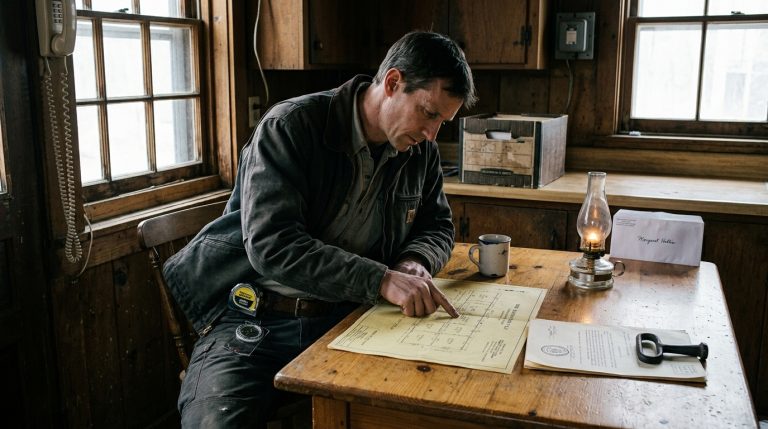
Inside sat three thick packets of photocopied bank ledgers, certified checks, and carbon-copy disbursement slips stamped by the regional municipal clearinghouse. Roland pulled the top statement toward him, tilting his desk lamp downward until the glare caught the fine print.
For three consecutive years, operating funds collected from Pinewood Grove’s twenty-two households—dues, late fees, architectural review deposits, and mandatory landscaping surcharges—had flowed into a primary association account at the local credit union. But the ledger didn’t stop there. Beneath the primary column were monthly automated wire transfers labeled Consulting Retainers – Phase 1 through 4, routed directly into an account held by Grove Management LLC.
Roland’s thumb traced the routing numbers. He cross-referenced the entity identifier against the business registry he had pulled earlier in the week. Grove Management was not registered to a Bloomington PO box. It was filed directly under a residential address three miles away, carrying a maiden name matching Darlene Pritchard’s signature stamp.
“Thirty-one thousand dollars,” Roland murmured, the words tasting like dry ash in his mouth. “Not spent on repaving, not spent on common area maintenance. Straight to a private slush fund disguised as administrative oversight.”
“That’s just the tip of the piling,” Pop said, walking over and dropping a second sheaf of papers onto the table. He pulled a chair out and sat down heavily, his joints popping in the quiet room. “Look at the contractor quotes attached to the back of that disbursement log. Morrison Construction. You know who they are?”
Roland flipped the page. A series of itemized invoices for routine curb maintenance, mailbox replacements, and pressure-washing services stared back at him. Each line item was inflated by exactly thirty-five percent compared to standard Marion County municipal rates. And at the bottom of the final invoice, stamped in bright purple ink, was a handwritten notation initialed with a sharp, sloping D.P.: Includes agreed 20% finder fee allocation.
“Kickbacks,” Roland said, his jaw tightening until the muscles stood out in sharp relief. “She’s billing the association inflated rates from a contractor, then taking a cash cut on the back end.”
“More than that,” a sharp voice cut through the kitchen doorway.
Marcus stepped unannounced through the back screen door, letting it slam shut against its pneumatic arm with a sharp thwack. He wasn’t wearing his suit jacket today; his shirtsleeves were rolled up to his elbows, and his tie was stuffed into his back pocket. He slammed a certified legal transcript onto the table, right on top of the bank statements.
“I spent the last six hours at the county courthouse pulling property lien records,” Marcus said, breathing heavily as he pulled out a chair. “I found a file on a guy named Patterson. Lived on the north end of the cul-de-sac two years ago. Darlene hit him with four consecutive violation notices for an unapproved roof shingle tint. When he couldn’t pay the cumulative fines within her arbitrary seventy-two-hour window, she slapped a formal association lien on his title.”
Roland looked up from the bank ledgers. “Did he lose the house?”
“Worse,” Marcus said, jabbing his finger against a stamped receipt in the middle of the transcript. “Patterson managed to scrape together the cash. He paid those fines in full—every single dollar, verified by a cashier’s check from his credit union. But Darlene never filed the lien release with the county recorder. She left it active on the public registry. Two weeks later, when Patterson tried to refinance his mortgage to pay for his wife’s medical treatments, the active lien tanked his credit rating. The bank killed the refi. He lost forty thousand dollars in equity, defaulted three months later, and walked away with nothing.”
The kitchen grew deathly still. The hum of the refrigerator seemed to drop an octave, vibrating through the floorboards.
Roland reached out and picked up Patterson’s canceled cashier’s check, holding it next to Darlene’s signed lien enforcement notice. The dates didn’t just overlap; they proved deliberate, calculated sabotage. She hadn’t made a clerical error. She had maintained the encumbrance intentionally to force the default, clearing the path for Vanguard Management Group to sweep in and pick up the title at a fraction of its market value.
The air in the room felt heavy, choked with the friction of unyielding concrete and ironclad malice.
“That’s not just a civil contract breach,” Marcus whispered, leaning across the table, his eyes wide and bright in the yellow lamp light. “That’s mail fraud, extortion, and criminal falsification of public records. If we take this straight to the county prosecutor, she’ll be facing felony indictments within forty-eight hours.”
Roland stared at the stack of papers, his mind rejecting the clean, easy exit of an immediate police raid. If they handed the files over to the district attorney now, the legal machinery would grind slowly through months of bureaucratic hearings, injunctions, and appeals. Darlene would hire a high-priced corporate defense attorney, claim administrative oversight errors, and quietly slip out the back door with her assets intact, leaving the neighborhood trapped in a paralyzed legal limbo.
“No,” Roland said, his voice dropping into a flat, cold register that made Marcus pause.
“No?” Marcus echoed, blinking. “Roland, we have her dead to rights on felony counts. Why wait?”
“Because an indictment doesn’t fix a broken system,” Roland said, standing up from the table. He walked over to the kitchen window, looking out into the gathering dusk where the amber streetlights of Pinewood Grove were just beginning to flicker on one by one, casting long, rigid shadows across the identical beige lawns. “If the state takes her down in a courtroom downtown, the residents here remain spectators. They stay quiet. They stay scared.”
He turned back around, his eyes locking onto Marcus and Pop in the harsh glare of the desk lamp.
“We don’t want a quiet conviction,” Roland said, his fingers curling slightly against the edge of the counter. “We want an absolute, undeniable reckoning where the entire neighborhood watches the architecture of her control collapse under its own weight. The election is twenty-seven days away. We let her keep building her case. And on election night, we open the ledger in front of every single person she’s bled.”
Pop let out a slow, gravelly breath, leaning back in his chair with a dry, humorless chuckle. He reached out and tapped the corner of the bank statement with a calloused finger.
“A public hanging of the books,” Pop said. “I like it. But she’s not going to sit quietly while we stack the deck. When she realizes her numbers don’t add up, she’s going to strike back first.”
“Let her,” Roland said, walking back to the table and squaring the edges of the manila folder with precise, deliberate movements. “We have the votes. We have the paper trail. By the time she realizes the board isn’t hers anymore, the gavel won’t even belong to her.”
CHAPTER 5: THE COMMUNITY CENTER RECKONING
The fluorescent tubes in the Pinewood Grove Community Center hummed with a harsh, electrical vibration that cut through the low murmur of the crowd. Outside, the autumn wind rattled the aluminum frames of the double doors, but inside, the air was dead and heavy, thick with the chemical scent of artificial lavender and the dry, stale sweat of thirty-eight nervous homeowners packed into folding chairs.
Roland stood at the back of the room, half-shrouded in the shadows near the fire exit. His hands rested flat against the scarred laminate surface of the rear utility counter, his fingers curled slightly over the edge. Beside him sat two heavy bankers boxes stuffed with certified bank ledgers, lien records, and the itemized contractor invoices bearing Darlene Pritchard’s sloping signature stamp.
At the front of the room, behind a folding table draped in a green plastic cloth, Darlene sat at the center. Her velour tracksuit was immaculate, her oversized sunglasses pushed up onto her lacquered hair like a crown of office. Beside her sat Vernon, his head bowed so low toward a yellow legal pad that his chin nearly touched the paper, his fingers rhythmically clicking a cheap plastic pen with an erratic, frantic beat.
“This special meeting has been called pursuant to Section four of the association bylaws,” Darlene announced, her voice pitched sharp and clear, cutting through the murmurs of the room. She rapped a small, lacquered wooden gavel against the table. The sharp crack echoed off the cinderblock walls. “We have an emergency agenda to address unauthorized proxy solicitation and outside corporate interference threatening our property values.”
A low rumble of dissent rippled through the third row, where Bernard sat with his arms crossed tightly over his chest, his jaw set in a hard, uncompromising line.
Roland did not wait for the gavel to strike a second time. He pushed away from the utility counter, his boots making a heavy, measured thud against the linoleum floor. He walked down the center aisle, neither rushing nor hesitating, the silence spreading outward from his footsteps until the entire room turned to watch him approach.
Darlene’s hand froze mid-swing, the gavel hovering an inch above the table. Her eyes narrowed behind her tinted lenses. “You’re out of order, Mr. Vance. You are not recognized to speak.”
“Section four, paragraph eight,” Roland said, his voice level, stripped of any defensive inflection, carrying the flat weight of an engine idling under a heavy load. “When association elections and structural financial challenges are formally petitioned by a verified majority of property owners, procedural review supersedes board agenda items.”
“You don’t have a majority,” Darlene snapped, her smile tightening into a thin, white line as she gripped the edges of the table. “This board operates under executive discretion.”
Roland reached the front of the room, stopped three feet from the folding table, and reached down into the first bankers box. He pulled out a single, stiff sheet of paper—the consolidated property registry showing twelve authenticated deed transfers—and dropped it onto the green plastic cloth. The paper slid across the plastic, coming to a halt directly against Darlene’s stacked folders.
“Executive discretion doesn’t cover thirty-one thousand dollars in unapproved wire transfers routed through Grove Management LLC,” Roland said.
The room went absolute, dead silent. The fluorescent hum seemed to drop an octave.
Vernon’s pen snapped with a sharp crack in the front row. The plastic barrel cracked down the middle, spilling black ink across the clean yellow lines of his legal pad. Vernon didn’t look up; he simply let go of the broken pieces as if they burned his fingers, his hands dropping limply into his lap.
Darlene stood up so abruptly her chair screeched against the concrete floor. “That’s a fabrication. Those are private corporate documents—”
“They’re public municipal records,” Marcus called out from the second row, standing up and dropping a certified copy of the county clerk’s audit onto the floor near the front row. “Pulled under state freedom of information statutes. Every check, every inflated contractor invoice from Morrison Construction, every kickback initialed with your personal stamp.”
Darlene’s face lost its color beneath the layers of makeup, draining into a chalky, gray pallor. She looked wildly from Marcus to Roland, then back toward the rows of homeowners who had slowly risen to their feet, their faces locked in hard, unyielding expressions. There were no shouts, no chaotic demands—just the heavy, suffocating weight of twenty-two households realizing the exact shape of the cage they had been kept in.
“You don’t understand,” Darlene whispered, her voice finally cracking, the sharp authority dissolving into a desperate, thin rasp. “I kept the property values stable. I kept the riff-raff out. If I hadn’t enforced the rules—”
“You didn’t enforce rules, Darlene,” Roland interrupted, stepping closer until the edge of the table separated them by barely a foot. He pulled Patterson’s canceled cashier’s check and the active lien notice from his breast pocket and laid them side by side on the plastic cloth. “You engineered defaults. You turned compliance into a tollbooth, and when people couldn’t pay, you sold their equity out from under them.”
Darlene stared down at the papers, her breath coming in shallow, ragged hitches. Her hands trembled on the edge of the table, her manicured fingernails digging into the green plastic until the material stretched and tore. For a fraction of a second, her eyes flicked toward the side exit, searching for a path through the wall of silent, watching neighbors, but the aisle was blocked by Bernard and the Torrances, standing shoulder-to-shoulder with the heavy, unmovable patience of fence posts.
“The meeting is adjourned,” Darlene choked out, her voice rising in panic as she grabbed her purse by the strap. “You have no legal authority—”
“The authority was never yours,” Roland said quietly. He reached out, took the lacquered wooden gavel from where it rested beside her hand, and lifted it off the table. The wood felt cool, dense, and heavy in his palm. “The association is dissolved, effective immediately. And your signature is no longer worth the paper it’s printed on.”
He set the gavel down on the center of the table, right over her scattered folders, and turned his back on her, walking back up the aisle toward the shadows of the rear exit as the first low murmur of voices broke the silence of the room.
CHAPTER 6: THE DUSTY THRESHOLD
The late autumn air outside the community center bit with the sharp, clean scent of frost and dry earth. Roland stepped down the concrete ramp into the gravel parking lot, the crunch of small stones beneath his boots steady and deliberate. Behind him, the glass double doors remained shut, muffling the distant, frantic murmur of Darlene’s defense attorney attempting to salvage a shredded corporate charter.
Pop was leaning against the passenger fender of the truck, his arms crossed over his canvas jacket, a faint cloud of vapor rising with his slow exhale.
“She’s done,” Pop said quietly as Roland approached. It wasn’t a question. “The county investigator just served her with the initial warrant papers by the side entrance. Her brother-in-law’s construction firm is already freezing their municipal assets.”
Roland nodded, resting his palms on the cold steel of the truck bed. “It was never about the rules, Pop. Rules are just iron bars people build because they’re terrified of open space.”
The transition back to Pinehurst Lane was made without fanfare. There were no flashing cruiser lights, no cheering crowds lining the curbs. The streetlamps hummed with their usual amber glow, casting long, rigid shadows across lawns that were finally free to grow at their own pace.
Over the following months, the machinery of corporate control dismantled itself piece by piece. The state prosecutor’s office fast-tracked the indictments under commercial racketeering statutes, turning the embezzlement case into a textbook precedent across the county. Vernon took a plea deal, trading his testimony for probation and packing his remaining boxes into the back of a sedan before moving out West to live with his sister. Darlene’s white Lexus vanished from the driveway at number 114, replaced weeks later by a young family of schoolteachers who immediately set up a small wooden sandbox near the front porch.
Roland spent his weekends on the back deck, working with calloused hands and steady persistence. He took down the rotting sections of the old cedar railing, replacing them with thick, unpainted oak beams that smelled of raw sap and forest floor.
One Saturday afternoon, three months after the community center vote, Marcus pulled his sedan up to the curb. He stepped out carrying a heavy manila envelope stamped with the county recorder’s official seal.
“It’s official,” Marcus said, walking up the driveway with a tired but genuine grin. “The master covenant has been legally vacated. Pinewood Grove HOA is officially dissolved. Common areas have been deeded over to the municipal parks department, and every fraudulent fine collected over the last three years has been cleared from the public registry.”
Roland took the envelope, sliding the stiff parchment free to check the final seal. The paper was clean, smooth, and entirely devoid of fine print.
“And the surplus from the restitution settlement?” Roland asked.
“Seated in the community fund,” Marcus replied, adjusting his glasses. “Sarah’s Second Chances scholarship is fully endowed. The first disbursement goes out next month to the local high school’s vocational program.”
After Marcus left, Roland walked over to the small garden bed he had cleared beside the front steps. The soil was dark, rich, and turned over fresh. He reached into his coat pocket and pulled out a small, hand-painted ceramic object—six inches tall, its green-and-brown glaze slightly chipped around the rim from years of travel.
He knelt down in the dry earth, pressing the ceramic turtle firmly into the soil right beside the roots of a newly planted lavender bush. The afternoon sun caught the glossy surface of its painted shell, casting a quiet, unmoving reflection against the gray stone of the foundation.
Pop walked up behind him, carrying a pair of pruning shears, his joints clicking as he stopped at the edge of the flowerbed. He looked down at the turtle, then up at the open street where a group of neighborhood kids were currently drawing an enormous, chaotic chalk mural across the asphalt of the cul-de-sac without a single piece of yellow tape in sight.
“Looks like it found its stride,” Pop said softly.
Roland stood up, dusting the dark earth from his knees. He reached out and adjusted the angle of a wooden trellis supporting a cluster of climbing ivy along the porch pillar, feeling the solid, unyielding resistance of the wood beneath his fingers.
“It’s just moving at the right speed,” Roland said.
He turned away from the street, walking back up the wooden steps into the quiet warmth of the house, leaving the door unlocked, the threshold clear, and the dusty Indiana wind blowing freely through the open gate.