The 130-Year-Old Property Line That Brought Down a Suburban Tyrant and Restored Peace to the Valley
CHAPTER 1: THE FIRST WARNING
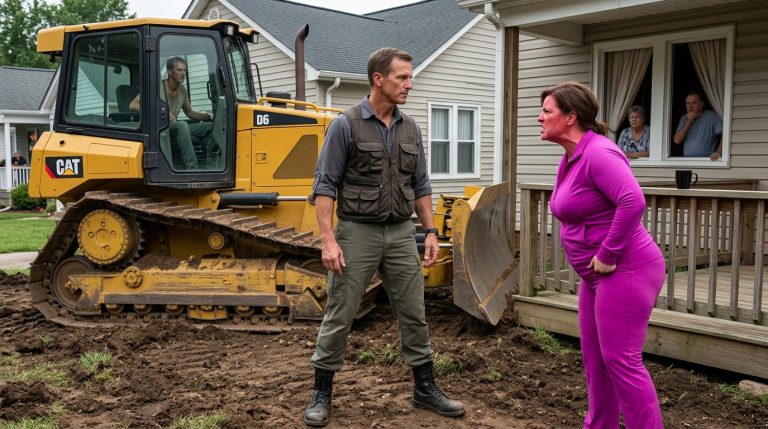
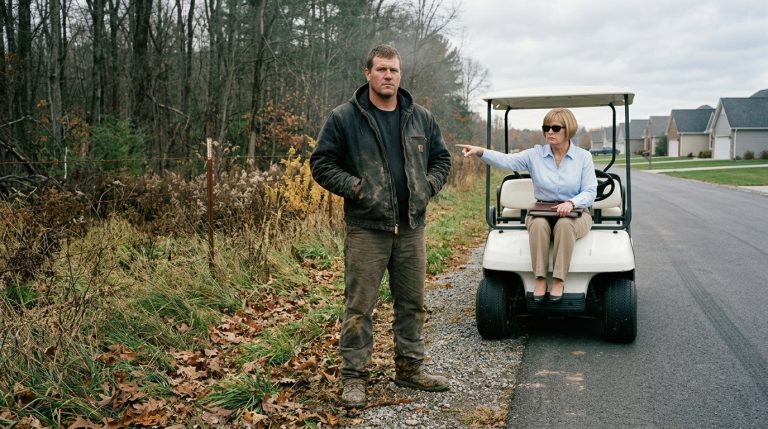
The gravel driveway crunched under the weight of a beige sedan that didn’t belong. I stood on the porch with my coffee, watching the clipboard move before I saw the face.
She wore a suit the color of wet sand and carried herself like an inspector general who had never smelled diesel exhaust in her life. Her name was Karen, and her laminated badge claimed she spoke for Whispering Pines.
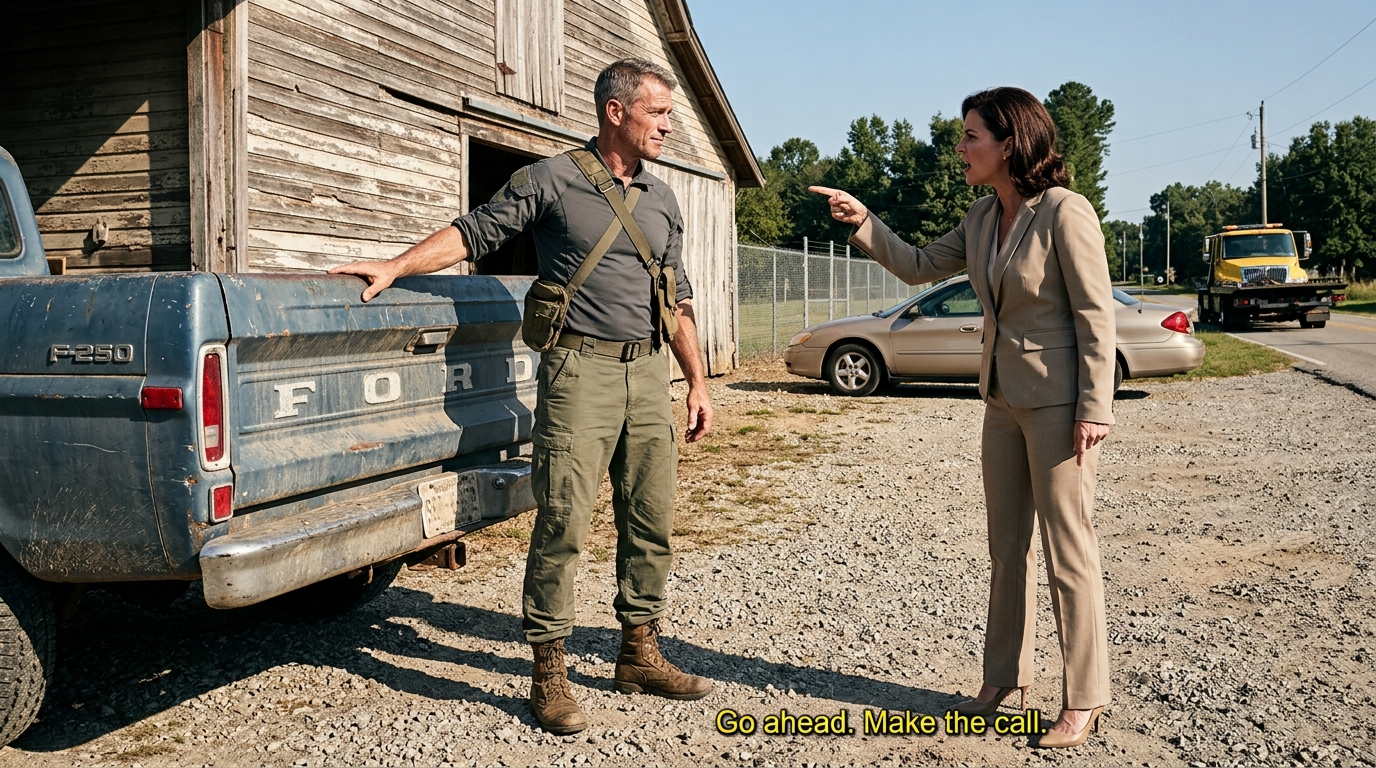
“That’s a final warning, Mr. Miller,” she said, her voice dripping with manufactured authority. “Either you move that rusting piece of junk into a garage, or I authorize its removal.”
She pointed a manicured finger at my grandfather’s 1968 Ford F-250. It sat gleaming under a fresh coat of wax next to the barn, right where it had rested for three decades.
The truck was older than her entire subdivision, built with thick American steel that didn’t bend to committee votes. I felt a slow, heavy pull in my chest, the familiar cold discipline of twenty years in the Corps of Engineers locking onto a target.
“That truck runs on the first turn of the key, Karen,” I said, keeping my voice flat and low. “And this land has been in my family since 1892. Your jurisdiction ends at the old stone wall.”
She waved a dismissive hand toward the county road where a tow truck idled like a vulture. “Paperwork is forever, Mr. Miller. We have the planning commission’s approval.”
She pulled a radio from her belt, her thumb hovering over the call button. She wanted a shouting match, an ugly public spectacle to paint the veteran as an aggressor.
I didn’t give her the satisfaction. I took a slow breath, letting the cool morning air settle the weight in my shoulders.
“Go ahead,” I said, offering a dry, humorless smile. “Make the call.”
CHAPTER 2: THE PAPER TRAIL
The county hall smelled of damp wool and old lime plaster.
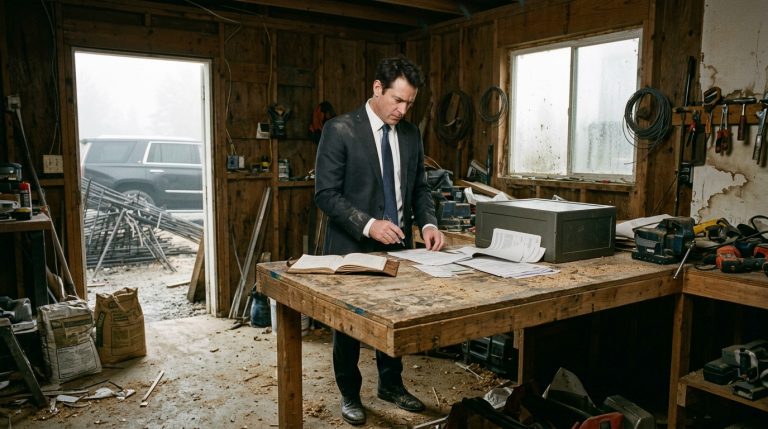
Without access to the digital GIS portal, I had to trace the boundaries the hard way, sliding heavy steel drawers open in the basement archives.
A single fluorescent tube overhead flickered with an irregular, dry hum, casting harsh light over the yellowed linen maps.
The original plat from eighteen-ninety-two sat unrolled under my fingertips, held flat by two iron weights.
A red grease pencil mark cut across the margin where a modern clerk had scrawled a provisional annexation note over the historical ledger.
The handwriting was sloppy, pushed through in a rush to satisfy a developer’s preliminary filing.
Footsteps echoed down the concrete stairs behind me, heavy and deliberate.
“They told upstairs you were poking through dead files, Mr. Miller.”
I didn’t look up from the map.
“Dead files are harder to alter than digital ones,” I said.
The clerk, an older man with grease under his fingernails and a county badge pinned crookedly to his shirt, leaned against the metal shelving.
“Karen’s been down here twice this month asking about parcel seven-B. She wanted to know if the historic homestead exemption could be administratively dissolved.”
“And?”
“The supervisor told her no,” the clerk muttered, sliding a manila folder onto the table. “Not without a signature from the deed holder. But she didn’t seem like the type to let a signature stop her.”
I opened the folder, my eyes catching a secondary discrepancy stamped into the county tax assessment logs.
An administrative override had been logged against the township maintenance fund, routing emergency fees through an unlisted private routing number.
It wasn’t a mistake. It was a calculated reroute of community funds into an account completely detached from public oversight.
I traced the routing number with the edge of a dry brass compass, feeling the cold steel bite into my thumb.
“She’s not just moving lines on a map,” I murmured, staring at the financial cross-reference. “She’s building a toll booth on public land.”
The clerk adjusted his glasses, looking nervously toward the stairwell.
“If you’re going to fight her on this, you’re going to need more than an old map. You need someone inside who saw the checks clear.”
CHAPTER 3: BEHIND ENEMY LINES
Tom slid a manila folder across the granite counter, his fingers drumming a sharp, uneven rhythm against the polished surface.
“The letters stopped coming to my house,” Tom said, his jaw tight as he leaned against the refrigerator. “Instead, they’re showing up in neighbors’ mailboxes on our street, disguised as standard architectural warnings.”
Sarah poured two cups of black coffee, her hands steady despite the exhaustion lining her eyes.
“She’s trying to isolate us before the quarterly meeting,” Sarah said, sliding a cup toward me. “Karen told three families on our block that if they associate with the Miller homestead, their assessment fees will double by next month.”
I wrapped my hands around the ceramic mug, feeling the warmth cut through the damp chill of the archives.
“Fear only works when people think they’re standing alone in the dark,” I said, looking out the kitchen window toward the pristine, identical lawns of Whispering Pines. “A community built on intimidation doesn’t need an army to tear it down. It just needs a crack in the drywall.”
Tom opened a spiral notebook filled with handwritten names, dates, and cataloged fines.
“We have twelve households ready to sign the petition for a special meeting,” Tom said, sliding the list across the counter. “They’ve all had enough of the arbitrary fines and the closed-door budget votes.”
“Twelve isn’t enough to override her block votes,” I replied, tapping a finger against the notebook. “We need twenty-five percent of the total plat map signatures to force her hand legally.”
A soft knock at the back door interrupted the room.
Tom pulled the door open to reveal Mrs. Henderson, her silver hair slightly disheveled and her hands trembling slightly as she clutched a crumpled violation notice.
“They towed our neighbor’s utility trailer this morning,” Mrs. Henderson whispered, stepping into the warm kitchen. “Karen claims it violated section twelve of the aesthetic code. But they didn’t even leave a warning tag.”
“That’s because it’s not about the code,” I said, standing up from the counter. “It’s about sending a message to anyone who looked at our unfiltered website.”
CHAPTER 4: THE FINANCIAL SEAM
I took the slip of paper from her fingers, feeling the thin, cheap cardstock bend against my thumb.
“She’s using the operating account to pay for these extra towing sweeps,” Tom said, sliding a printout across the counter from the community portal. “Look at the transaction timestamps. Every time she targets a non-compliant yard, a corresponding fee clears through an unlisted routing number.”
Sarah leaned in, her eyes tracing the line of numbers.
“That’s not an ordinary maintenance fee,” she said. “That’s a direct draw from the capital improvement reserve.”
“Which means she isn’t just bullying people,” I replied, setting the paper down next to the brass compass. “She’s treating the community treasury like a personal checking account.”
We needed proof that the bank would recognize before filing a formal motion to compel.
I folded the printout and slipped it into the breast pocket of my work shirt.
“Tom, pull up every ledger entry from the last twenty-four months where a fine was collected in cash or electronic transfer,” I said. “If she’s skimming the top of the penalty pool, there has to be a shadow balance sheet somewhere in their internal records.”
Tom’s fingers flew across the keyboard, the screen illuminating his face with a pale, steady glow.
“Found it,” he whispered a moment later. “There’s a secondary routing ledger hidden inside the architectural committee’s private folder. It requires a dual-authorization password to unlock.”
“Which Karen holds exclusively,” Sarah added, biting her lip.
“Not exclusively,” I said, reaching for my coffee cup. “Every management company leaves an administrative backdoor for audits. We just need to find the accountant who set it up before she changed the locks.”
CHAPTER 5: THE MASTER DEED
I slid the heavy wooden drawer open in the county record room, my fingers brushing against the coarse grain of nineteenth-century calfskin binding.
The archivist didn’t look up from her desk.
“The eighteenth-ninety-two tract is cataloged in vault three, Mr. Miller. You know the rules. No digital photography.”
“I have my pen and paper,” I said, lifting a legal pad and a scarred brass fountain pen.
Vault three smelled of dry tannin and cold iron.
I unrolled the original federal land patent issued to Jedodiah Miller, holding the parchment flat with two lead anchor weights.
The ink was faded but the iron gall structure remained razor-sharp, spelling out boundaries that predated every municipal code within fifty miles.
Right there in the lower margin sat the clause the modern title examiners had conveniently ignored.
A perpetual, unobstructed right-of-way for passage and agricultural conveyance across all contiguous parcels, established now or in the future.
The clubhouse, the entry gate, and the community pool sat squarely on what the original patent designated as the primary wagon track of the Miller homestead.
A shadow fell across the parchment.
Karen stood at the glass threshold of the vault, her beige suit jacket buttoned tight, her jaw set in a hard, pinched line.
“You’re wasting your time digging through dead paper, John,” she said, her voice echoing off the concrete walls. “The county planning commission already signed off on our master plat. Your little parchment doesn’t override corporate zoning.”
I capped my fountain pen with a sharp click that cut through the silence of the vault.
“Zoning laws regulate buildings, Karen,” I said, turning to face her with a flat, steady gaze. “They don’t rewrite federal land grants signed before this state had a governor.”
She stepped closer, her nostrils flaring as she caught sight of the red wax seal on the document.
“You can’t use that,” she snapped, her composure cracking around the edges. “The board will sue you into bankruptcy before you ever reach a courtroom.”
“Let them try,” I said, walking past her toward the exit. “I’ve dealt with worse opposition than a committee of busybodies with a checkbook.”
CHAPTER 6: THE FINAL LEDGER
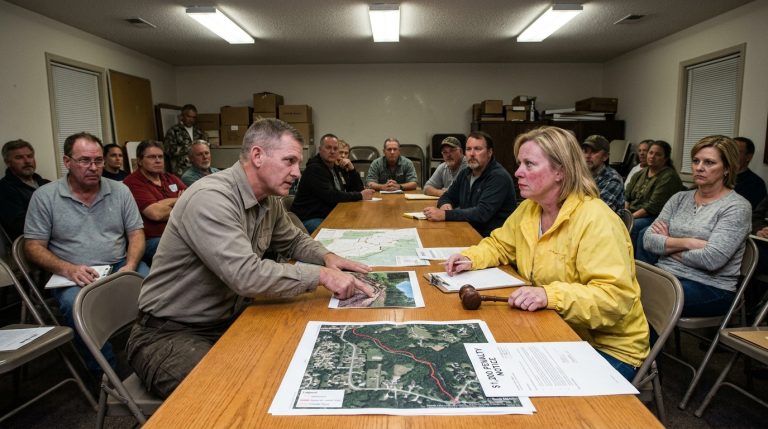
The room was packed wall-to-wall with residents standing shoulder to shoulder under the fluorescent glare.
Karen sat at the front table with two board members, her beige jacket stiff and her expression locked in artificial calm as she banged a wooden gavel.
“This unauthorized meeting is adjourned,” Karen announced, her voice rising above the murmurs of the crowd. “Anyone remaining will face immediate legal trespass notices.”
I walked down the center aisle, holding the certified copy of the 1892 federal land patent against my thigh.
“You can’t trespass on a public right-of-way, Karen,” I said, my voice cutting cleanly through the space without a shout.
She slammed the gavel down again, her knuckles whitening against the wood.
“You’re a disgruntled outsider,” she spat, her face flushing a deep, mottled red. “The architectural review committee has absolute authority over this entire valley.”
“That committee hasn’t seen the county’s tax routing records or the federal patent,” I replied, placing the heavy parchment squarely on her table over her clipboard.
Tom Davidson stepped up beside me, laying out the management credit card statements detailing the unauthorized capital draws.
“Embezzlement isn’t an architectural violation, Karen,” Tom said plainly. “It’s a felony.”
Panic flickered in her eyes as she scanned the signatures on the financial log, her mouth opening and closing without sound before she lashed out with a desperate counter-move.
“It’s all a forgery!” she screamed, knocking the papers to the floor. “They broke into the management office! Arrest them!”
The two sheriff’s deputies standing near the back exit didn’t move toward us.
Instead, they walked forward, their boots clicking rhythmically against the tile floor, and stopped directly behind Karen’s chair.
“Karen Peterson,” the lead deputy said, resting a hand on his belt. “You need to come with us.”
As they pulled her arms back and secured the cuffs, she glared across the room with unyielding venom.
“You ruined everything!” she snapped.
“No, Karen,” I said, watching her get led toward the exit under the camera lights of the local reporter. “I just held up a mirror.”
Weeks later, the community pool echoed with the laughter of children playing around newly erected wooden playsets.
I sat on the front porch of the homestead at sunset, holding a warm mug of coffee while my grandfather’s newly recrromed Ford F-250 gleamed under the evening light.
The old stone wall stood silent and unbroken against the valley breeze.
Good fences really do make good neighbors, so long as everyone knows exactly where the boundary lines are drawn.