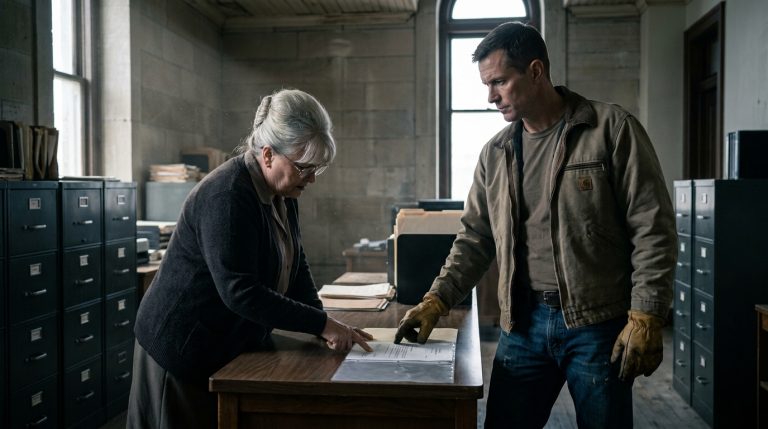
The Iron Perimeter: A Cold-War Recoil in the Quiet of North Ridge Meadows
CHAPTER 1: THE BOUNDARY LINE
The envelope didn’t just sit in my hand; it had the specific, dead-weight pull of a court order, delivered by a woman who smelled of industrial lavender and dry rot.
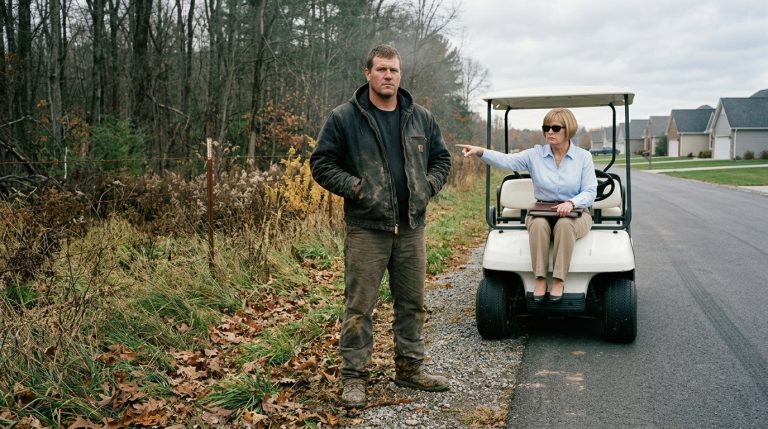
Karen stood on the gravel shoulder of Oak Ridge Trail, her heels sinking slightly into the soft, rain-loosened granite of my driveway. Behind her, the electric hum of her beige golf cart vibrated in the damp air—a low, insect-like drone that seemed to irritate the pine needles resting on the hood. She had her chin tilted up, her throat tight with a posture she’d likely practiced in the mirror of her three-bedroom suburban colonial down the road.
“Thirty days, Mr. Callahan,” she said. Her voice didn’t carry; it rasped, scraping like a flat shovel against dry concrete. “We aren’t in the unincorporated flats anymore. The Board has voted. The silo is a non-conforming agricultural blight, and it comes down. Or we start the daily assessments.”
I didn’t answer right away. I let my thumb slide along the top edge of the envelope. The paper was heavy stock, the embossed gold seal of the North Ridge Meadows Homeowners Association slightly off-center. I looked past her shoulder toward the back of my ten acres, where the galvanized steel panels of the silo rose through the dark canopy of the ponderosa pines. At ninety feet, the cylinder was a silver finger pointing straight up into the gray underbelly of the valley’s rain clouds. To her, it was an eyesore. To me, it was the structural housing of a high-gain relay node holding the valley’s only digital pulse.
“This property was built out before the first asphalt was poured for your subdivision, Karen,” I said. My voice was flat, level, the pitch I used when setting the calibration dials on a tactical transceiver.
“The covenants are retroactive to all parcels within the subdivision boundary, Mr. Callahan,” she replied. She reached down to smooth the front of her floral print mumu, a movement designed to hide the slight tremor in her fingers. “You signed the boundary joinder when the county annexed the ridge. Or perhaps your memory isn’t what it used to be.”
She turned back to her golf cart, her weight shifting heavily onto the plastic seat. She didn’t look back as she spun the wheel, the knobby tires spitting three pieces of gray crushed rock against my mailbox post.
I stood there until the sound of her electric motor died behind the ridge. Only then did I look down at my western fence line.
There was a physical discrepancy.
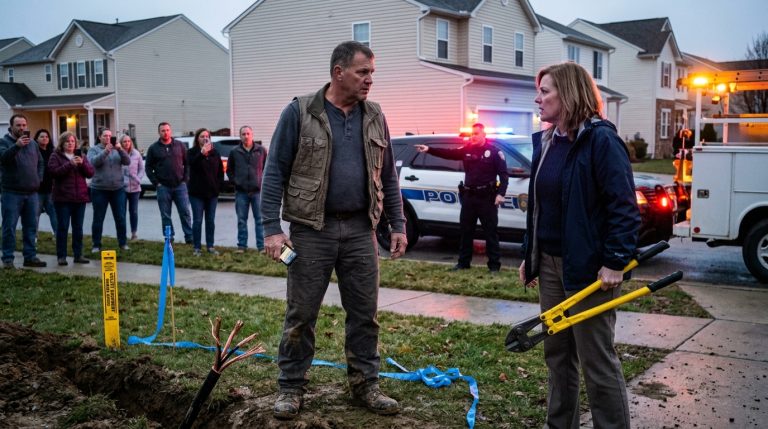
Two feet from my corner post, a fresh survey stake with a strip of fluorescent orange flagging was driven into the black soil. It hadn’t been there yesterday. The pine wood was clean, white, and split at the top where a heavy mallet had struck it. It was driven deep, exactly two inches on my side of the wire.
I knelt in the damp grass, my hand brushing the cold, galvanized wire of the fence. I reached out and pulled the stake from the earth with a single, sharp tug. The damp soil clung to its tip, smelling of leaf mold and rotted oak.
They weren’t just checking the view. They were measuring the perimeter.
I walked back toward my workshop, the wood stake balanced across my palm like a cold barrel. Inside, the air was dry, smelling of mineral spirits, machine oil, and the sharp scent of cedar shavings from my workbench. I placed the white stake next to my old brass plumb bob, watching the heavy metal weight sway on its cord, its pointed tip hovering a fraction of an inch above the scarred oak surface of the table.
The boundary lines were clear. The battle wasn’t about the silo’s rust. It was about who owned the air above it.
CHAPTER 2: THE COLD ARCHIVE
The gravel was still settling into the ruts of my driveway when I stepped over the threshold of my workshop, the white survey stake balanced in my left hand. Its splintered cedar base was still damp from the soil, leaving a dark smudge across my palm that smelled of decomposed pine needles and iron ore.
I set the stake down on the clean edge of the workbench, right beside the disassembled components of my old AN/GRC-206 tactical radio. The brass plumb bob, heavy and tarnished with thirty years of skin oils, swung in a slow, precise circle over the oak grain. The tip pointed down at the exact center of a penciled grid I had drawn on the wood three winters ago. I watched the swing decay, millimeter by millimeter, until the point hung perfectly motionless.
Outside, the first real rain of the season began to hit the corrugated tin roof of the workshop. It was a rhythmic, hollow clicking, like a hundred small relays closing at once.
I didn’t open Karen’s envelope yet. Instead, I stood by the door, listening to the water find the rusted seams in the metal gutters. In the field, you didn’t look at the payload until you mapped the delivery vector. I knew the physical boundaries of this acreage by heart—every surveyor’s monument, every cedar post, and every line of barbed wire I’d pulled taut with a come-along after the Air Force retired me. The fact that someone had driven a white stake two inches inside my wire wasn’t a mistake. It was a probe. They were testing the line to see if the sensor tripped.
I wiped my dirty palm on my canvas trousers, walked to the back corner of the workshop, and stood before the filing cabinet. It was an old military-surplus steel four-drawer unit, olive drab, with a locking bar that required a heavy brass padlock. The key was on my ring, worn thin and smooth at the edges. I inserted it, turned the cylinder until it clicked, and swung the heavy steel bar down.
The drawer slid out with a metallic screech that echoed off the high rafters. The green hanging folders inside were filed by date, beginning with my discharge papers from the communications wing at Ramstein and ending with the property deeds from nineteen years ago.
I pulled the folder labeled Omnilink-99 Lease.
The paper was thick, twenty-pound bond that had gone slightly yellow at the margins where the mountain air had reached it. I laid the document flat under the workbench light, the cold fluorescent tube flickering once before settling into a steady, hum-free glow. On page four, under Section 11A, the text was clean and unmarred by the passage of time:
…the Lessor hereby covenants that the structural easement designated as Tower Site Sector-734 shall remain unencumbered by any subsequent local, municipal, or private covenant enacted after the commencement date of this agreement, pursuant to the federal protections of the Telecommunications Act of 1996.
I traced the words with my thumb. The signature at the bottom was David Chen’s, written in a tight, vertical script that looked like it had been drafted with a technical pen. Beside his name was a small, blue stamp: Omnilink Infrastructure – Sector-734 Protocol.
I pulled my cell phone from my belt holster. The screen showed five full bars, the signal strong and clean, pulsing from the receiver disguised inside the fake silo three hundred yards away. I dialed the number I had memorized during the installation phase, fifteen years ago.
“Chen,” the voice answered on the second ring. It was dry, backgrounded by the soft, synthetic hum of a server room somewhere in Denver.
“David,” I said. “It’s Jack Callahan. The neighbors have started driving wood.”
There was a three-second silence on the line, the kind of gap you get when a satellite link is routing through a regional uplink. “How far across the line?”
“Two inches,” I said, looking down at the white cedar stake on my bench. “And I’ve got an envelope with an HOA seal on it. They’re calling it an aesthetic blight.”
“They’re fifteen years too late for an aesthetic argument,” David said, his voice dropping into a flat, legal cadence. “The Omniink-99 Lease is registered with the county recorder’s office under the master plat. If they try to touch the structure, they’re violating federal easement law. I’ve got three field engineers on the western slope right now. Do you need a perimeter check?”
“Not yet,” I said, my eyes tracking the slow drip of water from the workshop’s eave onto the gravel outside. “I want to see how much weight they put on the shovel before the handle snaps. Don’t send the regional legal team in with a hammer. Not yet.”
“Your call, Jack,” David said. “But the Sector-734 Protocol is always active. If they try to cut the main line, the NOC gets an automatic drop alarm. We won’t wait for a letter then.”
“Understood,” I said.
I hung up, placing the phone next to the lease. The rain was coming down harder now, the sound on the metal roof turning into a steady, dull roar that drowned out the hum of the valley below. I reached for the thick white envelope Karen had forced against my chest.
I didn’t use my hands to tear it. I picked up a clean utility knife from the tool rack, ran the blade along the top edge, and tipped the contents onto the oak table.
Three sheets of paper slid out. The first was a formal notice of assessment, the font clean and bureaucratic, listing a fine of five thousand dollars for a “non-conforming agricultural silo.” The second was a schedule of daily non-compliance penalties—five hundred dollars for every twenty-four hours the structure remained standing.
But it was the third sheet that made me stop.
It was a photocopy of a local plat map, showing my ten acres highlighted in pink. Across the western boundary, where the pines grew thickest, a series of hand-drawn red arrows pointed toward the silo. At the bottom of the map, in small, block letters, was a routing stamp that hadn’t been blacked out: Approved for Phase II Access – Meadow-Lush Holdings.
I picked up the heavy brass plumb bob, holding the cold metal in my hand, feeling its weight balance against the rising wind outside. They didn’t want the silo down because of the view. They wanted the corridor.
CHAPTER 3: THE REDACTED INK
The tip of the utility knife caught the edge of the photocopied plat map, pinning it to the scarred oak of my workbench. Beneath the cold glare of the fluorescent tube, the words Approved for Phase II Access – Meadow-Lush Holdings sat like a challenge. The ink on the photocopy was thick, a cheap laser-toner print that left a gritty residue when I ran my index finger over the paper.
I set the utility knife back into its magnetic groove on the tool rack. The brass plumb bob had finally stopped its slow, elliptical orbit, its polished point hovering precisely over the intersection of the grid lines on the wood. The wind outside slammed a heavy gust of rain against the northern tin wall, a sudden drumroll that rattled the loose steel washers sitting in an old tin can on the shelf.
My attention remained on the paper bundle.
Beside the map lay the chaotic stack of financial ledgers Eleanor Henderson and the others had extracted from the HOA. It was a dense pile of poor-quality reproductions, heavily marked by broad strokes of a felt-tipped black pen. I slid the sheets toward me, my thumbs turning the gritty pages one by one. The smell of stale photocopy toner and damp paper rose between us.
Most of the lines were entirely blackened—specifically the vendor payments and the names of the banks holding the secondary reserve accounts. But Karen’s team had been sloppy. On page fourteen, the thick marker had dried out slightly, leaving a series of faint, parallel gray streaks instead of a solid black block.
I bent lower, adjusting the articulating arm of the workbench lamp. Under the concentrated beam, the shape of the letters began to resolve. It wasn’t a standard utility company name. It was an outgoing check draft issued to a company called Meadow-Lush Holdings, routed through a regional bank branch in the lower county.
I reached for my magnifying glass—a heavy, steel-rimmed lens from my communications kit. I dragged the glass across the textured paper, tracking the faint, translucent ink trail.
There was a second, smaller document folded flat between the bank records. It was a white envelope, un-postmarked and clean, containing a single invoice printout. At the top left, a sharp-edged logo read Meadow-Lush Holdings. The address listed wasn’t an office suite or a commercial park. It was a post office box in the neighboring county, registered under the name of Todd’s sister’s holding company.
I leaned back, my hand resting on the smooth wood of the workbench.
They weren’t just attempting to clean up the neighborhood’s aesthetics. The “non-conforming agricultural structure” was a manufactured crisis designed to initiate a foreclosure protocol on my land. By establishing a continuous violation fine of five hundred dollars a day, they could accumulate a massive debt against my deed within sixty days. Once the lien was officially ratified by the board, Meadow-Lush Holdings could step in to purchase the debt, executing a quiet foreclosure to seize the ten-acre parcel for the planned Phase II corridor.
A sudden, sharp mechanical click came from the back wall.
The backup battery on my auxiliary receiver began to hum, its green indicator light cycling to amber. I walked over to the rack and touched the cold steel casing. The voltage meter was fluctuating, dropping two millivolts every ten seconds.
It wasn’t an internal short. It was an external draw on the line.
I opened the glass case of the terminal monitor. The diagnostic grid showed a minor but persistent signal drop along the western boundary trench—the exact location where the white cedar survey stake had been driven. Someone had been digging near the buried conduit for the Omnilink-99 Lease line, likely trying to map the depth of the armored fiber cable before bringing in heavy equipment for the HOA’s proposed perimeter fence.
I pulled my cell phone from my shirt pocket, my eyes fixed on the fluctuating voltage needle. The screen still showed five bars, but the diagnostic log on the utility app showed a series of packet losses along the Sector-734 Protocol loop.
I picked up a heavy, rubber-coated flashlight and slid my yellow rain slicker over my shoulders. If they were working the wire in this rain, they were desperate to get the measurements done before the county inspectors arrived.
“Marcus,” I said when the line connected, my voice barely louder than the steady rattle of water against the workshop door.
“Go ahead, Jack,” his voice came through, crisp and immediate, accompanied by the background clink of brass reloading dies.
“Get your boots on,” I said. “We need to look at the western ditch. They’re trying to locate the armored line.”
“I’ll meet you at the culvert in five,” he replied.
I cut the connection, slid the phone into my inner pocket, and grabbed my dry-erase marker. Before I left the workshop, I drew a thick, black line across the plat map, connecting the location of the white stake directly to the P.O. Box of Meadow-Lush Holdings. The trap wasn’t just physical anymore. It was documented.
I pushed the heavy wood door open, stepping out into the cold, driving rain of the ridge.
CHAPTER 4: THE STORM RECON
The rain didn’t fall in drops; it came down in hard, angled sheets that felt like fine grit throwing itself against my face. As my boots cleared the doorframe, the heavy oak slab slammed shut behind me, the latch catching with a metallic thud that was instantly swallowed by the storm.
I pulled the hood of the yellow slicker lower, shielding my eyes as I switched on the rubber-coated flashlight. The beam was a solid, milky cone cut by the dark diagonals of the downpour. I kept the light low, painting the wet pine needles on the ground. Water was already pooling in the shallow ruts of my tractor path, turning the red clay into a slick, deceptive slurry that dragged at the soles of my boots.
I walked west, taking long, deliberate strides. My hand rested on the pocket of my coat, feeling the solid, angular wedge of my mobile terminal beneath the canvas.
The drainage ditch along the western perimeter was a hundred yards out, cutting through a thick stand of black oaks before meeting the county culvert. Under normal conditions, the ditch was a dry, rocky seam filled with leaf litter. Tonight, the roar of rushing water reached me before I even cleared the trees—a low, gravelly grinding of stones shifting under immense pressure.
A second light appeared through the dark trunks ahead. It was sharp, white, and bobbed with a rhythmic, military stride.
“Jack!” Marcus’s voice was a dry bark, slicing through the wash of the wind.
He stepped out from the shadow of a sprawling oak, his Gore-Tex jacket slicked black with water. He carried a heavy iron spade over his shoulder, the steel edge catching the stray glare of my flashlight.
“The culvert is backed up,” Marcus said, his teeth catching the light as he spoke. “The runoff from the new subdivision asphalt is dumping straight down our draw. It’s not just a puddle. It’s a flume.”
I swung my flashlight beam down into the ditch. The sight made my jaw tighten.
The ditch was a brown, frothing torrent, three feet deep and rising. The current was carrying broken branches, plastic silt fencing from the construction site uphill, and chunks of dislodged red clay. Exactly where the white survey stake had been driven, the rushing water had carved a deep, raw bite into the bank, exposing the thick, black sheath of the armored fiber cable.
The plastic outer jacket of the line was completely bare, suspended like a tense wire across a four-foot gap where the earth had collapsed. A heavy pine limb, swept down by the current, was pinned against the cable, the weight of the water shoving the rough wood directly into the protective conduit.
“That’s the main feed for the Sector-734 Protocol,” I said, my voice tight. “If that branch snaps the core fibers, the whole valley goes dark before we can set the legal floor.”
“The grade is failing,” Marcus observed, stepping closer to the edge. The muddy bank beneath his boot gave way, a chunk of sod sliding silently into the brown rush. “If we don’t clear that block at the culvert, the erosion is going to undermine the entire anchor pad of the silo.”
“We don’t touch the block first,” I said, analyzing the physical load on the wire. “We stabilize the span. If we clear the block, the sudden surge will rip the cable out of its sleeve.”
I unzipped my inner pocket and pulled out the mobile terminal. The screen was wet, the capacitive glass flickering as rain hit the panel, but the diagnostic loop was still active. The packet loss had spiked to fifteen percent. The physical tension on the line was stretching the internal glass cores, refracting the light pulses before they could reach the transceiver.
“We need a deadman anchor,” I told him. “The old steel fence posts in the shed. We drive them three feet back from the break and lash the cable with the wire rope.”
Marcus didn’t waste breath arguing. He nodded once, the brim of his hood dripping water onto his collar. “I’ll fetch the post driver and the aircraft cable. Keep that limb from bouncing.”
He turned and dissolved back into the dark wood, his boots making a heavy, sucking sound in the saturated earth.
I knelt at the edge of the collapsing bank, the mud soaking through the knees of my trousers. I reached down, my bare hands finding the rough, wet bark of the pine limb pinned against the conduit. The cold water ran up my sleeves, numbing my forearms within seconds. Every time a fresh surge of runoff hit the limb, I could feel the vibration through the cable—a high-frequency shudder that told me the glass inside was reaching its mechanical limit.
Through the rain, a pair of headlights flickered on the ridge road above my fence line. A white utility truck was idling on the wet asphalt, its amber roof-beacons rotating silently in the mist.
They weren’t engineers. The logo on the door was too small, too clean. Even through the downpour, I could recognize the block lettering of Meadow-Lush Holdings. They were waiting for the line to fail.
I braced my boots against a protruding oak root and gripped the pine branch, holding my position against the current. I didn’t pull. I just held the load steady, matching the physics of the storm with the dead weight of my own shoulders, waiting for Marcus to return with the steel.
CHAPTER 5: THE BOUNDARY STAKE
The headlight beams from the ridge road cut through the downpour, illuminating the individual fat drops of rain as they pelted the black water of the ditch. My shoulders burned. I dug the heels of my boots deeper into the clay, the fibers of my yellow slicker groaning against the strain as I held the wet pine limb steady, keeping its rough, heavy bark from crushing the exposed conduit.
A shadow broke the beam of the truck up on the ridge. A figure was standing near the guardrail, silhouette framed in yellow amber, watching the ditch. They didn’t move to help; they were simply measuring the failure.
The heavy thud of boots on mud returned from behind me. Marcus slid down the slick embankment, his arms loaded with three green-painted T-posts and a spool of braided aircraft cable that glinted like coiled silver in the beam of my flashlight. He dropped the heavy post driver into the mud with a dull, wet clink.
“They’re watching from the line,” Marcus muttered, his breath coming in short, white plumes in the cold air. He didn’t look up at the headlights. He simply stepped into the rushing water of the ditch, his boots sloshing through the brown current.
“Let them watch,” I said, my teeth clenched as a fresh surge of water threatened to twist the branch from my grip. “Drive the first anchor. Three feet back from the break. Now.”
Marcus swung the heavy steel post driver over the first T-post. The sound of metal striking metal was sharp, a high-velocity ringing that echoed off the trunks of the wet oaks. Clang. Clang. Clang. With each blow, the steel post sank deeper into the stable clay behind the wash.
He didn’t stop until the green steel was buried three feet into the earth, leaving only the notched head exposed.
“Cable,” I grunted, my forearms trembling as the lactic acid built up in my muscles.
Marcus uncoiled a length of the aircraft cable. The metal wire hummed as he pulled it taut, the tension singing in the damp air. He looped it twice around the buried post, then threaded the free end beneath the exposed conduit of the Omnilink-99 Lease line, bypassing the heavy pine branch completely.
“On three,” Marcus said, his hands gripping the cable sleeve. “Lift.”
We pulled together. The physics of the load shifted. The braided wire bit into the black outer sheath of the conduit, lifting it slowly, millimeter by millimeter, away from the grinding weight of the pine branch and the rushing water below. I felt the vibration through my palms change—the high-frequency shudder of over-stressed glass core fibers dying down, replaced by the dead, solid resistance of anchored steel.
I let go of the wet branch. It plunged instantly into the brown torrent, swept down toward the culvert like a broken bone.
The mobile terminal in my pocket buzzed twice. I pulled it out with numb, shaking fingers. The diagnostic loop on the screen had stabilized. Packet loss was dropping—ten percent, five percent, then a steady zero. The Sector-734 Protocol was holding its line.
Up on the ridge, the headlights of the utility truck flickered. The driver put the vehicle in reverse, the tires whining against the wet asphalt as it backed away from the boundary line and disappeared into the gray mist of the subdivision.
“They wanted a clean break before morning,” Marcus said, wiping a mixture of sweat and rainwater from his forehead with the back of his hand. “They wanted to claim natural erosion took the utility line out. That would have given the HOA’s lawyers the leverage to demand immediate easement access to clear the ‘hazardous obstruction’ on your land.”
“But they didn’t get it,” I said.
I looked down at the newly driven steel post, its green paint scratched where the aircraft cable had bitten into the zinc coating. It was a permanent anchor now, a physical monument of our counter-presence driven deep into the contested dirt.
I reached down and picked up my flashlight, the rubber grip cold and greasy with mud. I pointed the beam back toward the western fence line, where the white survey stake had been pulled. In its place, the surveyor’s crew I had hired earlier in the week had driven a series of professional yellow-capped brass markers, deep into the rocky limestone base of the ridge.
“We need the official map certified by the county recorder first thing in the morning,” I said, my voice flat, returning to the tactical rhythm that had kept me alive in the service. “If they try to argue the boundary lines at the emergency meeting, we don’t present theories. We present registered coordinates.”
“The meeting is scheduled for Tuesday,” Marcus said, his eyes tracking the muddy water as it slowly began to recede, the worst of the flash flood passing. “Karen’s already sent out the community-wide notice. She’s calling it a ratification vote for the demolition lien.”
“Let her call it,” I said, looking back toward the dark outline of the silo rising through the trees. “She thinks she’s setting up an execution. We’re just letting her build the platform.”
I turned and began the slow, heavy walk back to the workshop, my boots dragging in the wet clay, Marcus walking a pace behind me with the post driver slung across his shoulder like a cold iron rifle.
CHAPTER 6: THE FORGED SEAL
My wet wool socks felt like lead inside my boots as we reached the gravel apron of the workshop. The yellow slicker clung to my chest, stiffened by the cold mountain runoff, shedding a small pool around my feet as I reached for the brass handle of the door. Inside, the quiet was absolute, broken only by the steady, high-frequency hum of the power supplies idling on the equipment rack.
I stood in the center of the room, my shoulders dropping as the adrenaline from the trench slowly receded, leaving behind a deep, cold ache in my lower back. Marcus hoisted the iron post driver onto the steel storage rack by the door. The metal clanged against the frame, a sharp, flat sound that cut through the silence. He didn’t take his hood off; he just stood there, his chest rising and falling in slow, controlled cycles.
“The wind is shifting to the north,” Marcus said, his voice husky. He reached into his pocket and pulled out his pocketknife, scraping a chunk of gray clay from the heel of his left boot. “Which means the rain is going to freeze before dawn. If they try to bring heavy equipment down that ridge trail tomorrow, they’ll slide straight into the ravine.”
“They won’t bring machines tomorrow,” I said, peeling the wet canvas gloves from my fingers. My skin was wrinkled, bone-white from the moisture, and smelled of rusty steel. “They don’t need to dig anymore. They saw the line didn’t go dark.”
I walked back to the workbench, where the magnifying glass still sat over the redacted bank statements. Beside the ledger, a fresh piece of paper lay where I had dropped it before heading out to the trench—a yellow slip of weather-resistant paper I’d pulled from a plastic sleeve stapled to the boundary post near the road.
I picked up the heavy brass plumb bob, letting its solid, cold weight settle into my palm to ground my focus. With my other hand, I slid the yellow slip under the lamp.
It was a Notice of Emergency Abatement, dated three days prior. The heading bore the official seal of the County Planning and Zoning Commission. The text stated that due to a “structural hazard posing immediate danger to the public wireless grid,” the county had authorized the North Ridge Meadows HOA to execute a “curative clearing” of all unauthorized structures along the western easement corridor.
I brought the magnifying glass down to the bottom of the page.
The signature was a messy scrawl above the typed name of Arthur Vance, Chief Zoning Inspector. But the ink was wrong. It was a standard blue ballpoint pen, but the physical impression on the paper was completely flat. On a real county notice, the administrative seal was dry-stamped, leaving a raised, textured perimeter you could feel with your thumb. This paper was completely smooth.
“They forged the inspector’s sign-off,” I said, my voice dropping into a register that made Marcus look up from his boots.
He walked over, his heavy stride vibrating the floorboards. He leaned over my shoulder, the wet nylon of his jacket brushing my arm. “Vance? I met him at the county office when I pulled the permit for my flagstaff. The man doesn’t sign anything without using the county’s red-ink registrar stamp. He’s meticulous about it.”
“Exactly,” I said. “This was printed on a commercial office machine. Probably the one in the HOA management suite. They needed a physical document they could show to a deputy if I tried to block their crew at the fence line.”
I pulled my phone from my pocket. The diagnostic screen for the Sector-734 Protocol was completely green now, but a new alert was flashing in the corner—a notification of an emergency docket entry filed with the county district court.
I tapped the screen. It was an application for an expedited injunction, filed by the HOA’s law firm. They were requesting a temporary restraining order to prevent me from “interfering with safety-critical utility maintenance along the western boundary.” The hearing was set for Tuesday morning, three hours before the special board meeting.
“They’re running a double-track play,” I told Marcus. “They use the court to tie my hands on Tuesday morning, then they use the special meeting on Tuesday night to ratify the foreclosure lien under Meadow-Lush Holdings before the legal department at Omnilink can file their federal preemption response.”
“It’s a tight loop,” Marcus said, his jaw tightening. “They’re betting we can’t get the certified survey maps through the county recorder’s office before the judge signs the order.”
I looked down at the forged notice, then back at the green indicator light of the Omnilink-99 Lease terminal. The light was steady, pulsing with a cold, rhythmic certainty that no local board could touch.
“They’re betting on the wrong speed,” I said. “We don’t wait for Tuesday morning to show our hand to the judge. We drop the survey coordinates and the forgery audit onto the court’s digital registry tonight.”
I sat down at the desk, my fingers cold against the plastic keys of the computer terminal as I began drafting the response. The rain outside had turned to sleet, a hard, crystalline clicking against the tin walls that sounded like a countdown.
CHAPTER 7: THE COLD SIGNAL
The computer screen pulsed once as the upload status bar reached one hundred percent, changing from a harsh yellow warning to a flat, silent blue checkmark: Filing Accepted. Case #26-041-CV.
My frozen finger peeled away from the plastic return key. The sleet hitting the glass window behind me sounded like a handful of gravel thrown against a tombstone, sharp and irregular. I sat rigid in my metal swivel chair, my damp flannel shirt stiffening around my shoulders as the small electric space heater under the desk clicked, its orange coils slowly fading into dull charcoal gray.
Marcus didn’t move from his spot near the gun rack. He stood with his arms crossed over his wet canvas coat, his eyes locked on the amber diagnostic screen of the wireless terminal. The fan inside the server chassis gave a sudden, high-pitched whine, then settled back into its rhythmic, mechanical purr.
“The court’s automated clerk just routed the copy to the HOA’s registered agent,” Marcus said, his gravelly voice flat. “If Todd or Karen have their alerts on, their phones are buzzing right now.”
“They won’t back down because of a digital filing,” I replied, standing up slowly. My knees made a dry, popping sound in the cold room. I picked up the heavy brass plumb bob from the table, feeling the cold weight of the metal press into the calluses of my hand. “A forged county signature is a criminal charge, but Karen doesn’t think the county applies to her. She thinks the ridge is its own closed system.”
“The meeting is in twelve hours,” Marcus said. “The storm is going to clear by morning, but the temperature is dropping. If they’ve already hired a contractor to serve that lien notice, they’ll be at the community hall before the doors officially open.”
“Then we make sure the hall is crowded,” I said.
I walked to the steel cabinet, took out the folder labeled Omnilink-99 Lease, and slid it into my black leather briefcase. I added the original certified plat map, the high-resolution scan of the forged zoning notice, and the unredacted bank records that pointed directly to the registered P.O. box of Meadow-Lush Holdings. Every document was a piece of cold steel, shaped to fit a specific slot in the mechanism of their self-destruction.
I looked out the small window of the workshop. Through the dark pine boughs, three miles down the ridge, the yellow sodium streetlights of the North Ridge Meadows subdivision flickered like a dying circuit. They looked fragile from up here—dozens of identical rooftops covered in a thin, gray crust of ice, all of them relying on the silent, high-gain signal of Tower Site Sector-734 to connect them to the world outside their fences.
“Let’s move,” I said, snapping the locks of the briefcase shut. The metallic snick was sharp, final. “We have seven families to visit before the ice freezes the roads completely.”
We stepped out into the biting cold of the morning, the sleet stinging my cheeks as we made our way to the truck. The tires of my F-150 crunched over the frozen gravel, heading down the mountain toward the community center where the trap was waiting to be sprung.
Tuesday evening arrived with a quiet, frozen stillness that hung over the valley like a sheet of dirty glass.
The community center was a low-slung, concrete-block building, its double glass doors fogged from the heat of the packed room inside. When Marcus and I pushed through the entryway, the blast of warm, dry air smelled of damp wool, cheap floor wax, and stale coffee. The room was buzzing—not with the polite murmurs of a standard budget meeting, but with a tense, low-frequency hum that vibrated in the soles of my feet.
Every chair was occupied. Eleanor Henderson sat in the second row, her small, gloved hands clasped tightly over her handbag, her eyes fixing on me with a sharp, encouraging nod as I walked down the center aisle. Behind her, Mr. Garcia stood with his arms folded over his chest, his face set in a hard, uncompromising line.
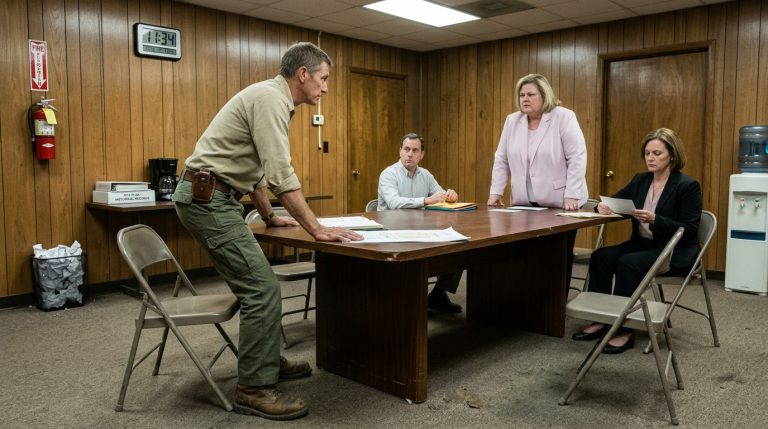
At the front of the room, behind a long folding table covered in green felt, sat Karen and Todd.
Karen wore a heavy, plum-colored blazer that looked stiff and synthetic under the buzzing fluorescent tubes. Her face was flushed, a bright, mottled red that matched the plastic folder resting before her. To her left, Todd was systematically clicking a silver ballpoint pen—click-clack, click-clack—his eyes darting toward the double doors every time the draft whistled through the frame.
“This meeting is called to order,” Karen announced, her gravelly voice cutting through the hum. She didn’t use the gavel; she slammed her palm down on the felt table, making her water glass rattle. “We have a single item on the agenda tonight: the ratification of the emergency demolition lien against parcel 141-Oak Ridge.”
She paused, her narrow eyes scanning the crowd until they locked onto me. I sat in the third row, the leather briefcase resting flat across my knees. I didn’t lean back. I kept my spine straight, my posture mimicking the level vertical of my plumb bob.
“The Board has received certified notification from the regional planning commission,” Karen continued, her voice rising with an aggressive, rhythmic cadence. “The non-conforming agricultural structure at 141 Oak Ridge is in direct violation of municipal safety codes. The fines have reached twenty-five thousand dollars, and under the bylaws of this association, we are voting tonight to authorize immediate foreclosure proceedings to clear the corridor.”
“The Board is lying,” a voice cut in from the back.
It was Marcus. He didn’t stand up; he just let his deep baritone carry across the concrete walls. The room went instantly silent, the only sound the high-pitched hiss of the old steam radiators along the wall.
“You’ll have your turn to speak during the resident comment period, Mr. Vance,” Karen snapped, her fingers digging into the edge of her folder. “Right now, the Board is executing its legal duty to protect the community’s infrastructure and property values.”
I stood up. I didn’t rush. I unlatched the briefcase, the metallic snick echoing in the quiet room, and pulled out the white, un-postmarked envelope we had found in the ledger.
“This isn’t about property values, Karen,” I said, my voice quiet, carrying the flat, level tone of a tactical briefing. “And it isn’t about an agricultural silo.”
I walked toward the front of the room, placing the white sheet of paper directly on the felt table in front of Todd. He stopped clicking his pen. His fingers stayed frozen on the plastic barrel.
“That’s a copy of the filing we submitted to the district court last night,” I said, looking from Todd to Karen. “Along with a certified survey from the county recorder’s office showing that your new fence line sits exactly two inches inside my deeded boundary. And this.”
I reached into the briefcase and pulled out the yellow county zoning notice with the forged signature.
“This is the notice you used to justify your emergency clearing. Arthur Vance didn’t sign this, Karen. The county registrar’s office confirmed this morning that no inspection was ever ordered for parcel 141. The digital signature was lifted from a three-year-old road maintenance permit and printed on the laser copier in your basement.”
A collective gasp went through the room. Eleanor Henderson leaned forward, her eyes wide.
“You’re out of order, Jack!” Karen shrieked, her voice cracking as she stood up, her chair scraping violently against the linoleum floor. “That document is a certified administrative directive! If you don’t sit down, I’ll have the deputy at the door remove you!”
“The deputy is already reading the court docket, Karen,” I said, my eyes tracking the dark, sweating skin of her forehead. “And so is the county prosecutor. But let’s talk about why you wanted that corridor cleared so badly.”
I clicked the remote in my hand, activating the community center’s overhead projector. A bright, sharp image filled the white screen behind her folding table. It was the business registration sheet for Meadow-Lush Holdings.
“The landscaping company, Lush Greenscapes, isn’t an independent contractor,” I said, my voice echoing off the concrete blocks. “It’s a subsidiary of Meadow-Lush Holdings. A shell corporation registered to Todd’s sister, with Karen listed as the sole managing director. Every dollar this neighborhood paid in ‘fines’ was routed through Meadow-Lush to pay for ‘Phase II engineering’—an unapproved expansion plan designed to condemn my parcel and sell the right-of-way to a national developer.”
Todd stood up, his face the color of wet chalk. “This is… we didn’t… the Board has the authority to allocate funds—”
“You allocated forty thousand dollars of community dues to your own family’s bank account, Todd,” I said, my hand dropping to my pocket, finding the cold glass screen of my mobile terminal. “And you tried to cut the fiber optic line to my tower last night to simulate an emergency hazard. But you didn’t know the core of that tower is protected by the Sector-734 Protocol.”
I pulled the terminal out, the screen glowing bright amber under the fluorescent lights.
“Let’s see what happens when the community loses its signal,” I said.
I tapped the screen once.
The signal bars on every phone in the room dropped to zero. A high-pitched, electronic chime rang out from Todd’s pocket as his own device lost connection, followed immediately by a chorus of diagnostic beeps from dozens of phones throughout the crowd. The quiet panic was instantaneous—heads dropping, fingers scrolling frantically, faces pale under the green glow of dead screens.
“Turn it back on!” a man in the back yelled, his voice laced with sudden, real-time fear. “My wife is on oxygen—her monitor just went offline!”
“That tower isn’t an eyesore, Karen,” I said, turning my back on her and facing the packed room. “It’s the only link this valley has. And she was going to tear it down to line her pocket with Meadow-Lush developer fees.”
The room erupted. The sound was a solid wall of noise—not of confusion, but of cold, collective fury directed at the long felt-covered table.
Karen sank back into her chair, her face a bloated, blotchy mask of defeat. Her plum-colored blazer looked small now, wrinkled and cheap under the bright lights, her petty kingdom collapsing into the damp linoleum around her boots.
CHAPTER 8: THE RESTITUTION
The plastic keys of Karen’s cell phone did not click; they lay completely dead under the white glare of the fluorescent tubes. A heavy, airless silence followed the roar of the crowd, settling over the green felt of the folding table like dust on a concrete floor. I stood three feet from her, my leather briefcase still open on the wood, the cold amber display of my mobile terminal pulsing in the palm of my hand.
Karen’s mouth opened, but only a dry, whistling sound came out. Her eyes darted from the dark screen of her dead phone to the projection behind her head, where the digital registry of Meadow-Lush Holdings lay exposed in block letters. She reached out, her thick fingers clawing at the edge of her plum-colored folder, but her hand lost its grip, sliding off the slick plastic and knocking her water glass onto the floor. The heavy tumbler shattered with a sharp, flat crack, sending a radial pattern of clear water and glass shards across the gray linoleum.
None of her loyal supporters moved to clean it. Todd was already backward-stepping toward the emergency exit, his shoulder blades hitting the wood frame of the door with a hollow thud.
“Todd,” I said, without raising my voice. “The deputy in the hall has the county’s digital warrants. If you clear that door, you’re changing a misdemeanor subpoena into a felony flight.”
Todd’s boots stopped sliding. His posture went completely rigid, his gaze dropping to the shattered glass at his feet. The hum of the room returned, lower now, a dangerous, vibrating growl from the residents who had lived under their ledger-shuffling for two years.
Karen slowly pulled her hands back, folding them into her lap as if trying to hide the twitching muscle in her right wrist. “This is… an administrative misunderstanding, Jack,” she whispered, her voice scraping like dry shale. “The Board has the discretion to consolidate accounts for community safety. The Phase II corridor was planned to lower everyone’s infrastructure burden.”
“The only burden you consolidated was the private tax shelter, Karen,” I said. “You used the HOA’s reserve assessments as a forensic shield to buy up the easement rights under Meadow-Lush Holdings, planning to sell the right-of-way back to the county at a four-hundred percent markup. You didn’t want the silo down because of the view. You wanted the Omniink-99 Lease voided so you could clear my ten acres without a federal interference claim.”
I tapped the terminal screen one last time.
The Sector-734 Protocol cycled back to baseline. Instantly, a hundred phones in the room chirped, vibrated, and chimed as the high-gain signal flooded back into the valley. The digital dark age ended as quickly as it had begun, but the warmth did not return to Karen’s face.
She looked down at the forged zoning notice lying on the felt, her shoulders slumping into the cheap fabric of her blazer. The illusion of her authority was gone, stripped down to the raw utility of the legal codes she had tried to manipulate.
The cool down began almost immediately.
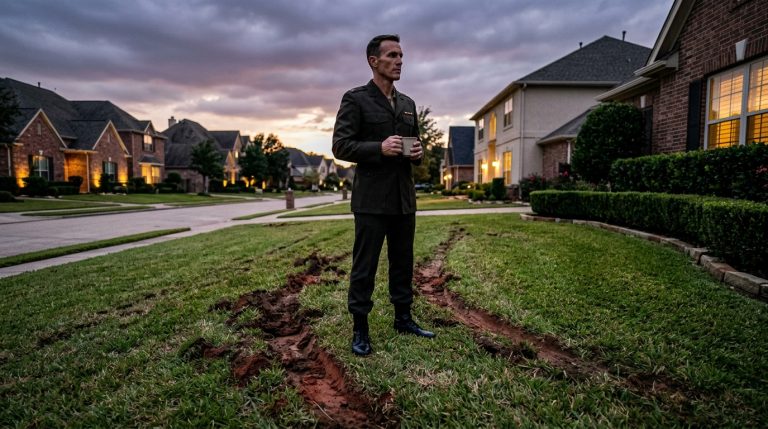
Within forty-eight hours, the county sheriff’s department had unsealed the formal indictments. I watched from the window of my workshop as the moving van arrived at Karen’s property three houses down the ridge. It was a grey, overcast Thursday morning, the sleet from the storm having cleared to leave the ponderosa pines covered in a quiet, crystal glaze of white frost. The smell of pressurized pine resin and cold damp earth was thick in the air.
Karen was carrying a cardboard box toward the back of the van, her steps slow, her heavy boots dragging on the frozen asphalt of her driveway. She didn’t look up at the ridge. She didn’t look at my silo. Her house was already listed on the county foreclosure database, her personal assets liquidated to meet the restitution order drafted by the new interim board.
I walked to my workbench, where the old AN/GRC-206 tactical radio was fully assembled, its gray steel casing clean and free of dust. Beside it, the heavy brass plumb bob hung perfectly still, its sharp point aligned precisely with the center of the hand-drawn grid.
I reached out and picked up the white cedar survey stake I had pulled from the mud on the first night of the conflict. It was dry now, the wood split along the grain where the soil had expanded. I picked up my hand plane, the carbon steel blade sharp and cold against my palm, and ran it along the rough side of the cedar.
The wood curled away in clean, thin ribbons that smelled of fresh forest floor. With three steady strokes, I shaved the white paint and the mud from the surface, exposing the clean, red heartwood underneath.
I set the tool down, the smooth cedar block balanced on the corner of the oak table. The line was clean. The boundaries were fixed.
Marcus stepped into the workshop, his boots dry, carrying a fresh pot of coffee. He didn’t say anything; he just set the metal pot on the wood burner and poured two tin cups, the hot, dark liquid steaming in the cold draft.
I took the cup, the heat soaking through my calloused palms, and looked through the clean glass of the window toward the silo. It stood tall against the pale mountain sky, its galvanized panels catching the first pale rays of the winter sun, silent, vital, and completely uncompromised.