The Concrete Wall and the Paper Empire: How One Retired Engineer Dismantled a Corrupt HOA
CHAPTER 1: THE YELLOW CLAMP
The voice on the other end of the phone drips with a slick, practiced indifference that scrapes raw against my nerves.
“That’ll be $500 for removal plus the $200 violation fee, Mr. Reynolds. Cash or credit card.”
I don’t answer. My grip tightens on the receiver while my eyes lock onto the bright, offensive flash of canary yellow clamped tight around the front tire of my meticulously restored 1978 Ford F-150.
The concrete floor of my garage is cold beneath my work boots, carrying the faint, familiar tang of motor oil and sawdust. The heavy steel roll-up door is half-open, framing the glaring afternoon sunlight and a freshly taped notice on the windshield.
Violation O47: Unauthorized storage of commercial vehicle. Authorized by Creekwood Estates HOA president Karen Miller.
I roll a scarred steel torque wrench over in my palm, letting the cold metal ground the hot surge of fury hammering in my chest. This isn’t a parking ticket; it’s a trespass, a forced seizure executed inside the private footprint of my own home.
The drone on the phone keeps talking about late fees and processing windows, but my mind has already stopped listening. The shock is gone, replaced instantly by the cold, clear calculation of a structural assessment.
I tap the screen of my phone to record the call’s active timestamp, keeping my voice entirely level and devoid of heat.
“I’m looking at the notice right now,” I say quietly, raising my camera to capture the exact serial number stamped into the lock of the yellow clamp. “And we are going to measure every single inch of this violation against your own governing documents.”
CHAPTER 2: DISSECTING THE ENEMYS BINDER
The heavy grain of the community bylaws rests flat against the mahogany table under the harsh glare of a single desk lamp.
I trace the tip of my red pen down Article 7, Section 3B, ignoring the cold coffee sitting half-forgotten beside my elbow.
The text is explicit, defining commercial vehicles and storage boundaries with dry, unambiguous legal precision.
My 1978 Ford F-150 is registered as a personal classic vehicle, kept entirely within the enclosed perimeter of my private garage.
The rule itself completely vindicates my position, stripping away every single pretext the board tried to hang their authority on.
I flip two pages over, my thumb catching on the crisp paper edge as I search for the mechanism they used to justify the morning raid.
Article 9, Section 1 grants the association right of entry onto any lot for emergency repairs or documented covenant violations.
The catch sits right there in black and white, demanding a mandatory 48-hour written notice delivered directly to the property owner before any action can occur.
No notice ever arrived in my mailbox, nor was an email or a digital warning logged anywhere in my personal records.
Their entire enforcement action crumbles on a basic procedural failure of their own making, exposing a reckless disregard for their own governing framework.
I drag the red pen across the margin, circling the missing clause that supposedly authorized a private booting company to seize personal property on private land.
Nowhere in the entire document does it grant the HOA or Prestige Management the power to attach physical hardware to a resident’s vehicle.
They invented a penalty out of thin air, weaponizing administrative overreach to turn a peaceful neighborhood into a tollbooth.
My phone rests face down on the table, silent for the moment, but the blueprint for their dismantling is already mapped across the legal pad.
CHAPTER 3: THE BEIGE FORTRESS SHOWDOWN
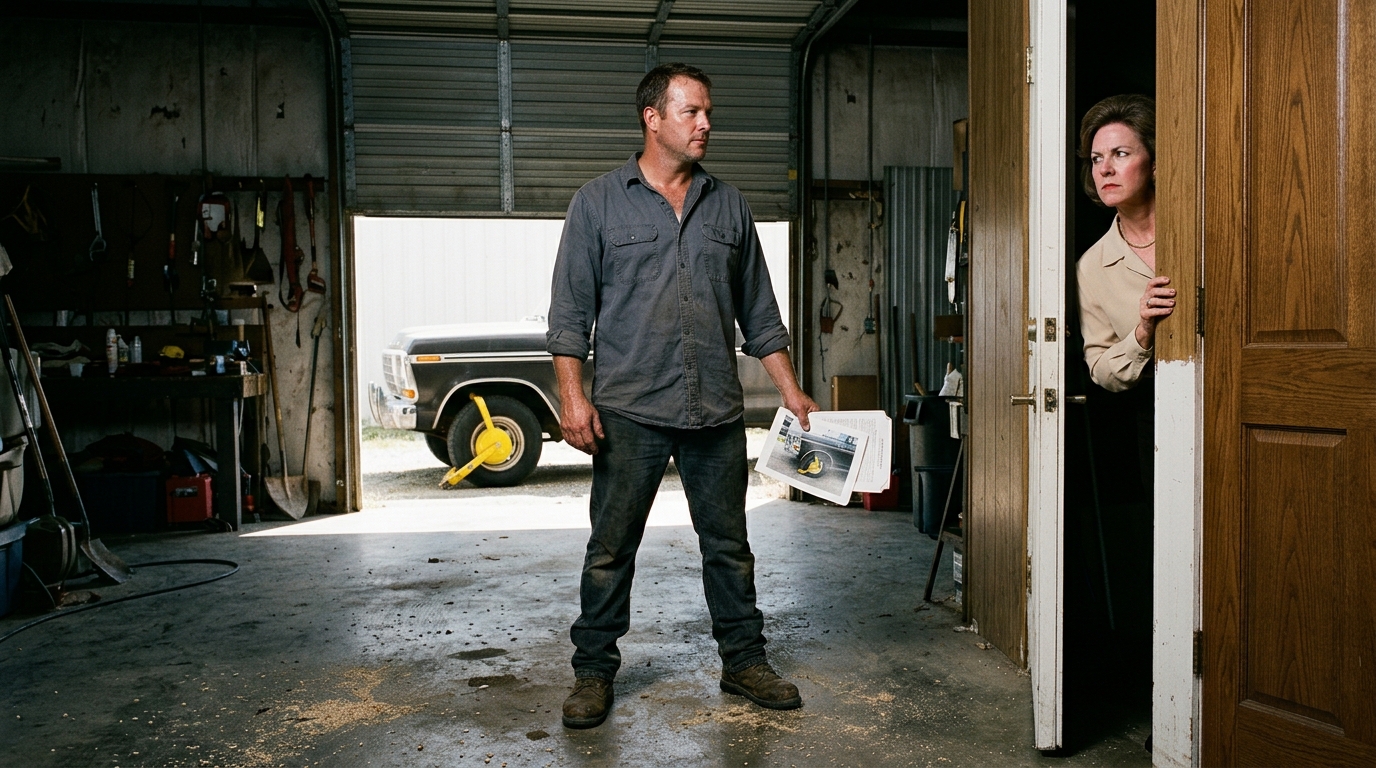
The heavy brass chain rattles against the oak door frame as Karen Miller pulls it back just enough to reveal a pair of narrowed, suspicious eyes.
“Yes?” she snaps, her voice carrying the exact imperious tone she uses to bully landscaping contractors.
I step forward, keeping my posture entirely relaxed while holding the crystal-clear photo flat against my palm.
“Mark Reynolds from 4217 Oak Drive,” I say, letting my tone drop into a flat, steady register. “I believe you authorized this.”
Her eyes flicker down to the image of the yellow hardware clamped onto my classic truck inside my private garage, and a tiny, arrogant smirk twitches at the corner of her mouth.
“Ah, the F-150,” she scoffs, shifting her weight behind the reinforced barrier. “We’ve had our eye on that vehicle. It doesn’t fit our community standards.”
“My truck is a registered classic vehicle parked inside my private garage,” I reply, pushing the folded legal notice and a copy of the photograph straight through the narrow crack in the door. “Your actions constitute illegal trespass and property seizure. This is a formal demand for immediate removal. You have twenty-four hours.”
The smirk vanishes instantly, replaced by a dark surge of indignant color flooding her face.
“How dare you?” she shrieks, her fingers digging white into the wood. “I am the president of this association, and that garage is a common visual element when your door is open!”
I don’t blink, holding my ground as the heavy door slams shut with a metallic crash against the chain.
CHAPTER 4: PAYING UNDER PROTEST
The phone hums against my ear as the automated voice confirms the transaction has cleared.
“Your payment of eight hundred dollars has been successfully processed,” the agent states smoothly.
I tap the screen to save the digital receipt directly into a dedicated folder titled DBPR Evidence.
The moment they accepted payment for an illegally imposed fee under formal written protest, the dynamic shifted completely from a civil dispute to a consummated financial crime.
A sharp notification pings across my laptop screen moments later, announcing that the physical yellow clamp has finally been removed from my property.
I walk out to the driveway and kneel beside the driver-side rear wheel of the F-150.
A jagged, fresh scratch mars the custom powder-coated finish of the aluminum rim where their crude removal tool slipped.
It is a minor physical blemish, but structurally it serves as tangible evidence of vandalism committed during an unauthorized seizure.
I snap three close-up photographs of the damaged rim, capturing the raw metal glinting under the sunlight.
The paperwork packet bound for the state regulatory board sits stacked neatly on the workbench, weighing nearly an inch thick with affidavits and photocopied bylaws.
Dave Sterling’s legal analysis clicks into place in my mind, confirming that the booting contractor lacks the mandatory county immobilization license required by state statute.
We aren’t just filing a complaint about a parking fine anymore.
We have engineered an airtight regulatory trap that will automatically pull the licensing carpet out from under their entire operation.
CHAPTER 5: THE ANNUAL MEETING RECKONING
The air inside the community clubhouse is thick with collective heat, over two hundred homeowners standing shoulder-to-shoulder along the walls.
Karen Miller grips her small wooden gavel at the front folding table, her knuckles stark white against the dark wood as she tries to shout over the mounting murmur of the crowd.
“This meeting is officially adjourned!” she shrieks, her face flushing a deep, mottled purple under the fluorescent lights.
Dave Sterling steps smoothly into the center aisle, holding up a heavy document binder without a shred of hesitation.
“The meeting continues under procedural rules, Madame President,” Dave states, his voice carrying effortlessly across the tense room. “We have over thirty percent of the homeowners signed on for an immediate recall petition.”
Barry from Prestige Community Management shifts nervously in his folding chair, his cheap plastic smile entirely gone as he fumbles with his briefcase latches.
I step forward next to Dave, dropping a fresh stack of state regulatory investigation files right onto their table with a sharp, echoing thud.
“You didn’t just misinterpret the bylaws, Karen,” I say, locking my gaze onto hers while the entire room leans in close. “You ran a predatory extortion racket, and the state Department of Business and Professional Regulation has already seized your operating files.”
Karen opens her mouth to snap a defense, but the words fail her entirely as a sea of hands shoots up uniformly across the room in a unanimous vote for her immediate termination.
CHAPTER 6: THE NEW NORMAL AND THE OPEN GARAGE
The smooth paste wax dries to a powdery haze across the midnight-blue metal of the front fender.
I work the clean microfiber cloth in slow, rhythmic circles, listening to the muffled groan of heavy cardboard boxes shifting inside a departing moving van down the street.
Karen Miller’s beige house sits vacant behind the freshly manicured lawns, its oversized presence stripped of every ounce of manufactured authority.
A sharp, cheerful crunch of gravel breaks the afternoon stillness as Mrs. Gable walks up the driveway holding a ceramic plate balanced on her palm.
“Thought you might like a slice of fresh apple pie,” she says, her eyes crinkling at the corners with genuine warmth. “You’ve more than earned it.”
I set the cloth down on the workbench and take the plate, letting the rich scent of cinnamon drift up into the cooling air.
“Thank you, Mrs. Gable,” I reply, nodding toward her prize-winning rose bushes where a cheerful ceramic garden gnome stands proudly among the leaves.
The neighborhood feels lighter now, the oppressive cloud of arbitrary fines and intimidation replaced by quiet trust and common sense.
I look past her shoulder at my truck, its customized aluminum rim gleaming brightly under the open garage door, completely free of locks, clamps, and paper notices.
The retired routine is back in place, stripped of hostility, leaving nothing behind except the solid peace of a boundary well defended.