The Iron Blueprint: A Tale of Rusted Covenants, Broken Concrete, and the Architecture of Quiet Retribution
CHAPTER 1: THE MEASURE OF THE GAP
The green plastic turtle sandbox sat in the corner of the yard like a dropped military helmet, half-baked by the August sun. From the curb, if you tilted your head just past the dry leaves of the overgrown privet hedge, you could catch a three-inch sliver of its faded shell. It was a harmless thing, scratched by plastic shovels and smelling faintly of damp play-sand.
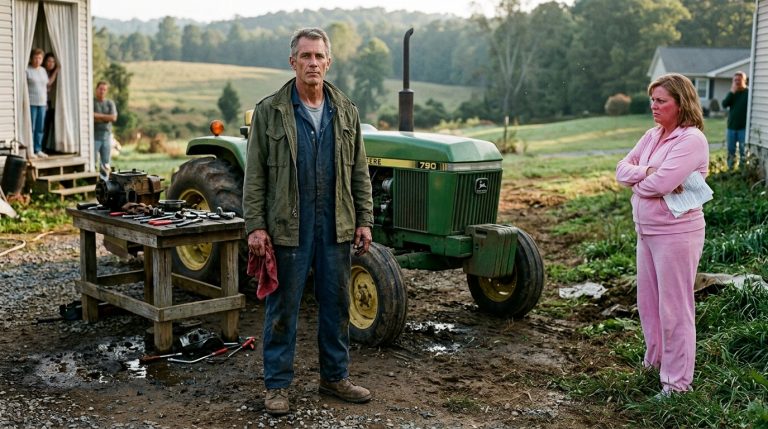
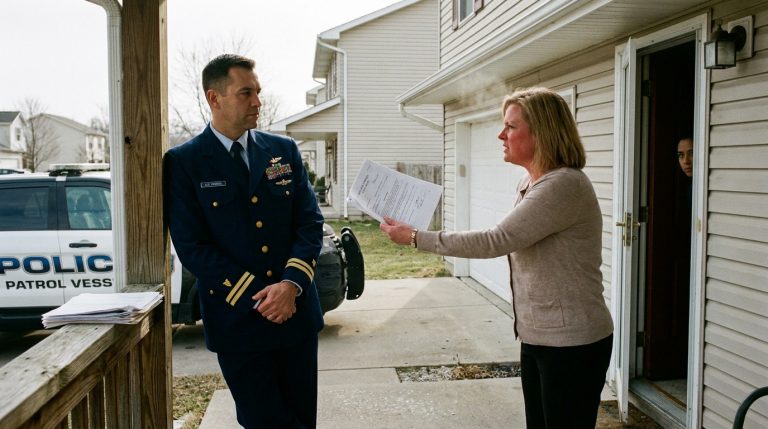
Mark Thorne adjusted his grip on the rusted brass caliper in his pocket, his thumb trailing over the notched steel ruler. He didn’t need to measure the distance from the sandbox to the property line; his eyes, trained by twenty-five years of aligning bridge footings for the Corps of Engineers, knew the gap down to the millimeter. The sandbox was well within the legal easement.
“She didn’t even ring the bell, Major,” Sarah Miller said. Her knuckles were white where she gripped the screen door, her eyes darting toward the street as if a patrol were about to round the corner. Behind her, the rhythmic, high-pitched wail of her four-year-old boy cut through the thick afternoon heat. “She just pounded. Like she was trying to break the wood. She said the lease was void. She said the sheriff would have our things on the curb before the month was out.”
“The sheriff doesn’t move for private citizens, Sarah,” Mark said, his voice flat, retaining the dry, low gravel of a man who had spent decades speaking over the roar of diesel generators. “And he certainly doesn’t move over twenty pounds of injection-molded polyethylene.”
He stepped off the porch, his boots crunching on the sun-baked pine needles that littered the driveway. The heat here was dry, smelling of iron dust and parched earth—the kind of heat that made oil-slicked asphalt bubble. He walked to the fence line, his fingers tracing a gray, rusted iron survey pin driven into the hard clay near the curb.
The pin was loose.
It shouldn’t have been. A survey marker was meant to be permanent, driven deep into the subsoil to anchor a legal reality. Yet this one wobbled with a simple touch, the dirt around it fresh, as if someone had recently tried to pry it up to alter the visual boundary of the lawn.
[V-1] Mark knelt, his thumb brushing the loose soil around the iron pin. There was a faint, blue-inked plastic tag buried in the dirt just beneath the rust—a marker belonging to a private survey firm, not the county.
He pulled his hand back, his mind clicking the detail into place. Karen Peterson hadn’t just looked through the fence gap. She had been down here, on her knees in the dirt, measuring things that didn’t belong to her.
“Go inside, Sarah,” Mark said, rising and wiping the red clay from his palms. “Keep the screen locked. If she comes back, do not open the door. You tell her to call the landlord.”
“She said you couldn’t help us,” Sarah whispered, her voice thinning. “She said the board owns the dirt.”
Mark didn’t answer. He looked down the long, desaturated stretch of Chestnut Drive. The houses were identical, painted in various shades of HOA-approved oatmeal, their lawns clipped to a mandatory three inches. It was a clean, quiet, sterile neighborhood. But beneath the fresh mulch and the uniform paint, the iron pins were loose in the clay.
He reached into his pocket, pulled out his phone, and opened a blank text document. He typed a single name: Karen.
The operation had begun.
CHAPTER 2: THE ANGLE OF REPOSE
The red clay did not brush off easily. It clung to the small whorls of Mark’s thumb, dry and abrasive, smelling faintly of ancient, subterranean rust. He stood slow, his knees popping with a dry sound that was swallowed instantly by the heavy, parched air. Down Chestnut Drive, a shimmering heat mirage pooled over the asphalt, warping the uniform, oatmeal-colored mailboxes into liquid shapes.
He didn’t look back at Sarah Miller’s closed screen door, though he heard the faint click of the latch settling into the frame. Instead, his eyes remained fixed on the gray iron survey pin at his boots.
A standard municipal boundary marker was driven three feet into the subgrade with a pneumatic hammer. It didn’t wiggle under the weight of a thumb unless the soil had been bored out, or unless the marker itself had been replaced with a shorter, non-standard rod. Mark reached down again, his fingers bypassing the dry top-crust of pine needles to grasp the metal shaft. He pulled upward. With a dry, scraping protest, the rod slid free of the earth.
It was barely eight inches long.
The bottom of the rod wasn’t sheared or broken; it was clean, factory-cut steel. The blue-inked plastic tag buried in the loose dirt just beneath the rim read Aegis. There was no county seal. There was no surveyor license number.
Mark turned the metal rod over in his palm. The steel was cold despite the midday heat, holding the chill of the deeper ground it had been hastily shoved into. Aegis. The noun sat in his head like an unaligned gear. In his years with the Corps, “Aegis” was a shield, a protective system. Here, tucked into the red dirt of a suburban margin, it looked more like a wedge driven into a crack.
He slipped the shortened iron stake into the deep side-pocket of his canvas work trousers. The weight of it swung against his thigh, a rhythmic, heavy reminder of the physical discrepancy. He began walking toward his truck, his boots leaving faint, red-dusted prints on the baking asphalt.
He did not drive away immediately. He sat in the cab of his Ford, the steering wheel hot beneath his palms, letting the air conditioning struggle against the dense, close heat of the cabin. He pulled a yellow legal pad from the glove box and drew a single, clean line representing Chestnut Drive. He marked Sarah’s house, then the adjacent lot owned by George. He drew a dotted line where the official county easement should be, then a solid, parallel line representing the boundary Karen’s self-made notice claimed.
The gap between the two lines was exactly twelve feet.
Twelve feet of land, running the entire length of the eastern boundary of the development. In engineering, twelve feet was a lane width. In real estate, it was a corridor. If Karen was adjusting the survey pins, she wasn’t just complaining about a green plastic turtle sandbox; she was physically shifting the legal definition of the community’s shared property.
He started the engine. The transmission engaged with a solid, mechanical clunk. He drove slowly, his eyes scanning the curbs. Every fifty feet, at the property corners, the small circles of gray iron survey pins should have been visible in the grass.
Most were covered by fresh, thick black mulch—the heavy, dyed variety that smelled of sour vinegar and damp bark. The kind of mulch that hid everything beneath it.
He drove toward the exit of Oakmont Creek, his eyes tracking a white utility truck idling near the community clubhouse. Painted on the driver-side door was a faded, circular logo: a stylized shield enclosing the words Aegis Landscaping & Site Development.
Mark stopped his truck at the stop sign, his gaze lingering on the utility vehicle. A young man in a sweat-stained gray shirt was tossing empty plastic mulch bags into the truck bed. The air around the vehicle was thick with that same sour, vinegar scent of dyed wood.
Mark didn’t roll down his window. He didn’t ask questions. He simply watched the boy’s shoulders rise and fall, noting the casual, unhurried rhythm of a worker who knew he wasn’t being watched by anyone who mattered.
He memorized the license plate.
As he pulled out of the subdivision, the tires hummed against the concrete highway, a steady, low-frequency vibration that filled the empty cabin. The piece of steel in his pocket clinked against his pocketknife with every slight turn of the truck. Karen Peterson had built her small empire on the assumption that people only looked up—at the paint on the siding, at the height of the grass, at the color of a plastic toy.
They never looked down at the dirt. They never measured the pins.
Mark Thorne reached down, his fingers curling around the cold, shortened steel rod in his pocket. He would find out who bought the steel, who drove the pins, and exactly whose land was being sliced away twelve feet at a time under the cover of aesthetic purity.
CHAPTER 3: THE BINDING FORCE
The tires sang a flat, metallic drone against the expansion joints of Highway 12, a continuous vibration that climbed up the steering column and settled into the bones of Mark’s wrists. In the passenger seat, the shortened steel stake lay silent on the yellow legal pad, rolling a fraction of an inch with every sweeping curve. The blue tag of the surveyor’s marker caught the hot, dry sunlight slicing through the windshield, casting a tiny, sharp glare onto the dashboard.
Mark didn’t turn up the radio to drown out the road noise. In his experience, silence was a tool, a blank sheet of drafting paper where details could be arranged without the interference of static. He crossed the river bridge, eyes noting the rusted steel trusses and the peeling green zinc paint—signs of neglected municipal maintenance, the slow, silent surrender of iron to oxygen.
Ten minutes later, the truck tires crunched over the gravel margin of his commercial office lot. The brick facade of the building was cool in the shadow of two parched oaks. He cut the ignition, grabbed the yellow pad and the iron pin, and stepped out. The dry air smelled of hot engine oil and parched grass.
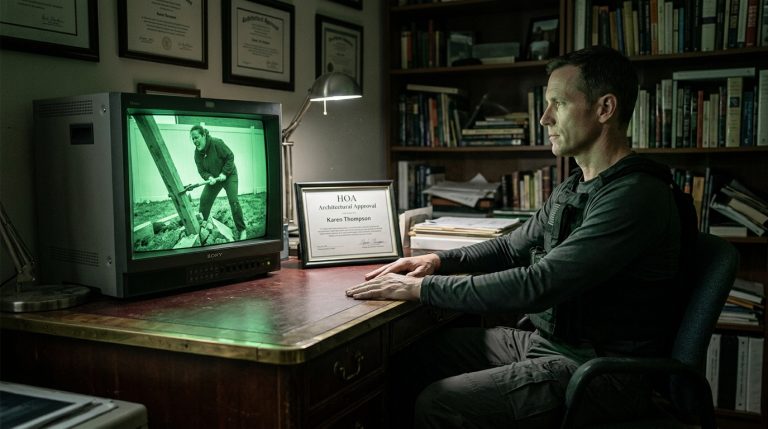
Inside, the silence of his office was thick, smelling of old blueprints, ammonia, and the faint, dry musk of aged adhesive. He laid the shortened steel stake on his drafting desk, right next to the thick, black-bound binder containing the Oakmont Creek Homeowners Association declaration.
He didn’t sit down. He stood over the desk, his calloused palms resting on the edge of the seasoned oak drawing board, and opened the binder to the table of contents. The paper was heavy, a high-grade linen stock that felt slightly dusty between his fingertips. Before he touched a single page, he pulled the brass caliper from his pocket and set it down as a paperweight to keep the sheets from curling.
He flipped past the introductory clauses—the standard legal throat-clearing about “harmonious living” and “mutual benefit.” He was looking for the structural joints of the organization.
His eyes tracked down the margins of Article 4, Section 2. He read the text slowly, his finger tracing the lines to ensure his brain didn’t skip a word to save time. The clause was exactly as he remembered: vague, elastic, and designed to stretch over any minor aesthetic disagreement. It authorized the board to regulate “temporary and permanent improvements to the landscape.”
But then he reached the end of the section. In the tight margin near the binding, the paper had a microscopic ridge. It was a discrepancy so small most eyes would have dismissed it as a manufacturing flaw—a slight thickening of the binding adhesive.
Mark leaned closer, the shadow of his head falling over the linen page. The page was numbered 42. The next was page 43. But the texture of the paper under his thumb changed between the two sheets. The margin of page 42 was slightly stiffer, the fiber of the linen tighter, holding a faint, chemical scent of fresh lacquer.
He took his pocketknife, his thumb sliding the small brass lock to release the thin, fine-tipped blade. He didn’t cut. He used the flat, unsharpened back of the steel point to gently probe the seam between the page and the heavy black backing strip.
A tiny flake of yellowed, dried glue cracked and fell onto the drafting board like a speck of dry skin.
With slow, calculated pressure, Mark ran the flat of the blade up the seam. The paper didn’t tear; it peeled back. A third page, printed on thinner, cheaper stock, had been glued flat against the back of page 42, its edges trimmed with a razor to perfectly match the margins of the sheet above it.
It was a hidden insert, its heading printed in a slightly darker, typewriter-style typeface that didn’t match the elegant serif font of the main document.
The title at the top of the concealed sheet read: Bylaw Addendum 14-C: Special Capital Levies and Emergency Realignment.
Mark’s chest tightened slightly, his breathing shallow and regular. He read the dense blocks of legal text, his eyes focusing on the specific coordinates listed in the first paragraph. The addendum authorized the “Aegis Trust,” acting as an independent receiver, to execute boundary corrections and assess capital levies against any property deemed “chronically non-compliant under Article 4.”
He didn’t move. He didn’t reach for his phone. He simply stared at the name Aegis Trust printed on the cheap, thin paper. The ink was slightly faded, but the reality of it was solid, cold, and heavy, like the iron stake lying three inches away on his desk.
The sandbox wasn’t the target. It was the lever.
Mark sat down in his drafting chair, the old leather groaning under his weight. He picked up the brass caliper, his thumb spinning the small adjustment wheel until the metal jaws closed down to zero. The steel stake on his desk was eight inches of stolen ground, but the hidden page in the binder was the blueprint for a much larger excavation.
CHAPTER 4: THE SHADOW OF THE BOUNDARY
Mark closed the leather binder with a soft, air-compressing puff that stirred the loose dust on his desk. He slipped the brass caliper back into his canvas pocket, where its cold weight settled familiarly against his hip, and picked up the shortened survey rod. His fingers memorized its rough, saw-cut end before he slid it into his side pocket. There was no time to sit and let the implications settle. A structure built on altered foundations only stood until someone put a level to the load-bearing joints.
He drove back to Oakmont Creek under the white glare of the three-o’clock sun, the truck’s suspension groaning over the concrete gutters. Instead of parking in Sarah’s driveway, he pulled onto the gravel shoulder near the empty retention basin at the edge of the development. The stagnant water below smelled of rotting algae and sun-baked concrete—the damp, close odor of a system designed to hold runoff but failing to drain.
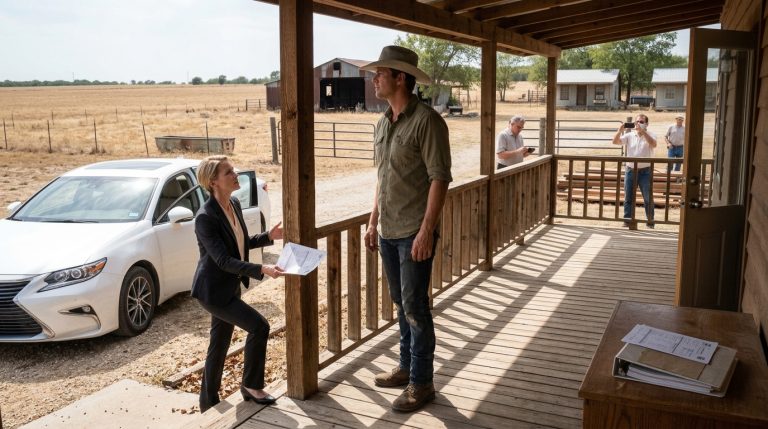
George was waiting near the elderberry bushes that marked his northern property line. The retired postal worker wore a faded denim work shirt, his thin shoulders slightly curved from decades of carrying a leather mailbag. He was holding a rusted weeding tool, but his gaze wasn’t on the weeds; it was fixed on a newly poured concrete retaining wall that separated his backyard from the empty common area.
“You look like a man who just checked the grade on a bad culvert, Mark,” George said, his voice a dry rasp that barely carried over the buzz of the cicadas in the parched fescue.
“The pins are short,” Mark said, stopping two paces away. He didn’t offer a handshake; his hands were still grayed with the graphite from his drafting table. “They’ve been replaced with eight-inch spikes. Someone bored the holes out and dropped them in loose.”
George’s jaw tightened, the skin over his cheekbones turning the color of parched clay. He pointed the tip of his weeding tool toward the corner of the concrete retaining wall. “I noticed it yesterday when the boys from Aegis were clearing the brush. They brought a commercial gas-powered edger right up to the foundation of my tool shed. When I told them they were six feet over the line, the supervisor didn’t even look up from his clipboard. He just said they were working off the ‘realigned plat.'”
[V-1] Mark walked to the edge of the wall, kneeling where the concrete joined the red earth. In the corner of the stone, someone had used an angle grinder to cut a fresh, clean notch into the masonry. The scar was white and powdery against the weathered gray concrete, and right next to it, driven into a drilled hole, was a lead anchor holding a small, stamped brass disc.
Mark leaned in closer, his thumb tracing the cold, rough-cut notch. The brass disc was stamped with a single string of alphanumeric characters: AEGIS-14C.
“They’re marking a new baseline,” Mark said, his voice dropping into the flat, quiet register he used when assessing a compromised bridge abutment. “They aren’t just adjusting the map on paper, George. They’re establishing physical reference points to claim the dirt. If this notch stands for ninety days without a formal dispute, the legal description of your lot permanently shrinks to match it.”
“They’re trying to force me out,” George said softly. He didn’t look angry; he looked tired, his gaze drifting toward the small garden patch behind his garage where a few yellowed tomato vines clung to wooden stakes. “Just like they did with the Garcias. It starts with the warnings. Then the fines. Then you wake up one morning and find out they’ve leveraged a lien against your title for ‘unauthorized modifications’ to a fence you built ten years ago.”
Mark stood up, his boots sinking slightly into the soft, red clay near the concrete wall. He looked back toward Sarah Miller’s house, where the small green turtle sandbox was barely visible behind the screen of dried privet.
“They’re using a hidden addendum,” Mark said. “It’s glued into the master declaration. It’s called Addendum 14-C. It gives a receiver called the Aegis Trust the authority to execute these ‘corrections’ on any property that falls into chronic non-compliance.”
George turned his head slowly, his eyes narrowing under his faded cap. “The Aegis Trust? I’ve been checking the county registry for five years, Mark. There’s no trust by that name registered in this district.”
“Not under the county registry,” Mark replied. He reached down and touched the cold brass disc on the concrete wall again. “But they’re using company trucks to dump the mulch. They’re using their own workers to drive the pins. They’re building the case with their own hands, twelve feet at a time.”
He turned back toward his truck, the heat radiating off the hood in visible, oily waves. He had the measurement. He had the physical proof of the alteration. But to break a lever like the one Karen was swinging, he couldn’t just throw his shoulder against it; he had to find the fulcrum where her authority met the money.
CHAPTER 5: THE DAMP CURE
A low, hollow rumble vibrated through the parched soil before the first drop fell. The sky, which had been a bleached, blinding white, bruised to the color of wet slate in the span of three minutes. Then the air cooled, dropping ten degrees instantly as a sudden downpour broke over Oakmont Creek. The heavy rain didn’t soak into the parched earth; it struck the dry, brick-hard clay with a loud, rhythmic hiss, turning the red dust into a slick, blood-colored grease within seconds.
Mark didn’t run for the cab of his truck. He stood his ground on the shoulder, his canvas trousers darkening to black as the water saturated the heavy fabric. Across the narrow gap of the drainage ditch, George pulled his collar tight against his neck, his boots slipping a fraction of an inch on the muddy bank.
“We need to get under the awning, Mark,” George called out over the increasing roar of the downpour. “This clay turns to grease when it’s wet. If you lose your footing on these slopes, you’ll end up in the concrete flume.”
[V-3] Mark looked down. The dry, cracked earth around the newly poured retaining wall was already liquefying, a thick torrent of red mud beginning to wash over the freshly notched concrete. The white, powdery scar from the angle grinder was disappearing under the dark silt, and the lead anchor holding the AEGIS-14C brass disc was submerged in the rising pool of runoff.
He took a step forward to cross the narrow ditch, but his boot heel lost purchase on the slick clay. The ground gave way, sliding outward under his weight. He caught his balance by driving his heels into the firmer gravel shoulder, the muscles in his calves tightening to lock his joints. A lesser man would have tumbled into the stagnant water pooling in the concrete culvert below.
“Don’t cross,” Mark said, his voice carrying clearly despite the curtain of water. “Stay on the high side of the masonry, George.”
He reached into his pocket, his hand brushing past the cold brass caliper to find the small, sealed plastic pouch he kept for field notes. He pulled it out, his fingers working the plastic seal despite the wetness. Inside was a blank, yellow index card. With a pencil stub, he quickly sketched the coordinates of the concrete notch relative to the fixed utility pole forty feet behind George’s shed—a marker the landscaping crew couldn’t easily shift or hide with fresh mulch.
A sudden, sharp metallic ping echoed from the direction of the street entrance.
Mark raised his head, blinking back the cold water dripping from the brim of his cap. Through the gray sheets of rain, a pair of headlights cut through the gloom. A white utility van was creeping down Chestnut Drive, its wipers slapping a fast, ragged rhythm against the glass. The logo on the door was obscured by the spray, but Mark recognized the heavy, steel-framed rack bolted to the roof—the kind used for hauling surveying equipment and iron grade stakes.
The van stopped forty yards away, idling in the middle of the empty street. The exhaust pipe blew a pale, shifting cloud of steam into the rain.
“Is that them?” George asked, his voice tighter now, his fingers hooking into the chain-link fence behind him for stability.
“They’re checking their markers,” Mark said. He slipped the plastic pouch back into his side pocket and patted it flat. “The rain is washing out their fresh dirt. If the pins shift before the concrete cures around those anchor bolts, their entire realignment map loses its structural tolerance.”
He walked back toward his truck, his steps slow and deliberate, each boot placement calculated to cut through the slick mud to find the firmer stone beneath. The driver of the utility van didn’t get out. The dark, tinted window on the driver’s side rolled down exactly three inches. A pale hand appeared, holding a small, yellow-cased digital distance meter.
A red laser dot, faint but distinct in the heavy downpour, flickered across the rain-slicked surface of George’s retaining wall. It searched for the white notch, found the submerged brass disc, and held steady for three seconds.
Then the red light vanished. The window rolled up, and the van accelerated slowly down the street, its tires throwing up twin fans of red, muddy water.
Mark reached the cab of his truck, his hand slick on the cold metal latch. He didn’t climb inside immediately. He stood on the running board, looking at the fresh tire tracks filling with water in the red clay. They were deep, heavy impressions, suggesting the vehicle was carrying more than just lightweight surveying tools.
He climbed in, the air inside smelling of damp upholstery and the faint, copper tang of wet iron from his pockets. He pulled the yellow pad from the passenger seat, his wet fingers leaving a dark smear across the margin of page three.
Beneath his previous sketch of the twelve-foot gap, he wrote a single line: Aegis van active during rain event. Verifying reference notch AEGIS-14C.
The rain continued to hammer the cab’s sheet metal with a deafening, hollow roar, but inside, the calculus of the conflict was hardening. Karen wasn’t just waiting for thirty days to run. She was checking her structural tolerances in real-time, under the cover of the storm, ensuring the physical evidence of her theft remained locked in the dirt.
CHAPTER 6: THE COMMERCE OF SHADOWS
The rain was still hammering the roof of the Ford when Mark shifted the transmission into park back at his office lot. He let the engine idle for a minute, his headlights cutting through the gray, liquid curtains to illuminate the wet brick facade of the plaza. His wet canvas trousers clung to his shins, stiff and heavy with the red silt of Oakmont Creek.
He didn’t run inside. He stepped out of the cab deliberately, carrying the yellow legal pad in a tight, protective tuck under his arm. The cold rain hit his neck, washing away the grit of the clay but leaving behind a deep, bone-deep chill. Inside his office, the stillness was absolute. The only sound was the drip of water from the hem of his jacket onto the linoleum floor.
He laid the yellow legal pad on his drafting table, right next to the open black binder where Bylaw Addendum 14-C remained exposed under the blade of his pocketknife. He needed to verify a corporate registration, a task that required the clinical, unhurried precision of an audit.
He sat at his desk and pulled up the public property records portal for the commercial plaza he owned at 780 Oak Creek Parkway. His fingers, slightly stiff from the chill of the storm, typed the address. The master lease was held under his own investment LLC, a clean, single-member entity. He opened the tenant ledger for the plaza, scrolling past the bakery and the local dry cleaner until he reached the entry for The Crafty Corner.
The franchise paid twelve thousand dollars a month, wired automatically on the first of every term. The lease was signed by a corporate vice president of development, but the local operations contact listed in the digital file was exactly who he expected: Karen Peterson, Store Manager.
Mark leaned back, the leather of his chair creaking in the silent room. He opened a second tab, accessing the state’s division of corporations database. He typed the name he had found on the hidden page: Aegis Trust.
The search came up empty. He tried three different spelling variations. Nothing.
He didn’t click away. If the trust wasn’t registered as a legal entity in the state, it meant one of two things: either it was a completely fabricated shell name used to terrify homeowners, or it was registered under a parent corporation to shield its operations from casual inspection.
He took his brass caliper from his pocket and set it on the desk, its cold, heavy metal clicking against the wood. He began to run a secondary search, using the license plate number he had memorized from the white utility truck in the subdivision.
The registration returned a hit. The van was registered to Aegis Landscaping & Site Development, LLC. He clicked the link to view the LLC’s filing history. The company had been formed three years ago. The listing for the registered agent was an office building in the county seat, but when he scrolled down to the listing of managing members, his eyes stopped.
Manager: Karen Peterson.
Co-Manager: Aegis Trust.
The address listed for the Aegis Trust wasn’t an office building or a post office box. It was the physical address of the retail space at 780 Oak Creek Parkway—the exact commercial bay where The Crafty Corner operated.
Mark sat motionless, his gaze locked on the glowing screen. The correlation was mathematically perfect. Karen wasn’t just managing a craft store; she was running a private, unlicensed landscaping company out of the back room of his own building, using his property as the legal anchor for a shell entity that was systematically stealing land from his tenants.
The knock on his front glass door was sudden, a sharp, metallic rap that vibrated through the quiet office.
Mark didn’t start. He rose slowly, his hand slipping into his pocket to touch the cold, notched edge of the surveyor’s stake. He walked to the front of the office, his boots silent on the wet floor.
Through the rain-streaked glass, the outline of a figure stood under the narrow overhang. It wasn’t Karen. It was a man wearing a dripping wet postal uniform, his leather mailbag slung low over his hip.
Mark unlocked the deadbolt. The door swung open, admitting a gust of damp, cool air that smelled of ozone and wet pavement.
“Major Thorne?” the postman asked, his voice low and tired. He reached into his bag and pulled out a large, stiff white envelope. “Certified mail. Needs a physical signature.”
Mark took the silver pen from the counter and signed the yellow slip. The paper was slightly damp, the ink bleeding slightly into the grain as he wrote his name. He closed the door, locked it, and walked back to the drafting table under the bright, fluorescent light.
He sliced the envelope open with his pocketknife.
Inside was a single, heavy sheet of legal paper. The header bore the official seal of the Oakmont Creek Homeowners Association, but the signature at the bottom was written in a thick, aggressive hand. It was a Notice of Intent to Lien. The document claimed his rental property was in delinquency for non-payment of fines totaling fifteen hundred dollars, and that if the balance was not settled within thirty days, foreclosure proceedings would begin.
Mark laid the paper flat next to the hidden bylaw page. The trap was closing, but the teeth of the mechanism were now fully visible. Karen had escalated the war to his property line, but she had done so by anchoring her corporate shadow directly to the foundation of the building he owned.
CHAPTER 7: THE ARCHITECTURE OF COLLAPSE
The white legal envelope was stiff, its corner digging slightly into the dry pad of Mark’s thumb as he held it under the desk lamp. The ink of his own signature on the return receipt was still damp enough to smudge, a small gray streak at the edge of the yellow paper. Fifteen hundred dollars. A fabricated debt, anchored to an illegal survey line, stamped with the authority of an association that was slowly eating its own edges.
[V-2] Looking at the sharp, blocky lettering of the lien notice, a cold memory surfaced from the dry sands of Al-Anbar—the concrete footings of a perimeter wall we had poured in a rush during the wet season. It had looked solid on the surface, clean and square, but the mud underneath had liquefied, shifting the load until the entire western barrier cracked with a sound like a pistol shot. It didn’t fall all at once. It sagged, millisecond by millisecond, until the failure was absolute. Karen’s operation was sagging now. The aggression in her letters wasn’t strength; it was the frantic bracing of a wall that had already begun to shear at the base.
Mark folded the document, the crease clean and sharp under the pressure of his thumb. He walked across the office, his boots squeaking faintly on the damp linoleum, and picked up his leather briefcase. Beside it lay the black binder containing the master covenants. He dropped the lien notice inside, along with the shortened eight-inch survey pin.
The drive to the public library in the neighboring township was a slow crawl through the dying remnants of the storm. The tires hissed over the flooded gutters of the state road, the headlights of oncoming trucks reflecting off the wet asphalt in long, distorted smears of orange and white. The rain had slowed to a heavy, cold mist that clung to the windshield like gray grease.
The library was a low-slung, flat-roofed building from the mid-seventies, its exterior brick stained dark by decades of coal soot and rain. Inside, the air was warm and smelled of decaying paper pulp and wet wool.
Mark descended the concrete stairs to the basement community room, his hand tracing the cold, iron handrail. The light downstairs was fluorescent, flickering with a low-frequency hum that vibrated in the teeth.
George was already there, sitting at a long laminate table with Ms. Albright and three other homeowners whose names Mark had logged in his file. Between them sat cardboard boxes filled with utility bills, fine notifications, and tax assessments. The air in the small room was close, thick with the smell of wet umbrellas and stale coffee.
“They’re starting the foreclosure process on Mark’s Chestnut Drive house,” George said to the room as Mark entered, his voice flat but carrying a dry rattle. He held up a copy of the registry filing. “They’re moving the timeline up. Usually, it takes ninety days to clear a default. They’re executing under the emergency receiver rules.”
“They’re executing under Addendum 14-C,” Mark said, setting his briefcase flat on the table. The brass latches popped open with a synchronized, metallic snap. He pulled out his highlighted copy of the master declaration, laying it open to the glued-in sheet. “It’s a receiver clause. It allows the board to bypass the standard municipal court filing if a property is deemed a ‘structural hazard to the aesthetic boundary.'”
Ms. Albright, her fingers trembling slightly as she adjusted her glasses, leaned forward. “A sandbox is a structural hazard?”
“It doesn’t have to be a sandbox,” Mark said. He pulled the shortened steel stake from his bag and set it on the laminate table. The iron clinked against the faux-wood surface, a solid, heavy sound that made George’s eyes narrow. “The boundary line has been shifted twelve feet to the west. This stake was driven inside your property line, George. They’re using the landscaping company—Aegis—to establish a physical record of the correction. Once the lien is filed, the Aegis Trust acts as the receiver. They buy the debt for pennies, take the title under the emergency clause, and clear the property.”
He reached into his pocket and pulled out his phone, displaying the state’s corporate registry page he had saved. “And the registered address for the Aegis Trust is the craft store in my commercial strip. Karen Peterson’s office.”
The room went completely silent, save for the low, rhythmic rattle of the ventilation shaft overhead.
“She’s buying her own foreclosures,” George whispered, his thumb tracing the worn edge of his denim sleeve. “Using our dues to pay the legal fees to the firm that files the liens, then taking the land through her own shell company.”
“She is,” Mark said. “But a structural arch only holds weight if the key is locked in the center. She’s using company time and corporate resources from her retail job to run the receiver trust. That’s a breach of her employment contract with her parent company, and it’s a breach of state corporate filing laws. We don’t just file an appeal, George. We bury her in the paperwork of her own design.”
He opened the second compartment of his briefcase, pulling out six identical manila folders. Inside each was a pre-drafted, formal grievance—not to the HOA board, but to the state licensing board and the regional operations director of the franchise retail chain.
“We sign these tonight,” Mark said, his voice dropping into that quiet, engineering-grade certainty. “Every violation. Every moved pin. We document the physical discrepancies on the ground. We don’t argue about the rules. We show them the measurements.”
George reached for the pen resting on the table. His hand was steady now, his fingers gripping the cheap plastic casing with the practiced resolve of a man who spent thirty years sorting the mail. He pulled the first folder toward him, the paper dry and stiff in the quiet, hum-filled room.
CHAPTER 8: THE REMOVAL OF THE KEY
The laminate surface of the library table clicked as George set the pen down, the ink on the final grievance folder drying in the warm basement draft. That quiet, signed resolution carried an unbroken line of momentum directly into the heavy, crowded air of the Oakmont Creek clubhouse. The room was too small for eighty people. It smelled of damp coats, chlorinated pool water from the deck outside, and the dry, sweet scorch of an old ventilation motor struggling against the humidity.
Mark sat in the back row, his knees pressed against the metal frame of the chair in front of him. His left hand rested flat on the gray vinyl of his briefcase, his fingers steady. Beside him, Ms. Albright adjusted the strap of her purse, her breathing quick and shallow in the close space.
At the front of the room, behind a folding utility table, Karen Peterson sat flanked by two silent board members whose eyes remained fixed on their respective yellow legal pads. Karen looked exactly like her office files: polished, severe, and utterly convinced of the boundaries she had drawn. She held a small, varnished wooden gavel, her thumb tracing the edge of the striker block.
“The chair recognizes the treasury report as submitted,” Karen said, her voice amplified by a small, tinny PA system that crackled every time she leaned toward the microphone. “We will now proceed directly to the election of officers for the upcoming fiscal term. Only homeowners in good standing—those with zero outstanding assessments or structural violations—are eligible to cast a ballot.”
A murmur, low and dry like wind through dead grass, rippled through the rows.
George stood up from the middle aisle. His spine was straight, his old postal service cap resting on the empty chair beside him. “The bylaws do not authorize the suspension of voting rights without a formal hearing before the full committee, Madame President. Article 9, Section 3 is explicit.”
Karen’s knuckles tightened on the handle of her gavel. “Section 3 was modified under executive receiver rules three years ago, George. If you had reviewed the updated covenants on the portal, you would know that delinquent accounts are automatically classified as non-voting stakeholders.”
Mark did not look at Karen. He looked at the middle board member—a quiet man named Miller who kept his elbows tucked close to his ribs. Mark reached down, unclasped the brass latches of his briefcase with two silent, synchronized clicks, and pulled out a stack of twenty thick, bound dossiers.
“The executive receiver rules require a secondary registry filing under state corporate law,” Mark said, his voice cutting through the hum of the PA system without the need for a microphone. He stood up, the metal feet of his chair scraping once against the linoleum. “And they require the disclosure of any third-party corporate interest operating within the subdivision’s physical boundaries.”
Karen’s gaze snapped to the back of the room. Her shoulders went rigid, the blue fabric of her linen blouse straining against her collar. “This is an administrative election, Mr. Thorne. Personal disputes regarding individual violations are not on the agenda.”
“This isn’t an individual dispute,” Mark said. He stepped into the narrow center aisle, the first dossier tucked under his left arm. He handed the first copy to an elderly resident in the back row, then the second to a young couple three seats down. “This is a structural audit.”
He walked toward the front of the room, his boots making a dull, rhythmic thud against the floorboards. With each step, another folder was placed into a pair of waiting hands.
“Twelve days ago, an unauthorized survey alignment was executed along the eastern perimeter of Chestnut Drive,” Mark said, stopping five feet from the folding table. He laid three copies of the dossier directly in front of the board members. “The work was carried out by Aegis Landscaping, using shortened eight-inch pins to establish reference notches in private masonry. The manager of Aegis Landscaping is currently sitting at this table.”
Karen didn’t pick up the folder. She leaned forward, her face turning a mottled, angry red under the harsh fluorescent tubes. “Aegis is a licensed contractor approved by the board for common-area maintenance. The fees are standard.”
“The fees are funneled through a non-registered receiver entity operating under Bylaw Addendum 14-C,” Mark said, his voice remaining level, the cold precision of a structural calculation. “An addendum that was glued into the master ledger without a community vote. The registered agent for that receiver trust is registered to the commercial space at 780 Oak Creek Parkway. Your workplace, Karen.”
The silence that followed was heavy, broken only by the dry rustle of twenty people opening the folders at the same moment. George stood up fully now, his hand holding a paper copy of the state registry search.
“I make a motion for a vote of no confidence,” George said, his voice echoing off the concrete walls of the clubhouse. “And the immediate suspension of the current board pending an independent forensic audit of the ledger.”
“Second,” a voice called from the middle row.
“Seconded,” another followed immediately from the left.
Karen slammed the gavel down. The sharp, dry crack of the wood was swallowed by the rising volume of the room as residents began to look at the photos of the shortened stakes and the copied state filings.
“This meeting is adjourned,” Karen hissed, her hand shaking as she reached for her purse on the floor behind her. “The motion is out of order. The security company will clear the room.”
“The security company is contracted through Aegis, Karen,” Mark said, his hand resting on the edge of her table, preventing her from pulling the ledger toward her. “And their commercial invoice is currently sitting in my file. The meeting stays open until the ballots are cast.”
The board member to her left, the quiet man, looked down at the highlighted page of the dossier showing his own signature on the authorization form for the Aegis Trust. His face went pale, his hands sliding beneath the table as if trying to shrink away from the paper.
“I… I resign,” he whispered, his voice caught by the crackling microphone.
The room erupted. It wasn’t a roar of anger, but the cold, focused resolve of a crowd that had spent years paying for their own displacement. Ballots, pre-printed by George on heavy yellow stock, began to pass down the rows, hand to hand, card by card, like mail being sorted in the quiet of the morning.
CHAPTER 9: THE BACKOFFICE AUDIT
The yellow ballots were still sliding down the rows, whispering dryly against worn denim and raw canvas, when Karen Peterson bolted. She did not look back. Her hand remained white-knuckled around the strap of her bag as her shoulder caught the heavy steel crash bar of the side exit, letting the damp evening heat swallow her shadow. Miller and the other board members remained seated at the table, frozen under the flickering glare of the fluorescent tubes like structural pillars holding up nothing but dead weight.
Mark did not run. He stepped over the dropped wooden block of the gavel, his boots making a dull, deliberate strike against the linoleum. He didn’t need to hurry. An arch doesn’t choose its trajectory once the key is removed; it only falls.
“Take the chairs, George,” Mark said, his voice dropping below the rising noise of the room. “Collect the tallies. Lock the doors behind you.”
He pushed through the heavy steel exit door. The rain had ceased, but the night air remained thick, carrying the smell of wet tarmac and parched earth. The tail-lights of Karen’s sedan were already clearing the gravel drive of the clubhouse, the tires kicking up a fine spray of red clay that floated in the yellow glow of the sodium lamps.
He climbed into his Ford. The diesel engine caught on the first crank, a deep, rhythmic thrum that shook the heavy frame. He didn’t chase her with sirens; he engaged the clutch, steering the truck onto the dark asphalt of Highway 12. He knew where she was going. When a structure shears, the builder always runs back to the blueprint.
Ten minutes later, the truck tires rolled onto the gravel lot of the Oak Creek Plaza. The strip mall was mostly dark, the neon sign of the bakery hummed a pale pink against the wet asphalt. But at the far end, behind the high glass windows of The Crafty Corner, a single fluorescent fixture flickered.
Mark parked his truck. The cabin smelled of damp cloth and wet iron. He stepped out, his hand sliding into his canvas pocket to feel the cold edge of his keys. He didn’t use the customer entrance. He walked around the corner of the brick building, down the narrow service alley where the grease traps and HVAC compressors lined the concrete foundation, until he reached the rear delivery door.
The key slid into the brass lock cylinder with a crisp, oily click. Mark swung the heavy steel door outward, stepping into the dark back room.
The air here was cloying, smelling of dry pinecones, synthetic glue, and stale cinnamon. In the center of the office, illuminated by a single unshaded bulb, Karen stood over a green metal filing cabinet. She had three cardboard boxes on the floor, already half-filled with plastic-sheathed tax documents and property folders.
Her severe haircut was damp, several graying strands clinging to her forehead as she spun toward the door, her fingers digging into the edge of a thick, hand-bound notebook with a dark, cracked cover.
“This is commercial property, Mark,” she said, her voice dropping its high, tinny PA timber, replaced by a low, dry wheeze. “You have no right to be in this back room. The store is closed.”
“You work in my building, Karen,” Mark said, his voice level as he stepped into the office, his boots silent on the concrete. “Your company leases this slab from my group. And your operations contact list is signed under the same hand that authorized the Aegis Trust to place a lien on my Chestnut Drive property.”
Karen’s knuckles turned white where they gripped the notebook. “The trust is a separate entity. It’s fully legal. It’s registered under the master covenants.”
“The master covenants contain an illegal insert,” Mark said. He reached into his pocket and pulled out his brass caliper, laying it on the small metal desk between them with a sharp click. “You used Bylaw Addendum 14-C to create an emergency receiver. But you didn’t just use it to clear landscaping violations, Karen. You used it to clear the titles.”
He stepped closer, his shadow falling over her cardboard boxes. Through the open top of the nearest box, he could see the edges of manila folders stamped with the county seal.
“The Aegis Trust didn’t just buy the default debts,” Mark said, his gaze locked on her hands. “You used the landscaping fees to inflate the association’s liabilities. When the homeowners couldn’t pay the emergency levies, you used the receiver clause to foreclose. You bought the houses yourself, wiped the deeds, and transferred them to a shell company. You’ve been skimming the titles of your own neighbors for five years.”
Karen’s mouth twisted into a thin, pale line. “The neighborhood was declining. The Garcias let their paint blister. People don’t look after the investments. I was protecting the values. I was the only one keeping the standard.”
“You were the one driving the pins, Karen,” Mark said. He pointed his thumb toward the notebook she was holding against her ribs—the thick, dark, hand-bound ledger. “And the true balances aren’t in the corporate portal. They’re in The Ironwood Ledger you’re holding right now.”
Karen took a step back, her heel hitting the base of the metal filing cabinet with a hollow metallic clang. She didn’t drop the book. Her gaze darted toward the side desk where a landline phone sat in the shadow of a plastic card file.
“You can’t prove the transfers,” she whispered. “The board signed the authorizations. Miller signed them. They’re all on the record.”
“Miller resigned twenty minutes ago,” Mark said. “He signed a full statement before he left the clubhouse. The county sheriff is already reviewing the survey logs from Chestnut Drive. The pins were short, Karen. But the audit on this room is going to be very, very long.”
He reached out, his open palm steady in the pale light.
Karen stared at his hand. The fight didn’t leave her eyes all at once; it withered, the rigid, severe lines of her face collapsing into the dry, worn texture of a middle-aged woman standing in the back room of a hobby shop, surrounded by cheap glitter and artificial pine.
She laid The Ironwood Ledger onto his open palm.
The binding was rough, the cardboard edges frayed and smelling of damp glue. Mark didn’t open it. He tucked the book under his arm, picked up his brass caliper from the desk, and turned toward the dark delivery door.
CHAPTER 10: THE RESTORED LINE
The leather-bound edges of the ledger pressed firm against his ribs as Mark stepped out of the back room of the craft store, the rear steel exit door settling into its latch with a cold, solid strike. The night had cleared completely. Above the dark, jagged roofline of the commercial plaza, the sky had cooled to a deep indigo, holding the first faint, pale points of starlight. The sharp, chemically sweet stench of the hobby shop faded, replaced by the damp, metallic breath of wet gravel and parched weeds growing along the curb.
He loaded the binder and the book into the steel storage box bolted behind the cab of his Ford, turning the heavy brass padlock until the tumbler snapped. Every action had its physical consequence; the weight of the evidence was now secured under three millimeters of hardened steel.
The drive back to Oakmont Creek was silent. On the passenger seat, the brass caliper lay in the small depression of the vinyl cushion, no longer needed to measure the margins of a fraud. The headlamps of the truck swept over Chestnut Drive, illuminating the quiet, identical front lawns. The white utility van was gone from the clubhouse. The windows of the small pool building were dark, the folding tables and yellow ballots packed away into George’s basement, leaving only the clean, empty sweep of the pavement under the streetlamps.
Mark parked at the curb of his rental property. He didn’t turn off the headlights; the long, white beams cut through the gloom of the side yard, throwing the shadow of the privet hedge in sharp, skeletal lines across the grass.
He stepped out of the cab, his boots sinking slightly into the damp clay of the ditch. The earth was cooler now, the top-crust of mud starting to set into a stiff, dark skin after the afternoon downpour. From the truck bed, he pulled a five-pound sledgehammer and the long, zinc-coated iron survey pin he had bought at the county depot three months ago—the true, thirty-six-inch legal marker.
George was already leaning against the cedar fence post, a thermos of black coffee resting on the top rail. He didn’t speak. He simply watched as Mark knelt in the wet grass near the loose iron survey pin.
Mark cleared the wet red clay from the hole with his fingers, reaching down until his knuckles brushed the cold, buried root of the old oak tree that anchored the corner of the lot. He pulled the short, eight-inch spike out of the ground and tossed it into the weeds. It landed with a dull, hollow thrum.
In its place, he set the long zinc stake. He checked the alignment twice, his eyes tracking the distance from the iron pin to the corner of the concrete retaining wall where the white grinder notch had been cut.
He raised the sledgehammer.
The first blow was heavy, a loud, metallic ring that broke the silence of the street and echoed off the brick facades of the houses. The steel stake bit into the hard subsoil, settling three inches into the red clay.
“The sheriff’s office called forty minutes ago, Mark,” George said, his voice a dry, quiet rattle over the sound of the wind through the pines. “They’re executing the warrant on the office at Oak Creek Parkway tomorrow morning. The county attorney’s already got the filing for the title-skimming case on the Garcia house.”
Mark didn’t stop. He swung the hammer again. Another clean, ringing strike. The zinc rod sank deeper, passing through the soft, water-logged top-crust into the dense, rocky aggregate below.
“They’ll find what they need in the ledger,” Mark said, his breathing regular, his shoulders moving with the slow, practiced leverage of a man who had cleared roads through the jungle. “Every transfer was logged under Bylaw Addendum 14-C. She kept the receipts for the title transfers from the Aegis Trust right next to the landscaping invoices.”
He delivered three more rhythmic, heavy strikes until the head of the survey pin was flush with the damp sod, its zinc surface cold and silver in the white glare of the headlights. He packed the red clay back around the metal, pressing it down with the heel of his boot until the earth was solid and unyielding.
He stood up, his lower back aching with a dull, familiar heat. He wiped the sweat from his forehead with the back of his sleeve, looking toward the dark house. Behind the locked screen door of the porch, the small, green plastic turtle sandbox sat quiet in the shadow of the fence, its faded shell catching a sliver of the truck’s headlights.
“The new board is signing the contract termination for the landscaping crew tomorrow,” George said, holding out a paper cup of coffee. The steam rose in a thin, pale curl against the dark blue of the sky. “We’re rewriting the bylaws next month. No more emergency receivers. No more hidden pages.”
Mark took the cup, his hand holding the warm cardboard. The heat of the liquid seeped into his stiff fingers, easing the tension in his joints. “Make sure you use the county surveyor to verify the western boundary, George. Don’t let them guess where the line is.”
He walked to the fence, his fingers tracing the rough, parched grain of the cedar post. The wood was damp with the evening dew, holding the clean, sharp smell of wet forest.
The transition was complete. The hostile structure had been dismantled, not with a sudden, violent burst, but by the steady, clinical application of its own rules against itself. The line had been drawn, measured, and driven deep into the red clay where no one could shift it in the dark.
Mark Thorne took a slow sip of the coffee, looking out over the quiet lawns of Chestnut Drive. The silence here was different now—no longer the tense, watchful stillness of a community under siege, but the deep, natural rest of a ground that had finally settled back into its true coordinates.