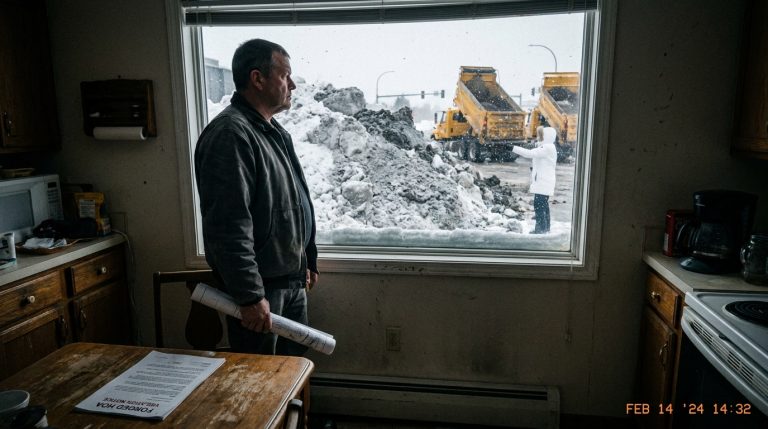
The Sapper’s Perimeter: A Tactical Investigation of Suburban Cruelty and the Calculus of Retribution
CHAPTER 1: THE LIQUID GREEN
The night-vision monitor in the corner of the study cast a cold, high-contrast glow across the brass edges of the spirit level resting on the desk. Outside, the Carolina night was a thick, stagnant press of moisture, but inside the air-conditioned room, the temperature was a flat sixty-eight degrees.
At 2:17 a.m., the silent alert on the terminal hummed once. A single blue pixel pulsed against the black map of the perimeter.
Mark didn’t reach for a weapon. He reached for his glasses.
On the screen, the world was rendered in shades of radioactive green and charcoal. The low-light camera disguised in the fake landscape limestone captured the sidewalk with clinical clarity. Karen Thompson was there, her body encased in a heavy, dark sweatsuit that absorbed the dim streetlamp glare. Her movements were jerky, inefficient, and loud. Beside her, Gary stood with a small penlight, his hands shaking so violently the thin beam of light skittered across the grass like a panicked insect.
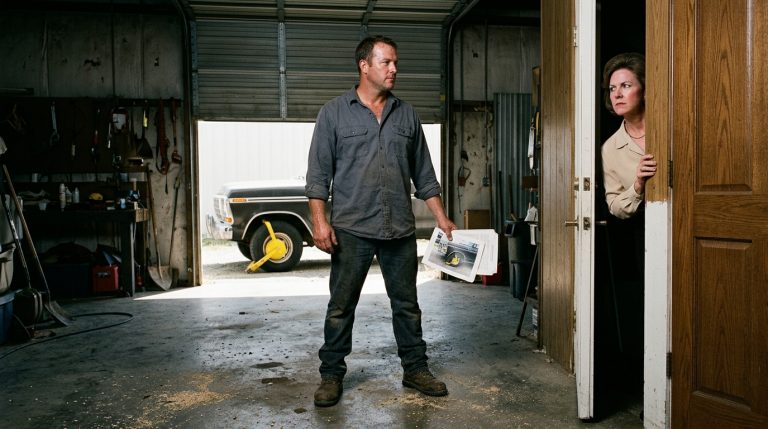
They had a rented mechanical post-puller. Mark recognized the heavy, industrial cast-iron baseplate instantly. It was a professional tool, designed for clearing fence lines on ranches, not for suburban disputes.
Mark watched as Karen positioned the clamp around the base of his first cedar post. The wood was six-by-six Western red, set three feet deep in eighty pounds of cured concrete. He had leveled it himself just forty-eight hours ago, watching the tiny bubble in the brass spirit level float into the exact center of its liquid chamber.
Through the directional microphone buried in the ivy, the audio came through with surprising sharpness.
“Get the lever down, Gary,” Karen hissed. Her voice was a strained, wet rattle in the humid air. “Hurry up. If that dog starts barking…”
“Karen, this is crazy,” Gary whispered back, his voice thin, whistling through his teeth. “The permit—he showed you the permit.”
“I signed a provisional draft, you idiot. I didn’t sign off on this. He’s mocking us. Look at the height of these things. It looks like a stockade.”
She threw her weight onto the fulcrum.
On the monitor, Mark watched the physical reaction of the post. The wood groaned—a sharp, splintering dry creak that carried across the empty lot. The wet Carolina clay around the base bubbled up, releasing a slick, sucking sound as the concrete plug was forced upward. Karen’s face contorted, her mouth open in a wide, dark circle of physical effort. Under the infrared light, her sweat shone like grease.
Mark sat perfectly still, his hands resting flat on the mahogany desk. His pulse remained in the low sixties. In the field, you learned to separate the event from the emotion. If you reacted to the noise, you missed the layout of the minefield. You let the target complete their action because the completion of the action was the only thing that established intent.
“One,” Mark muttered to the empty room.
The post came free with a heavy, wet thud, tilting uselessly into the dirt. Karen stood over the gap, her chest heaving, a small, ugly smile cutting across her pale face. She didn’t look at the trees. She didn’t look at the rocks. She had no idea she was performing for a lens less than ten feet away.
She moved her heavy iron apparatus toward the second post.
Mark clicked the save button on the console, routing the digital stream to a secondary off-site server. He looked back at the level on his desk. The brass was cold to the touch. He picked it up, feeling its familiar, solid weight, and waited for her to pull the next one.
CHAPTER 2: THE COLD ASSESSMENT
The red recording indicator on the secondary drive ceased its rhythmic pulsing, leaving only the flat, green-gray luminescence of the empty sidewalk on the monitor. Across the street, the floodlight on the corner of the Thompson garage flickered once and went dark. Mark did not immediately stand. He remained seated in the leather chair, his fingers still curved around the cold, machined brass of his grandfather’s spirit level. He ran his thumb over the small, engraved graduation marks along the metal casing.
The silence in the house was absolute, save for the rhythmic, low-frequency hum of the server tower beneath the desk.
In the master bedroom down the hall, Sarah’s breathing remained shallow, even—the fragile equilibrium of a body fighting its own defenses. She had slept through the vibration of the seismic tripwires, through the dull, wet groans of the cedar being wrenched from its foundation. Mark preferred it that way. The perimeter was his concern; her recovery required quiet, a space where the air did not carry the metallic scent of conflict.
He stood, his knees making a dry, paper-thin click in the quiet. He did not turn on the overhead light. Instead, he navigated the hallway by memory, the soles of his bare feet cataloging the slight temperature drop as he moved away from the core of the house toward the kitchen.
Through the glass of the back door, the backyard was a dark, featureless slate. He stepped onto the linoleum, the cold floor pressing against his arches, and looked out toward the fence line. In the faint amber wash of the distant streetlamp, the upright posts stood like broken teeth against the treeline. Four of them lay tilted at unnatural angles, their pale, raw cedar bottoms exposed to the night air, clotted with heavy, dark clumps of Carolina clay.
Mark took a slow, measured breath. He felt no surge of heat, no sudden spike of adrenaline. The military had burned those reactions out of him years ago in the dry, rocky valleys outside of Khost. Anger was an inefficient fuel; it burned too hot and left too much ash in the cylinders. What remained was simply the calculation of mass and velocity. Karen had applied a specific amount of leverage to his boundary. Therefore, he would apply a corresponding level of structural resistance.
He walked to the mudroom, slipped into his work boots without lacing them, and stepped out onto the damp grass.
The dew was heavy, soaking the cuffs of his trousers within three paces. The air smelled of wet earth and the sharp, chemical tang of the quick-set concrete that had been shattered during the extraction. He stopped at the edge of the first hole. The cavity was ragged, a dark, muddy crater where the ninety-pound concrete plug had been dragged upward.
He knelt, his hand reaching into the wet grass to touch the iron baseplate Karen had left behind in her clumsy retreat. It was cold, heavy, and slick with cheap grease. He ran his finger along the edge of the metal casting. There was a small, rectangular serial number stamped into the iron, partially obscured by a smear of yellow paint.
Vanguard Landscaping.
The name was stenciled in small, faded block letters near the hinge of the locking clamp. Mark’s eyes narrowed slightly. He did not know the company, but the registration mark on the tool was distinct. It was not a standard rental from the commercial yard on Highway 17. This was fleet equipment, logged and tracked under a commercial tax exemption.
He pulled his phone from his pocket, the screen’s brightness dialed down to its minimum setting, and took three high-resolution macro photographs of the stamped serial number and the yellow stenciled name. The camera’s lens clicked softly in the dark.
From the shadow of the neighbor’s hedge, a low, rhythmic panting emerged. General, the three-legged German Shepherd, slid through the gap in the privet, his nose twitching as he caught Mark’s scent. The dog did not bark; he had been trained to move in the silence of the perimeter. He hopped forward, his single rear leg working with a quiet, efficient leverage, and pressed his damp snout against Mark’s hand.
“Easy, boy,” Mark whispered, his voice barely lifting above the rustle of the pine needles overhead. He ran his hand down the dog’s scarred flank, feeling the steady, powerful throb of his ribcage. “Keep it quiet.”
He stood up, looking down the street toward the dark, silent shape of the Thompson house. The lighthouse mailbox at the end of their driveway blinked its gaudy, solar-powered light—a tiny, regular pulse of blue in the dark.
CHAPTER 3: THE RECONNAISSANCE
The transition from the wet lawn back into the kitchen was marked by the flat squeak of damp rubber soles on tile. Mark stepped out of his boots, leaving them perfectly aligned on the threshold tray. General sat quietly by the pantry, his single hind leg tucked under his flank, his gaze fixed on Mark’s face. The kitchen clock read 2:54 a.m.
Mark hung his damp canvas coat on the hook behind the door. The coat’s heavy brass zipper made a tiny, metallic chime as it hit the wood paneling. He stood still in the dark, listening to the quiet of the hallway. No floorboards creaked. Down the passage, a thin ribbon of pale yellow light spilled from beneath the master bedroom door—Sarah’s oxygen concentrator hummed its low, three-second rhythm, a mechanical inhalation that had become the baseline of their lives.
He walked to the sink, washed his hands with unscented soap, and dried them on a clean towel. He did not go to bed. Instead, he returned to the study, sitting back down before the low green-gray glow of the terminal.
On the desk lay his primary logbook. It was a heavy, black-bound ledger with grid-lined pages—the same style he had used in the service to catalog demolition inventories. With a fine-tipped technical pen, he began to record the night’s entries. He wrote in a tight, blocky hand, noting the exact timestamps of the seismic tripwire activations, the serial numbers he had photographed on the post-puller, and the physical measurements of the damaged cedar posts.
He did not write Karen’s name. He wrote Subject A. Gary was Subject B.
Beside his ledger, a single, faded manila envelope sat. It contained his copy of the original HOA architectural approval. He pulled the document out, running his fingertips over the blue-ink signature at the bottom. Karen Thompson. The stroke of her pen was aggressive, ending in a sharp, jagged tail that cut deeply into the paper. Beside her name was a second signature, light and faint: Arthur Vance.
Mark picked up his phone and opened a map of the neighborhood, his thumb tracing the layout of the streets. Oakmont Estates was laid out in a series of nested concentric circles, designed to isolate the residents from the main arterial road. The Thompson property sat two lots down from his own, positioned at the highest point of the cul-de-sac.
He zoomed in on their parcel, his eyes focusing on the satellite imagery of their backyard. A large, dark rectangle was visible near the property line—a custom-built greenhouse, constructed three years prior. Mark tapped his pen against the desk. He opened his digital folder of the HOA bylaws and scrolled to page 14: All accessory structures must maintain a five-foot setback from property lines and receive written approval from the ARC.
“Reconnaissance first,” he murmured.
At 6:15 a.m., the sky outside transitioned from charcoal to a pale, watery yellow. The morning air was cool, carrying the smell of damp pines and exhaust from the distant highway. Mark walked down the hallway, finding Sarah awake, sitting up in bed with a light wool blanket over her knees. Her face was pale, the dark circles beneath her eyes a persistent violet, but she smiled as he entered.
“You’re up early,” she said, her voice carrying the soft rasp of the oxygen line.
“Just checking the perimeter,” Mark said. He leaned down, pressing his forehead briefly against hers. Her skin was warm, slightly dry. “The wind came through last night. Knocked a couple of things over in the yard. I’ll take care of it after my walk.”
“Don’t spend all day working,” she said, her fingers curling lightly around his sleeve. “The garden needs you too.”
“The garden is safe,” he replied.
He whistled low, and General stood, his claws clicking on the hardwood as they headed toward the front door.
The morning air of the neighborhood was quiet as they stepped onto the asphalt. A light mist hung over the manicured lawns. Mark maintained a steady, even pace, his hands tucked into the pockets of his jacket, his gaze scanning the houses as he walked. He was not looking at the landscaping; he was looking at the details that did not fit.
At the edge of the Thompson yard, he slowed his pace. The gaudy, lighthouse-shaped mailbox sat crooked on its pine post, its small solar panel coated in a thin layer of yellow pine pollen. He paused, letting General sniff the base of the post, while his eyes tracked the side of the Thompson garage.
Three large, green trash receptacles stood there, overflowing with black plastic bags and garden debris. The lids were propped open by thick branches of pruned crepe myrtles. Mark took out his phone, holding it at chest level as if checking a text, and snapped a clear, timestamped photograph.
Bylaw 12.2: Trash receptacles must be shielded from view of the common area by a solid wall or evergreen screen.
He looked toward the driveway. There was a faint oil stain on the concrete—a dark, iridescent puddle from Gary’s sedan. But it was the yard itself that caught his attention. Scattered throughout the formal garden beds were twenty-two distinct ornamental gnomes, their red hats and painted eyes peeling under the harsh Carolina sun.
He noted each one, mentally cross-referencing them with the ARC ledger’s restrictions.
As he turned back toward his own street, a white commercial van rolled past, its diesel engine rattling in the quiet cul-de-sac. On the side of the vehicle, a familiar logo caught his eye: a stylized cedar tree with the words Vanguard Landscaping printed in faded yellow letters. The driver, a young man with a stained baseball cap, did not look at him as the van turned toward the main road.
Mark watched the vehicle fade into the mist, his fingers tightening around the brass level in his pocket. The trap was set, but he needed to lay the bait.
CHAPTER 4: THE COALITION
The thin, bitter smell of burning charcoal rose from the corner of the patio, cutting through the damp scent of the pine straw. Mark held the long-nosed lighter to the grate, watching the small blue flame lick at the dark pyramids of briquettes. The hiss of the escaping gas was a sharp, steady whistle in the morning air.
Suddenly, the dry, chemical smell of the accelerant hitting the warm coals forced a sharp contraction in his chest. For a fraction of a second, the manicured lawns of Oakmont Estates vanished. His mind slipped back to a gravel-strewn outpost three miles outside of Lashkar Gah, where the persistent, greasy stench of burning diesel and waste pits hung over the perimeter walls like a physical weight. He remembered standing by a collapsed concrete barrier, his hands slick with hydraulic fluid, waiting for the blast sweepers to clear a pressure plate. His jaw tightened, a muscle jumping beneath his cheek, before the cool Carolina breeze cleared the smoke and pulled him back to the gravel pathway. He let the lighter click shut, sliding it back into his apron pocket.
The physical transition of his backyard from a private sanctuary to a tactical briefing room was complete.
By 11:30 a.m., the clouds had burned away, leaving a hard, direct light that cast sharp-edged shadows across the cedar planks of the deck. Six chairs were arranged around the iron table. On the center of the table lay a sleek, black digital tablet, its glass screen catching the reflection of the overhanging oak limbs. Beside it sat a thick, blue three-ring binder containing David’s bank printouts and a xeroxed copy of the physical ARC Ledger—the official record of community approvals that Arthur Vance had quietly smuggled out of his home office the night before.
The gate latch clicked.
Mrs. Gable was the first to enter, her gait cautious, her small frame wrapped in a faded cardigan that smelled of lavender and damp earth. Behind her came the Chengs, their movements synchronized, Mr. Cheng carrying the baby with a protective, high-arm hold. David and Maria brought up the rear, their faces set in the neutral, business-like expressions of professionals entering a courtroom.
Mark did not offer a standard neighborly greeting. He gestured toward the iron chairs. “Sit down, please.”
“Thank you, Mark,” Mrs. Gable murmured, her fingers nervously picking at the frayed hem of her cardigan. Her eyes darted toward the empty spaces along the fence line where the cedar posts had been ripped out, leaving dark, wounded circles in the grass. “It looks… so empty out there.”
“The posts will go back in,” Mark said. His voice was flat, carrying the weight of a physical law. “But first, we need to establish the record.”
He reached down and tapped the screen of the tablet. The display woke up, showing a paused frame of the midnight infrared footage.
David leaned forward, his spectacles slipping slightly down his nose as his eyes locked onto the glowing glass. “Is that what I think it is?”
“Watch,” Mark replied. He pressed play.
The scene unfolded in silence. The grainy, high-contrast figures of Karen and Gary appeared at the left edge of the frame. Through the tablet’s speaker, the heavy, wet grunt of Karen’s physical exertion was instantly audible, followed by the dry, splintering crack of the red cedar being forced from the ground. Gary’s thin, panicked whisper—Hurry up, Karen—carried across the quiet patio like a physical current.
Mrs. Gable drew a sharp, whistling breath, her hand flying to her mouth. Beside her, Mrs. Cheng’s fingers tightened against the armrest of her chair until her knuckles turned a stark, bloodless white.
“She actually did it,” Mr. Cheng said, his voice dropping an octave into a hard, rhythmic rasp. “She used a professional puller. In the middle of the night.”
“The baseplate on that puller was stenciled,” Mark said, his index finger tapping the screen to pause the video on a close-up of the metal tool. “It belongs to Vanguard Landscaping. The serial number matches an asset registration under the name of her brother-in-law’s firm. That’s the first connection.”
David reached out, his hand hovering over the xeroxed pages of the ARC Ledger. “And here is the second. Look at the ledger page for your lot, Mark. The approval entry is dated three months ago, but the ink density doesn’t match the surrounding entries. She retroactively altered the registry to list your approval as ‘pending review’ after she realized you were going to build.”
“It’s fraud,” Maria said, her fingers tracing the edge of her coffee mug with mechanical precision. “Both civil and criminal. But we can’t present this to the board yet. If we strike now, she’ll claim the video is a fabrication, or that the tool was borrowed without her knowledge. We need the physical papers that tie her to the accounts.”
Mark nodded once, his eyes reflecting the hard glare of the tablet screen. “The insurance letter goes out today. We let her think she has the high ground. Let her sign her name to the denial.”
He stood up, walking back toward the smoking grill, his boots leaving clean, dry imprints on the warm stone patio. The alliance was formed, the roles were cast, and the target was already marching directly into the center of the kill zone.
CHAPTER 5: THE BAITED HOOK
The scrape of Mark’s boots on the warm patio stone signaled the end of the war council. One by one, the neighbors retreated through the side gate, their departures quiet and staggered to avoid drawing the attention of the house two doors down. Mrs. Gable walked with a slightly lighter step, though her gaze remained fixed on the scarred lawn where her beloved garden gnomes once stood sentinel. The Chengs moved together, Mr. Cheng keeping his shoulder angled as a shield around his sleeping child.
Within minutes, the backyard returned to its heavy, sun-baked stillness. Only the scent of cooling ash from the grill and the slight indentation of chair legs in the grass remained to prove they had been there. Mark didn’t linger in the warm afternoon glare. He cleared the table, carrying the tablet and the copy of the ARC Ledger back inside his house.
He did not stop in the kitchen. He marched directly to his study, where the air was dry and smelled of old paper and the static charge of the monitors.
Sitting at his desk, Mark dialed Ben Carter’s private line. The call connected on the second ring, the audio crisp and clear through the desk speaker.
“The coalition is set, Ben,” Mark said, his voice flat, devoid of the heat that usually accompanied such declarations. “They’ve seen the footage. David has traced the serial numbers of the post-puller back to Vanguard Landscaping.”
“Good,” Ben’s voice came through, a gravelly baritone that sounded like it had been cured in courtroom dust and cheap coffee. “But a video alone is just a skirmish. We need a paper trail that she cannot wiggle out of. If we file a lawsuit today, she’ll claim she was acting in her official capacity to remedy a structural violation. She’ll hide behind the HOA’s liability umbrella, and the association’s insurance will foot her legal bill.”
“So we strip the shield,” Mark said, his hand resting on the smooth wood of his grandfather’s spirit level.
“Exactly. I’ve drafted the formal demand letter. We are sending it via certified mail today to Karen Thompson as President, with individual copies to every board member’s home address. We are claiming $1,500 in property damage. But here is the bait: the letter states the vandalism occurred on ‘common property’—specifically the strip of turf between the concrete sidewalk and the curb.”
Mark’s lips thinned into a razor-thin line. “But the posts are planted eighteen inches inside my survey line. On my private property.”
“Exactly,” Ben chuckled, a low, dry sound. “We are offering her a jurisdictional escape route. She is arrogant enough to think she’s spotted a fatal flaw in our claim. She will pounce on it. She will write a response denying the insurance claim, and in doing so, she will be forced to explain why the HOA isn’t responsible. To do that, she has to formally declare that she ordered the removal as an administrative action.”
“She’ll sign her own indictment,” Mark concluded.
“She’ll sign it, seal it, and have her attorney mail it directly to us. Once she admits in writing that she ordered the destruction, she can no longer claim it was the work of ‘unidentified vandals.’ And when we reveal the video showing her physically pulling the posts herself in the middle of the night, the board’s insurance company will immediately pull their coverage. They don’t insure intentional criminal acts by board members. She’ll be completely exposed. Personally liable.”
“Send it,” Mark said.
He hung up the phone. He pulled a fresh sheet of grid paper from his desk drawer and began to map out the legal timeline, his technical pen scratching rhythmically against the heavy stock.
A sudden, sharp knock at the front door broke the rhythm of the room.
Mark’s hand froze. He did not jump, but his shoulders squared under his shirt. Beside the desk, General’s ears instantly swept forward, a low, barely audible growl vibrating deep in his throat. Mark stood up, walking down the carpeted hallway with silent, deliberate steps.
Through the narrow glass pane beside the door, he saw a young man in a blue vest holding a electronic clipboard. A white delivery van sat idling at the curb, its exhaust plume shimmering in the afternoon heat.
Mark opened the door.
“Mark Roads?” the courier asked, not looking up from his screen.
“Yes.”
“Sign here, please. Certified delivery from the Oakmont Estates Homeowners Association.”
Mark took the stylus, signing his name with a single, sharp stroke. The courier handed over a thick, white envelope sealed with a red adhesive strip. The return address was printed in blocky, black ink: Office of the President, Oakmont Estates HOA.
Mark closed the door and walked back to the kitchen table. He slid a silver letter opener beneath the flap, his movements precise, cutting the paper without tearing the fibers. He pulled out a single sheet of heavy bond paper.
It was a formal notice of non-compliance. But it was the fine attached that made his eyes narrow.
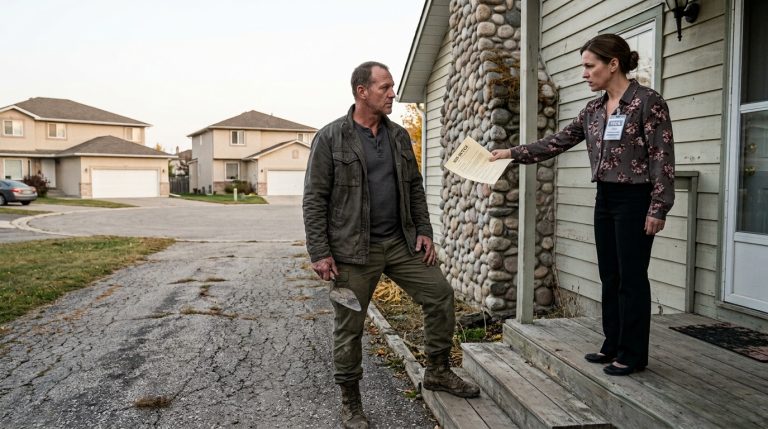
Third Notice of Violation: Failure to cease and desist unauthorized construction. Fine accrued: $500. Continued non-compliance will result in immediate property abatement at the homeowner’s expense.
At the bottom of the page, the signature was bold and jagged, the blue ink still fresh enough to leave a faint smear near the margin. Karen Thompson.
Mark turned the page over, looking at the clean back of the sheet. She wasn’t just escalating; she was moving with a desperate speed. He took out his phone and sent a single text to Ben: The hook is in the water. She’s already trying to clear the line.
He walked to the window, looking out past his driveway. In the distance, the white Vanguard Landscaping van rumbled past once more, its tires kicking up a small cloud of dry Carolina dust as it turned onto the cul-de-sac. The physical friction of the neighborhood was tightening, and the first fracture was about to show.
CHAPTER 6: THE LEDGER TRAIL
The white van’s diesel rattle dissolved completely, leaving only the thin, high-frequency hum of the kitchen refrigerator and the raspy rhythm of Sarah’s oxygen line down the hall. Mark held the thick white paper by its upper corner, his thumb pressing into the coarse, uncalendered stock of the HOA letterhead. The embossed gold seal of Oakmont Estates was slightly off-center—a small, mechanical imperfection that caught the light as he angled the sheet.
He didn’t make a sound. He walked with measured, flat-soled steps back into the study, the non-compliance document resting flat across his open palm like an unexploded shell.
David was already waiting on the secure voice channel, his breathing a dry, rhythmic hiss over the desktop monitor’s speaker. On the left screen, the folder labeled Financials was open, displaying three years of pixelated, scanned bank statements.
“The demand letter was delivered to her attorney forty minutes ago, Mark,” David said, his tone carrying the cold, antiseptic dry-pulp flavor of a lifetime spent auditing tax returns. “And I’ve just finished running the cross-reference on the public business registry. The ledger has a hole in it. A big one.”
Mark sat down, his fingers immediately returning to the cool, reassuring weight of the brass spirit level on his desk. “Explain.”
“Vanguard Landscaping isn’t a regional operation,” David said, the click of his computer mouse sharp and fast over the line. “It’s a single-member LLC registered in Delaware, but its local billing address is routed to a post office box in Myrtle Beach. Specifically, P.O. Box 482. What’s interesting isn’t the box—it’s who pays the annual lease on it.”
Mark’s gaze remained locked on the scanned bank ledger on his screen. “The HOA.”
“No,” David replied, and for the first time, his voice carried a faint, hard edge of professional satisfaction. “The lease is paid by a corporate debit card registered to an entity called The Orlando Escrow. I ran the corporate filing. The registered agent for that escrow is Karen Thompson. But here’s the discrepancy: the HOA’s monthly landscape maintenance fee of four thousand dollars is paid directly to Vanguard Landscaping. Only, the money doesn’t stay in the Vanguard account for more than forty-eight hours. It’s immediately wired out to Orlando.”
Mark traced a finger along the grid lines of his paper ledger. “An extraction loop.”
“Exactly. She’s using the landscape contract as a siphon. She retroactively alters the ARC approvals to keep homeowners compliant, and if anyone starts asking questions about where the capital reserve funds are going, she buries them in fines from her personal committee. The fines aren’t just punitive, Mark. They are deposit slip balancing acts. She’s been using your fence—and the subsequent litigation threats—to justify a ‘legal defense reserve’ transfer of twelve thousand dollars from the main HOA capital account into the Orlando Escrow.”
“A decoy within a decoy,” Mark said. His pulse didn’t waiver. The geometry of the threat was clearing, revealing the exact structural weak point of Karen’s entire apparatus. “She isn’t just protecting her authority. She’s protecting her solvency.”
“If we present the financial audit alone at the annual meeting,” David warned, “she’ll hire a defense team to drag this through the civil courts for five years while she liquidates the assets. She’ll claim it’s a standard accounting dispute between partners. We need the physical nexus. We need the original ARC ledger—the one she kept in her house.”
A low, metallic scratch echoed from the front of the house.
General stood up from the floor, his head cocked toward the hallway, the fur along his spine rising in a stiff, dark ridge. Mark didn’t stand up immediately. He slowly closed his grid paper notebook, slid the brass level into his pocket, and stood.
“Stay on the line, David,” Mark whispered.
He moved down the carpeted corridor, his bare feet absorbing the microscopic vibrations of the floorboards. Through the small glass pane of the front door, the street was empty, the shadows of the pine trees stretching long and dark across the asphalt. But near the base of his driveway, a single white sheet of paper was stuck to the mailbox post, fluttering weakly in the warm breeze.
Mark opened the door and stepped onto the concrete. The air was hot, smelling of dry dirt and the bitter tang of asphalt. He walked down the driveway, his gaze tracking the empty cul-de-sac.
He pulled the paper from the post. It wasn’t a standard notice. It was a handwritten note on lined yellow paper, the ink heavy and dark.
This is your last warning, Roads. Remove the posts or the county health inspector will be called about the illegal concrete runoff. We have the photos.
Mark crumpled the note in his fist, feeling the dry paper crush against his knuckles. He turned his head, his eyes locking onto the second-story window of the Thompson house. A curtain flickered, a dark shadow sliding back into the gloom of the master bedroom.
She was running out of time, and like any cornered target in a closed perimeter, her movements were becoming erratic, desperate, and loud. He walked back up his driveway, his fingers smoothing the crumpled note as he stepped back inside his sanctuary, locking the door behind him.
CHAPTER 7: THE PROJECTION
The yellow lined paper rasped dryly against the skin of Mark’s palm as his fist closed completely, flattening the threat into a tight, solid core. He did not look back up at the flickering curtain of the Thompson house. His boots held their slow, deliberate cadence on the concrete, carrying him over his threshold and back into the quiet of his hallway. He threw the deadbolt. The metal tongue clicked home inside the strike plate with a heavy, final sound.
“David,” Mark said, his voice dropping into the quiet of the empty hall, “we are moving the timeline up. The annual meeting is tonight.”
“Everything is locked, Mark,” David’s voice came back through the terminal in the study. “The certified ledger scans are compiled. The bank records for Vanguard Landscaping and the transaction logs showing the transfers to the Orlando Escrow are formatted into a single, clean sequence. The paper trail is airtight.”
“I’m loading the projection array,” Mark said.
He spent the next three hours in the garage. His movements were mechanical, stripped of haste. He unzipped a heavy, padded nylon flight case and retrieved a high-lumen commercial projector, checking the lens casing for dust before wiping it down with a micro-fiber cloth. He packed a fifty-foot spool of shielded HDMI cable and a heavy, collapsible projection screen, loading the gear into the back of his truck with the quiet precision of a combat engineer securing a demolition kit.
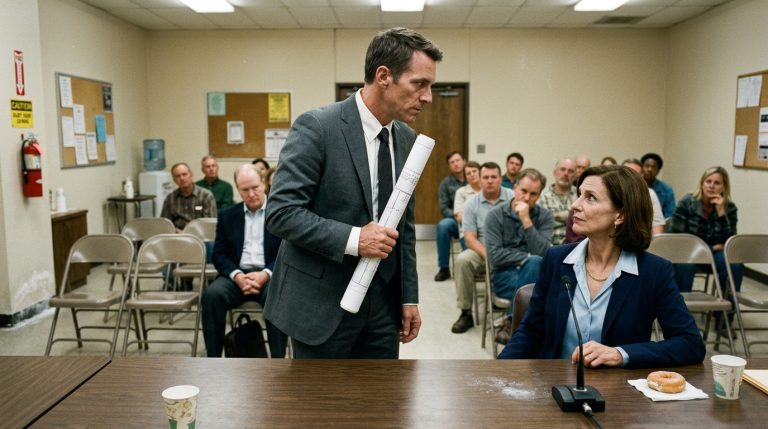
By 6:45 p.m., the sky had bruised into a deep, heavy indigo. The air-conditioned interior of the Oakmont Estates Community Center smelled of ancient industrial floor wax, stale instant coffee, and the sharp, chemical tang of cheap plastic folding chairs.
Mark worked in the shadows at the back of the hall. He did not talk to the early arrivals. He set the tripod legs of the screen, extending the white vinyl canvas until it locked with a metallic snap. He ran the thick black cable along the base of the wall, taping it down with clean strips of gaffer tape so no one would trip. When the projector hummed to life, it cast a blinding, empty white rectangle onto the screen—a clean slate waiting for the payload.
“This is private HOA business, Mr. Roads,” a voice cut through the low hum of the cooling fan.
Mark turned slowly. Karen Thompson stood at the edge of the center aisle. She wore a royal blue pantsuit that seemed stiff, almost like armor, but her collar was slightly damp with sweat. Her face was pale beneath her makeup, and a tiny, persistent twitch pulled at the corner of her left eyelid. Beside her, Gary hovered like a shadow, his fingers nervously twisting the strap of a leather folder.
“It is neighborhood business, Karen,” Mark said, his voice flat, carrying the cold texture of a steel ruler. “We are simply setting up the visual aids.”
“I have the authority here,” she hissed, her voice dropping into a sharp, venomous whisper. “The board has voted to initiate formal litigation against you. Your presence here is a violation of the community’s safe-space guidelines.”
Mark did not argue. He did not raise his voice. He simply reached into his pocket, pulled out the brass spirit level, and set it flat on the projection table. The small green bubble floated to the exact center, perfectly level, perfectly still.
“The meeting is about to start,” Mark said.
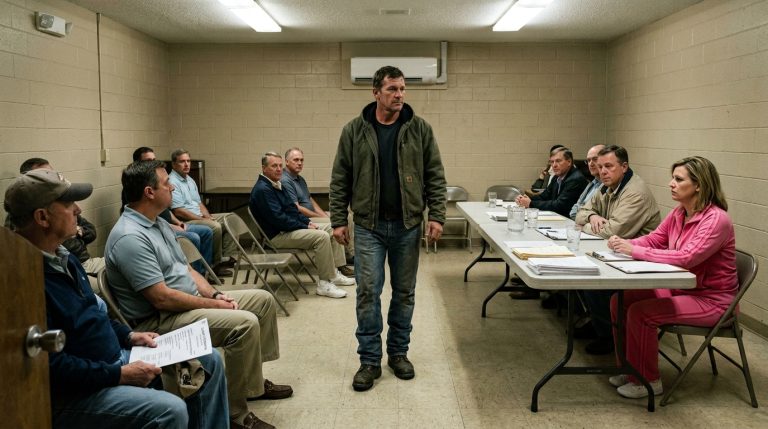
The room filled rapidly, the metal legs of the folding chairs scraping loudly against the linoleum as over a hundred residents packed into the tight space. The air grew warm, heavy with the murmurs of a community that had lived under a quiet reign of fear for five years.
Karen took her place at the head folding table, flanked by her two silent board members. She tapped her knuckles against the plastic table.
“Order,” she announced, her voice cracking slightly before she corrected her posture. “We will begin with new business. Specifically, the egregious violation of our architectural standards by the property at lot fourteen. The board has filed a formal petition for property abatement and a civil suit for non-compliance.”
She held up a sheaf of papers, her hand shaking just enough to make the pages rustle.
“Mr. Roads has ignored our fines. He has attempted to extort the association for alleged vandalism that was, in truth, a lawful removal of unauthorized structures by the committee’s direction.”
Mark stood up at the back of the room. The entire assembly turned, a hundred faces shifting in the warm, dim light of the overhead fluorescent tubes.
“Karen,” Mark said, his voice cutting through the space without the aid of a microphone. “You are right. A lawsuit requires evidence. Let’s look at yours.”
He tapped the spacebar on his laptop.
The projector flared. The empty white screen vanished, replaced by the stark, high-contrast green-and-black footage of the midnight raid.
The silence that fell over the hall was absolute, a sudden, heavy vacuum of sound. On the screen, Karen’s distinctive, bulky figure in the dark sweatsuit was unmistakable, grunting in high-definition infrared as she clamped the iron baseplate of the Vanguard Landscaping post-puller around Mark’s red cedar post. The wet, splintering groan of the wood echoed from the room’s speakers. Gary’s thin, terrified voice—Hurry up, Karen—vibrated through the rafters.
Karen froze at the head table, her mouth opening in a silent, pale circle of horror.
“That’s fake,” she shrieked, her hand slamming onto the table, but the sound was thin, swallowed instantly by the rising murmur of the crowd. “That is a computer fabrication! He’s a soldier, he’s a specialist—he made this!”
“The metadata is pristine, Karen,” Mark said, his voice dropping like an anvil. He tapped the spacebar again.
The video split, revealing the scanned pages of the ARC Ledger with the altered dates, followed immediately by the bank statements for Vanguard Landscaping and the monthly wire transfers routing four thousand dollars of community reserve funds directly into The Orlando Escrow account.
The room erupted. The sound was a physical wave of noise—chairs scraping back, voices rising into a roar of indignation. Neighbors stood up, pointing at the head table. Mrs. Gable was on her feet, her small face flushed with a sudden, fierce vindication.
Karen looked toward Gary, but her husband’s seat was already empty; the side door of the community center was still swinging shut where he had slipped out into the dark.
At the back of the room, Officer Miller stepped forward from the wall, his dark blue uniform a clean, physical presence in the warm light. He didn’t draw a weapon. He didn’t need to. He simply walked down the center aisle toward the head table, his boots clicking in a slow, steady rhythm on the linoleum.
Karen sank back into her plastic chair, her royal blue suit looking suddenly too large for her body. She looked at Mark, her eyes wide with a cold, impotent hatred, but the perimeter had closed. The trap was sprung, and there was nowhere left for her to run.
CHAPTER 8: THE SOVEREIGN BOUNDARY
The quiet of the community center was a heavy, physical pressure, broken only by the sharp, metallic snap of Officer Miller’s utility belt as he adjusted his posture. Karen sat paralyzed, her manicured fingers digging into the edge of the plastic table until her nails turned an ivory, bloodless white. She stared at the black projection screen as if hoping her own image would dissolve from the fabric. She did not raise her head. Her breathing was a shallow, whistling rattle that barely rustled the damp collar of her royal blue jacket.
“Karen,” Officer Miller said, his voice flat, carrying the cold authority of the badge pinned to his chest. “We need to step outside. There are files on that drive that require a formal inventory, and the municipal clerk has already flagged the registration on the Orlando Escrow.”
She didn’t scream. She didn’t launch into a frantic defense. The arrogance that had sustained her five-year reign had drained away, leaving only a hollow, middle-aged woman staring at a plastic table. She reached into her leather handbag, her hand trembling so violently that her key ring made a rapid, desperate chatter against the wood-grain laminate. She dumped the contents onto the table—the bright brass keys to the common facilities, the HOA debit cards, and the black leather-bound ledger she had kept locked in her kitchen pantry. They clattered onto the formica like spent casings.
Mark did not step forward to claim them. He stood at the back of the room, his hand resting in the deep pocket of his canvas trousers, his fingers curled around the cold, machined steel of his grandfather’s spirit level. He watched her stand, her knees locking twice before she could steady her weight. She walked down the center aisle, her eyes fixed on the linoleum floors, refusing to meet the gaze of the neighbors who had once shrunk from her path. Mrs. Gable did not look away; she stood by her chair, her chin tilted up, watching the slow, grinding machinery of the law carry her tormentor out into the humid Carolina night.
The door swung shut behind them, the heavy hydraulic arm whistling as it pulled the glass frame into the latch.
The cool-down of the room was immediate. The high-tension hum of the projector fan died with a soft, descending whine as Mark clicked the power switch. He began to dismantle his equipment, coiling the thick, black HDMI cables with slow, rhythmic loops over his forearm, his movements deliberate and unhurried.
One by one, the neighbors approached the projection table. They did not offer loud congratulations; they spoke in the quiet, respectful tones of survivors examining a cleared minefield. David stood beside him, his hand resting flat on the blue three-ring binder that had dismantled a financial empire.
“The forensic audit will be complete by Tuesday,” David said, his voice carrying the dry satisfaction of an accountant who had balanced a corrupt ledger. “The bank has already placed a administrative hold on the Vanguard Landscaping account. The Orlando Escrow funds are frozen.”
“Good,” Mark said. He zipped the padded flight case shut, the brass teeth of the zipper locking together with a clean, metallic bite. “Let the insurance company handle the recovery. My concern is the fence.”
The following Saturday, the sun rose over a different neighborhood. The air was cool, carrying the clean, sharp scent of freshly cut cedar and the damp aroma of the Carolina soil.
Mark stood in the GAP along his property line, a ninety-pound bag of quick-set concrete resting across his shoulder. His boots were caked in the wet clay, his trousers stained with gray dust, but his movements were steady and fluid. He lowered the bag into the first ragged hole, splitting the paper casing with the sharp edge of his spade.
He didn’t use a power auger this time. He did it by hand, feeling the physical resistance of the earth, the way the wet clay clung to the steel spade. He leveled each post himself, holding the brass spirit level against the grain of the red cedar until the tiny green bubble floated into the exact, absolute center of the glass vial.
“Mark,” a voice called out from the sidewalk.
He looked up, his hand still resting on the cedar post. Mrs. Gable stood at the edge of his grass, her small face bright under a straw sun hat. She held a cardboard box in her arms, her fingers hooked under the cardboard flaps.
“This is for the gate,” she said, stepping onto the grass. She opened the box, revealing a small, hand-painted ceramic garden gnome with a bright red hat and a fishing rod resting over his shoulder. “He’s the captain of the guard. To watch the perimeter.”
Mark’s face didn’t break into a wide smile, but the tension in his jaw relaxed, his fingers loosening their grip on the wood. He took the small figure, its glaze cool and smooth against his calloused palm. “Thank you, Mrs. Gable. He’ll stand right by the latch.”
He set the sentinel on the wide post-cap, then turned back to his work, pouring the dry concrete mix around the base of the wood.
From the shadow of the back porch, a low, rhythmic panting emerged. General bounded across the lawn, his single rear leg launching him with surprising speed, his tail sweeping through the tall grass in a wide, joyous arc. He did not bark; he simply ran, circling the newly set posts, his black-and-tan fur catching the bright, warm gold of the morning sun.
Sarah stepped out onto the deck, her wool cardigan pulled tight against the morning chill. She didn’t have her oxygen line; her breathing was deep, even, and clear. She watched the dog run, her hand resting on the cedar railing he had built for her, a quiet, peaceful smile settling on her face.
Mark watched them—his wife, his dog, his neighborhood—and felt the final, lingering heat of the deployment desert dissolve into the damp Carolina earth. The boundary was restored. The perimeter was level. The sanctuary was safe.